Abstract
This paper presents a “virtual archive” of women’s epistolary exchange in
19th-century Finland. By harmonising metadata from over 1.2 million letters and over
100,000 correspondents across key cultural heritage organisations and leveraging
linked open data, we gain an unprecedented view of 19th-century epistolary
communication and 20th-century archival practices. Using quantitative analysis,
enriched metadata, and network visualisations, we explore the gendered nature of
these collections. Are women archival protagonists, or are their materials embedded
within the collections of male relatives? Do the data reveal overlooked women with
extensive archival networks absent from historical narratives? We introduce the
framework of “critical collection history,” which combines theoretical debates
and research interests from critical archival studies and digital history and
combines them with contemporary digital methods. This approach underscores the
necessity for scholars using data-driven methods in historical research to critically
engage with digitised archives. Moreover, critical collection history highlights how
“big cultural heritage metadata” can expose archival biases and enhance our
understanding of source limitations – biases that digital scholarship may
unintentionally perpetuate.
1 Introduction
A few years ago, we contacted the key cultural heritage organisations in Finland and
asked what we thought was a simple question touching on central historical source
material: “How many nineteenth-century letters do you have in your collections?”
The answer was simple, though not quite what we expected: “There is no way of
knowing.” This means that neither the organisations nor the humanities scholars
who regularly use these materials have a comprehensive view of the extent or basic
structural characteristics of these collections. Consequently, we cannot assess their
inherent biases or distortions, nor can we evaluate the representativeness of the
collections in relation to nineteenth-century “epistolary cultures”.
A reasonable follow-up question is why information about archived material is
important. After all, scholars have successfully used the contents of epistolary
collections to answer a wide variety of historical research questions since the
establishment of national and other archival institutions and the development of
historical methods based on primary sources. A lack of interest in the logics
or
“ethnographies” [
Dirks 2002] of complete archival collections is likely due to hermeneutic and microhistorical
research interests among scholars immersed in
historical epistolary exchange. It is also due to the difficulty of obtaining
accurate and comparable quantitative data on vast and diverse materials accumulated
over decades or even centuries and catalogued in astonishingly diverse ways. However,
when combined with the latest digital humanities technologies, collection-level
archival metadata offers untapped potential for historical enquiry.
In this paper, we suggest that the research agenda of digital historians should be
expanded to include questions about the composition of archival collections. We
analyse a new digital archive constructed by combining letter metadata (e.g.
information about senders, recipients, dates and quantities of letters) from
databases, finding aids and archival catalogues of person and family archives held
in
various Finnish cultural heritage organisations. This
“big
metadata” [
Enqvist and Pikkanen 2024] transcends organisational boundaries, enabling
us to obtain quantifiable and comparable information about the collections. When we
transform it into linked open data and connect it to external sources, such as
biographical and other datasets and ontologies, we can enrich the data with
categories not present in the archival metadata, such as the gender of letter writers
and recipients. This allows us to observe relations that are simply not detectable
in
traditional archives of printed finding aids or organisational archival
databases.
This paper argues that a fruitful intersection exists between digital humanities,
computational humanities, and critical archival studies, which we refer to as “critical collection history”. While it may be possible to
conduct such research using traditional methods, we aim to demonstrate that, at its
most effective and ambitious, critical collection history is digital collection
history. Repurposing information stored in archival finding aids and other
repositories of archival metadata using computational methods provides us with an
unprecedented and powerful tool with which to explore the interplay between
historical source criticism and the archival politics of inclusion and exclusion
(Whose materials are preserved by cultural heritage organisations and made available
for scholarly and other purposes?). This approach also allows us to gain new
perspectives on the interaction of historical actors within past contexts.
There is a well-established international scholarly tradition of compiling and
editing carefully curated collections of correspondence. In the last 15 years, such
data have been published as digital research resources and, in many cases, as linked
open data. Projects such as the EU-funded large-scale Reassembling the Republic of
Letters (RRL), the Circulation of Knowledge and Learned Practices in the
17th-century Dutch Republic (CKCC) and the German correspondence metadata aggregator
correspSearch, mainly focus on the epistolary materials of learned men, because
traditional epistolary editions have centred on this group.
Our material allows us to adopt a more comprehensive perspective. In what follows,
we
will address the gendered aspects of nineteenth-century epistolary collections in
Finland. We are particularly interested in the traces that nineteenth-century women
left in archival collections. The nineteenth century has been characterised as the
golden age of letter writing [
Lahtinen et al. 2011] and women have been
identified as the main protagonists of this development [
Monagle et al. 2023]. Does quantitative analysis of the collected
epistolary metadata confirm these qualitative findings? Based on our data, did women
play a prominent role in epistolary communication? Do they
“own” their
collections and archives? By delving into the collected metadata, can we find
individuals who are not part of our current scholarly canon? Throughout the paper,
we
will revisit a broader question: Does the material tell us more about
twentieth-century archival practices or particular developments in nineteenth-century
society?
Compared to previous publications of linked open data on epistolary metadata, there
are certain methodological and interpretative difficulties associated with the use
of
large collections of metadata gathered directly (“bottom-up”) from cultural
heritage organisations. The primary challenges pertain to the commensurability of
the
archival collections themselves and the validation of the results. There are no
comparable epistolary metadata datasets that we can use to measure the significance
and/or Finnish and nineteenth-century specificity of our findings. The best approach
is to use the entire dataset to provide context and calibration for its constituent
parts (i.e. different organisational or thematic collections), and vice versa.
2 Literature Review
The rapid expansion of big data and digital humanities since the early 2000s has
emphasised the importance of understanding the shape or contours of (digital)
archives and corpora. The research framework proposed in this paper is similar to
recent studies that have examined the
“anatomies” of
historical data collections and the processes involved in their creation, both before
and during digitisation (e.g. [
Tolonen et al. 2022], [
Beelen et al. 2023], [
Ortolja-Baird and Nyhan 2022]). It has
been suggested that large digital datasets require a new kind of critical attitude;
those who produce and use such data must pay particular attention to its local
context: how it was acquired and prepared, its strengths and weaknesses, and whether
it is fit for purpose [
Loukissas 2019, 8, 195], [
Ahnert et al. 2020, 54–55]. At the same time, it has been recognised
that much digitised historical material can be analysed using computational methods.
Indeed, quantitative analysis is particularly effective when we want to interrogate
the characteristics, structures, and properties of digital archives and collections
and reflect on the relationship between datasets and the phenomena they represent
or
model [
Hyvönen et al. 2021, 53], [
Guldi 2023, 29], [
Bode 2020, 4–5].
Over the past few decades, researchers in archival and cultural studies have been
addressing the same questions, albeit mostly in the context of analogue archives,
close-reading individual collections. Since the archival turn of the 1990s and early
2000s, there has been growing interest in analysing the processes involved in
creating, organising, appraising, and describing archival holdings, as well as the
ways in which these processes reproduce and/or challenge existing hierarchies,
dominant discourses, and ideologies ([
Edquist 2021, 109]; see
also [
Schwartz and Cook 2002], [
Taavetti 2016]; [
Ketelaar 2017]; [
Mikkola et al. 2019]. Critical archival
studies pay attention to the processes prior to the possibility of digitisation. Like
critical theory on a wider social scale, these studies are emancipatory in nature
[
Caswell et al. 2017, 2]. They seek to highlight injustices in
current archival research and practice, offering recommendations for improvement.
As
with researchers working with large digital corpora, the importance of analysing the
logics, classification systems and exclusions of archival collections has been
emphasised [
Dirks 2002]. Recently, digital techniques have emerged for
studying curatorial practices and the historical and cultural context of museum
curation and archival appraisal (e.g. [
Salway and Baker 2020]; [
van Lange et al. 2022], [
Enqvist and Pikkanen 2024]). Paradigmatic
quantitative studies of letter collections are the results of the aforementioned RRL
project (e.g. [
Hotson and Wallnig 2019]), as well as various case studies
that use network analysis (e.g. [
Ahnert and Ahnert 2019]).
3 Description of dataset
Our study uses information from letter catalogues and databases from the Grand Duchy
of Finland (1809–1917). However, as sets of correspondence often extend beyond the
designated end year of 1917, we have also included these data where available.
[1]
The dataset is available online
[2],
“upcycling” these collections for reuse as FAIR data for research, as suggested by [
Scheltjens 2023]. The current version of the dataset comprises around 1.2 million letters featuring
approximately 114,052 unique actors (senders and recipients) from nine organisations
and four digital editions (see Table 1).
[3].
Letter catalogues have also been used to create datasets in various other projects.
The information in these catalogues varies considerably (see [
Kudella 2019] for more on modelling in the RRL project, for example). In
our case, the archival metadata includes basic information about the senders and
recipients (whether individuals, groups, or families). While dates are often clearly
delineated in some well-curated collections, more often than not, they are given as
the span of a set of correspondence (e.g., 25 letters between 1870–1895). Beyond
archival organisations, we have knowledge of the archival collections in which the
letters are held. In Finnish cultural heritage organisations, personal materials,
including letters, are organised in separate
“collections”, or
“archives” as they are usually
called. In the Anglophone world, such collections are often referred to as
“papers” (for example,
“the Cecil
Papers”, referring to a collection gathered by William Cecil (1520–1598)
and his son, Robert Cecil (1563–1612)). However, to avoid conceptual confusion
between organisations and their collections, the term
“fonds” will be used when discussing a body of records created and
accumulated organically, reflecting the functions of its creator [
Fonds SAA Dictionary].
| Cultural Heritage Organisation |
Years covered (within 1809-1917) |
Letters and actors in the dataset |
| Åbo Akademi University Library |
1809–1917 |
366 614 / 27 299 |
| Albert Edelfelts brev (Albert Edelfelt’s Letters, SLS) |
1867–1901 |
1310 / 5774 |
| Elias Lönnrot Letters (SKS) |
1823–1887 |
6296 / 1117 |
| Finnish National Gallery |
1809–1917 |
11 092 / 2901 |
| Gallen-Kallela Museum |
1895–1914 |
144 / 4 |
| J. W. Snellman, kirjeet (J. W. Snellman Letters) |
1826–1881 |
1563 / 4733* |
| The Migration Institute of Finland |
1881–1917 |
359 / 35 |
| The National Archives of Finland |
1809–1917 |
292 073 / 32 372 |
| The National Library of Finland |
1809–1917 |
281 157 / 33 746 |
| Serlachius Museums |
1883–1899 |
411 / 136 |
| The Society of Swedish Literature in Finland (SLS) |
1862–1917 |
175 990 / 13 762 |
| The Finnish Literature Society (SKS) |
1809–1917 |
108 157 / 13 256 |
| Zacharius Topelius Skrifter (Zacharias Topelius Writings, SLS) |
1829–1898 |
1407 / 71 |
| Total |
|
1 246 573 / 114 052 (unique) |
Table 1.
Number of letters and actors (metadata) in the dataset extracted from the
letter catalogues of the cultural heritage organisations. Source: LetterSampo
Finland dataset (19 February 2025). The actors in different organisations are partly
overlapping.
*The number includes actors retrieved also from the letter content.
The metadata are transformed into linked open data by an automatic transformation
pipeline (see [
Drobac et al. 2023b] for a detailed description). The
resulting data model builds on international standards, such as CIDOC CRM ([
Doerr 2003]), Dublin Core and ICA Records in Contexts, to promote
interoperability with other datasets. The data model aims to facilitate the modelling
of relevant metadata properties collected from source datasets. The most central
classes in the current data model are
“Letter”,
“Actor”,
“Place”, and
“Time-Span”. Provenance (the MetadataRecord class) and
archival/collection-level information (Fonds and Organisation classes)
are also included.
To represent actors (senders and recipients of a letter) in different source
datasets, we use an adapted version of the proxy concept from the Open Archives
initiative Object Reuse and Exchange (OAI-ORE) specification. In our case, a proxy
signifies a particular viewpoint on a person or group within a designated source.
In
the harmonisation process, proxies that are identified (through
deduplication/disambiguation workflow [
Drobac et al. 2023a], matching
based on a trained probabilistic data linkage Splink model
[4])
to represent the same person or group are linked through a shared instance
of the class ProvidedActor. This class is an adaptation of the Europeana Data Model’s
(Doerr et al., 2010) class ProvidedCHO (Provided Cultural Heritage Object). In
Europeana, the ProvidedCHO
“represents the Cultural Heritage
Object that Europeana collects descriptions about”. In practice, a proxy
represents a
“local”, or source-specific, view of an actor
(with metadata ingested from that source), whereas a ProvidedActor represents a
“global” view of the actor by assembling all the
information about the actor from various sources. The core classes and properties
of
the data model are presented in Table 2.
| Property URI |
C |
Range |
Description |
| LETTER (:Letter) |
| skos:prefLabel |
1 |
xsd:string |
Preferable label |
| :was_authored_by |
1..n |
crm:E39_Actor |
Sender/creator of the letter |
| :was_addressed_to |
1..n |
crm:E39_Actor |
Recipient of the letter |
| :has_time-span |
0..n |
crm:E52_Time-Span |
Time of sending |
| :was_sent_from |
0..n |
crm:E53_Place |
Place of sending |
| :was_sent_to |
0..n |
crm:E53_Place |
Place of receiving |
| :type |
0..n |
:LetterType |
Type, e.g., letter, telegram |
| :fonds |
0..1 |
:Fonds |
Archival collection the letter is part of |
| :original_data_provider |
0..1 |
:Source |
The organisation that has provided the data |
| dct:source |
1 |
:Source |
Data source |
| :metadata |
1 |
:MetadataRecord |
Original metadata record |
| METADATA RECORD (:MetadataRecord) |
| :original_record |
1 |
xsd:string |
Datasheet row or document paragraph as in source data |
| :number_of_letters |
0..1 |
xsd:string |
Integer, can be interpreted (e.g. "[[1]]") |
| ACTOR PROXY (:crm:E39_Actor) |
| skos:prefLabel |
1 |
xsd:string |
Preferable label |
| :proxy_for |
1 |
:ProvidedActor |
The provided actor that connects different proxies |
| PROVIDED ACTOR (:ProvidedActor) |
| skos:prefLabel |
1 |
xsd:string |
Preferable label |
| :floruit |
0..1 |
crm:E52_Time-Span |
Time of Flourishing |
| PLACE (crm:E53_Place) |
| skos:broader |
0..n |
crm:E53_Place |
Place higher in hierarchy |
| wgs84:lat |
0..1 |
xsd:decimal |
Latitude of the coordinates |
| wgs84:long |
0..1 |
xsd:decimal |
Longitude of the geocoordinate |
| skos:prefLabel |
1 |
rdf:langString |
Preferable label |
| PERSON PROXY (crm:E21_Person) |
| rdfs:subClassOf |
crm:E39_Actor |
class-level property |
| :birthDate |
0..1 |
crm:E52_Time-Span |
Birth date |
| :deathDate |
0..1 |
crm:E52_Time-Span |
Death date |
| :was_born_in_location |
0..1 |
crm:E53_Place |
Birth location |
| :died_at_location |
0..1 |
crm:E53_Place |
Death location |
| bioc:has_gender |
0..1 |
bioc:Gender |
Gender |
| bioc:has_occupation |
0..n |
:Occupation |
Occupation |
| bioc:has_person_relation |
0..n |
bioc:Person_Relationship_Role |
Relation to other person (in role) |
| FONDS (:Fonds) |
| skos:prefLabel |
1 |
rdf:langString |
Preferable label |
| :original_data_provider |
1 |
:Source |
The organisation that has provided the data |
| :records_creator |
0..n |
crm:E39_Actor |
Records creator |
Table 2.
The core classes and properties of the LetterSampo Finland data model.
Column “C” means cardinality of the property.
4 Methodology
Our study is based on the availability of epistolary metadata as Linked Open Data
(LOD). Having transformed the metadata collected from various cultural heritage
organisations into a harmonised data model, we can analyse the resulting dataset as
a
whole, while taking into account the differences in archival practices between the
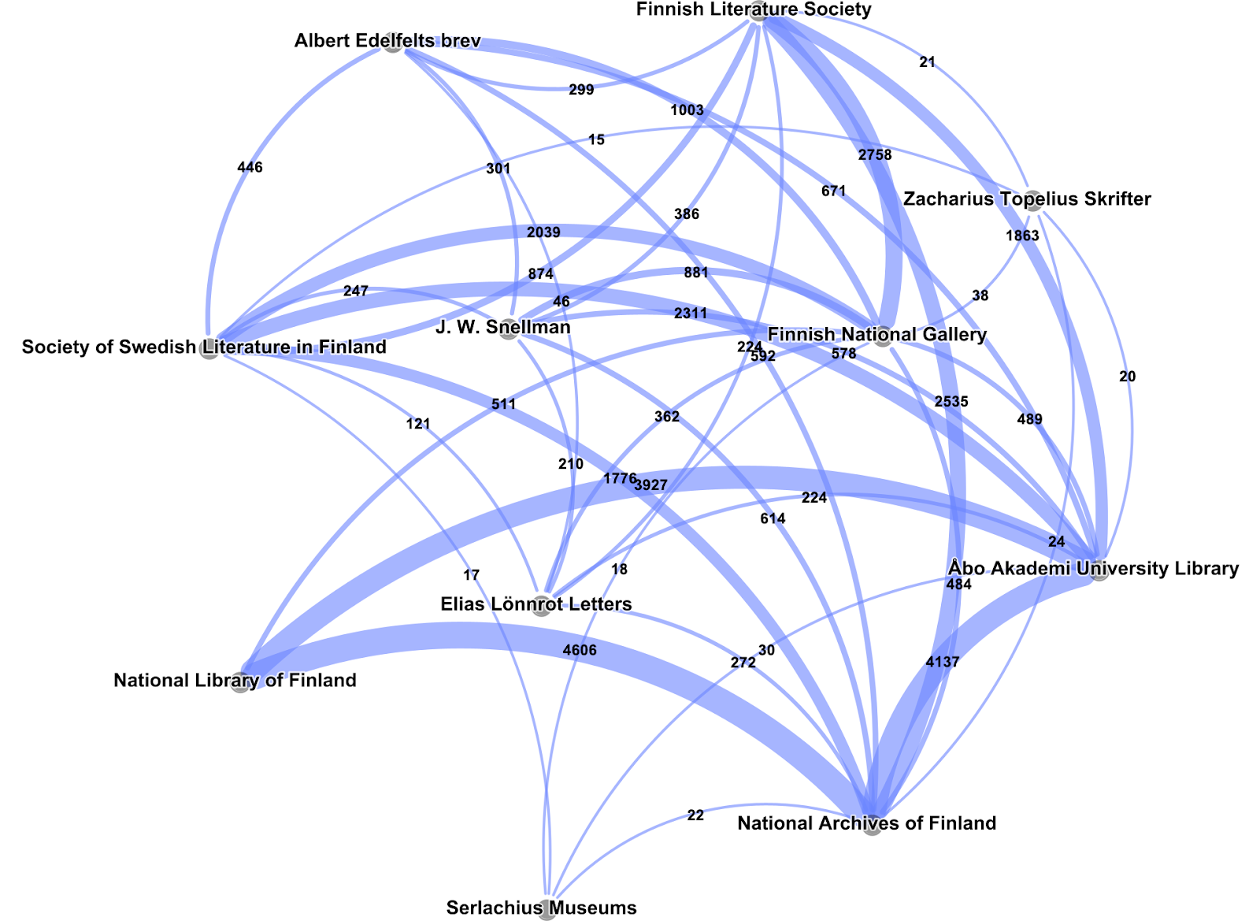
organisations that provided us with data. As illustrated in Figure 1, our research
can be extended from examining a single collection or the collections of a single
archival organisation to exploring the combined dataset (or union catalogue), thereby
capitalising on the inherent links between collections and organisations.
Figure 1 shows how many person-actors the different organisations have in common.
Making the data available in a machine-readable, structured format (RDF) and in a
SPARQL endpoint means that we have a multidimensional dataset that enables evolving
historical research questions and allows us to query the data in rich and meaningful
ways. Linking the data entities (e.g. person-actors) to external sources enriches
the
dataset with contextual information, providing ways to obtain details such as the
biographical background of the people in the dataset. At the same time, possible
links to external data sources, such as the National Biography of Finland or
Wikidata, indicate that the person in question is recognised as relevant, at least
from today’s perspective. The data for the studies reported in this paper were
generated by formulating SPARQL queries to select subsets of the dataset.
In addition to SPARQL queries, we use the LetterSampo Finland semantic portal
[5]. Based on the Sampo model [
Hyvönen 2022], the portal is implemented using the Sampo-UI programming
framework [
Ikkala et al. 2022]. It allows users to search, browse and
analyse letters, actors (people and organisations), archival organisations and
collections (fonds), and places in the dataset. The interface is based on the faceted
search paradigm [
Tunkelang 2009] and enables users to search for
letters from a specific time period, sent by a particular person and archived by a
particular organisation, for example. Visualisations include the yearly distribution
of letters, top correspondents, and correspondence networks. Data including
letter-sending locations can be visualised on a map.
Some cultural heritage organisations have built up their collections over decades
or
even centuries, during which time cataloguing practices, descriptive concepts and
standards have changed. In some cases, the material was initially handled by
non-specialists. Combined with the creative individualism of archivists, this has
resulted in a wide variety of finding aid formats, presenting one of the challenges
of data modelling work and transforming letter catalogues into machine-readable data.
The solution is to engage in continuous dialogue about humanistic knowledge interests
and the emerging data model. A linked open data solution has proven suitable for
modelling cultural heritage metadata relating to archives and historical figures.
However, perhaps even more important is the way in which the modelling process forces
us to consider the
“things” being modelled. What are the catalogued collections
of letters, and how can we conceptualise phenomena such as epistolary culture? As
[
Ciula et al. 2018, 345] write, models can be learnt from
“at two different stages, in the creation of the model and in its
application and successive manipulation”. In the case of epistolary
metadata, modelling the letter collections has led us to focus on specific aspects
of
the collections themselves.
In addition to the properties provided by the linked data, we use network analysis
to
construct specific correspondence networks. These networks illustrate changes in
women’s centrality over time, helping us to visualise the gendered structure of
nineteenth-century archival collections. Our focus is on contacts established through
correspondence rather than on the direction of interaction through letter-writing.
The main reason for this is the partiality of our collections (more on this below).
The intention behind these network visualisations is not to examine how the network
functions, but rather to offer an alternative viewpoint on the women in our
collection data through their interconnectedness. The layout used is a force-directed
model, meaning that the most important nodes in terms of connectivity remain at the
centre of the network. Although our primary focus is on the networks as collections,
we also highlight other themes relating to nineteenth-century women’s historical
correspondence as reflected in our dataset.
5 Case study
One way to challenge the boundaries of archival organisations and their collections
is to create a virtual collection of metadata relating to women’s letters. We will
proceed in three steps, firstly discussing the quantitative results in terms of the
total number of women actors and women as so-called records creators, then examining
the ten most active women in terms of letters, and finally exploring the position
of
women in specific correspondence networks over time. Our findings will be
contextualised in relation to archival practices, scholarly focus, and the
modernisation of nineteenth-century society. Finally, we will assess the
representativeness of our dataset as a whole. To this end, the Åbo Akademi University
Library and the Finnish Literature Society will serve as sample datasets and main
points of comparison. These organisations have exceptional collections covering
different geographical regions and representing the two national languages, Swedish
and Finnish.
The current dataset comprises 114,052 actors, 24.1% of whom are female. While this
figure is higher than that observed in previous European projects, it is less
pronounced than expected based on research emphasising that women’s epistolary
activity peaked in the nineteenth century [
Monagle et al. 2023]. However,
when we filter out groups and administrative units, and consider all person-actors
in
the dataset, the percentage of female actors rises to 29%. In the Åbo Akademi data,
the proportion of female actors is 31.7%, and in the Finnish Literature Society data,
it is 32.5%. Furthermore, of the 1,246,573 letters, on average 38% were sent by women
(alone or together with someone), and the corresponding percentage of letters
received was 36%.
In addition to examining the characteristics of the entire pool of person-actors,
collecting and enriching epistolary metadata gives us access to another class of
actors. In archival parlance, these are known as
“records
creators” or
“entities of origin”. These are
individuals, families, corporations or administrative units that
“create, receive or accumulate a body of records, personal papers or
objects”
[
Entity of Origin SAA Dictionary]. Their names are usually found in catalogue
headings and indexes of letter collections. Archival fonds contain letters received
by such entities, but often also letters sent by them. These may be copies kept by
the entity or originals added to the collection at a later date. Often, there are
also letters sent and received by other entities that may have had a family or other
connection with the original records creator. The Finnish Literature Society provides
a basic list of records creators on its website to serve as an entry point to its
epistolary material. In contrast, the Åbo Akademi University Library provides online
access both to its epistolary database and the database of records creators; however,
it remains difficult to find and combine information about actors who are not records
creators, even if they had extensive collections.
By comparing the total dataset of person-actors with that of records creators, we
can
see that the status of records creator is granted to a select few. Although the
number of actors varies greatly between our two sample organisations, only around
2%
of them are also records creators in both cases. In the case of the Åbo Akademi, we
can see that the gender of records creators is relatively close to that of the
overall actor data, but it is significantly higher in the Finnish Literature
Society’s collections (37.5% female). By contrast, the National Library of Finland
has a very ‘masculine’ catalogue of epistolary fonds: 85% of records creators are
men, with only 14.6% being women. These differences can be explained by the archival
policies and constituencies of these organisations. The Åbo Akademi University in
Turku was founded in 1919 to serve the Swedish-speaking minority in newly independent
Finland. Its collections include materials representing the old Swedish-speaking
aristocracy and intelligentsia — the country’s early political and cultural elite.
In
contrast, the Finnish Literature Society, founded in 1831, has a very different
profile. Its collections reflect the ideas of nineteenth-century Finnish-language
nationalists in the fields of folklore studies and Finnish language and literature.
The collections include the personal archives of literary writers, translators,
literary critics, and others. Through the National Library’s connection to the
University of Helsinki, professors, researchers, and other academics are well
represented in the library’s archival collections as professional groups.
Linking to external data sources provides additional insight into the actors and
records creators, as well as the general characteristics of the entire dataset. Only
19% of all actors can be enriched with information provided by links to databases
and
repositories of historical narratives that can be captured with digital methods.
However, these individuals are responsible for 85% of all letters. This means that
we
have a very prominent group of individuals who have left an extensive trace of
themselves in the form of letters and other personal papers, despite being few in
number, and a large number of individuals with few letters and connections. Such
“long tails” have been observed in other epistolary
collections of a different nature [
Ahnert and Ahnert 2019, 31]. When
it comes to the narrower group of records creators, however, about 80% of them can
be
linked to external resources, suggesting a continuing scholarly interest in them.
Collected lists of records creators can therefore serve as a kind of
“who’s who” of nineteenth-century Finland and nineteenth-century studies. The collections of
prominent records creators have also preserved the correspondence of individuals who
would otherwise have left little or no archival trace.
Thus, we can see that nineteenth-century epistolary collections in general, and the
group of records creators in particular, are dominated by literate elites and the
middle classes. This is consistent with what we know about the development of
literacy in this north-eastern corner of Europe. At the beginning of the nineteenth
century, writing skills were still rare, despite the fact that half of all Finns
could read. It was not until the introduction of primary schools in the 1860s that
literacy and text comprehension really began to spread. Statistics from the
Evangelical Lutheran Church indicate that, by 1880, 86.3% of the population could
read, though only 12.4% were literate. By 1900, the literacy rate had risen to 38.6%,
reaching 55.3% ten years later [
Latomaa and Nuolijärvi 2002]. The educated
elite and middle classes also appear to have taken care to preserve their
correspondence in personal, family and manor archives. These archives were
transferred to cultural heritage organisations when they began collecting private
archival material in the late nineteenth and early twentieth centuries.
These organisations operate under the principle of provenance (respect des fonds), which emphasises preserving records according to their
origin and within the units in which they were collected. However, a digital, virtual
metadata archive provides an opportunity to challenge established practices and offer
new perspectives on archival materials. For instance, we can explore the collections
of notable politicians and academics, or large family holdings, and ‘liberate’
mothers, sisters, and daughters by granting them independent status as virtual
records creators, thereby ensuring their immediate visibility and discoverability.
One such individual is Aline Reuter (née Procopé).
Table 3 presents the ten most active women in the entire dataset, ranked by the
number of letters. Interestingly, only half of these women are linked to content-rich
external resources; that is to say, they have a Wikipedia page or an entry in the
National Biography of Finland. For these women, we have readily available
occupational information. In contrast, much less information is at our disposal for
the other four women – the
“dark horses” of our virtual archive. Aline Reuter’s
correspondence at the Åbo Akademi comprises 8,178 letters (3,072 sent and 5,106
received). This makes it one of the largest collections of letters from a
nineteenth-century woman in our current dataset. You might think that such a large
collection, covering a period considered so formative for Finnish nationalism and
studied by generations of historians, would be used extensively. This does not seem
to be the case, however. The few mentions that shed light on her life can be found
in
the National Biography entries of her three famous professor sons and in the Reuter
family entry (see, for example, [
Autio 1997a] and [
Autio 1997b]). There are also Wikipedia pages (e.g.
“Edvin Titus
Feodor Reuter”) and a Geni.com profile (
“Aline Reuter”) which, for
technical reasons, cannot be used to enrich the data. These sources provide
information about her lifespan (1828–1916) and some details about her family (husband
and four sons).
| Name |
Total letters |
Occupations |
Archives |
Records creator |
External links (Wikipedia) |
| Procopé (Reuter), Aline (1828–1916) |
8178 |
- |
NAF, NLF, SKS, SLS,ÅA |
no |
3 (no) |
| Wrede, Hedvig Gustava Matilda (1854–1917) |
5582 |
- |
ÅA |
no |
2 (no) |
| Söderhjelm, Alma (1870–1949) |
5567 |
author, historian, full professor, docent, essayist, professor |
AEL, FNG, NAF, NLF, SKS, SLS, ÅA |
yes (ÅÂ) |
8 (yes) |
| Aalberg, Ida (1857–1915) |
5485 |
actor, stage actor, theatrical director |
AEL, FNG, NAF, NLF, SKS, ÅA |
yes (NLF) |
7 (yes) |
| Talvio, Maila (1871–1951) |
5396 |
writer, honorary doctorate, translator |
NAF, NLF, SLS, SKS, ÅA |
yes (SKS) |
7 (yes) |
| Ackté, Aino (1876–1944) |
5242 |
opera singer, librettist |
AEL, FNG, NAF, NLF, SLS, SKS, ÅA |
yes (FNL) |
9 (yes) |
| Granfelt (Lavonius), Magdalena Lovisa (1877–1946) |
5183 |
teacher |
ÅA |
no |
4 (no) |
| Gripenberg, Aleksandra (1857–1913) |
5078 |
member of parliament, writer, chairperson, politician, editor, public
figure |
NAF, NLF, SLS, SKS, ÅA |
yes (SKS) |
7 (yes) |
| Haahti, Hilja Theodolinda (1874–1966) |
5004 |
author, translator, writer |
NAF, NLF, SKS, ÅA |
yes (SKS) |
7 (yes) |
| Reuter, Anna Hildur Elisabeth (1855–1936) |
4944 |
- |
NAF, NLF, SKS, ÅA |
no |
1 (no) |
Table 3.
Ten most active female authors in the dataset.
Source: LetterSampo Finland dataset (19 February 2025).
Note: AEL (Albert Edelfelt’s Letters), FNG (The Finnish National
Gallery), SKS (The Finnish Literature Society), NAF (The National Archives of
Finland), NLF (The National Library of Finland), SLS (The Society of Swedish
Literature in Finland), ÅA (The Åbo Akademi University Library).
However, obituaries of Aline Reuter in the newspapers provide further insights into
her life. She had 13 children in total, many of whom died young. She homeschooled
the
surviving children until they reached grammar school age, and she acquired such
excellent skills in subjects such as Latin and mathematics that, when her son Odo
Reuter, a professor of zoology, became blind, Aline Reuter (now in her 80s) took over
his professional correspondence and proofread his papers. However, more than her
obvious intellectual agility, the obituaries emphasise her
“rich
inner life” and remind readers that
“there were no
great events in her life” (see, for example, [
Dagens Press 1916]). This statement alone arouses curiosity about the
contents of Reuter’s extensive collection of letters, tempting one to immerse oneself
in her
“epistolary space”
[
How 2003] and reflect on its representativeness, for example with
regard to the experienced, personal nationalism of nineteenth-century women [
Eiranen 2021] or other significant ways of discursively shaping oneself
and one’s surroundings [
Monagle et al. 2023, 12].
“Mother Aline” is thus a prime example of a marginalised
or forgotten person who only becomes clearly visible when we recontextualise her
letters in the collected and enriched metadata. Indeed, it is only through the
combined metadata that we can confirm the extraordinary quantity of surviving
correspondence. By way of comparison, the most extensive set of male correspondence
is that of Senator Leopold (Leo) Mechelin (1839–1914), whose entire collection of
letters from various organisations totals 14,399.
We can make further observations about the gender distribution in the Finnish
nineteenth-century data with the help of network analysis and simple degree metrics,
which build on the above analysis of the number of contacts each person had. This
enables us to visually assess the extent to which the women in our letter collections
were connected. As our dataset spans over a hundred years, we decided to examine two
periods in more detail: 1830–1860 and 1880–1910, which reflect the socio-economic,
legal and social changes that affected women’s correspondence in the modernising
Grand Duchy of Finland. From the 1860s onwards, women gradually gained access to
higher education. As the country’s economy liberalised, women’s legal and economic
rights were strengthened, and they participated in associations and societal
movements. Hypothetically, this meant that women’s epistolary networks became more
similar to those of men, and we were interested to see if we could find traces of
this in the archived epistolary material.
As expected, looking at the position of women in the correspondence networks reveals
that their connectivity increases as we move from the first to the second period.
At
the same time, the
“archival status” of the most
well-connected women and their links to external biographical databases undergoes
a
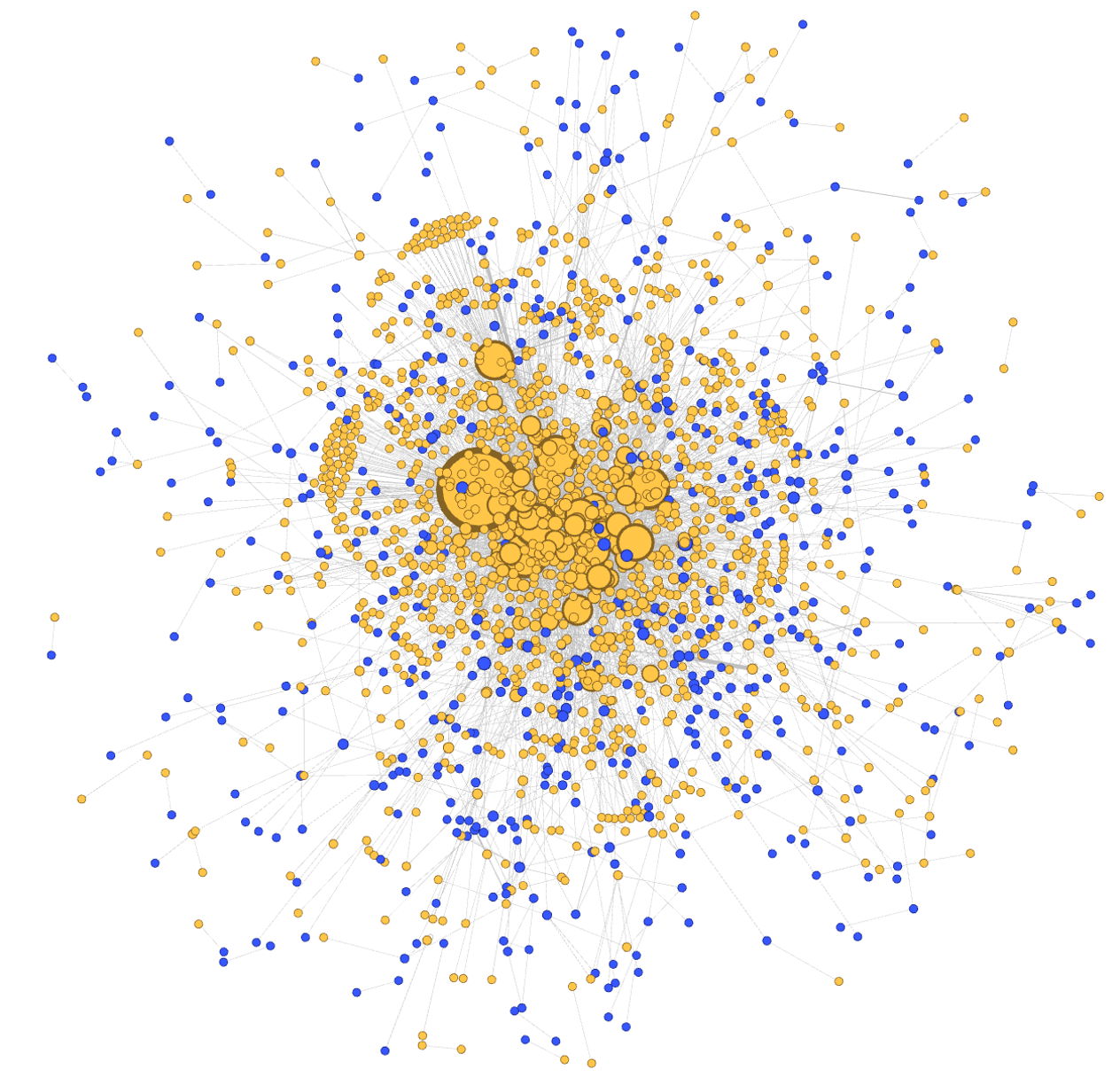
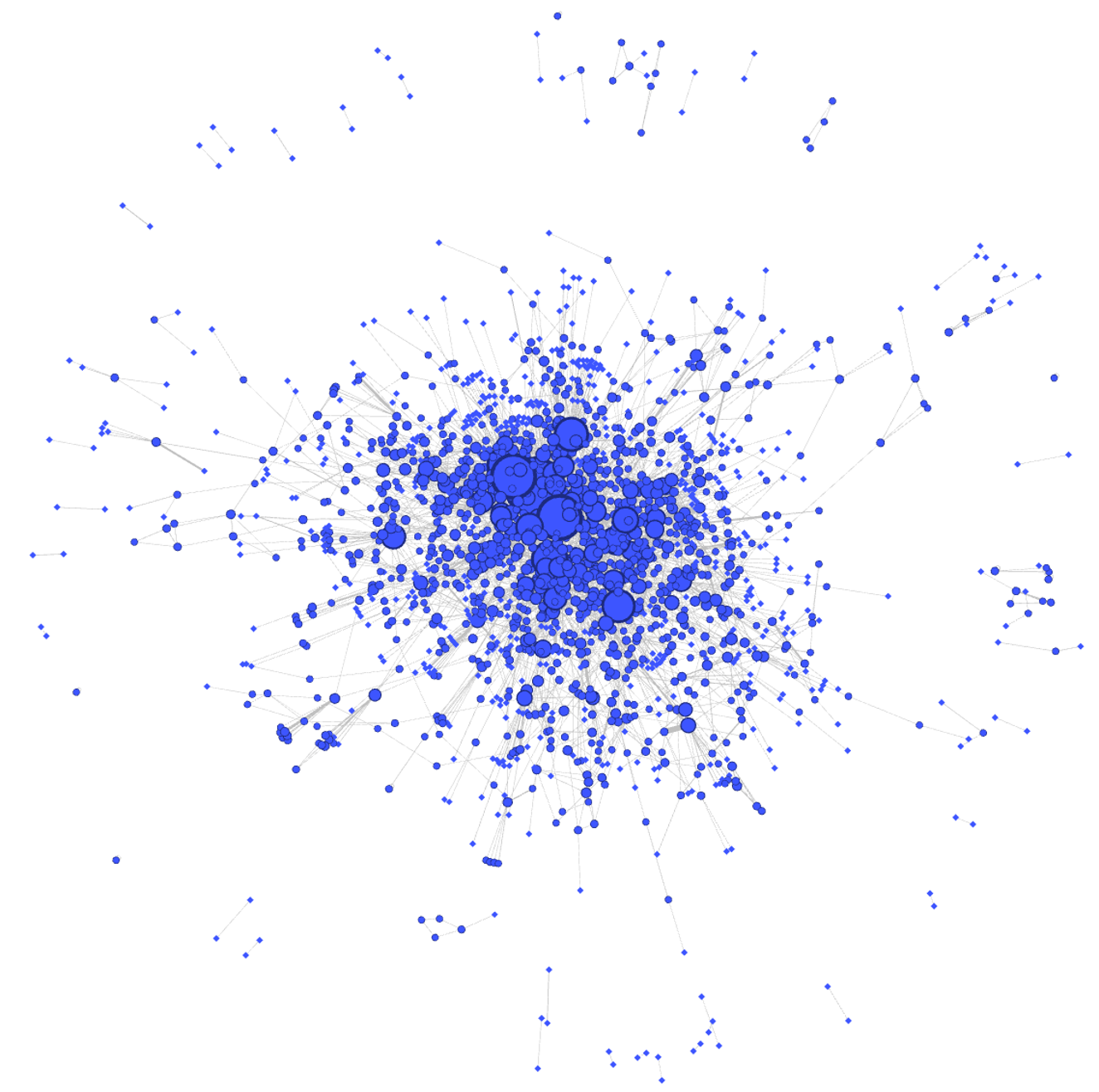
significant change. As illustrated in Figure 2, during the initial period of letter
correspondence (1830–1860), men dominate the centre of the network, with most women
(represented by blue nodes) situated in the middle and outer spheres. The ten most
connected women are also not central figures from an archival perspective (see
Appendix 2, Table 5). As they are not records creators, the bulk of their letters
have been archived as part of their families’, husbands’ or sons’ fonds. Furthermore,
linking to external databases has only resulted in links to genealogical databases.
Professional information was only found for two women (Fredrika Runeberg and
Elisabeth Blomqvist), who have also attracted academic interest (e.g. [
Klinge 2006]
[
Konttinen 2000]). The situation is quite different for the ten most
connected men of this period (see Appendix 2, Table 4): they are all records
creators; their letters originate from 7–9 archival organisations; and they are well
linked to external sources, including Wikipedia.
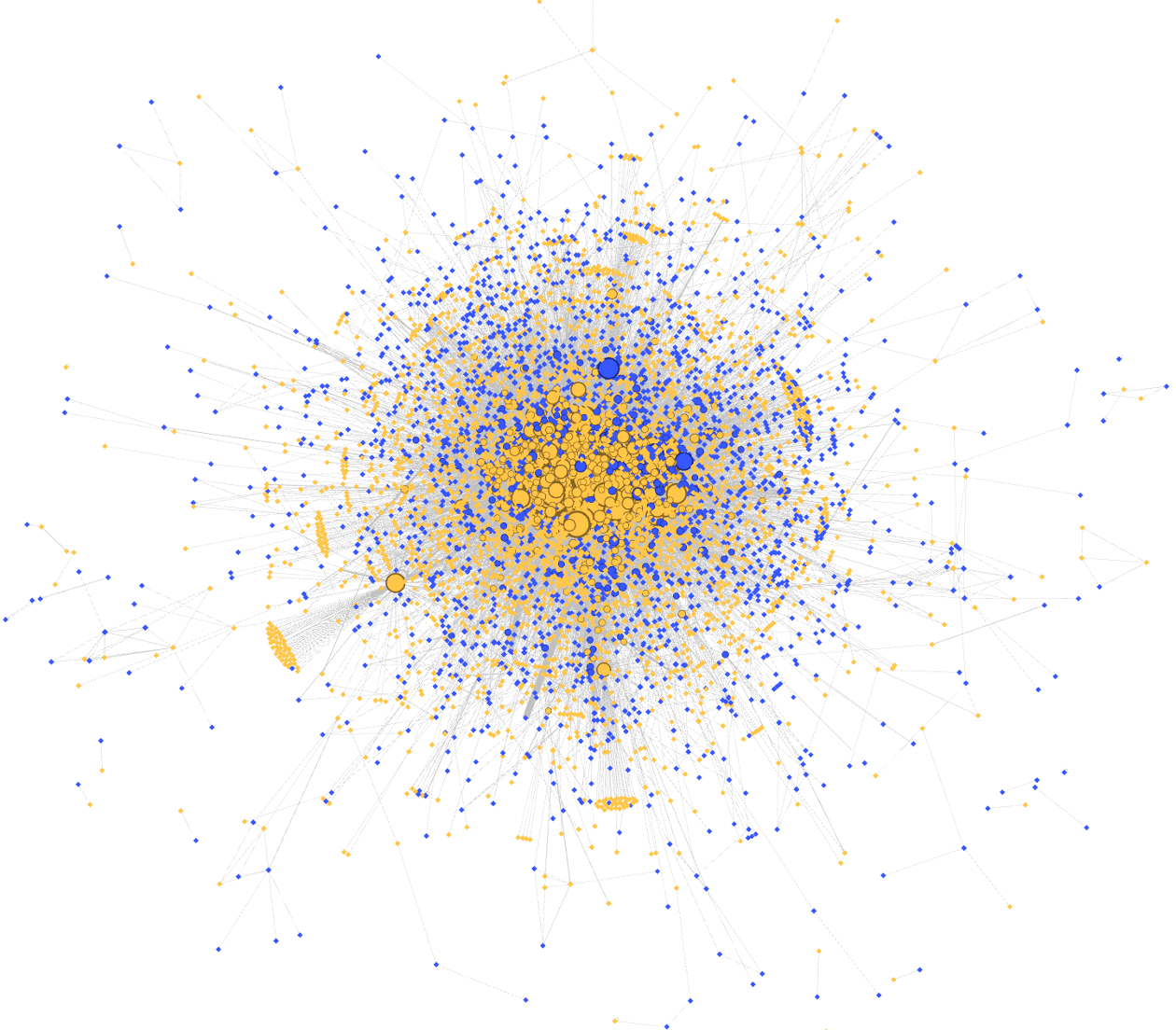
During the second period (1880–1910), women were more centrally positioned within
the
network, as illustrated in Figure 3. The profile of the women with the most
connections in this later period is very different to that in the earlier period:
nine out of ten of these women are records creators, and their letters are widely
distributed across different archival organisations (see Appendix 2, Table 7). These
women are well-known cultural figures – artists, writers and politicians – and are
well connected to external data sources. They also have a Wikipedia entry. Their
network profiles thus differ significantly from those of lesser-known figures such
as
“Mother Aline”, who, despite her extensive
correspondence, plays a more peripheral role in the network. In both periods, the
biggest difference in our metadata between men and women is that women have
significantly fewer contacts, even those who worked in the public and private sectors
in the late nineteenth century (such as the social activist and politician Aleksandra
Gripenberg; see Table 3 and Appendix 2, Table 7 and Appendix 3, Table 9). Based on
archival materials, women’s epistolary networks were narrower. However, as noted
above, the ties were proportionally stronger in terms of the number of letters
exchanged.
In addition, networks consisting exclusively of correspondence between women provide
further insight into the organisation of archival collections, the focus of scholarly
interest and the changes brought about by the modernisation of the country. The
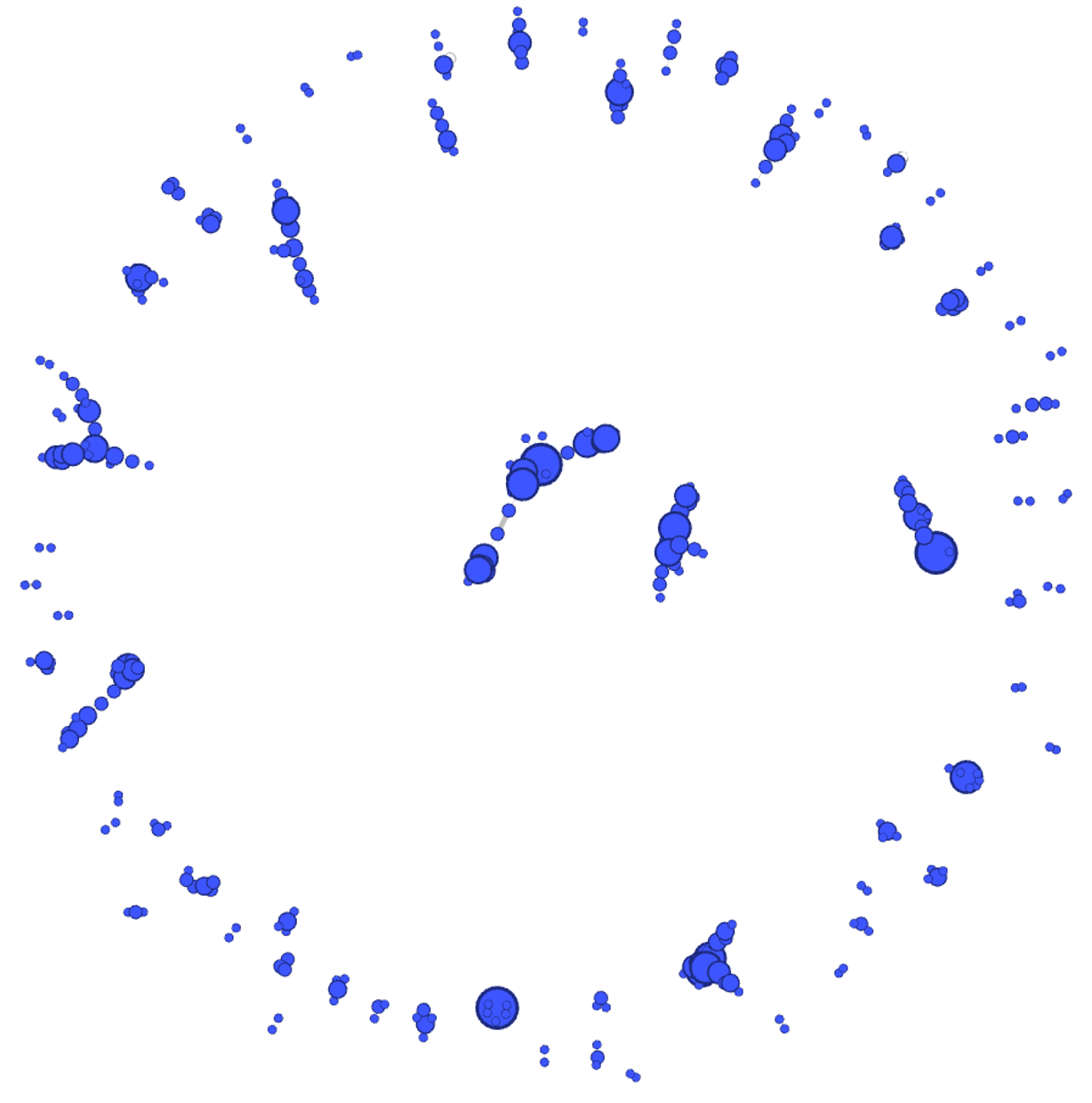
configurations of women’s correspondence networks are illustrated in Figure 4 for
the
periods 1830–1860 and 1880–1910. During the earlier period, women exchanged
significantly less correspondence, and their networks formed several distinct but
small clusters. While most of the women are the same as in the full network, the
shape of the network now suggests a predominance of family networks, as previous
research [
Monagle et al. 2023] has suggested. However, further data
analysis and qualitative research are needed to confirm this. Additionally, many of
the women’s letters are uniquely archived at Åbo Akademi, likely due to the
institution’s substantial collection of family archives from the Swedish-speaking
population. For the second period (1880–1910), the situation is very different, as
can be seen from the shape and size of the network in Figure 4. The women were highly
interconnected, with significant nodes at the centre of the network. Examining the
most central women reveals that, with the exception of two individuals, all of those
in the
“women's network” and the broader network remain
the same during this period, albeit with slightly different rankings (see Appendix
3). Therefore, in the latter period, it is not possible to identify separate clusters
of women’s correspondence. Instead, women’s correspondence is interwoven with the
networks of the country’s artistic and cultural elite, whose correspondence is spread
across all the archival organisations in our dataset.
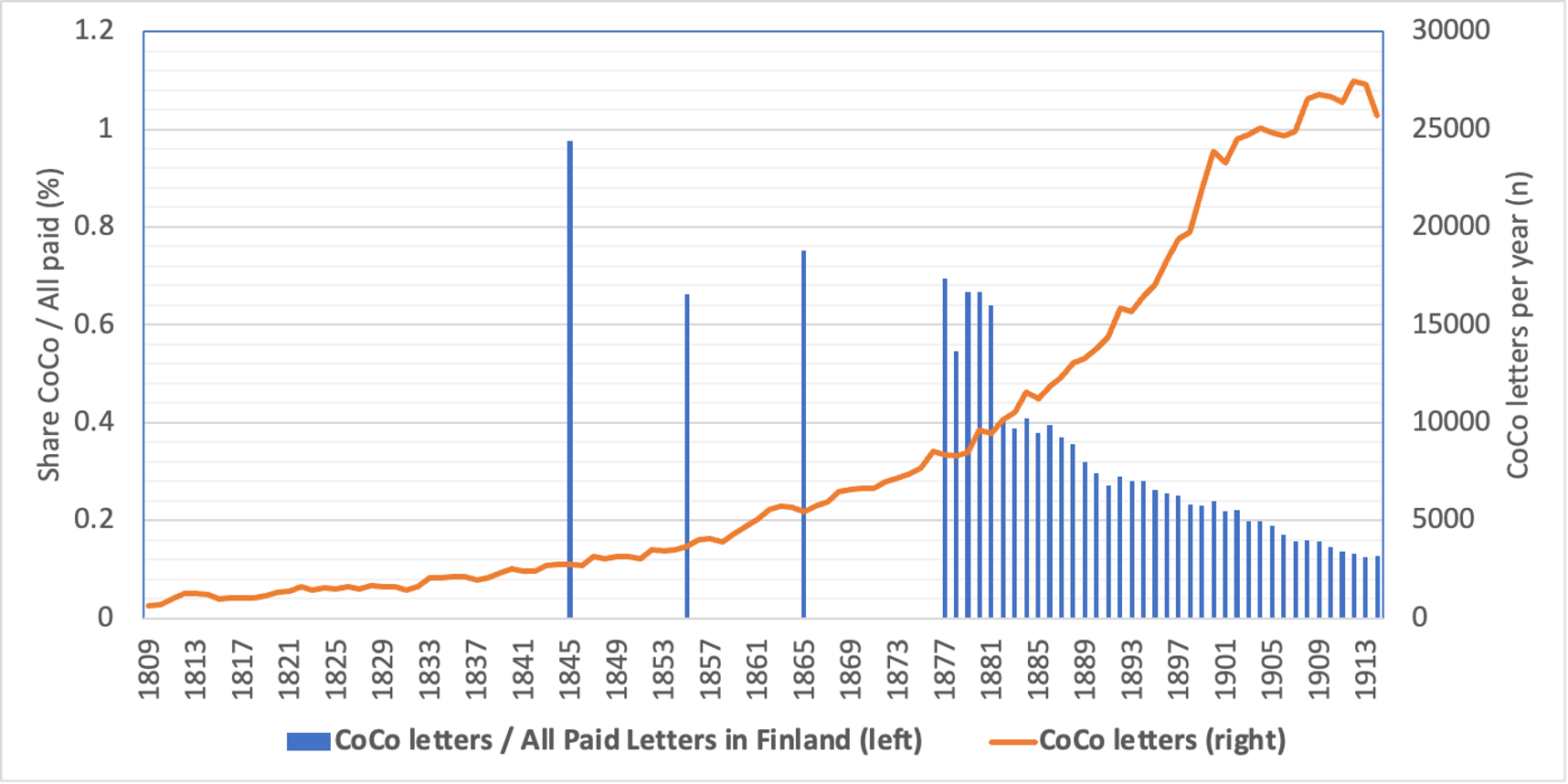
Despite these extensive collections, archived materials only provide patchy and
partial access to nineteenth-century epistolary communication. When we compare the
dataset — and thus the collections of the largest Finnish cultural heritage
organisations — with statistics on all letters sent in the Grand Duchy of Finland,
it
is clear that coverage and representativeness are low (Figure 5). The collected
metadata does not reflect the growth in letter correspondence in the country, which
was driven by the expansion of trade, commerce and administration, as well as the
development of technologies that supported easy and affordable letter exchange, such
as cheap postage and stationery, prepayment of letters and increasing delivery speeds
(Pietiäinen, 1988). After the mid-1880s, when literacy rates began to rise, archival
coverage decreased further still. It appears that archival organisations lacked the
means or interest to preserve everyday correspondence in the Grand Duchy, and
lower-class individuals and small businesses may not have had the inclination to
create personal archives. Therefore, an interesting question is whether we can
estimate what materials are missing. Can we see what is not there?
At the start of the data collection, we asked cultural heritage organisations to
estimate the proportion of their collections that were unorganised and uncatalogued
(see Appendix 1). The results of this survey clearly demonstrate a growing shortage
of resources for the labour-intensive work of archival description. However, it is
reasonable to assume that letters added to collections since the nineteenth century,
perhaps up to the 1980s, were more thoroughly indexed due to the greater availability
of human resources relative to the size of the collections. Nevertheless, the
collections do not represent a random sample of nineteenth-century epistolary
culture, as evidenced by the social and cultural status of most of the records
creators. Therefore, while cultural heritage organisations’ collections are not
representative of the majority of letters sent, especially in the late nineteenth
century, they do reflect the membership of the elite and upper middle classes
relatively well.
However, what has been preserved of the total body of correspondence that once
existed is often coincidental, even among the literate elite. For instance, Senator
Mechelin received 12,129 letters, which are kept in his family’s collection at the
National Archives. However, we only have 2,270 of his letters (mainly in the
collections of other individuals in five different organisations). Assuming that
people mostly replied to the letters they received, this kind of disparity in the
material points to definite gaps in the collections. Conversely, it is more
challenging to determine whether the proportion of female actors (24% of the total,
and 29% of those for whom gender can be identified) and the proportion of letters
sent and received by them (38% and 36%, respectively) is indicative of missing
material. Similar, large-scale datasets of epistolary metadata from other European
countries are lacking, making it difficult to compare our findings and results. The
closest we have are the results of the ambitious RRL projects mentioned above, which
provide a rare insight into the gender distribution of epistolary material from
earlier centuries. The datasets currently available in Germany and the Netherlands
show an overwhelmingly male correspondence of 85%, but this is understandable given
the projects’ premises.
6 Discussion
In the era of flourishing research on LGBTQIA+ histories, exploring the role of women
as archival protagonists may not seem very revolutionary. In fact, the first attempt
to enable sustained research on women’s history in Finland was made in the mid-1990s
with the publication of
Naisia, asiakirjoja, arkistoja: Suomen
naishistorian arkistolähteitä (
Women, Documents, Archives:
Sources for Women’s History in Finland, [
Härkönen 1994]), which
identified various archival collections of potential interest to the emerging field
of gender history. However, as we have demonstrated, applying data science methods
can render the process of critically revising archival collections much more
systematic and powerful. Epistolary metadata is, of course, only one type of
information that can be used to interrogate the role and visibility of different
social, cultural, or ethnic communities in our social narratives. Indeed, cultural
heritage metadata may offer a more affordable and realistic way of making dispersed
archival and museum collections accessible and researchable than mass digitisation
projects. However, metadata alone can be frustrating for scholars accustomed to
interrogating vast textual archives, and a dialogue between digital and more
traditional research methods is required. Nevertheless, using
“pure” metadata enables us to
“map missing bricks in
the wall of knowledge”, for instance by categorising individuals and social
groups whose biographies do not yet exist [
Guldi 2024, 525] – a
task we have begun with the help of Aline Reuter, among others.
Jo Guldi has recently referred to such digital approaches as
“counting the silences”
[
Guldi 2024, 524].
“Silence” is a
buzzword used by scholars to refer to missing data or issues that archives cannot
or
will not ‘talk about’. It is often used interchangeably with terms such as ‘gaps’,
‘bias’ and ‘occlusion’ (see also [
Carter 2006, 217]. To clarify,
[
Guldi 2023, 30–37] distinguishes between occlusion and bias.
For Guldi, a digital humanist who works with large textual corpora, the Occluded
Archive is an archive that is closed to view. It consists of materials that we cannot
access for various reasons. Occlusion operates at the level of political and
historical factors, as well as archival organisation (e.g. which social groups are
literate, which archives are preserved, and how relevant documents are hidden in
separate datasets). For Guldi, bias is
“dirt” or
“filth” in the textual content. This powerful metaphor refers
to racist, misogynistic and other expressions and narratives that carry a heavy
ideological burden. Historians are usually aware of such omissions and biases, which
they identify as part of their work. However, these factors are not always considered
when data science methods are applied to materials.
Our data consist of metadata from the letter collections; we do not have the content
of the letters in our dataset. This means that we need to introduce an additional
feature of occlusion: the partly accidental and partly selective nature of the entire
life cycle of historical and archived materials. Many archival theorists interpret
“silences” as tangible gaps in the archival record.
These gaps can arise from everyday practices such as the accidental disappearance
or
deliberate destruction of materials prior to and after archiving, or from appraisal
and subsequent rejection in a cultural heritage organisation ([
Fowler 2017]; [
Edquist 2021]). The historical reasons for
this kind of fundamental, irreversible non-preservation vary, and there is little
evidence of such processes producing structural bias in historical sources. However,
it may be possible to model some gaps using digital methods or conduct the
time-consuming task of searching organisational records for traces of decision-making
processes. In this paper, we have identified both gaps (in the representativeness
of
the data, compared with the information available on nineteenth-century postal
activity and literacy) and silences (in the lack of research on certain notable women
in our dataset) by examining what has been preserved in the collections of Finnish
cultural heritage organisations. A persistent
“silence” is
often only recognised in retrospect, for example, when a paradigmatic change in
theory or technology allows a new view of the archived material.
It is true that material separated into different repositories or organisations
is
a strong occluding factor. However, occlusion also occurs within individual
organisations. A key factor here is how organisations prioritise the creation of
metadata and categorise catalogued documents as open and accessible or closed (e.g.
[
Sherratt 2015]). Only collections that have been organised and
described can be made available to researchers and other users (see Appendix 1).
Furthermore, it has been argued that creating a fonds and assigning a records creator
carries significant intellectual and hegemonic weight, yet these decisions often
remain invisible [
Drucker 2021, 326], [
Friedrich 2021, 312–317].
Digital humanities scholars often work with materials that were originally indexed
in
a library context. While these bibliographic databases, catalogues, and digitised
repositories are incomplete and less representative than many scholars might hope
(see, for example, [
Bode 2020]), they do comprise fairly homogeneous
sets of materials. Furthermore, issues of archival access and its political
constraints are frequently examined in the context of sensitive government records
(e.g. [
Risam 2019]; [
Sherratt 2015]). However, it is also
important to recognise these mechanisms in relation to cultural heritage materials
and those held in private archival organisations. All organisations whose letter
metadata are included in our dataset have their own acquisition policies, enabling
them to accept or reject archival material offered to them, provided they justify
their decisions. Compared to material generated in library contexts and governmental
organisation records, archival organisations’ vast collections, particularly person
and family collections, seem more
“wild”, especially when considering material beyond
the high research canon. Cataloguing categories vary, information comes in different
formats, and many collections are only partially organised, with huge backlogs of
unorganised material.
7 Conclusion
In this paper, we introduce the framework of Critical Collection History. Using the
powerful qualities of Linked Open Data, this framework finds relevant features in
a
dataset comprising over a million letters and over 100,000 actors. It is motivated
by
discussions in the fields of critical archival studies and digital humanities. We
argue that critical collection history occurs when the boundaries of cultural
heritage organisations and their collections are erased and the structure of
traditional paper archives is challenged and
“weirded”. At the most general
level, critical collection history asks whose actions and experiences are important
enough to be archived and catalogued, and which individuals and groups are visible
in
finding aids, indexes and external research repositories. Digital technologies enable
us to examine archival collections individually and collectively as large sets of
historical data, not as static and inherently objective entities providing direct
access to the past, but as multi-layered, dynamic and processual entities resulting
from various historical, socio-economic and political processes. Similar to many
contextualising approaches to digital collections (e.g. [
Beelen et al. 2023]), the aim is not to
“correct”, but to identify
how such processes and layers manifest in the collections in question. Furthermore,
we are not merely users of archival data; we are also actively involved in making
the
archival record more visible (or ‘louder’) in the digital space (Johnson, 2017). For
instance, we make decisions about modelling the data and solving problems related
to
resource constraints when obtaining source data ([
Drobac et al. 2023b]).
This article discusses materials that mainly comprise person and family collections
held in private archival organisations. These collections are widely used by scholars
and favoured as case studies in archival research [
Edquist 2021], yet
they are rarely considered in postcolonial and other critical approaches. As a case
study, we have created a virtual archive of
“epistolary
women”. Our analyses suggest that the collections available to us as linked
data are relatively representative of the upper echelons of nineteenth-century
society. However, it is more difficult to assess whether the proportion of female
person-actors (29% of all actors and 26–34% of the more filtered group of records
creators in two sample organisations) accurately represents women’s epistolary
activities. Nevertheless, network analysis indicates that the available epistolary
metadata reflects changes in women’s societal roles brought about by modernisation.
This demonstrates that even partial datasets can reveal significant historical
phenomena and be profitably used by humanists, provided the gaps or ‘missingness’
are
understood and acknowledged [
Ryan and Ahnert 2021].
In addition, we have identified certain epistemic silences: women who do not feature
in our current research canon but who have substantial archival collections that
could offer valuable insights into a variety of historical topics. Overall, the
results are tentative but promising. However, we must bear in mind that the current
data include four online publications of letters and letter metadata from only nine
cultural heritage organisations – albeit the largest and most central – and only from
those collections that have been indexed at the level of individual letter exchanges.
Nonetheless, despite all the gaps and omissions discussed in this paper, the
collected metadata provides the most comprehensive sample available of who actually
sent and received letters in nineteenth-century Finland.
This article has demonstrated the potential of linked open data and critical
collection history in identifying gendered structures within epistolary metadata
collections. In the future, we can continue to explore women’'s correspondence as
a
historical phenomenon by focusing more qualitatively on the women we identify using
data-driven methods. Furthermore, we can direct our historical research towards
archival collections as the outcome of specific political, cultural, and
socio-economic pressures – pressures that leave their mark, turning the archives
themselves into artefacts of history [
Burton 2005, 6]. To achieve
this, we should digitise the acquisition registers of various organisations and study
their decision-making processes relating to archival appraisal where possible. While
many organisational histories touch on these issues – most recently [
Hakala 2023] study of the Swedish Literature Society in Finland’s
archival collections – a combined history focusing on private epistolary collections
as a case study remains to be written. A critical collection history is also always
a
history of the construction of collective identity; it can reveal whose experiences
are available to us as historians, and also whose experiences have been narrativised
as history at different stages in the past.
Appendix 1: Survey about the current situation of letter metadata held by Finnish
cultural heritage organisations
The project Constellations of Correspondence – Large and Small
Networks of Epistolary Exchange in the Grand Duchy of Finland (CoCo) has
launched a survey on nineteenth-century letter collections in Finnish cultural
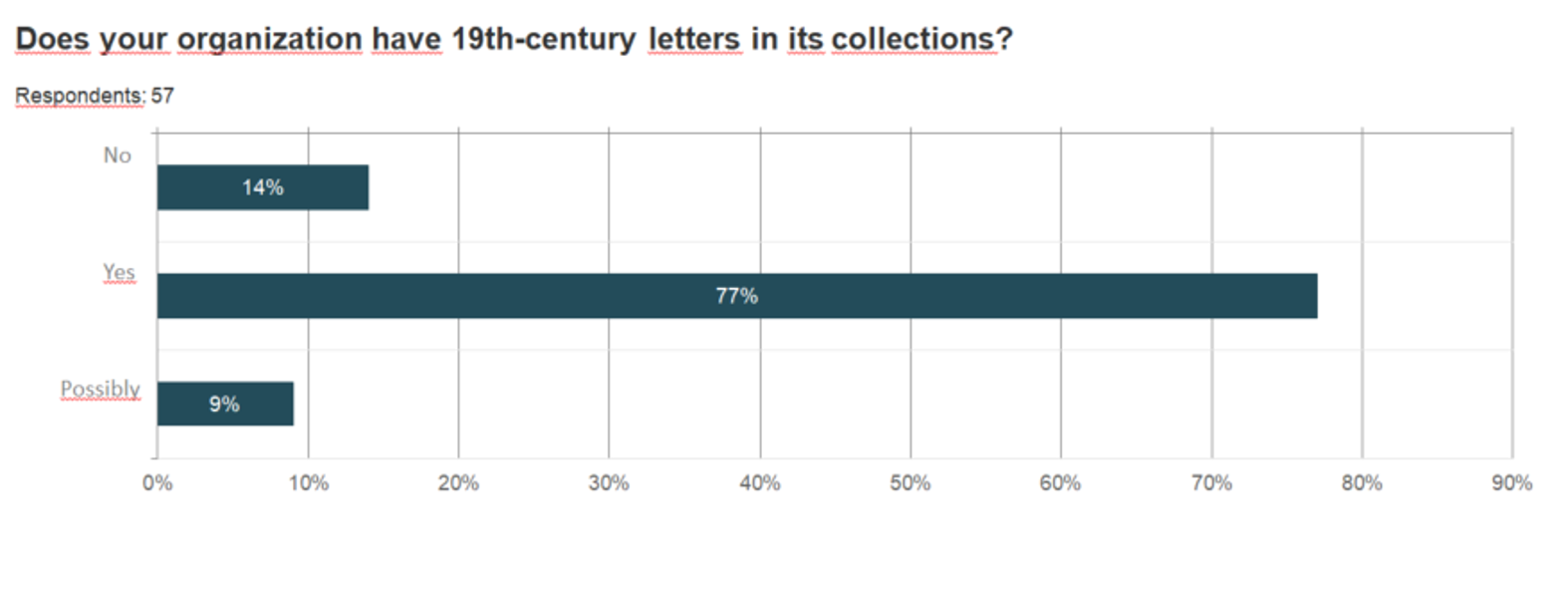
heritage organisations. To date, 57 archives, libraries and museums have responded.
The survey contains 18 questions to help understand the current situation and the
challenges of aggregating collection metadata. Here, we present results relevant to
this paper in Figures 6-8. In summary, 86% of respondents either have or possibly
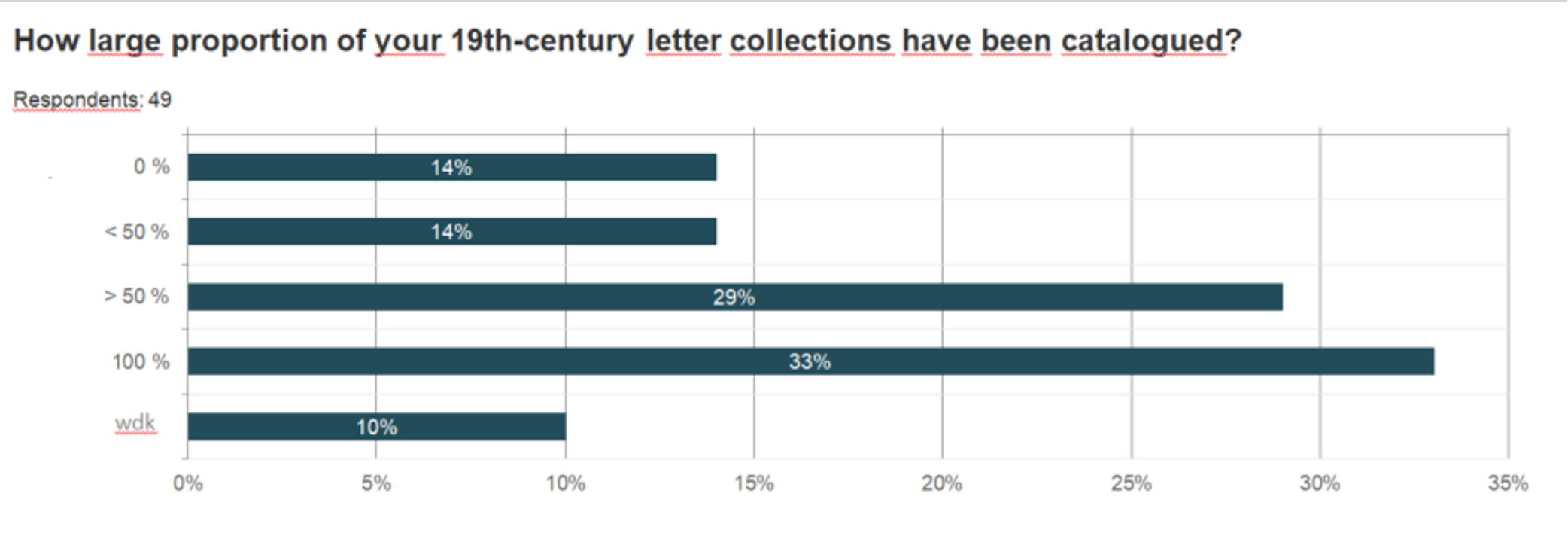
have nineteenth-century letters in their archival collections. The word ‘possibly’
is
explained by the fact that only 33% have catalogued all their letters. Conversely,
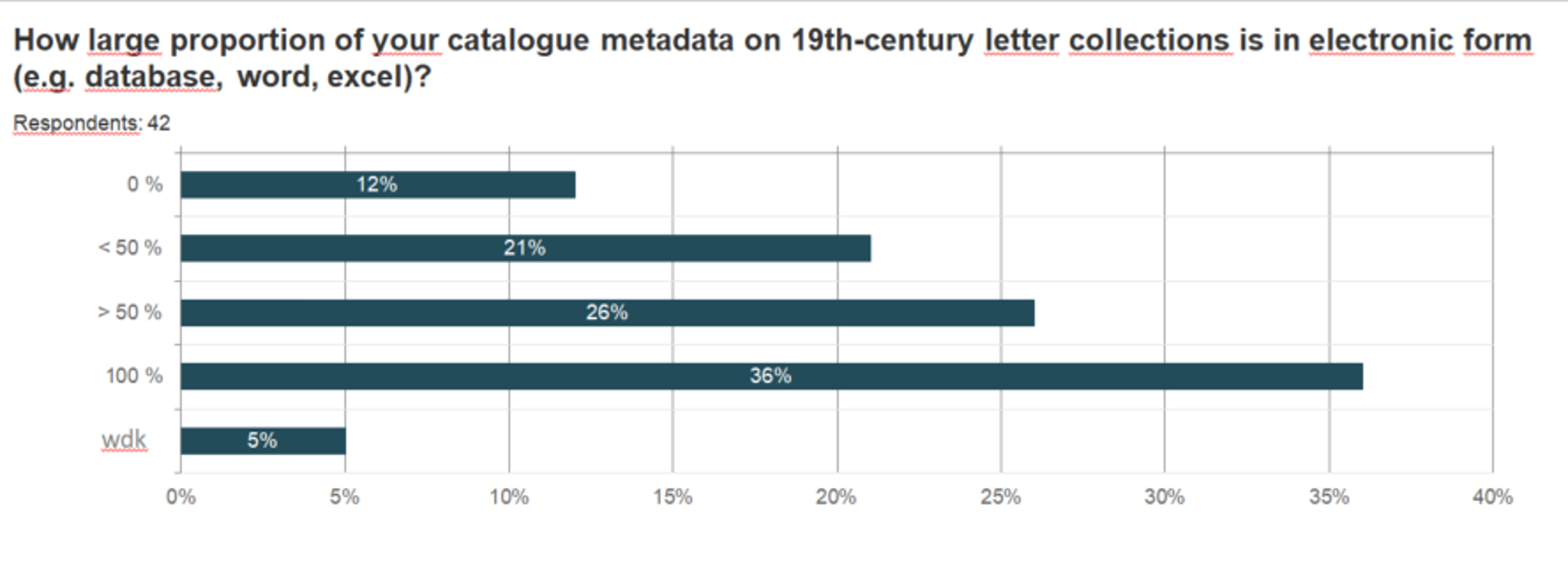
14% have not catalogued them at all. Regarding archival finding aids, only 36% of
respondents with nineteenth-century letters have catalogues in electronic form, such
as databases, Excel files, or Word documents. This makes the content
machine-readable, but additional structuring and harmonising is required.
Appendix 2: Top 10 male and female authors in the complete correspondence network
based on degree (non-weighted), 1830–1860 and 1880–1910.
| Name |
Degree rank and value (non-weighted) |
Occupations |
Archives |
records creator |
External links (in Wikipedia) |
| Lönnrot, Elias (1802–1884) |
1 (266) |
author, botanist, collector, folklorist, full professor, hymnwriter,
lexicographer, linguist, pedagogue, philologist, physician, physician writer,
poet, professor, writer |
AEL, ELL, FNG, JVSL, NAF, NLF, SKS, SLS, ÅA |
archive (ELL) |
11 (yes) |
| Armfelt, Alexander (1794–1875) |
2 (135) |
minister-secretary, count, chancellor |
AEL, FNG, JVSL, NAF, NLF, SLS, ÅA |
yes (FNA) |
9 (yes) |
| Topelius, Zachris (1818–1898) |
3 (125) |
amanuensis, author, children’s writer, full professor, historian, history
teacher, journalist, poet, professor, rector, school teacher, writer |
AEL, ELL, FNG, JVSL, NAF, NLF, SLS, SKS, ZTS, ÅA |
archive (ZTS) |
9 (yes) |
| Ilmoni, Immanuel (1797–1856) |
4 (125) |
director, full professor, Master of Philosophy, physician, professor,
prosector, secretary, senior accountant |
ELL, JVSL, NAF, NLF, SLS, SKS, ÅA |
yes (SKS) |
7 (yes) |
| Gottlund, Carl Axel (1796–1875) |
5 (119) |
author, explorer, historian, lecturer, linguist, translator, writer |
ELL, FNG, JVSL, NAF, NLF, SLS, SKS, ÅA |
yes (NLF, SKS) |
6 (yes) |
| Mannerheim, Karl Gustaf (1797–1854) |
6 (111) |
count, County governor, doctor of both laws, entomologist, judge,
notary |
JVSL, NAL, NLF, ÅA |
yes (NLF) |
9 (yes) |
| Cygnaeus, Fredrik (1807–1881) |
7 (104) |
author, docent, full professor, historian, literary critic, poet, rector,
school teacher, writer |
AEL, ELL, FNG, JVSL, NAF, NLF, SKS, ÅA |
yes (NLF) |
11 (yes) |
| Runeberg, Johan Ludvig (1804–1877) |
8 (87) |
author, school teacher, full professor, journalist, priest, lecturer |
AEL, ELL, FNG, JVSL, NAF, NLF, SLS, SKS, ÅA |
yes (SLS) |
10 (yes) |
| Schauman, Berndt Otto (1821–1895) |
9 (87) |
amanuensis, intendant, member of the Diet of Finland, non-fiction writer,
politician, writer |
AEL, ELL, FNG, JVSL, NAF, NLF, SLS, SKS, ÅA |
yes (NLF) |
8 (yes) |
| Rein, Gabriel (1800–1867) |
10 (83) |
member of Diet ofFinland, historian, full professor, rector, lecturer |
AEL, ELL, JVSL, NAF, NLF, SKS, ÅA |
yes (NLF) |
8 (yes) |
|
|
|
|
|
|
Table 4.
Appendix 2, Table 4. Ten authors with highest degree (non-weighted) in
1830–1860. Source: LetterSampo Finland dataset (19 February 2025). Note: The information
about
occupations, archive, fonds, and external links concerns all letters by the
author. AEL (Albert Edelfelt’s Letters), ELL (Elias Lönnrot’s Letters), JVSL
(Johan Vilhelm Snellman’s Letters), FNG (The Finnish National Gallery), SKS (The
Finnish Literature Society), NAF (The National Archives of Finland), NLF (The
National Library of Finland), SLS (The Swedish Literature Society in Finland), ÅA
(The Åbo Akademi University Library).
| Name |
Degree rank and value (non-weighted) |
Occupations |
Archives |
records creator |
External links (in Wikipedia) |
| Runeberg, Fredrika (1807–1879) |
61 (25) |
writer, journalist, novelist, editor |
AEL, ELL, JVSL, NAF, NLF, SLS, SKS, ÅA |
yes (SLS) |
10 (yes) |
| Gadd, Carolina Lovisa (1810–1867) |
81 (19) |
- |
NLF |
no |
1 (no) |
| Tengström (Bergbom), Johanna Carolina (1803–1885) |
98 (16) |
- |
JVSL, NLF, SLS, ÅA |
no |
4 (no) |
| Armfelt, Wava |
108 (15) |
- |
ÅA |
family (ÅA) |
0 (no) |
| Collan (Wasenius), Johanna (1814–1901) |
115 (14) |
- |
NLF, ÅA |
son (NLF) |
4 (no) |
| Tengström (Kellgren), Anna Sofia (1826–1906) |
118 (14) |
- |
JVSL, NLF, SLS |
husband (NLF) |
4 (no) |
| af Brunér, Emma (1814–1857) |
119 (14) |
- |
ÅA |
no |
2 (no) |
| Blomqvist, Elisabeth (1827–1901) |
132 (12) |
director, head teacher, painter, painter and varnisher |
AEL, JVSL, NAF, NLF, SLS, SKS, ÅA |
family (NLF) |
6 (yes) |
| von Haartman, Naema Aurora (1822–1866) |
135 (12) |
- |
NLF, ÅA |
family (ÅA) |
4 (no) |
| Westzynthius (Haartman), Margaretha Sophia (1807–1894) |
146 (11) |
- |
ÅA |
no |
1 (no) |
Table 5.
Appendix 2, Table 5. Ten female authors with highest betweenness in 1830–1860.
Source: LetterSampo Finland dataset (19 February 2025). Note: The information about
occupations,
archive, fonds, and external links concerns all letters by the author.
| Name |
Degree rank and value (non-weighted) |
Occupations |
Archives |
records creator |
External links (in Wikipedia) |
| Mechelin, Leopold (1839–1914) |
1 (528) |
banker, deputy, director, doctor of both laws, entrepreneur, full professor,
politician |
AEL, FNG, JVSL, NAF, NLF, SKS, SLS, ÅA |
yes (NAF) |
10 (yes) |
| Palmén, Ernst Gustaf (1849–1919) |
2 (476) |
historian, member of parliament, member of the Diet of Finland, politician,
professor |
AEL, FNG, NAF, NLF, SLS, SKS, ÅA |
yes (NLF) |
9 (yes) |
| Topelius, Zachris (1818–1898) |
3 (473) |
amanuensis, author, children’s writer, full professor, historian, history
teacher, journalist, master’s degree, poet, professor, rector, school teacher,
writer |
AEL, ELL, FNG, JVSL, NAF, NLF, SLS, SKS, ZTS, ÅA |
archive (ZTS) |
9 (yes) |
| Schybergson, Magnus Gottfrid (1852–1925) |
4 (356) |
historian, full professor |
AEL, NAF, NLF, SLS, SKS, ÅA |
yes (ÅA) |
8 (yes) |
| Setälä, Emil Nestor (1864–1935) |
5 (333) |
anthropologist, Chancellor, diplomat, linguist, member of parliament,
Minister for Foreign Affairs of Finland, Minister of Education, politician,
senator, university teacher |
NAF, NLF, SLS, SKS, ÅA |
yes (SKS) |
9 (yes) |
| Aspelin-Haapkylä (Aspelin), Eliel (1847–1917) |
6 (325) |
art historian, full professor, counselor of state |
AEL, ELL, FNG, NAF, NLF, SLS, SKS, ÅA |
yes (SKS) |
8 (yes) |
| Colliander, Otto Immanuel (1848–1924) |
7 (305) |
bishop, politician, priest |
AEL, FNG, NAF, NLF, SLS, SKS, ÅA |
yes (NAF) |
8 (yes) |
| Cygnaeus, Gustaf (1851–1907) |
8 (269) |
journalist, lecturer, newspaper editor |
AEL, FNG, NAF, NLF, SLS, SKS, ÅA |
yes (ÅA) |
6 (yes) |
| Schauman, Berndt Otto (1821–1895) |
9 (252) |
amanuensis, intendant, member of the Diet of Finland, politician,
writer |
AEL, ELL, FNG, JVSL, NAF, NLF, SLS, SKS, ÅA |
yes (NLF) |
8 (yes) |
| Palmén, Johan Axel (1845–1919) |
10 (238) |
member of Diet of Finland, full professor, ornithologist, entomologist,
geographer |
NAF, NLF, SLS, SKS, ÅA |
yes (NLF) |
7 (yes) |
Table 6.
Appendix 2, Table 6. Ten authors with highest degree (non-weighted) in
1880–1910. Source: LetterSampo Finland dataset (19 February 2025). Note: The information
about
occupations, archive, fonds, and external links concerns all letters by the
author.
| Name |
Degree rank and value (non-weighted) |
Occupations |
Archives |
records creator |
External links (in Wikipedia) |
| Aalberg, Ida (1857–1915) |
21 (182) |
actor, stage actor, theatrical director |
AEL, FNG, NAF, NLF, SKS, ÅA |
yes (FNL) |
7 (yes) |
| Gripenberg, Aleksandra (1857–1913) |
31 (157) |
member of parliament, writer, editor, chairperson |
NAF, NLF, SLS, SKS, ÅA |
yes (SKS) |
7 (yes) |
| Käkikoski, Hilda (1864–1912) |
40 (145) |
member of parliament, politician, teacher, writer |
NAF, NLF, SLS, SKS, ÅA |
yes (SKS) |
6 (yes) |
| Friberg, Maikki (1861–1927) |
60 (114) |
editor, journalist, suffragist, teacher, writer |
NAF, NLF, SLS, SKS, ÅA |
yes (NAF) |
5 (yes) |
| Westermarck, Helena (1857–1938) |
63 (112) |
editor, historian, painter, painter and varnisher, visual artist,
writer |
FNG, NAF, NLF, SLS, SKS, ÅA |
yes (ÅA) |
7 (yes) |
| Söderhjelm, Alma (1870–1949) |
68 (103) |
author, docent, essayist, full professor, historian |
AEL, FNG, NAF, NLF, SKS, SLS, ÅA |
yes (ÅA) |
8 (yes) |
| Talvio, Maila (1871–1951) |
79 (95) |
writer, translator, honorary doctorate |
NAF, NLF, SLS, SKS, ÅA |
yes (SKS) |
7 (yes) |
| Ackté, Aino (1876–1944) |
83 (90) |
opera singer, librettist |
AEL, FNG, NAF, NLF, SLS, SKS, ÅA |
yes (FNL) |
9 (yes) |
| Elfving (Runeberg), Lina (1841–1916) |
89 (84) |
- |
AEL, FNG, NLF, SLS, ÅA |
husband (SLS) |
3 (no) |
| Åström, Emma Irene (1847–1934) |
91 (83) |
lecturer, school teacher, teacher |
NAF, NLF, SKS, ÅA |
yes (ÅA) |
6 (yes) |
Table 7.
Appendix 2, Table 7. Ten female authors with highest degree (non-weighted) in
1880–1910. Source: LetterSampo Finland dataset (19 February 2025). Note: The information
about
occupations, archive, fonds, and external links concerns all letters by the
author.
Appendix 3: Top 10 female authors in the correspondence network with only women
based on degree (non-weighted), 1830–1860 and 1880–1910
| Name |
Degree rank and value (non-weighted) |
Occupations |
Archives |
records creator |
External links (in Wikipedia) |
| Runeberg, Fredrika (1835–1857) |
1 (8) |
writer, journalist, novelist, editor |
AEL, ELL, JVSL, NAF, NLF, SLS, SKS, ÅA |
yes (SLS) |
10 (yes) |
| Tallqvist, Alina Fredrika (1835–1899) |
2 (8) |
- |
NAF, NLF |
no |
4 (no) |
| af Brunér, Emma (1814–1857) |
3 (8) |
- |
ÅA |
no |
2 (no) |
| Westzynthius (Haartman), Margaretha Sophia (1807–1894) |
4 (6) |
- |
ÅA |
no |
1 (no) |
| Westzynthius, Emilia Teodora (Emmy) (1835–1906) |
5 (6) |
- |
ÅA |
no |
3 (no) |
| von Haartman, Naema Aurora (1822–1866) |
6 (6) |
- |
NLF, ÅA |
family (ÅA) |
4 (no) |
| Thuneberg, Yolanda Aurora (1826–1888) |
7 (6) |
- |
NAF, NLF, ÅA |
family (NLF) |
3 (no) |
| Collan (Wasenius), Johanna (1814–1901) |
8 (6) |
- |
NLF, ÅA |
son (NLF) |
4 (no) |
| Tengström (Kellgren), Anna Sofia (1826–1906) |
9 (6) |
- |
JVSL, NLF, SLS |
husband (NLF) |
4 (no) |
| Blomqvist, Elisabeth (1827–1901) |
10 (5) |
director, head teacher, painter, painter and varnisher |
AEL, JVSL, NAF, NLF, SLS, SKS, ÅA |
family (NLF) |
6 (yes) |
Table 8.
Appendix 3, Table 8. Ten authors with highest degree (non-weighted) in the
letter network containing only women, 1830–1860. Source: LetterSampo Finland dataset
(19 February 2025).
Note: The information about occupations, archive, fonds, and external links
concerns all letters by the author.
| Name |
Degree rank and value (non-weighted) |
Occupations |
Archives |
records creator |
External links (in Wikipedia) |
| Gripenberg, Aleksandra (1857–1913) |
1 (96) |
member of parliament, writer, editor, chairperson |
NAF, NLF, SLS, SKS, ÅA |
yes (SKS) |
7 (yes) |
| Friberg, Maikki (1861–1927) |
2 (71) |
editor, journalist, suffragist, teacher, writer |
NAF, NLF, SLS, SKS, ÅA |
yes (NAF) |
5 (yes) |
| Käkikoski, Hilda (1864–1912) |
3 (71) |
member of parliament, politician, teacher, writer |
NAF, NLF, SLS, SKS, ÅA |
yes (SKS) |
6 (yes) |
| Westermarck, Helena (1857–1938) |
4 (55) |
editor, historian, painter, painter and varnisher, visual artist,
writer |
FNG, NAF, NLF, SLS, SKS, ÅA |
yes (ÅA) |
7 (yes) |
| Åkerman, Emma (1851–1931) |
5 (52) |
poet, teacher, writer |
NAF, NLF, SKS |
family (NLF) |
8 (yes) |
| Aalberg, Ida (1957–1915) |
6 (51) |
actor, stage actor, theatrical director |
AEL, FNG, NAF, NLF, SKS, ÅA |
yes (FNL) |
7 (yes) |
| Elfving (Runeberg), Lina (1841–1916) |
7 (49) |
- |
AEL, FNG, NLF, SLS, ÅA |
husband (SLS) |
3 (no) |
| Söderhjelm, Alma (1870–1949) |
8 (41) |
author, docent, essayist, full professor, historian |
AEL, FNG, NAF, NLF, SKS, SLS, ÅA |
yes (ÅA) |
8 (yes) |
| Hagman, Lucina (1853–1946) |
9 (39) |
chairperson, head teacher, member of parliament, politician, professor,
teacher, women’s rights activist, writer |
NAF, NLF, SLS, SKS, ÅA |
yes (NAF) |
7 (yes) |
| Åström, Emma Irene (1847–1934) |
10 (37) |
lecturer, school teacher, teacher |
NAF, NLF, SKS, ÅA |
yes (ÅA) |
6 (yes) |
Table 9.
Appendix 3, Table 9. Ten authors with highest degree (non-weighted) in the
letter network containing only women, 1880–1910. Source: LetterSampo Finland dataset
(19 February 2025). Note: The information about occupations, archive, fonds, and external
links
concerns all letters by the author.
Acknowledgments
Computing resources of the CSC – IT Center for Science were used in our work.
Works Cited
Ahnert and Ahnert 2019 Ahnert, R. and Ahnert,
S. E. (2019)
“Metadata, surveillance and the Tudor
state”,
History Workshop Journal, 87, Spring
2019, pp. 27–51. Available at:
https://doi.org/10.1093/hwj/dby033 (Accessed: 28 June 2024).
Ahnert et al. 2020 Ahnert, R. et al. (2020)
The network turn: Changing perspectives in the
humanities. Cambridge: Cambridge University Press. Available at:
https://doi.org/10.1017/9781108866804 (Accessed: 06 February 2024).
Ahola et al. 2025 Ahola, A., Björklund, M., Drobac, S., Enqvist, J., Hyvönen, E. A., Jauhiainen, I.,
Kanervo, S., Koho, M., Koho, O., Kukkonen, V., Leal, R., Leskinen, P., La Mela, M.,
Paloposki, H.-L., Pikkanen, I., Poikkimäki, H., Rantala, H., Sainio, S., Tuominen,
J., & Wahjoe, M. F. (2025)
LetterSampo Finland (1.0.0) [Data set]. Zenodo.
https://doi.org/10.5281/zenodo.15210590.
Autio 1997a Autio, V.M. (1997a)
“Reuter, Enzio” in
Kansallisbiografia-verkkojulkaisu ('National Biography of Finland',
online publication). Studia Biographica 4. Helsinki: Suomalaisen Kirjallisuuden
Seura. Available at:
http://urn.fi/urn:nbn:fi:sks-kbg-006353 (Accessed: 05 July 2024).
Autio 1997b Autio, V.M. (1997b)
“Reuter (1600–)” in
Kansallisbiografia-verkkojulkaisu ('National Biography of Finland',
online publication). Studia Biographica 4. Helsinki: Suomalaisen Kirjallisuuden
Seura. Available at:
http://urn.fi/urn:nbn:fi:sks-kbg-008049 (Accessed: 05 July 2024).
Beelen et al. 2023 Beelen, K. et al. (2023)
“Bias and representativeness in digitized newspaper
collections: Introducing the environmental scan”,
Digital Scholarship in the Humanities, 38(1), pp. 1–22. Available at:
https://doi.org/10.1093/llc/fqac037 (Accessed: 14 April 2024).
Burton 2005 Burton, A. (2005)
“Introduction: Archive fever, archive stories” in Burton,
Antoinette (ed.)
Archive stories: Facts, fictions, and the
writing of history. Durham, NC: Duke University Press, pp. 1–24. Available
at:
https://doi.org/10.2307/j.ctv11smn7b.4. (Accessed: 27 June 2024).
Caswell et al. 2017 Caswell, M., Punzalan,
R., and Sangwand, T.K. (2017)
“Critical archival studies:
An introduction”,
Journal of Critical Library and
Information Studies: Critical Archival Studies, Special issue, 1(2), pp.
1–8. Available at:
https://doi.org/10.24242/jclis.v1i2.50. (Accessed: 12 March 2024).
Ciula et al. 2018 Ciula, A. et al. (2018)
“Models and modelling between digital and humanities. Remarks
from a multidisciplinary perspective”,
Historical
Social Research / Historische Sozialforschung, 43(4), pp. 343–361.
Available at:
https://www.jstor.org/stable/26544261. (Accessed: 24 June 2025).
Dagens Press 1916 Dagens
Press (newspaper), 1 May 1916 (99).
Dirks 2002 Dirks, N. B. (2002)
“Annals of the archive: Ethnographic notes on the sources of
history” in Axel, B. K. (ed.)
From the margins:
historical anthropology and its futures. Durham, NC: Duke University
Press. Available at:
https://doi.org/10.1215/9780822383345-002. (Accessed: 28 June 2024).
Doerr et al. 2010 Doerr, M. et al. (2010)
“The europeana data model (EDM)” in
World library and information congress: 76th IFLA General Conference
and Assembly, Gothenburg, Sweden. IFLA, pp. 1–12. Available at:
https://cdn.ifla.org/past-wlic/2010/149-doerr-en.pdf (Accessed: 27 June
2024).
Drobac et al. 2023a Drobac, S., Leskinen,
P. and Wahjoe, M. F. (2023a)
“Navigating the
challenges of deduplicating actors in historical letter exchanges”,
Proceedings of the 24th European Conference on Knowledge
Management, 24(2). Reading: Academic Conferences International Limited,
pp. 1694–1697. Available at:
https://doi.org/10.34190/eckm.24.2.1317. (Accessed: 19 February
2025).
Drobac et al. 2023b Drobac, S. et al. (2023b)
“The laborious cleaning: Acquiring and transforming
19th-century epistolary metadata”,
Digital Humanities
in the Nordic and Baltic Countries Publications, 5(1). Oslo: Digital
Humanities in the Nordic and Baltic Countries, pp. 248–262. Available at:
https://doi.org/10.5617/dhnbpub.10669. (Accessed: 17 February 2024).
Drucker 2021 Drucker, J. (2021)
The digital humanities coursebook: An introduction to digital
methods for research and scholarship. London: Routledge. Available at:
https://doi.org/10.4324/9781003106531 (Accessed: 01 July 2024).
Edquist 2021 Edquist, S. (2021) “Archival divides: Archives as contested realities and
metaphors” in Öhrberg, A. et al. (eds) From dust to
dawn: Archival studies after the archival turn. Uppsala: Uppsala
University, pp. 102–129.
Eiranen 2021 Eiranen, R. (2021) “Personal nationalism in a marital relationship: Emotive and
gendering construction of national experience in romantic correspondence”
in Kivimäki, V., Suodenjoki, S., and Vahtikari, T. (eds) Lived nation as the history of experiences and emotions in Finland,
1800–2000. London: Palgrave, pp. 85–108.
Enqvist and Pikkanen 2024 Enqvist, Jo.
and Pikkanen, I. (2024)
“Kirjeluettelot tutkimusaineistona ja
kulttuuriperintönä: metadatan mahdollisuudet digitaalisen käänteen jälkeen”
in Karhu, H., Kivilaakso, K., and Parente-Čapková, V. (eds)
Tutkimuspolkuja yksityisarkistoihin – Aineistot historian,
kulttuurin ja kirjallisuuden tutkimuksessa. Helsinki: Suomalaisen
Kirjallisuuden Seura, pp. 390–426. Available at:
https://doi.org/10.21435/skst.1495.
Fowler 2017 Fowler, S. (2017) “Enforced silences” in Thomas, D. and Fowler, S. (eds) The silence of the archive. London: Facet Publishing, pp.
1–40.
Friedrich 2021 Friedrich, M. (2021) “The Archivist” in Blair, A. et al. (eds) Information. A historical companion. Princeton, NJ:
Princeton University Press, pp. 312–317.
Guldi 2023 Guldi, J. (2023) The
dangerous art of text mining. A methodology for digital history.
Cambridge: Cambridge University Press.
Guldi 2024 Guldi, J. (2024)
“The
revolution in text mining for historical analysis is here”,
The American Historical Review, 129(2), pp. 518–543.
Available at:
https://doi.org/10.1093/ahr/rhae163. (Accessed: 14 June 2024).
Hakala 2023 Hakala, P. (2023) Att minnas eller glömma. Tillkomsten av Svenska litteratursällskapets arkiv och
dess roll i skapandet av identitet 1885–1920. Bidrag till kännedom av
Finlands natur och folk 223. Helsingfors: Finska Vetenskaps-Societeten.
Hotson and Wallnig 2019 Hotson, H. and
Wallnig, T. (eds) (2019)
Reassembling the republic of
letters in the digital age: Standards, systems, scholarship. Göttingen:
Göttingen University Press. Available at:
https://doi.org/10.17875/gup2019-1146. (Accessed: 01 March 2024).
How 2003 How, J. (2003) Epistolary spaces: English letter-writing from the foundation of the post office
to Richardson's Clarissa. Aldershot: Ashgate.
Hyvönen 2022 Hyvönen, E. (2022)
“Digital Humanities on the semantic web: Sampo model and portal
series”,
Semantic Web – Interoperability, Usability,
Applicability, 14(4), pp. 729–744. Available at:
https://doi.org/10.3233/SW-223034.
(Accessed: 16 March 2024).
Hyvönen et al. 2021 Hyvönen, E. et al. (2021)
“Citizen science archaeological finds on the Semantic Web: the
FindSampo framework”,
Antiquity 95(382).
Available at:
https://doi.org/10.15184/aqy.2021.87. (Accessed: 01 July 2024).
Härkönen 1994 Härkönen, M. (ed.) (1994) Naisia, asiakirjoja, arkistoja. Suomen naishistorian
arkistolähteitä. Helsinki: Suomen Historiallinen Seura.
Ikkala et al. 2022 Ikkala, E. et al. (2022)
“Sampo-UI: A full stack JavaScript framework for developing
semantic portal user interfaces”,
Semantic Web –
Interoperability, Usability, Applicability, 13(1), pp. 69–84. Available
at:
https://doi.org/10.3233/SW-210428 (Accessed: 16 March 2024).
Johnson 2017 Johnson, V. (2017) “Solutions to the silence” in Thomas, D., Fowler, S.,
and Johnson, V. (eds) The silence of the archive.
London: Facet, pp. 141–162.
Ketelaar 2017 Ketelaar, E. (2017) “Archival turns and returns: Studies of the archive” in
Gilliland, A. J., McKemmish, S., and Lau, Andrew, J. (eds) Research in the Archival Multiverse. Clayton, Victoria: Monash University
Publishing, pp. 228–268.
Klinge 2006 Klinge, M. (2006)
“Runeberg, Fredrika” in
Kansallisbiografia-verkkojulkaisu ('National Biography of Finland',
online publication). Studia Biographica 4. Helsinki: Suomalaisen Kirjallisuuden
Seura. Available at:
http://urn.fi/urn:nbn:fi:sks-kbg-002845. (Accessed: 21 February
2025).
Konttinen 2000 Konttinen, R. (2000)
“Blomqvist, Elisabeth” in
Kansallisbiografia-verkkojulkaisu ('National biography of Finland',
online publication). Studia biographica 4. Helsinki: Suomalaisen kirjallisuuden
seura. Available at:
http://urn.fi/urn:nbn:fi:sks-kbg-003307. (Accessed: 07 July 2024).
Kudella 2019 Kudella, C. (2019)
“How do we model the republic of letters?” in Hotson, H.
and Wallnig, T. (eds)
Reassembling the republic of letters
in the digital age: Standards, systems, scholarship. Göttingen: Göttingen
University Press, pp. 41–53. Available at:
https://doi.org/10.17875/gup2019-1146. (Accessed: 01 March 2024).
Lahtinen et al. 2011 Lahtinen, A. et al.
(2011) “Johdanto: Kirjeiden uusi tuleminen” in
Leskelä-Kärki, M., Lahtinen, A., and Vainio-Korhonen, K. (eds) Kirjeet ja historiantutkimus. Historiallinen Arkisto 134.
Helsinki: Suomalaisen Kirjallisuuden Seura.
Latomaa and Nuolijärvi 2002 Latomaa, S.
and Nuolijärvi, P. (2002)
“The language situation in
Finland”,
Current Issues in Language Planning,
3(2), pp. 95–202. Available at:
http://dx.doi.org/10.1080/14664200208668040.
Loukissas 2019 Loukissas, Y. A. (2019)
All data are local: Thinking critically in a data-driven
society. Cambridge, MA: The MIT Press. Available at:
https://doi.org/10.1080/14664200208668040.. (Accessed: 25 May
2024).
Mikkola et al. 2019 Mikkola, K., Olsson, P.,
and Stark, E. (2019)
“Minority cultures and the making of
cultural heritage archives in Finland”,
Ethnologia
Europaea, 49(1), pp. 58–73. Available at:
https://doi.org/10.16995/ee.818.
(Accessed: 28 February 2024).
Monagle et al. 2023 Monagle, C. et al. (2023)
European women's letter-writing from the eleventh to the
twentieth centuries. Amsterdam: Amsterdam University Press.
Ortolja-Baird and Nyhan 2022 Ortolja-Baird, A. and Nyhan, J. (2022)
“Encoding
the haunting of an object catalogue: on the potential of digital technologies to
perpetuate or subvert the silence and bias of the early-modern archive”,
Digital Scholarship in the Humanities, 37(3), pp.
844–867. Available at:
https://doi.org/10.1093/llc/fqab065. (Accessed: 25 February 2024).
Pietiäinen 1988 Pietiäinen, J.P. (1988)
Suomen postin historia I–II. Helsinki: Posti- ja
telelaitos.
Risam 2019 Risam, R. (2019) New digital worlds: Postcolonial digital humanities in theory, praxis, and
pedagogy. Evanston, IL: Northwestern University Press.
Ryan and Ahnert 2021 Ryan, Y. C. and Ahnert,
S. E. (2021)
“The measure of the archive: The robustness
of network analysis in early modern correspondence”,
Journal of Cultural Analytics 6 (3), pp. 57–88. Available at:
https://doi.org/10.22148/001c.25943. (Accessed: 31 January 2025).
Salway and Baker 2020 Salway, A. and Baker,
J. (2020)
“Investigating curatorial voice with corpus
linguistic techniques”,
Museum & Society,
18(2), pp. 151–169. Available at:
https://doi.org/10.29311/mas.v18i2.3175. (Accessed: 01 July 2024).
Scheltjens 2023 Scheltjens, W. (2023)
“Upcycling historical data collections. A paradigm for digital
history?”,
Journal of Documentation, 79(6),
pp. 1325–1345. Available at:
https://doi.org/10.1108/JD-12-2022-0271. (Accessed: 25 February
2024).
Schwartz and Cook 2002 Schwartz, J. M. and
Cook, T. (2002)
“Archives, records, and power: The making of
modern memory”,
Archival Science, 2, pp. 1–19.
Available at:
https://doi.org/10.1007/BF02435628. (Accessed: 01 July 2024).
Sherratt 2015 Sherratt, T. (2015)
“Unremembering the forgotten” in
Annual
Conference of the Association of Digital Humanities Organisations (DH2015),
Sydney. Zenodo. Available at:
https://doi.org/10.5281/zenodo.3566887. (Accessed: 30 January 2025).
Taavetti 2016 Taavetti, R. (2016)
“A Marshall in love. Remembering and forgetting queer pasts in the
Finnish Archives”,
Archival Science, 16(3),
pp. 289–307. Available at:
https://doi.org/10.1007/s10502-015-9251-7. (Accessed: 15 June 2024).
Tolonen et al. 2022 Tolonen, M., Mäkelä,
E., and Lahti, L. (2022)
“The anatomy of eighteenth century
collections online (ECCO)”,
Eighteenth-Century
Studies, 56(1), pp. 95–123. Available at:
https://doi.org/10.1353/ecs.2022.0060. (Accessed: 25 February 2024).


 https://orcid.org/0000-0001-9435-7163