Abstract
This paper attempts to construct a virtual space of possibilities for the
historical embedding of the human figure, and its posture, in the visual arts by
proposing a view-invariant approach to Human Pose Retrieval (HPR) that resolves
the ambiguity of projecting three-dimensional postures onto their
two-dimensional counterparts. In addition, we present a refined approach for
classifying human postures using a support set of 110 art-historical reference
postures. The method’s effectiveness on art-historical images was validated
through a two-stage approach of broad-scale filtering preceded by a detailed
examination of individual postures: an aggregate-level analysis of
metadata-induced hotspots, and an individual-level analysis of topic-centered
query postures. As a case study, we examined depictions of the crucified, which
often adhere to a canonical form with little variation over time — making it an
ideal subject for testing the validity of Deep Learning (DL)-based methods.
1. Introduction
As early as 1884, the French physiologist Étienne-Jules Marey (1830–1904)
invented
chronophotography to derive human motion only from points
and lines. He dressed his subjects in dark suits, with metal buttons at the
joints connected by metal stripes and photographed them with a camera that
captured multiple exposures on a single, immobile plate. In so doing, he
introduced the human skeleton as an objectified distillation of
“pure movement”
[
McCarren 2003, p.29], emphasizing only trajectory snapshots of points and
lines, eliminating inherently human features, such as skin and muscle; it is
“visually unmoored from bodies and space,” as Noam M. Elcott [
Elcott 2016, p. 24] put it. By abstracting the human form, as Marey demonstrated, we are
prompted to inquire about the intrinsic qualities that remain when the body is
stripped of its psychological and most physical identifiers. This theme of
abstraction has been a recurring element in art history, a discipline inherently
linked to the visual, where the human form not only is a subject of
representation but a
carrier of meaning — along with the body
movements and postures that emanate from it [
Egidi et al. 2000].
However, art history has emphasized gesture, which pertains to localized
movements of body parts — especially the head and hands — rather than posture,
which, as in Marey’s chronophotography, describes the entire body’s stance,
extending beyond the upper extremities to also include the lower body (see e.g.,
[
Gombrich 1966]
[
Baxandall 1972]). Acknowledging this historical perspective on
abstraction informs our methodology in this paper, which employs
state-of-the-art
Human Pose Estimation (HPE) and
Human Pose
Retrieval (HPR) techniques to capture — and analyze — posture in its
full complexity.
[1] By leveraging computational methods that echo Marey’s
trajectory snapshots, we intend to better understand both the universal and
culturally specific aspects of the human form.
Specifically, this paper harnesses the ‘artificial eye’ of computational
methodologies to construct a
virtual space of possibilities — of
associations, references, and similarities — for the historical embedding of the
human figure, and its posture, in the visual arts. By explicitly applying
state-of-the-art HPE and HPR methods, we bridge the gap between traditional
historical analysis and modern computational approaches. In this context, we
argue for the integration of both
close and
distant
viewing, where the global analysis of
distant viewing
logically precedes and enhances the localized, detailed analysis of
close
viewing — i.e., the qualitative analysis of individual artworks
within their spatio-temporal contexts.
[2] From a computational point of view, the approach
first
estimates joint positions of human figures,
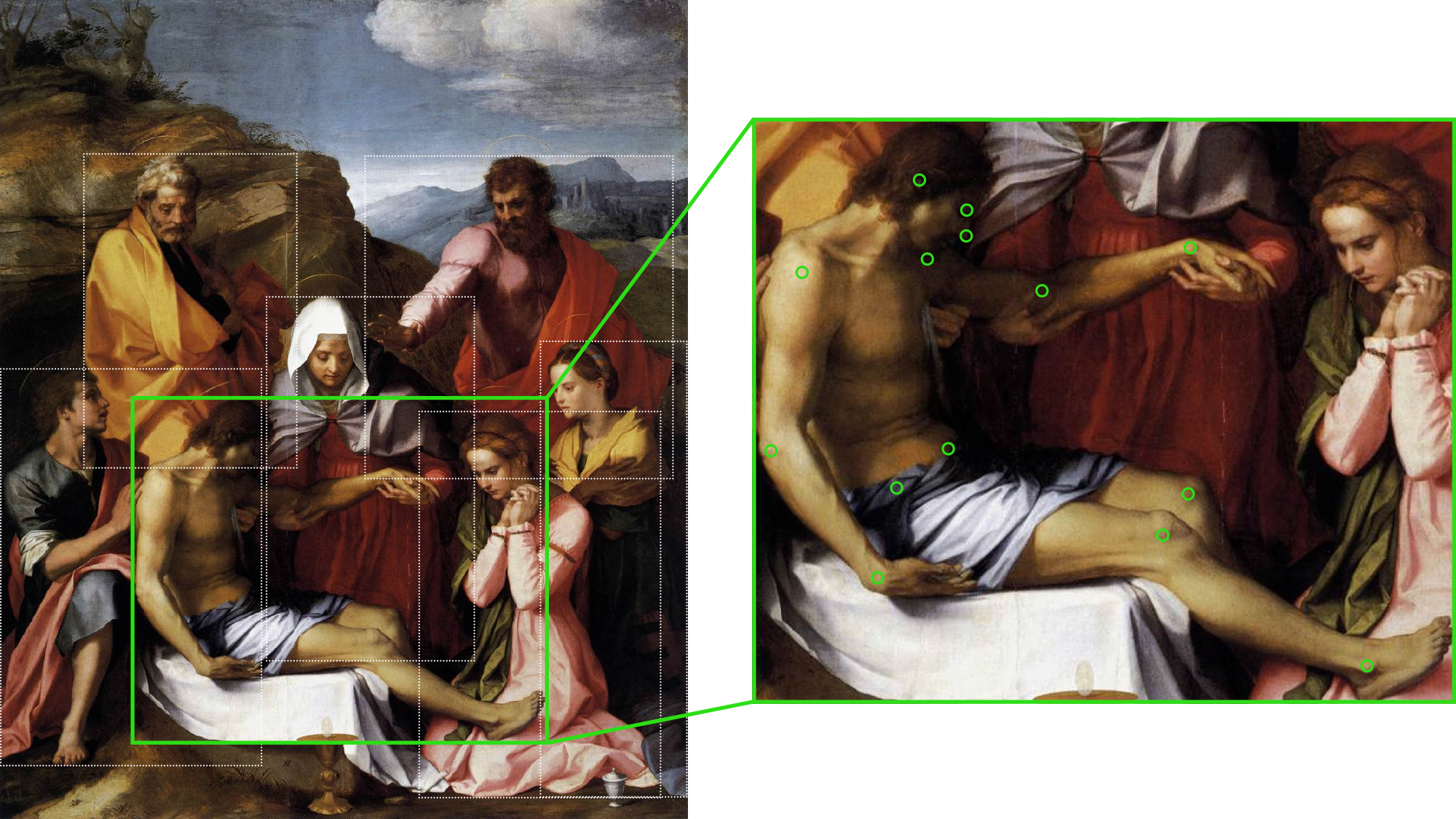
keypoints (Figure 1), that resemble Marey’s metal buttons, to
create a vector representation,
embedding, of the human skeleton,
which is then utilized to
retrieve figures of potential relevance —
with two postures considered similar if they represent variations of the same
action or movement. To this end, we utilize a view-invariant embedding,
following the methodology proposed by [
Liu, T. et al. 2022], that projects
three-dimensional postures onto their two-dimensional counterparts, recognizing
that postures can be visually identical but mathematically distinct, depending
on the observer’s perspective.
Although embeddings derived from neural networks — or more generally:
Deep
Learning (DL) methods — have proven beneficial for various
art-historical retrieval tasks (e.g., [
Ufer et al. 2021]
[
Karjus et al. 2023]
[
Offert and Bell 2023]) by capturing semantically pertinent information
within dense vector spaces, their practical inspection remains underexplored in
scholarly discourse. While previous research has provided the groundwork for
DL-based retrieval, our study narrows the focus by specifically investigating
HPR applications. This leads us to our main research question:
How can the perceptual space of embeddings, obtained by DL models, be explored
and interpreted? What spatial patterns emerge within these spaces, and to what
extent can they encode posture?
Put simply, we determine how DL techniques can be leveraged to systematically
explore the representation of posture. We outline that, in their current state,
such methods can serve as
recommender systems in art-historical
posture analysis, but also in related fields — such as theatre and dance studies
— that critically examine human posture and movement. To this end, we introduce
a two-stage approach of broad-scale filtering preceded by a detailed examination
of individual postures: an aggregate-level analysis of metadata-induced
hotspots, and an individual-level analysis of topic-centered query postures.
Both pipelines are intended, at least in this paper, to reaffirm the embedding
space’s usefulness in art-historical research, rather than to discover novel
art-historical knowledge. Our study, therefore, is designed to synthesize DL
methods into a unified workflow, easily adaptable to other disciplines, enabling
scholars to potentially trace the evolution of posture in art-historical
objects, allowing a thorough exploration of their
“underlying psychic
structures” [
Butterfield-Rosen_2021, p. 21]. As a concrete example, our case
study focuses on depictions of the crucified. These depictions, while globally
diverse, often adhere to a
“canonical” form that exhibits little variation
over time — characterized by specific positions of Christ’s head and the arch of
his torso — making them an ideal subject for testing the validity and
transferability of DL-based posture analysis that is accessible even to
non-experts in the field.
Methodologically, the paper thus contributes to the field of
Digital Art
History (DAH), which has grown considerably since Johanna Drucker in
2013 criticized the delayed advent of computational methods for art-historical
inquiry, despite the increasing availability of suitable data in online
repositories [
Drucker 2013]. Section 2 first discusses related
work. In Section 3, we introduce our proposed methodology that processes images
of human figures into a machine-readable format. This involves first abstracting
the figures’ postures into skeletal representations and then converting these
into robust, view-invariant posture embeddings suitable for retrieval and
classification tasks. Section 4 elaborates on the data set used for interaction
with and exploration of the embedding space during the case study’s inference
phase. The case study itself is detailed in Section 5 and extensively discussed
in Section 6. The paper concludes with Section 7, which summarizes the findings
and discusses future research directions.
2. Related Work
Art-historical research has emphasized the analysis of gesture, a semantically
charged sub-category of bodily movement, over posture — influenced by the
Renaissance’s re-invigoration of scholarly rhetoric [
Zimmerman 2011, p. 179].
For instance, Ernst Gombrich in 1966 suggested that gestures in the visual arts
originate from natural human expressions that have been ritualized, thus
acquiring unique forms and meanings [
Gombrich 1966]. In
particular, Warburg’s concept of
Pathosformeln
contributed significantly to the discourse: by identifying formally stable
gestures from antiquity that were in the Renaissance repeatedly employed to
express primal emotions [
Warburg 1998]. Nevertheless, Emmelyn
Butterfield-Rosen advocates for posture as a
“more useful category” for
exploring
“permanent, underlying psychic structures” [
Butterfield-Rosen_2021, p. 21]. Already in the early 20th century, the Finnish art historian Johan Jakob
Tikkanen proposed a typology of leg postures as
“cultural motifs” in the visual
arts [
Tikkanen 1912]; these motifs, according to Tikkanen, have
evolving functions that may be traced through European art from antiquity to
modernity. Despite, or perhaps because of, Tikkanen’s own admission of the
typology’s limitations and his insistence on a multidisciplinary approach to
better understand the evolution of motifs, his work has remained largely
unrecognized in academic discourse, often relegated to the footnotes (see, e.g.,
[
Steinberg 2018, p. 200] [
Butterfield-Rosen_2021, p. 279]).
In response, recent efforts have employed digital methods to the large-scale
investigation of art-historical posture. Yet, the adoption of HPE methods
remains limited: on the one hand, due to significant variations in human
morphology between artistic depictions and real-world photography, and, on the
other hand, due to the absence of domain-specific, annotated data required to
train neural networks. Predominantly, existing approaches [
Impett and Süsstrunk 2016] [
Jenícek and Chum 2019] [
Madhu_2020] [
Zhao, Salah, and Salah 2022] therefore utilize models trained on real-world photographs without
integrating art-historical material. Only recently, [
Springstein et al. 2022]
and [
Madhu et al. 2023] have begun to refine model accuracy by fine-tuning with
domain-specific images — an approach we also leverage in this paper. To then
assess how similar these machine-abstracted postures are to every other posture
in a data set,
low-level approaches obtain scores directly from
keypoint positions (or angles) using numerical similarity metrics [
Kovar, Gleicher, and Pighin 2002] [
Pehlivan and Duygulu 2011]. However, as
morphological or perceptual features cause variations in keypoint positions [
Harada et al. 2004]
[
So and Baciu 2005], which may affect the reliability of similarity metrics
even between identical postures,
high-level approaches have begun
to exploit the latent layers of neural networks [
Rhodin, Salzmann, and Fua 2018]
[
Ren et al. 2020]. Given the task-specific nature of these latent
representations, [
Liu, J. et al. 2021] suggest normalized posture features
that are invariant to morphological structure and viewpoint; however, the method
relies on fully estimated postures without missing keypoints. Following the
strategy of [
Liu, T. et al. 2022], called
Probabilistic View-invariant
Pose Embedding (Pr-VIPE), we instead propose a solution that is not
only robust to occlusion,
[3] but also easily adaptable to various domains.
3. Methodology
The proposed methodology transforms images of human figures into a
machine-readable format by first simplifying their postures into skeletal
representations. These skeletal models eliminate non-essential visual
information — such as background scenery and clothing — so that only the body’s
posture is retained. Each posture is then numerically encoded as an array of
real numbers, referred to as an embedding, which compresses
postural specifics and enables similar postures to be retrieved across a large
collection of artworks. Consequently, the embedding represents a distilled
version of the original figure, while the embedding space constitutes a
virtual space of possibilities, i.e., of all conceivable
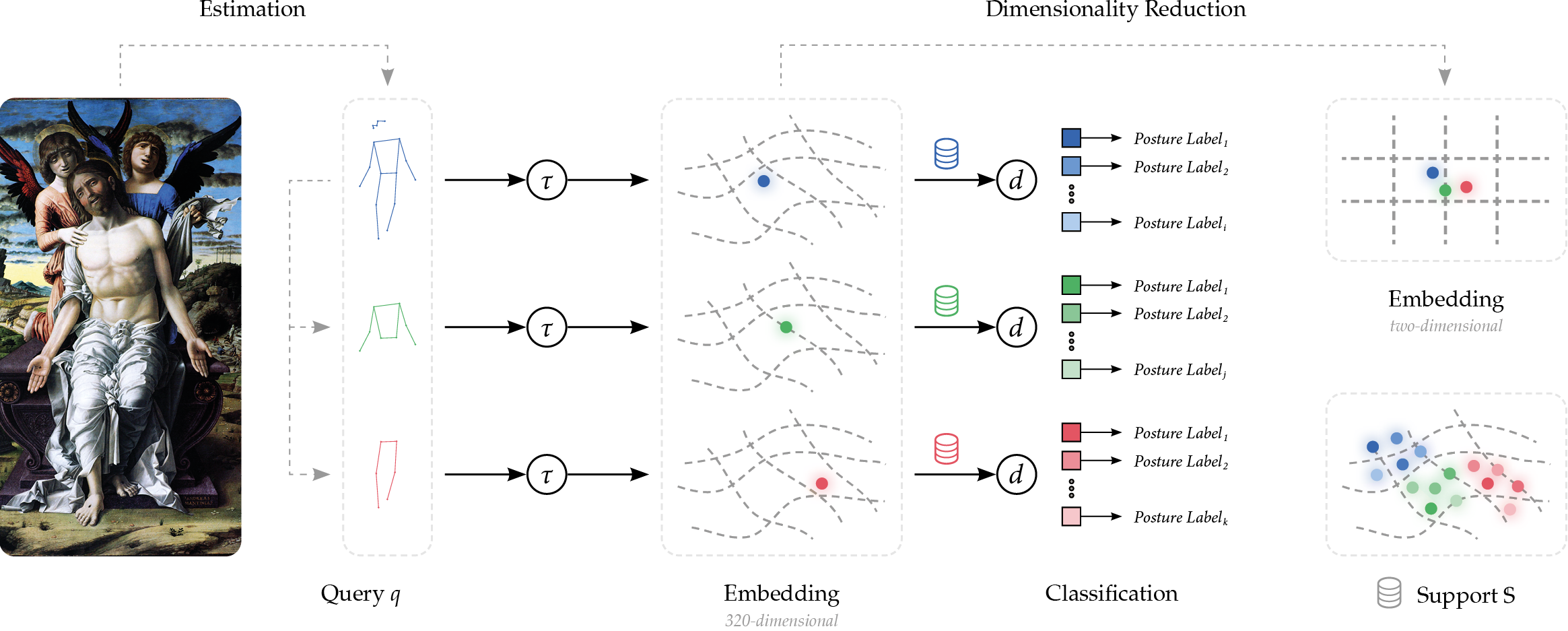
postures. The overall architecture of this pipeline is shown in Figure 2.
3.1. View-invariant Human Posture Embedding
To make posture recognition more accurate, we follow an approach inspired by
[
Springstein et al. 2022] that integrates
Semi-supervised
Learning (SSL). This means that our system learns from both
labeled and unlabeled images, allowing it to improve over time by generating
its own training data. We implement the regression-based
Pose
Recognition Transformer (PRTR), as outlined by [
Li et al. 2021], which employs a cascaded Transformer architecture
with separate components for bounding box and keypoint detection [
Vaswani et al. 2017]
[
Carion et al. 2020].
[4] The
proposed methodology for HPE thus leverages a
top-down
strategy: In the first stage, human figures are localized within an
image by rectangular bounding boxes, which are then examined in the second
stage to identify keypoints, i.e., points relevant to the abstraction of the
figures’ posture.
The estimated whole-body posture is segregated into the upper and lower body,
shown in green and red, respectively, in Figure 3; these components, along
with the whole body, then comprise the search query employed for retrieval
purposes. The lower body is composed of six keypoints (ankles, knees, hip)
and the upper body of eight keypoints (hip, wrists, elbows, shoulders). This
division increases the reliability of the system: Even if the whole-body
posture cannot be detected (e.g., due to missing or obscured joints), the
upper and lower body may still provide enough information to accurately
classify the figure. In the next step, configurations exceeding 50% of the
maximum possible keypoints are filtered to eliminate configurations with
high uncertainty. Valid configurations are then projected into
320-dimensional embeddings using the Pr-VIPE proposed by [
Liu, T. et al. 2022].
[5]
Unlike methods that depend solely on keypoint positions, Pr-VIPE encodes the
appearance of a posture — as perceived by humans — so that it remains robust
to changes in perspective, allowing similar postures to be compared across
different viewpoints. It does so by mapping each two-dimensional posture
into a probabilistic embedding space where the representation is not a fixed
point, but a probability distribution. During training, the system is
exposed to pairs of two-dimensional postures obtained from different camera
views, often augmented by synthesizing multi-view projections from
three-dimensional keypoints. The learning objective encourages the
embeddings of postures that are visually similar (i.e., represent the same
underlying three-dimensional posture) to be close to each other in the
probabilistic space — even if there are perspective-induced variations in
the two-dimensional keypoint positions.
[6]
3.2. One-shot Human Posture Classification
To classify postures, the pipeline is as follows: We first manually identify
110 art-historical images with reference postures of human figures and label
them with keypoints. We then re-use the Pr-VIPE and compute the cosine
distances between the embeddings, associating each query to the closest
matching reference posture(s). This allows a fine-grained indexing of
postures, even when the body parts of each configuration could not be
adequately estimated. At the same time, there is no fixed, semantically
dubious categorization into groups, as is the case with agglomerative
clustering methods [
Impett and Süsstrunk 2016]. However, as shown in
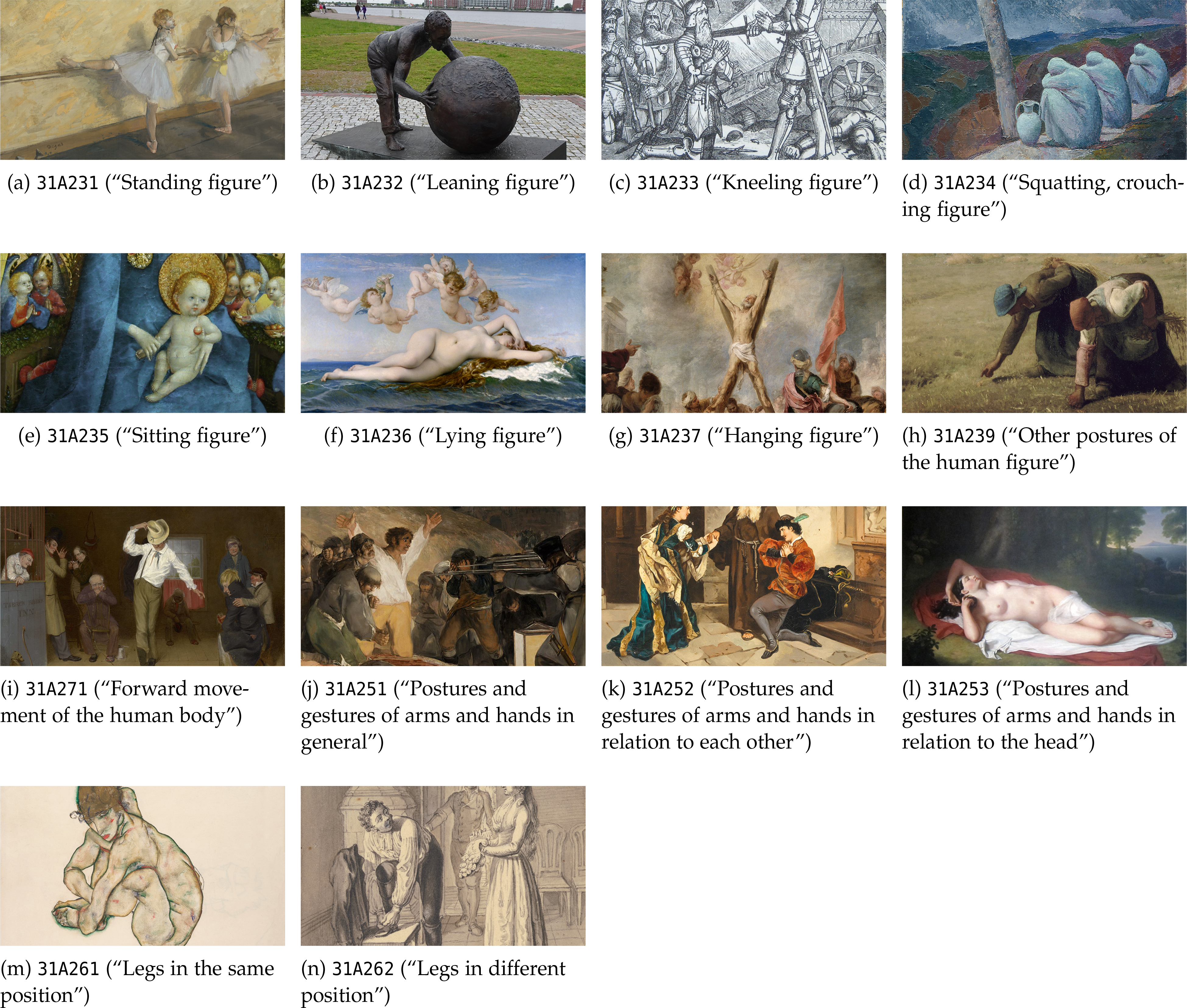
Figure 3, where example images of the reference postures are shown, a single
human figure can only model a fraction of the high postural variability
within the subnotations.
The selected postures, derived from the Iconclass taxonomy [
van de Waal 1973], range from elementary configurations, such as
“arm raised upward,” to
complex full-body arrangements, such as
“lying on one side, stretched out,”
reducing the limitations of culturally or temporally dependent labels.
Iconclass, while explicitly designed for the iconography of Western fine
art, also includes universal definitions ranging from natural phenomena to
anatomical specifics, the latter of which are pertinent not only to our
research but also potentially beneficial for scholarly investigations into
human anatomy across various disciplines, such as dance studies. Each
definition within the Iconclass taxonomy is represented by a unique
combination of alphanumeric characters, referred to as the ‘notation,’ and a
description, the ‘textual correlate,’ accompanied by a set of keywords. A
notation consists of at least one digit symbolizing the first level of the
hierarchy, ‘division.’ This may be followed by another digit at the
secondary level, and one or two (identical) capital letters at the tertiary
level. The structure, referred to as the ‘basic notation,’ can be further
supplemented with auxiliary components [
van Straten 1994]. We
consider four groups of Iconclass notations: notation
31A23 (textual
correlate
“postures of the human figure”),
31A25 (
“postures and gestures of
the arms and hands”),
31A26 (
“postures of the legs”), and
31A27 (
“movements
of the human body”). Notations
31A23 and
31A27 represent the whole body,
31A25 the upper body, and
31A26 the lower body. Each group is almost equally
represented: upper-body notations with 31 instances, lower-body notations
with 25, and whole-body notations with 27 each.
4. Data Set
Using the Wikidata SPARQL endpoint,
[7] we extract 644,155 art-historical
objects classified as either
“visual artwork” (Wikidata item
Q4502142) or
“artwork series” (
Q15709879) that have a two-dimensional image.
[8] For
these objects, our model identifies 9,694,248 human figures, which are — after
the filtering stage — reduced to 2,355,592 figures.
[9] Wikidata was chosen primarily for practical reasons: It surpasses
other art-related databases that are limited by institutional and regional
focus, like that of the Metropolitan Museum of Art. Moreover, unlike distributed
image archives such as Europeana,
[10] where considerable effort is
required to filter out reproductions of the same original, Wikidata is
continuously updated, reducing the number of near-duplicates and thus increasing
the reliability of the data.
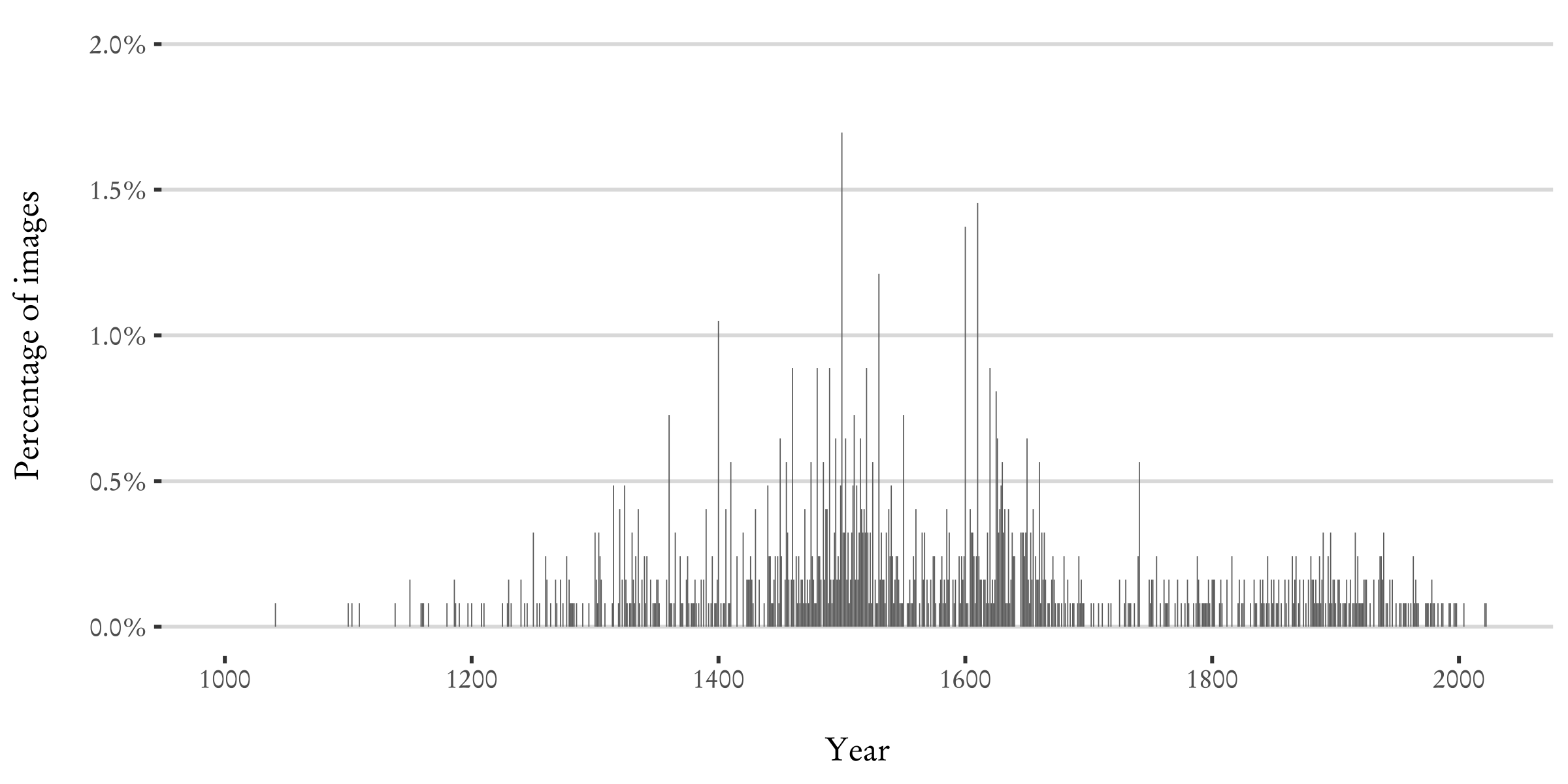
We determine the objects’ creation dates based on the earliest probable date and
ending with the latest. As shown in Figure 4a, using only the starting point of
the interval causes many data points to converge around the turn of the
centuries, leading to an inaccurate peak in the number of objects. To overcome
this, we employ bootstrapping: For the 71.9% of objects with defined time
intervals, we randomly select a point within the time interval over
50 iterations and calculate the average number of objects per time point. This
method is valuable for all types of objects that are dated by time intervals, as
is common in historical research. In addition, it enables the creation of
so-called confidence intervals, which reflect the natural
uncertainty in the dating of historical objects. The result, as shown in
Figure 4b, provides a better understanding of the potential density of objects
in different time periods: There is a continuous increase in the number of
objects after 1400, with isolated peaks around 1500 and 1650. More dominant
peaks appear only around 1900, with a pronounced one between 1935 and 1940,
largely due to the collecting activities of the National Gallery of Art that is
featured prominently in Wikidata.
Filtering the Wikidata data set for the term “crucifix” and its French and German
translations yields a subset of 1,516 objects for the case study (Figure 7 in
Appendix A). Most of these objects are labeled as paintings (65.1%), prints
(6.3%), or sculptures (4.4%), with crucifixes themselves accounting for 4.2%.
Featured are works from artists such as El Greco (1541–1614; 33 objects),
Anthony van Dyck (1599–1641; 19 objects), and Lucas Cranach the Elder
(1472–1553; 17 objects); 32.7% of the objects are without attribution. Of
course, not all human figures depicted in these metadata-selected objects are
crucified, as we filter solely for terms related to crucifixion scenes, not for
figures depicted as crucified.
5. Case Study
In the following, we outline two analytical pipelines for exploring the
constructed embedding space as a virtual space of possibilities: a
distant viewing focused on an aggregate-level analysis of
metadata-induced hotspots, and a close viewing focused on an
individual-level analysis of topic-centered query postures.
5.1. Analytical Process
The first pipeline entails filtering objects based on their metadata, in
particular the Wikidata “depicts” property (P180) and labels in English,
French, and German. Objects containing any of the query terms are selected
and then analyzed for their spatial position within the embedding space to
identify density structures — the metadata-induced density peaks are thus
utilized for the distant viewing of objects whose postures
closely resemble those pre-selected by the metadata. Each point in the
embedding space denotes a unique posture, with density referring to how
these points are grouped — either clustering in high-density areas or
scattering in low-density regions. The second pipeline is predicated on the
density peaks identified at the aggregate level; it focuses on the
recognition and exploitation of individual postures associated with specific
iconographies, thus enabling a posture-to-posture search. This
involves a close viewing of objects that are visually related
to the identified query postures; it also explores the developmental
trajectories of different postures within the embedding space to trace the
‘evolution’ of iconographic elements.
Our case study examines the variability in the representation of the
crucified. It focuses specifically on the depiction of the crucified Christ,
excluding accompanying figures traditionally portrayed at the cross’s base,
such as Mary and Christ’s disciples — especially the apostle John. Although
depictions of the crucified Christ vary widely throughout the world,
influenced by local and ethnic traditions, they are generally unified by a
“canonical” form:
“dead upon the Cross, Jesus’s head is slung to
one side, typically our left; his torso is naked and upright, sometimes
slightly arched” [
Merback 2001, p. 69].Variations in the positioning of Christ’s limbs are subtly evident in
different artistic traditions: Gothic crucifixes, for instance, show Christ
in a dynamic, bent position, with legs thrust forward and knees spread [
Brandmair 2015, p. 100], while in Italian iconography,
Christ is often depicted with upward-angled arms, his head slumped on his
chest, with varying leg positions to represent the deceased body’s movement
[
Haussherr 1971, p. 50].
To conduct a qualitative analysis, the embedding spaces of the embeddings are
reduced from 320 to two dimensions. Traditional dimension reduction
techniques such as
t-distributed Stochastic Neighbor Embedding
(t-SNE) [
van der Maaten and Hinton 2008],
Uniform Manifold
Approximation and Projection (UMAP) [
McInnes 2018], and their variants (e.g., [
Im, Verma, and Branson 2018]
[
Linderman et al. 2019]) are known to preserve either local or
global spatial relationships, which can result in the formation of
artificial clusters that are not present in the original data.
[11] To overcome this limitation, we employ
Pairwise Controlled Manifold Approximation (PaCMAP), which
first identifies global structures and then refines them locally [
Wang et al. 2021]. We re-use the Pr-VIPE model checkpoints from [
Liu, T. et al. 2022].
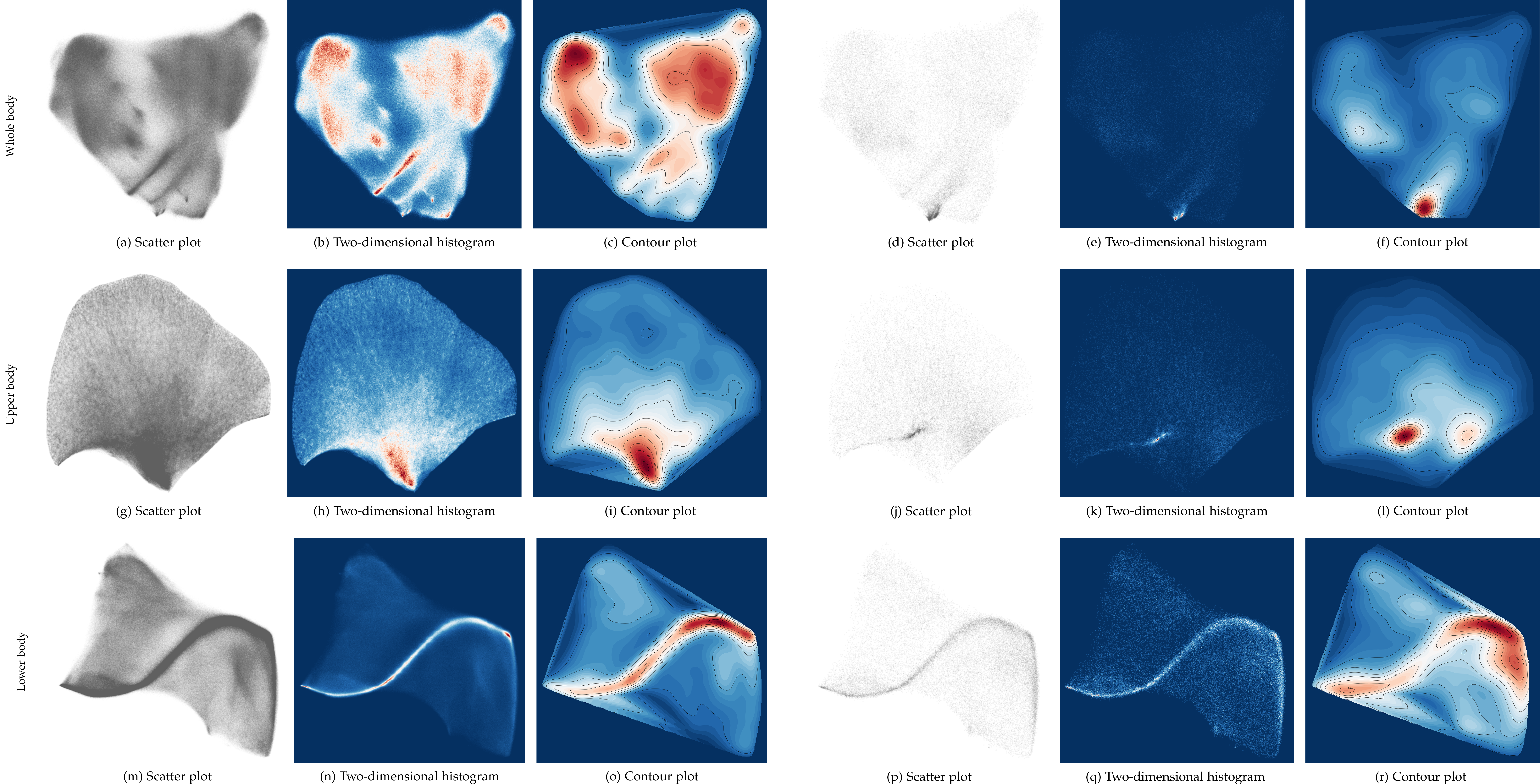
[12] To analyze the density structure of
the embedding spaces, and thus the
virtual space of
possibilities, we employ three visualization techniques: scatter
plots, two-dimensional histograms, and contour plots (Figure 5). Both
histograms and contour plots employ a color gradient ranging from blue
(denoting lower concentrations) to red (denoting higher concentrations),
with white signifying the midpoint. Contour plots are often favorable
because of their superior ability to discern isolated high-density areas
clearly; however, smaller, less dense regions are more reliably identified
in two-dimensional histograms. Further details of the techniques are given
in Appendix B.
5.2. Aggregate Level
The embedding space is structured so that similar postures are grouped
closely together. This proximity implies that finding a posture in a
particular region of the embedding space generally means that another
similar posture can be found nearby — hence, semantic groups of postures
typically cluster, providing a structured approach to efficient retrieval
based on these spatial concentrations, as will be discussed in the
following. In each case, our analysis begins with an examination of the
embedding spaces for all images to establish a baseline understanding. We
then narrow our focus to compare these embedding spaces with those
containing only crucifixion scenes, in order to determine how particular
thematic elements influence the spatial organization within the
embedding.
5.2.1. Whole-body posture embedding
The distribution within the two-dimensional whole-body posture embedding
space of all images is characterized by a significant concentration in
the upper-left quadrant, with density gradually decreasing towards the
southern regions (Figures 5a, b, and c). The upper-right quadrant, while
also densely populated, features a slightly downward-shifted center of
density, aligning it more centrally within the embedding space; it
mostly features postures in which the upper arms or thighs are
perpendicular to the upper body. In contrast, postures with nearly
extended arms or legs dominate the middle-lower quadrant, exemplified by
notation 31A2363 (“Lying on one side, stretched out”).
In addition, manual inspection of the whole-body embedding space reveals
two primary cluster-like formations that correspond mainly to specific
configurations of the upper and lower body — which is noteworthy given
that we are not focusing here on the upper-body and lower-body
embeddings. In the lower segment, we identify figures classified with
subnotations under 31AA2511 (“Arm raised upward – AA – both arms or
hands”), including T- or Y-shaped crucified ones in the lower-central area (31A237,
“Hanging figure”). Those stretching sideways or backwards are centered
with a downward tilt, mapped to the subnotations 31A2513 (“Arm stretched
sidewards”) and 31A2514 (“Arm held backwards”). The upper-left segment
is dominated by configurations of the lower body. For instance, the
standing figure with straight legs is prominent in the upper left,
identified as 31A26111 (“Standing or leaning with both legs straight,
side by side, feet flat on the ground”); she is usually depicted with
her arms held down. A third segment in the upper-right quadrant features
postures with bent limbs that is particularly difficult to capture
semantically; it includes the subnotations 31A234 (“Squatting, crouching
figure”) and 31A235 (“Sitting figure”). The center’s less dense regions
frequently show errors in HPE that cannot be meaningfully
classified.
In the crucifixion’s embeddings, a compact hotspot is centrally situated
at the bottom, indicating specific posture configurations that differ
substantially from other configurations in the data set, with lesser
populated zones in the remaining embedding space, as evident in
Figures 5d, e, and f. The sparsity of data in other areas is primarily
related to objects associated with terms relevant to crucifixion scenes,
as opposed to crucified figures themselves; naturally, not all human
figures depicted in the metadata-selected objects are crucified, given
the large number of figures involved in these scenarios. The utility of
hotspot post-filtering becomes apparent when comparing the postures in
images labeled with “crucifix” to those labeled and within the hotspot
located at the central bottom. Notable are Iconclass notations with a
clear emphasis on upper-body positions, such as 31A2364 (“Lying on one
side, with uplifted upper part of the body and leaning on the arm”) and
31A23711 (“Hanging by one arm”).
5.2.2. Upper-body posture embedding
In the two-dimensional upper-body posture embedding space, we observe a
singular high-density region towards the lower center (Figures 5g, h,
and i). This area, with its circular shape, implies a central group of
similar upper-body postures in the data set. Elsewhere, the embedding
space exhibits a gradient of posture densities with no other significant
hotspots, suggesting a more dispersed representation of upper-body
postures; this pattern is likely due to the limited number of eight
keypoints used in the embedding, which reduces the variation between
postures. The lower center of the embedding space contains mostly
postures with one arm bent in front of or behind the body.
[13] In the lower-left quadrant,
postures often feature an arm bent upwards, as indicated by notation
31A2513 (
“Arm stretched sidewards”).
The distinct posture of the crucified — with arms outstretched sidewards
— is validated in the two-dimensional upper-body posture embedding space
by a small, elongated high-density area in the lower central region
(Figures 5j, k, and l). This area corresponds with the high-density
region of the notation 31AA2513 (“Arm stretched sidewards – AA – both
arms or hands”). When examining the distribution of the upper-body
similarities, there are only slight variations between images labeled
“crucifix” and the data set’s remainder, due to the large spread of
points in the embedding space. Yet, differences are evident when
considering dominant Iconclass notations compared to the general
population: Notations such as 31A2531 (“Hand(s) bent towards the head”)
and 31AA2514 (“Arm held backwards – AA – both arms or hands”) have
notably higher similarity values in the metadata- and hotspot-filtered
subset.
5.2.3. Lower-body posture embedding
The configuration of hotspots in the lower-body posture embedding space
of all images is mostly elongated and narrow, suggesting a linear
progression of posture similarities (Figures 5m, n, and o). The contour
lines in the lower-body posture embedding follow a sinusoidal pattern,
with pronounced peaks and valleys — maybe reflecting an inherent data
structure where certain lower-body positions are more common, and others
less so. The lower-right quadrant of the embedding space is dominated by
postures with straight or slightly bent legs. In contrast, the
upper-left quadrant mostly features postures with more significantly
bent legs, encompassing squatting and various sitting positions, such as
notation 31A26123 (“Squatting with legs side by side”).
Subtle but discernible shifts compared to the density structure of the
overall data set are observed in the crucifixion’s lower-body embedding
only at the sinusoidal pattern’s edges, particularly in the central left
and right quadrants, with a slight downward extension in the right
quadrant (Figures 5p, q, and r). The infrequency of leg positions that
uniquely denote crucified figures, as evidenced by the rarity of
hotspots, confirms the lack of specific leg configurations in these
depictions, which often resemble normal standing positions with slightly
bent legs. This absence of specific configurations in the iconography
compared to the broader data set is further accentuated when assessing
lower-body posture similarities: There are extensive overlaps between
the Iconclass notations, like those of the upper-body similarity
distributions.
5.3. Individual Level
In the second pipeline, our approach departs from the broad analysis of
metadata-induced hotspots and instead focuses on the in-depth study of
individual artworks and their comparative analysis based on the generated
embeddings. To this end, we implement an approximate
k-nearest neighbor graph,
Hierarchical Navigable Small
World (HNSW) [
Malkov_2020], which
contains the 320-dimensional embeddings of the whole body, upper body, and
lower body. To illustrate its practical application, we examine James
Tissot’s
The Strike of the Lance (1886–1894)
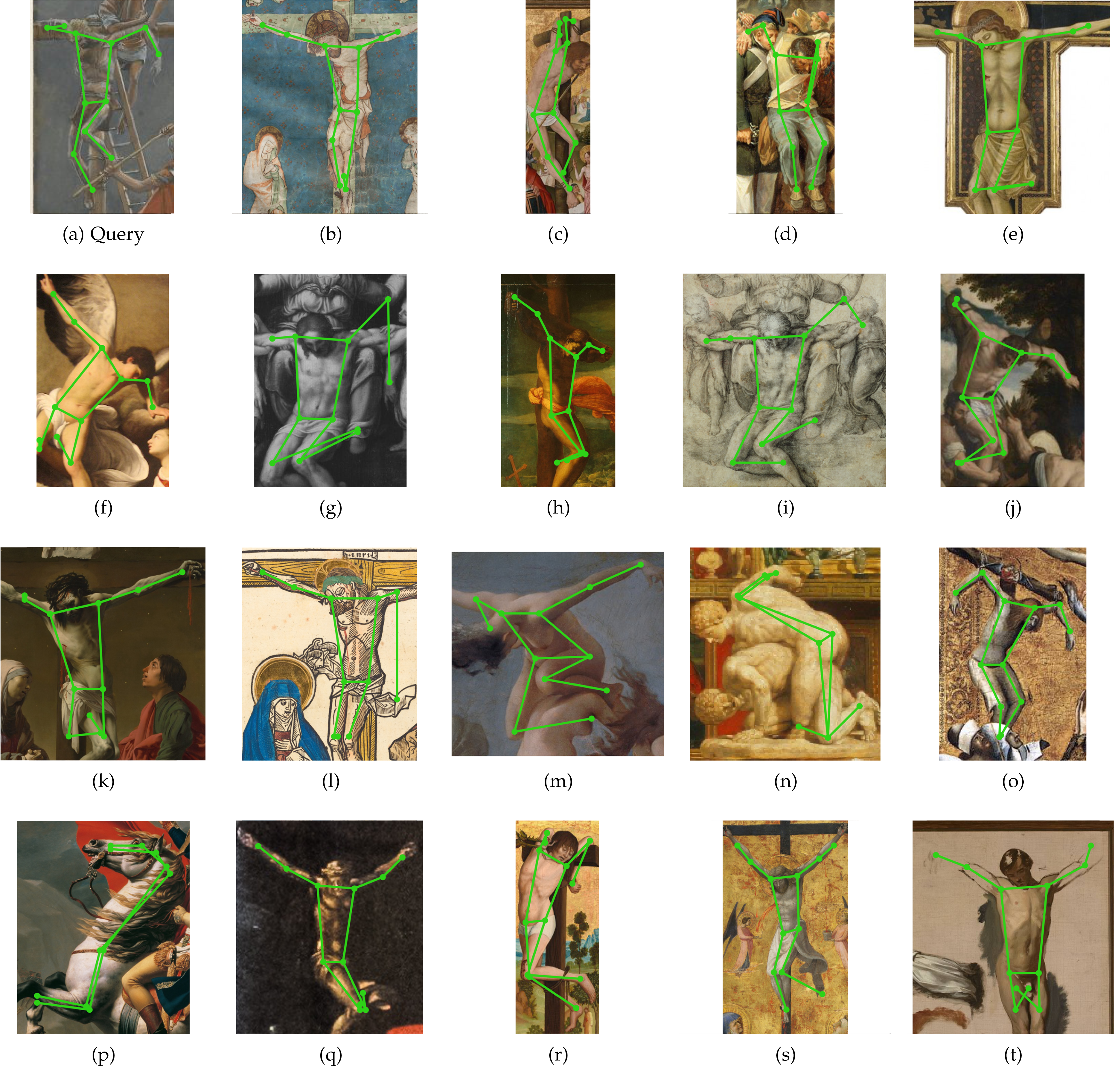
and more specifically, the thief crucified to Christ’s right (Figure 6a). As
shown in Figure 6, the thief’s bent arm is echoed in the Pietà, for instance
in a rendition after Marcello Venusti (c. 1515–1579; Figure 6g), where Mary
is portrayed mourning her son. Interestingly, the horse’s upright stance in
Jacques Louis David’s
Napoleon on the Great St
Bernard (1801; Figure 6p) is mistakenly recognized as a human
figure — with outstretched arms and bent legs — echoing the thief’s posture;
this error results from imprecise bounding box detection, which frequently
misclassifies animals with human-like physiognomies as human figures.
Misalignments of the lower body are evident also in works such as Perino del
Vaga’s
A Fragment: The Good Thief (Saint Dismas)
(c. 1520–1525; Figure 6h), Hendrick ter Brugghen’s
The
Crucifixion with the Virgin and St John (1625; Figure 6k), and Jan
de Hoey’s
Ignatius of Loyola (c. 1601–1700;
Figure 6r), primarily with inaccurately shortened ankles, which also trace
back to limitations in bounding box detection. Despite these issues, minor
inaccuracies, such as the misestimation of the left wrist in Figure 6l, seem
to not affect the retrieval performance. The degree of keypoint
misestimation is proportional to its effect on the generated feature vector,
which is essential for accurate retrieval. Even when keypoints are grossly
misestimated, as shown in Figure 6l, the model only marginally penalizes
these errors in the resulting embedding, provided that the majority of
keypoints are estimated with sufficient accuracy.
To understand the evolution of iconographies in art history — here: the
postural configurations in crucifixion scenes — it is essential to analyze
both the posture and its temporal distribution. This involves, in
crucifixion scenes, distinguishing between
T- and
Y-shaped upper-body postures that depend on the arms’
position on the cross. To assess the Pr-VIPE’s ability to differentiate
between such configurations, we first select three crucifixion depictions
from Wikidata: Marcello Venusti’s
Christ on the
Cross (1500–1625), in
T-shape, with arms
outstretched horizontally;
[14] Diego Velazquez’s
Christ
Crucified (1632), in weak
Y-shape, with
arms slightly upraised;
[15] and Peter Paul Rubens’
Christ Expiring on the Cross (1619), in strong
Y-shape, with arms strongly raised.
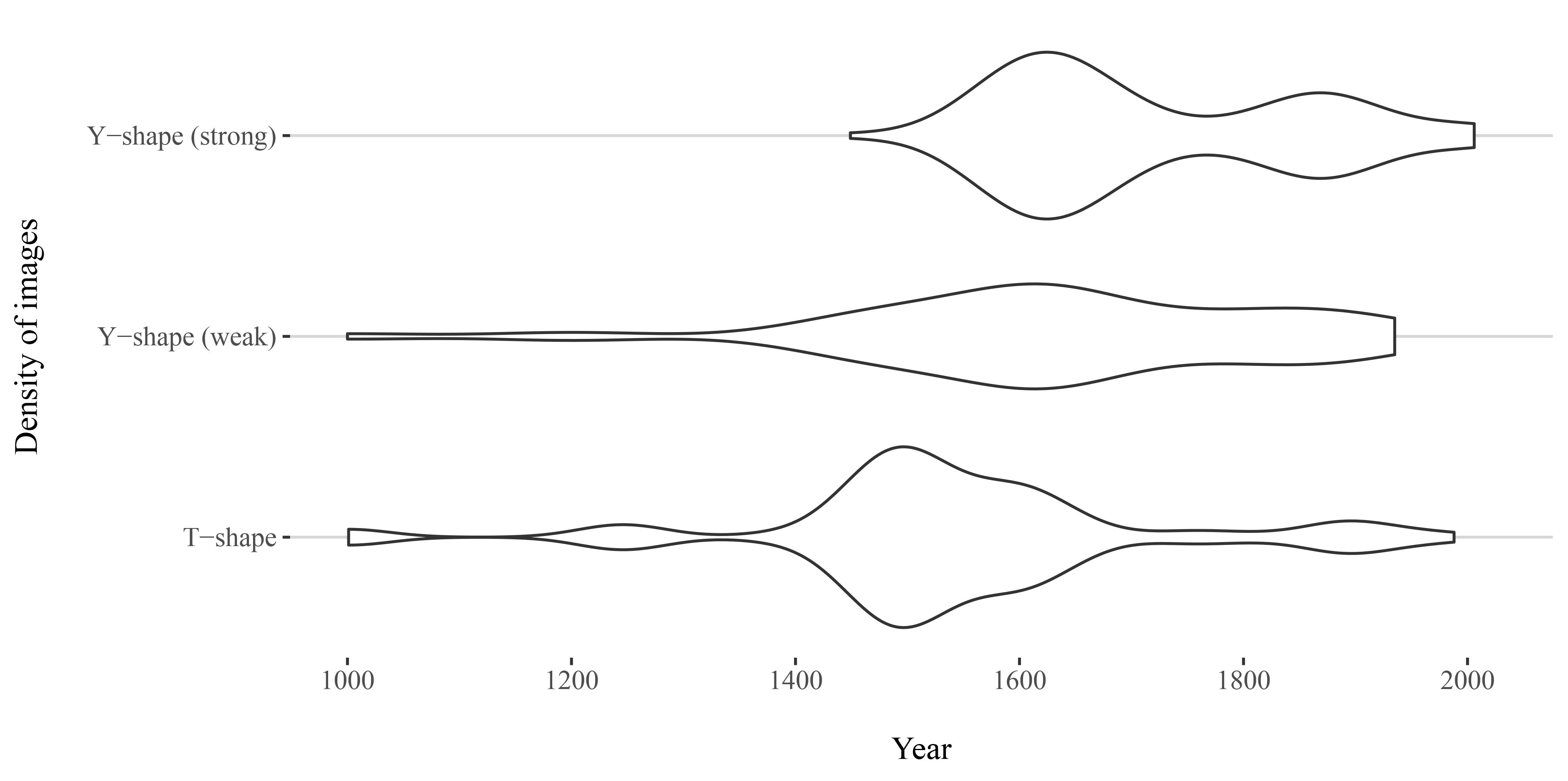
[16] That is, each image served as a query to
identify the top 100 similar Wikidata object entities based on their
upper-body similarity. Analysis of the bootstrapped distribution of creation
dates then shows that
T-shapes start increasing
around 1200, peak sharply around 1400, and then gradually decrease, with
another smaller peak around 1800, while
Y-shaped
figures have a more widespread, uniform distribution between 1400 and 1900 —
in case of weak
Y-shapes, without notable peaks
(Figure 8 in Appendix A). The evolution of the shapes can be also observed
clearly in the contour plot of the two-dimensional upper-body posture
embedding. Naturally,
T- or slightly
Y-shaped figures, with their symmetrically
outstretched arms, are most often associated with crucifixions, whereas the
upward curvature of stronger
Y-shapes appears in a
wider range of contexts, including depictions of ascension and resurrection
that imply spiritual elevation, such as the putti in Rembrandt’s
The Ascension (1636). This variation in upper-body
posture is also reflected in the artworks’ temporal distribution: Strong
Y-shapes occur mostly around 1600, with another
notable peak around 1900, and are rarely found before 1400. The Pr-VIPE’s
ability to distinguish these postures suggests its effectiveness in
identifying both the physical configurations and, on closer historical
inspection, the underlying symbolic meanings. This evidence suggests
potential verifiable patterns in the representation of different upper-body
forms across historical periods, although conclusive historical evidence
remains to be established.
6. Discussions
In contrast to previous approaches that compute how similar two postures are
based solely on the positions or angles of two-dimensional keypoints [
Kovar, Gleicher, and Pighin 2002] [
Pehlivan and Duygulu 2011], our three-step HPR
pipeline integrates the relational context between joint positions by encoding
them in 320-dimensional view-invariant embeddings. Qualitative experiments on a
data set of 644,155 Wikidata object entities confirm the method’s validity: They
reveal dense clusters in the two-dimensional embedding spaces corresponding to
the 110 manually selected reference postures derived from Iconclass. These
findings demonstrate the system’s ability to detect clusters of similar postures
in the context to their artistic expression. Although some inaccuracies — mainly
due to bounding box detection limitations — are observed, these errors in
individual joint estimates do not significantly affect retrieval performance. As
shown, at the aggregate level, certain posture configurations are identified as
compact hotspots that differ from other, more common postures in the Wikidata
within the embedding space. However, while it is possible to interpret the
embedding space from a historical perspective, the methodology at the aggregate
level, as opposed to the posture-to-posture search at the individual level,
differs markedly from traditional historical research, with the reliance on
metadata-induced density peaks being intuitive to statisticians, but highly
unconventional to art historians.
It is therefore of utmost importance to emphasize that HPR is designed to support
knowledge generation, rather than to directly ‘produce’ knowledge — as evidenced
by the
T- and
Y-shaped upper-body
configurations of the crucifixion scenes, which may spotlight historically
significant conjunctions. DL models can identify areas that may contain evidence
or knowledge, but these need to be validated, at least by random sampling;
without integrated close viewing, computational analysis cannot be taken as
conclusive evidence or knowledge unless DL models independently provide a
historically plausible interpretation of their results — a capability yet to be
achieved. They, at least currently, can serve only as
recommender
systems, provided they achieve high accuracy, as our research has
shown. Still, the utility of computational methods in humanities research should
not be underestimated: They allow researchers to quickly navigate and reduce
large data sets to tractable sizes, making possible studies that would otherwise
be logistically unfeasible due to the sheer volume of the data involved.
[17] To fully
realize the potential of these methods, we consider a hybrid approach that
combines traditional scholarly expertise with computational techniques to be
essential. Such integration could enrich the interpretive possibilities of
data-driven inquiries into the past and facilitate a more nuanced understanding
of cultural heritage, revealing previously overlooked or misinterpreted
connections between objects. Thus, while computational analysis is neither
infallible nor standalone, it does represent a significant advance in the
toolkit of humanities researchers, providing them with unprecedented analytical
capabilities — if they know how to utilize them.
However, whether a research question can be effectively pursued using DL methods
also depends heavily on the availability of the study’s objects, similar to
traditional humanities research where the identification and collection of
relevant sources, including archival material, is a crucial preliminary step. As
shown in Figure 5, Wikidata primarily features post-1800 artworks, with medieval
art notably underrepresented — a pattern that is common across databases. Since
the true distribution of artworks is not known definitively, reliance on
digitally available repositories might introduce research bias by either under-
or over-representing certain historical periods or artistic styles. At present,
and likely in the future, it is not possible to assemble a data set that
represents the full range of art history — or other historically oriented areas
of visual culture — as many objects have been lost or have not yet been
digitized. Nevertheless, for narrowly defined research questions, it may still
be possible to rely on a manually compiled and thoroughly curated data set, such
as one developed within a specific project. Despite the potential for
large-scale data sets like Wikidata to include works outside the traditional
canon, they may also inadvertently reinforce the canon within the digital
environment. It is therefore essential to critically evaluate the data sets
employed in digital humanities research, especially considering their potential
impact on the results: The skewed focus on more contemporary objects may cause
researchers to overlook or inadequately cover older or lesser-known historical
periods and styles, thereby perpetuating a biased view of art history.
Moreover, the performance of HPE, and by extension HPR, depends fundamentally on
the accuracy of the bounding box detection in the pipeline’s initial stage.
Incorrectly estimated bounding boxes will almost certainly lead to incorrectly
estimated — or even missing — keypoints, which in turn will affect, to a lesser
extent, the embeddings generated from these keypoints. Improving the accuracy of
bounding box detection could mitigate cascading errors in the pipeline, thereby
increasing the reliability of the entire process. As shown by [
Springstein et al. 2022], the solution may not lie in the adoption of progressively newer
models that yield little practical benefit. Instead, optimizing the training
data used to create these models might prove more effective — for instance, by
merging data sets like PoPArt [
Schneider and Vollmer 2023] and
SniffyArt [
Zinnen et al. 2023] to provide a broader range of
posture scenarios and thus enrich the model’s learning environment. However,
increasing model performance depends more on the quality of the data rather than
just its quantity. Investing in well-curated training data sets that feature a
diverse array of human figures, especially those previously underrepresented,
could significantly boost model training (cf., [
Zhao et al. 2024]). [
Springstein et al. 2022] confirm that data sets with thorough,
high-quality domain coverage outperform larger but less diverse alternatives.
Consequently, for studies requiring high visual specificity not represented in
available data sets, a small, manually annotated training data set is still
imperative for achieving high model performance.
It could be argued that relying on a single embedding space provides only a
partial understanding of the underlying structures in high-dimensional data. By
reducing the dimensionality of an originally practically inscrutable latent
space, one inevitably imposes certain modeling assumptions that may obscure or
distort inherent relationships. In addition, the specific parameters employed in
any given dimensionality reduction technique yield divergent visualizations of
the same data, i.e., not all apparent clusters in a two- or three-dimensional
projection necessarily exist in the original high-dimensional space, and points
that appear far apart in the embedded space may actually be close neighbors in
the latent space. However, [
Wang et al. 2021] observed empirically that certain
approaches can maintain more robust structures under parameter variation. Their
sensitivity analysis across multiple datasets — with both known local and global
structures — demonstrates that PaCMAP consistently preserves qualitative
relationships regardless of parameter choice. In the context of our case study,
this finding implies that the semantic positioning of similar postures remains
reproducible and is not merely a product of random chance or overly sensitive
parameters. This level of robustness contrasts with methods such as UMAP [
McInnes 2018], which are more sensitive to parameter
tuning. Ultimately, the decision to employ a particular dimensionality reduction
technique should be made in the context of the research scenario — the data’s
size and the nature of the structures one seeks to preserve — to ensure that any
conclusions drawn from a visual analysis are based on solid empirical ground
rather than the artifacts of a particular algorithm.
7. Conclusion
The analysis of posture has traditionally been marginalized in art-historical
scholarship, prompting the adoption of digital methodologies to re-examine it on
a large scale. In Section 3, we proposed a three-step methodology for this
purpose that leverages whole-body keypoints to differentiate the human body into
upper- and lower-body segments. These segments were first encoded in
320-dimensional Probabilistic View-invariant Pose Embeddings
(Pr-VIPEs). Using these Pr-VIPEs, we then assembled 110 reference postures for
classification purposes. This methodology’s relevance to art-historical research
was validated through qualitative experiments with a data set of
644,155 art-historical Wikidata objects, primarily addressing the following
questions:
How can the perceptual space of embeddings, obtained by Deep
Learning (DL) models, be explored and interpreted? What spatial
patterns emerge within these spaces, and to what extent can they encode
posture?
In this context, Section 4 outlined a two-stage approach of broad-scale filtering
preceded by a detailed examination of individual postures: a distant
viewing focused on an aggregate-level analysis of density-based
hotspots, and a close viewing focused on an individual-level
analysis of query postures. At the aggregate level, certain posture
configurations were identified as compact hotspots that differed from other,
more common postures within the embedding space. Yet, for postures that have
undergone considerable historical evolution, the effectiveness of
metadata-driven pre-filtering diminishes. Here, the individual-level
posture-to-posture search is advantageous because it provides
resilience to minor inaccuracies without significantly affecting the retrieval’s
performance. Moreover, the case study revealed numerous dense clusters in the
two-dimensional embedding spaces, largely corresponding to the reference
postures. It proved the system’s ability to identify hotspots and decipher
connections between object entities, thus expediting cluster identification in
the embedding space — DL models can thus serve effectively as recommender
systems. However, their application must be critically evaluated and
not undertaken without scholarly oversight, as misestimations could raise
concerns among traditional art historians about the trustworthiness of
computational methods. Nevertheless, we argue that even with manual
re-evaluation, the likelihood of encountering works outside the canon increases,
although the reproduction of the canon is, of course, also perpetuated in the
digital space.
In the future, we plan to refine our research pipeline, focusing in particular on
improving the classification process, which currently — due to the limited
number of reference postures — makes it difficult to achieve the granularity
required for complex art-historical inquiries. Although it was shown that the
integration of a reference set can largely align with existing taxonomies of
body-related behavior, it also highlighted the challenges of discriminating
among a large number of postures with high variability. We intend to adopt a
cross-modal retrieval framework, as introduced by [
Delmas et al. 2022], which
integrates two-dimensional keypoints with textual descriptions into a joint
embedding space. By synthesizing these methods into a unified pipeline, we are
for the first time able to trace the evolution of posture on a large scale,
allowing a thorough exploration of their psychic structures. This approach is
not limited to art-historical objects but also holds promise for cultural
heritage objects in a broader sense. For instance, in theatre studies, the
analysis of body postures and movements could facilitate comparative
examinations across different artistic traditions, periods, and conventions.
Appendix B
Scatter plots represent human postures as individual points, which are placed
according to their x and y
coordinates from the reduced two-dimensional embedding. In contrast to scatter
plots, two-dimensional histograms visualize the density of the underlying data
rather than individual points. They partition the embedding space into a fixed
number of bins, here 250, with each bin colored according to the number of
figure postures it contains. Similarly, contour plots visualize the density of
postures on a two-dimensional plane. Much like topographic maps, they connect
points of equal density with contour lines and label each contour with its
corresponding density level. Thus, while contour plots offer an abstract,
continuous representation of density gradients, two-dimensional histograms
provide a segmented, quantitative analysis. Areas of high density may indicate
frequently observed or ‘standard’ postures, whereas regions of low density may
be related to less common postures.
Works Cited
Arnold and Tilton 2019 Arnold, T. and Tilton, L.
(2019)
“Distant viewing. Analyzing large visual
corpora”,
Digital Scholarship in the
Humanities, (34), pp. i3–i16. Available at:
https://doi.org/10.1093/llc/fqz013.
Baxandall 1972 Baxandall, M. (1972) Painting and Experience in 15th Century Italy. A Primer in the
Social History of Pictorial Style. Oxford: Oxford University
Press.
Brandmair 2015 Brandmair, K. (2015) Kruzifixe und Kreuzigungsgruppen aus dem Bereich der
,,Donauschule”. Petersberg: Imhof.
Butterfield-Rosen_2021 Butterfield-Rosen, E. (2021) Modern Art and the Remaking
of Human Disposition. Chicago, IL: University of Chicago
Press.
Carion et al. 2020 Carion, N., Massa, F.,
Synnaeve, G., Usunier, N., Kirillov, A., and Zagoruyko S. (2020)
“End-to-end object detection with transformers”, in
Computer Vision – ECCV 2020. Cham: Springer
(Lecture Notes in Computer Science), pp. 213–229. Available at:
https://doi.org/10.1007/978-3-030-58452-8_13.
Chen and Guestrin 2016 Chen, T. and Guestrin, C.
(2016)
“XGBoost. A scalable tree boosting system”, in
B. Krishnapuram et al. (eds.)
Proceedings of the 22nd ACM
SIGKDD International Conference on Knowledge Discovery and Data
Mining. New York: ACM, pp. 785–794. Available at:
https://doi.org/10.1145/2939672.2939785.
Delmas et al. 2022 Delmas, G., Weinzaepfel, P.,
Lucas, T., Moreno-Noguer, F., and Rogez, G. (2022)
“PoseScript. 3D human poses from natural language”, in S. Avidan et
al. (eds.)
Computer Vision – ECCV 2022 – 17th European
Conference. Cham: Springer (Lecture Notes in Computer Science), pp.
346–362. Available at:
https://doi.org/10.1007/978-3-031-20068-7_20.
Egidi et al. 2000 Egidi, M., Schneider, O.,
Schöning, M., Schütze, I., and Torra-Mattenklott, C. (2000) “Riskante Gesten. Einführung”, in M. Egidi et al. (eds.) Gestik. Figuren des Körpers in Text und Bild, pp.
11–41. Tübingen: Narr (Literatur und Anthropologie, 8).
Elcott 2016 Elcott, N.M. (2016) Artificial Darkness. An Obscure History of Modern Art and
Media. Chicago: University of Chicago Press.
Eriksson 1973 Eriksson, E.S. (1973)
“Distance perception and the ambiguity of visual stimulation. A
theoretical note”,
Perception &
Psychophysics, 13(3), pp. 379–381. Available at:
https://doi.org/10.3758/BF03205789.
Gombrich 1966 Gombrich, E.H. (1966)
“Ritualized gesture and expression in art”, in
Philosophical Transactions of the Royal Society of
London. (B, Biological Sciences), pp. 393–401. Available at:
https://doi.org/10.1098/rstb.1966.0025.
Harada et al. 2004 Harada, T., Taoka, S., Mori,
T., and Sato, T. (2004)
“Quantitative evaluation method for
pose and motion similarity based on human perception”, in
4th IEEE/RAS International Conference on Humanoid Robots,
Humanoids 2004. New York: IEEE, pp. 494–512. Available at:
https://doi.org/10.1109/ICHR.2004.1442140.
Haussherr 1971 Haussherr, R. (1971) Michelangelos Kruzifixus für Vittoria Colonna. Bemerkungen zu
Ikonographie und theologischer Deutung. Opladen: Westdeutscher
Verlag.
Impett and Süsstrunk 2016 Impett, L. and
Süsstrunk, S. (2016)
“Pose and pathosformel in Aby Warburg’s
Bilderatlas”, in G. Hua and H. Jégou (eds.)
Computer Vision – ECCV 2016 Workshops. Cham: Springer (Lecture
Notes in Computer Science), pp. 888–902. Available at:
https://doi.org/10.1007/978-3-319-46604-0_61.
Jenícek and Chum 2019 Jenícek,
T. and Chum, O. (2019)
“Linking art through human
poses”, in
International Conference on Document
Analysis and Recognition, ICDAR 2019. New York: IEEE, pp. 1338–1345.
Available at:
https://doi.org/10.1109/ICDAR.2019.00216.
Karjus et al. 2023 Karjus, A., Solà, M.C., Ohm,
T., Ahnert, S.E., and Schich, M. (2023)
“Compression
ensembles quantify aesthetic complexity and the evolution of visual
art”,
EPJ Data Science, 12(1). Available
at:
https://doi.org/10.1140/EPJDS/S13688-023-00397-3.
Kovar, Gleicher, and Pighin 2002 Kovar, L.,
Gleicher, M. and Pighin, F.H. (2002)
“Motion graphs”,
ACM Transactions on Graphics, 21(3), pp.
473–482. Available at:
https://doi.org/10.1145/566654.566605.
Li et al. 2021 Li, K., Wang, S., Zhang, X., Xu, W.,
and Tu, Z. (2021)
“Pose recognition with cascade
transformers”, in
IEEE Conference on Computer
Vision and Pattern Recognition, CVPR 2021. New York: IEEE, pp.
1944–1953. Available at:
https://arxiv.org/abs/2104.06976.
Linderman et al. 2019 Linderman, G.C., Rachh,
M., Hoskins, J.G., Steinerberger, S., and Kluger, Y. (2019)
“Fast interpolation-based t-SNE for improved visualization of single-cell
RNA-seq data”,
Nature Methods, 16(3).
Available at:
https://doi.org/10.1038/s41592-018-0308-4.
Liu, J. et al. 2021 Liu, J., Shi, M., Chen, Q., Fu,
H., and Tai, C-L. (2021)
“Normalized human pose features for
human action video alignment”, in
IEEE/CVF
International Conference on Computer Vision, ICCV 2021. IEEE, pp.
11501–11511. Available at:
https://doi.org/10.1109/ICCV48922.2021.01132.
Liu, T. et al. 2022 Liu, T., Sun, J.J., Zhao, L.,
Zhao, J., Yuan, L., Wang, Y., Chen, C.-L., Schroff, F, and Adam, H. (2022)
“View-invariant, occlusion-robust probabilistic
embedding for human pose”,
International Journal
of Computer Vision, 130(1), pp. 111–135. Available at:
https://doi.org/10.1007/s11263-021-01529-w.
Madhu et al. 2023 Madhu, P., Villar-Corrales, A.,
Kosti, R., Bendschus, T., Reinhardt, C., Bell, P., Maier, A., and Christlein, V.
(2023)
“Enhancing human pose estimation in ancient vase
paintings via perceptually-grounded style transfer learning”,
ACM Journal on Computing and Cultural Heritage, 16(1),
pp. 1–17. Available at:
https://doi.org/10.1145/3569089.
Madhu_2020 Madhu, P., Marquart, T., Kosti, R.,
Bell, P., Maier, A., and Christlein, V. (2020)
“Understanding compositional structures in art historical images using pose
and gaze priors. Towards scene understanding in digital art history”,
in A. Bartoli and A. Fusiello (eds.)
Computer Vision – ECCV
2020 Workshops. Cham: Springer (Lecture Notes in Computer Science),
pp. 109–125. Available at:
https://doi.org/10.1007/978-3-030-66096-3_9.
Malkov_2020 Malkov, Y.A. and Yashunin, D.A.
(2020)
“Efficient and robust approximate nearest neighbor
search using hierarchical navigable small world graphs,”
IEEE Transactions on Pattern Analysis and Machine
Intelligence, 42(4), pp. 824–836. Available at:
https://doi.org/10.1109/TPAMI.2018.2889473.
McCarren 2003 McCarren, F.M.
(2003) Dancing Machines. Choreographies of the Age of
Mechanical Reproduction. Stanford: Stanford University Press.
McInnes 2018 McInnes, L.,
Healy, J., Saul, N., and Großberger, L. (2018)
“UMAP.
Uniform Manifold Approximation and Projection”,
Journal of Open Source Software, 3(29). Available at:
https://doi.org/10.21105/joss.00861.
Merback 2001 Merback, M.B. (2001) The Thief, the Cross and the Wheel. Pain and the Spectacle of
Punishment in Medieval and Renaissance Europe. London: Reaktion
Books.
Offert and Bell 2023 Offert, F. and Bell, P.
(2023)
“imgs.ai. A deep visual search engine for digital art
history”, in A. Baillot et al. (eds.)
International Conference of the Alliance of Digital Humanities
Organizations, DH 2022. Available at:
https://doi.org/10.5281/zenodo.8107778.
Pehlivan and Duygulu 2011 Pehlivan, S. and
Duygulu, P. (2011)
“A new pose-based representation for
recognizing actions from multiple cameras”,
Computer Vision and Image Understanding, 115(2), pp. 140–151.
Available at:
https://doi.org/10.1016/j.cviu.2010.11.004.
Ren et al. 2020 Ren, X., Li, H., Huang, Z., and
Chen, Q. (2020)
“Self-supervised dance video synthesis
conditioned on music”, in C.W. Chen et al. (eds.)
MM ’20: The 28th ACM International Conference on
Multimedia. ACM, pp. 46–54. Available at:
https://doi.org/10.1145/3394171.3413932.
Rhodin, Salzmann, and Fua 2018 Rhodin, H.,
Salzmann, M. and Fua, P. (2018)
“Unsupervised geometry-aware
representation for 3D human pose estimation”, in V. Ferrari et al.
(eds.)
Computer Vision – ECCV 2018 – 15th European
Conference. Springer (Lecture Notes in Computer Science), pp.
765–782. Available at:
https://doi.org/10.1007/978-3-030-01249-6_46.
Schneider and Vollmer 2023 Schneider, S. and
Vollmer, R. (2023)
“Poses of people in art. A data set for
human pose estimation in digital art history”. Available at:
https://doi.org/10.48550/arXiv.2301.05124.
So and Baciu 2005 So, C.K.-F. and Baciu, G. (2005)
“Entropy-based motion extraction for motion capture
animation”,
Computer Animation and Virtual
Worlds, 16(3–4), pp. 225–235. Available at:
https://doi.org/10.1002/cav.107.
Springstein et al. 2022 Springstein, M.,
Schneider, S., Alhaus, C., and Ewerth, R. (2022)
“Semi-supervised human pose estimation in art-historical images”, in
J. Magalhães et al. (eds.)
MM ’22: The 30th ACM
International Conference on Multimedia. ACM, pp. 1107–1116.
Available at:
https://doi.org/10.1145/3503161.3548371.
Steinberg 2018 Steinberg, L. (2018) Michelangelo’s Sculpture. Selected Essays. Edited by
S. Schwartz. Chicago: University of Chicago Press.
Tikkanen 1912 Tikkanen, J.J. (1912) Die Beinstellungen in der Kunstgeschichte. Ein Beitrag zur
Geschichte der künstlerischen Motive. Helsingfors: Druckerei der
finnischen Litteraturgesellschaft.
Ufer et al. 2021 Ufer, N., Simon, M., Lang, S., and
Ommer, B. (2021)
“Large-scale interactive retrieval in art
collections using multi-style feature aggregation”,
PLOS ONE, 16(11), pp. 1–38. Available at:
https://doi.org/10.1371/journal.pone.0259718.
Ullman 1979 Ullman, S. (1979)
“The interpretation of structure from motion”, in
Proceedings of the Royal Society of London. (B,
Biological Sciences), pp. 405–426. Available at:
https://doi.org/10.1098/rspb.1979.0006.
van de Waal 1973 van de
Waal, H. (1973) Iconclass. An Iconographic Classification
System. Completed and Edited by L. D. Couprie with R. H. Fuchs.
Amsterdam: North-Holland Publishing Company.
van Straten 1994 van
Straten, R. (1994) Iconography, Indexing, Iconclass. A
Handbook. Leiden: Foleor.
Vaswani et al. 2017 Vaswani, A., Shazeer, N.,
Parmar, N., Uszkoreit, J., Jones, L., Gomez, A.N., Kaiser, L., and Polosukhin,
I. (2017)
“Attention is all you need”, in I. Guyon et
al. (eds.)
Advances in Neural Information Processing
Systems 30, Annual Conference on Neural Information Processing Systems
2017, pp. 5998–6008. Available at:
https://doi.org/10.48550/arXiv.1706.03762.
Wang et al. 2021 Wang, Y., Huang, H., Rudin, C.,
and Shaposhnik, Y. (2021)
“Understanding how dimension
reduction tools work. An empirical approach to deciphering t-SNE, UMAP,
TriMap, and PaCMAP for data visualization”,
Journal of Machine Learning Research, 22, p. 1–73. Available at:
https://doi.org/10.48550/arXiv.2012.04456.
Warburg 1998 Warburg, A. (1998) “Dürer und die italienische Antike”, in H. Bredekamp and
M. Diers (eds.) Die Erneuerung der heidnischen Antike.
Kulturwissenschaftliche Beiträge zur Geschichte der europäischen
Renaissance. Gesammelte Schriften. Berlin: Akademie Verlag, pp.
443–449.
Zhao, Salah, and Salah 2022 Zhao, S., Salah, A.A.
and Salah, A.A. (2022)
“Automatic analysis of human body
representations in western art”, in L. Karlinsky, T. Michaeli, and K.
Nishino (eds.)
Computer Vision – ECCV 2022
Workshops. Cham: Springer (Lecture Notes in Computer Science), pp.
282–297. Available at:
https://doi.org/10.1007/978-3-031-25056-9_19.
Zimmerman 2011 Zimmermann, M.F. (2011) “Die Sprache der Gesten und der Ursprung der menschlichen
Kommunikation. Bildwissenschaftliche Überlegungen im Ausgang von
Leonardo”, in H. Böttger, G. Gien, and T. Pittrof (eds.) Aufbrüche. Für Andreas Lob-Hüdepohl. Eichstätt:
Academic Press, pp. 178–197.
Zinnen et al. 2023 Zinnen, M., Hussian, A., Tran,
H., Madhu, P., Maier, A., and Christlein, V. (2023)
“SniffyArt. The dataset of smelling persons”, in V. Gouet-Brunet, R.
Kosti, and L. Weng (eds.)
Proceedings of the 5th Workshop
on analySis, Understanding and proMotion of heritAge Contents, SUMAC
2023. New York: ACM, pp. 49–58. Available at:
https://doi.org/10.1145/3607542.3617357.


 https://orcid.org/0000-0003-4915-6949