


DHQ: Digital Humanities Quarterly
Editorial
Image Reuse in Eighteenth-Century Book History: Large-Scale Data-Driven Study of Headpiece Ornament Variants
Ruilin Wang <ruilin_dot_wang_at_helsinki_dot_fi>, , University of Helsinki  https://orcid.org/0009-0000-2864-5634
https://orcid.org/0009-0000-2864-5634Enes Yılandiloğlu <enes_dot_yilandiloglu_at_helsinki_dot_fi>, , University of Helsinki https://orcid.org/0009-0009-2764-8011
https://orcid.org/0009-0009-2764-8011Mikko Tolonen <mikko_dot_tolonen_at_helsinki_dot_fi>, , University of Helsinki https://orcid.org/0000-0003-2892-8911
https://orcid.org/0000-0003-2892-8911Lidia Pivovatova <lidia_dot_pivovarova_at_helsinki_dot_fi>, , University of Helsinki https://orcid.org/0000-0002-0026-9902
https://orcid.org/0000-0002-0026-9902Yann Ryan <y_dot_c_dot_ryan_at_hum_dot_leidenuniv_dot_nl>, , Digital Humanities and postdoctoral researcher, Leiden University https://orcid.org/0000-0003-1878-4838
https://orcid.org/0000-0003-1878-4838Abstract
This study uses large-scale computational analysis to trace the reuse of decorative headpieces in eighteenth-century books. The results highlight how image variants reveal complex networks of printers and publishers beyond simple one-to-one ownership.
Introduction
In the handpress era of book production (c. 1450–1800), many works contained ornamental
or illustrative elements, alongside the printed text. These graphical elements ranged
from large, detailed engravings and woodcuts to small pieces of decorative type, known
as fleurons. The study of these elements is integral to the understanding of the history
of the book, for instance, charting graphical innovation in the eighteenth-century
novel [Barchas 2003]. Graphical elements have been particularly useful to bibliographic studies. The
study of the printers’ devices, for example, can be used — in some cases — to identify
the bibliographic details around which a particular book was published [Wilkinson, Briggs, and Gorissen 2021]. Computational analysis allows us to scale up this research. The main advantage
of modern computational techniques is that we approach the material in a data-driven
fashion, without any assumptions on image use in the collection. On the contrary:
in this paper we demonstrate how data-driven grouping of visual devices reveals hidden
patterns and unknown regularities of ornament circulation.
One main focus in this paper is headpiece —a large decorative illustration placed
usually at the top of a page. These headpieces, as with other ornaments, were impressed
onto the page with ink, with a reusable carved or engraved template. The images which
form the objects of study here are therefore most of the time repeated copies of a
certain woodcut [Mosley 2009]. Although we are broadly interested in all these different types of images, our
goal here is to examine how headpieces, and especially their variants and close copies,
relate to the book trade and its various actors. This approach allows us to go beyond
simply creating a finding aid or presenting a one-off case study and instead investigate
the deeper significance of the varied nature of the headpieces within eighteenth-century
publishing.
The discipline of book history has a tradition of scholarship with the goal of identifying
a specific printer’s ornament stock. This approach was notably advanced by Keith Maslen’s
(1973) study of the London printer William Bowyer (1699–1777). Bowyer is a particularly
valuable subject for this kind of study because his printing ledgers have survived,
meaning the books he printed can be definitively verified. Maslen examined all the
books recorded in Bowyer’s ledgers, extracted the ornaments from those books, and
argued that these ornaments were Bowyer’s, based on the assumption that Bowyer owned
the woodblocks that created these images. Maslem’s focus was on one-to-one matching
between an ornament and Bowyer. Subsequent major studies on printer's ornaments, focusing
on Richardson [Maslen 2001] and Woodfall [Goulden 1988], assert ambitions akin to Maslen's original study. As we demonstrate in this article,
variants of ornaments were widespread, and are, we believe, an underutilised source
of evidence for printing and publishing practices in the eighteenth century. Understanding
the use of these variants, in combination with the idea that, for example, Bowyer
owned certain woodblocks, offers an interesting perspective.
This practice of matching headpieces to a single printer works fine if we are only
interested in these individuals. A broader perspective emerges when we track ornaments
and their variants at scale. In this pilot study, we combine a large, representative
sample with computational methods to reveal that the printer–publisher landscape in
the eighteenth century was far more complex than a simple one-to-one link between
an ornament and a single printer. In particular, major publishing houses like Tonsons
— employing multiple printers — may have actively shaped the distribution and consistent
use of certain designs, potentially extending their “house style”, even to Irish editions.
While we do not claim conclusive proof of this in our proof-of-concept study, we highlight
new avenues of exploration — such as the role of publishers in orchestrating ornament
use — supported by corroborative examples.
Our hypothesis is that printers were not the only ones to own woodblocks: publishers
either owned them too or had preferences towards particular styles or blocks and allocated
them to printers for specific projects. The border between publishers and printers
was not strict in the handpress era and, for example, many book trade actors who started
out as printers ended up as publishers. When operations grew, publishers engaged different
print shops for a single publication, provided the paper (e.g. [Bidwell 2010, 215–216]) and orchestrated the production while printers of different capacity executed
the tasks (about complexities of copyright ownership of books beyond legal disputes,
cf. [Belanger 1975]; [Treadwell 1982]). It is therefore unlikely that publishers did not have a hand in selecting and
coordinating the use of certain ornaments. Moreover, publishers, such as the most
famous eighteenth-century publisher, Jacob Tonson and his successors, within their
“publishing house” (a term which we refer to their full operation of producing their
products) worked closely, but not exclusively, with certain printers. This scenario
underscores the complexity and still evolving nature of the print industry, suggesting
that the distribution of different woodblocks likely involved a more complex story
and a larger network than previously understood (about different techniques to produce
duplicate images, see [Mosley 2009, 184–185]).
Our argument is that complex dynamics were at play in the production and dissemination
of printed materials, challenging simplistic narratives about ornament ownership and
usage in the eighteenth-century publishing landscape. Additionally, these dynamics
were influenced by the various places of publication. In our use case, we examine
the cross-border relations between London and Dublin, revealing patterns in the use
of near variants of particular ornaments. These patterns suggest use that goes beyond
the notion of a single printer owning a specific set of woodblocks for creating ornaments.
To grasp this complexity, we employ computational methods..
This article explores the extent to which a computational analysis of headpiece ornaments
can illuminate the printing practices of the eighteenth century. The article serves
as a proof of concept, demonstrating that:
a) Machine learning can be employed to cluster hundreds of thousands of headpiece
ornaments from the Eighteenth Century Collections Online (ECCO) database, providing meaningful insights into book history, by identifying
patterns in the use of these ornaments.
b) By integrating bibliographic metadata with the results of image classification,
this can reveal the networks of publishers and printers associated with ornaments
and their variants, highlighting intentionality in ornament reuse.
State of the art
Previous studies have worked on the assumption that ornaments generally belonged to
the stock of a particular printer and used that as the basis for analysis ([Maslen 1973]; [Maslen 2001]; [Goulden 1988]) see also [Ross 1990]. As mentioned, the approach here differs in that a) it does not focus on specific
printers and b) we also track close copies of individual ornaments. We adopt an agnostic
and large-scale perspective on headpieces, organising them based on the comprehensive
data available in ECCO, a source of approximately 200,000 digitised books (33M pages),
mostly printed in Britain, Ireland, and North America, digitised by the software company
Gale (on the ECCO as data, see [Tolonen, Mäkelä, and Lahti 2022]).
[1]
This allows us to examine headpieces and their variants, in all their complexity and
through the changing of hands, within the broader context of eighteenth-century printing
practices.
Detecting and classifying visual elements in digitized historical texts is useful
for a variety of downstream tasks, for example identifying the printers of books where
such information was previously unknown ([Wilkinson 2013]), or establishing the order in which different editions of a work were printed [Bergel, Howe, and Windram 2014]. More recent and ambitious work has approached the printing process as a whole,
in order to reveal the circulation of images, printers’ practices, and iconographic
traditions [Dondi et. al 2020]. In order to do this, large-scale processing of a book collection is necessary,
which is increasingly feasible by the means of modern machine learning techniques,
which are able to recognize and group images at scale.
For the ECCO collection, such analysis has been previously done within the Compositor
project [Wilkinson, Briggs, and Gorissen 2021]. The Compositor database was created on top of ECCO books by computationally extracting
all printer ornaments found within the digitised pages of the collection. Additionally,
a ‘visual search engine’ was created which enables the discovery of similar images.
There are some limitations, for instance there is no functionality to classify extracted
images into more specific categories such as headpiece or decorative initial. Other
projects specifically focused on the detection of decorative initials ([Uttama 2006]; [Nguyen, Coustaty, and Ogier 2020]), extracted decorative initials and clustered the results to aid the discovery of
document provenance ([Hu et al. 2015]), and made illustrations available for visual analysis [Dutta, Bergel, and Zisserman 2021].
It has been suggested that scanned pages within ECCO are not suitable for distinguishing
the smallest details and deciding whether two images are made from the same woodblock
[Wilkinson 2013]. We agree that the quality of ECCO images introduces complexities to the process,
but we aim to show in this paper that the ECCO data can still be used to address a
wide variety of questions related to the circulation of images. However, this requires
a shift of perspective from a single image or a specific work to broad sets of similar
images that consists of both exactly matching images and semantically clustered versions
[Chung et. al 2015].
Methodology
In practical terms, the article refers to a very large number of images and image
sets. These have been automatically extracted, classified and grouped together, and
then re-grouped and checked with extensive manual annotation. As the article refers
to so many image sets, they have been given unique codes which are used throughout
the text and refer to images found in the appendix. The code consists of two parts:
first, an alpha-numerical code (e.g. C123_04), and second, a code consisting of a
number of more humanly-readable keywords. The alphanumeric codes follow pattern CXXX_XX,
where the first three numbers are main class code and the last two are subclass code.
Additionally, we used a large language model to generate descriptive titles from each
image’s key features (e.g., botanical details), limiting output to under 12 lowercase
words without frequently occurring words (like ornamental), which allows enhancing
the overall consistency of our nomenclature. For example, the top image in Figure
1 has the identifier C002_01 and titled “mercury_head_with_crossed_trumpets_floral_borders_0”.
Henceforth in this paper we refer to image classes and subclasses using codes and
titles from the Appendix.
We refer to the broad phenomena we are studying in this paper as image reuse, which includes a range of practices from reproduction, woodblock lending, intentional
production of several copies, to simply using the same generic motif. The procedure
we propose is data-driven: it allows us first to detect the general fact of image
reuse and then go deeper into distinguishing the specific cases.
To that end, we extracted all headpieces from ECCO and grouped them according to their visual similarity, without
any assumptions on what can and cannot be grouped. We then distinguished between close similarity and remote similarity of the images. We organized all extracted images on two levels: groups
of closely similar headpieces were combined into bigger classes of remotely similar
headpieces, due to deliberate copying, reproduction, or simply a similar or generic
motif. For example, in Figure 1 we show three headpieces that belong to three different
subclasses inside the same class.
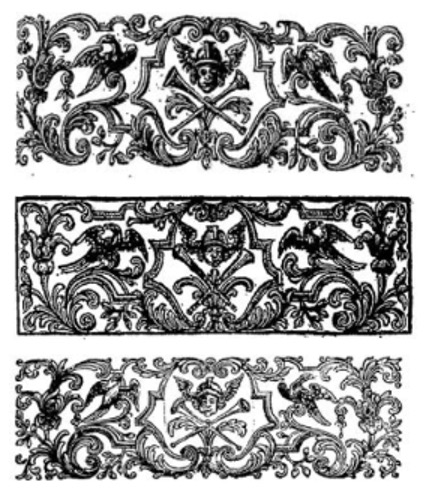
Figure 1.
Example of a similar image (C002_01; C002_02; C002_03) Three headpieces that look
very similar but bear subtle differences (e.g. different flora at the corners) and
thus belonging to the same superclass but to different subclasses.In Figure 2 we show a workflow diagram of our processing pipeline. The first step
is printmark detection using a neural object detection model. The method is described in (Wang, 2023); the
headpiece extraction works with 94% accuracy, which means that our dataset contains
almost all headpieces in ECCO, and, according to manual inspection, the vast majority
of images in the dataset are indeed headpieces. However, in some cases they are used
for different roles, e.g. situated in the middle of a page rather than on top. Images
are extracted automatically, and we do not impose additional limitations on how they
are positioned.
The next step is image representation learning, i.e. training a model that assigns to each image an embedding, i.e. vector representation, in such a way that similar images have similar representations.
We used the SimCLR model ([Chen et. al 2020]), which can be trained without using manually annotated examples. To that end, we
automatically produce two slightly different versions of each image, e.g. by applying
random cropping, rotating and blurring. Images are then run through a neural network
that outputs image embeddings. We use a standard convolutional ResNet network with
50 layers for that purpose [He et al. 2016]. Then the model is optimized in such a way that it produces similar outputs for
two versions of the same image and dissimilar for other image pairs.
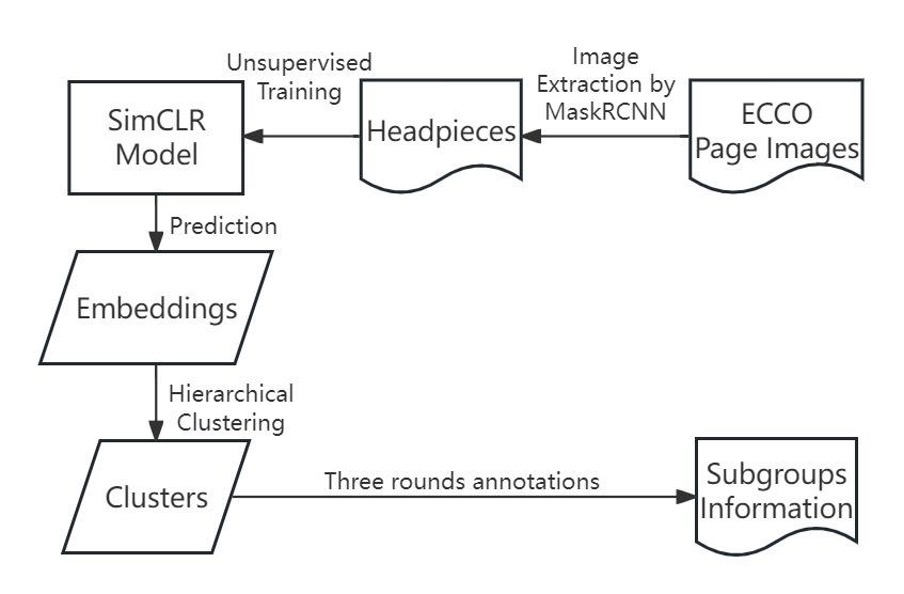
Figure 2.
The overall image analysis pipeline.Image processing workflow
Since this work is the first that applies this approach to book ornaments, we evaluated
the model using manual annotation. First, we randomly chose 2000 pairs of headpieces
in such a way that this test set consisted of pairs with diverse, both high and low,
similarity scores. Then we manually annotated these pairs: the task for the annotators
was to judge whether two given visual elements are matched. Comparing these annotations
with our best representation model, we found that representation works with 95% precision.
However, high-quality pairwise similarity by itself does not imply meaningful image
grouping due to peculiarities in clustering algorithms. Thus, we conducted a separate
evaluation of image clusters, using additional 1500 headpieces which we manually grouped.
We clustered the whole dataset and then evaluated clustering performance for those
headpieces. We experimented with several clustering methods and found that Hierarchical
Clustering is the best performing for our data, resulting in 60% performance.
We examined a few instances where the output of the best model differs from manual
annotation. It seems that in many cases false positive pairs are very similar, as
in Figure 3 which suits our broad definition of image reuse and can serve as an initial
step in a more complex analysis.
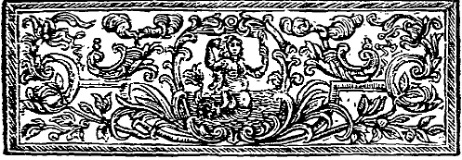
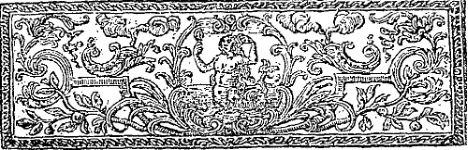
Figure 3.
Headpieces with similar patterns C011_02 and C011_01. Two very similar headpieces
where a central character is looking in opposite directions.We then conducted image extraction across the entire ECCO dataset and trained a bigger
SimCLR model using 709,299 headpieces. Training with the full ECCO image set allowed
the model to capture more complex and subtle differences across the visual elements.
In the next step, we applied hierarchical clustering to the representations obtained
from this SimCLR model. To reduce computational costs of the clustering we focused
only on broad headpieces, with the smallest width to height ratio. Such headpieces
contain more detailed images, were used in more expensive books and most relevant
for our use case analysis. Although very narrow ornaments may have been reused more
often, for example as dividing rules, their lack of detail make them computationally
more difficult to distinguish, particularly when taking into account the focus here
on variations. Very narrow headpieces are often very common or generic ornaments;
an extreme case is that the image with a ratio more than 10 is close to a simple ornamental
line and hence is not representative in finding potential printer information. We
also noticed during manual annotation that these headpieces are more often incorrectly
grouped together since they do not bear enough information for the model (or a manual
annotator for that matter) to discriminate — this decision was also taken, therefore,
for pragmatic technical reasons.
In this pilot case, we want to focus on the large clusters that cover as many printers
and publishers as possible. As our evaluation showed, the model can capture pairs
of similar images, but complete clustering of the whole dataset is more problematic.
Since very accurate results were needed for useful historical evidence, we conducted
manual post-correction.
To do this, we checked the clusters manually predicted by the model and first examined
the large clusters with more than 20 images in each cluster. We randomly sampled 5
images from each large cluster to quickly estimate its quality. If at least 4 images
looked similar we chose the cluster for further manual annotation. Next, manual annotation
was performed in two stages: in the first stage we tried to obtain as large parent
classes as possible. In the second stage, we divided them into fine-grained child
classes.
The final result was 172 main classes and 496 subclasses, composed of 15,249 images.
We present all classes in the Appendix, where for each subclass we show an example
image, a year range when it was in use, a count of hits (separate usages) and the
number of books in which it was found. In addition, each class has a title that was
given to it for visual clues for annotation purposes.
Case Study
Comparing previous work on ornament stocks with our data
After completing the classification, we manually compared our subclasses with the
bibliographies which give instances of the headpieces used by three different printers:
Samuel Richardson ([Maslen 2001]), Richard Bowyer ([Maslen 1973]) and Woodfall ([Goulden 1988]). In essence, we looked through these works and matched the images to our own clusters.
We could then compare the results, for instance by comparing the date range for which
a headpiece was known to have been used to the results in the clusters. For Richardson,
270 ornaments were cross-checked, for Woodfall 214, and for Bowyer 112. As a result
of this check, 49 of our classes matched with Richardson, 37 with Woodfall, and 24
with Bowyer. The reason why we do not get matches with all of their ornaments is that
we have taken a random, representative sample of more often used headpieces at this
stage to use as a proof-of-concept to evaluate the earlier results and printing practices,
rather than categorising every single headpiece.
| The average class size for manual analysis data | The average class size for our matched data | The average lifespan for manual analysis data (years) | The average lifespan for our matched data (years) | |
| Bowyer | 28,87 | 44,5 | 29,45 | 34,12 |
| Richardson | 23,77 | 32,97 | 21,63 | 24,16 |
| Woodfall | 9,37 | 34,29 | 8,78 | 23,67 |
| All our headpiece data | 23,39 |
Table 1.
Average usage interval for the ornaments.Table 1 compares the average lifespan for headpieces in previous studies to that detected
by the computational methods used here. In our analysis, lifespan is calculated for
all usages of the image, regardless of who used them.
This suggests that computational methods are useful to find more comprehensive sets
of related images than by a manual approach alone. To take an example, Goulden’s work
on Woodfall’s ornament stock found considerably fewer examples in comparison to those
found in our data. Additionally, the date range (or lifespan) of the images is notably
shorter: Goulden found evidence of the survival of ornaments over an average range
of about 8 years, whereas the equivalent clusters in our data have an average lifespan
of just over 23 years. While some of this disparity may be attributed to methodological
differences, it also makes clear that leveraging computational approaches, which enable
the search and analysis of images over a much wider time range and larger set of data,
can improve our knowledge and understanding of the subject.
Comparing previous work on ornament stocks with our data
An often overlooked aspect of eighteenth-century publishing is the dynamic between
London and other centres of English-language publication [Ryan and Tolonen 2024]. English books were often reprinted in Ireland, a practice which was known for its
lower production costs and quality, potentially resulting in higher profits for all
parties involved. Therefore, London publishers formed alliances with Irish printers
to produce economical Dublin editions of their titles. By investigating the variations
of headpieces across different editions of the same work, as well as across distinct
works, we can unveil such practices and gain an understanding of the reuse of images.
Recent scholarship has moved beyond the outdated view of all Irish eighteenth-century
printing as piratical, instead highlighting potential collaborative ventures (cf.
[Rumbold 2020, 174–176]; [Benson 2010, 170–172], see also [Feather 1987] and [Harris 1996]). While the use of ornaments does not alone indicate such relationships, we aim
to show that their systematic analysis reveals distinct patterns of usage, thereby
shedding light on certain facets of the publishing trade. In this section we offer
few straightforward examples that showcase how the examination of headpieces can be
used to shed new light on certain aspects of the printing connections between Dublin
and London.
Our analysis of headpieces suggests particular collaborations between London and Dublin,
aligning with the well-established relationship between Bowyer and the prominent Irish
printer George Faulkner. This confirms that our system effectively captures historical
connections identified through traditional scholarship, allowing us to build on these
findings and uncover further patterns of collaboration. Both [Rumbold 2020, 174] and [Pollard 2000, 198] note that Faulkner’s eclectic use of ornaments suggests he borrowed from various
printers' stocks. By examining comprehensive sequences of ornament usage, rather than
focusing on the inventory of a single printer, we have identified instances of ornaments
exchanging hands. For example, Bowyer and Faulkner used three unique, identical-looking
ornaments, indicating these were likely transferred from Bowyer to Faulkner, who had
been working for Bowyer until 1729. While earlier scholarship has established that
Faulkner sourced some ornaments from Bowyer, what remains unexplored are the variations
within the Bowyer-Faulkner connection and the broader use of Bowyer-associated ornaments
in Ireland. The fact that we can now identify these patterns computationally — without
relying on archival records — demonstrates the effectiveness of our method and provides
a foundation for further analysis.
One of our objectives with the images extracted and classified by the computational
means has been to identify close copies. Excessively long runs of the same image in
different places of publication may suggest that they are copies rather than the same
image. As an example, the ornament in Figure 4 can be found in books almost 75 years
apart. To both the clustering algorithm, and in this case, to the naked eye, these
images seem to be from an identical block, but we can speculate that in fact there
existed several copies of the image. With the right data, it may be possible to identify
such cases.

Figure 4.
Headpiece centered_shell_in_leafy_ring_flanked_by_pots_and_snails_0 (C127_01) the
first recorded use in 1710 on the left and the last recorded use in 1786 on the right.
Two practically identical headpieces found in the data 75 years apart.The timeline of this headpiece in Figure 5 illustrates its extensive use in Dublin,
despite being initially linked only to Bowyer. While Bowyer's use is documented in
22 volumes, we have recorded a total of 50 instances, highlighting a notable temporal
shift: Bowyer used it until the early 1720s, and Faulkner's use begins after 1733.
This pattern is also observed with other headpieces.
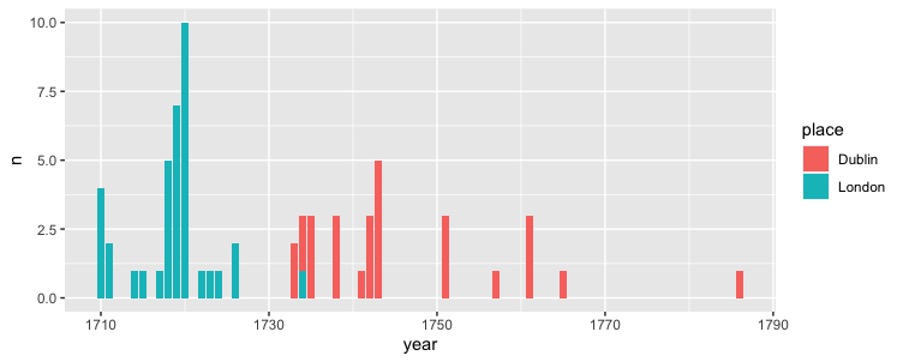
Figure 5.
Use of the above centered_shell_in_leafy_ring_flanked_by_pots_and_snails_0 (C127_01)
by place. A histogram showing that until 1730s all instances of the headpiece were
found in London publications, while after that date most instances with very few exceptions
are found in Dublin publications.Furthermore, the employment of Bowyer's ornaments and their close variants in Dublin
extends beyond Faulkner’s use, with the publishing house of Powells also utilizing
the same designs that originated with Bowyer. Despite some exceptions, these ornaments
are unmistakably linked, highlighting the shared use and possible exchange of ornaments
between these printers across geographical boundaries. This complex scenario cannot
be explained by simple lending practices alone. To understand what is happening, we
need comprehensive evidence, and we must interpret individual cases within the broader
context of the totality of ornament data which we intend to do in subsequent research.
Further complexities in ornament reuse
The connection between Faulkner's use of identical headpieces and his link to Bowyer
illustrates the interaction between Dublin and London printing — given that a single
woodblock can only be in one place at any given time. However, the situation becomes
significantly more complex when considering the reuse of variants of a specific headpiece.
In Dublin's printing scene, there were undoubtedly instances of copying and perhaps
even pirating the appearance of London publications. Yet, it is also a plausible scenario
that London publishers occasionally supplied Irish printers with woodblocks, enabling
them to produce works that shared a stylistic resemblance with their London counterparts.
This potential exchange introduces a layer of complexity in understanding the relationships
and practices within the broader publishing landscape.
An interesting possibility involves publishers commissioning woodblocks that represent
variations of the same image, then deploying these in a consistent pattern. Of particular
interest here is what we refer to as the Tonson-Watts enterprise. Rather than treating
Tonson Sr. and Jr. as separate publishers, we aim to study them as one publishing
house, to which we also connect John Watts for practical reasons (following [Foxon 1991]). Within the context of Tonson-Watts publishing, we observe ornaments in Dublin
publications that bear a striking resemblance to those consistently utilised by the
Tonson-Watts enterprise. For the Tonsons, we proceed with the premise that ornaments
frequently featured in their publications might indicate a connection to these works.
If this is the case, the large-scale, computational identification of variants of
woodblocks can help us to understand more about publisher affiliations.
[2]
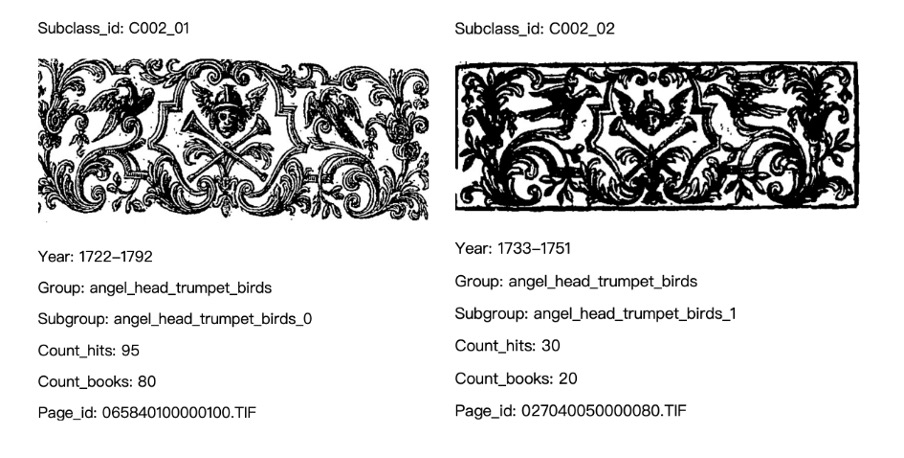
Figure 6.
Two subclasses of mercury_head_with_crossed_trumpets_floral_borders (C002). Two headpieces
with angel head in the middle that share a common structure but obviously printed
from different wood blocks, accompanied with metadata information.In our study of the Tonson-Watts enterprise, we have identified a series of near-identical
variants utilized by both Tonson and Dublin printers, with examples including "eagle_flower_vines_pedestal_vase_cartouche"
(C057); "cupids_playing_near_fountain_one_kneeling_one_holding_bow" (C065); "harbor_scene_with_multiple_ships_and_buildings"
(C080); and "centered_flower_in_oval_border_with_flanking_baskets" (C101). While these
instances might suggest piracy, that topic falls outside the scope of our current
interest. The origins of these nearly identical ornaments — whether due to a craftsman
producing multiple versions for various publishers and printers, deliberate imitation,
or other factors — are difficult for us to determine and are not our primary focus.
Instead, our investigation centres on ornament reuse that extends beyond simple replication,
as we try to understand the significance of the relationship between two variants
of an ornament, and its implication for the connection between the works and producers
of the works from whence they came.
A particularly striking example of ornament reuse is the “mercury_head_with_crossed_trumpets_floral_borders”
(C002) design, frequently employed by Tonsons in London. As discussed earlier, determining
the rationale behind certain variations can be challenging. However, comparing the
Tonson headpiece (C002_01) with its Dublin counterpart (C002_02) (see Figure 6) reveals
two distinct designs: both feature a central head and trumpets, but in C002_01 the
birds face away from the head, while in C002_02 they turn toward it. C002_01 corresponds
to Tonson/Watts prints in London, whereas C002_02 appears in Irish printing. Similar
patterns can be seen with “mermaid_with_torch_surrounded_by_foliage” (C011_01 & C011_02)
and “centered_owl_with_spread_wings_on_book_surrounded_by_foliage” (C171_01 & C171_02).
This prompts the question of whether such differences reflect Tonson’s own connection
to Irish editions for certain titles. We have found over 20 Irish examples and many
Tonson prints spanning more than three decades. The deliberate way these headpieces
differ — and their consistent use, in contrast to the usually sporadic nature of pirated
ornaments — suggests something more than a simple imitation of a publishing style.
Instead, it may indicate a strategic choice behind retaining and reusing these ornaments.
It is important to clarify that our goal in this paper is not to definitively establish
intentional and authorized use of woodblocks. Instead, we propose this as a plausible
scenario to reconsider the dominant printer-focused narrative. This line of inquiry,
especially concerning Tonson, warrants further exploration to elucidate the complexities
of eighteenth-century publishing practices.
Dublin reprints and reused ornaments
The investigation above looks at reuse, copies and variants of ornaments without regard
to the work in which they appeared. A further aspect that we wanted to test was the
question of the reuse of images and Dublin editions, by looking specifically at ornament
reuse or variant reuse in Dublin editions of existing works. One possibility is that
Dublin printers aimed to counterfeit London editions, copying not just the text but
also the appearance of the London books, including the headpieces. The ECCO contains
multiple editions of the same work, which we have grouped together [Ijaz et al. 2019]. We investigated whether variant headpieces were consistently used across different
Dublin editions of London books. Doing this at scale allows us to state that this
was generally not the case. While similar headpiece variants were found in both London
and Dublin, as described above, they typically did not appear in the same works.
We found that in our data only a handful of copies have any similar images as their
London counterpart. The most definitive example of a Dublin edition modelled after
its London original in our study is John Laurence's A New System of Agriculture, published in London in 1726 and in Dublin in 1727. The Dublin edition's frontispiece
copperplate closely corresponds to the London edition's, albeit not as an exact replica.
Moreover, the initial pages of the Dublin edition — including the headpieces — faithfully
mirror those of the London version, though this does not extend throughout the entire
book. Notably, the Dublin edition employs a variant of the London headpiece (seated_figure_with_bordered_frame_and_holding_object_with_cherubs_1
(C108_02) and seated_figure_with_bordered_frame_and_holding_object_with_cherubs_2
(C108_03)), offering subscribers an edition worth their money.
Laurence's A New System of Agriculture thus stands out as a notable exception in our data. Beyond this, there are only a
few instances where Dublin reprints sought to replicate the images from their London
originals. This does not imply that Dublin reprints lacked images altogether, but
rather, aiming faithfully to copy the exact images from the London editions was not
a widespread practice. However, there are exceptions to this observation that Dublin
reprints did not commonly reuse the same images as their London counterparts. For
instance, John Hughes' Siege of Damascus, published by Tonson in London in 1721, saw its London reprint in 1741 and subsequent
reprints in London (1753) and Dublin (1765) utilising variants of the same image ("harbor_scene_with_multiple_ships_and_buildings"
(C080)). Similarly, James Hervey’s Theron and Aspasio, published in London and Dublin in 1755, featured the "centered_flower_in_oval_border_with_flanking_baskets"
(C101) image.[3]
Moreover, the reprinting dynamic was not exclusive to London and other locations.
Samuel Madden’s Themistocles, initially published in Dublin in 1729, was reprinted forty years later in Cork in
1769, including the same headpiece ("baskets_with_curved_foliage_and_decorative_frame_2"
(C067_03)), an image which featured in different publications in six different cities
(Cork, Oxford, London, Glasgow, and Dublin). Beyond this example, we identified five
additional subclasses of the same ornament, illustrating the complex network of variants
which extends beyond the practices of individual printers.
Discussion
Our work has suggested that the study of close variants of ornaments can play a valuable
role in understanding publisher and printer connections, particularly when computational
methods allow us to do this at scale. These computational methods suggest that the
scale of reuse, copies, and variants is extensive, and moved across different centres
of publication. Even if these studies correctly distinguished between the variants
and focused only on those belonging to a particular printer, the existence of similar
variants raises many unanswered questions. Proper documentation of these distinctions
becomes crucial for accurate identification.
Each printer’s stock (if we want to use such an expression in the first place) and
selection of headpieces was thus diverse and dependent on various factors that are
mostly obscure to contemporary historians. Some, most likely, borrowed ornaments from
major printers or publishers, while others had their own headpieces. Therefore, to
understand the usage and circulation network of headpieces in eighteenth-century Britain
and Ireland, we have aimed to focus on general tendencies through a large dataset,
providing individual examples through our data set where relevant. This has supplemented
the conventional approach that prioritises identifying a specific printer before analysing
their use of ornaments. Our data, including that on Bowyer, reveals the extensive
use elsewhere of ornaments previously attributed to his inventory, providing evidence
of systematic use in works not previously documented. We aimed to provide explanations
for these patterns in selected instances, illustrating the need for a revised understanding
of ornament reuse in eighteenth-century printing.
There are potential pitfalls to be avoided when looking at image reuse at scale. Identifying
minute differences between ornaments and establishing whether they are the same or
copies is a difficult task with good-quality images, and made more difficult with
the mixed image quality of ECCO. Scholars should exercise caution regarding the existence
of variants when leveraging ornaments as evidence of a specific printer's work. Some
headpieces, presumed to be borrowed from another printer's stock — particularly in
Dublin — turn out to be variants of the original ornament. The nearly identical nature
of these ornaments can lead to confusion and misinterpretation due to fragmented evidence.
Care must also be taken not to confuse new editions with reissues of unsold sheets
(usually with a new title page), which was a fairly widespread practice in the eighteenth
century and can identify false cases of reuse. In this case study, examples were manually
checked, but it could easily be done at scale computationally and incorporated into
the workflow. Another important point is that of false imprints: particularly where
a title page states one geographic location for a work actually published elsewhere.
While there is no automatic way of detecting these false imprints through images,
the practice was not, (at least between the Dublin and London publishers discussed
here) widespread enough to refute the broader picture presented here [May 2019, 83]. Additionally, the ESTC bibliographic data often flags false imprints where
they are known, allowing us to exclude them from our results.
Conclusion
In this paper, we have outlined a mixed methodology and workflow for the identification
and analysis of images found in digitised books. The images in question need a new
approach because they are atypical in comparison to other types of images found in
historical sources: they are used repeatedly, their primary purpose is often decorative
rather than semantic, and the handmade process by which they were created, coupled
with the uneven nature of the digitised collections in which they are found means
that straightforward techniques of image recognition need some modification. Our work
has shown that a combination of computational methods with manual annotations and
analysis allows us to reveal image reuse on various levels of granularity. Just as
importantly, we demonstrated the ways in which the resulting data can be operationalised
to tackle key questions relating to the discipline of book history and propose a set
of methods by which this can be achieved. In this way, image recognition and grouping
are a starting point for further investigations, investigations which themselves need
a new set of practices and approaches, involving both close and distant ‘reading’
of the ornaments, as well as visualizations and network analysis.
As we and others have shown, the data from ECCO can be used to study ornaments. A
further question is how we can understand who produced books, given that the metadata
(taken from book imprints) is inconsistent or untrustworthy. We argue that one should
follow consistent patterns of both imprint and ornament practices and combine this
work with external evidence. By working with computational history rather than traditional
bibliographic approaches, studying consistent patterns becomes more effective. This
includes following recent advances in computer vision and other fields of AI. With
the rapid development of these fields, it is often possible to improve results obtained
just a few years ago. However, we argue for even deeper collaboration between the
two fields. In this paper we demonstrate how switching from exact image similarity
to continuous image distances results in a broader inventory of historical book analysis
methods.
At the same time, in order to produce worthwhile results, it is of utmost importance
to do the work to clean up the big data available to us: whether that be the metadata
taken from library catalogues providing evidence on the production of books, or the
information on visual images as we have worked with here. This, we argue, still requires,
and is best carried out, with manual intervention.
While we are not the only researchers using ECCO to explore printers' ornaments, we
believe our work makes a valuable contribution in its serious consideration of variants,
alongside integrating publisher and printer metadata. This novel approach has led
us to rethink how ornament data can illuminate eighteenth-century publishing practices,
moving beyond the simplistic debate on ornament ownership by printers — a reality,
albeit not the sole focus. Our analysis aims to shed light on broader publishing networks,
the practice of employing multiple printers, and the circulation of ornaments through
sales, inheritance, and other means. Furthermore, we suggest that publishers may have
played a more involved role than just financing publications. We know that they were
the ones that supplied the paper used in books, it would not seem that far-fetched
assuming that some of them also owned headpiece ornaments that would be used in their
books even if the printing was done elsewhere.
This paper serves as a proof of concept, demonstrating how book-historical and computational
approaches can be combined to study ornament reuse at scale. Although we have focused
on a large but still limited set of headpieces, our findings illustrate the promise
of uncovering more about the material practice of book production — especially the
interconnections among publishers in different locations and the artisans who carved
the woodblocks. Questions of production, distribution and the exchange of stylistic
influences between, for example, Irish and London actors, open rich avenues for further
research.
Our pilot study also lays the groundwork for a deeper investigation of the Tonson
publishing house, building on the ornament clusters presented here alongside other
evidence. If the name “Watts” was often absent from title pages, “Tonson” is also
elusive. By treating books as holistic objects — focusing on works, editions and all
relevant quantitative data — we can begin constructing a puzzle that has so far remained
unsolved. While we find the Tonson case especially intriguing, this is only one example
of how our scalable methods could be applied to other publishing enterprises, encouraging
further inquiry into the complexities of eighteenth-century book production.
Appendix
The appendix contains all manually annotated images referred in this paper by alphanumeric
codes or names, along with the metadata. The appendix can be found on the web with
this link: https://doi.org/10.5281/zenodo.17035991.
Notes
[1] It is possible that the detection of reused headpieces is in fact reissue of
unsold sheets. We have not come across any instances of this in our examples. Books
with identical sheets could be easily detected in a future update to the methods.
[2] While ECCO is used as the source of image data, the bibliographic information
used as evidence for our findings comes from a cleaned and enhanced version of the
English Short-title Catalogue (ESTC), which in some cases has more detailed and accurate
information.
[3] This observation does not extend to near-variant headpieces designed to mimic
original books, which may arise from carvers distributing nearly identical headpieces
to various publishers and printers or, in instances of printing outside London, unlicensed
attempts to replicate the style of the original publications. Our evidence indicates
that these practices were prevalent, encompassing exclusive ornament usage, unauthorized
replication of headpieces, and the circulation of several near-identical ornament
copies, often without a deliberate pattern in their application.
Works Cited
Barchas 2003 Barchas, J. (2003) Graphic design, print culture, and the eighteenth-century novel. Cambridge: Cambridge University Press.
Belanger 1975 Belanger, T. (1975) “Booksellers’ trade sales, 1718–1768”, The Library, 5th Series, 30(4), pp. 281–302. Available at https://doi.org/10.1093/library/s5-XXX.4.281. (Accessed: 19 August 2025).
Benson 2010 Benson, C. (2010) “The Irish Trade”, in Suarez, M. and Turner, M. (eds.) The Cambridge history of the book in Britain, vol. 5. Cambridge: Cambridge University Press, pp. 366–382.
Bergel, Howe, and Windram 2014 Bergel, G., Howe, C., & Windram, H. (2014) “Lines of succession in an English ballad tradition: the publishing history and textual
descent of The Wandering Jew’s chronicle”, Digital Scholarship in the Humanities, 31(3), pp. 540–562. Available at: https://doi.org/10.1093/llc/fqv003. (Accessed: 20 August 2025).
Bidwell 2010 Bidwell, J. (2010) The industrialization of the paper trade, in Suarez, SJ M. F., & Turner, M. L. (eds.) The Cambridge history of the book in Britain. Cambridge: Cambridge University Press, pp. 200–217. Available at: https://doi.org/10.1017/CHOL9780521810173.010. (Accessed: 19 August 2025).
Chen et. al 2020 Chen, T. et al. (2020) “A simple framework for contrastive learning of visual representations”, in International conference on machine learning. PMLR, pp. 1597–1607. Available
at https://doi.org/10.48550/arXiv.2002.05709. (Accessed: 19 August 2025).
Chung et. al 2015 Chung, J. S. et al. (2015) “Re-presentations of art collections”,’ in Computer Vision - ECCV 2014 Workshops. Cham: Springer, pp. 85–100. Available
at https://doi.org/10.1007/978-3-319-16178-5_6. (Accessed: 19 August 2025).
Dondi et. al 2020 Dondi, C. et al. (2020) “The use and reuse of printed illustrations in 15th-century Venetian editions”, in Dondi, C. (ed.) Printing r-evolution and society 1450–1500. Studi di storia.. Venice: Edizioni Ca’ Foscari – Digital Publishing, Fondazione Università Ca’ Foscari.
Available at: https://doi.org/10.30687/978-88-6969-332-8/030. (Accessed: 19 August 2025).
Dutta, Bergel, and Zisserman 2021 Dutta, A., Bergel, G. and Zisserman, A. (2021) “Visual analysis of chapbooks printed in Scotland”, in Proceedings of the 6th International Workshop on Historical Document Imaging
and Processing (HIP ’21). New York: Association for Computing Machinery, pp. 1–6.
Available at: https://doi.org/10.1145/3476887.3476893 (Accessed: 19 August 2025).
Feather 1987 Feather, J. (1987) “The publishers and the pirates: British copyright law in theory and practice, 1710-1775”, in Shevlin, E. F. (ed.) The history of the book in the west: 1700–1800. 1st edn. London: Routledge, pp. 5–32.
Foxon 1991 Foxon, D. (1991) Pope and the early eighteenth-century book trade. Oxford: Clarendon Press.
Goulden 1988 Goulden, R. (1988) The ornament stock of Henry Woodfall, 1719–1747. A Preliminary Inventory Illustrated. The Bibliographical Society.
Harris 1996 Harris, M. (1996) “Paper pirates: the alternative book trade in mid-18th-century London”, in R. Myers and M. Harris (eds.) Fakes and frauds: varieties of deception in print and manuscript. 1st edn. New Castle, DE: Oak Knoll Press, pp. 47–70.
He et al. 2016 He, K. et al. (2016) “Deep residual learning for image recognition”, in Proceedings of the IEEE conference on computer vision and pattern recognition. IEEE, pp. 770-778. Available at: https://doi.org/10.1109/CVPR.2016.90. (Accessed: 19 August 2025).
Hu et al. 2015 Hu, B. et al. (2015) “Establishing the provenance of historical manuscripts with a novel distance measure”, Pattern Analysis and Applications, 18(2), pp. 313–331. Available at: https://doi.org/10.1007/s10044-013-0332-z. (Accessed: 19 August 2025).
Ijaz et al. 2019 Ijaz, A. et al. (2019) “Analytical Determination of Editions from Bibliographic metadata”, in Proceedings of the Research Data And Humanities (RDHUM) 2019 Conference: Data, Methods
And Tools. Oulu: University of Oulu, pp. 9-19.
Maslen 1973 Maslen, K. (1973) The Bowyer ornament stock. Oxford: Oxford Bibliographical Society.
Maslen 1993 Maslen, K. (1993) “George Faulkner and William Bowyer: the London connection”, Long Room, 38, pp. 20–30.
Maslen 2001 Maslen, K. (2001) Samuel Richardson of London, Printer: A study of his printing based on ornament use
and business accounts. Dunedin: University of Otago.
May 2019 May, J. E. (2019) “False and incomplete imprints in Swift’s Dublin, 1710–35”, in Bischof, J., Juhas, K., and Real, H. J. (eds.) Reading Swift: Papers from the Seventh Münster Symposium on Jonathan Swift. Leiden: Brill | Fink. Available at: https://doi.org/10.30965/9783846763971_005. (Accessed: 19 August 2025).
McKerrow 1925 McKerrow, R. B. (1925) Fable of the bees [Book review]. The Library, 4(6), pp. 109–111.
Mosley 2009 Mosley, J. (2009) “The technologies of printing”, in Suarez, M. and Turner, M. (eds.) The Cambridge History of the Book in Britain, vol. 5. Cambridge: Cambridge University Press, pp. 163–199.
Nguyen, Coustaty, and Ogier 2020 Nguyen, NV., Coustaty, M., and Ogier, JM. (2020) “An adaptive document recognition system for lettrines”, International Journal on Document Analysis and Recognition (IJDAR), 23, pp. 115 –128. Available at: https://doi.org/10.1007/s10032-019-00346-9. (Accessed: 19 August 2025).
Pollard 2000 Pollard, M. (2000) A dictionary of members of the Dublin book trade, 1550–1800. London: Bibliographical Society.
Ross 1990 Ross, J. C. (1990) Charles Ackers' ornament usage. Oxford: Oxford Bibliographical Society.
Rumbold 2020 Rumbold, V. (2020) Swift in print: Published texts in Dublin and London, 1691-1765. Cambridge: Cambridge University Press.
Ryan and Tolonen 2024 Ryan, Y., and Tolonen, M. (2024) “The evolution of Scottish enlightenment publishing”, The Historical Journal, 67(2), pp. 223–255. Available at: https://doi.org/10.1017/S0018246X23000614. (Accessed: 19 August 2025).
Tolonen 2009 Tolonen, M. (2009) Self-love and self-liking in the moral and political thought of Bernard Mandeville
and David Hume [Doctoral dissertation, University of Helsinki].
Tolonen 2021 Tolonen, M. et al. (2021) “Examining the Early Modern Canon: The English Short Title Catalogue and Large-Scale
Patterns of Cultural Production”, in Baird, I. (ed.) Data Visualization in Enlightenment Literature and Culture. Cham: Palgrave Macmillan, pp. 63–119. Available at: https://doi.org/10.1007/978-3-030-54913-8_3. (Accessed: 20 August 2025).
Tolonen, Mäkelä, and Lahti 2022 Tolonen, M., Mäkelä, E., and Lahti, L. (2022) ‘The Anatomy of Eighteenth Century
Collections Online (ECCO)’, Eighteenth-Century Studies, 56(1), pp. 95–123. Available at: https://doi.org/10.1353/ecs.2022.0060 (Accessed: 19 August 2025).
Treadwell 1982 Treadwell, M. (1982) “London trade publishers, 1675–1720”, The Library, 6th Series, 4(2), pp. 99–134.
Uttama 2006 Uttama, S. et al. (2006) “Segmentation and retrieval of ancient graphic documents”, in Graphics Recognition. Ten Years Review and Future Perspectives. GREC 2005. Lecture Notes in Computer Science, vol. 3926. Berlin, Heidelberg: Springer, pp.
88–98. Available at: https://doi.org/10.1007/11767978_8. (Accessed: 19 August 2025).
Wang 2023 Wang, R. (2023) Visual element extraction and grouping from eighteenth-century books based on deep-learning
methods [Master’s thesis, University of Helsinki].
Wilkinson 2013 Wilkinson, H. (2013) “Printers’ flowers as evidence in the identification of unknown printers: Two examples
from 1715””, The Library, 14(1), pp. 70–79. Available at: https://doi.org/10.1093/library/14.1.70. (Accessed: 19 August 2025).
Wilkinson, Briggs, and Gorissen 2021 Wilkinson, H., Briggs, J., and Gorissen, D. (2021) “Computer vision and the Cceation of a database of printers’ ornaments”, Digital Humanities Quarterly, 15(1). Available at: https://dhq.digitalhumanities.org/vol/15/1/000537/000537.html. (Accessed: 19 August 2025).

URL: https://dhq.digitalhumanities.org/editorial/000815/000815.html
Comments: dhqinfo@digitalhumanities.org
Published by: The Alliance of Digital Humanities Organizations and The Association for Computers and the Humanities
Affiliated with: Digital Scholarship in the Humanities
DHQ has been made possible in part by the National Endowment for the Humanities.
© 2026 the authors

Unless otherwise noted, the DHQ web site and all DHQ published content are published under a Creative Commons Attribution-NoDerivatives 4.0 International License. Individual articles may carry a more permissive license, as described in the footer for the individual article, and in the article’s metadata.
Comments: dhqinfo@digitalhumanities.org
Published by: The Alliance of Digital Humanities Organizations and The Association for Computers and the Humanities
Affiliated with: Digital Scholarship in the Humanities
DHQ has been made possible in part by the National Endowment for the Humanities.
© 2026 the authors
Unless otherwise noted, the DHQ web site and all DHQ published content are published under a Creative Commons Attribution-NoDerivatives 4.0 International License. Individual articles may carry a more permissive license, as described in the footer for the individual article, and in the article’s metadata.
