Abstract
Industry standard programming languages often leverage the English language for reserved
keywords – words interpreted as specific execution commands for the compiled program.
The Java programming language is no exception to using English reserved keywords,
and is used widely in industrial and educational settings.
The expert-novice programmer divide exemplifies an intriguing middle-ground for navigating
metaphor and highlighting polysemic interpretations of keywords. For experts, keywords
become “dead metaphor” (drawn from “career of metaphor” theory). That is, the expert
sees the keyword – often the entire grammatical construct with it – and derives programmatic
meaning near instantly. For the expert, there is rare consideration of alternative
English-language interpretations. Novices however, in attempting to first navigate
programming, may use these English keywords as familiar landmarks in unfamiliar terrain.
Amidst a sea of semicolons, single letter variables, and math operators, they may
gravitate to familiar words such as “if” or “while” to derive meaning.
Attempts by novices to create meaning using these English definitions can, however,
result in potential misconceptions. The word “for” as a preposition has over a dozen
distinct definitions. Which definition should a novice programmer use to achieve understanding
in learning to program, and what misconceptions may they develop through alternatives
to the “correct” choice? For some keywords, there may be no completely “correct” definition.
While this ambiguity can create a myriad of interpretations for critical code studies,
it can provide pitfalls for those first learning to program. This essay samples several
keyword interpretations that novice programmers may derive from the Java language’s
keywords and how polysemous meaning may affect their interpretation. Through observation
of students in their CS1 class, the author began exploring how polysemy, linguistics,
and metaphoric interpretations may affect understanding in beginner courses. These
students are largely native English speakers, highlighting that understanding rifts
exist even for native and colloquial speakers.
Code snippets are explored with both compiled keyword meanings and potential understood
meanings. This provides insight into pathways for student reasoning and navigation
in the programming landscape. The myriad of potential conclusions or definitions are
contrasted against the compiler’s singular interpretation, and how the polysemic potential
of natural language falls to singular dead metaphor in experts. This stark difference
between natural linguistics, critical code analysis, and compiled code meaning highlights
contrasts between programming and natural languages, in addition to highlight paradigm
shifts that may occur in pursuit of expertise.
1 – Strangers in a Strange Land: Novices at the Terminal
Learning to program a computer is not an easy task: we wave goodbye to the shores
of our analog realm, immersed in pools of strict digital logic. Novice programmers
often struggle to navigate this new terrain: with strange symbols punctuating supposed
sentences, and perplexing rules governing the effects of their efforts. When considering
the complexity of the novice’s first voyage into programming, it is little wonder
that syntactic keywords which appear as “real words," can become beacons they affix
their interpretations to.
1.1 Building Beacons: Core Concepts in this Essay’s Exploration
Before setting out, let us place a grounding keyword beacon for this essay. The term
“polysemy” suggests “\“the coexistence of many possible meanings for a word or phrase.” In this essay, polysemy refers to the concept of multiple interpretations used while
reasoning is at the forefront.
Polysemy naturally cohabitates with ambiguity: with many paths of interpretation before
us, which one will we choose? A word, a phrase, an idea, or a creative work may have
many meanings, exemplifying polysemy. This space for interpretation, for meaning-making,
is central to critical analysis and human creative endeavors. The beauty of ambiguity,
however, comes from a deep enough understanding to recognize and explore this ambiguity.
The interpretation of polysemy in critical code studies requires one to be able to
recognize a multitude of meanings within the text – to “walk each path” and consider
its destination.
This potential gives polysemy its poetic power, as seen in critical readings and literature
interpretations throughout human history. In pedagogical contexts, however, polysemy
can create tension. The intense novelty of learning new skills and information can
place pragmatic limits on our ability to appreciate polysemy. When learning how to do a task (reading or writing, for example) we focus on skill development and
tool mastery. Many pathways become an obstacle in this context: we cannot appreciate
“walking paths of meaning” when we are still achieving a baseline of the ground beneath
our feet.
Before we can craft new meaning – exploring complexity and abstraction, inviting novelty
– we must first understand how to wield what might be termed “original” or “intended”
meanings. We subvert and transcend through meaning making only through knowledge of
existing expectations and interpretations. As Critical Code Studies notes,
“As with all texts, the discovery and creation of meaning grow out of the act of reading
and interpretation” [
Marino 2020] – but this act of meaning making requires the skill of reading and the ability to
interpret what we have read to be present first. Through this work’s usage of the
term, polysemy may appear to be a negative to be “eradicated." This is not the intention:
it is a foundation of critical code studies and to creative analysis and exploration
of code. However, critical code studies rests on foundations of meaning-making
about and with code, which may consequently require “exploring pathways."
This challenge for novices learning to program is the crux of this paper.. Novices
often must first “resolve” on some level inherent polysemy in code – “choose a correct
path” – in order to conceptually understand programming. Once the task of programming
is understood, they may return and explore critically, recognizing and appreciating
the multitude of polysemic paths.
This essay explores specifically how the polysemy inherent in programming language
design through the use of English keywords can affect novice efforts to “make sense”
of coding as a practice. For instructors of novice programmers, language designers
seeking to create scaffolding for novice programmers to ease the barrier to entry,
or for those seeking to understand how novice programmers may interpret code throughout
the process of learning it, the question is how might this ambiguity be “resolved.”
The difficulties in polysemy “resolution” for novice learners should not be conflated
with critical analysis and interpretation. Where inherent polysemy can create challenges
on the path to learning, it creates potential and poetry by seeing code as a complex
cultural text in the hands of experts.
1.2 Mental Maps: How Do We Rationalize and Reason?
To better understand novice programmer engagement with syntactic keywords, it is vital
to consider the consistent perils they overcome while exploring learning to code.
Our investigation here of the novice’s journey begins with the concept of working
memory and chunks in order to build our theoretical framework on cognitive limits.
Expansion on these topics and their correlation to novice programming comprehension
can be found in the author’s dissertation [
Bettin 2020].
Neuro, cognitive, and learning sciences present evidence helping us better understand
novice programmers and the difficulty navigating digital landscapes. Novices develop
mental models of their environments, including the task of programming. Mental models
vary in size, complexity, and interconnectivity, but the summation of these models
and their connections form the cognitive basis of how we understand the world around
us [
Norman 1983]; [
Glynn 1994].
Learning to program can require developing many models. These may range from “how
a loop executes” to
“how the computer interprets programming instructions”, as well as connecting to other models, such as
“interpreting real world and word problems to solve using code”. Humans can possess multiple models of a single idea: interconnected models comprising
a theme (such as the interconnected “programming models” shown prior), fragmented
or partial models, and even distinctly different toggling models surrounding the same
idea to view a problem from new perspectives [
Norman 1983]; [
de Kleer and Seely Brown 1983]; [
Linder 1993]. Modeling is a foundational theory in human cognition, making it foundational to
understanding the process of learning to code.
Our mental models help us reason about the world and organize the vast quantity of
information in our minds. A complex problem becomes easier to solve when we recognize
component parts and their operational relationships. Understanding of those components
is built upon pre-existing mental models, which we use to reason about concepts like
potential action, reaction, and utility. When presented with problems so novel that
we are forced to reason intensely on each individual piece, our success in reasoning
suffers [
Anderson and Jeffries 1985]; [
Muller, Ginat, and Haberman 2007]; [
Vainio and Sajaniemi 2007]. In neuroscience, this lowered reasoning capability is largely correlated to working
memory – the area of our brain devoted to active problem reasoning. This area is fast
at reasoning about and retrieving relevant information but limited in the “space”
it has for this information. Folk science (in this case informed by neuroscientific
theory) suggests considering memory as 7 “plus or minus 2” chunks [
Miller 1956]. For a novice learning to program, the whole problem space is a novel area, and
each moving part can require distinct attention.
“Chunks” in working memory is useful for understanding the difficult task novice programmers
face. Mental model consolidation and organization helps to reduce the number of “chunks”
taken up in working memory, creating more space for ideas and reasoning processes.
If one is asked to remember the numbers “4 8 15 16 23 42," this would typically take
up six imagined “chunks” of memory to actively maintain these disjoint pieces of information.
However, if a fan of the TV show LOST is asked to recall “The Numbers” [
Lieber, Abrams, and Lindelof 2004] they might easily retrieve this information as one model, even after significant
time has passed from the remembrance task being given.
Mental models aid in meaning attribution through such consolidation, making complex
ideas and connections easier to access and retrieve. This leaves more working memory
for active reasoning tasks, like using those numbers to do calculations and recall
any necessary steps. Anyone who has repeated a phone number under their breath, or
counted out loud only to start over after a distraction, has first-hand experience
with working memory’s limitations. We only have so many “chunks” to devote to the
problem at hand, and when we cannot or have not developed a mental model for the problem
space yet, our ability to complete the task suffers as we struggle to juggle information
and reasoning with limited chunks [
Anderson and Jeffries 1985]; [
Muller, Ginat, and Haberman 2007]; [
Vainio and Sajaniemi 2007].
For the novice programmer, the nature of being a novice makes nearly every aspect
of the programming task new: they are indeed strangers in a strange land. Individual
lines of code are not even chunks – they are made up of chunks! Each element in that
line is a separate glyph they must reason about. To understand this further, let us
contrast the novice with the expert (or at least, more senior) programmer.
2 – Exploring Expertise: Chunking and the Career of Coding Metaphor
Where the novice sees each element as novel and distinct, experts see abstracted meaning.
Quickly glance at this Java example snippet:
$$for (int i = 0; i < 10; i++){ System.out.println(i * i);}$$
If you have programmed before, what does the above mean to you?
Depending on your level of confidence or cursory glance speed, you may indicate something
high-level such as “it's a loop ”or “it repeats and prints something.” Perhaps you got more specific: “it prints the squares of the iterated values,” “it’s a loop that runs ten times,” or “the code prints the square of all values between 0 and 9.” You may have had confusion at first if you have programmed in another language which
uses the keyword “for” that is not Java, but you likely still arrived at an iteration-based
conclusion. Regardless of how you interpreted the snippet (though how one communicates
their interpretation is a viable critical code exploration in itself), your mental
model of programming informs that quickly reasoned abstraction: repetition is happening
in relation to numeric values.
For the novice, there are several potential barriers to that abstraction. Where experts
simply see “a for loop” as a single chunk, the novice is still reasoning about “what
a for loop is." Let us imagine for a moment working memory “chunks” as an array in
Java – a finitely sized grouping of elements. We will set our working memory array
to a length of seven elements and attempt to represent the contents. This is of course
a naive representation of our mental processes, but can help us understand the reasoning
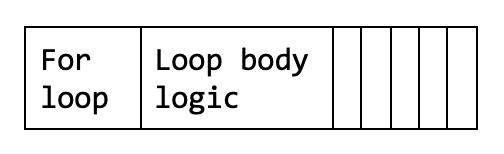
divide. The expert’s working memory in reviewing the snippet might currently be represented
as:
There is plenty of space for reasoning and “reconsolidating/collapsing” ideas. An
expert may use a chunk to consider the “iteration pattern” and reason about the executions
iterating variable i does, before reconsolidating that information back into the “for
loop” chunk to “free up space” again. Experts often do such reconsolidation without
recognizing any significant mental processing has even occurred!
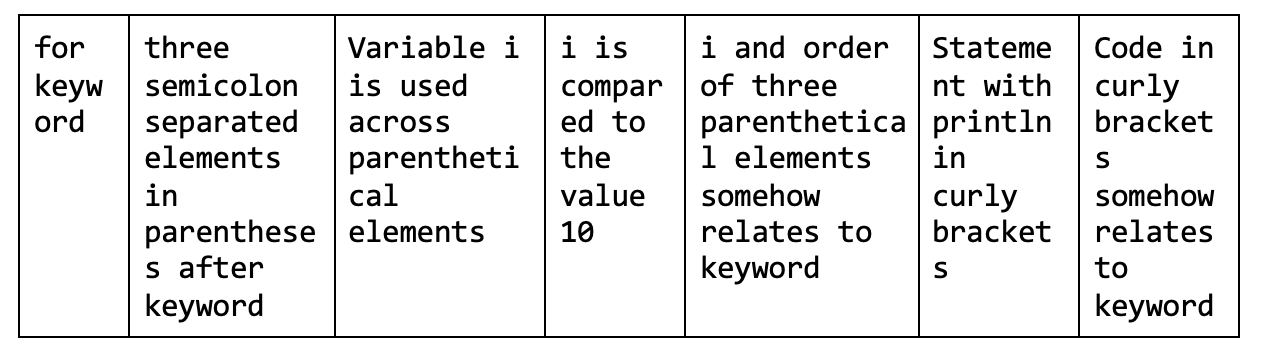
On the other hand, the novice is still developing their model of what a loop is. Their
working memory looks much different. They reason about each component piece, trying
to recall distinct sets of instructions and rules for each piece to ascribe meaning
to the whole. For example:
The novice’s seven “chunks” are easily taken up in this example just assessing components
of the for-loop structure. They must then also reason about potential vocabulary words,
orders of operations, and use each element simultaneously in working memory to ascribe
meaning to the entire snippet in order to understand it. The novice is also likely
still assimilating prior topics, requiring additional resources to recall ideas still
being formed in mental models, such as variables or conditional comparison behavior.
This overload of working memory causes forgetting, mistakes, and slowed reasoning
as one attempts to make the problem space more manageable.
But
why do novices and experts reason so differently? Career of metaphor ([
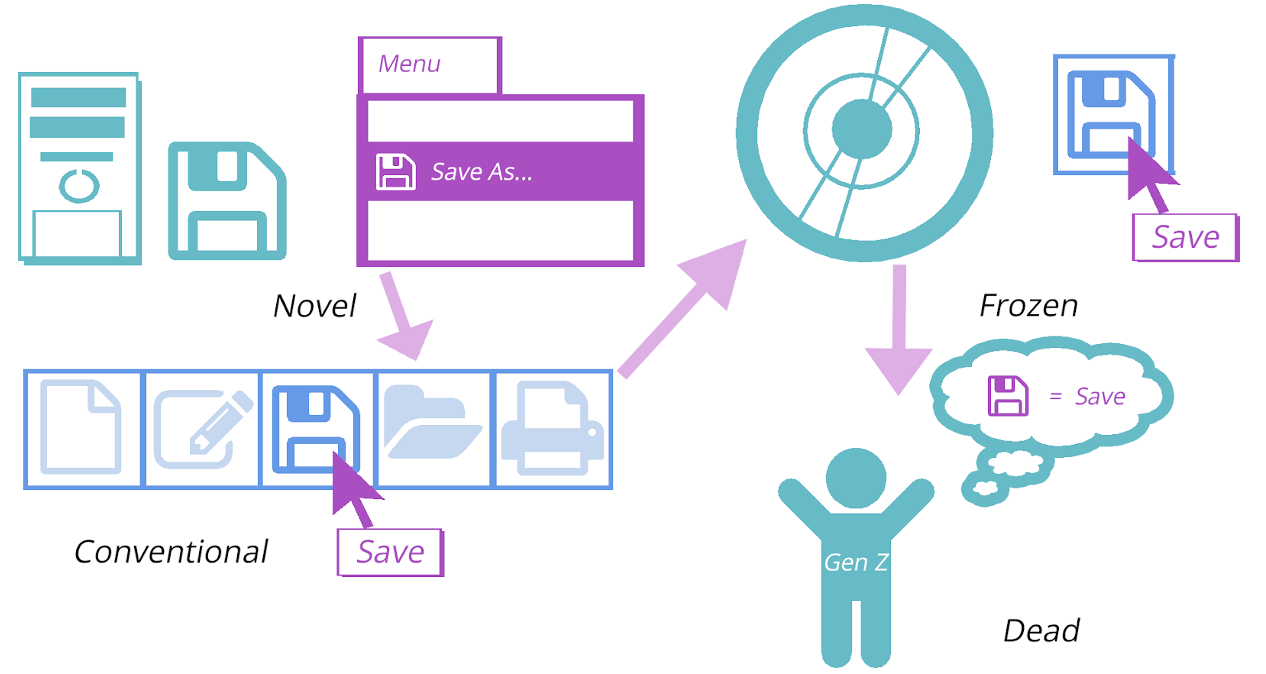
Gentner and Bowdle 2008]) offers potential insight. Career of metaphor suggests metaphoric interpretation
undergoes four distinct phases: novel, conventional, frozen, and dead. “Novel” metaphor
is entirely new; we must actively work to create connections and attribute meaning.
As metaphor becomes “conventional," the concept and its metaphoric meaning is considered
alongside other ascribed meanings, normalizing the concept’s metaphoric associations.
“Frozen” metaphors are stuck in an intriguing historical state: their meaning is primarily
metaphoric, but the rationale underlying this metaphoric meaning is easily known and
reasoned about. “Dead” metaphors become purely associated with metaphoric meaning,
with their historic roots largely unknown or not considered in reasoning.
The original paper introduces career of metaphor’s progression using the term “blockbuster”
[
Gentner and Bowdle 2008]. Here, I use the concept of the “save” function on a computer. “Save” being associated
with a semiotic representation of a floppy disk was novel, requiring consideration
to associate the action and result (“clicking this button saves information to the
object that looks like this”). As the metaphor became conventionalized, one did not
need to “develop” the line of reasoning between why the floppy disk was a metaphor
for “Save” – it became implicit. As save functionality moved toward CD-ROM, USB, and
other forms, the icon of the floppy disk remained: exemplifying a “frozen” metaphor.
Many folks could still easily recall the original connection, but the iconography
was entirely metaphoric. Finally, Generation Z onward saw the floppy disk as a dead
metaphor, associating it only with/as the save icon. The metaphoric roots were not
relevant to understanding the representation: the floppy disk “is” the save icon.
Career of metaphor and expert coder behaviors suggest that code concepts and patterns
become frozen to dead-or-nearly-dead metaphor through repeated application and interpretation.
Concepts are novel as novices: one must create considerations and associations, developing
mental models of the idea. Through conventionalization and freezing, component parts
collapse into a semiotic metaphor of the code concept. Mental models then crystalize
to an intuitive and implicit, near-reactionary understanding of the meaning, giving
no indication of the building and meaning-making process along the way. The metaphor
dies: it is just a for loop, after all.
It is worth noting that “dead metaphor” does not denote that one cannot engage in
critical studies or analysis to revive and “remix." When indicating an expert believes
“it’s just a for loop," this denotes the ways in which expert mental models “rechunk”
a for loop as a singular element in order to better process the larger code problem
they are working with. One who engages in critical studies is inherently committing
to deeper analysis (and thus, more working memory devoted) to each portion, “reviving”
the pieces in mind in order to tinker, play, and critically consider their meaning.
One could parallel this difference as rote memorization of a poem and critical analysis
of its contents. While one who has memorized a poem may be capable of critically analyzing
it, they are not inherently engaging in that analysis each time they repeat it. However, their knowledge of the
subject matter is in part what affords them the ability to critically analyze it.
The same can be said for the expert: dead metaphor does not inherently mean the expert
cannot critically study code, but rather, in their “rote” daily activities, it may
not be necessary, and in those times, the code concepts remain dead metaphor.
3 – Landmarks in Learning: Keywords as Wayfinding
Novices navigating the complex coding environment and attempting to develop mental
models and schema are likely to engage in wayfinding behaviors to make sense of what
they see. The wayfinding process can help orientation in the strange programming landscape
through seeking recognized concepts. For many novices, one of the most salient wayfinders
are English language keywords. These elements are ascribed special meaning, associated
with some specific functionality in the programming language.
Gaps in “fitting” existing English words with strict programmatic intentions can create
pitfalls for novice programmers. As they seek out familiar elements in the unfamiliar
territory of programming, these recognized words are tangible waypoints. However,
they are expected to have one overarching intended meaning for problem-solving, but
possess myriad interpretations novices could arrive at.
These multitude of interpretations may create confusion about how code works. Programming
is
“a problem of mapping one culture onto another” ([
Arawjo 2020]), and sociocultural learning is
“a gradual appropriation of aspects of a specific culture” [
Haglund 2013]. When learning to program, novices reason not only about topics, but about norms
and representations of a new discipline, working to incorporate them into their mental
models.
Novices making novel metaphor connections to conventionalize programmatic understanding
may derive incorrect interpretations through the process, especially among words which
are already deeply polysemic. If keyword usage in programming and common parlance
differ, novices must develop an entirely new polysemic meaning and undergo the career
of metaphor process [
Gentner and Bowdle 2008]. Programming syntax precision compared to human language can easily necessitate
polysemous meaning for terms strictly based in “coding meaning" [
Krishnamurthi and Fisler 2019]. The keyword often serves here as a seemingly viable mid-step, creating programmatic
meaning for that word by considering
“the English use in a code context.” With English use understood, this can facilitate meaning-making in order to reduce
cognitive load. This behavior is by design: keywords were chosen because of this potential
transfer and relevance.
These existing definitions, however, can imply new or distinct meanings to novice
programmers which result in confusion while learning. Evidence for linguistic considerations
in programming language structure was shown in an empirical study which requested
participants identify the word they most associated with a behavior description. Perceived
intuitiveness of syntax words observably differed between programmers and non-programmers,
and specific terms such as “repeat” were more intuitive across populations [
Stefik and Siebert 2013]. Such lexicon issues also exist with words such as “document” and “save," which
behave as polysemic metaphor by connecting to analog equivalents, but typically have
a stricter meaning in technology contexts [
Forišek and Steinová]. Linguistic factors extend beyond the scope of syntax: they are embedded in the
design of technological vocabulary itself.
Through teaching novice computer science students, I have seen polysemic perils confuse
students still learning the programmatic paths before them. The power of words making
ideas tangible is a near-magical aspect of coding, but can be in conflict with the
narrow definitions these words hold to the compiler in programming. Investigating
these alternative meanings that may carry over provides an interesting linguistic
challenge for learners, programming instructors, and language developers.
3.1 Navigating Nuances: The Folly of ‘For’
The keyword “for” is inherently difficult due to its definition being highly context
dependent to its usage. To explore polysemy and its potential implications with regard
to learners, “for” is in a league of its own. Isolated, the word “for” as a wayfinding
tool is largely unhelpful due to its plethora of meanings – all of which are context-dependent.
Working with a student, one might attempt to explain this code snippet:
$$for(int i = 0; i < 10; i++){ System.out.println(i * i);}$$
To mean this:
Starting with an integer i that is equal to zero, continue repeating the code inside
the curly brackets while i is less than 10. Each time a repetition is over, increase
i by 1 before evaluating if i is still less than 10 again. The inside code calculates
and prints out i times i. This repeating loop starts at 0 and continues while i is
less than 10, with i increasing by 1 each time. That means this loop is going to print
out the values of all whole numbers from 0 to 9 squared.
Notice that in this description the word 'for' was never used. When one pauses beyond
rote syntax to ask: “where is the for in the for-loop?,” this keyword can easily begin to feel shoehorned in. We might say: “for i starting at 0, while i is less than 10...” but this does not provide any new or more specific meaning. The keyword 'for' is
lost in the weeds of additional, frankly strange-looking syntax. This strange syntax
and unhelpful keyword can lead students to believe a for-loop must be “fundamentally
different” than other loop types. Pedagogically, it is not: the looping condition
is identical to a “while” loop condition. The use of “for” does not suggest this,
nor does it provide any context on the additional syntax provided in this loop structure.
Historically, the use of the “for” keyword was introduced in ALGOL in 1958 (Wikipedia,
2022). Prior, “do” was the closest keyword match. The origin of “for” uses different
syntax than we see in Java and many other languages today:
$$FOR i = 0 (3) 99 BEGINPRINT (FL) = i END$$
Would print out in ALGOL each value of “i” starting at 0, changing by 3 each time,
and ending at 99. In this context, we might read it as: “for i starting at 0, incrementing by 3 and stopping at 99, print out i." This historical
context may shed some light on the keyword’s origins, but does little to help a novice
looking at the modern Java syntax make sense of the word choice today. Even in trying
to map the pieces, the ordering and function of elements has morphed as well: what
was once (base, step, end) is now (base, continue, step).
Merriam-Webster's dictionary provides two entries and eleven total definitions of
“for” (Merriam-Webster, 2020). Ten of these definitions apply to “for” as preposition
and one is a conjunctive version (this is excluding any prefix or suffix-based definitions).
This alone highlights the fluid, polysemic nature of “for” in natural language. Programming's
use of “for” to create understanding for novices captures none of that, often leading
to confusion as to “what it means” in the programming context. With “for” being a
context dependent word in English, only to become an independent syntactic keyword
in languages like Java, it is no wonder novice meaning-making gets lost in translation.
Uses of the word “for” in other modern programming languages – and even in other concepts
within Java – may only add to novice confusion. A “for each” loop (also called an
enhanced for loop) is another Java loop structure with a different syntactic pattern:
$$int[ ] a = {0, 1, 2, 3, 4, 5, 6, 7, 8, 9};for (int i : a) { System.out.println(i*i);}$$
The above snippet uses the variable i not as an iterating numeric value, but as a
variable taking on the value of each element in an iterable set. With a created array of integer values named “a” prior to the
“for-each” loop containing the values i “took on” in the original for-loop, the “for-each”
loop presents the same keyword with new grammar as polysemic within the language itself.
The “for each” loop uses the same word to indicate instead “for each element in a,
let i represent that element, and do the actions within the loop body."
The “for each” loop is somewhat clarifying in that it “does some action (FOR) each
thing," but obfuscates even more what the word “for” as a keyword means, especially
in the original example. Novices cannot be blamed for wondering if “for” is always
an abbreviation of “for each” and thus arriving at misconceptions.
Exposure to additional programming languages can create murkier waters for understanding
“for." The MATLAB language’s “for” loops use an iterating numeric variable like Java’s,
but are syntactically more similar to Java’s “for each” loop. This can easily draw
confusion as two distinct concepts in Java are “blended” in MATLAB. In Snap! (a block
based graphical programming language), one block states the action “say for x seconds."
Here we see the syntactic keyword from Java – “for” – used as part of a natural language
command description! The use of “for” is not the same here: this block describes a
duration of real-world time, not programmer-controlled iteration. While it may seem
trivial, students first learning to program may relate these prior experiences when
encountering keywords across courses. They may arrive at unique and seemingly improbable
reasoning through polysemic blends of wayfinding and known meanings.
The “for” keyword highlights some of the rote expectations in learning programming
and why it can be difficult to understand what novices do not understand. Expert programmers,
through repetition, ingrain the strict representation of “what a for loop does” and
“how to set up a for loop." Experts internalize sentences like the one above, automatically
associating them to the representative code. Deeper investigation reveals that those
interpretations are not inherent – in fact, those mappings can be incredibly difficult.
The nuance of meanings within this word betrays its confusing nature. The ease with
which experts map keyword “meaning” outside of any syntactic evidence is a learned
skill, masking some of the difficulty English language presents in syntax. In fact,
this rote memorization and dead metaphoric relation can even cause inability to recognize
how this lexicon could pose obstacles at all.
3.2 Charting the Terrain: What’s This?
The keyword “this” in Java refers to the implicit parameter — the object calling an
instance method, “this object." For example, a Dog class:
public class Dog { }
Might be used to create Dog object variables in a program. The Dog class defines all
the properties and behaviors of Dog objects. I may wish to have the particular Dog
object, which is referencing the class, do an action or access as a variable. If the
Dog class defines some “play” behavior, I may wish to have “the Dog that is playing”
wag its tail. Within the play behavior, one could write: this.wagTail();
So when any dog object uses the play behavior, “that dog” will wag its tail.
$$Dog jake = new Dog(); jake.play();$$
The above creates a new Dog variable based on the class named “jake," and has “jake”
execute the play behavior (method). When “jake” does the play action, the Dog class
as a template is referenced for “how to do this action." The Dog class has no idea
what any variable may be named – programmers are able to name variables at their discretion.
The “this” keyword thus serves as a mirror reflecting “the object that called the
method” – in our case, “this” translates to “jake."
For novices, the keyword “this” and its function can be a source of confusion. Utilizing
“this” requires an understanding of object-oriented paradigm, which can be a major
shift from traditional ways of programming. Not only are students working to assimilate
meanings and models of various code concepts, but entire ways of thinking about “how
code is written” and “what code does” can be upended through object-oriented paradigms.
$$public Dog(String breed){ this.breed = breed;}$$
In the above example, the “this” keyword allows a demarcation to distinguish between
two variables of the same name. “this” refers to “This object” – the object calling
the constructor here in order to create a Dog object. Were I to reference creating
an object by indicating:
$$Dog ziggy = new Dog(“Doberman”);$$
“this” would refer to “ziggy” – this object, the object calling the constructor. Thus,
the code above can use the same variable name (breed) to refer to two different concepts
– the value passed to the constructor, and an instance variable of the object. “this.breed”
says THIS dog object’s “breed” variable, “ziggy’s variable”. The use “this”prior to
the variable name is here indicating use of an “ instance variable
$$private String breed;$$
But the class’s private variable is a distinct variable from “String breed” noted
in the constructor parameter list – despite having the same name. The implication
here is that “this.breed = breed” allows one to indicate “the Dog object calling this
constructor’s breed variable should be set equal to the breed variable in the parameter
list." In our case, “Doberman” was passed as argument to the parameter, and so ziggy’s
private breed variable would be set equal to “Doberman."
It can be difficult for novices to understand what “this” is, because “this” has the
potential to be any object! Tying to polysemic confusion, “this” typically refers
to an entity “close at hand or being indicated or experienced” (Merriam-Webster, 2021).
Novice programmers often write code to solve a specific problem, yet the “this” keyword
requires grappling with potential futures and objects which may not exist yet. When
considered from the extensible program design angle, “this” in programming is almost
at odds with its vocabulary definition. Novices know the name of variables “close
at hand” in their program – they created them. “Why not just call them by name? What is the point of “this”?” These questions encapsulate difficulty with an object-oriented paradigm shift, one
the “this” keyword’s polysemy does not initially help novices mitigate, given their
proximity to their own code files.
Novice programmers, in not understanding extensible design yet, may attempt the following
in writing their classes:
$$public Dog(String breed){ ziggy.setBreed(breed); }$$
In the above example, the novice is attempting to use the variable name they know
(“ziggy”) in place of “this." However, this makes the constructor only ever modify
ziggy, despite a constructor being called in order to construct new Dog objects. Thus
if the student then writes:
$$Dog wishbone = new Dog(“Jack Russell Terrier”);$$
When the constructor is called to create “wishbone," “ziggy” will be modified to be
a Jack Russell terrier, and no variables will be set for wishbone. Further, this code
will only function without error if the students are in fact creating their Dog objects
in the Dog class itself. Consider when Dogs are created in a “DogPark” class for
example that exists in the same project:
$$public class DogPark(){ public static void main(String[] args){ Dog ziggy
= new Dog(“Doberman”); Dog wishbone = new Dog(“Jack Russell Terrier”);
}}$$
The novice’s attempts simply will not function, as the Dog objects are out of scope
in the Dog class, and thus, attempting to call those object’s variable names within
that scope will give errors. This is often a source of confusion: “I made my Dog variable,
and I change the breed, why doesn’t the code recognize the variable?”
While the above examples of “avoiding” this might seem strange to an expert, they
are reasonable for the novice who is first grappling with extensible class design.
The concept of classes as “templates," which may derive many different variables,
is removed from a “step by step” paradigm that many novices are first introduced to.
The avoidance of “this” is rooted in confusion surrounding extensible object-oriented
programming for the first time. However, as novices begin to unravel extensible object-based
paradigms, “this” can reverse from confusing to clarifying. The trouble often lies
in novices needing to use “this” to navigate object-oriented design in the first place
(as shown above to change the Dog breed), creating a chicken-and-egg scenario.
3.3 Pondering Paths: Other Examples of Polysemy Play and Syntax Specifics
3.3.1 – Final : The “final” keyword in Java denotes variables which have an unchanging value. The
value is “finalized."
final double PI = 3.14159;
The above means the variable “PI," which is of type double, cannot be changed from
its final value of 3.14159. However, the word “final” can often indicate completion
of something that was previously able to change. In Java, “final” must be stated during
declaration when the variable’s name and type are defined. Simply: one must know a
variable is going to be “final” when the variable is created, so it will only ever
have that one value. Java has no process for the variable to take on different values
before achieving the “final” value. We cannot do calculations and then “arrive” at
the final value. The variable starts as, and always is, final.
Other languages use the keyword “constant” or “const” to represent the concept of
“final” in Java. “Constant” describes a persistent state of being in the same form,
which is much more aligned to the expected behavior in Java. Though better, “constant”
is not perfect, as it may introduce new polysemic confusion, such as a variable being
“constantly” available similar to how a “public” variable might be. Java’s use of
“final” introduces potential new ideas and interpretations for how the code is allowed
to execute due to the keyword’s existing meaning. This polysemy when used in wayfinding
may lead to misconceived notions.
3.3.2 – Static : Methods (functionality or actions; sometimes called functions, tasks,
or sub procedures in other languages) that do not return a value use the keyword “void”
as their return type in Java. “Void” indicates to be “empty or without something,"
but can also mean “absence of” or “lacking." Novices can struggle to recognize void
methods can still have “value” in their actions, even if they cannot return a value
back. A novice may question “why they would ever write a void method," believing these
methods are without any value of use. This case of polysemy obstructing understanding is rather amusing,
as most applications in Java require the following method in order to encapsulate
the runnable code:
public static void main(String[] args) { }
Novices are clearly aware this method “has value," as without it they cannot run their
code. When writing their own custom methods, however, they can struggle with void’s
meaning in context, and see the value of “methods that aren’t main” as only being
“to send stuff back." Methods promote consolidation and meaning-making in programs,
allowing statements that have meaning to be bundled together and clarified with a
name used to activate those statements.
One may also question if novices draw to mind the “not valid” definition of “void,"
such as when a check or contract is voided. They may believe that writing “void” negates
their method and makes it unusable in some way, thereby rendering it to have “no value."
This definition of void is one of the more common “daily life” uses, and thus would
be a reasonable polysemic connection for a novice to make.
3.3.3 – Continue and Break : There are many cases where a keyword’s definition-based meaning may be clear, but
its intended usage in a “code sentence” is not. Keyword “continue” for example might
be interpreted to mean “continue on to the next statement” not “continue on to the
next loop iteration":
$$while (true){ continue; System.out.println(“Hello”);}$$
The expert might question in this example how one could read “continue” as meaning
“move to the next statement” as it would be trivial. They would question writing a
loop that infinitely checks its condition then continue to the next iteration while
never printing anything. For a novice investigating code examples for the first time,
however, continue may look like a “permission” statement. They may believe “continue”
is required in loops to move forward to the body when the condition is true. If one
has not learned the specific intended meaning in programming, an assumption like this
can form and subsequently strange code artifacts can result. A novice may similarly
believe interpretations such as “break” meaning “to break out of the program, to stop
immediately” rather than “to leave the current iteration of the loop." Novices have
written code snippets not unlike the following:
$$while(x < 10) { //some changes are being made to x here if (x == 12){
break; }}System.out.println(“Program complete”);$$
If a novice interprets “break” as “break out of the program”, then they do not believe
“Program complete” will print out at all if x is equal to 12 in the loop. Instead,
12 is seen as a special exit case which terminates the program early.
4 – Monuments with Petrified Purpose: Assimilation to the Unbending Compiler
Often, novice programmers are making a good faith effort to communicate programmatic
ideas – not unlike a traveler making a good faith effort to speak local languages
or dialects. However, where locals often also make an effort to understand speakers
with weak language skills, the computer makes no such effort – because it cannot.
The computer is viewed as an intelligent but suspicious conversation partner. We trust
a computational conversation partner is “telling the truth” in terms of its actions,
but often do not “trust” it. Uncanny valley, fear of automation, and further digital
phenomena point to value acknowledgement but scrutinizing uncertainty by humans. Programming
can compound this preconception.
Perceiving the computer as knowledgeable but not trustworthy only exacerbates efforts
by technologists to build stronger support into the programming conversation. When
programs like Microsoft Word attempt to aid users with formatting – trying to “converse”
with users knowledgeable about writing – it can be seen as patronizing, intrusive,
and annoying. When programming environments with “intelli-sense” such as Eclipse or
IntelliJ attempt to help novices correct mistakes through in-application feedback,
the “knowledgeable” preconception overrides other characteristics. The novice programmer
sees the computer as expert in matters of computational language, taking its suggestions
without critical analysis or discourse.
While novices in all fields often defer to experts as truth tellers, the preconceptions
of the computer add a new layer. Conversations become one-sided, with programming
software intended to help appearing to “state facts” rather than providing feedback
for critical analysis. This causes additional issues that the “truthful” nature of
human experts does not. The compiler does not have context for intention: it parses,
translates, and derives meaning only from what it sees within the coded communication.
Human experts may say something confusing, leading novices to an incorrect assumption.
However, human experts have contextual information allowing them to revise their responses
and effectively deliver their expertise. Compilers, intelli-sense, and such can only
revise within their parsing and capacity to interpret that parsing. We communicate,
but the program has limited bounds to understand that communication. And unlike natural
language, we cannot shift our linguistic style or add additional explanations in the
same way to bridge understanding. We are communicating, but not in the way we as humans
are conditioned to expect.
New keywords, strange structures, and a lack of guidance on why it was suggested to
“put that element there” can lead to novice reasoning attempts which manipulate the
polysemy of keywords in ways that lead to incorrect conclusions. In learning object-oriented
paradigms, students may often struggle with the “static” keyword’s use (or lack of)
in Java. A non-static method is one an object uses, and what students learning object-oriented
paradigms should be creating. However, if they struggle to invoke their non-static
methods, the development environment often suggests converting the method to static
in an attempt to “resolve the issue." The “knowledgeable” computer is “the expert,"
and the student implements the suggestion, but the program is no longer object-oriented.
The compiler has communicated an illogical suggestion for the problem at hand, and
the student, working still to develop and recall meaning, does not know better. The
student may make assumptions about static methods based on these suggestions, because
their code now “works." In attempting to understand the word “static” as a bridge
to their problem’s “solution," they may create entirely new meanings and subsequently,
new models justifying this coded behavior.
Even when programmers become capable of reviewing compiler and development environment
suggestions as feedback to be analyzed, the conversation falls short beyond that point.
They are now engaged in critical analysis, but the compiler can only help begin that
process – it is not a conversational partner through it. More expert programmers know
that this programmatic feedback should become an exercise in analysis and consideration.
But once the computer opens the conversation, it promptly becomes ill equipped to
engage in it! Debugging approaches allow the computer to facilitate and become part
of the process, but the programmer develops the analysis and discourse within their
own mind. The conversation partner is not really a partner at this point – the concept
of communication has shifted at the exact point that strong communication is desirable.
4.1 Lost in Translation: The Novice-Expert-Compiler Fault Lines
Novice programmers face a daunting task in learning to program. They create mental
models of an entirely new way of reasoning, symbols and grammars within that reasoning,
and translating ideas across native spoken/written languages to programming ones.
The nature of this learning can become more difficult due to expert-novice gaps and
compiler-programmer relationships.
To simply see “a for loop” and intuitively understand its meaning is to have navigated
the career of metaphor and created meaning for the entire code concept. To grok the
concept in this way moves past polysemic keyword wayfinding (and often even component
part acknowledgement) into a built model which identifies the entire code concept
as a monolithic metaphoric representation.
These monolithic metaphors can be seen as dead-or-nearly-dead clearly through the
struggle of those who “know programming” to tangle out how they arrived at them. Frustration
takes root as experts try desperately to point out what the code, to them, definitively
is: “it’s just a for loop, that’s what it does!” The novice, working to learn and create these associations, cannot appreciate this
dead metaphor. They are grappling with the novelty and connection making of so many
smaller chunks to build this larger metaphoric model. Their difficulties with polysemic
keyword interpretation make no sense to the expert, so removed from reasoning about
the concept at that level that they cannot separate the parts from the whole. Many
struggles in teaching and peer learning activities stem from communication gaps. Several
of these gaps are likely attributed to distinct levels of mental model changing what
metaphoric interpretation is occurring.
4.2 Back to Square One: Novices as Experts, then Novices Yet Again
Given the potential confusion and obstacles, it may be a wonder that novices become
expert programmers at all. Novices are resilient, and our mental models adapt through
critique and challenges [
de Kleer and Seely Brown 1983]. As novices encounter situations which conflict with the polysemic “meaning making”
they have arrived at, critique and revision promotes development toward understanding
“how code works." Novices engage with programming culture and the digital landscape,
growing more familiar with programming norms. Repeated exposure and practice further
develop their models, freeing working memory and allowing them to reason more about
the semiotic meaning of keywords.
Experts are not strictly confined to dead metaphors either. As keywords are used in
new contexts, experts often leverage the same heuristic wayfinding to English meaning
that novices use. Experts may use this in conjunction with what they “already know
about code," attempting to critique and expand their model further. Experts also extend
this heuristic commonly in another direction: they may see common keywords as dead
metaphors, but make assumptions about the behavior of non-keyword functionality given
its naming convention. Method names are intended to reveal expected behavior such
as “hasNextLine” determining if another line of text exists for a Scanner object to
read. An expert may make assumptions or have skewed perspective in interpreting a
method’s intention as they create polysemic associations between the functionality
name and the functionality they imagine a need for. Just as novices become experts
through repetition, so too do experts in new environments and novel situations often
return to this novice wayfinding tendency.
Circling back to our beginnings, experts may once again break free from dead metaphor
to interrogate the power of polysemy through critical code studies explorations. With
“dead metaphor” understanding in hand, reflection, analysis, and questioning may allow
for more interpretations and new views of “old, dead” code as a cultural text to make
new meaning from and with.
5 – Markings Meant for More: Towards Polysemic Programming Futures for All
Programming expresses problem solutions using specific grammars, definitions, and
structures. These methods of expression are referred to as programming “languages,"
further driving implications of communication. This creates a paradox of polysemy
for novices at the onset. Where natural language is malleable and able to shift with
culture, programming’s current form requires rigid ascribed meanings for compiler
translation. We can (and do) develop high level languages, intelli-sense, and other
features attempting to bridge divides. Still, our programs are currently bound by
the need for the compiler to execute them. And the compiler, unlike humans, does not
have an ability to contextually interpret, shift linguistic patterns, accommodate
communication levels for conversation participants, and so on.
Humans do these things in conversation. Machines, presently, cannot.
Learning to program requires mapping new concepts, environments, and vocabularies:
metaphoric ideas are woven into the representations within computer systems, such
as icons, application designs, and commands [
Wozny 1989]. Computation’s language is largely borrowed, and the discipline of computer science
consistently creates its own subject matter, a novelty among disciplines [
Colburn and Shute 2008]. The metaphors within programming contexts create comfortable analogs to non-programming,
“known” landscapes, such as the English language or physical objects. These analogs
can help us navigate these strange spaces – to make sense of novel terrain through
footholds in the familiar. They may even promote creative comparison of programming
to other disciplines, and of course in the hands of experts, these metaphors can spark
creative critical code analysis leading to new forms of meaning making. Despite these
benefits of metaphor creating pathways and connections in meaning making, we are ultimately
expected to engage with concepts, systems, and vocabularies in a specific way as novice
learners to navigate “how to code."
While programming keywords rely heavily on polysemic meaning, their compiled interpretation
is rigid and unrelenting, at odds with the flexibility and context of natural language.
However, as a discipline that invents itself, programming can imagine new and different
futures for its languages. New language development may: center and employ different
design approaches, consider implications and potential meaning-making before choosing
keywords, and explore the pitfalls and poetic power that keywords may present. New
compiler and integrated development technologies could scaffold “context creation,"
to create more relevant dialogues between the programmer and the technology, aiding
model development and communication. Integrated development tools could help novices
interrogate polysemy, indicating when a programmer may be applying a definition at
odds with expected compilation behavior. Languages taking on new paradigms and characteristics
may also allow for greater polysemic meaning making and new ways of creating programming
metaphor, such as Jon Corbett’s morphemic language structure in Cree# [
Corbett and Temkin 2021].
While polysemy may be an initial hurdle for the novice, moving past these initial
hurdles into expertise allows them to reopen this world of metaphoric meaning as a
design instrument in their code. However, to get there they must first narrow their
view of meaning to
“what will happen during execution” before they can fan out again. Natural language and culture are nuanced and dynamic,
but programming keywords compile rigidly and single-mindedly. Metaphorical and situational
reasoning, including the process of polysemy, are core aspects of our cognition, meaning-making,
and subsequent modeling of the world [
Gick and Holyoak 1980]; [
Gentner 1983]. As programming moves forward, let us hope for languages and tools that foster greater
communication and understanding, allowing novices to create enough meaning of programming
to become experts able to themselves engage in the subversive and cultural meaning-making
of critical code studies.