Introduction
In this essay we explore the relationship between code and the physical world by examining
a media artifact that, we contend, challenges some common assumptions about this relationship.
We wish, in particular, to challenge the preconceived notion of a strong dichotomy
between code and external world: that code is the result of an encoding, a translating
of some aspect of the physical world into a discrete symbolic system that, when executed
on computational hardware, follows its own rules. Code is commonly, if implicitly,
represented as an interiority intimately intertwined with, but ontologically and pragmatically
delineated from the exterior, analog environment. In this model, computational hardware
bridges the gap between these two worlds — between, that is, the symbolic representation
and what it accomplishes, the digital and the analog. In what follows we interrogate
this formulation, as well as the attendant assumption that code must always be digital,
by examining a unique and culturally significant example of a video game: Volleyball, coded for the first home video game console, the Magnavox Odyssey. The Odyssey
was developed from 1966 to 1969 by Ralph Baer and a small engineering team at Sanders
Associates and released by Magnavox in 1972. Unlike nearly every other video game
console released since, the Odyssey lacked a microprocessor: its internal signals
were continuously variable voltages, not quantized bits. While this categorizes it
as an analog device, in what follows we argue that its analog architecture does not
preclude it from possessing digital logic, nor from being programmable. Situating
the Odyssey within the historically significant, but academically under-examined tradition
of analog computing, our purpose is threefold: First, we wish to draw attention in
critical code studies to the tradition of analog computing, offering an examination
of many parallels between digital and analog programming. Second, we explore the
unique affordances of the Odyssey as a programmable platform that integrates logic
and material structures in a unique and historically important way. Finally, we argue
throughout for an expanded concept of code and coding that challenges the centrality
of the digital and more expansively engages the roles of users and physical environments
as components of coded systems.
The Odyssey came bundled with twelve games and many insertable game cards, television
overlays, decks of cards, game boards, and other “playing aids” that supplemented
the on-screen graphics, and which are necessary to fully constitute the games. Shortly
after launch, a collection of six additional games was released to the public through
Magnavox retailers as an add-on purchase for Odyssey owners.
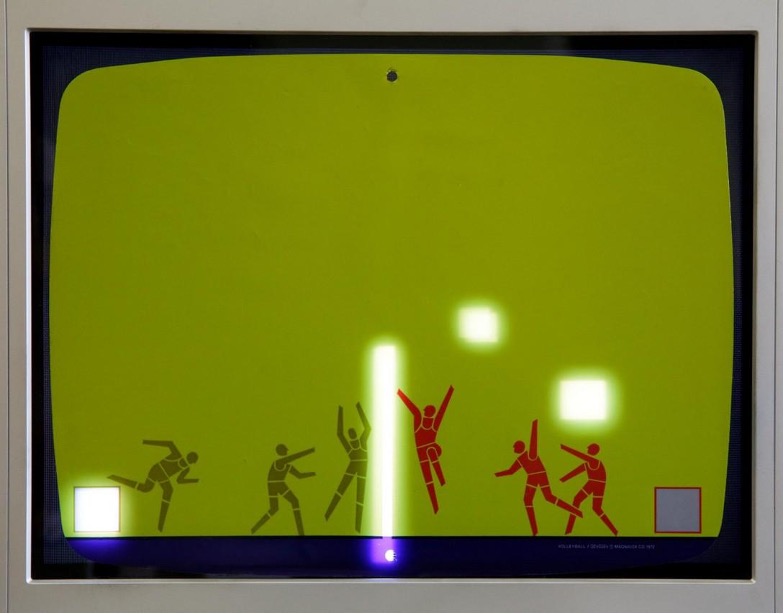
Volleyball, the specific program we analyze here (Figure 1), was one of those six add-on games.
[1]
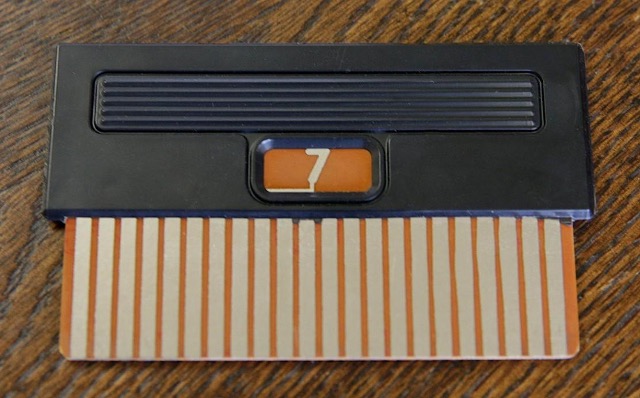
It was commercially released in its own product box packaged with a game card (#7),
an instruction sheet, and an overlay in two sizes (for 19” and 26” televisions).
Like almost all other Odyssey games,
Volleyball requires the players to place a thin plastic overlay over their television screen
to provide additional (static) graphics for the on-screen environment and to produce
various optical effects such as altering the color of the television’s graphics, hiding
them with opaque layers, or brightening them with clear sections.
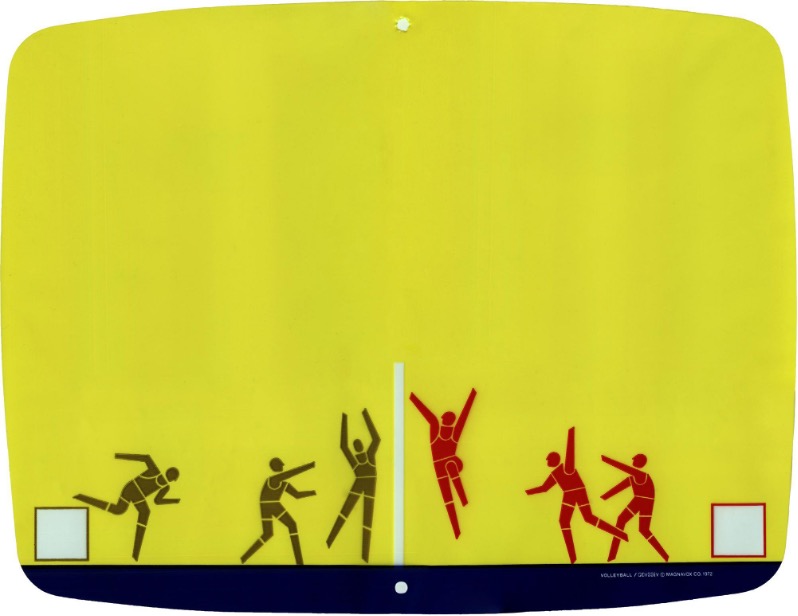
Volleyball’s overlay is relatively simple, composed of a single color background, serve locations,
net location, and images of volleyball players in action (Figure 1). Judged by number
of components, this was the sparest game in the pack. We’ve chosen to analyze this
particular game not because it was especially popular or influential, but because
it is representative of analog programming at the time, makes use of many of the Odyssey’s
capabilities, and possesses a number of unique features that we consider particularly
illuminating of both the differences and intertwining between analog and digital systems
In particular,
Volleyball is a useful object with which to explore the gap between the simulation produced
by coded games and the actual milieus and processes to which they refer.
In order to explore the relations between code and world, staged by Volleyball and the Odyssey, we will consider and demonstrate several symbolic schemas for representing
the game’s code, each illuminating a different “level” of operation, scale, and abstraction.
First, we examine the Odyssey’s hardware, in which much of its digital logic and analog
computation is encoded as a series of circuits and flows. Second, we consider Volleyball’s code as a series of mathematical functions that link hardware to symbolic operations.
Third, we demonstrate the logic flow layer of the program using analog computation
notation (“program blocks”) and compare this to coding in today’s digital programming
languages. Finally, we consider elements of the game’s algorithm that are addressed
directly to players and require various real-world bodies, objects, and interfaces
to fully run the program’s main loop. Along the way we examine the affordances of
each symbolic system and ontological layer for revealing meaning in the code, as well
as the limitations of each.
We hope that this discussion will also serve as a primer on the nearly forgotten media
ecology of analog computation and programming. We argue that Volleyball “plays in the gap” between simulation and reality, digital and analog, code and world,
and thereby provides us with an exciting object with which to think through not only
the historical birth of home video games (as precursor to home computing), but also
the material affordances and transitive capacities of all code, analog or digital.
This examination of an Odyssey game will lead us to a characterization of its programming
as assemblage-making —a kind of code that runs on different levels simultaneously,
accepts feedback from their unique properties, and composes new channels for communication
between levels. We hope that this vision of code as material, multiscalar, and porous
what we call multi-level coding, will inspire programmers to explore similar modalities
in the future.
Level 1: Hardware
Hardware, or an active substrate capable of running code, must be able to receive
signals, transform them in accordance with their content, and usually produce some
sort of output, either digital (such as a string of serial data) or analog (such as
light emitted from a screen or sound emitted from a speaker). Media theorist Friedrich
Kittler, in his notorious essay, “There is No Software,” notes that “all code operations,
despite such metaphoric faculties as call or return, come down to absolutely local
string manipulations, that is, I am afraid, to signifiers of voltage differences”
[
Kittler 1997, 150]. In Kittler’s formulation, code functions culturally to conceal its own signification,
to “obscure hardware with software,” a kind of conjuring trick pulled off through
the stacking of many “interfaces between formal and everyday languages” [
Kittler 1997, 150]. If code’s actual signifieds are physical state changes, software misdirects
its human users to invest meaning elsewhere, in an abstract, symbolic space. This
seems to disturb Kittler because code pretends to a universality (a Turing machine)
that subsumes and transcends the physical world when in fact it engages only a small
portion of it: that which is programmable using discretized hardware configurations.
Kittler goes on to argue that nonprogrammable systems (continuous or analog structures
such as “waves,” “wars,” and “beings”) are not only more characteristic of “the world,”
but also far more dynamic in connectivity and growth. Code, he implies, is inadequate
to represent or capture such processes because it is functionally limited by the discrete
hardware to which it reduces, and “only computations done on nonprogrammable machines
could keep up with (the continuous systems of the world).” Kittler’s argument is
more nuanced (and perhaps beguiling) than is usually acknowledged, or indeed that
his essay’s polemic title would suggest. While there are a number of ways to answer
(or dismiss) his claims, we would like to explore them in a novel way by examining
code that performs its computations on precisely the sort of “nonprogrammable machine”
that Kittler seems to rule out: the Magnavox Odyssey, a platform whose physical substrate
is fundamentally continuous, or analog, rather than discrete, or digital.
The Odyssey is not constructed out of silicon chips that quantize voltages in on-off
gates at discrete times. Rather, it consists of an electrically conductive set of
nested circuits that elicit continuous and discontinuous waves and modulate these
signals at every moment, thus retaining their continuous (analog) nature. Nonetheless,
it processes sets of instructions that deftly weave digital logic with continuous
processes by converting between the two internally and providing output signals that
retain both characters. A fully digital computer can, through numerical integration,
analog-to-digital converters, and digital-to-analog converters, approximate behavior
of analog systems; yet as Kittler and audiophiles who shun digital formats for vinyl
have long argued, approximation is not ontology, and what is at stake is being, or
presence, itself.
The Odyssey is, at its hardware level, an analog device, and yet it is programmable.
As such, it is a member of a class of devices once significantly more common than
digital computers, yet contemporaneous with them: the electronic analog computer.
The general neglect of analog computers, by both popular culture and scholars, is
perhaps at least partially attributable to a “progress narrative” constructed by the
nascent digital computer industry in the 1950s for marketing purposes, which was enthusiastically
taken up by the popular press of the time. This discourse suggested, contrary to
professional discourse, that digital computers were superior successors to analog
computers rather than contemporaneous machines suited to different sorts of tasks
[
Kline 2019]. Part of the allure of the digital machines was that they seemed analogous to brains
and were in fact usually called “electronic brains.” The analog computer, as we will
see, functions by programming dynamic systems that were analogous to those about which
they computed. Ironically, then, their greater analogic flexibility rendered them
narratively less sensational than digital computers, with their single striking analogy.
This asymmetric popular coverage has been inherited by scholars today. Another discursive
trend has also served to diminish the historical visibility of analog computing, and
that is our contemporary popular characterization of code. Code captures the imagination
because it is expressed in linguistic terms, yet opens a communications channel to
complex machines. In the popular conception, code is associated with digital computing
only. We are, in this article, attempting to correct both the historical elision
that led to the misconception that only digital platforms are coded systems.
The first modern electronic analog computer, the special purpose “Polyphemus,” was
invented in 1938 by George Philbrick, then refined into general purpose versions in
Germany and the USA during World War II [
Holst and George 1982, 144]; [
Ulmann 2019, 1763]. Electronic analog computers use electricity as an “analog” or dynamic model
of real world systems being studied (such as planetary motion, economic behavior,
stresses on bridges, and the aerodynamic performance of aircraft designs). As one
popular guide to analog computing from 1952 puts it:
In these devices physical quantities, such as voltages and shaft rotations, are made
to obey mathematical relations comparable to those of the original problem. The physical
quantities, or machine variables, which may be conveniently varied and measured in
the laboratory, must, then, behave in a manner analogous to that of the original variables”
[Korn and Korn 1952, 2].
In the case of electronic analog computers, electricity itself was the analogous substrate
employed. Users would program the computers to mimic the behaviors of the systems
they wished to study and then input variables to compute how the system would behave.
Until about 1970, analog computers were significantly cheaper, smaller, and faster
than digital computers and saw widespread use in business, government, and universities
[
Korn and Korn 1952, 2]; [
Gilliland 1967, 1–1]. We’ll explore the analog computer further in the following sections as we
follow
Volleyball’s code up to higher and higher levels of abstraction. First, however, we must take
a look at the Odyssey, which we will regard as a special purpose electronic analog
computer.
The Odyssey’s prototypes were developed by a team of engineers led by Ralph Baer at
U.S. defense contractor Sanders Associates from 1966 to 1969 [
Baer 2005]. Because the console was designed to play real-time interactive games and remain
inexpensive enough to be released as a consumer product, the use of analog computing
circuitry was a logical choice: not only were the engineers at Sanders extremely familiar
with such implementations, but analog computers’ speed of operation suited the real-time
gameplay that Baer desired.
[2]
Baer’s “TV Games” console, however, would be custom built to dramatically reduce the
cost and complexity of the device, eliminating all circuitry that didn’t serve to
enable the suite of games imagined by its engineering team. Nonetheless, despite
its limited internal circuitry, the Odyssey prototypes retained a high degree of user
programmability via a bank of switches that served to re-route the internal circuits
to produce many different possible machine states, or analogs of physical behavior.
Magnavox engineers, as they refined the design from 1970 to 1972, replaced this interface
with a card-based system. Programs were pre-manufactured into circuit board based
“game cards” that were then inserted into a slot in the console. Each card contained
44 pins that could be interconnected in numerous different ways. Thus, the end user
need only insert the proper numbered card to load a particular program. This design
proved highly influential in the home console industry that the Odyssey spawned.
The game
Volleyball that we are analyzing here used game card #7 (Figure 2).
Internal Odyssey circuitry uses a nominally 5.6V single ended power supply. Its circuitry
is organized into ten modules (circuit boards) that take the form of removable “daughter”
cards plugged into slots on the Odyssey motherboard. Signals are passed from daughter
card to daughter card in a variety of ways including analog and digital signals. The
motherboard mostly consists of direct connections between daughter cards. However,
it also contains circuitry for adjusting spot size, wall size, ball speed, a latch
circuit (“crowbar”), and an RF modulator to encode its video signal into the format
required by consumer televisions of the period. In Level 2, we will discuss specific
sub-circuits within the Odyssey and the differential equations that describe them.
In today’s digital computers, electrical components on motherboards are used to condition
electrical current to power various devices (from processors to amplifiers to LCD
arrays) or to carry digital signals from one processor or memory bank to another.
In analog computers, electrical components become the processors themselves: by altering
the current or voltage of electricity within their circuits over time, they alter
the information contained in those flows. Each banal electrical component, then, becomes
an information processor analogous to a line in an equation or a digital programming
language. Let’s take a look at several common components.
Resistors reduce the available voltage by converting some of the available power into
heat. They follow Ohm’s law, which states that the current through the device increases
linearly with the voltage across it as determined by the device’s resistance [
Horowitz and Winfield 2015, 4]. Due to their extraordinarily linear behavior, they can predictably convert certain
states to others, and are particularly useful for creating relationships between multiple
time-varying voltage and current sources. A particularly interesting case is potentiometers
which are resistors whose resistance can be internally changed by rotating a physical
mechanism. As we will see below, potentiometers enable user input in the form of
rotating knobs.
Capacitors follow a different type of model which has a time dependence. In capacitors,
the rate of charge (voltage increase) increases linearly with the current through
the capacitor. The ratio is determined by the device's capacitance [
Horowitz and Winfield 2015, 19]. Thus, capacitors can act as timers, producing repeatable change over time as
they charge or dissipate.
Diodes have substantially different behavior than resistors and capacitors because
the current through the device is affected by the direction of the voltage across
it. A diode can be thought of as a one-way valve for current with a minimum voltage
required to “push” the valve open [
Horowitz and Winfield 2015, 31]. In reality, the equation governing the relation between voltage and current
in a diode is very complex. We will use a piecewise linear model that combines the
Constant-Voltage-Drop Model with the Small-Signal model for the discussions in Level
2 [
Sedra and Smith 2015, 190–200].
The last component we consider in this article is the transistor, which can be thought
of as an electrical switch, similar to the spigot of a garden hose. It is a three-terminal
device, where one terminal (called the base), allows turning “on” and “off” the flow
of current between the two other terminals (collector and emitter). The Odyssey uses
NPN and PNP Bipolar Junction Transistors (BJT). BJT’s are current controlled devices,
meaning the current through their “base” terminal determines how much current can
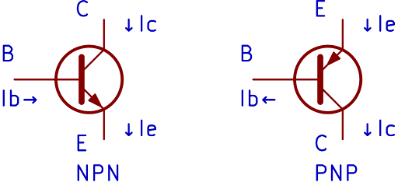
flow through their collector and emitter terminals. In Figure 3, we show the symbols
for the NPN and PNP transistor as well as the directions of current through the “positive”
terminals [
Horowitz and Winfield 2015, 71, 76].
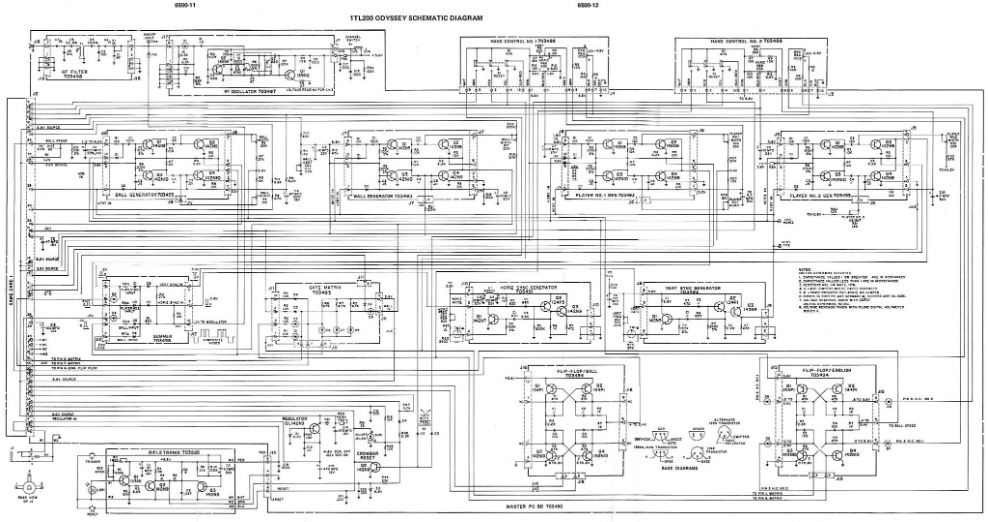
The motherboard hosts ten daughter cards. There are four spot generators (ball, wall,
player 1, player 2), one summer, one “gate matrix”, one horizontal sync generator,
one vertical sync generator, and two flip-flops (Figure 4). Each of these daughter
cards is constructed using a combination of the basic electrical components detailed
above. For example, the sync generators use capacitors to produce regular timed signals
to sync with televisions, the flip-flop uses transistors to switch between two possible
states (directions the in-game ball can travel), the spot generators use transistors
to draw the vertical and horizontal boundaries of player avatars, a ball, and/or a
wall, and the summer uses a series of diodes to combine these various shapes into
a single video signal. The motherboard has one forty-four pin edge connector which
accepts the “game card.” All game cards consist solely of physical connections between
the forty-four pins. The simplest example is a connection from pins two to four which
provides power from the batteries or wall jack to the internal circuitry of the Odyssey.
This function harnesses the analog nature of the console to both power up the machine
and start the game program simultaneously. The motherboard has two twelve-pin Molex
connectors for two controllers. The notable parts inside each controller are three
three-terminal potentiometers and one three-pole,
[3]
double-throw pushbutton switch.
The game card for
Volleyball engages the following functions (Table 1):
| Pin Connections |
Function enabled |
| 2-4 |
Connect supply voltage to 5.6V regulator input (power all circuitry) |
| 6-8-10-14-16-20-22 |
Supply 5.6V to Player 1, Wall, Ball, Wall Shorten Resistor, Wall Widen Resistor. Power
gate matrix output resistors. |
| 13-27 |
Connect ball-wall contact signal to crowbar input (motherboard latch) (setting the
conditions under which the ball disappears). |
| 23-25 |
Connect crowbar active signal to ball disable (causing the ball to disappear when
the above condition is met). |
| 30-34 |
Flip-flop bidirectional resistor output to ball horizontal direction |
| 31-39 |
Player 2 on screen to gate matrix player 2 input |
| 35-37 |
Player 1 on screen to gate matrix player 1 input |
| 42-44 |
Put resistors in parallel to increase ball vertical response speed |
Table 1.
Table of
Volleyball game card’s (#7) connections and functions.
At the hardware level, this is how Volleyball works: The game card “switches on” four spot generators, each of which produces
an on-screen element: two square “players” (simulated volleyball players), one vertical
“net” in the center of the screen, one small “ball,” and a resistor that changes the
vertical timing of the wall-spot generator so that the normally infinite height “wall”
spot is shortened so it resembles a “net”. The ball’s horizontal and vertical positions
are controlled by the charge in two respective capacitors. The charge of the vertical
position capacitor is set by the “English” potentiometer (which appears to players
as the “English” knobs on their controllers) of the most recent player to make contact
with the ball. The charge of the horizontal position capacitor decreases or increases
based on the flip-flop’s state, propelling the ball signal horizontally across the
screen. At the same time, the gate matrix continuously monitors the ball, wall, and
player signals from their respective spot generators. If any two are “on” at the same
time during the electron beam’s scanning of the TV screen (represented internally
by the Odyssey’s oscillators that produce the NTSC timing signals), then the two objects
have made contact on the screen. When the gate matrix detects such contact between
a player and the ball, it sets or resets the flip-flop in order to change the direction
of the ball’s horizontal travel and transfer control of vertical position to the correct
English potentiometer (player controller).
This process, by which a collision between the ball and an on-screen player is detected
and causes the ball to “bounce” in the opposite direction, is a perfect illustration
of the conjoining of the digital and analog in the Odyssey’s logic. The electrical
charge stored and dissipated in the horizontal position capacitor is a purely analog
phenomenon, like water splashed into or draining out of a tidepool. This propels the
ball along the screen. But at the same time, the position of the flip-flop circuit
is binary: it is in either one state or the other (depending on the particular state
of its transistors), and that state determines whence the ball flies. Thus, digital
states are manifested in continuous physical properties within the console.
The summer daughter card combines the signals of the four different onscreen “spots,”
passes this “composite” signal to the RF modulator daughter card and subsequent RF
filter and the output is sent to a raster scan device (consumer television). Thus,
the console’s video output is not merely the final step after the position of each
graphical frame has been rendered digitally by the system, as it would be with most
graphical outputs today. Here, not only does the Odyssey draw each frame line on
the fly, like the later Atari VCS,
[4]
but in addition, the gate matrix monitors the spot generators to determine if any
are on simultaneously at a given position of the scanning beam. As we noted above,
this information is used to detect the coincidence of particular elements — such as
when the ball hits a player spot.
The Odyssey contains no circuitry to arrest the movement of the ball before it exits
one side of the screen or the other. This presents a potential problem for a game
meant to simulate the real-world sport of volleyball, in which making contact with
the net causes the ball to drop to the ground (physical event) and exit play (logical
event). However,
Volleyball simulates these events through the implementation of a “crowbar” circuit located
on the motherboard, routing the ball’s signal through its output terminal. The crowbar,
physically constructed from a thyristor, is best described as a latch [
Horowitz and Winfield 2015, 208]. During normal operation the crowbar is off. When a signal pulse is received
on the crowbar’s input port it activates and connects its output pin to ground. The
crowbar then uses the current flowing through it (from the output terminal to the
ground) to keep itself active (and the output almost shorted to ground) indefinitely.
To bring the crowbar back to the inactive state, the current flowing from output terminal
to ground must be interrupted. The crowbar reset circuitry (hardwired to the Reset
button on the Odyssey’s controllers) accomplishes this by shorting the current away
from the crowbar’s output to ground along an alternate path. Without current flowing
through it, the crowbar becomes inactive due to lack of electrical energy. In
Volleyball, Game Card #7 connects the input and output of the crowbar circuit such that coincidence
between the ball and wall (“net”) spots activates the crowbar, which then renders
the ball invisible by shorting the ball’s active signal to ground. Momentarily, pressing
either controller’s Reset button resets the crowbar (rendering the ball visible again).
Additionally, the losing player’s Reset button flips the flip-flop to its opposite
state, thus resuming the program and sending the ball flying back onto the screen.
The moment the ball makes contact with the net, then, it seems to the players to disappear
from the screen, simulating arrested movement (the physical event of a volleyball
hitting a net). At the hardware level, however, the ball’s signal is still present
— it has been pulled low by the crowbar circuit but not all the way to ground (0V).
Thus, its signal possesses enough voltage to trigger the flip-flop but not enough
to enable the ball’s signal to be added to the console’s output (television) signal
via the summer daughter card. To the user, it appears as if the ball has been eliminated,
but in actuality it is still invisibly bouncing back and forth until it misses one
of the player spots and finally exits the screen. As we will discuss in Level 4,
the logical event of halted play must be enacted by players (prompted by the phenomenological
event of the ball becoming invisible) since it isn’t enforced by the console’s logic.
This invisible ball is a pseudo end-state to the program: it is technically still
running on the hardware, but appears to the players to have stopped, awaiting their
input (the next serve). Thus, the “netted” ball is something of a ghost, actively
haunting the system even after the players believe it to have expired.
The Odyssey’s designers felt that this was an adequate physical approximation of a
game-stopping consequence (as we’ll discuss further at the subsequent levels) that
could be coded without undue expense or complexity. It is an example of hardware
economizing combined with creative programming: in Volleyball the crowbar function is used to simulate the ball hitting the net; whereas, in other
games the crowbar is programmed to simulate a torpedo hitting a ship (Submarine), an airplane being shot out of the sky (Dogfight), a cat catching (and presumably eating) a mouse (Cat and Mouse), or a spaceship burning up in the sun (Interplanetary Voyage). These conditions have very different meanings to players in their different contexts,
even if they all arise from the same hardware function, programmed differently. We
will need to look at higher levels of this code to trace out the process by which
hardware states are transformed into symbolic meaning, but already we have seen that
in analog computing, the hardware layer is a direct substrate for programming. Rearranging
or reconnecting components in different configurations produces different electrical
behavior, enabling new sets of interactions, input, and output. While this is clearly
a continuous — that is, analog — process of altering current and voltage over time,
it is not true that the analog and the digital cannot coexist. The crowbar, the gate
matrix, and the flip-flop subcircuits all utilize continuous flows to encode digital
logic in definite states (invisibility, coincidence, and direction, respectively).
Fully discrete hardware (i.e., digital processors) is not required to implement digital
logic because digital logic can directly interface with analog signals. It may come
as a surprise that the two can coexist quite productively in the Odyssey. However,
this is what historically enabled the decades-long practice of analog computing.
It is commonplace that higher levels of code (from machine to assembly to language
to scripting, for example) are always more abstract than lower levels of code [
Abelson and Sussman 1996, 491–610]. As we’ll argue, however, this is not necessarily the case in our example:
hardware capabilities can reach high levels of abstraction (as the crowbar example
shows); however, higher levels are not necessarily more abstract than the hardware
level. A great deal of
Volleyball’s program is coded directly at the hardware level: game card #7 connects the inputs
and outputs of the circuits we have described, producing these effects. This does
not mean, however, that there are no higher levels of code. After all, what we have
described so far is primarily the movement of electrons through circuits. Higher
levels of this codified system, each of which represents a different way to characterize
Volleyball’s code, were used to program the game, and can be uncovered again through reverse
engineering in order to reveal much more about the game’s nature, how it functions,
and what its programming assumed about its players.
Level 2: Mathematical Operations
In order to understand the formal relationship between hardware platform (Level 1,
above) and logic flow (Level 3, below), we must explore the relation of each to mathematical
formulae. This is the secret to the historical success of the electronic analog computer.
These computers were not only used to model physical phenomena to aid in the design
of everything from aircraft to atomic reactors but also to solve equations that would
be far too time consuming to solve manually or via digital computers of the time.
As Granino Korn noted in 1962, “Unlike digital computers, most analog computers employ
distinct computing elements for each mathematical operation required to solve a given
problem (parallel operation). Parallel operation is an essential reason for the very
high computing speeds possible with d-c analog computers” ([
Huskey and Korn 1962, 1–4]), (emphasis in original). Put simply, analog computers could perform, at very
low levels of abstraction, many mathematical equations directly. Digital computers,
by contrast, could only sequentially perform a fixed set of operations, usually limited
to addition and subtraction [
Brown and Vranesic 2009, 249–295]. Thus, in digital computers, hgher order operations had to be built up
from these lower level ones, necessitating higher levels of software abstraction.
In contrast,analog computers could perform calculus directly at the hardware level
[
Korn and Korn 1952, 8].
A complete mathematical formulation of Volleyball would serve as a legitimate low level expression of its code, but it would require
many pages of this journal. Thus we will only undertake a complete description of
the code at a higher level (Level 3). In this section, we will examine the relationship
between hardware and logic to demonstrate, for two of Volleyball’s functions, how code can be expressed as mathematics that blend continuous time,
continuous values, and discrete meaning.
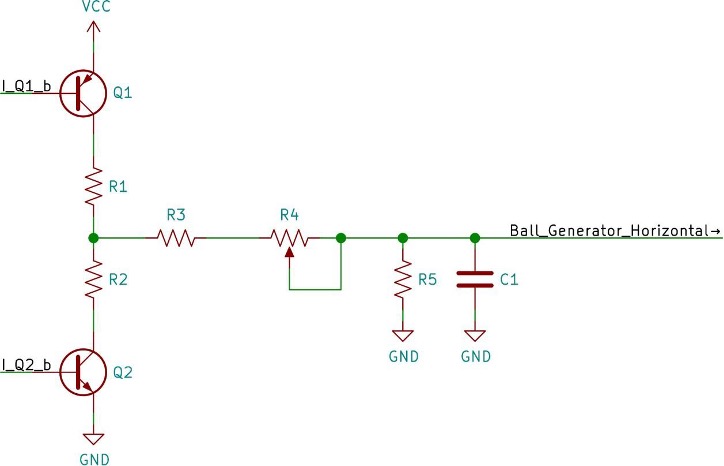
The first example we consider is the regulation of the ball’s horizontal position
by an “integration” circuit in Volleyball (Figure 5). On the left are two transistors that are part of the flip-flop that tracks
the direction of the ball. Their output is the “direction” that charges or discharges
the horizontal position capacitor.
In Figure 5, the voltage between node Ball_Generator_Horizontal (abbreviated Vb) and
ground defines the horizontal position of the ball. Lower voltage means the ball is
further to the right of the screen. Because this differential equation describes a
continuously variable function, there are an infinite number of possible ball positions
described by this equation and instantiated during the running of the Volleyball program. This is strongly in contrast with digital systems that can only support
quantized positions on the screen
The flip-flop has two states, “left motion” and “right motion.” In the configuration
shown in Figure 6, the transistors are complementary, meaning if one is off, the other
is on. In the “right motion” state, the base of Q1 has a high voltage comparable to
its collector, meaning that a current flows through its base pin that is too small
to turn it on. Meanwhile, Q2 has voltage higher than its emitter applied to its base,
great enough that the current through it’s base pin turns it on. Using Kirchoff’s
Voltage Law (KVL) and Kirchoff’s Current Law (KCL)
[5]
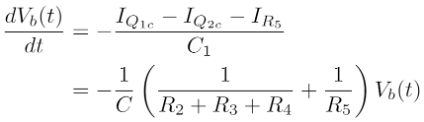
, we can write a differential equation for the voltage at Vb for the case of “right
motion.”
Assuming the initial position is beyond the left side of the screen (Vb is a high
voltage like Vcc) then the equation above has the solution [
Tenenbaum and Pollard 1985].
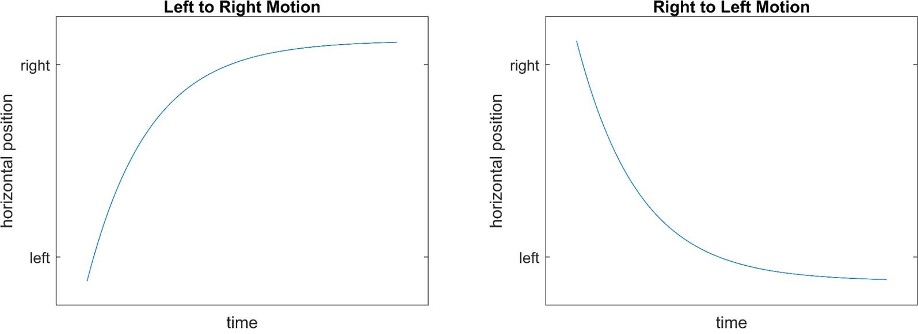
In the case of “left motion” starting from beyond the right side of the screen (Vb
is a low voltage like 0) then the solution looks different, but is qualitatively the
same as shown in Figure 6.
In general, the solution to a differential equation cannot be expressed as an easily
evaluated equation (closed form), as was done for Vb above. When available, such solutions
instantly provide a qualitative description of a systems behavior in all conditions
and are thus very useful for designing a circuit’s behavior. In this example, such
a solution was only available because the transistors were assumed to be in a particular
operating mode which rendered the considered circuitry linear. While more complicated,
nonlinear differential equations can be characterized using simulation or advanced
techniques from dynamical systems theory [
Khalil2002]. using such techniques to qualitatively describe a system as large as the Odyssey
would be an incredibly difficult and labor intensive. Thankfully, individual sub-circuits
can be described qualitatively and “sending” sub-circuit terminals can be connected
to “receiving” sub-circuit terminals without greatly affecting the “senders” behavior.
This property makes it possible for the analog programmer to design behaviors without
considering the entire circuit at once. In the extreme case, it makes the abstractions
later described in Level 3 possible. This illustrates the complexity and nonlinearity
of analog systems.
When used as substrates for computing, these dynamic systems can be harnessed to form
analogs of other complex, nonlinear systems; this was the principle insight that lead
to the field of analog computing. Digital systems, by contrast, are necessarily simplified
models of complex systems, built up through code from simpler to more complex forms.
Put another way, digital computing at this level — which we might call assembly code
— must combine low-level hardware states (binary) into more complex mathematical functions.
To cause a ball to accelerate across the screen, as in this example, the code must
combine many simple arithmetical functions into a differential equation, then apply
that equation to a pre-defined grid of positions to move the ball across the screen
from pixel to pixel. The analog computer, as we have seen, begins with a differential equation that simply describes the physical behavior of electrons
within the circuit. Then, while the digital system must somehow simplify the equation
it has built up, approximating positions within limited matrices, the analog computer
simply feeds its signal into an analog output. The granularity may get reduced by
the output device (the phosphor pattern on a CRT television, for instance), but such
resolution reduction is not part of the machine’s code.
The analog computer converts physical states into symbolic or logical ones through
equations that describe that physical behavior, while the digital computer begins
with simple data, then must build up ever more complex instruction sets to construct
a set of equations to transform that data into results that can be output. In the
analog computer, dynamic states are translated into the symbolic, while in the digital
computer, the symbolic is constructed piecemeal, always under conditions of simplification
and approximation.
At the next level we will examine some of the implications of this difference for
the programmer. First, however, we’ll look at one more example of the Odyssey’s physical
states translated into a symbolic (mathematical) model: the gate matrix’s detection
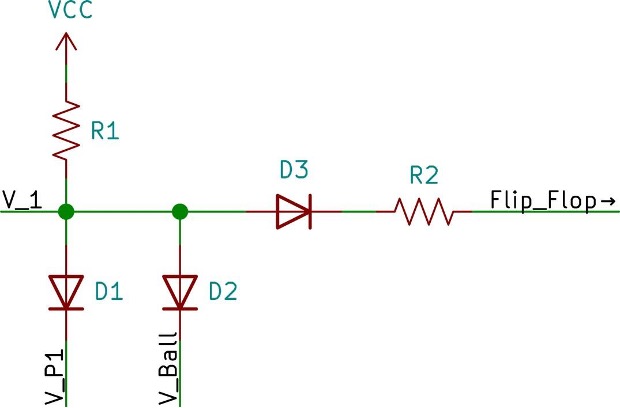
of player and ball contact. The sub-circuit considered is shown in Figure 7.
We can view the circuit as mapping the two inputs (VP1, VBall) to one output (Flip_Flop).
The line VP1 has a high voltage, close to Vcc, when the Player 1 spot is being drawn
on the screen. The same applies to the VBall input. Meanwhile, the output is connected
to the flip-flop that controls the directional motion of the ball. Current through
R2 triggers the flip-flop and changes the direction of horizontal travel of the ball.
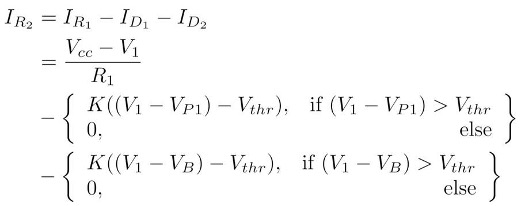
Using the circuit laws and models mentioned thus far, the equation for IR2 as a function
of VP1 and VBall can be expressed in piecewise linear form.
In order to simplify this equation, we have to consider the four possible different
cases encompassing all the possible combinations of the voltages on VP1 and VBall.
| VP1 |
VBall |
ID1 |
ID2 |
V1 |
| 0 |
0 |
~0.5*(Vcc - Vthr)/R1 |
~0.5*(Vcc - Vthr)/R1 |
~Vthr |
| Vcc |
0 |
0 |
~(Vcc - Vthr)/R1 |
~Vthr |
| 0 |
Vcc |
~(Vcc - Vthr)/R1 |
0 |
~Vthr |
| Vcc |
Vcc |
0 |
0 |
Vcc - IR2R1 |
Table 2.
Table of solutions for ID1, ID2, and V1 given all possible combinations of VP1 and
VBall.
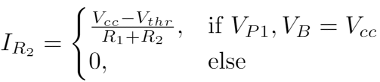
Thus, across the four possible combinations of VP1 and VBall , V1 there are two possible
output values. With this observation, we can write down a simpler expression for IR2.
In essence, the diodes perform an AND operation between VP1 or VBall and send the
detection of coincidence to the flip-flop.
These equations describe a system of interactions that incorporate both continuous
(analog) functions and discrete (digital) ones. A continuously variable function
(ball position in time) acts on a threshold equation to determine two binary states:
the coincidence between a player spot and the ball spot, and the state of the flip-flop,
which determines which of the two directions the ball travels in.
Unlike at the other levels, here we can see that the mathematical operations clearly
specify the behavior of Volleyball’s physical instantiation in hardware. Similar to assembly code for digital computers,
these equations determine the specific states of physical components — that is, they
describe the behavior of physical systems. However, unlike digital computers, there
is almost a one-to-one mapping between physical states and something perceivable by
the player. These equations mix continuous with discrete, analog and digital. They
describe discrete states of the machine, but as piecewise continuous functions. Thus,
at this critical level of transformation between hardware substrate to abstract logic,
there is no definitive move from the analog to the digital; both are operative simultaneously.
What we observed at the hardware level, then, holds even at the level of translation
into the symbolic.
Thus this level is unique in its affordances for the programmer. For example, if the
game designer (programmer) wishes the ball to travel at a particular speed, then the
equations discussed, and specifically the solution to the differential equation, can
guide the choice of resistors and capacitors that accomplish that goal. Mathematical
notation thus provides us with a glimpse of the transitive nature of Volleyball’s code: it operates upon the material substratum of the console, while remaining
symbolically manipulable by humans at other scales. This is the reason that code can
jump from scale to scale, linking levels together in communicative feedback loops.
Mathematical equations capture an essential aspect of a code’s meaning: the formal
rules by which values are transformed as they pass from one level of abstraction to
another. These are passage points where code can intervene in scalar transformations.
We typically think of mathematics in code as primarily attempting to capture something
about the analog world (encoding the continuous into the discrete) or performing calculations
on other stored numbers. In this case, however, our glimpse at Volleyball’s underlying equations reveal an intricate entanglement of analog and digital functions
that together describe the simplest of on-screen transformations in the program: bouncing
the ball back and forth across the screen. Here there can be no delineated point at
which the analog (phosphors on the screen, current in circuits) has been transformed
into the digital, a threshold beyond which all coded manipulations are in a simulated,
digital world. Rather, analog and digital functions rely upon each other and are interwoven.
The mathematical components of code exert control over the system, but the system
cannot be thought of as a mere simulation of the real. We could not claim that the
ball in Volleyball is definitively digital or definitively analog. Rather, it appears to bounce between
the two.
In this sense the ball in
Volleyball is a unique object in early gaming and early programming, and serves as an icon or
mark of transitivity: it moves of its own accord (according to the equations we’ve
related here); it can be made to bounce, to halt, to disappear, to soar, or slam downward
like a missile.
[6] The ball is a boundary object that can bounce between levels of abstraction, as
both an object operated upon by code and as code operating on its various environments.
These sorts of liminal coded objects are rarely considered as such, but perhaps that
is because the equivalent level at which they can be resolved, assembly, itself receives
little attention. Still, we could look to other boundary objects like wavetable synthesis,
scanners, and quartz oscillators as ubiquitous digital equivalents.
The liminal quality of Volleyball’s ball provides an interesting response to Kittler. Because the ball is both analog
and digital, material and codeable, we can accept Kittler’s argument that continuous
or analog structures are more characteristic of the physical world as a whole while
rejecting his assumption that they are “unprogrammable.” That is, we can accept his
argument that digital systems capture or represent only a small slice of the world
and obscure even that through symbolic abstraction but also reject his dichotomy between
continuous and programmable. Volleyball’s ball demonstrates that continuous structures are very much programmable, and that
code and continuous material substrate can sustain reciprocal, non-reductive relations.
Let’s follow this analog-digital hybrid volleyball on its path as it weaves together
multiple scales, multiple procedures, and multiple bodies.
Level 3: Abstract Logic
When programmers write code and humanities scholars read it, the code encountered
is usually expressed in a high-level programming language. These languages are powerful
because they retain the precision and machine readability of lower levels of code
and at least some of the features of natural language. That is, they use words and
syntax borrowed from natural languages (usually English) wherever possible to aid
in the composition and human readability of the coded program. Code written in a
programming language is semantically unique in that it is addressed to two audiences:
machines and humans.
Programming languages are not available for analog coding. This is because the machine
is an analog of a physical system, not a linguistic one. While any analog program
can be approximately described in natural language (as we have attempted thus far),
there is no necessary connection between sequences of machine instructions and linguistic
sequences that would render language a particularly suitable form for coding analog
machines. Historically, analog computer programmers tended to use a semi-standardized
block diagram notation system to record, check, and disseminate their programs. Similar
to digital programming languages, block diagramming standardized code so that it could
be “set up” (analogous to compiling) on different architectures and understood by
different human programmers. Additionally, the diagrams served as a record of the
code fed to the machine, just as today source code is sharable, archivable, and readable
outside of its particular expression when run on its intended platform.
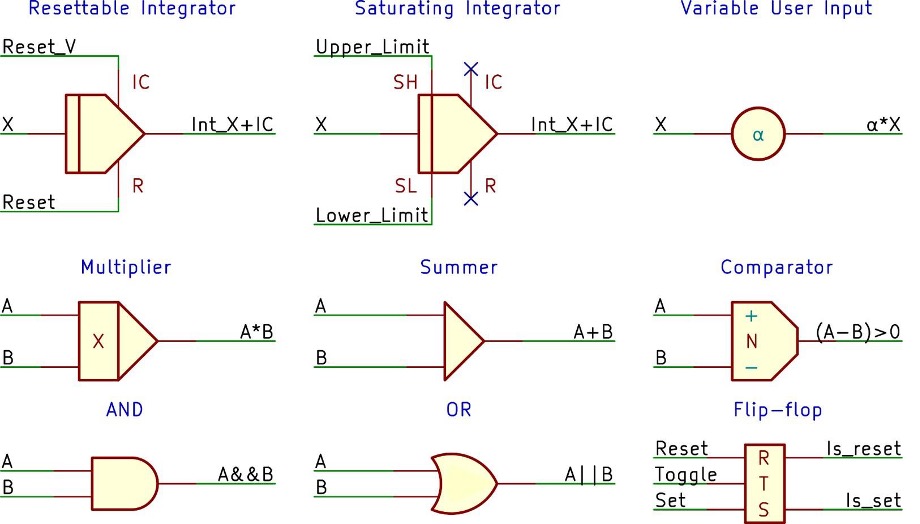
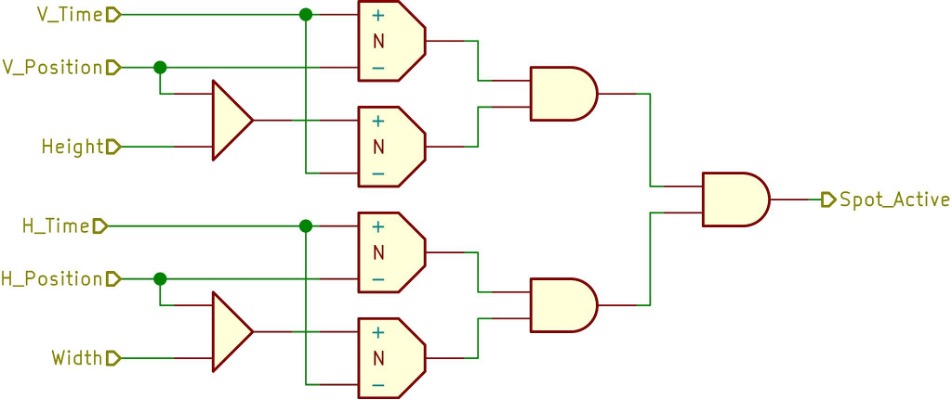
Block diagramming essentially visualizes the logical flow of a program. Each block
simultaneously represents a logical operation and a hardware component. Figure 8
includes nine basic programming blocks closely adapted from the Handbook of Analog
Computation [
Gilliland 1967]. These are the building blocks of
Volleyball’s code.
These program blocks make intuitive sense to the programmer, and also convey precise
instructions to the machine. To recall our previous example, IF the ball makes contact
with the net, THEN it will disappear. Using program blocks, this could be represented
using an AND block to detect coincidence between the ball and the wall and flip-flops
which latch upon receipt of the AND gate’s output in order to make the ball disappear
for the remainder of the program. Every logical operation that comprises a program
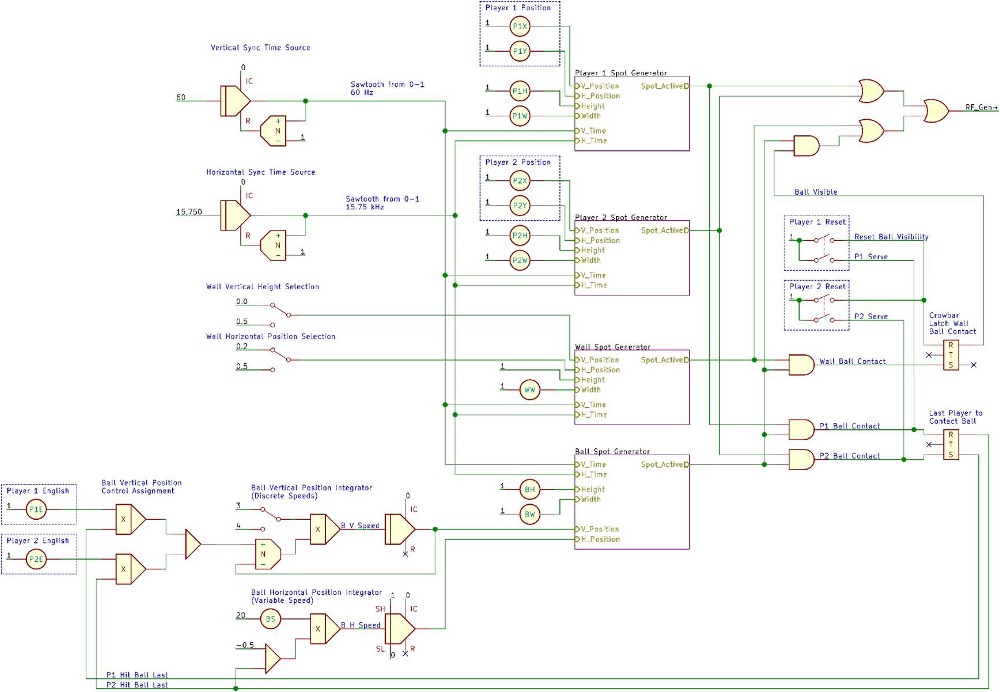
can be diagrammed in this fashion. Volleyball is simple enough to have been programmed entirely in its coders’ heads and therefore
Ralph Baer and his collaborators may never have developed a formal block diagram when
designing its logic. Nevertheless, it is quite possible to reverse engineer the program
and formally express it as code, as we have done in Figure 9.
The spot generators indicated in Figure 9 have the following logical structure (Figure
10):
Notating Volleyball in this way reveals a different aspect of the same code we have explored as hardware
and as a series of mathematical equations. Here we notate not the electrical components,
nor a mathematical representation of voltage transformations, but rather the more
abstract level of logical flow. When viewing the diagram as a whole, Volleyball’s larger-scale relational structure is revealed. We may notice, for example, the
centrality of the ball: it is acted upon directly by the players via their controllers
but also subject to a number of conditional branches that govern its state. As players
of the game, we might expect that our avatars, the player spots, are the most central
objects in the program. However, this logical flow diagram alerts us to the fact
that they primarily serve as input to other processes — that is, as triggers. Very
little affects them, while they affect the logical flow in a number of ways.
From a gameplay standpoint, this produces an interactive system that does not render
its playable characters vulnerable to in-game threats: these avatars have free reign
in the world of Volleyball. They primarily act to constrain their principal medium of exchange: the ball.
On the face of it this isn’t surprising: sports games are usually more about doing
things to a ball than avoiding or mitigating pitfalls directed at your avatar. However,
even in this genre of game, avatars in most sports games are highly constrained by
coded conditional branches. For example, we are not aware of a later volleyball video
game that allows its characters to cross over to the other side of the net during
play. The same sort of conditional branch that causes the ball in Volleyball to become invisible when it makes contact with the net typically halts player movement.
No such conditional branch is present in the above program, and sure enough, players
can move their avatars over to their opponents’ side of the court. They can even
leave the court entirely! Thus the logical structure of Volleyball enacts a particular form of player agency.
Granino and Theresa Korn, in their classic 1952 text on analog programming, take pains
to describe the creativity involved in designing any particular analog computer program:
There are usually many possible setups (programs) for a given problem. It will always
be somewhat of an art to find the setup which will result in the greatest possible
accuracy or in the most economical use of the computing elements. Experience as well
as ingenuity will give the operator a feeling for the new mathematical medium, and
one may say that an elegant setup will be aesthetically satisfying as well as practically
useful [Korn and Korn 1952, 22].
Today’s programmers will recognize and relate to the concept of elegant coding: while
there is no single “right” way to achieve particular results from code, there are
various more or less elegant ways to do so through concision, recursion, and creativity.
As Mark Marino notes, “people who do not program often assume that code is like arithmetic,
with symbols and processes that are expressed in the only way possible. However, programming
actually creates artifacts of processes that reflect the selections made by the programmer
from the paradigm of possible options” [
Pressman and Marino 2015, 29].
In the case of Volleyball, these functions could have been implemented in a number of different ways. What
is perhaps most striking is the economy of this program: it makes use of the absolute
minimum number of conditional branches and drawn elements necessary to simulate a
game of volleyball. It is working within the hardware limitations of its platform,
but as one of the core games written during prototype development, it also influenced
those hardware specifications. For example, an extra resistor and its attendant parallel
wiring and connection to the game card edge connector had to be added to the motherboard
in order to implement the program block we have designated as “Wall Vertical Height
Selection” above. This is the function that limits the height of the Wall spot in
order to refashion it into a short volleyball net. Out of twenty-eight commercially
released Odyssey games, only Volleyball actually calls this function (via a trace on game card #7).
Another feature linking hardware with logic flow that is revealed by block program
notation is the vertical and horizontal timing sources built from self-resetting integrators.
Together, the analog output of these circuits represent the X-Y position of the television’s
electron beam and thus sets the timing for the entire program. It is remarkable that
this sense of time is accomplished purely using program blocks. In digital computers
this is not possible, since time is discrete, and must be incremented by some external
source such as a crystal oscillator [
Heiserman 1978, 14], [
Patterson and Hennessy 2014, 33]. Here, by contrast, the bidirectional coupling of analog and digital elements
in the program, their mutual permeability, enable digital events to occur in continuous
time.
Like most code,
Volleyball mediates between human-readable accounts of the world and machine-readable models
of non-ambiguous instruction. Annette Vee describes this dual function of programming
compositionally as “the constellation of abilities to break a complex process down
into small procedures and then express — or ‘write’ — those procedures using the technology
of code that may be ‘read’ by a nonhuman entity such as a computer. To write code,
a person must be able to express a process in hyper-explicit terms and procedures
that can be evaluated by recourse to explicit logic rules” [
vee2017, 22]. While Vee compares the machine-logic structure of code with its linguistic
properties, our block programming notation is primarily visual and networked rather
than linguistically expressed. Does this help (or compel) us to conceive of the human-readable
layer of code, or indeed its composition, differently?
Visualizing logical flow privileges particular machine actions and opens up spaces
for inputs and outputs at other levels of abstraction. This is the level at which
we can study code for its syntactic qualities and topological structures (especially
loops). We can look for linearity or circularity, openings for inputs and opportunities
for outputs. It is the level at which potential is closed and captured for particular
logical structures.
Another characteristic of
Volleyball that is far less apparent at the hardware or mathematical levels, but which is readily
revealed by its programming block diagram, is the precariousness of its main loop
structure. Video game programs typically require a program loop that continually
reads input states, calculates trajectories, tracks progress, remembers inventory
and score, and draws the onscreen graphics and sends them to a frame buffer [
LaMonthe 1995, 34–43]. If the program loop is interrupted (by someone yanking the power plug out
of the wall, for instance), the current state is lost and the program must start over
from the beginning (though it may re-load saved data). In
Volleyball’s program logic, certain timed input pulses continue indefinitely and the positions
of any spots are continuously drawn, but all of the interactive logic of the game
relies on a loop created by successive flip-flop activations. If a flip-flop is not
activated within a particular period of time, the loop terminates. Player spots are
still drawn, but no interaction is possible. To the players, the game has become
inert. No set of computational instructions necessarily repeats as a result of
Volleyball’s logical structure.
If Wilfried Hou Je Bek is right that we should “regard the loop as a species of tool
for thinking about and dealing with problems of a certain nature” ([
Hou Je Beck 2008, 180]) then
Volleyball’s contingent loop is a telling detail in the conceptual flow of this game. In practice,
the “volley” in the game’s title refers to a sustained, repetitive sequence of a ball
bouncing off the left and right players. But as we can readily see, this sequence
can’t repeat without direct player input via the controllers. Our program block diagram
reveals that there is no loop connecting an internal signal to the “Player 1 Position”
composite block in Figure 11. In this sense,
Volleyball has a limited runtime without active input. The code will have run its course once
the ball exits the screen and only uninteresting periodic behavior will be produced
by the system, driven by the oscillations of the vertical and horizontal time sources.
In essence, if no player intervenes, the program grinds to a halt. The ball will
not be returned from off the screen, and will not be automatically served. No demonstration
sequence or player prompt will load. In Alexander Galloway’s useful conceptual schema,
Volleyball does not include in its program loop what Alexander Galloway calls “ambiance acts,”
or diegetic actions performed by the machine without operator input [
Galloway 2006, 10]. The program will have halted until a player presses their Reset button, which
begins the program again.
Volleyball’s loop structure represents a way of thinking about code-mediated interaction as
a player loop. Rather than external players merely triggering timed inputs that modify
the specific expressive details of the program loop, which is otherwise internally
consistent and self-sufficient, here the loop requires the analog world in two-way
participation. This program loops through physical space rather than treating physical
space a mere input to be encoded.
This radical form of programming helped to usher in an entirely new form of human-computer
interaction: the video game.
Level 4: Game
In order for Volleyball to be fully playable, its program logic must be supplemented with another, higher
level of code that allows it to cohere as a particular type of program: a game. At
this level, the user is included as part of the program, and its larger operational
context comes into view. For a program that is meant to be a game, this is the level
at which it can be played.
Typically, when analyzing digital code, the user can be bracketed out of the discussion,
assumed as a given, but at a higher level of abstraction than code itself. As Montfort
et al. note, critical code studies is methodologically located in between the scales
of platform studies (underlying hardware) and software studies (processes, users,
and cultural context), even if these scales and approaches tend to blend together
in scholarly work (Montfort et al. 2012, 7). But once again, Volleyballand the Odyssey confound even the fuzzy distinctions between these levels. Just as
the code makes no sense without reference to the hardware level (the medium that embodies
its logic and makes it “live”), so too must we confront the fact that the game doesn’t
even become a game, doesn’t become executable, without reference to a higher level
of abstraction that includes human players in a closed circuit with the signal paths
we’ve been describing, as well as natural language rules that are an essential part
of the program’s instruction set. As we shall see, when analyzing Volleyball, it is difficult to make even an analytical distinction between these scalar levels.
Perhaps the most surprising twist in this game for today’s first-time players is that
the Odyssey doesn’t simulate gravity: the ball is not coded to fall downwards! When
hit by a player, as we have seen, the ball changes direction via a digital flip-flop
and increases its speed through the charging of an analog capacitor, driving it to
the right or left depending on the initial condition before the coincidence of ball
and player. But the ball’s vertical position as it travels is determined by the setting
of a special (third) knob on the player’s controller: the “English” knob. Turning
this knob directs the ball upward or downward. The ball’s upward arc, apogee, and
downward arc, together simulating the effects of gravity, are encoded not by game
card #7, nor any digital or analog logic hardwired into the motherboard, nor by a
differential equation, but rather by two very human-readable sentences on the game’s
instruction sheet: “Each player must use his ENGLISH Control to arch the ball over
the NET and then down into his OPPONENT’S playing court. The ball must be directed
down towards the floor of the court and is not permitted to go off the screen at the
TOP or SIDE” [
Magnavox 1972, 1].
The result, as surely as the insertion of a parabolic equation in a line of program
code, is that the ball tends to arc over the net and then drop down to the bottom
of the screen. Such is the power of code.
The “Set Up” section of the same document instructs the player, as the second step,
to “place the VOLLEYBALL Overlay on the screen” (Volleyball 1972, 1). The overlay
in question is a thin, offset-printed sheet of plastic cut to fit the distinct rounded
CRT screens of 1960s and 1970s television sets (Figure 11). All but one of the Odyssey’s
twenty-eight released games uses a similar overlay. These overlays make use of a
mixture of three optical effects: opacity (via a special opaque layer applied to the
back that blocks all onscreen elements when they pass through the coated area), translucency
(via graphics printed on the front of a frosted substrate), and transparency (non-printed
areas on a clear substrate). The entire Volleyball overlay is translucent: on-screen graphics project through the overlay but pick up
the color printed thereon. The yellow backdrop of the Volleyball overlay tints both the players and ball distinctly yellow, presumably evoking a beach
setting.
The overlay’s design includes two squares. As the instructions explain, the players
must position their avatars inside these “boxes” for every serve. Here, then, written
rules reference and require the on-screen game logic and resulting luminescent shapes,
as well as the physical overlay, which composites two sets of images (those produced
via the cathode ray tube and those statically printed on the plastic sheet). Both
the algorithm (set of instructions) and the elements necessary to execute it span
across multiple media and modalities: graphical overlay (with optical properties of
reflection and refraction), natural language instructions, coded machine behavior
via game card #7 and the various digital and analog circuits it modifies, and human-generated
input governed by the affordances of the Odyssey controller — including the semantic
affordance of the prominent label for its one and only button: “Reset.”
Pressing a button labeled “Reset” in order to serve a ball induces some cognitive
dissonance. Ralph Baer’s final prototype for what was to become the Odyssey, his
“Brown Box,” labeled its corresponding button “Serve.” The Magnavox team changed
the button’s label (though not its function) to “Reset.” The semantic difference
is stark: to “serve” is to provide service to another person, to provide them with
the ball, and to set a projectile in motion. It is a narrative act, both initiatory
and consequential. To “reset,” on the other hand, is to return to the beginning,
to start over. This is a user action that effects a change of machine state: in this
case, enacts a loop that keeps the program running. Here, then, is the missing link
in the machine code’s loop. It is offloaded to human action, but certainly not decoded
or uncoded: the “Reset” button ensures that the human player is not only physically,
but logically and semantically enrolled into the game’s series of machine actions
as a fundamental element of its program logic. In Alexander Galloway’s typology,
which contrasts machine actions vs. player actions on one axis and diagetic vs. non-diagetic
actions on the other ([
Galloway 2006]), this is an example of a non-diagetic machine action (loop end state) masquerading
as a diagetic machine action (ball out of court), prompting a diagetic player action
(serving the ball) that nonetheless reveals its non-diagetic nature (restarting the
program loop) via the tellingly labeled “Reset” button. While this tell-tale sign
is the most blatant slip of the curtain, it is characteristic of much of the game’s
logic of simulation. Even human vocalization and memory are drafted as game functions:
the players must keep a running tally of their scores, calling them out and retaining
the arithmetical chain until a winner can be declared.
The Odyssey in general, and
Volleyball in particular, can be regarded as exceptionally economical in its design when, from
this angle, we trace the ways that its program code jumps media and seamlessly meshes
them together into a necessarily complete circuit of coded behavior. The overlay,
natural language instructions, mathematical functions, logical program flow, and individual
physical states all work as part of a larger assemblage to define the bounded system
that is the game
Volleyball. There is no redundancy between, for example, the instruction set given to the human
players and the instruction set given to the machine. Not only is gravity offloaded
to players as an aspect of gameplay (governed by formal rules) rather than as a machine-enforced
constant,
[7]
but scoring too is given over to players to adjudicate and mentally tally. The instruction
sheet explains that where on the overlay the ball exits determines who receives points
or takes the next serve.
Of course, players aren’t forced to follow these rules if they don’t wish to do so.
This represents a significant difference between this distributed, analog-digital
system and purely digital ones: digital code has a finality about it — a way of enforcing
constraints without relying on formal human-addressed rules to do so. As Cathy O’Neil
argues, digital systems and their black-boxed algorithms “define their own reality
and use it to justify their results,” creating feedback loops that foreclose appeal
and tend to perpetuate injustice [
O'Neil 2017, 7–11]. Lawrence Lessig has made a similar point about the autocratic nature of
code, arguing that it prevents unauthorized behavior from the beginning, which circumvents
a fundamental right of citizens to a legal process to challenge unjust rules. In
programmed systems, “code is law” [
Lessig 2006, 5]. When the rules are baked into the system they cannot be challenged. Compare
this to
Volleyball, which codes no prohibition on where players may or may not move during the course
of the game. The human code dictates that “each player must stay on his own side
of the net,” but the machine code does not enforce this. It is a rule, but one that
can be broken: as we have noted, players can move to their opponents’ sides of the
net, and even outside of the visible area on the television screen if they wish.
This “breaks” the game, of course. Players can probe the edges of the machine logic,
but must adhere to the semantic content of the rules and self-police them or the program
doesn’t work. A reversal of priorities, then: the program requires a higher-level
set of semantic structures in order to function correctly. Human language structures
the logic system, rather than the logic system rigidly determining the sorts of semantic
content that can emerge from play. In one sense, then,
Volleyball is rigidly structured by rules. In another, though, the distribution of those rules
across various media and abstraction levels allows them to be differentially (and
creatively) applied, opening up a new space for experimentation and creative interfacing
with the system. McKenzie Wark has argued that such engagement with games can help
players to navigate and find ways to subvert or break everyday reality, which is increasingly
structured by digital system dynamics and marked by gamification. This technosocial
milieu, which Wark calls “gamespace,” has saturated life itself and transformed it
into an agon that instrumentalizes all action and reifies the values of capital [
Wark 2007, 8]. In gamespace, literal video games have the potential to reveal the ways that
players’ relationship to reality has been coded:
“The game opens a critical gap between what gamespace promises and what it delivers,” acting as the first step toward dismantling its ideology and discovering ways to
subvert its everyday functions [
Wark 2007, 32]. Playing games in this way enables the player to “trifle with the game to understand
the nature of gamespace as world — as the world” [
Wark 2007, 21].
If games are simulations — of particular spaces, times, and relations, or of gamespace
as a whole — and analog programs are also simulations or analogs of particular states,
then we must emphasize here that Volleyball troubles the usual relationship between model and reality. This program is meant
to simulate a volleyball court and ball, and two humans playing its titular sport.
In standard computational simulations (including analog ones), humans tweak variables
and observe how the system behaves. In video games, variables take the form of timed
inputs encoded through physical interfaces: buttons, joysticks, voice commands, gestures,
and so on. But while that is still true for Volleyball, the simulation is less autonomous and less autocratic. That is, this coded system
does not foist the constraints of the simulated reality on the user and challenge
them to perform within those constraints. Here, code is not law, and the simulated
world it conjures is permeable with the reality it simulates. As we have seen, Volleyball calls its players to a somewhat different challenge: rather than understanding and
mastering this new, coded, virtual reality, the player is tasked with completing the
simulation itself, with closing the gap between model and world, analog and referent.
The players must add gravity to this simulated beach volleyball game. The players
must keep the program loop going by constantly resetting it (flipping the flip-flop
and recharging the horizontal position capacitor) via their Reset buttons. The players
must enforce their starting positions vis-a-vis the mediation of an overlay that is
not part of the machine code and thus can only be integrated by the human nervous
system. The players must supply the interpretation of various plays to adjudicate
and assign scores. The players must supply the memory to keep track of these scores
and declare a winner. We may read this as a particularly neoliberal enrollment of
human capability into gamespace (not only do the players have to perform within a
simulation, they have to take on the labor of completing the simulation that enslaves
them), or we may read it as something of an inverse of today’s ubiquitous and seamless
gamespace: instead of restructuring (gamifying) the player’s relations with the social
and material world by instrumentalizing and quantifying their actions and enrolling
them in a milieu of perpetual competition, Volleyball asks players to generate their own bridge from the virtual to the real. In this
conception, instead of gaming exposing the gap between a promised milieu and its actual
mechanics, as Wark argues is the norm today, gaming here represents playing in and
exploring the gap itself, in the notable absence of teleology or promises.
One of us, Zachary Horton, often teaches the Odyssey platform in his undergraduate
courses and has witnessed many students struggle with Volleyball in particular. Players must use three different knobs and one button nearly simultaneously
to keep the program running (Figure 12). While it is not unusual for games or other
software to require difficult, coordinated patterns of movement (this is notoriously
endemic to the street fighting genre of video games, for example), these functions
are usually tied to avatar or user actions rather than the layer of simulation itself.
While controlling multiple continuously variable processes with only two hands is
indeed difficult for most players, the true challenge of this game is, we hypothesize,
due less to poor hand-eye coordination than it is to the conceptual leap, unfamiliar
to today’s gamers, from inhabiting an immersive simulation to completing and maintaining
it. Roughly speaking, the conceptual leap in the mentality of the player is equivalent
to the conceptual shift inaugurated between analog and digital coding. The Odyssey’s
players complete both its electrical and conceptual circuits, tracing a continuous
line from their embodied experimentation to the logical flow of its program to its
humming hardware. No level is fully self-sufficient, and none can pretend to subsume
the others.
It is no small trick to maintain the enmeshed meta-stability of this multi-level,
multiscalar, multi-modal system. As we have seen, intricate programming that spans
modes, scales, and levels of abstraction is required. Volleyball, as a game, and the Odyssey, as a platform, are exemplars of what we might call multi-level
coding. This style of programming addresses multiple scales simultaneously, exchanging
information between them, and thereby weaving a tapestry of digital states, analog
contours, natural language instructions and machine instructions, physical affordances
and symbolic transformations. As we have argued, Volleyball’s code is not reducible to any one of these strands; it only comes into focus as
a human-computer assemblage when all are considered and traced as enmeshed processes.
The Odyssey challenges not only our common assumptions about the strict programmatic
separation between the analog and the digital, but also the role of video games in
computational history. Volleyball makes a compelling case for early video games as far more innovative and consequential
than as merely one subsidiary category of home software focused on self-contained
simulations. Volleyball is porous rather than self-contained, a program that enters and incorporates the
material world rather than a hermetically sealed digital simulation. Players have
to do far more than learn the algorithms of the system and optimize their performance
within it: here they become active authors in the primary program loop, actualizing
and sustaining the code as if they were part of the hardware platform — which indeed
they are. The Odyssey may not attempt to teach its players anything about formal
computer programming, but it does teach them how to integrate with, realize, and tweak
complex human-computer systems that render commensurate radically disparate scales
and modes. Far from being merely primitive versions of later digital simulations,
the generation of games to which Volleyball belongs were charting a radical path devoted to bringing worlds together and teaching
their players how to sustain these new, hybrid human-computer assemblages.
Conclusion
We have traced an unusual program coded for a mostly forgotten platform as a deliberately
provocative edge case for critical code studies, and academic study in general. Not
everyone, we think, would agree that this program constitutes code at all, if we insist
on defining code as discrete symbolic characters that are encoded in a binary system
and compiled for general processors consisting of transistorized logic gates. However,
we would argue that none of these features are necessary for a program to be considered
code. As we have shown, even extremely limited-purpose analog computer programs possess
the same logic operations, abstract layers, and semantic context as digital code.
The fact that Volleyball does not prioritize any particular level of abstraction nor set of linguistic conventions
(a defined programming language) does not make it any less of a formally coded system.
We have argued that its functions are distributed across multiple modes, layers of
abstraction, and scales that function as dynamic and mutually constitutive levels,
all of which are required for the program to generate meaning and become operationalized
at all. It thus charts a new set of potentials for human-computer interaction, formalizing
them as the user-sustained, coded loops we now know as video games.
Video games were (and are) at the vanguard of human-computer interaction and mutual
composition. Instead of viewing them as typical code wrapped in layers of input-output,
we can consider them as prime examples multi-level code, variously materializing themselves
across boundaries, bouncing from level to level, environment to environment, expanding
with each bounce the terrain upon which code can operate. While we mean to draw attention
to the underrepresentation of analog programs, so prevalent historically, in scholarly
discourse about code, computers, and media, we also point to the potential of even
software of the more common sort — digitally coded in alphanumeric form in a programming
language oriented within a software stack — to reactivate these active, self-reflexive
relationships through multi-level coding.
If video games proper are only one particularly self-reflexive expression of a more
generalized gamespace that governs our actions at all levels, from database structure
([
Horton 2021, 185]) to social interfaces ([
Galloway 2012]) to planetary scale computing ([
Bratton 2016]), then renewed attention is due to the analog-digital hybrid loops formed by game-like
coded systems, including especially the boundary objects that are both produced and
exploited by these systems.
Volleyball and the Magnavox Odyssey remind us that code too can be fuzzy, that it may require
a breakdown of the distinction between inside and outside, even if it also means giving
up the ability to pin code down to a particular scale, level, or mode. We would be
hard pressed to define a bright boundary for
Volleyball’s code, a critical threshold between that which is inside the code and that which
is external to it. It is commonplace to assume that code is neatly contained within
its own self-defined representation, hermetically sealed from environments it doesn’t
internally define or model. Perhaps we receive this conception of code from the conventions
of singular files and their representation within operating systems and digital file
systems. We say that a program is run on hardware (implying a strong logical separation),
and that interfaces mediate between input, code, and output. In the case of
Volleyball, we have shown that though we can analytically differentiate between levels or modes
of expression, we cannot isolate code at any particular one of them and hope to produce
a complete explanation of how it runs.
Volleyball works, or alternately “crashes,” by expressing itself as a distributed, multi-scalar
system. This program belongs to a special class of analog programs that are rare
today
[8]
, but we suggest that these insights can be applied to other programs, analog and
digital, as well.
We are arguing for a version of code and coding as mutational, material, and transitive,
that can run on multiple levels simultaneously, and thus composes a platform, along
with hybrid objects and their attendant subjects. In this sense, the program we have
explored here resists Kittler’s distinction between hardware and software, the programmable
and the non-programmable, and thus does indeed manage not only to “keep up with” the
dynamics of the material world, but helps to compose and shape them. Digital code
may not reduce to signifiers of the physical world so much as it expands to incorporate
them. Abstraction doesn’t necessarily hide materiality; it can couple with it to
form multi-leveled systems with joint characteristics of the natural environment and
syntactic procedural organization. This is, in fact, how code got its teeth, and
why it matters as a social and political actor.
If there appears to be something humble about analog programming, it is because it
cannot pretend to totality. If the digital computer, “like any good universal solvent,
has dissolved its own container and vanished from sight” ([
Haugh 2019, 1]) and is thus capable, in principle and in neoliberal ambition, of swallowing
up everything else, establishing a gamespace that “dynamites everything that is not
in the game, like an outdated Vegas casino” 9[
Wark 2007, 9]), then
Volleyball, from the dawn of video games and the twilight of analog computation’s golden age,
provides a fascinating countermodel to hegemonic coding. Instead of either contributing
to the quantification and programmability of the analog world (capture, encoding,
simulation) or enacting hacks that challenge digital capital’s totality or sovereignty
(the exploit, gaming),
Volleyball exists on a different axis. Its function, in our reading, is to explore the possibility
of a milieu that isn’t collapsed on one side by an all-encompassing digital media
that enrolls its users as data or on the other by coders and players who consume the
digital as a means of manipulating simulated worlds.
Volleyball is not a simulation of its titular sport, but rather an analog of world making.
Works Cited
Abelson and Sussman 1996 Abelson, H. and Sussman, G. J. (1996) Structure and interpretation of computer programs. Cambridge: The MIT Press.
Baer 2005 Baer, R.H. (2005) Videogames: In the beginning. Springfield: Rolenta Press.
Bogos 2009 Bogost, N.M. (2009) Racing the beam: The Atari video computer system. The MIT Press.
Bratton 2016 Bratton, B. (2016) Cambridge: The MIT Press.
Brown and Vranesic 2009 Brown, S. and Vranesic, Z. (2009) Fundamentals of digital logic with VHDL design, Third edition. New York, New York: McGraw-Hill.
Galloway 2006 Galloway, A.R. (2006) Gaming: Essays on algorithmic culture, First edition. Minneapolis: Univ Of Minnesota Press.
Galloway 2012 Galloway, A.R. (2012) Polity, first edition. Cambridge: Cambridge University Press.
Gilliland 1967 Gilliland, M.C. (1967) Handbook of Analog Computation. Systron-Donner Corp.
Haugh 2019 Haigh, T. (2019) “Introducing the early digital”, in Exploring the early digital. New York, NY: Springer.
Heiserman 1978 Heiserman, D.L. (1978) How to design & build your own custom tv games. Blue Ridge Summit, Pennsylvania: Tab Books.
Holst and George 1982 Holst, P. and George, A. (1982) Philbrick and olyphemus: The first electronic training simulator. undefined.
Horowitz and Winfield 2015 Horowitz, P. and Winfield, H. (2015) The art of electronics, Third edition. New York, New York: Cambridge University Press.
Horton 2021 Horton, Z. (2021) The cosmic zoom: Scale, knowledge, and mediation. Chicago: University of Chicago Press.
Hou Je Beck 2008 Hou Je Bek, W. (2008) “Loop”, in: Fuller, M. (ed.) Software studies: A lexicon. Cambridge: The MIT Press, pp. 179–183.
Huskey and Korn 1962 Huskey, H.D. and Korn, G.A. (1962) Computer handbook. Edited by H.D. Huskey and G.A. Korn, Etc. McGraw-Hill Book Company.
Khalil2002 Khalil, H. K. (2002) Nonlinear systems, Third edition. Upper Saddle River, New Jersey: Prentice Hall.
Kittler 1997 Kittler, F.A. (1997) “There is no software”, in: Johnston, J.H. (ed.), Literature, Media, Information Systems. GB Arts International, Amsterdam, pp. 147–155.
Kline 2019 Kline, R.R. (2019)
“Inventing an analog past and a digital future in computing”, in: Haigh, T. (ed.)
Exploring the early digital, history of computing. Springer International Publishing,
Cham, pp. 19–39.
https://doi.org/10.1007/978-3-030-02152-8_2.
Korn and Korn 1952 Korn, G.A. and Korn, T.M. (1952) Electronic analog computers. McGraw-Hill.
LaMonthe 1995 LaMothe, A. (1995) Black art of 3D game programming. Corte Madera, California: Waite Group Press.
Lessig 2006 Lessig, L. (2006) Code, Version 2.0. Basic Books.
Magnavox 1972 The Magnavox Company (1972) Volleyball instruction sheet. The Magnavox Company, Fort Wayne, Indiana.
Magnavox 1974 The Magnavox Company (1974) 1TL200 Odyssey Game Simulator. Magnavox Service Manual,
Fort Wayne, Indiana.
Montfort et al. 2012 Montfort, N., Baudoin, P., Bell, J., Bogost, I., Douglass, J., Marino, M.C., Mateas,
M., Reas, C., Sample, M. and Vawter, N. (2012) 10 PRINT CHR$(205.5+RND(1)); : GOTO
10.
O'Neil 2017 O’Neil, C. (2017) Weapons of math destruction: How big data increases inequality and threatens democracy, Reprint edition. New York: Crown.
Patterson and Hennessy 2014 Patterson, D. A. and Hennessy, J. L. (2014) Computer organization and design, Fifth edition. Waltham, Massachusetts: Morgan Kaufmann.
Pressman and Marino 2015 Pressman, J., Marino, M.C. and Douglass, J. (2015) Reading project: A collaborative analysis of William Poundstone’s project for tachistoscope
{Bottomless pit}, 1st edition. Iowa City: University Of Iowa Press.
Sedra and Smith 2015 Sedra, S. S. and Smith, K. C. (2015) Microelectronic circuits, Seventh edition. New York, NY: Oxford University Press.
Tenenbaum and Pollard 1985 Tenenbaum M. and Pollard H. (1985) Ordinary differential equations. New York, NY: Dover Publications.
Thomas et al. 2012 Thomas, R. E., Rosa, A. J., and Toussaint, G. J. (2012) The analysis & design of linear circuits, Seventh edition. Hoboken: John Wiley & Sons.
Wark 2007 Wark, M. (2007) Gamer theory. Cambridge: Harvard University Press.
vee2017 Vee, A. (2017) Coding literacy: How computer programming is changing writing. Cabridge: The MIT Press.