Why Social Media? A Conversation Between Humanists in the Age of AI and Big Data
SM: Let’s start at the very beginning. Jonathan, how did we meet?
JMS: In 2019 you graciously invited me to speak at UMass Amherst, where you were a
PhD candidate and where you are now a faculty member. The day after the talk, we got
coffee, and you mentioned the idea for this project. I loved it and asked if I could
be a part of it. After I left Amherst, we corresponded for several months. Your co-parent
Tom designed the project’s logo. We designed the website and launched the Instagram
account. Then, in the summer of 2020, we went live! In some ways, it was a pandemic
baby.
SM: Your account of our first meeting is so sweet. I was, in fact, so nervous to meet
you! I had been following your work at
Fashioning the Self in Slavery and Freedom for some time.
Fashioning the Self is a scholarly and artistic venture examining the historic and aesthetic relationships
between fashion and slavery in the Americas. The project lives primarily on Facebook
and Instagram, which is where I discovered it circa 2018. When I found
Fashioning the Self I was just beginning my dissertation research, which explored the relationship between
textiles and storytelling in contemporary counternarratives of slavery. At the time,
I knew very little about the field of fashion studies, but
Fashioning the Self opened this new door to me. Because
Fashioning the Self was so public-facing and deeply engaged with its audiences on social media, I felt
invited to interact with the short-form scholarship you published, to share it, and
to ask questions. I began to think to myself — oh, this is a paradigm for knowledge
production that feels not only accessible, but deeply accountable to a broad and diverse
public audience. Your work was no small inspiration to me as I began to imagine how
one might do scholarship otherwise in the humanities.
All of this to say, when we met in that coffee shop in Amherst, I was intimidated
and was experiencing feelings of being an imposter — what if Jonathan isn’t interested
in working together? I think it is important to reiterate your description of what
we were up to at the time: I was a graduate student at a state university and you
were contingent faculty at Harvard — my perception of hierarchies and elitism in academia
shaped who I thought I was “qualified” to work with, who I permitted myself to see
as a peer. At our first meeting I did not see myself as your peer by any stretch.
But — and this is so important to state because it is so rare — from the moment we
sat down together you made me feel like not only your peer, but a co-conspirator in
imagining new ways of knowing and being in academia. Your politics and practice of
deep listening — to the archives, to people both within and outside of your communities
— is what makes Fashioning the Self so powerful and rigorous, and, I would hope, our project, Rendering Revolution, as well. And, since we’re thinking about the past, do you remember our first post?
JMS: Like it was yesterday. Nikki Willson wrote it. We are really big fans of her
work and her Fanm Rebèl project. In many ways, it is a sister project of Rendering Revolution. We asked her to write about a painting of Catherine Flon by Haitian-American artist
Patricia Brintle. In many ways, this artwork and post about it embodies the ethos
of our project. It was written about a female figure who is understudied, yet central
to the Haitian Revolution. Secondly, it was not written by us. Our project has been
explicitly collaborative from the beginning. This aligns with what Marisa Parham refers
to as “material conditions” for digital humanities work that resist hierarchy and
center care and collectivity (Parham, 2018). Like many of the artists and curators
we admire, we believe in modes of authorship that are intentionally plural and resistant
to individualist frameworks of scholarly success.
SM: You’re exactly right that this post exemplifies the goals and ethos of the project
— centering women and queer people in our explorations of Haitian history and highlighting
the relationships and collaborations that make it possible to share and discuss the
actions and legacies of these individuals. Fanm Rebèl is also a project we draw much inspiration from because, while it has an important
digital dimension and online presence, much of Willson’s work is in the material,
public sphere — of ensuring, in particular, that Queen Marie Louise Christophe’s legacy
— the first and only queen of Haiti — is physically visible and memorialized in places
such as London, where she lived in exile with her two daughters in the early 19th
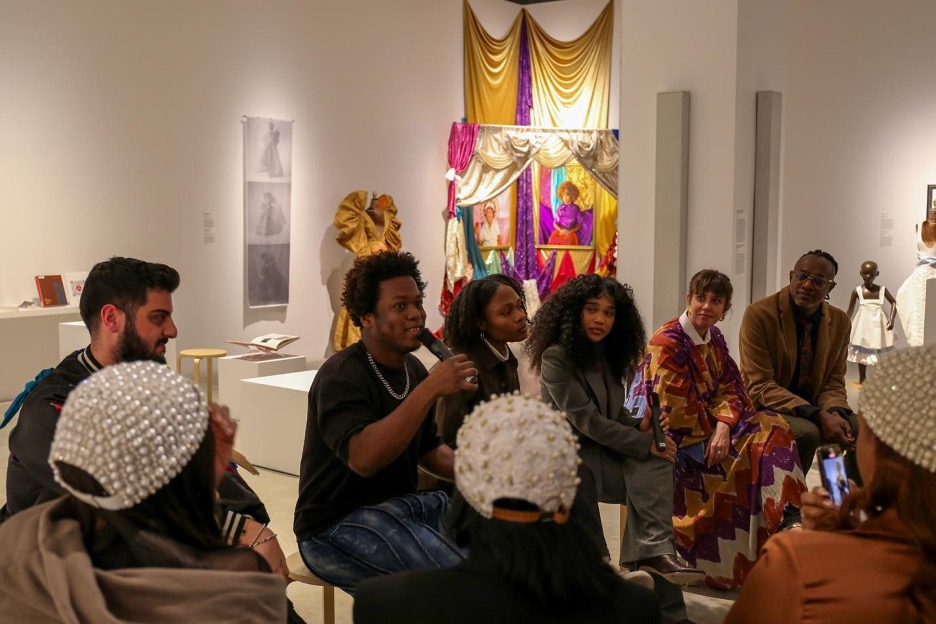
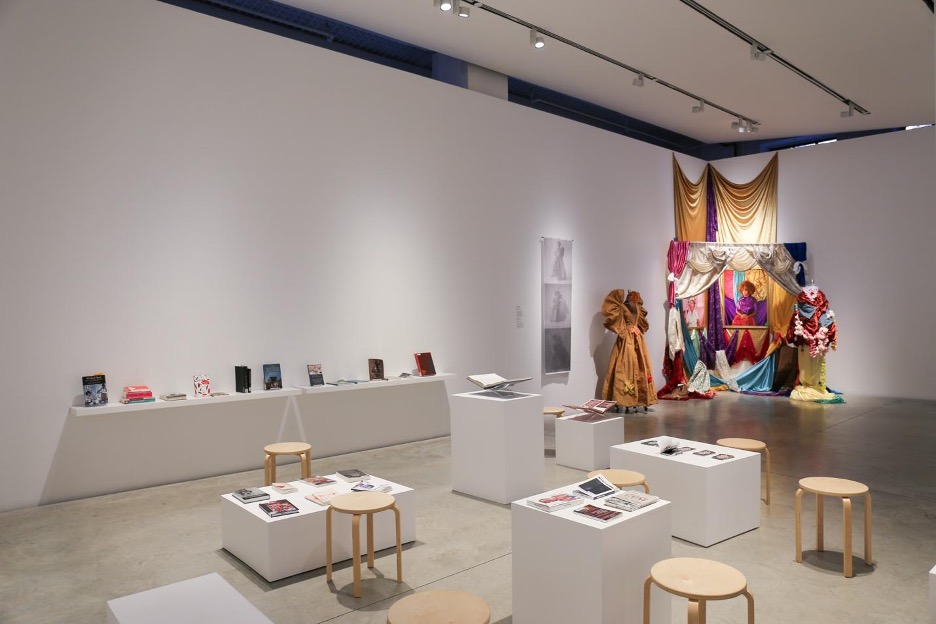
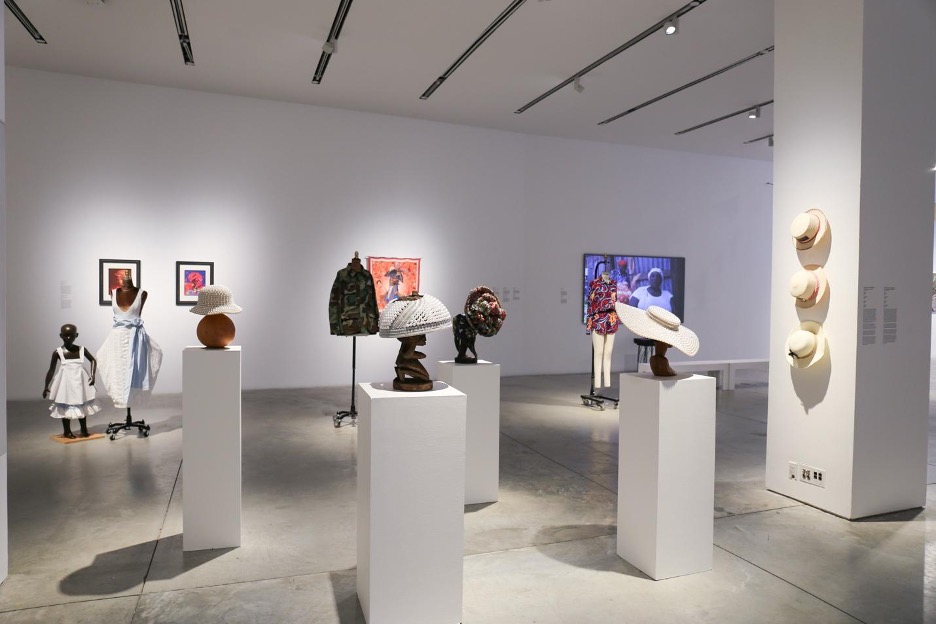
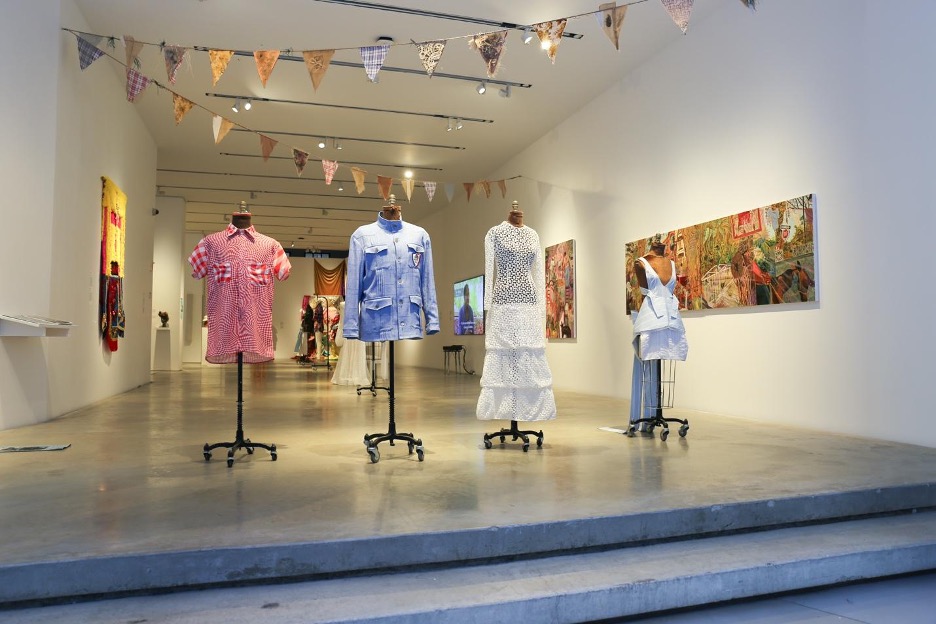
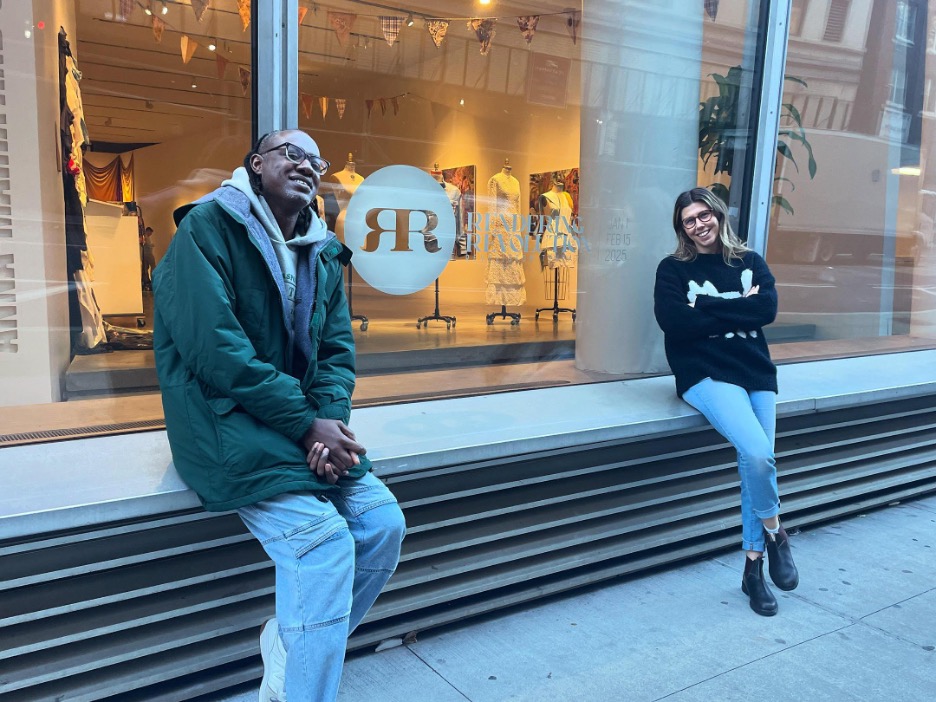
century. With our exhibition, Revolisyon Toupatou, which ran at Parsons School of Design in January and February of 2025, we had a
similar goal — to illustrate how digital humanities work is deeply rooted in the material
world, in people coming together in physical space, not just interacting in digital
environments.
I think the
Fanm Rebèl project and other digital humanities projects that operate at the intersections of
Caribbean and black DH, such as
Hidden Hands in Colonial Natural Histories, directed by Victoria Dickinson and Anna Winterbottom;
LifeXCode, directed by Jessica Marie Johnson; and
Archipelagos, edited and founded by Alex Gil and Kaiama Glover, have demonstrated that, in many
ways, the power of digital humanities work lies in the possibility of forging new
connections with people we may not have met or known otherwise and that these connections
can be nurtured and realized in the form of conversations, art, performance, writing,
roundtables, workshops, celebrations, social media likes, reshares, and comments,
etc. As these projects have demonstrated to me, I think in its most beautiful and
powerful iterations, digital humanities work centers the imagination and possibility
afforded by human relationships, often in spite of academic, industry and oppressive
social structures that too often keep artists, curators, activists, students, and
professors in separate spheres of operation. Martha S. Jones writes about this in
“The Power to Create: Building Alternative (Digital) Worlds” [
Glover, Jones, and Johnson 2023] a conversation with Jessica Marie Johnson moderated by Kaiama L. Glover, specifically
with regard to forging her own communities within (and sometimes in spite of) academia:
I was remembering today that the first time I did an exhibition, a brick-and-mortar
exhibition — it couldn’t have been more conventional — and I shared it with the colleagues
in my department. Someone sort of tossed the postcard on the table and said, ‘We just
don’t do this.’ And I thought ‘Wow.’ And there are lots of moments like that — the
‘We just don’t do this…’ So, what to do? For me, it has been to fugue. It has been
to flee. It has been to find and to construct another kind of community within the
vastness that is many of our universities. My best compatriots, my allies, my fellow
travelers have been librarians, and curators, and artists [
Glover, Jones, and Johnson 2023].
I appreciate Jones’s reflections, particularly around fugue, or marronage, a concept
that she and Johnson explore at length in their exchange. I see our project as the
result of a fugue: in building Rendering Revolution, we sought to escape a confining and narrow structure for scholarly production, and
in so doing we wanted to run toward people — in the direction of artists and designers
whose work we admired, of translators whose labor makes it possible to communicate
across linguistic and cultural boundaries, of other researchers who were keen to center
collaboration as a model for humanistic inquiry. Like Jones, I feel like we have built
our own community and it is ever-evolving.
JMS: Over the course of running this project, we have developed our own particular
methodology/creative practice. Sometimes we take an “everything but the kitchen sink”
approach, posting anything remotely related to Haitian visual culture. However, I
always return to a fundamental insight you shared with me, Siobhan: the core of our
project is deeply rooted in black feminist praxis and queer theory. Our approach is
also shaped by a recognition that visual archives of blackness have historically been
curated through frameworks of violence or erasure. By creating our own curated grid,
we take cues from projects like “Black Futures,” which imagine archival practice as an embodied, present-tense act of care and radical
possibility.
SM: Definitely. At the time we began the project I was deeply inspired by the work
of Saidiya Hartman and Fabiola Jean-Louis. Though they work in distinct modalities
(writing for Hartman, visual art for Jean-Louis) their feminist experiments with aesthetics
— textual and sculptural — powerfully create space for reading forms — bodies, fictions
— as valuable and intimately connected sites of knowledge creation about the past.
For example, Hartman’s 2008 article, “Venus in Two Acts” examines the silences in slavery’s archive with regard to recorded (textual and visual)
information regarding the lived experiences of enslaved people. Hartman suggests that
acts of violent erasure in the archive produce a historical epistemology in which
silence is accepted as fact, thus determining, contouring, the possibilities for knowledge-creation
about slavery and its operation as a social, political, and economic system. The practice
of calling attention to and working against this epistemology is, as Hartman writes,
“predicated upon impossibility”:
—listening for the unsaid, translating misconstrued words, and refashioning disfigured
lives — and intent on achieving an impossible goal: redressing the violence that produced
numbers, ciphers, and fragments of discourse, which is as close as we come to a biography
of the captive and the enslaved
[
Hartman 2008, 2–3].
Here Hartman identifies practices of redress and refashioning that are central to
the very premise of Rendering Revolution as a digital humanities project. She suggests that engaging seriously with material
culture in the archives — specifically histories of textiles, dyeing, sewing, and
dress practices — is critical to shaping not only what we know about the embodied
and lived experiences of enslaved peoples in Saint Domingue, including women, girls,
and queer people, but also how we identify historical sources understood to be “authoritative,”
“truthful,” or “factual.”
Similarly, an intellectual and artist whose work also deeply influenced and shaped
our project’s methods and goals is Fabiola Jean-Louis, a paper-sculpture concept artist
who was born in Port-au-Prince, Haiti, and currently resides and works in Brooklyn,
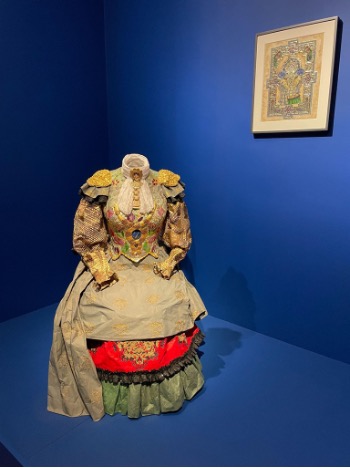
NY. Jean-Louis is known for sculpting intricate and beautiful period gowns out of
paper. I had the privilege of seeing one of Jean-Louis’s sculptural dress pieces at
her solo show at the Isabella Stewart Gardner Museum in Boston in the spring of 2025.
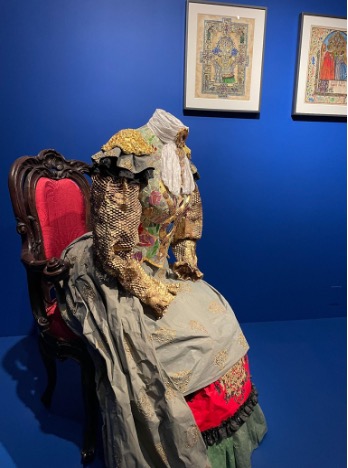
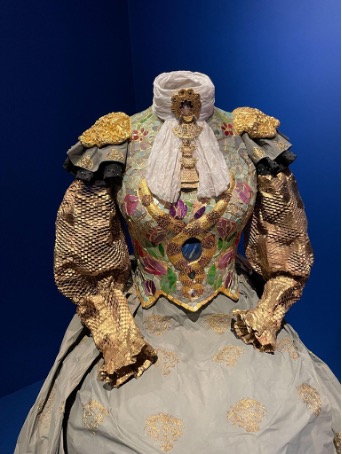
Constructed from what was originally white paper, this dress sculpture is composed
of a variety of precious materials including 24-karat gold, lapis lazuli, amethyst,
labradorite, and Swarovski crystals. Titled
“Justice of Ezili,” the dress recalls the power, creativity, and beauty of the eponymous Vodou lwa. The
folds of the dress incorporate histories of adornment that were intimately tied to
the transatlantic slave trade in which valuable textiles such as chintz served as
powerful forms of economic and cultural currency. Before this dress sculpture traveled
to Boston, it served as an anchor within the Afrofuturist period room
“Before Yesterday We Could Fly” on display at the Metropolitan Museum of Art in New York. Describing the significance
of
“Justice of Ezili” as it contributed to the Afrofuturist vision of
“Before Yesterday We Could Fly,” curator Hannah Beachler commented on how the position of dress — at rest, seated
— summons a version of the past that she rarely feels called to acknowledge:
“She occupies a space between the future and the past in beautiful clothing, at rest
in the past. Which you never see. And it became very important not so much about evoking
a person as much as evoking a way of being that you do not know. And to be able to
see that, it did something to me. It changed how I carried myself” [
Metropolitan Museum of Art 2021]. As Beachler’s reflections suggest, the situation of
“Justice of Ezili” at the threshold between past and future is a gesture that underscores the significance
of dress as it draws attention to stories of embodied life that are too often ignored,
inaccessible, or rendered invisible. Jean-Louis’s emphasis on the power of materiality
— of fashion — for understanding the past and imagining the future — is critical to
our own methods in exploring Haitian fashion and material histories across time and
space.
JMS: Another memorable moment for me in the beginning our project was reading your
review [
Meï 2020], in
The Fashion Studies Journal of the exhibition
Fugitifs at the Musée National des Beaux Arts du Québec. This exhibition featured renderings
of self-emancipated freedom seekers. The artist used images from runaway slave ads
to recreate their likenesses. That exhibition was an early inspiration for us, as
we aimed to highlight visual representation of femme and/or queer figures from the
Haitian Revolution (i.e., Cécile Fatiman, Romaine-la-Prophétesse, Suzanne Louverture,
Catherine Flon, etc.) who did not always have the opportunities to sit for portraits.
SM: I appreciate you mentioning that exhibition, which was beautiful and centered
knowledge-production about slavery by contemporary artists of African descent in Québec.
That review was also one of my first open-source publications, as the FSJ is a fully online and open-access journal. I was really excited to share that article
on my personal social media platforms knowing that friends and family could easily
access it. In this vein, let’s talk about social media! We use it! In many ways, the
Instagram account is the organizing motor of Rendering Revolution. It is also an archive of what we were “nerding out on” at a particular moment, i.e.,
an evolution of our intellectual interests.
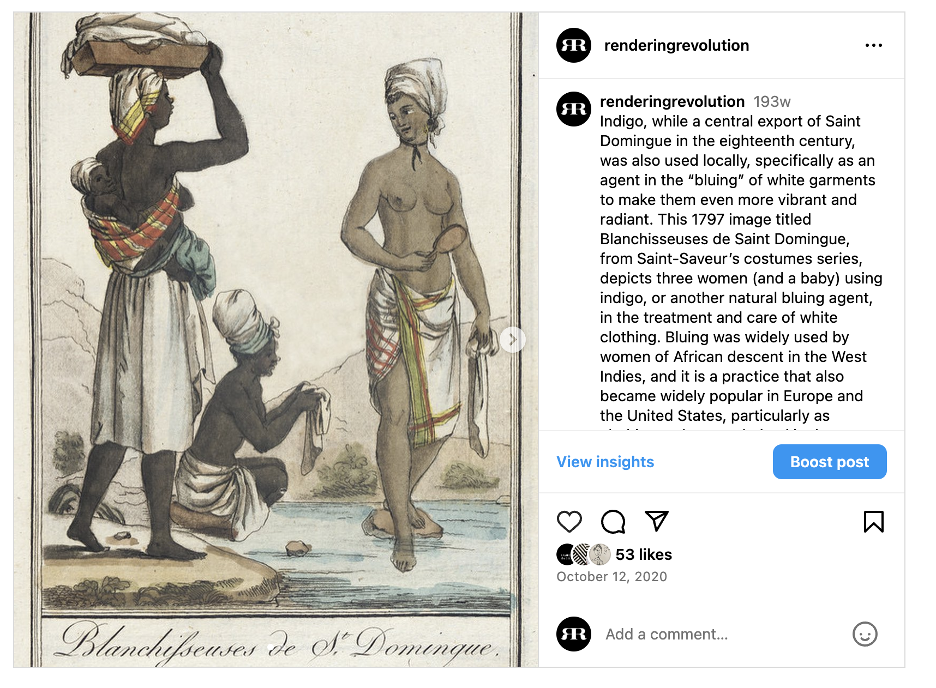
JMS: I have a great example to illustrate this point. Remember when we were deeply
interested in indigo production? We dedicated an entire week to creating content on
the cultivation and use of indigo in Haiti. Much of the scholarship on plantation
economies rightly focuses on sugar, but we were both fascinated by the significant
yet understudied role of indigo in Haiti's plantation economy. We created a post about
indigo's use as a bluing agent [
Rendering Revolution 2020a] for white garments, another one on the trend of white clothing in the metropole
that was inspired by practices in West Africa and the Caribbean, a third post about
the role of India and Indian textiles in the global textile trade, and a fourth one
on the significance of white clothing in Vodou and other Afro-Diasporic syncretic
religions. This comprehensive exploration highlighted the diverse and interconnected
uses and cultural meanings of indigo and white clothing across different regions and
contexts.
SM: I really loved that series and appreciate your articulation of one of the key
components of our methodology: that it is shaped by our own interests, discoveries,
and conversations, all of which shift on the daily — here I’m also recalling your
earlier characterization of what we choose to dwell on as an “everything but the kitchen
sink” approach, which is spot on. In this way, our use of Instagram as the “‘organizing
motor’’ for our project is worth pausing on and explaining.
As many already know, Instagram was founded as a tech start-up in 2010 in Palo Alto,
California, by Kevin Systrom and Mike Krieger. What set Instagram apart from other
social media products of the time such as Facebook, was that Instagram was designed
explicitly for mobile devices as opposed to desktop environments. This development
and design choice to create a social app native to smartphones led to a swift increase
in Instagram’s popularity, as users were able to not only instantaneously share photos
taken on their phones from their everyday lives but also modify them in ways previously
only those with photography experience could (think cropping, filtering, etc.). Instagram
was sold to Facebook in 2012 and its original founders, Systrom and Krieger, left
the app in 2019. As of today, Instagram has roughly 2.4 billion users, and as of 2018,
80% of Instagram users are outside of the United States [
MacDowall and Budge 2022]. In short, Instagram is a hugely popular and global application due in no small
part to its user-friendly interface, its privileging of visual communication, and
the fact that, like many social media apps, it is free to use.
Many of these characteristics of Instagram appealed to us as a platform for Rendering Revolution— accessibility, instant feedback from other users, immediate publishing, the possibility
of discovering new audiences and communities. In particular, given our project’s focus
on material culture and visual art, Instagram was an easy choice as a “motor” for
our project as it was quickly becoming one of the most powerful digital tools on the
market for sharing and creating art. Lachlan MacDowall and Kylie Budge’s book Art After Instagram: Art Spaces, Audiences, Aesthetics (2022) is about (and a testament to) this very dynamic: that Instagram has fundamentally
shifted the way humans view and ultimately, produce art. As they write:
[Instagram] has made art and art spaces visually appealing and accessible through
the digital screen, and in, doing so, it has shifted the power balance away from those
own and command art spaces, especially institutionalized places such as museums and
galleries with their authoritatively loaded histories and ambiences, permitting more
agency for art audiences as they photograph, post, and share their interpretations
of such spaces
[
MacDowall and Budge 2022, 3].
In our case, we wanted to reach diverse, public audiences that intersected with our
academic communities, but did not center them. Instagram allows us to bypass, or skirt,
institutional gatekeeping mechanisms within art and scholarship, such as museum entry
fees and cultural know-how as well as publishing processes, which in the humanities
can take months and often results in output that is only read by a niche group of
scholars. In short, we wanted to be in active conversation with artists — specifically
Haitian artists and designers, and with people from around the world who were interested
in design, aesthetics, fashion and history — in ways that were not mediated by the
traditions of academic publishing or the confines of physical space.
We should make it clear however that we do not think that Instagram is a democratizing
or even ethical form of media production and consumption — truly, we are trading one
form of mediation and surveillance for another in terms of how we achieve the goals
of our project. Particularly, given the history of Haiti as a historic site of resistance
to European imperialism and US neoliberal extractive capitalism, it is important for
us to grapple with and be accountable to how the very vehicle of our project, Instagram,
is implicated in larger, nefarious systems of data collection. Meta, Instagram’s parent
company, continues to face public scrutiny for its practices of selling user data
to third party organizations, its role in fueling hate speech, in promoting unlawful
discrimination in sectors such as housing and employment, in fostering misinformation
online, and in ignoring the negative health impacts of its products on users, particularly
children and young people. As digital humanists we believe it is our responsibility
to understand not only the history of the technology we use and how it functions,
but how technologies such as social media impact human society. Black DH is a field
that has historically asserted that being critical of the “powerful rhetorics of empowerment
and democracy that underpin many analyses of contemporary media forms” [
MacDowall and Budge 2022, 13] is necessary in order to counter conceptualizations of technology as ideologically
neutral or passive conduits for human expression (see, for example, Kim Gallon’s work
on Black Twitter) [
Gallon 2016].
While MacDowall and Budge situate their research in the context of platform studies,
many of their approaches and assertions could be strengthened by looking to the literature
of Black DH as a field that has asserted, from the aughts onward, that in order to
critically engage with social media as products and tools, one must examine their
history, their technical architecture, their APIs, and their complex function within
a capitalist society in which much of the world’s wealth is in the hands of only a
few people and many design decisions are shaped by legacies by white supremacy and
are often made by investors in products, not by users. Drawing on the work of scholars
of Black DH such as Kim Gallon, Jessica Marie Johnson, Kaiama Glover, and Marisa Parham,
we understand that we do not currently live in a world of public-interest technology
and our own way of talking about
Rendering Revolution must not make it seem like products such as Instagram are fundamentally radical or
liberatory.
J.M.: Yes, and all of this is not to say that ideas and conversations facilitated
by digital connectivity are not radical or liberatory or deeply imaginative. In fact,
recent history shows us the complicated role social media can play in propelling radical
grassroots movements and social change. I’m thinking of social movements of the early
and late aughts including the Arab Spring, Occupy Wall Street, #SayHerName, Black
Lives Matter, and the Umbrella Revolution, all of which had a significant social media
component both in terms of organizing and in launching powerful, often multinational,
public awareness campaigns. Considering our use of Instagram in this larger context
of social media as a vehicle for activism and for attracting new audiences, we’ve
noticed and come to appreciate that there is a type of agency, liberty, or even just
unruliness, afforded by the relationship this social media platform facilitates between
audience, technology, and art. This dialogue is also constantly evolving, due in no
small part to the ephemerality and transience of social media. While user data is
certainly collected and stored somewhere, perhaps permanently, users’ lived experience
of media online is fleeting: users of platforms such as Instagram consume textual
and visual information quickly. At
Rendering Revolution, we know that some users will sometimes spend no more than a second or two on a post
we share, for example.
You and I have talked about how we see the ephemerality of posts — the way they will
appear in a user’s feed and then disappear, often according to an opaque algorithmic
system — as very much reflecting the ethos of our project, in that we hope to show
how notions of taste, aesthetics, and beauty are socially constructed, ever-evolving,
and, deeply contingent on one’s identity and experience of the world. The role of
contingency is something that [
Gallon 2016] explores in her earlier-referenced article
“Making a Case for Black Digital Humanities” in which she considers how computing technologies can be used as a lens of sorts
to
“further expose humanity as a racialized social construction.” Like technologist Ruha Benjamin, Gallon suggests that computing technologies cannot
be understood outside of the systems and processes of racialization that determine
who is considered human. In this way, Gallon reminds readers of the contingency of
the category ‘human’ — a keyword in DH itself that should be understood to be in perpetual
construction:
Black digital humanity, with its emphasis on humanity as an evolving category, also
changes how we should view the ongoing concerns about sustainability and the future
of digital projects. Recognizing that humanity is a construct, a contingent idea,
forces digital humanities to come to terms with the contingency of digital projects
[
Gallon 2016].
I appreciate Gallon’s emphasis on contingency here, and the way it can, and perhaps
should, inform the expectations, goals, and outcomes of black digital humanities work.
Our use of Instagram, a corporate social media platform that is deeply entrenched
in the logics of late-stage capitalism, obliges us to regularly confront constructs
of humanity, specifically the role that computing technologies such as social media
play in perpetuating anti-black violence, a very recent example of this being the
continued racist portrayals of Haiti and Haitians in the US public media ecosystem.
At the same time, the contingency of the Instagram media-form itself has permitted
us to create a new sort of logic for knowledge-production in which contingency — ephemerality
— is both the context and the modality of our work.
SM: Here, perhaps we can explore this question of contingency further by explaining
how we actually built our project at the intersections of our values and our available
resources? Our use of a freely available platform (IG) was critical for us at the
time we founded the project, given we had very limited financial resources. I think
it is worth discussing sustainability here as well as some of the technical backend
and funding know-how that makes DH projects like ours tick. In short, how do we do
what we do, Jonathan?
JMS: Most digital humanities projects present themselves as altruistic, serving the
public in some way. With Rendering Revolution, we take a different approach by sometimes prioritizing our own experiences and relationships.
We pursue this project because we genuinely enjoy it and find it enriching. We believe
that this passion translates into an edifying experience not only for ourselves but
also, hopefully, for our followers. In fact, we prioritize building relationships,
communities, and conversations in Rendering Revolution, as opposed to a static archive that researchers tap into. This is particularly important
as neither you nor I is Haitian, and as such we view our DH contributions to our scholarly
and public communities as emerging directly from our active and continuous conversations
with those whose identities, histories, and cultural legacies are deeply tied to Haiti
and its diaspora.
I think that explains, in part, the bilingual nature of the project. While we are
not native Haitian Creole speakers, we have both committed to becoming at least conversant
in it. The project is bilingual because we want to reach out to Haitian Creole speakers.
However, in all honesty, most of our Haitian and Haitianist audience is also fluent
in English, Spanish, and/or French. It is an important exercise for us to challenge
ourselves and make the effort to speak to a variety of communities, many of which
are multilingual.
SM: Definitely. And here, I think it is important to talk about funding. Many digital
humanities projects are quite expensive to produce and require know-how that many
of us trained in the humanities do not necessarily have. When we began the project
we had very limited resources and identifying funding continues to be a journey for
us! We are grateful to the Massachusetts Society of Professors, Parsons School of
Design, The Manning College of Information and Computer Sciences at UMass Amherst,
and Mount Holyoke College for helping make our project, particularly its bilingual
dimensions, possible. We use the majority of the funding we receive to remunerate
and recognize our expert translators.
We’ve also hired a developer who helped us to create our website (which is built on
Tumblr!), and we’ve paid for our domain name which uses .ht, the web designation for
Haitian digital content. We received word in December 2024 that we received a Caribbean
Digital Scholarship Collective Micro-Grant, which will allow us to not only revamp
our website, but also fund our inaugural Maker-Scholar Fellowship, which offers funding
to emerging artists from the Caribbean and its diasporas. We are so grateful that
organizations like the CDSC exist and with this grant we hope to further develop Online
Educational Resources from the project, which will include expanding the syllabus
we have put together on our website (which as of now is largely a giant index). Ultimately,
and especially for those just beginning their journey in the digital humanities, I
would say that it is OK to use what you have at your disposal (i.e. free online software
and tools) in order to bring your project to fruition. As you have highlighted, Jonathan,
when you’re working in close collaboration with others whose values you share, the
creative process and problem-solving one does certainly feel less lonely and, in our
experience, the funding will eventually come, even if it takes time.
JMS: Speaking of partnerships, what is the role of collaboration in our project? Collaboration
is the driving force behind our project. Siobhan, while you initially conceptualized
the project, I quickly became an integral part of it. Our combined efforts have proven
that our strengths and weaknesses as scholars are complementary, creating a balanced
and dynamic partnership. Together, we have been able to achieve far more than either
of us could have accomplished alone. Our collective expertise, perspectives, and dedication
are what truly propel this project forward, making it a testament to the power of
collaboration in scholarly endeavors.
SM: Yes, Rendering Revolution, as one can see from our Network Page, is composed of a group of people from all
over the world. Kai Marcel, Nadège Cherubin, Danielle Dorvil, Nathan Dize, Nicole
Willson, Dieulermesson Petit Frère, and Mirline Pierre were, and are, some of the
core contributors to the project, many of them hailing from different disciplines
and residing in a variety of places, including France, Costa Rica, and the UK. One
of the powerful aspects of DH work, in my mind, is how we can push back against the
single-author paradigm that continues to play a dominant role in dictating the “value”
of research in humanities fields. Very few of our posts have authorial attributions,
though we do consistently recognize the name of the translator for a given post. Here,
we want to be clear that the work of translation is intellectual work and should be
recognized and remunerated as such, countering a long history of invisibilizing the
labor of translators, perhaps particularly in the context of humanities scholarship.
We want to explore how to write and do research in community with others and in this
way, we feel like we need to examine what types of “authorship” make sense for our
project (this is, of course, part of a larger conversation within the world of the
digital humanities). Considering our collaborations on content creation as a somewhat
experimental scholarly and curatorial practice, how does it look in practice? What
are the posts that you feel exemplify our project?
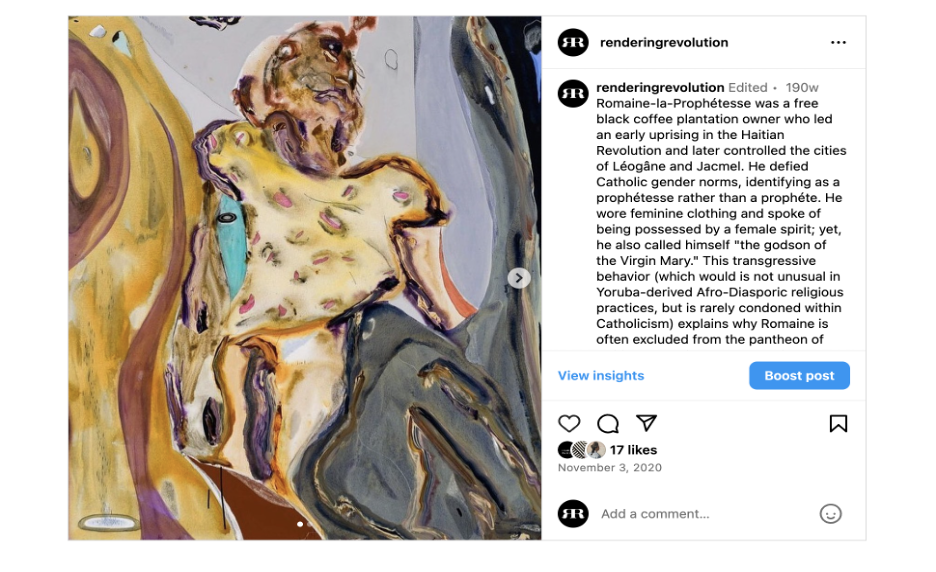
JMS: Our post [
Rendering Revolution 2020b] on Romaine-la-Prophétesse in many ways exemplifies the project. He was a free black
coffee plantation owner who led an early uprising in the Haitian Revolution and later
controlled the cities of Léogâne and Jacmel. He defied Catholic gender norms, identifying
as a prophétesse rather than a prophéte. He wore feminine clothing and spoke of being
possessed by a female spirit; yet, he also called himself
“the godson of the Virgin Mary.” This transgressive behavior (which is not unusual in Yoruba-derived Afro-Diasporic
religious practices, but is rarely condoned within Catholicism) explains why Romaine
is often excluded from the pantheon of Haitian revolutionary leadership. In this way,
Romaine exemplifies what Bianca Beauchemin terms “sensuous marronage,” a fugitive
practice of embodiment and gender expression that resists colonial order. Since there
are no surviving portraits of Romaine, artist Manuel Mathieu used his imagination
in rendering him, intertwining abstraction and figuration in this diptych.
SM: There are so many posts I appreciate in our project — our series examining fugitive
slave advertisements from the 18th century has been critical to helping us understand
the role of textiles and clothing in the context of marronage in Saint Domingue, and
for that reason I’m especially invested in those pieces of scholarship. Many were
also produced with assistance from other scholars and collaborators such as Robert
DuPlessis, a historian of the material Atlantic world who helped us, for example,
define and trace
chemise de halle, a shirt made from a textile that we were unfamiliar with when we first encountered
it in a fugitive slave advertisement describing a young man who had stolen his freedom
in 1773. In his archival research on trade logs, DuPlessis found
halle commonly listed along with
brin — another kind of hemp linen.
Halle was at one point cheaper than
brin and other popular linens of the time, including
gingas. DuPlessis’s research, which he graciously shared with us for this post [
Rendering Revolution 2022], shows that
halle was, at a moment in time, one of most affordable linens available in Saint Domingue.
Though the inclusion of material details relating to dress in these adverts are intended
to serve as markers of enslavement, a reader can also draw on these details to imagine
people in the context of their pursuit of freedom. To return to this notion of contingency
once more, clothes are transitive things in the slavery archive: serving simultaneously
as modes of identification for recapture and as critical expressions of identity and
self-making. Though fashion’s transitive or ephemeral nature has been linked to its
denigration in popular thought as a serious form of human expression, fashion’s transitivity
is one of the conditions that makes the re-telling of history possible, particularly
when situated in the context of transatlantic histories of fabric production, trade,
and circulation. A post such as this one is thus illustrative of the possibilities
for imagining the past by considering not simply the commercial facts, but the embodied
histories of textiles in the 18th century.
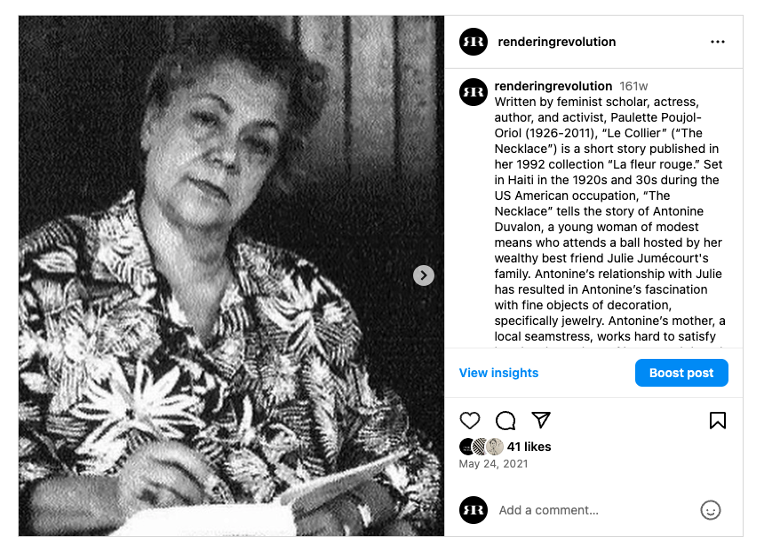
One of my favorite posts, though, might have to be this one from 2021 on Paulette
Poujol-Oriol’s 1992 short story,
“Le collier” or,
“The Necklace” [
Rendering Revolution 2021]. Here, we offer a summary of the story, which takes place during the US occupation
of Haiti in the early part of the 20th century.
“Le collier” describes a young woman, Antonine, and her husband (both of modest means) who must
pay back a debt to a wealthy family for having lost an expensive and elegant necklace
belonging to them. The story compellingly connects material and political histories
in Haiti, situating the class struggle of Haitian artisans in the 20th century within
the broader context of the material debt imposed upon the newly formed Haitian state
by France in the wake of the Revolution. I appreciate this post because it shows that
historical archives are not the only source of knowledge we should consult when it
comes to understanding the role that fashion objects and materiality play in constructing
human societies. Literature has always been a powerful site for re-imagining the past
and for anticipating the future in the Haitian context, and clothing, textiles, and
objects of adornment are critical features of storytelling that are worth our attention,
as Poujol-Oriol powerfully suggests in
“Le Collier.”JMS: We’ve talked quite a bit up until now about our methods and goals in the project,
but we should probably address our project’s inclusion in this special issue in particular,
which centers DH projects of and on Latin America. How do we see our project in relation
to the broader landscape/field of Latin American Studies?
SM: You and I have been discussing this quite a bit lately. As you helpfully signaled,
Jonathan, in our most recent conversation, Latin America is a colonial construction
and, often a narrow construction, in terms of accounting for the diversity of cultural,
linguistic, and social phenomena in the hemisphere. For example, following their fight
for independence from the French, Haitians in the early 19th century named their country
Haiti (Ayiti in Haitian Creole) using the Taíno name for the island that Haiti and
the Dominican Republic currently share, and in so doing, acknowledging and honoring
their country’s indigenous legacy. Haiti is also the first black republic in the western
hemisphere, and this fact remains central to contemporary discussions of Haitian identity.
All of this to say, notably perhaps in 2018, there have been public debates (often
occurring online) about the relationship between Haitian identity and Latin America,
specifically with regard to the question of whether Haitians are Latinx, Afro-Latinx,
or neither. I’d say that the inclusion of our project in this special issue is pushing
at the boundaries of what is traditionally considered “Latin America.” This is due
to the ways in which anti-blackness has historically textured Haiti’s relationship
to other nations in Latin America as well as other anti-colonial and decolonial movements
throughout the hemisphere. As contemporary Haitian artist and performer, Nathalie
Cerin, writes:
When we gained independence, Dessalines declared us as a nation of Blacks, and any
Haitian citizen from that day forward would be known as Black. This established an
identity for us that is not rooted in who happened to colonize us and the language
they forced on us in the process. The anti-blackness that is at the heart of our
exclusion among these nations is not our responsibility to fix. We don’t need labels
of groups that have neither invited or welcomed us to make us more exotic or palatable.
Being Haitian in itself is enough
[
Cerin 2018].
These discussions of identity are sometimes contentious and yet are critical to recognize
when doing public digital humanities work, particularly given the role that identity
plays in the formation of communities, both in the digital world and within physical
and imagined geographies. For us, these discussions have been important given that
in founding this project we sought to be in conversation with Haitian artists and
artists of Haitian descent specifically.
I want to return to our use of social media to engage a public audience and our project’s
relationship to the field of Black DH in particular. In “Making a Case for Black Digital Humanities,” Kim Gallon theorizes recovery in the field of Black Digital Humanities as a critical
praxis, and ultimately, a technology in and of itself. More specifically, she highlights
the role that social media plays in recovery projects that center black humanity and
experiences. She writes:
This technology of recovery operates as the shared basis for black academic and nonacademic
digital work, one that dominates the ways by which both Black studies scholars and
a black public approach technology. Everyday discursive interactions on social media
networks are a case in point. Black people’s subsistence in and resistance to the
complex oppressive systems of slavery, colonialism, Jim Crow, mass incarceration,
and police brutality, across time and space, make black lives ground zero for a technology
of recovery using social media. Movements that protest the ongoing police brutality
of black women and men, which began on “Black Twitter” and Facebook with hashtags
such as #SayHerName, #BlackLivesMatter, and #ICantBreathe, continue black people’s
centuries-old endeavor to make their humanity apparent to the world
[
Gallon 2016].
In your mind, Jonathan, how does Gallon’s analysis of social media as a technology
of recovery in Black Studies speaks to our own use of social media as a platform for
doing public digital humanities work?
JMS: Gallon's analysis of social media as a technology of recovery in Black Studies
provides a profound framework for understanding our own use of social media as a platform
for public digital humanities work. By engaging with our followers, we tap into a
vast reservoir of collective knowledge that enriches our projects. Our followers not
only fill in the gaps in our understanding, but also offer invaluable suggestions
and critiques that shape our work in meaningful ways. This collaborative process induces
collective knowledge production, enabling us to recover and highlight narratives,
histories, and perspectives that might otherwise be overlooked or deemed unworthy
of preservation. Through this dynamic exchange, we can bring to light stories and
insights that contribute to a more inclusive and comprehensive understanding of Haitian
visual culture.
We also draw significant inspiration from the Gee's Bend Quilters and other African
American quilting traditions, in which artisans transform upcycled scraps into beautiful,
intricate quilts. This act of creative repurposing reflects a profound ingenuity and
resilience that parallels the artistic expressions found within Haitian visual culture.
The colors, patterns, and symbolic meanings embedded in these quilts resonate with
the rich tapestry of Haitian art, which often incorporates elements of folklore, spirituality,
and historical memory. Furthermore, the visual structure of Instagram, with its grid
layout, mirrors the patchwork nature of these quilting traditions. Each post, like
a quilt square, contributes to a larger, cohesive narrative. Our curated platform
leverages this aesthetic alignment to showcase the interconnectedness of Black artistic
practices in Haiti and beyond.
SM: Given our project’s focus on visual culture, specifically fashion and design,
which artists most inspire our work?
JMS: We truly admire Stella Jean. Her innovative approach is characterized by vibrant
patterns and bold prints that celebrate her Haitian-Italian heritage. Jean’s work
transcends mere clothing, transforming each piece and collection into powerful narratives
that evoke her unique identity and heritage. Her commitment to ethical fashion, working
closely with artisans around the world, further elevates her designs, ensuring that
they are not only visually stunning, but also socially impactful. Though it may be
wishful thinking, we would love to collaborate with her in some capacity in the future.
As you mentioned earlier, we also love Fabiola Jean-Louis. Her work embodies all of
the things that we value in our project: Black feminist praxis and creative practice
that centers Haiti. She is not only renowned for her attention to detail, but the
way those details challenge and redefine traditional representations of Black bodies,
including her own.
SM: I’d also add that we’ve been delighted to be in conversation with several incredible
artists based in the New York and Miami areas including Daveed Baptiste, Steven Baboun,
Madjeen Isaac, and Saphyra Saint-Fort.
While our project examines colonial and historical archives, at Rendering Revolution one of our goals is also to create a new, digital archive of our interviews and features
of contemporary Haitian artists. As part of this work, we held programming throughout
our exhibition that centered the voices and experiences of contemporary artists and
designers, including an artist panel at the opening reception of Revolisyon Toupatou as well as a collaboration with the Fashion Scholarship Fund during New York Fashion
Week in February 2025 to highlight the work of emerging Haitian designers such as
The Gayo Twins. We also convened two roundtables at the Haitian Studies Association
annual conference to be held in Brooklyn, NY in October 2024, one of which was titled
“Curating Haitian Art in the Digital Age.” This roundtable, which included curator, artist, and scholar Dr. Petrouchka Moïse
and Montrèal-based visual and textile artist, Stanley Wany, centered discussions of
power, originality, and ownership as these concepts are being negotiated in the era
of Big Data and generative AI. In short, we are invested in learning from and celebrating
the cultural and intellectual contributions of Haitian artists to critical conversations
on the very meaning and role of arts and humanities today.
JMS: As a project deeply engaged with the intersections of art, material culture,
and digital innovations, and given your own position within a STEM-focused academic
environment, we fully embrace the need to grapple with the implications of emerging
technologies. We’re particularly invested in thinking critically about how digital
tools, including artificial intelligence, shape knowledge production and dissemination,
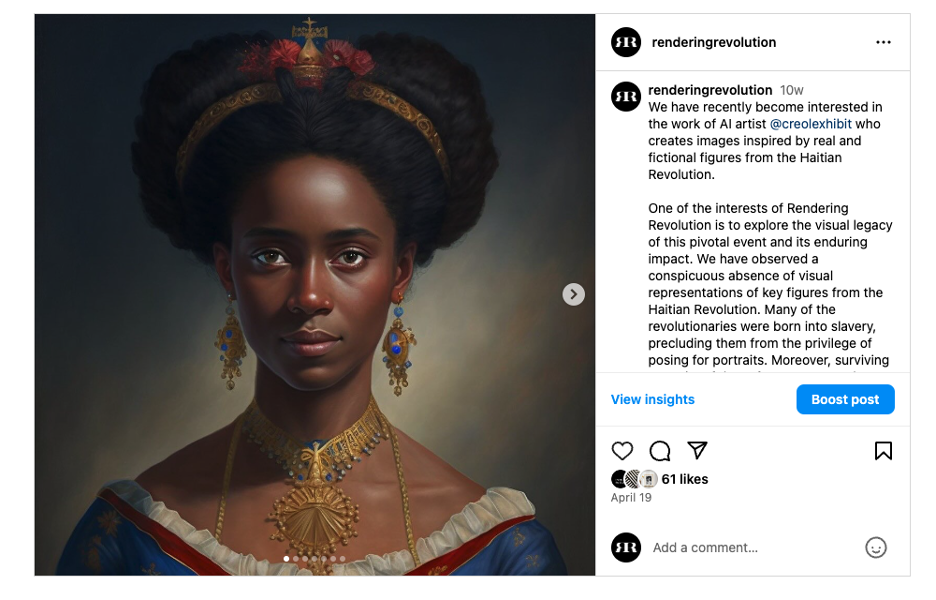
especially in fields like art, history, and cultural studies. Earlier this year (2024),
we shared a post [
Rendering Revolution 2024] that explored the potential role of AI in filling gaps in the Haitian visual archive.
The responses we received were generative and complex, prompting meaningful dialogue
about the stakes of such an approach. These exchanges helped us to recalibrate our
own methodology and refine the ways in which we think about the uses and limitations
of digital tools and resources in public humanities work.
At the same time, I often feel that the academic world can be frustratingly reactive
or even Luddite in its stance toward technology. Rather than outright rejecting tools
like AI, we try to adopt a position of thoughtful engagement: the technology exists,
and it is already shaping the cultural and intellectual landscape in which we work.
We can either ignore it and cede interpretive control to corporate interests, or we
can enter the conversation on our own terms. I would not describe myself as a proponent
of AI in any unqualified sense. But I do believe it’s possible, and even necessary,
to explore how such tools might be leveraged in ways that align with the values of
justice, transparency, and collaboration. For us, it’s about striking a balance and
recognizing that while these technologies may never replace the insights that come
from lived experience and community-based research, they can serve as a complement
to more traditional scholarly methods when approached with care and ecological mindfulness.
SM: The post you mention here was so important and we received such interesting responses
to it from a variety of people including artists, art historians, and curators. And
you’re right, as someone who works in a college of Computer Science, I do see up close
where and how public discourse about AI and its technical architecture and social
impact intersect. This is my personal opinion, but I am highly skeptical of generative
AI as a net positive social good (it’s the same way I feel about social media, really).
Here, I turn to the scholarship of researchers such as Timnit Gebru, Joy Buolamwini,
Ruha Benjamin, Amy J. Ko, Safiya Noble and others who have helpfully shown how computing
technologies reify pre-existing social inequities. Part of the problem is epistemological
— computing, mathematics, and other sciences are too often perceived as objective
or neutral — as disconnected from ideology, culture, history. The myth of objectivity
that continues to define the gaze and methods of scientific inquiry, including and
perhaps especially in computing, is a product of white supremacy and is part of a
longer history of science in the West that cannot be divorced from European colonialism.
Here, I’m not absolving the humanities from similar epistemological problems, but
because of computer science’s close relationship to industry, we are seeing how quickly
and powerfully the products of this field can enter and directly impact human society
and our natural environment.
I just finished reading the excellent piece
“Provocations from the Humanities for Generative AI Research” [
Klein et al. 2025] on how including, and perhaps even centering, humanities perspectives on AI development
and use is critical for sustainable and ethical technological futures. This article
gave me hope, particularly as a humanist working in a STEM space where I sometimes
feel like my training and expertise are not as valued as my colleagues who have CS,
Math, or Engineering degrees (I am a proud holder of a PhD in Comparative Literature).
I guess, in short, my current perspective is that we need to be skeptical of generative
AI and, if we are discussing or using it in our classrooms, I think it is important
to make clear to students the ethical considerations of the technology in a way that
does not necessarily center plagiarism (as I’ve seen be the dominant framework through
which educators are discussing gen-AI), but rather that focuses on the ethics of the
development of genAI itself — the data it was trained on, the carbon footprint of
training a tool on increasingly large data sets, the vision and priorities of investors
in major AI companies such as Google, the outsourcing of data labeling to underpaid
workers in the global south… the list goes on. I agree with Klein et al. in their
assertion that this is a time in which we really need strong and equitable interdisciplinary
partnerships, particularly between the humanities and computing fields.


 https://orcid.org/0000-0001-9395-2286