Abstract
Baobáxia is an initiative developed by the Afro-Brazilian network Rede Mocambos that
serves as a model of community digital organizing so they can propose data justice,
digital sovereignty and autonomy. Baobáxia is a technology that interconnects diverse
communities in Brazil (i.e, Quilombos, Indigenous communities and Favelas, among others),
and also creates a structure to store, curate and disseminate local knowledge, traditions,
histories and representations. This infrastructure demonstrates how non-expert communities
can use digital strategies to defend their territory, preserve their cultural production,
and affirm their human condition. Throughout this article I discuss how Baobáxia and
Rede Mocambos work, as well as a collaborative project to connect with other quilombos,
Black and Indigenous communities in the Americas. The collaborations described herein
are part of community digital humanities initiatives that go beyond the boundaries
of the university and the academia expanding their scope and contributing to a humanization
of technology.
Introduction
In their introduction, the editors of this special issue describe the state of emergency
the humanities and, in general, higher education at large are facing. From their perspective,
those difficult realities call for
“new approaches to scholarship.” They also argue that education must play a role beyond the classroom and that
“[t]hose whose work deals with marginalized peoples must build solidarity with those
communities and co-create best practices for working together” [
Fernández Quintanilla]. It is in that spirit that the present article discusses a collaborative and co-creative
engagement with Rede Mocambos, an Afro-Brazilian network that pursues digital and
data autonomy through the development of digital tools and their and adaptation to
community needs. I carried out that work to help Rede Mocambo extend its network and
replicate its strategies and protocols for data adaptation and autonomy in other quilombola,
black and indigenous communities in the Americas.
The article can be read in the context of critical archival studies as proposed by
T-Kay Sangwand [
Sangwand 2018] and of critical infrastructural studies as discussed by Amanda M. Smith [
Smith 2014] who are interested in critiquing and proposing alternative actions to archival extractive
practices. The article also aims to explore the reach and limits of the digital humanities
as a field that has all the potential to transcend the walls of the university to
co-create spaces where justice and recovery of hidden histories, brilliant futures
and a hopeful present are possible. To do that, I document a process of co-creative
actions with some black communities — particularly Rede Mocambos — in the Americas
that have been and are currently using digital tools and engaging the discourse of
data and big data to reenact their humanity. Many of these communities identify as
quilombos or maroon communities who have been resisting colonial impositions and therefore
proposing new ways of existence for hundreds of years. Confronting some of the colonial
designs of current technological developments seems to be just another layer added
to the challenging landscape they have inhabited.
The digital humanities have been built around ideas such as collaboration, co-creation,
and the possibility of overcoming the siloed work developed inside the walls of the
academe. Many of these ideals have been realized in projects that ensemble teams with
scholars from different fields, sometimes from different nations and with a plethora
of interests and expertise. Some of these projects interact with communities and aim
to serve them in multiple ways. However, many of them also end up hosted, maintained
and managed by universities as central players of the digital humanities ecology,
sometimes leaving non-academic communities as agents that don’t have a central role
in deciding how to showcase their traditions, how to store their information and who
should, and should not, have access. This article, however, aims to highlight the
process of collaboration and co-creation from a different perspective, one in which
non-academic communities share the centrality of the projects with academic ones as
a way to extend their networks, replicate the methodologies they create to use, adopt,
and adapt digital and data-driven tools, and to carry out their cultural, social,
and political agendas.
Engaging communities beyond academia to develop digital humanities projects that center
them requires the adoption of hybrid methods. Hybridity in this case entails the productive
interaction between digital and ethnographic methods; the combination between close
and distant reading to approach documentation and data produced by and with the communities;
the recovery of memories coupled with the creation of collections and spaces where
those memories can live, be disseminated and connected with other similar projects
and actions; and the development of concrete case studies in the context of networked
nodes that, seen as a dynamic construction, can reveal surprising patterns, relationships
and connections. In general, following [
Snow 2002, 151–152], the hybrid methods used to develop the collaboration that gives life to
this article can be understood as research strategies that seek to generate richly
detailed, thick and holistic elaborations and understandings of instances or variants
of bounded social phenomena through the triangulation of multiple methods. A key element
within such a methodological design is the possibility of going from digital tool
mediation to co-existence with community members who are not subjects of study but
agents, active members in defining how and why to use certain digital tools. In that
sense, the research process that gives flesh to this article started from a pure distant
reading process through a digital ethnography (e.g. careful observation of web spaces
created by studied communities, systematization of what was being observed, use of
digital tools to map, visualize and identify patterns, etc.) and culminated in a participatory
ethnography (e.g. carrying out in-person observations and participative actions in
the context of certain communities) that allowed me not only to gather information
but to become an active participant of the communities. The visualizations and the
identification of patterns carried through a distant reading processes led me to ask
new questions, go from distant to close reading and participatory ethnography, and,
subsequently, to the formalization of concepts such as communitarian digital humanities
or digital maroonage, among others, that will be briefly explored.
This article discusses how I collaborated not only in overhauling a new version of
such an infrastructure, but also on how the productive collaboration between the organization,
their members, as well as scholars, generates the possibility for developing digital
projects that center the needs, voices and values of communities that have been historically
seen as contrary to technological development and innovation. This co-creative experience
can be seen as example of “communitarian digital humanities” (
communitarian DH from now on) [
Arriaga and Villar 2021]. This concept refers to the co-creative participation of academic and non-academic
communities in the construction of digital projects (e.g., data gathering, analysis,
visualization and dissemination) that benefit equally non-academic and academic communities.
Much as the public humanities, communitarian DH would aim to engage wider publics
not as passive receivers of information but as agents who use their traditional knowledge
coupled with digital methodologies and strategies to advance their own agendas. However,
it is important to underscore that such collaborations go beyond the paradigm of inclusion
versus exclusion as the fundamental approach and discursive practice when it comes
to digital technology in connection with marginalized communities. Rede as well as
other black communities are not aiming for inclusion but basically for control of
their own destiny, their own digital assets and their own memories. In that sense,
communitarian DH should be understood as a collaborative approach through which participating
agents do not aim to impose either methodologies or strategies, but to co-create,
learn from, empower and amplify the knowledge produced by involved communities, so
they can go from mere access to autonomy.
Another important point that is central to this experience of co-creation is the idea
of connection. Our contemporary, digital and data-centered world usually shows connections
as a byproduct of the technologies and dynamics created in the last couple of decades.
However,
“connections and the networks they form have multiple dimensions that implicate objects,
ideas, people and other living things” [
Arriaga and Villar 2021, 9], usually not highlighted when talking about digital connections. In the context
of this article and the co-creative experience with Rede, the organization has been
connecting diverse communities even before the popularization of digital technologies
and connectivity through digital platforms. These pre-existing connections and networks
are amplified by digital technologies, making them richer and more nuanced, adding
new layers of complexity without alienating them. For instance, Rede develops their
digital engaged practices based on an existing set of connections built by communities
who shared seeds to plant trees, stories to transmit cultural information, and values
to support and care for each other as governments and other power agents try to impose
forms to organize the world. Nonetheless, Rede and their members are aware that they
need assurances to have some control over the technologies that allow connections,
so their basic and ontological forms of interaction and connection do not get dramatically
changed or become data that is taken away and separated from its context in an extractive
fashion. That is the reason behind the creation of Baobáixa and other platforms, strategies
and systems they put into place. Likewise, these conceptions about connection, preservation
and co-creation amplified by digital tools were what allowed me and the communities
to carry out a productive collaboration that will be the central for the article’s
argument: the consolidation of communitarian DH as a powerful and human-centric process
to intervene and amplify the human cultural record.
In this article I will first discuss how Rede, as the organization, and Baobáxia,
as the digital infrastructure, can be considered part of a digital quilombo that aims
to pursue data and digital autonomy in connection with scholars and other important
agents. Then, the discussion will visit concepts such as data colonialism and data
justice, central to the co-creative process, and key elements in the consideration
of a communitarian DH. Such a discussion will serve as backdrop to present how the
expansion of the network and the co-creative interaction between scholars and the
Rede took place through a complex process of connection. Finally, I will discuss some
future actions that will be taken in the case of the collaboration with Rede, but
also in other projects that would like to implement a communitarian approach to the
construction of digital human-centered and centering projects.
Rede Mocambos and Baobáxia: Digital Quilombo in Search of Autonomy
Rede Mocambos has several connections with Gilberto Gil’s concept of
“Pontos da cultura,” which Gil, in his former role as Secretary of Culture, used to allude to hacker strategies
as a way to generate innovations to appropriate and use existing cultural assets [
Porã 2010]. Established in the region of Campinas, Rede is meant to guarantee the permanence
of knowledge produced by Quilombola and Indigenous communities and to create an infrastructure
from which to achieve it. TC Silva, Vincenzo (Vince) Tozzi, and other community leaders
from the Casa de Cultura Tainã, an organization founded in 1989 in Campinas to strengthen
local community bonds, conceived of Rede as a network of open exchange and interaction.
[1]
In this, it resembled the early internet, which began as a network of openness through
“request for comments” (RFC) protocols and later grew to “terms of service” (TOS) operations and became
increasingly automatized and dependent on software via
“application programming interfaces” (APIs). Rede attempts to recover the bottom-up and semi-horizontal model of the first
instantiation of the internet, and in doing so, stimulates a process of digital critical
consciousness by making evident how data is created and handled to extract information.
This comprehensive perspective lays bare how data-driven technologies are now highly
connected to quantification translated into financial interests that determine how
the current internet and other technologies are deployed. Contrary to these ideas,
Rede aims to disrupt quantification as a process that dehumanizes, and resist the
concentration of digital capital and power in the hands of few subjects. The way technology
works and is presented nowadays is part of a system that also sustains the illusion
that technology and technological protocols can be blindly trusted with mantras such
as
“abundance, permanence, services free-of-charge, security” [
Tozzi 2013]. The leaders of the Rede as well as those involved in developing its digital infrastructure
strive to maintain community control over its cultural production, including the data
produced by its members: quilombolas, black indigenous, artists, artisans, activists,
students and scholars.
It is important to understand that each technological development as well as each
action carried out by the Rede (including the Baobáxia infrastructure) is based on
a set of conceptual lines that define their existence. These are: cultural identity,
local development, technological appropriation, social inclusion, memory and historical
preservation. The organization proposes that they are going to “fazer o mundo mais
do nosso jeito”, which means an ontological dispute with a universalizing project
defined by the existence of “one-universalized-world.” Developing technology then
relates to using digital technologies to recover what has been erased and to highlight
alternative worlds. The existence and recognition of any group will depend on the
existence, preservation and dissemination of their histories, memories and values.
If history is usually told from the perspective of the victors, alternative worlds
are possible because those who have been marginalized can also use technologies to
store, tell, and disseminate the information about such alternative worlds.
In contrast to mainstream technologies produced for a mass audience, Rede proposes
a free and sustainable digital culture based on close connections with communities
and their territories.
[2]
This is being pursued by developing an independent digital infrastructure that guarantees
autonomy of the data and information integrity. They seek independence not only from
corporations who manage the tools through which data is collected, stored and transmitted,
but also from governments that, in many instances, have partnered up with such corporations
to extract data, or in other cases have used data to neglect communities and people
who are part of the nation. To achieve that autonomy, Rede generates a hybrid network
of both permanent and temporal connections, of analog and digital links, of ecological
and cultural exchanges. Such a network connects more than 200 communities. The resulting
web is a complex symbiotic connection between analog and digital domains through which
cultural identity and production is protected by making use of existing resources
(from seeds and people to cables and servers) that are related in a symbiotic manner.
An example of one of the digital networks produced by the Rede is Baobáxia, which
is a computer architecture that connects various local networks [
Tozzi 2013].
[3]
The Baobáxia can be seen as a collection of more than fifty interconnected spaces,
known as
mucuas, each of which belong to a particular community (see figure 1). Rede’s members assign
symbolic names related to Afro-Brazilian and Indigenous culture to each space (i.e.
Amilcar, Abdias, Oya, etc.). They also utilize other references such as Padua, quilomboom,
baobáfilm, namaste, etc., that represent diverse interests, origins or creations identified
as part of the network. The act of naming is an example of how the idea of keeping
a cultural identity is central to Rede’s processes and actions. In the same vein,
local development is implemented as a long-term project that has nothing to do with
the idea of a neoliberal globalizing initiative of constructing One World [
Escobar 2016, 20]. This digital architecture is self-developed using available technologies and
programming tools and languages such as Git, Django, and Python. All this organizing
and technological development rests on the shoulders of at least three sub-groups
that work on planning, coding, developing infrastructure and disseminating the content
through pedagogical space: the Node of Continuing Education, which prepares workshops
and offers educational opportunities for members interested in learning how to maintain
the infrastructure; the Node of Communication and Pedagogy, which is in charge of
disseminating information about the infrastructure; and the Node of Research and Technological
Development, which assumes responsibility for coding, software and infrastructure
development. These three groups are open for members who have previous experience
or who want to expend their knowledge base to join and collaborate in diverse activities.
It is also important to underscore that this design entails a communal conception
of technology and an openness translated into the open-source nature of the platforms
and infrastructures designed by the Rede.
Following the ideas of free software put forward by Richard Stallman in 1985 and its
GNU Manifesto, Rede developed Baobáxia not as a product but as a process. Such a process
should be passed on from user to user, from community to community, so it can be replicated.
Baobáxia must be considered then as digital space of resistance and re-invention of
new possible futures. Resorting to the free and open software conception entails challenging
the status quo of how the world produces and transmits knowledge (including technologies
in its digital and analog forms). Stallman, in his 1985 manifesto argued that he cannot
“in good conscience sign a nondisclosure agreement or a software license agreement.”
He continues to propose that sharing and copying is
“natural to a programmer as breathing, and as productive.” In that sense, “the fundamental act of friendship among programmers is the sharing
of programs” [
Stallman 1985]. Stallman proposes sharing and openness as two fundamental values for what he imagines
as a world of free flow of knowledge.
Free, however, shouldn’t be understood as related to price or payment. Although free software
can be copied for free or a friend programmer can share that with us at no cost, the
movement is more about sharing the blueprints of how the software was created and
how it works. Freedom here refers to the ability to copy, replicate and improve the
software. This idea is adapted in Brazilian society by the local free and open software
movement and supported by Gilberto Gil as Secretary of Culture back in the first decade
of the 21st Century. Rede sees the principles of the free software movement as closely
aligned with their conceptions of culture, freedom, autonomy, knowledge production
and dissemination initially applied at the analog level through their connections
with diverse quilombos in the country. Given the pervasive expansion of digital tools
and the centrality they gained during the first Lula administration, Rede was presented
with the challenge and the opportunity to adopt digital tools to preserve their knowledge
and continue with the construction of new possible worlds, in this case mediated and
aided by digital and data-driven tools. It is in that context in which Baobáxia emerges,
becoming not only an adaptation of existing technologies (e.g. Linux, Git, Django,
etc.) but the creation of new synergies and systems of information storage, retrieval
and dissemination. Freedom then goes against the idea of opacity and therefore of
proprietary software that aims to exploit
“human life for profit through data” [
Mejias and Couldry 2019, 20].
Baobáxia is a word coined to reflect the metaphorical, yet powerful process of creation
and interconnection pursued by Rede. Baobáxia is the result of the combination of
baobá, a traditional African tree that was brought by Africans to Brazil, and galaxia (galaxy), which refers to the connectivity and network-like organization of the infrastructure.
Rede imagines a network of locations connected by their ideas of resistance, innovation
and creation as well as by their interaction with nature through planting and growing
of baobás as the trees used to worship African deities. The digital form of such a
network is what constitutes Baobáxia. As a digital infrastructure, the Baobáxia is
composed of several elements. The first is the mucua (the term refers to the fruit
of the baoba), each of which is a computer with Linux and/or a pen drive that can
be circulated in the community. Each mucua could be seen as a node of the network,
a server where they store the information in the form of “balaios”. The second is
the balaio (a Portuguese word for “basket”), a site created to store information.
This balaio, stored inside a mucua, must be understood as a type of archive that can
store any content, from maps, to videos, photographs, etc. This simple structure generates
an interconnected infrastructure that allows Rede to carry out diverse related sub
projects: a data center, a TV station and a radio. All of them are connected through
the Baobáxia structure which is, at once, an electronic web made up of computers,
cables, processors, servers, software, and a net that connects people, nature and
their imaginations and productive interactions (see figure 2).
Baobáxia, Tozzi argues, is a decentralized network that allows flexibility to create,
share and store content, particularly cultural content created by the quilombos [
Arriaga 2024]. Since it aims to be a distributed network that does not rely on a unique central
node or location within the network, it is an effective structure to safeguard the
content produced and stored by members of the diverse quilombos and agents connected
through the network: black and indigenous Brazilian individuals, as well as artists
and artisans, initially located in Campinas, Brazil, but currently spreading throughout
Brazilian national territory as well other world locations. For instance, each quilombo
has its own mucua that can be copied, shared and carried around by members who go
from quilombo to quilombo, from community to community. In that sense, each quilombo
has a copy of their own mucua but they can also access copies of the other quilombos’
mucuas that, in turn, contain balaios and particular memories. If one mucua would
be taken down by an attack, the loss wouldn’t be as significant because there is a
redundant copy in each location. In that sense, Baobáxia is not concerned with security,
understood as a set of protocols put in place to avoid access to harmful agents and
protect some values. On the contrary, their conception of security is related to a
politics of communal care. Each person in the network cares for one another, as well
as for nature, natural resources, cultural products and other assets and resources
that are important for the community. This is translated in the protocols employed
by the network for data curation: following the Dublin Core protocol and the possibilities
open by tools such as Git and Git Anex, each quilombo produces metadata of the content
stored in their mucua. Thanks to Git Anex’s capabilities, they can share data and
metadata as separated entities. That way they do not exclude groups that do not have
access to the internet or whose storage capacity is less robust. Another key component
in the data curations and handling process has to do with the possibility of keeping
data as close as possible to the location where it was produced. This guarantees more
security — from a communitarian perspective — and contextualization of the data. Instead
of a model of security based on restrictions, they practice a type of process of communal
care that is replicated throughout the network.
The idea of collaboration and collective action crosses the entire project as well
as the web of channels produced by the Rede. This concept is rooted in two traditions
that are not inherently related: the collaborative nature of the quilombo as a space
of communal resistance, and the collaborative tradition of the open/free software
movement. This productive connection of values and actions can be termed digital maroonage (as the action) or digital quilombo (as the space). The central idea that underpins the creation of digital quilombos
is the possibility of creating alternative worlds where freedom and autonomy are an
option. Baobáxia, then, becomes a great example of how the digital maroonage works
and how a digital quilombo can be created and sustained. Rede, thanks to the advice
and leadership of the Node of research and technical development, uses Linux and other
open software applications to create their platforms and spaces to store memories.
Likewise, the strategies to share code and develop certain technologies are based
on the conception of openness. For instance, Rede’s Wiki page serves as a space in
which they post tutorials and other back-end instructions to replicate the structure
of the mucuas where they can upload any content from a particular community. They
have a space devoted to technical documentation, as well as a space for centers of
education where community members interested in learning how to code and maintain
the network can learn how to do so. It is based on that openness and shareability
that the Rede has recreated the quilombo’s dynamics: communitarian power through resistance
and the possibility of re-existence. Using the power of metaphorical language, Rede
members’ conceive of the web they created as a roda (a Portuguese word to refer to
a group of people in a circle around the drums and other musical instruments to sing
and have conversation) and the mucua as a drum that is placed at the center, becoming
the interface through which the collective manages to get connected, as if they were
listening to each other communicating through words as much as through drums and other
musical instruments.
Data Colonialism and Data Justice: What does DH have to do with it?
Data and data-driven technologies have been presented as positive tools that will
allow human beings to extend their lives, do more, know more and be able to continue
dominating the world we inhabit. Part of that narrative is the idea that we need to
produce more and better tools every day. For instance, as I write this article, Open
AI, Google, Meta, Amazon and some other less visible but equally powerful big tech
companies are in the AI race to create the best and more effective models (LLMs).
All the buzz seems to be based on the idea that all that is happening is in humanity’s
benefit, and that the more technology we create the better we’ll be.
However, there are harmful effects associated with these data-driven technologies.
“[H]uman life is literally being annexed to capital [and] our everyday relations with
data are becoming colonial,” argue authors such as [
Mejias and Couldry 2019]. In advancing this argument, Mejías and Couldry show how technologies that were
previously seen as serving or extending human life have been now embedded as fundamental
for sustaining human existence. Likewise, by embedding these tools in our daily life
we dramatically change the way we see and act in our world: “we’re data,” proposed
John Cheney-Lippold, discussing how our identities are certainly every day more defined
by the data we produce and consume [
Cheney-Lippold 2017]. When we go from being agents who use resources to being the resources that are
minded by others, we start experiencing what it is like to be on the receiving end
of what Aime Cesaire termed as “thingification” [
Césaire 2001]. Becoming objects -things- is not something that happens exclusively to colonized
people. Colonizers become objects too, making colonialism a process of value creation
and appropriation.
Resisting colonial regimes has never been an easy or harmless process. On the contrary,
it has involved violence, physical, mental and emotional struggles. One of the most
successful strategies used to resist and propose new forms of existence by enslaved
and other marginalized and objectified people was running away. Escaping from colonial
rule generated the opportunity to find territories where they could create new social
relations, new structures and share visions that were deemed unacceptable by the colonial
power. These new societies turned into what we know as runaway or maroon communities,
as well as quilombos (Brazil) or palenques (Colombia and some other countries in the
Americas). In these new societies, enslaved Africans and other marginalized people
–including Indigenous subjects– looked for opportunities to live their full humanity
outside of structures that condemned them to be less than human [
Escalante 1979];[
Dépreste 1984];[
Landers, Rodrigo, and Pavony 2002];[
Nascimento 1980]. People in these communities were resisting an imposed social order and, even more
importantly, were imagining new forms of existence. Data and information systems have
been used to subjugate, control and exploit human and non-human entities for a long
time [
Milner and Traub 2021]. Slavery, colonialism, and neo-colonialism are just examples of that connection
between power and data. Data decolonization, as previously discussed, and digital
maroonage as a concrete instance become alternatives to resist such colonial regimes.
This is the case of Rede and the collaborative interaction I carried out with them
in the context of advancing communitarian digital humanities.
Several black scholars and activists such as René Dépreste or Abdias Do Nascimento
have recovered the concept of the quilombo as a space of creativity and imagination.
These authors have assessed how the quilombo as a historical construction can be connected
to more contemporary political and cultural projects such as Negritude and Pan-Africanism.
Traditional historiography, however, has downplayed the quilombos representing them
as simple spaces of runaway slaves, of those who didn’t want to follow an imposed
social order. However, the scholarship developed by these and other black scholars
interested in studying the process of liberation, auto determination and decoloniality
see these spaces as complex and dynamic structures. They even explain the emergence
of national projects as well as projects of liberation and resistance as directly
connected to these spaces of liberation. Betariz Nascimento, for instance, argues
that such spaces and their dynamics are the genes for the creation of black political
movements in Brazil that draw inspiration from the Republica dos Palmares [
Nascimento 2018].
[4] Similarly, Franklin Miranda Robles contends that marooning as a process becomes one
of the key elements on which Afro-Latin American cultures were built [
Miranda Robles 2010].
Quilombos as historical spaces and cultural constructions whose values of rebellion, resistance
and creativity are passed down from generation to generation cannot be seen as coming
to a full realization with the process of running away. After escaping, maroon or
quilombo inhabitants had the task of creating the world they wanted to inhabit: at
once independent and connected. This contradictory and dialectic existence entailed
the creation of paths–usually in the middle of the jungle or in “abandoned” hills–to
allow, at the same time, access and privacy. Likewise, quilombo inhabitants needed
to create strategies to defend their lives that were constantly under the threat of
colonial forces and traditional structures. In addition, being independent didn’t
mean living in isolation but returning to the world they were escaping from–whether
the mine, the plantation–to steal goods or recruit new members. In general, quilombos
as spaces and the marronage as the force at the core of their creation obey a series
of cultural traits: creativity, multiplicity, appropriation, survival and the generation
of a project of re-existence based on resistance. All these elements were developed
over time in the historical quilombos and adopted by the Afro-descendant communities
in existence today. Whether through artistic, political, cultural or any other social
actions, these communities have been searching for autonomy, auto determination, justice
and the possibility of living as full citizens and, therefore, enjoying their humanity.
Our current world, however, is in a stage in which colonialism as a force based on
appropriation, exploitation and quantification for profit becomes actualized in diverse
aspects of our existence. It is not only the idea of neo-colonialism as a concept
coined post-WWII that refers to the new relationship of former colonial nations with
their colonizer. Such actualization becomes even more evident, pervasive and complex
in our current digital and algorithmic world. If neo-colonialism employed tactics
of economic dependency, cultural hegemony and the imposition of a world system, the
new version of colonization via the currency of data seems to go beyond those lines.
Based on the spreading of technological innovations, the personalization of computers
and mobile phones, data colonialism surpasses the imagined limits of the nation. The
goal continues to be the same but with a wider target: human life in general. Datafication
and therefore the colonial perspective of data affects areas such as health, education,
economy, labor, transportation, cultural production and, in general, all aspects of
human life that can be counted and transformed in data. All this means we (all humans)
are in a constant state of dependency.
The new version of coloniality is based on a totalizing rationality with its correlates
of objectivity, efficiency, and effectiveness that are central to the emergence of
projects in which data and development are interdependent. One example is data for
development (D4D), which is constructed on the idea that digital tools will foster
economic, cultural, social, and political development in the Global South. These projects
aim to set the Global South “straight” so it can become what the Global North currently
is. National governments in many parts of the world, including Brazil, adopted and
adapted those ideas to their national existence. Communities that have suffered historical
structural marginalization were presented with the idea that having access to technology
would reduce the hundreds-of-years social gap that separated them from the national
ideal. Projects premised on such assumptions tend to perpetuate the colonial binary
of colonizer and colonized. The notion of development itself creates a hierarchy between
those who have developed and those who have not yet done so, fostering a perpetual
game of catch-up for those deemed at the periphery of the global economy. The idea
of development that underlies D4D is a clear example of the dispersion of an overarching,
unitary model of social action for change that, if only implicitly, underlies the
notion of its own inevitability. The imbalance that, in former times, saw colonizers
competing for material resources has been translated to a competition for data. Data
is seen as raw material that is out there for the taking, “a public good that can
be mined, farmed, locked and unlocked, harnessed, tapped and trapped” [
Mann 2018]. The challenge that entails this conception of data, then, is the question of who
gets to control and mine the data produced by diverse groups, including black, indigenous,
historically marginalized and, in the context of this article, quilombos and black
organizations.
It is in that juncture that black Brazilian communities start questioning their role
in the process of production and dissemination of data and information. Data in the
form of videos, photographs, texts and sounds are collected by Rede as well as by
other groups interested in using technology to recover black and indigenous humanity
[
Gallon 2016]. Likewise, other black Brazilian groups also collect statistical data about garbage
disposal, sanitation, food insecurity, health, poverty, etc., and use it to create
new representations of their territories, contexts and lives, given the lack of interest
or infrastructure from governments to collect reliable data. Rede as an organization
based on the quilombo’s tradition is not different. In fact, this group could be considered
one of the trailblazers in the creation of strategies to resist the powerful corporate
and governmental pressures to be trapped by the big data and algorithmic hype. This
group pursues data justice and justice at several levels including social, territorial,
and cultural. All these struggles are related to the main objective of showcasing
their humanity and, therefore, their right to citizenship in nations that have traditionally
marginalized their existence.
Data justice could be seen as a process to guarantee fairness in the creation, distribution,
analysis and storage of data. This notion includes different viewpoints informed by
the disciplines in which it is used. Communities differ in how they can access and
use data, so an important dimension of data justice examines how data often reinforces
structural inequality [
Dencik et al. 2019].
[5]
Scholars such as Heeksand Shekar propose frameworks to understand how marginalized
communities seek data justice at diverse levels and how initiatives linked to data
for development have affected them [
Heeks 2019]. One of the frameworks they propose has a comprehensive perspective of at least
five dimensions that encompass diverse levels and contexts at which data affects communities
and justice can be sought. Data justice from a general perspective aims to follow
or fulfill principles such as legal uses of development data, data consent from citizens,
building of data related capabilities, promotions of rights such data access, privacy,
ownership and representation, among others. Data justice, then, aims to put data citizens
and regular users at the center of the process of data production, analysis, storage
and use for representation. In the case of Rede, the development of Baobáxia is an
example of how this group looks for and strives to achieve citizenship and recognition
as central agents of national culture and change. Data justice for the Rede is framed
in connection with ancestral values and perspectives from which they manage to re-think
data and data-driven technologies as human constructions that can be repurposed.
But what do the digital humanities (DH) have to do with all this? As an interdisciplinary
field and practice whose mission has been the study, conservation and dissemination
of the human record and the human digital record, DH is well positioned to think through
and contribute to solving issues faced by diverse human communities nowadays. This
is something that is currently happening, and the present special issue is an example
of the work done in that respect in the Americas and other locations around the world.
Nonetheless, DH will benefit by incorporating some of the values, perspectives and
strategies developed by communities that have been resisting, innovating and creating
protocols to safeguard their cultural products and memories whether in analog or digital
contexts. In fact, the addition of such values, perspectives and strategies has allowed
and will continue to allow DH to become a more engaged, socially responsible and interconnected
field. Although the digital humanities has become a popular field in academia in some
locations of the world, DH is not a widely accepted or universal practice. On the
contrary, many communities have limited awareness of the field because of the exclusionary
role played by universities, academia and scientific structures at large. Such exclusion
and resulting lack of interest from non-academic communities is a consequence of what
Christian Fuchs has characterized as the
“traditional liberal and individualistic Humanism” [
Fuchs 2022, 45]. Such Humanism is based on a negative dialectic, argues Fuchs,
“that calls for global inequalities as well as destructive and fascist potentials.” These values are contrary to the idea of resistance embraced by marginalized communities,
which further exclude them or make them lose interest in a discourse that does not
see them as valuable interlocutors. The idea of communitarian digital humanities then
becomes an alternative to re-think the way we do digital projects and engage communities
who produce digital cultural objects. The digital humanities have been doing such
work already, but it is important to continue formalizing collaborations between communities
(academic and non-academic ones) trying to break the barriers for collaboration and
centering of non-academic knowledge producers.
The digital humanities develops a more engaged ethos when scholars collaborate and
co-create with communities beyond academia.
[6]
Such interactions serve the purpose of challenging “inhumanity” as “the central problem
of contemporary digital societies” [
Fuchs 2022]. The mission is not only the stewardship of cultures produced by humans in diverse
formats and media but questioning who gets to be featured in such a record and who
does not; what implications such inclusion/exclusion would have for considering some
communities and individuals as human while excluding others; how we can partner with
those who have been traditionally marginalized to pursue justice with them; and finally,
how to transform both structure and practices in which such exclusions and injustices
take place. These and other questions are central to communitarian DH and connect
with what Christian Fuchs terms
“radical digital humanism.” In Fuchs' words, such humanism in the digital era aims to help humans liberate themselves
from
“digital exploitation, digital domination and digital ideology [...] to create a good
digital society” [
Fuchs 2022, 55]. In that sense, the efforts of several scholars such as Sylvia Fernández Quintanilla,
Alex Gil, Kim Gallon, Maria José Afanador Llach, among others, in the US and other
locations in the Americas, represents groundbreaking work. My collaboration with Rede
and other black communities in the Americas builds up on those experiences and bodies
of work and aims to contribute methodologies and conceptual designs that will enlarge
the discussion and humanize the field even more.
A collaborative process through connection
As a scholar interested in how Afro-Latinx and Afro-Latin American communities, individuals
and groups interact with data, digital technologies and our current algorithmic culture,
collaborating with Rede was an opportunity to witness, first-hand, processes of data,
algorithmic and environmental innovation and resistance. Originally,
Baobáxia was developed as a collaborative effort between several quilombos in Brazil, whose
main aim was
“compartilhamento e conservação do patrimônio cultural das sociedades territórios
remanescentes afro-brasileiras urbanas ou remotas [...] para perpetuar sua cultura
em formato digital.” However, Rede also wanted to generate a synergy of care through the possibility to
replicate such an infrastructure. If the initial impulse was at the local and national
levels, connecting quilombos and neighboring indigenous communities, their current
interest is the connection with other quilombos, people and like-minded institutions
at regional and global levels. Thanks to such an interest, I was able to start a productive
collaboration with the Tainã
[7]
, Rede and, therefore, with the Baobáxia infrastructure.
My first contact with Rede was through social networks. Using digital ethnography,
I was able to familiarize myself with the projects and connect with the organization
and their members. My first point of contact was Vinzenzo (Vince) Tozzi, the technical
lead in the development of the Baobáxia infrastructure. Vince explained the main ideas
behind the organization and discussed the values and goals. After connecting with
Vince, I was connected to TC Silva, founder of the Casa de Cultura Tainã and leader
of the Rede. TC, a musician and cultural organizer, explained that, as part of Casa
Tainã, they wanted to both build a better world and create networks through which
they will be able to transform the existence of their communities. Such a transformation
is only possible if there is a change in perspective. The current world is centered
on gaining money and the power tied to it by any means, TC argues. However, he also
proposes that culture and territory must be two of the main principles that guide
people’s actions and their daily lives. Based on this conception, Rede develops a
process to re-signify human values, especially in a moment in which they are impacted
by the influence of digital and algorithmic capitalism. Recentering culture, territory
and their human dimension is the best way to resist, to create alternative worlds
and, therefore, to create a culture of innovations and resistance or “aquilombarse.”
My initial conversation with Vince and TC was via email. Through a digital ethnographic
exploration, I also employed traditional tools to surf the web, understanding that,
as proposed by [
Rosa 2022],
“code — the lines of computer programming that turn our thoughts into online content
— is the very heart of what makes possible the digital content we see.” A browser such as Firefox by Mozilla was key in exploring content created by the
Casa da Cultura Tainã, as well as in understanding the type of design developed by
Rede. Although there was not an initial exploration of the code, this first approach
was a great way to have a clear perception of the front-end section of the projects.
Through this initial assessment, and in connection with the conversation with TC and
Vince, I was able to see how the diverse components fit together to provide a robust
presence for a network that does not depend on a single platform or tool. For instance,
the Rota dos Baobás
[8]
which could be seen, at once, as a space of storytelling and a process of infrastructural
development, is closely connected to the communitarian digital network of servers
and archives that makes up Baobáxia (see figure 2). It was through the Rota dos Baobás
that Rede’s members initially connected with other communities, and this program allows
Rede to make contact with diverse quilombos so they can set up the antennas and other
hardware needed to link to each other. In this way, they created an in-person initial
contact as the foundation to develop their digital infrastructure. This is a clear
example that digital spaces and elements related to the digital world must be considered
part of our materiality and based on material connections that help develop immaterial
ones.
Another channel employed to both explore and interact with Rede and its members was
Telegram. The messaging app is used by core members of Rede as well as by diverse
people connected to projects carried out by Casa da Cultura Tainã such as TV Tainã
- Canal. Using the chat functionality, there was the opportunity to discuss basic
ideas of how they designed the Baobáxia infrastructure, as well as how they connect
diverse communities. When questioned in these conversations about the use of mainstream
tools such as Telegram, they indicated that such applications matched their interest
in achieving certain autonomy and independence as fundamental goals to propose alternative
worlds whether digital or analog. Other similar apps such as WhatsApp (owned by Meta)
wouldn’t be an option for them because of the dubious way in which the app has handled
users’ data, as well as the potential risks when it comes to sharing data with governments
and other groups that might target individuals in diverse ways. In addition, Telegram’s
flexibility, encryption and compatibility with Linux and other open and free software
allows Rede to communicate with their members and make them agents of their digital
ecosystem.
As part of my interactions with Rede, Vince and TC extended an invitation to participate
in a hybrid “roda,” a meeting for discussing projects, connecting with new members,
thinking about their territory, and playing drums as a community ritual. The roda
was also created to “open the code” of the Baobáxia, so community members and guests
could get to know the architecture and the epistemological base behind the project.
The participation was virtual, using Jitsi Meet,
[9]
another open-source application. During the meeting, Vince and TC Silva were the lead
presenters who discussed technical aspects and opened the door for questions and comments.
There were more than twenty participants who discussed new ideas for the organization,
asked questions, experienced the platforms that were introduced. Although this was
a meeting to “open the code” and discuss technology, the conversation was not completely
technical and did not involve language that was inaccessible for non-experts. On the
contrary, since the idea of Rede is the democratization of technology and the possibility
of assigning quilombola and black communities leading roles in its implementation,
meeting leaders employed metaphorical language to explain how Baobáxia and the Rede
work. For instance, to explain the interconnection between servers and the creation
of content, archives and the protection of knowledge, TC and Vince employed the language
of tree planting. Although they were talking about digital networks and the creation
of digital archives, they were using an idea related to the conservation of territory,
nature and environment as connected processes. In fact, as discussed above, Baobáxia
and other projects developed by Rede emerge from a symbiotic relationship between
nature and technology: planting baobá trees is coupled with the creation of local
servers (the
mucuas) where communities can store their cultural production.
During the meeting, TC and Vince highlighted the desire of Rede to connect with additional
communities in the region. Although they already have many diverse connections in
Central and South America, Europe, Africa, and active collaborations with academic
institutions such as the Universidad Estadual de Campinas (UNICAMP), they wanted to
extend their collaborative efforts with other institutions and with other quilombos.
They also wanted to extend their network to North America to connect with grass roots
organizations and academic institutions who would support their efforts and projects.
After the meeting, I started a collaborative effort with Rede that will include work
at diverse levels: linking quilombola communities in the Americas, supporting the
development of open-source platforms, and replicating Baobáxia infrastructure in communities
and organizations that can benefit given the lack of access to the internet and/or
to independent platforms where their data will be secured and cared for. The first
step in that collaborative process was to visit quilombos in Colombia, particularly
San Basilio de Palenque, the first free African town in the Americas, where I carried
out a participatory ethnography and interaction with inhabitants. I contacted community
organizations in Palenque that are interested in developing strategies to conserve
their memories and cultural heritage, as well as to disseminate them, while keeping
their autonomy. Some of the organizations that were interested in collaborating were
Colectivo de Comunicaciones Kuchá Suto, Colectiva Madre Monte, and Colectivo Juvenil
Influencer Étnicos among others. I met with these organizations to discuss their expectations
and goals. Likewise, that meeting was the opportunity to introduce them to Rede and
to Baobáxia as the platform that can be used to store those memories, actions and
projects. One of the more appealing features that Palenque organizations identified
through the conversations was the possibility of achieving a certain digital autonomy
as proposed by Rede. All the San Basilio de Palenque organizations currently produce
digital and analog content as well as create digital archives to store such content.
However, they employ commercial servers owned by Google, Meta, YouTube, etc. They
also lack access to an exclusive wifi network and dedicated antennas that they could
use to connect to each other and share community content. Because Rede has such infrastructure,
this collaboration seeks to create bridges between palenques, quilombos and other
black and Indigenous communities who see data-driven technologies as key components
in the process of achieving justice and autonomy at all levels.
Referring to the way tech corporations see consumers and consumers’ data, TC Silva
argues that
“We are thought of as a product. Look at Google: it has nothing. YouTube doesn't either.
We are their product, everything they have there, we are the ones who put it there
(...). They make us think that without them we don't exist, but it's the opposite.
We are here to counter this logic. We are and we can, but we have to want to” [
Assard 2021].
[10]
TC underscores the centrality of people and people’s data for the existence of these
corporations. Based on a conception or resistance and re-existence central to the
quilombo epistemologies, he proposes that these communities should reclaim their centrality,
freedom and autonomy in a context of data and data-driven technologies that aim to
further marginalize them. In the conversation with community members of the San Basilio
de Palenque organizations, they realized that they need to follow that call to action
and start rethinking the way they approach content creation, data handling and the
conservation of their memories. In this collaboration, my role will not only be as
a link between communities, but also will involve the development of pedagogical models
and leading workshops and formative conversations so these communities can adapt the
Baobáxia’s protocols to their own realities.
It is important to recognize that the context in which I work (e.g., the US, at an
institution of higher education, whose approach to research and teaching is very progressive
and social justice-minded) there are some privileges such as resources for travel,
time to do research, support to connect with communities at diverse locations, etc.,
that allow for the development of such collaborations. In comparison to quilombos,
palenques and other communities that extend collaborations, I have many opportunities
to branch out, visit, carry out information and share visions. However, I am also
aware of the potential power imbalance that could poison the collaborative efforts.
In that sense, my collaboration must involve clarity around how I am just one additional
piece of the chain, and will merely contribute some ideas, methodologies and experience.
The community members themselves have many diverse experiences in their own context
and will be better positioned to make decisions about how to incorporate my ideas
and contributions. These communities engage the power of data and data-driven tools
from a multilevel perspective but always with the idea of spreading communal care
as opposed to security in the form of firewalls. Opening the door to collaborating
with scholars from other locations and cultural contexts entails giving them the responsibility
of becoming part of a caring community in which digital tools, data and other data-driven
components are mere channels that help dynamize a network in which the central nodes
are the territory and the human and non-human entities participating.
Although the work done by scholars in collaboration with communities such as Rede
might be translated into success in the form of promotions, recognitions and additional
resources and opportunities, the most meaningful return for this collaboration is
the possibility of generating data-driven and analog connections with communities
that have valuable perspectives to propose alternative worlds. A concrete example
is a three-day workshop that Rede and I developed in collaboration with other scholars
and activists from the Americas. This event — called Community Outreach
[11]
—was an opportunity to make the connections between Palenque and Rede more concrete
and to carry out collaborative actions in relation to technology, culture and ecology.
During the event the participants were able to work on updating Baobáxia, on creating
automatic systems of garden watering using a Rasberry pi 2 programmed with Python,
and on hackathons to modify and adapt tools such as Linux to better serve their initiatives
and needs. In this case, the data-driven and digital tools, methodologies and processes
follow the needs of the involved communities, generating a productive collaboration
that does not aim to impose methodologies or abstract concepts, but share experiences
to reimagine new ways to enact the humanity of individuals and communities whose histories
and humanity have been called into question.
Future Actions
This article has shown the initial steps of a process of connection, collaboration
and development that embodies the idea of communitarian digital humanities. As previously
discussed, many of the community groups that are part of these communitarian connections
are not aware of the digital humanities as an academic project. The lack of awareness
cannot be assigned to a fundamental cultural separation between academic projects
(belonging to Western culture) and popular communities (characterized as non-western).
In fact, these popular communities are very much part of western societies in which
there is room to challenge central values and debate the nature of culture and its
products. The lack of awareness has to do with the way institutions such as the university
or academic projects such as the DH have engaged knowledge production and dissemination:
with the idea of expertise and specialization as differential factors. However, since
these communities — contrary to the neo-liberal university described by Mbembe and
in which DH as an epistemological project takes place — do not need to sell any products
or projects, they carry out similar processes without a particular denomination. They
pursue justice at diverse levels with digital and data justice being some of the most
important processes of reparation. The central idea of Rede through Baobáxia is the
interconnection with quilombola, black and indigenous communities, so they can achieve
a certain degree of autonomy. They don’t want inclusion but control over their communicative
practices as well as over their data. In that sense, they carry out concrete digital
and data engagements that aim to expand the human cultural record while questioning
basic conceptions of humanity, what counts as cultural production and who should have
control over it.
The future steps of these collaborative efforts will have diverse stages and activities.
Some of them are: 1) implementation of workshops to exchange conceptions about technology,
data and ancestral technological adaptations; 2) planning meetings to discuss best
practices and ways to adapt Baobáxia’s protocols to diverse contexts and realities;
3) extensive exploration of digital national policies to understand how these communities
can execute action plans without putting in danger their safety, security and existence
by being legally excluded by existing national laws and policies; and 4) implementation
of Baobáxia’s strategies to connect analog and digital actions from building hardware
to design and implementation of digital spaces. All these actions will require time
but also gaining communities’ trust. In that sense, I plan to spend some time carrying
out additional interactions so that organic collaborations can result in benefits
for all communities involved. If data and technology are defining and further marginalizing
historically excluded communities and individuals, the process followed through these
collaborative projects will be the amplification of actions to re-humanize, question
exclusions and recenter the humanity of these communities interested in developing
their own set of technologies. These communities’ proposal, based on their radical
positionality, is the achievement of autonomy to develop a world from their own perspective.
The process is long and difficult, and only possible through an ethics of care and
community connection.
Notes
[1] “[Casa de Cultura Taina’s] mission is to enable access to information, strengthening
the practice of citizenship and the formation of cultural identity, aiming to contribute
to the formation of individuals who are conscious and active in the community”.
[2] A “Território digital livre” –a digital territory based on freedom) will be developed
based on “local needs (people), technological autonomy (knowledge), control of the
logic and material infrastructure (soil and territory), clear limits (sustainability)
and… drums (rhythm)”.
[3] Tozzi argues that the Baobáxia is “ ”uma arquitetura distribuída, voltada para a sincronização e integração de conteúdos
digitais entre redes.
[4] This is one of the most symbolic and powerful quilombos in the Americas, located
in Brazil in what today is known as the Alagoas state neighboring states such as Bahia
and Pernambuco.
[5] Scholarship on data justice, for instance, is concerned with “highlighting the unevenness of implications and experiences of data across different
groups and communities.”
[6] This is not a new and exclusive connection developed by the groups highlighted
here. In the context of the US digital humanities, we have powerful examples such
as the projects developed by the Public Digital Humanities Institute at University
of Kansas (https://publicdh.org/projects/). Another important endeavor is carried out by Kim Gallon who, in collaboration with
diverse communities, develops projects such as COVID Black and Black Beyond Data Project
(https://hub.jhu.edu/2021/07/15/jessica-marie-johnson-black-beyond-data/), which realize her idea of Black Digital Humanities, growing to become more than
simple academic digital humanities initiatives.
[7] Casa da Cultura Tainã was founded at the end of the 1980s. Its name was inspired
by the Indigenous tradition that sees the casa (house) as a world that has a deep
meaning for them in connection with African cultures and traditions. Likewise, the
Tupi-Gurani name “Tainã” means path of stars, which in turn points to a bright star.
In that sense, this organization aims to create a better world in connection with
diverse ancestral traditions.
[8] This could be roughly translated as The Baobab’s Route.
[9] Jitsi Meet is an open-source application developed by a global community. One
of the advantages and most important features is the fact that, since it is open source,
it can be hosted in the users’ servers. In the case of Rede Mocambos, this feature
is key for their project and for their idea of autonomy in territorial, digital and
epistemological terms. I proposed Zoom at first, but they suggested Jitsi Meet as
a more flexible, less invasive and more open option. See https://jitsi.org/about/.
[10] “[N]ós somos pensados como produto. Olha o Google: não tem nada. O YouTube também
não. Somos o produto deles, tudo o que eles tem lá, nós que botamos (...). Eles nos
fazem pensar que sem eles a gente não existe, mas é o contrário. Estamos aqui para
contrariar essa lógica. Nós somos e nós podemos, mas precisa querer.”
[11] The event was carried out from Dec 13 to 15 and resulted in a document that
declares the stance on community outreach and the way it will play a role in searching
digital, social, cultural and historic justice. See [Rede Mocambos 2024].
Works Cited
Arriaga 2024 Arriaga, E. (2024) Personal interview with Vincenzo Tozzi.
Arriaga and Villaer 2025 Arriaga, E. and Villar, A. (2025) Afro-Brazilian community data networks. Under contract with Vandebilt University Press. Manuscript.
Arriaga and Villar 2021 Arriaga, E. and Villar, A. (2021) Afro-Latinx digital connections. Gainesville: University of Florida Press.
Cheney-Lippold 2017 Cheney-Lippold, J. (2017) We’re data. Algorithms and the making of our digital selves. New York: NYU Press.
Césaire 2001 Césaire, A. (2001) Discourse on colonialism. New York: NYU Press.
De Sousa Santos 2014 De Sousa Santos, B. (2014) Epistemologies of the South. Justice Against Epistemicide. New York: Routledge.
Dencik et al. 2019 Dencik, L. et al. (2019) “Exploring data justice: Conceptions, applications and directions”, Information, Communication & Society, 22(7), p. 875. Available at: doi:10.1080/1369118X.2019.1606268. Accessed 15 November
2024.
Dobson 2019 Dobson J.E. (2019) Critical digital humanities: the search for a methodology. University of Illinois Press, Champaign.
Dépreste 1980 Dépreste, R. (1980) Bonjour et adieu à la Négritude. Paris: Robert Laffont.
Dépreste 1984 Dépreste, R. (1984) “Hello and Goodbye to Negritude”, in Africa in Latin America: Essays on history, culture, and socialization. Holmes & Meier Publishers, pp. 251–272.
Escalante 1979 Escalante, A. (1979) El Palenque de San Basilio. Una comunidad de descendientes de negros cimarrones. Bogotá: Editorial Mejoras.
Escobar 2016 Escobar, A. (2016)
“Thinking-feeling with the Earth: Territorial struggles and the ontological dimension
of the epistemologies of the south”,
Revista de Antropología Iberoamericana, 11(1). Available at:
https://doaj.org/article/0b1a907ed8194114b245f7a5807d861d. Accessed: 10 October 2024.
Fernández Quintanilla Fernández Quintanilla, S., et al. (YEAR) “Introduction”, Community, Activism, and Innovation in Latin American and Latinx Public Digital Humanities. Special issue of Digital Humanities Quarterly 20(2). Available at: URL. Accessed: DATE.
Fuchs 2022 Fuchs, C. (2022) “What is digital humanism?”, Digital Humanism. A Philosophy for 21st Century Digital Society. Bingley: Emerald Publishing.
Heeks 2019 Heeks, R. & Shekhar, S. (2019)
“Datafication, development and marginalised urban communities: an applied data justice
framework”,
Information, Communication & Society, 22(7), pp. 992-1011. Available at:
https://doi.org/10.1080/1369118X.2019.1599039. Accessed 15 November 2024.
Landers, Rodrigo, and Pavony 2002 Landers, J., Rodrigo, G., and Pavony, M. (2003)
“Cimarrones, africanos e indios en la frontera española con los Estados Unidos: El
caso de los ‘seminoles’ negros de la Florida”,
Memoria y Sociedad, 7(15). Available at:
https://research-ebsco-com.goddard40.clarku.edu/linkprocessor/plink?id=5352d1c6-f8f4-3e4b-963a-4d907fa89f36. Accessed 10 November 2024.
Mann 2018 Mann, L. (2018)
“‘Left to other peoples’ devices? A political economy perspective on the big data
revolution in development”,
Development and Change , 49(1), pp. 3-36. Available at:
https://doi.org/10.1111/dech.12347. Accessed: 15 November 2024.
Mejias and Couldry 2019 Mejias, U. and Couldry, N. (2019) The cost of connection: How data is colonizing human life and appropriating it for
capitalism (culture and economic life). Stanford University Press.
Miranda Robles 2010 Miranda Robles, F. (2010) Hacia una narrativa afroecuatoriana. Cimarronaje cultural en América Latina. Quito: Alba bicentenario.
Nascimento 1980 Nascimento, A. do. (1980) O Quilombismo. Documentos de uma MilitanciaPan-Africanista. Petrópolis: Vozes.
Nascimento 2018 Nascimento, B. (2018) “Historiografía do Quilombo”, in Quilombola e Intelectual: Possibilidades nos dias da destruição. Editora Filhos da África.
Sangwand 2018 Sangwand, T. (2018)
“Preservation is political: Enacting contributive justice and decolonizing transnational
archival collaborations.” Available at:
https://doi.org/10.5334/kula.36.
Snow 2002 Snow, D. and Trom, D. (2002) “The case study and the study of social movements”, in Methods of social movement research. University of Minnesota Press.
Treré 2019 Treré, E. (2019) Hybrid media activism. Ecologies, imaginaries, algorithms. New York: Routledge
Viola 2024 Viola, L. (2024) The humanities in the digital: Beyond critical digital humanities. New York: Palgrave McMillan-Spring Nature.


 https://orcid.org/0000-0001-8238-5589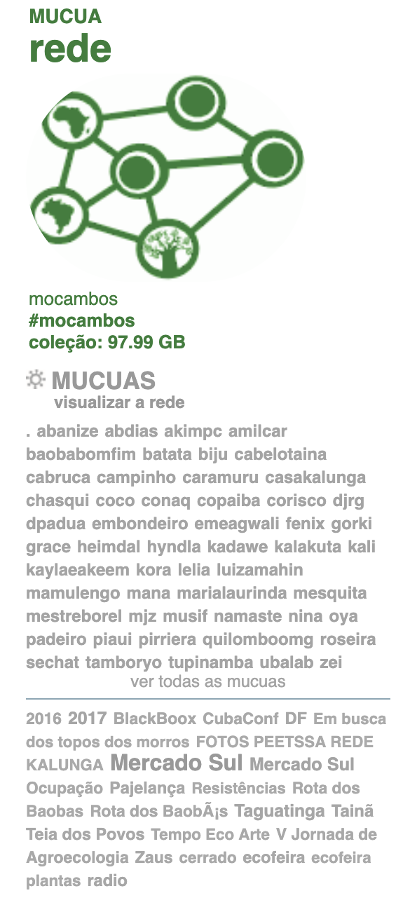
![A diagram of various computer devices connected by dashed and solid lines, with non-computer elements including a bird, a tree and a drum. Rota dos Baobás]](resources/images/figure2.png)


