Abstract
It is sometimes said that all politicians sound the same with their speeches mired
in political jargon full of clichés and false promises. To investigate how distinct
the plenary speeches of political parties truly are and what linguistic features make
them distinct, we trained a BERT classifier to predict the party affiliation of Finnish
members of parliament from their plenary speeches. We contrasted and compared model
performance to human responses to see how humans and the model differ in their ability
to distinguish between the parties. We used the model explainability method SHAP to
identify the linguistic cues that the model most relies on. We show that a deep learning
model can distinguish between parties much more accurately than the respondents to
the questionnaire. The SHAP explanations and questionnaire responses reveal that whereas
humans tend to rely on mostly topical cues, the model has learned to recognize other
cues as well, such as personal style and rhetoric.
Introduction
Language is a fundamental part of doing politics. The way laws are enacted, debates
held, and manifestos written are all deeply entrenched in rhetoric and discourses
that are both rooted in their time and take inspiration from the past. Scholars such
as Edelman claim that
“political language is political reality” ([
Edelman 1988, 104])
[1]
while Rubinelli says that
“the language of politics is essentially rhetorical” [
Rubinelli 2018, 27]. Politics are done through language and, thus, through language, we can make
inferences about the underlying ideological motivations of political actors. Being
able to differentiate between political parties is an important aspect of civil competence,
since informed citizens are recognized as the cornerstone of a functioning democratic
system, especially when it comeswith regard to political and civic participation [
Coverse 1975]. Although many studies have shown that the citizens’ factual knowledge of politics
shows remarkable variation ([
Delli Carpini and Keeter 1991 ]; [
Elo and Rapeli 2010]), trusted sources of information - for example friends, schoolmates, colleagues,
parties, educational institutions - play an important role as ‘shortcuts’ used to
compensate gaps in factual knowledge [
Iyengar 1990]; [
Lupia 1994].
In this paper, we research how distinct Finnish political parties are in their parliamentary
rhetoric by contrasting the performance of a BERT classifier, trained to predict the
party affiliation of a member of parliament given one of their speeches, to human
performance ion the same task. More precisely, we use FinBERT, a Finnish base model
built on the Transformer architecture that we fine-tune for our specific task using
the
FinParl corpus of plenary speeches of the Finnish Parliament [
Hyvönen et al. 2021]. We use the model explainability method SHAP (SHapley Additive exPlanations) to
examine the linguistic features that make the speeches distinct and extract party
specific keywords that reflect the words that are most important for the model in
its decision-making process. We then compare model performance to human performance
by examining responses to a questionnaire in which 438 participants are asked to identify
parties based on plenary speeches.
Our research questions are as follows:
- How distinctive are Finnish political parties based on their parliamentary speeches
for a machine learning model?
- How well do human respondents perform in distinguishing between the parties compared
to the model?
- How do the model and human respondents differ with regards to the linguistic features
that they use distinguish between the parties?
The Finnish parliament is an interesting subject to study because, as a multiparty
parliament, the differences between party policies are more subtle than in a two-party
parliament, which requires more nuanced understanding to distinguish between them.
So far,To date, most similar studies have been conducted on parliaments with fewer
parties. This also makes the use of a Transformer model more appealing, as they have
been shown to be much more accurate than simpler models in a number of tasks. Our
results should be of great interest to those working in the fields of political science,
computational social science and digital humanities, as it highlights the value of
model explainability methods, which are infrequentlynot much used in these fields.
Using deep learning combined with state-of-the-art model explainability methods, we
contribute to a deeper understanding of what makes political speech distinguishable.
The comparison between model explanations and human responses reveals further details
about the distinctiveness of plenary speeches and about the differences of cues identified
by humans and machine learning models. We show that the model can make predictions
on very different cues than humans.
Background and previous work
Finnish parliament
The Finnish parliament (Suomen eduskunta) is a one chamberunicameral parliament with 200 members of parliament (MPs) elected
in a general election every four years. The two official languages of Finland, Finnish
and Swedish, are also the official languages used in parliament, although, in practice,
only around 1-2% of speeches contain some Swedish. The government is typically formed
as a coalition of parties with the leader of the party holding most seats assuming
the role of prime minister. Although dozens of parties have appeared and disappeared
from Finnish politics during over athe more than a hundred years of democracy, from
the 1980s to 2011 there were three major parties: the Social Democratic Party (sosialidemokraattinen puolue, SDP), the National Coalition party (kokoomus, KOK) and the Centre Party (keskusta, KESK). In 2011, the meteoric rise of the Finns party (perussuomalaiset, PS) disrupted the status quo as the Finns overtook the Centre Party as the third largest
party in parliament. Smaller parties consistently present in parliament are the Left
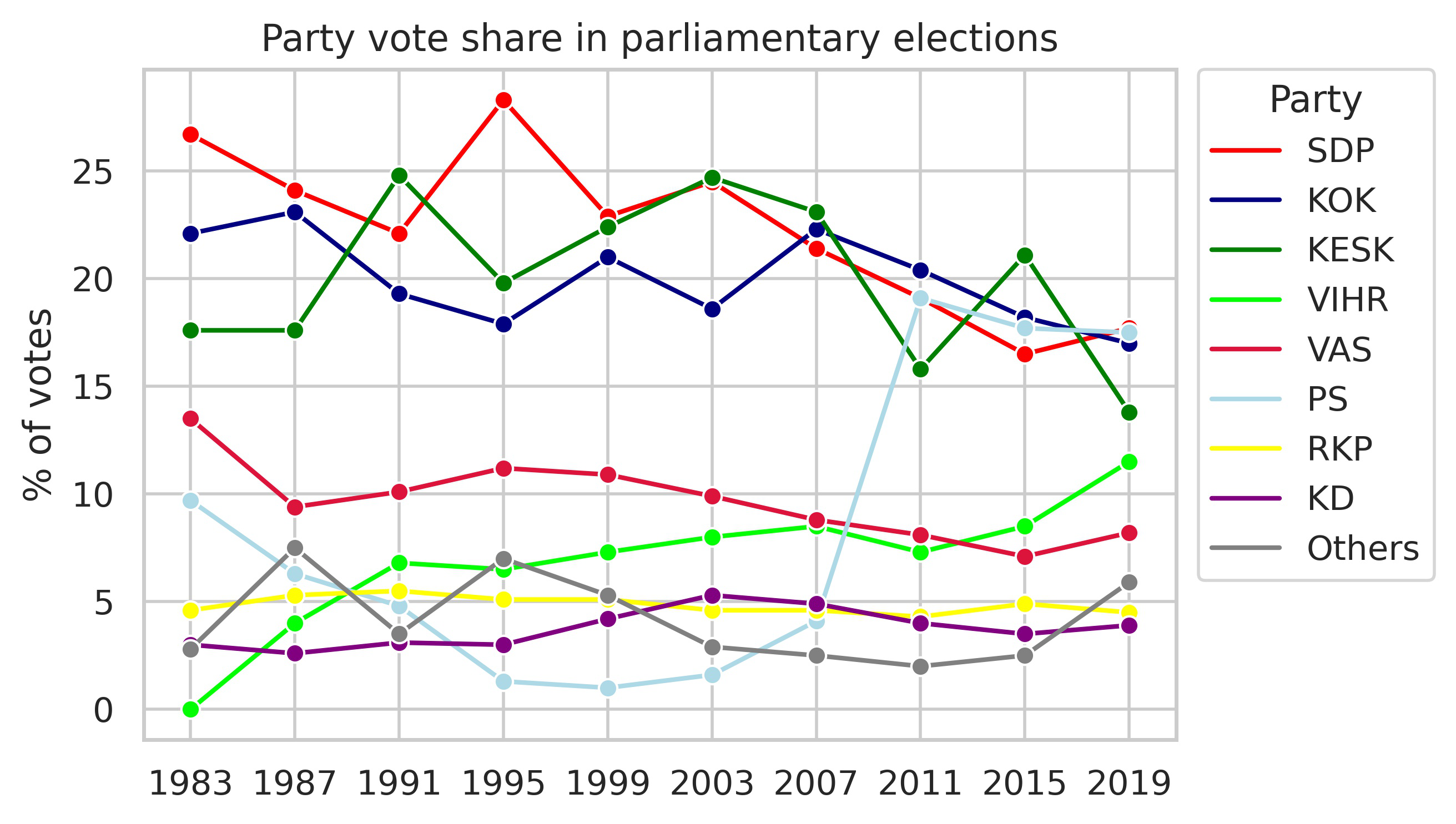
Alliance (vasemmistoliitto, VAS), the Green Party (vihreät, VIHR), the Swedish People’s Party (ruotsalainen kansanpuolue, RKP), and the Christian Democrats (kristillisdemokraatit, KD). Figure 1 shows the election results in Finnish parliamentary elections since 1983.
Plenary sessions (
eduskunnan täysistunto) include a variety of sections and agendas. Legislation is debated and enacted regularly
and, once a week, ministers have to answer oral questions from MPs during Question
Time (Finnish Parliament, n.d.). Plenary sessions are open to the public and are also
broadcast online (Finnish Parliament, n.d.). Although, formally, plenary speeches
are directed at the chairman, with speeches typically beginning with a direct address,
e.g.
Arvoisa puhemies [Honoured chairman], they are still audience oriented, heldgiven with fellow MPs,
media and the electorate in mind (Ilie, 2018). The Finnish parliament is what is known
as a working parliament as opposed to a debate parliament. This means that the most
heated debates are often held behind closed committee doors whereas plenary sessions
tend to be less confrontational. Compare This stands in contrast tothis to debate
parliaments, such as the UK House of Commons, in which lively public debates are commonplace
[
Ilie 2018]. The Finnish parliament is also considered to follow a consensual system ([
Gallagher et al. 2006]) because committee work, and coalition governments require co-operation between
members from different parties. This can potentially make distinguishing political
speeches in Finland more difficult than in countries with more confrontational parliamentary
cultures, since increased partisanship and politically extreme rhetoric has been shown
to make party affiliation easier to distinguish for machine -learning models [
Bayram, Pestian, Santel 2019];
#santel_minai2019; [
Diermeier et al. 2011].
All speeches held in the plenary sessions are transcribed. The transcriptions of are
close-to-verbatim documentations of the original. In principle, all speeches are presented
as spoken. However, the secretaries are allowed to standardizse phonological expression
or to remove expletives whenever needed to make the transcriptions more readable and
understandable. During the entire history of Finnish parliamentarism, the transcriptions
have sought striven to document what has been said in plenary sessions. Today, the
transcriptions are made according to detailed instructions and guidelines of the
eduskunta [
Voutilainen 2016].
Previous work on predicting party affiliation
Renáta Németh (2023) has conducted a review of recent publications that use Natural
Language Processing (NLP) methods to study political polarization. She found that
the number of new publications is on the rise and that most of these studies use data
from the United States and Twitter and present data from a short period of time. Of
the studies that she reviewed five use a classification approach, most use bag-of-words
models and only three discuss, which linguistic features affect classification. Some
studies (see e.g., [
Bayram, Pestian, Santel 2019]; [
Hirst et al. 2010]; [
Peterson and Spirling 2018]) use classification performance as a measure of party polarization, i.e., good performance
means high polarization. We believe that as polarization refers to two opposing entities,
it does not fit the Finnish political setting. We are skeptical sceptical of using
classifier performance as a direct measure of polarization because, as our results
and previous research (e.g. [
Hirst et al. 2010]; [
Potthast et al. 2018]) show, the linguistic features that drive classifiers like ours are not necessarily
politically or ideologically motivated. For these reasons, we opt to use the more
suitable term
distinctiveness.
Previous studies on predicting party affiliation from parliamentary speeches include
work on the United States’ ([
Bayram, Pestian, Santel 2019]), Lithuanian ([
Kapočiūtė-Dzikienė and Krupavičius 2014]), Norwegian ([
Søyland and Lapponi 2017]), and Danish ([
Navaretta and Hansen 2020], [
Navaretta and Hansen 2024]) parliaments. These studies use a number of different models to predict party affiliation
in varying political contexts. [
Bayram, Pestian, Santel 2019] trained several binary classifiers on data from the U.S. Congress and achieved 78
% accuracy with a Support Vector Machine (SVM). They trained the classifiers on 7
different congresses and used model accuracy as a proxy measure for partisanship across
time. They assumed more partisanship means that the two parties are more distinct
in their rhetoric and, thus, easier to classify. [
Peterson and Spirling 2018] show that this method gives results that correspond to conventional knowledge of
polarization in the British parliament. [
Diermeier et al. 2011] examined both politically extreme and politically moderate Republicans and Democrats
in the U.S. senate. Their results show that their SVM classifier did not distinguish
was worse at distinguishing between moderate senators thanas well as more extreme
ones, showing that more ideologically distinct politicians are easier to distinguish.
A feature analysis shows that senators were distinguishable on economic and moral
issues. The paper also shows some evidence of politically extreme senators using signal
words or dog whistles, which are used as covert messages to the more extreme elements
of the electorate.
Other studies have useduse classifiers in multi-party settings. [
Søyland and Lapponi 2017] trained an SVM classifier on speeches held in the Norwegian parliament. After heavy
preprocessing and adding metadata, their classifier reacheds an F1 score of 0.729
on a dataset with 7 parties. Similarly, [
Navaretta and Hansen 2020] trained several models and reached an F1 score of 0.57 on a 4-class classification
task of Danish parliamentary speeches. [
Kapočiūtė-Dzikienė and Krupavičius 2014] used the Naïve Bayes Multinomial method to classify Lithuanian parliamentary speeches
in two datasets, one containing speeches from 12 parties, the other containing speeches
from 8 parties with different levels of pre-processing. Their method achieveds 49%
accuracy.
[
Hirst et al. 2010] argue that what matters most in party rhetoric is not ideology, but institutional
positioning, i.e., the opposition-government divide. They trained an SVM using data
from the Canadian House of Commons and found that classification accuracy is better
with data from Question Periods than with data from debates. Moreover, they fouind
that when training on one parliament and testing on another in which the government-opposition
roles are flipped,
“the performance of the classifier completely disintegrates” [
Hirst et al. 2010, 739]. They thus argue that their classifier does not distinguish political parties
by ideology but by turns of attack and defence between opposition and government.
[
Navaretta and Hansen 2024] studied the identification of plenary speeches from opposition and government parties
in the Danish parliament by training several models based on different architectures.
They found that fine-tuning a Danish BERT model gave the best performance.
Most of the research discussed above has been conducted on parliaments with fewer
parties than the eight that regularly occupy the Finnish parliament. Thus, our setting
requires the classifier to detect and distinguish more minute differences between
party rhetoric to make correct predictions. The literature in the field shows that
government and opposition roles are reflected in plenary speeches. To mitigate this
effect, we trained our model with data that has all parties occupying both government
and opposition roles. Therefore, the model cannot reliably base its predictions on
linguistic cues caused by this division. Whereas previous studies have mostly used
SVMs and other relatively simple models, our deep learning model has the potential
to reveal previously unknown distinctive linguistic features of plenary speeches due
to it relying on context-aware word embeddings rather than bag-of-words-style features.
We also trained an SVM as a baseline comparison and show that the BERT model performs
better.
Cues and voter assessment of political parties
A voter’s ability to understand current affairs and to identify major ideological
differences is considered central for their political competences, i.e., for
“understanding of processes and structural components associated with developing public
events” [
Genova and Greenberg 1979, 89]. This links our current study to the broader field of research on civic competence
and political knowledge (e.g., [
Dahl 1992]; [
Delli Carpini and Keeter 1993]; [
Downs 1957]; [
Popkin and Dimock 1999]). A majority of studies on citizens’ ability to identify and assess political issues
focus on the impact of a party’s policy positions on citizens’ the voting behaviour
of citizens. [
Devroe 2020], for example, studieds voter assessment of a candidate’s competence based on the
candidate’s gender, some biographical information, as well as their policy position
on selected issues. The results indicate that voters tend to give positive evaluation
to candidates with similar policy positions. [
Adams, Weschle, and Wlezien 2021], in turn, show that voters tend to consider parties that appear cooperative to each
other
“as sharing more similar ideologies than those that exhibit conflictual relationships” [
Adams, Weschle, and Wlezien 2021, 112]. The study of [
Valentino et al. 2002] presents mixed conclusions about the impact of political cues. On the one hand,
voters being aware of such cues seem to be able to change their attitudes. On the
other, however, without an appropriate knowledge of politics, cues might be left unidentified
and negative cues unchallenged. The role of political knowledge and the proper understanding
of different party preferences are recognised by [
Gilens 2001], [
Tilley and Wlezien 2008], and [
Just 2022]. These studies bring upraise evidence that new policy-specific information and raw
facts might have a strong influence in the shaping of political judgements of party
placements and positions.
To sum upsummarize, a majority of former studies argue that a proper identification
of ideological positions is strongly dependent on citizens’ political knowledge and
their ability to recognise and use ideational cues. Put other way roundConversely,
analysing citizens’ ability to correctly classify plenary speeches to ideological
positions represented by different parties can help us to better understand how well
citizens are able to identify the vocabulary of politics and link its use to ideologies
underlying the party system.
Data & Methods
In this section, we introduce the FinParl dataset and how we built our corpus of speeches.
Next, we explain the basic principles of text classification with deep learning models.
Third, we show how the model explainability method SHAP provides explanations to the
predictions made by a machine learning model. Finally, we explain our experimental
setup, including how we trained our model, how we extracted SHAP explanations and
how the questionnaire was structured.
FinParl dataset and pre-processing
The data used for this research was obtainedcomes from the FinParl dataset, which
consists of parliamentary speeches held in the Finnish
eduskunta since its inception in 1907 [
Hyvönen et al. 2021]. From the years 1907 to 1999, the data is digitised using OCR, whereas later data
was collected from HTML and XML files. The contents of the dataset and how it was
created is explained in detail in [
Sinikallio et al. 2021]. In the current paper, we focus on speeches from 2000 to 2021.
We converted the data into CSV format containing the full text of the speech, the
speaker’s name, the party affiliation and the year. Speeches that were interrupted
and were thus separated into two or more segments, were combined, while the interruptions
themselves were discarded. While we aimed to keep as much of the original data as
possible so as not to introduce bias in the results, some filtering was applied where
it was deemed necessary. Speeches with the speaker tag ’chairman’, ’viceChair’, ’secondViceChair’
or ’elderMember’ were discarded, since they mainly consisted of formal boilerplate
text rather than ideologically motivated political speech. The data were further cleaned
by removing speeches that were deemed too short. To determine a suitable minimum speech
length, a manual review of deleted material at different cut-off points was conducted.
This led us to remove speeches with 12 tokens (see section on deep learning below) or fewer.
Finally, we removed mentions of party names, because these could make the classification
task trivial, especially in speeches with phrases, such as
Me perussuomalaiset [We, the Finns]. ItThis will also forces the model to make predictions based on other
than these obvious linguistic cues, which could reveal more latent features of party
rhetoric. Party names were removed using the Named-Entity Recognition (NER) model
developed by the National Archives of Finland.
[2]
Entities tagged with either the ORG or NORP tag that matched a party name or abbreviation
were replaced with the string
[PUOLUE], meaning [PARTY].
We did not remove Swedish speeches from the dataset, as the Swedish language holds
a significant cultural and historical place in Finnish society and politics. Swedish
in parliament is today mostly, but not exclusively, used in official communications,
and in everyday political debates by members of the Swedish People’s Party. The Swedish
People’s Party is a major political force in Finland, being a member of all coalition
governments since the 1970s with the exception of one four-year term between 2015
and 2019.
Only speeches from the 8 largest parties from 2000 to 2021 were retainedkept. Short-lived
minor parties such as Remonttiryhmä, who only existed for three years and had one MP, were discarded. The distribution
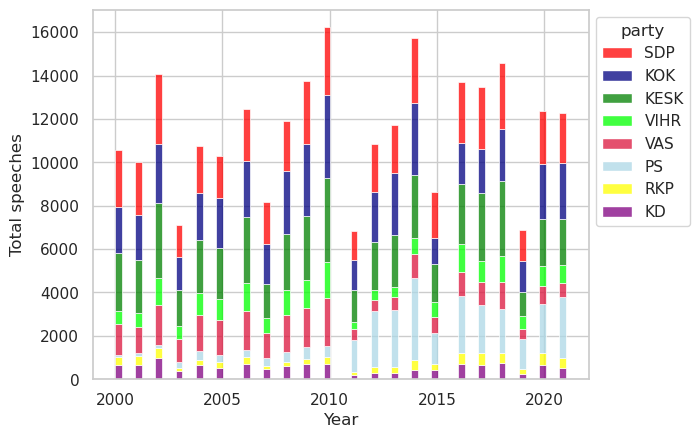
of speeches per party from 2000 to 2021 is shown in Figure 2. The figure shows that
the Social Democrats (SDP), the National Coalition (KOK) and the Centre (KESK) account
for most of the speeches in the dataset, over 50,000 each. The Finns, the Greens and
the Left Alliance account for over 20,000 speeches each, the Christian Democrats for
13,000 and the Swedish People’s party for 7,000. The major leap in vote share of the
Finns (PS) in the 2011 elections is also reflected in the data by an increased share
of speeches. The final dataset has speeches from 605 speakers. The average speaker
has 427 speeches in the dataset, the median being 272. Fifty-three53 speakers have
more than a thousand speeches attributed to them. The two most active speakers are
Erkki Pulliainen from the Green party and Pentti Tiusanen from the Left Alliance with
4525 and 4043 speeches, respectively. The average speech is 219 words long and the
median speech is 130 words long. After pre-processing, the dataset consists of 252,389
speeches.
Text classification using deep learning
Deep learning refers to neural networks that comprise multiple layers of modules that
each represent their input in increasingly abstract form. With sufficientenough layers
and training data, exceedingly complex functions can be learned [
LeCun, Bengio, and Hinton 2015]. BERT (Bidirectional Encoder Representations from Transformers) is a language representation
model released in 2018 that is built on the Transformer architecture. It performs
much better on many NLPnatural language processing tasks than previously popular models,
such as Support Vector Models [
Devlin et al. 2018]. More recently, Large Language Models (LLMs), such as ChatGPT, Claude and Mixtral
have again changedtransformed the field of the NLP landscape. For many classification
tasks, however, BERT based models are still preferable because LLMs are both computationally
and financially more costly to run.
BERT is trained on a masked language model objective, in which some input tokens are
masked (i.e., hidden), and the model is tasked with predicting the masked token given
both the left and right context. The original BERT model was trained on English and
was soon followed by Multilingual BERT and then other language specific versions.
As the base of our deep learning model, we use FinBERT, a Finnish BERT model pre-trained
on more than 3 billion tokens of Finnish [
Virtanen et al. 2019]. Its high performance in many Finnish NLP tasks makes it the best choice for our
study. We fine-tuned FinBERT for our text classification task using the FinParl data.
BERT models require their input text to be tokenized using a WordPiece algorithm,
first described by [
Schuster and Nakajima 2012]. A BERT model has a fixed vocabulary, with each token being assigned to a unique
token ID. Common words are represented by their own token IDs, but lessfewer common
words are represented by a combination of tokens. For instance, the sequence
"jatkuvasti kasvava byrokratia" ["ever growing bureaucracy"] is tokenized as jatkuvasti, kasvava, byrokra, ##tia.
Additionally, there are a few special tokens, such as [CLS] and [SEP] at the beginning
and end of each sequence. In effect, there are typically somewhat more tokens than
words in any given sequence. Whereas SVMs process input as bag-of-words, with BERT, word
order and context are taken into account. A limitation of the FinBERT model is that
its input cannot exceed 512 tokens, which is why long speeches are truncated to fit
within this limit.
Model explainability
Model explainability is the field of study that examines how the output of machine
learning models can be made understandable to humans. For simple models, the best
explanation can be the model itself, but more complex models require a separate
explanation model to getachieve a human understandable approximation of the model [
Lundberg and Lee 2017]. We use SHAP ([
Lundberg and Lee 2017]) to produce explanations of our deep learning model. SHAP produces explanations
by calculating the contribution that each input feature carries towards the outcome.
For a simplified explanation of how SHAP calculates the contribution of input features,
one can imagine three people digging a hole: A, B, and C. After one hour of digging,
they’vethey have dug a hole one meter deep. To calculate how much each person contributed
to the outcome, we can remove one at a time, dig another hole, and observe the difference.
If we remove person A, the resulting hole is only 0.4 meters deep. Removing B results
in a hole that is 0.5 meters deep. Finally, removing person C results in a hole that
is 1.1 meters deep. Therefore, we can calculate that the effect on hole depth per
person is A = 0.6m, B = 0.5m, C = -0.1m.
SHAP is model agnostic and can be used with tabular, visual or textual data. In practice,
in a text classification setting, each token is treated as a feature, and the outcome
is the prediction that the model produces. SHAP values are calculated by masking sets
of tokens in the model input and observing how the prediction of the model changes
in response. Previous uses of SHAP for text classification explainability include
COVID-19 related fake news detection ([
Ayoub, Yang, and Zhou 2021]) and humour analysis [
Subies et al. 2021]. One major disadvantage of SHAP is that calculating SHAP values for large datasets
is computationally demanding. To reduce the computational load, we use SHAP’s partition
explainer, which clusters tokens together hierarchically and thereby reduces the number
of calculations performed.
Experimental setup
To train our model, we first dividedsplit speeches held between the years 2000 and
2021 into train, development and test sets with 80-10-10 splits. The train and development
splits are used in model training and the test set is used to evaluate the performance
of the model. There are a number of training hyperparameters that need to be set manually
to train a deep learning model, such as learning rate and batch size. We used the
grid search method to optimize model performance. We used label smoothing, a regularisation
technique which prevents models from becoming overly confident, at a factor of 0.1.
This also ensures that the prediction probability of a given prediction is more closely
aligned with actual accuracy (i.e., at 90% prediction probability the model is close
to 90% accurate). To further prevent over-fitting and increase training efficiency,
we used early stopping during the training if the model did not improve its performance
for 10 evaluation calls. Training was done using the Transformers, Tokenizers and
Datasets Python libraries from Huggingface
[3].
To verify that our model performeds consistently, we used 5-fold random subsampling
(see [
Berrar 2019]). This means that five training, development and test sets are created, and each
are used to train a model. The average F1 score of these models is given as the final
performance of the model.
Questionnaire
To groundbase our results oin human performance we created a questionnaire in which
participants were given five speeches to associateconnect with a political party.
In addition to answering which party they believed had given which speech, respondents
were asked to choose the words or phrases that most influenced their decision and
to give a numerical rating on a scale from 1 to 5 (1 = very confident, 5 = not at
all confident) on how confident they were in their answer. Each informant was given
five speeches that were randomly selected from a stratified sample of 100 speeches
that were held between 2010 and 2019 and that were not included in the model training
dataset. We also attained the model predictions for this 100- speech sample. This
way, we could directly compare human performance against machine performance. The
questionnaire was sent to university students as well as circulated online. First,
we collected responses from 166 people, the vast majority of whom were students at
a Finnish university, who were taking a course in Digital Humanities. Later, the questionnaire
was shared by the Finnish national broadcaster Yle, which yielded an additional 272
responses. In total, 438 informants responded to the questionnaire.
Results
In this section, we first analyse the performance of the model quantitatively. We
then analyse the SHAP explanations for a sample of speeches and predictions to ascertainsee
what kinds of linguistic features the model uses to make its predictions. After this,
we turn our focus onto the questionnaire: we examine how well our respondents could
identify the parties and then compare their cues to the SHAP explanations. This comparison
demonstrates how the model and human respondents differ in distinguishing between
the parties.
Model performance
The average macro F1-score from 5-fold random subsampling for our models is 0.66.
As a baseline comparison, we trained an SVM model with lemmatized speeches cleaned
of stopwords, which reached a macro F1-score of 0.58. Using a BERT model shows a clear,
eight-point increase in classification performance, justifying its use in this study
instead of the simpler SVM model.Our fine-tuned FinBERT models achieved an average
macro F1-score of 0.66 across 5-fold random subsampling. As a point of comparison,
we also trained an SVM baseline on lemmatized data with stopwords removed. The SVM
reached a macro F1-score of only 0.58. Fine-tuning FinBERT leads to a substantial
eight-point improvement or a relative gain of nearly 14% in macro F1. Beyond the measurable
performance boost, FinBERT’s contextualized language representations capture nuanced
semantic and syntactic patterns that SVMs with bag-of-words-style features cannot,
making FinBERT a clearly justified choice over the simpler baseline.
To address the 512- token limitation of the FinBERT model, we tested the effect of
keeping the last 512 tokens of speeches exceeding this length instead of the first.
We found the model’s performance to be very similar in both cases. We conclude that
there is no clear difference in distinctiveness between the beginning and the end
of speeches and we feel confident that truncating longer speeches to the first 512
tokens will not affect the results much. Additionally, only approximately 15% of the
speeches exceeded the token limit.
Since some MPs are much more active speakers than others, we consider the fact that
the model might learn the speech patterns and typical word choices of individual MPs.
Therefore, we tested whether the number of speeches an MP has in the dataset affects
how well the model distinguishes that MP’s speeches. We calculated the accuracy of
the model on each speaker and found the accuracy to vary between 0% and 100%, the
average being 57%. Figure 3 illustrates that there is a weak to moderate (Pearsons’
r = 0.35) correlation between the number of speeches and accuracy. Still, many MPs
with few speeches are correctly predicted with high accuracy, while others, such as
Liisa Hyssälä (the Centre, 1,128 speeches) and Peter Östman (Christian Democrats,
896 speeches) are predicted with relatively low accuracy, at 35% and 21%, respectively.
Thus, even though the model has clearly learned to identify the speech patterns of
some speakers, such as MPs Pulliainen and Tiusanen (represented by the two dots in
the top right-hand corner in Figure 3), this is not a universal phenomenon that would
apply to all highly active speakers. NonethelessStill, as we discuss below, the idiosyncrasies
of individual MPs, especially in the case of MP Pulliainen from the Green party, can
have a profound impact on how the model learns to distinguish between parties.
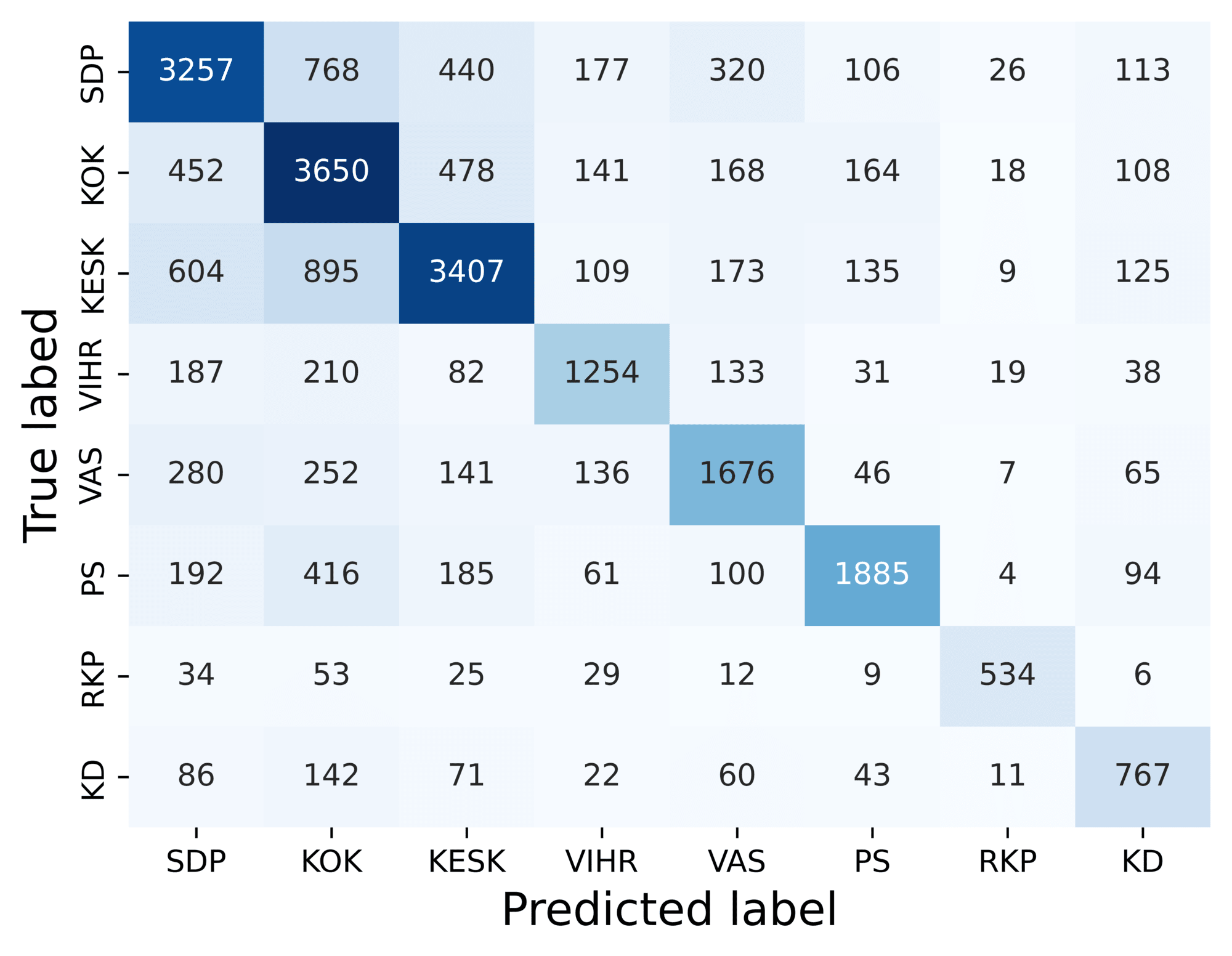
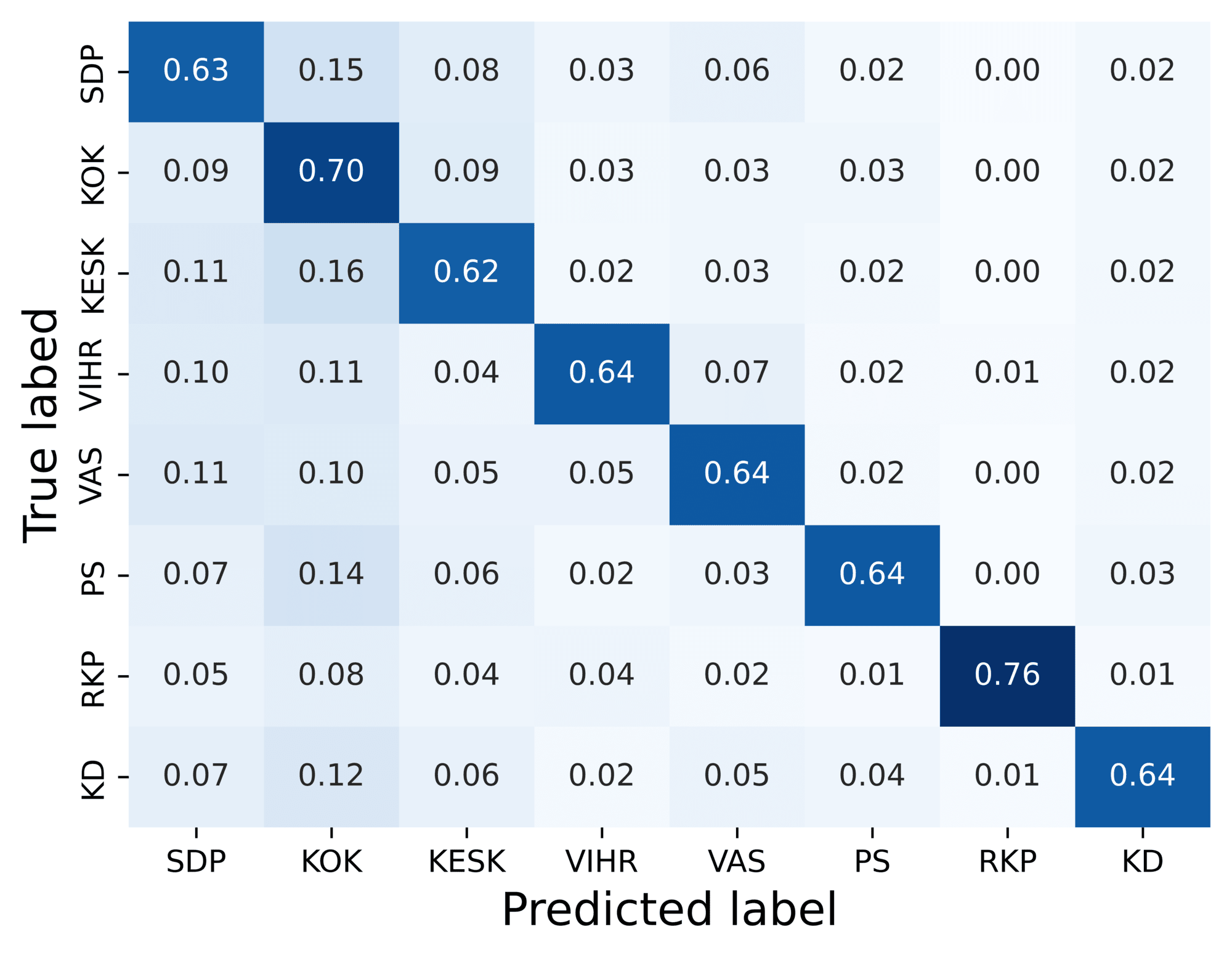
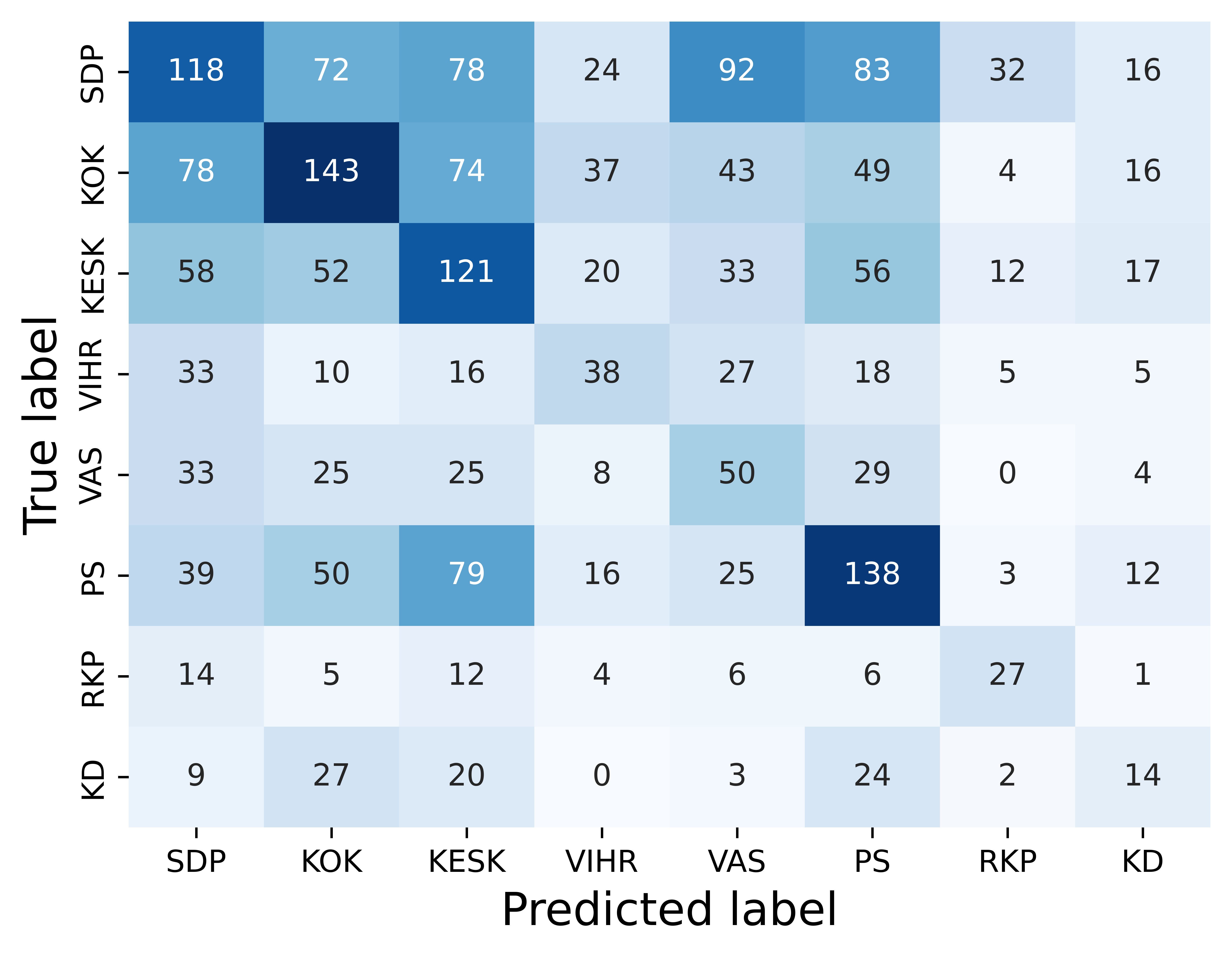
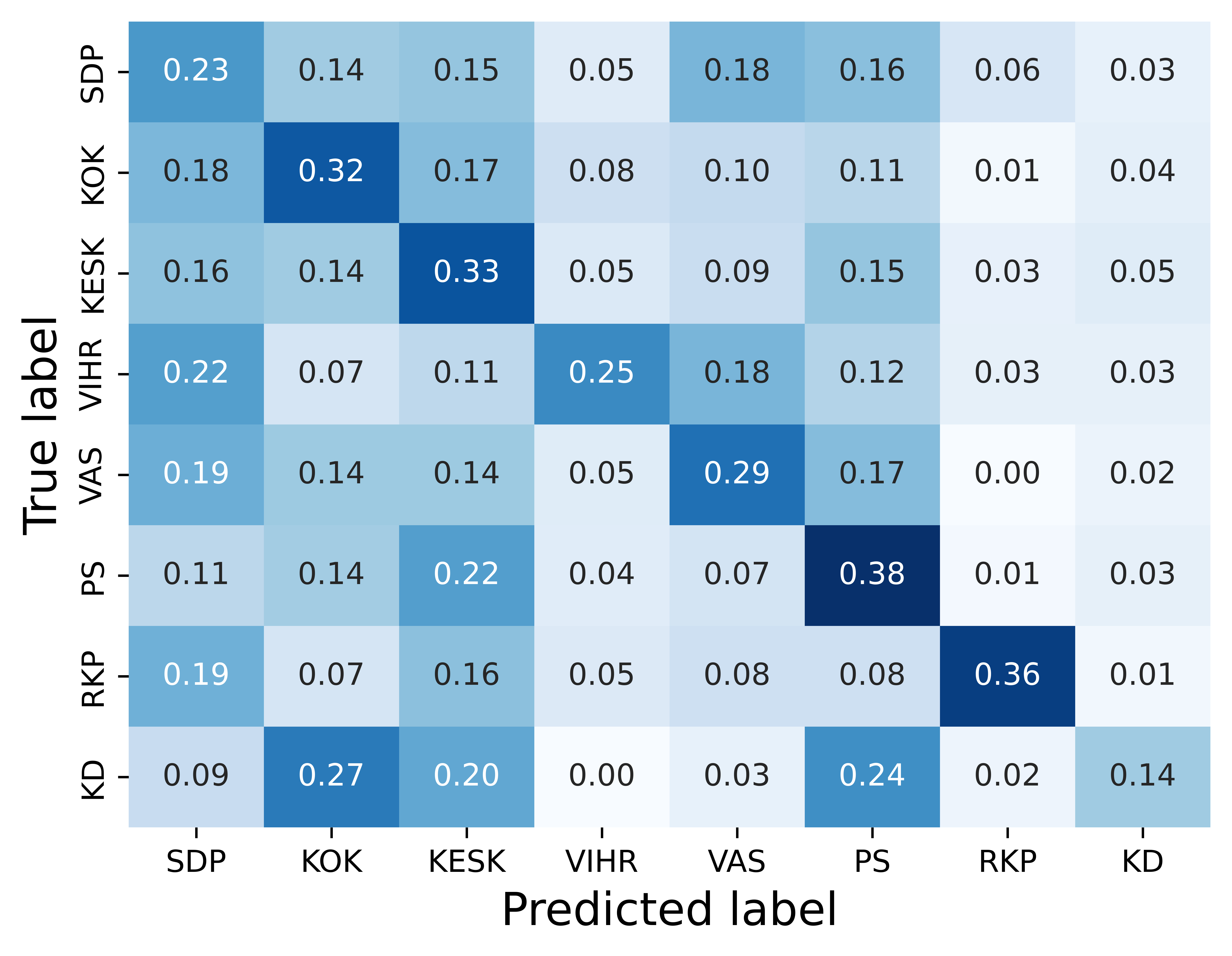
The confusion matrices in Figure 4 depict model performance. In the first confusion
matrix, we note that the model tends to confuse speeches from the three largest parties
(SDP, KOK, KESK) with each other. This suggests that there is something in common
between the speeches of these three parties. As the largest parties in parliament,
they often assume a leading role in government and opposition, which could explain
these similarities. The second confusion matrix shows that while National Coalition
(KOK) speeches are well recognised, it is also over-predicted, i.e., the model often
predicts that speeches from other parties are National Coalition speeches. In public
discourse, the party is often regarded as Finland’s ’economic party’ and our results
show that this reputation is not completely unearned. The strong connection between
the National Coalition and economic talk is evidenced by our finding that many speeches
that are mistakenly predicted to belong to the National Coalition concern public finances,
taxation or entrepreneurship.
Table 1 shows that the Swedish People’s Party (RKP) and the Finns (PS) have the highest
class-wise F1 scores, 0.79 and 0.70, respectively. The Swedish People Party’s speeches
are often partly or entirely in Swedish, which distinguishes them from other parties.
Although they are not the only party to use Swedish in parliamentSwedish is not used
exclusively by them, they are the party that uses the language the most, by far. The
Finns, on the other hand, are known for their populist rhetoric and colourful language
[
Ylä-Anttila and Ylä-Anttila 2015]. This sets them apart from other parties and could explain their higher F1 score.
This is also evidenced by the SHAP explanations, discussed below.
|
SDP |
KOK |
KESK |
VIHR |
VAS |
PS |
RKP |
KD |
| F1 |
0.63 |
0.61 |
0.65 |
0.64 |
0.63 |
0.70 |
0.79 |
0.62 |
Table 1.
Party-wise F1 scores, average of 5 training runs
The National Coalition is the label most often given to misclassified speeches, followed
by the Social Democrats and the Centre, i.e., the three largest parties. These results
are similar to those of Søyland and Lapponi (2017), who observed that larger parties
received more misclassification than smaller ones. It would be reasonable to assume
that parties that are close to each other ideologically, such as the Social Democrats
and the Left Alliance, also spokespeak similarly in parliament, and thus, would be
harder to distinguish from each other. YetHowever, the misclassifications only give
a weak signal that this is the case. Misclassified Left Alliance speeches are labelled
as Social Democrat speeches 30% of the time and National Coalition speeches 27% of
the time. Social Democrat speeches were most often misclassified as National Coalition
speeches (39%) and vice versa (30%). In fact, all theparty’s speeches of the parties,
except for the Left Alliance, are most often misclassified as National Coalition.
Overall, tThe Centre Party is overall the one most often misclassified. As they occupy
the political centre, they can at times take stances that are more aligned with the
political left and at other times align more with the political right, which could
explain why their speeches are most often misclassified.
SHAP explanations
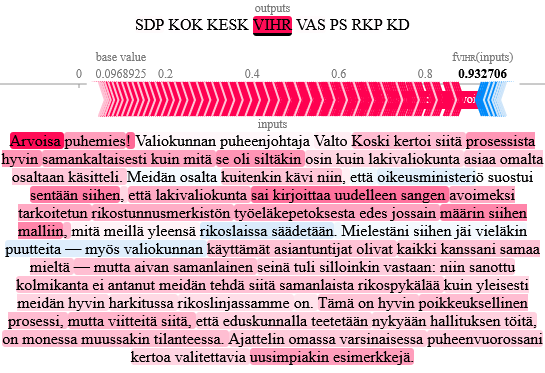
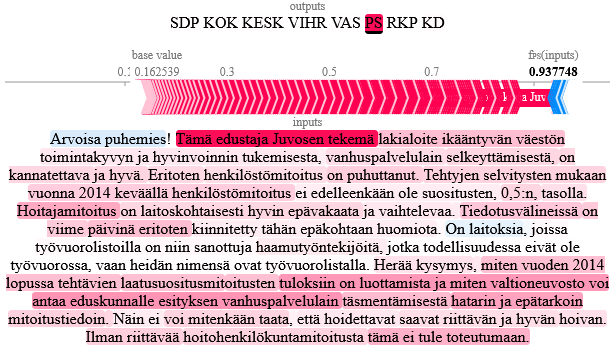
We analysed the SHAP explanations by taking a random sample of 20 correctly predicted
speeches with high prediction probability (>90%) from each party. As an example, Figure
5 shows a speech from the Green party. The words and phrases highlighted in red represent
features that were positive evidence (i.e. cue phrases) towards the model prediction and those in blue represent negative evidence, i.e.
the presence of these features make the prediction less likely. The darker the colour,
the stronger the effect that feature has on the prediction. In this example, the phrase
Arvoisa puhemies [Honoured chairman] was given a lot of weight by the model. We discuss possible explanations
for this at the end of this section.
Our analysis shows that the model paidys attention to two types of cue phrases, which
we call topical cues and rhetorical cues. Topical cues are phrases that relate to
a coherent topic, such as immigration, taxation, the EU. In other words, they convey
what the speech is about. Rhetorical cues on the other hand relate to style or tone
and are, at least in isolation, not directly linked to the topic of the speech. Rhetorical
cues are often identified by the presence of function words, adverbs and adjectives.
Table 2 aggregates some example SHAP cues that the model useds to identify the parties.
The SHAP cues show that the model has learned to identify both the core political
issues of the parties and also the style and tone of some individual speakers. The
SHAP explanations show that what makes the Social Democratic Party distinct is their
focus on the well-being of the unemployed and especially pensioners. They also provide
criticism of the free market and often use the term porvarihallitus [bourgeois government] to rebuke the actions of right-wing governments. The names
of National Coalition MPs are often strong explanatory features, which shows that
the Social Democrats position themselves as a counterforce to their free market policies.
The National Coalition is distinct in the way they talk critically about taxes and
government welfare programs. They highlight the importance of economic growth and
free markets. The fact that they occupied a government position for most of the two
decades that the data covers is also shown in the explanations, as phrases that applaud
the government can act as cue phrases. The Centre party speaks for the rural population:
their topical cue phrases concern different municipalities and areas, agriculture,
forestry and peat extraction, while the Christian Democrats stand out by raising issues
concerning healthcare and abortion. For the Finns, the model has learned to notice
their critical attitude towards the EU and incurring government debt. Another recurring
feature is critique against the government, which is likely a product of them occupying
the opposition position. Some rhetorical cues also highlight the party’s colloquial
style of the party and the populist rhetoric that they are known for. Examples of
these are koska koko kansa herää [when do the people wake up] and taitavat olla vanhimmatkin kansanedustajat hallitysryhmistä yhtä narrattavissa kuin
joulupukkiin uskovat lapset [even the oldest MPs in government seem to be as easily fooled as children who believe
in Santa Claus]. The Left Alliance has topical cue phrases that relate to defending
the poor and underprivileged, supporting welfare programs and workers’ rights. Additionally,
the party is also distinctive in its push for greener policies. The Swedish People’s
Party speeches were most easily identified by the use of the Swedish language. Cue
phrases that were not in Swedish concerned topics of equality and welfare as well
as the Finnish archipelago, which is where many Swedish speaking Finns live. Finally,
for the Green party, although topical cues relating to climate change and environmental
protection were present, the strongest cues were a result of the disproportionate
activity of MP Erkki Pulliainen, whose personal style has clearly had a strong impact
on what the model associates with the party. MP Pulliainen style of speaking in parliament
can be described as conversational or even playful and many adjectives and adverbs,
such as erikoisesti [peculiarly], täsmälleen [precicely], and äärimmäisen [utmost] often shine bright red in the SHAP explanations. Notably, out of the 20
Green party speeches sampled from the pool of correctly predicted speeches, 16 were
from MP Pulliainen.
| Party |
Examples of explanatory cues |
| Social Democratic Party |
"bourgeois government", "Zyskowicz", "the government is proposing great cuts into
pensioner housing benefits" |
| National Coalition |
"want to keep Finland a land of work and entrepreneurship", "encourage working and
diligence" |
| Centre |
"have defended the use of timber and Finnish peat", "to Savukoski" |
| Green party |
"so in other words", "carbon-neutral circular economy", "peculiarly" |
| Left Alliance |
"the poor and the underprivileged", "poverty has increased", "methane is a highly
potent greenhouse gas" |
| Finns |
"children who believe in Santa Claus", "more debt leads us on the Greek path" |
| Swedish People’s Party |
"Honoured chairman" (in Swedish), "equality legislation", "I would like to pay attention
to our marine conditions" |
| Christian Democrats |
"people’s health and illness", "abortion law", "risk of fetal disorder" |
Table 2.
Examples of party cues as indicated by SHAP explanations
Most of the SHAP cues discussed above are easy to understand to anyone with a thorough
understanding of the Finnish political parties and their political leanings. However,
there are also some surprising findings that are not easily explainable by party politics.
For instance, the customary greeting of the chairman or parts of it that starts virtually
all speeches, is shown to be a cue phrase of each party at least once in our sample
of speeches. Such is the case in Figure 55, where the word Arvoisa [Honoured] is the strongest individual cue in the whole speech. Why this is the case,
when all parties use the same phrase constantly, is unclear. There are variants of
this initial greeting where the explanation does make more sense. For instance, the
Finns cue phrase Kunnioitettu puhemies [Esteemed chairman!] is, in fact, used more by the Finns than other parties. At times,
the gender of the chair is revealed, when the greeting is Arvoisa (herra/rouva) puhemies [Honoured (Mr. /Mrs.) chairman!]. This gendered honorific is sometimes a cue phrase,
suggesting that the model has learned some temporal cues, as the chairman is at times
a woman and at others a man. Other puzzling explanatory phrases are rhetorical cues
that are mostly function words. As discussed above, sometimes they can be attributed
to the style and rhetoric of individual speakers that the model has learned to recognise.
At other times, the reason is much more obscure. Such is the example of sen tähden minusta tässä [because of that I think here], which is shown to be a strong cue phrase indicating
the Centre. This exact phrase appears only once in the training data and when it does,
it is spoken by a member of another party, namely the Christian Democrats. Yet, focusing
on only the beginning of this phrase, we realised that the Centre MP Timo Kalli usesd
the phrase sen tähden [because of that] 213 times in 141 speeches in the training data. In total this phrase
was usedappears 1190 times in 991 speeches in the training data, which means that
MP Kalli was responsible for roughlyaround 18% of all uses. Even though MP Kalli is
not a particularly active speaker, it seems that the model has noticed this particular
idiosyncrasy of one Centre MP and has thus come to associate it with the Centre party.
Lastly, the SHAP explanations show that even though mentions of party names were removed
and replaced with [PARTY], the model still learned to predict who is being referenced
based on the verb in the sentence. The Finns and the Christian Democrats are the only
parties, whose name is in plural form. Hence, when [PARTY] is the subject of the clause
and the verb is in plural form, the model knows that [PARTY] must be one of these
two parties.
In sum, our results show that the model has learned to identify the parties with decent
accuracy and that the Swedish People’s Party and the Finns are the most distinctive.
When the model misclassifies speeches, it most often gives the label of one of the
three largest parties. The model has learned to recognise the political leanings of
the parties but also uses rhetorical cues to make its predictions.
Questionnaire responses
A total of 438 people responded to the questionnaire. Each respondent labelled five
speeches resulting in a total of 2190 responses. Each speech was labelled between
15 and 28 times. Model accuracy on the 100 speech100-speech sample dataset was 62%,
whereas human accuracy was only 30%. In terms of F1 scores, the respondents correctly
identified speeches from the Finns most often, closely followed by the National Coalition
and the Swedish People’s Party, as shown in Table 3 and Figure 6. This result is similar
to model performance, reinforcing the notion that the Finns and the Swedish People’s
Party are distinctive. Conversely, responses were least often correct with Christian
Democrats’ speeches, where respondents reached an F1 score of just 0.15. Respondents
were asked to report their own estimate of their political knowledge but, surprisingly,
we found no correlation between reported political knowledge and accuracy in identifying
speeches. In terms of confidence, respondents gave an average score of 3.1 (1 = very
confident, 5 = not at all confident). We found that confidence correlates with accuracy.
The respondents found some speeches easier to connect to a party as evidenced by high
accuracy and high confidence score, while others were much harder.
Although the respondents did not perform too well in identifying party-specific political
speech, they performed far better when measured against their ability to identify
ideological similarities. If we use a simple left-right typology for the Finnish party
landscape, the success rate for identifying left-wing speakers wasis 50.3%, and for
right-wing speakers 71.5%. In this respect, our results indicate that respondent right-wing
speaking is somewhat easier to identify. However, more research with different political
texts and covering different contexts and periods of time is needed to obtain a clearer
picture about this.
|
SDP |
KOK |
KESK |
VIHR |
VAS |
PS |
RKP |
KD |
| F1 |
0.26 |
0.35 |
0.30 |
0.25 |
0.22 |
0.36 |
0.34 |
0.15 |
Table 3.
Party-wise F1 scores of human responses.
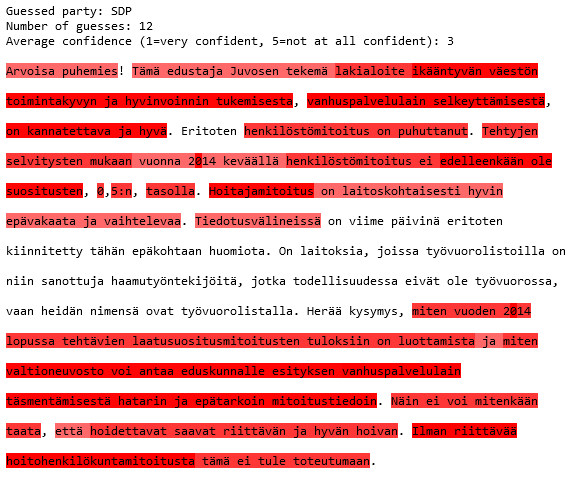
In addition to choosing a party, the respondents were asked to indicate which phrases
in the speech made them think that the speech was from the party that they believed.
Based on these responses, we formed a list of keywords. These were calculated by pooling
together all phrases that were chosen as cues for a given party. The phrases were
tokenized into words and lemmatized. We removed stop words and then calculated the
most frequent words for each party, which are shown in Table 4. It should be noted
that these keywords come from a set of only 100 speeches and should therefore not
be treated as representative of the party speeches as a whole. They do, however, give
some indication of what kinds of words people tend to associate with a given party.
The keywords indicate that people tend to be more topic focused than the model. The
topical keywords closely resemble those that the model has learned to identify: National
Coalition talk about economy, the Centre about regional matters and the Left Alliance
about unemployment.
| SDP |
KOK |
KESK |
VIHR |
VAS |
PS |
RKP |
KD |
| want |
must |
region |
human |
human |
Finland |
Swedish |
human |
| human |
Finland |
regional |
bring down |
government |
government |
then |
killing |
| good |
then |
country |
need |
must |
mind |
word |
life |
| government |
National Coalition |
then |
bear |
unemployed |
here |
own |
question |
| SDP |
economy |
good |
carcass |
cut |
important |
important |
child |
| then |
government |
MP |
set |
want |
then |
right |
ending |
| own |
time |
municipality |
sentence |
give |
must |
different |
government |
| must |
here |
government |
must |
time |
MP |
secure |
police |
| Finland |
police |
issue |
MP |
need |
very |
region |
Finland |
| employment |
country |
Finland |
Finland |
well |
issue |
very |
own |
| issue |
also |
strong |
issue |
small |
own |
go |
kill |
| need |
give |
well |
along |
cut |
talk |
honoured |
patient |
| propose |
work |
post |
juridical |
Finland |
police |
speaker |
important |
| time |
good |
must |
well |
issue |
current |
also |
hope |
| also |
growth |
whole |
sexual |
right |
want |
here |
yes |
| support |
get |
function |
orientation |
education |
yes |
issue |
good |
| well |
entrepreneur |
important |
question |
child |
year |
nordic |
must |
| National Coalition |
Europe |
different |
child |
most |
country |
honoured |
mind |
| say |
issue |
want |
whole |
work |
Europe |
good |
suicide clinic |
| important |
company |
wood |
right |
euro |
time |
court of appeal |
doctor |
Table 4.
Response keywords.
Comparison between model and humans
In comparisonWhen comparing the questionnaire response to model predictionsperformance,
Table 5 shows that the most common case is one in which the model made a correct prediction
while humans responded incorrectly. The next common case is one in which both were
incorrect. Only 9% of the time are humans correct while the model makes an incorrect
prediction. In this section, we analyse and compare the cue phrases chosen by the
questionnaire respondents to the cue phrases indicated by SHAP explanations. We do
this through a close reading of the speeches in the questionnaire and illustrate the
results with a selection of example speeches. The results show that while the model
useds both topical and rhetorical cues in its decision-making, the respondents reliedy
more heavily on topical cues. In the examples below, the phrases in bold are some
of the most important features for the model prediction as indicated by the SHAP explanations.
|
Model correct |
Model incorrect |
| Human correct |
458 / 21% |
191 / 9% |
| Human incorrect |
917 / 42% |
624 / 28% |
Table 5.
Human and model performance.
Different cues for model and humans
-
1. "Ja niin kuin edustaja Koskinen tässä jo totesi, niin mielestäni tänään täällä kuullut
puheenvuorot esimerkiksi pääministerin toimesta vain ikään kuin haastoivat meitä kaikkia siihen keskusteluun […] [M]eidän on laitettava suitsia näille
markkinavoimille, jotta me saamme palautettua näihin järjestelmiin sitä kansanvaltaa,
joka tänne kuuluu, näihin nimenomaisiin saleihin eri puolilla Eurooppaa."
"And as MP Koskinen already stated, in my opinion, what we have heard here today,
the speeches by for example the prime minister, as it were, challenged us to part-take in the discussion […] [W]e must start controlling these
market forces so we can reintroduce democracy to these systems, these exact halls all around Europe."
In Example 1, the speech from the Social Democrats was correctly predicted by the
model mostly based on the phrases in bold. The first phrase, a rhetorical cue, is
a rather mundane phrase that, intuitively, could be spoken by any MP from any party
and, indeed, was not indicated to be a cue phrase by any of the questionnaire respondents.
Yet, the model sees this as very informative. This could be due to the broader context,
such as the mention of MP Koskinen, which could be three different people, two of
whom are members of the SDP. The second phrase is more clearly linked to a coherent
topic, namely Europe and the EU, and in context, more specifically to controlling
market forces and strengthening democracy. It is curious, why this exact phrase at
the end of the speech is so important in the model’s decision making, when the phrases
before seem to be more informative, a claim supported by the respondents’ cue phrases.
12 of the 28 respondents who labelled this speech believed it was a Finns speech,
7 guessed SDP correctly, 4 picked the Left Alliance and rest of the answers were scattered
to other parties. Almost all respondents chose the phrase “mihin tämä koko unioni,
mihin euro on menossa” to be cue, regardless of the party they guessed. This indicates
that the respondents identified this phrase to be political but, at least here, devoid
of extra-linguistic context, could not connect it to a coherent political ideology
and party. In sum, this example illustrates how the model can base its predictions
on features that humans mostly ignore, and, in most cases, this makes it perform better.
Additionally, it shows an example of many respondents choosing the same cue but being
unable to accurately identify what it signifies.
-
2. "Tällä tavallahan tietenkään tilanne ei voi pidemmän päälle toimia, ja mielestäni
valiokunta toteaa aivan oikein, että 2013 — 2015 valtiontalouden kehyksiä tältä osin tarkastellaan uudelleen. [...] Nykyiset raja-asemien tilat sekä henkilöstö ovat käyneet
riittämättömiksi rajanylitysten kasvaessa kaksinumeroisilla luvuilla joka vuosi. [...]
Takanahan tässä asiassa on kaiken kaikkiaan se, että niin transito- kuin matkailuliikenne kasvaa todella kovaa vauhtia, ja kyllä sen matkailu- ja transitoliikenteen mukana myöskin meille tärkeää lisäarvoa eli rahaa tänne Suomenmaahan tulee."
"The situation cannot go on like this and, in my opinion, the Committee notes correctly
that the 2013–2015 state’s financial framework in this regard will be re-examined. [...] The current facilities and staff at border stations are
insufficient when border crossings increase by double-digit numbers each year. [...]
All in all, what is behind this is the fact that both transit and tourism traffic is growing really fast, and with this tourism and transit traffic, there is also an added value that is important to us, that is, money here in Finland."
In Example 2, another correctly predicted SDP speech, the first SHAP cue is partially
rhetorical and partially topical and the latter two are clearly topical. It is hard
to tell why the model focuseds on these phrases, when there are other, more politically
salient cues: most respondents believed this was a Finns speech due to the mention
of border crossings or a National Coalition speech because of the focus on economy.
Only one respondent chose "tourism and transit traffic" as part of their cue phrases,
which shows that this was not seen as salient cue even though it did help the model
make a correct prediction. Examples 1 and 2 illustrate how a machine learning model
can base its predictions on features that stray from human intuition.
Easily identified speeches
-
3. "Maamme on kotimaisten eurofiilien konsensuspoliitikkojen sekä Brysselin byrokraattien
toimesta jo melkein täysin alennettu EU:n merkityksettömäksi sivuprovinssiksi. Arvoisa herra puhemies! Suomalaisen kansanvallan edustajan on aina
asetettava Suomen ja suomalaisten etu ensimmäiseksi. Tämä vaatii joskus radikaaleja toimenpiteitä, mutta se, mikä on kansan etu, ei voi koskaan olla ylitsepääsemätöntä. […] Kansanäänestysteitse sveitsiläiset ovat
voineet painaa jarrua muun muassa vapaamielisten globalisaatiopoliitikkojen sekä heitä hännystelevän valtamedian massamaahanmuutto-
ja islamisointiprojekteille ilman, että tästä olisi syntynyt minkäänlaista Sveitsin eristämistä kansainvälisestä yhteisöstä.
[…] Lopuksi totean nopeasti, että kannatan tätä edustaja Hirvisaaren tekemää erinomaista lakialoitetta.
"Local Europhile consensus politicians and Brussels bureaucrats have almost completely
degraded our country into a meaningless EU side province. Honoured chairman! A representative of Finnish democracy must always
place Finland and the Finnish people first. Sometimes, this requires radical measures, but what is in the interest of the people can never be insurmountable. […] Through referenda, the Swiss have pulled the brakes
on, for example, the mass-immigration and Islamisation projects of liberal globalist politicians and
the mainstream media brown-nosing them, without Switzerland being shunned from the international community. […] Finally, I quickly
announce that I support this excellent bill proposed by MP Hirvisaari."
Six out of the 100 speeches were correctly identified by at least 80% of respondents.
One of these speeches was entirely in Swedish, which is what made it easy to connect
toassociate with the Swedish People’s Party. Four speeches directly mentioned the
name of the party in question. The sixth speech is shown in part in Example 3. This
speech comes from the Finns and is easily identified due to its anti-EU and anti-immigrant
sentiment as well as the compliments given to MP Hirvisaari, who was a relatively
well-known Finns MP. There is considerable overlap between the model’s and the respondents’
cues. Both the model and the respondents have identified the EU sceptic populist terminology,
such as “Brussels bureaucrats” and “globalist politicians”. This example shows that
the model explanations can be closely aligned with human intuition, especially when
the cues are as strong as they are here.
Model errors
-
4. "Tarkastakaa, miten oli euroalueella siihen aikaan, oliko siellä talouskasvua. Oli,
ja sen avulla Suomikin pääsi sitten talouskasvun imuun mukaan. Kysyisin pääministeriltä sitä, uskooko hän nyt, että tällainen vastaavantyyppinen elvytys,
mikä tehtiin silloin 2009, 2010 ja 2011, aikaansaisi talouskasvua, vai onko se kuitenkin
sitä, että meidän pitää täällä kotimarkkinoilla hoitaa kotipesämme kuntoon, ennen kuin päästään
kasvuun.”
"Please, check, what was the situation in the Euro zone, did the economy grow? It
did and Finland was also able to catch up with that economic growth. I would ask the prime minister, whether (s)he now believes that a similar stimulus, which was
carried out in 2009, 2010 and 2011, would lead to economic growth, or is it the case
that we need to get our house in order here in the domestic market before we get to
growth.”
Rarely, the respondents perform better than the model. The SHAP explanations reveal
that, in some cases, the model focusdes too much on rhetorical cues, while most respondents
could correctly recognise the clear topical cues. In Example 4, most respondents have
identified the economy related topical cues and, thus, correctly recognised that the
speech comes from the National Coalition. The SHAP explanation shows that model has
also noticed that these cues hint at the National Coalition, but the accusatory question
at the end of the speech misleads the model to predict Left Alliance. In Example 5,
a Centre speech, the model noticeds the repeated mentions of regional viability as
Centre cues but predicteds Social Democrats because of the topic of education. This
speech also split human responses along similar lines and similar reasons: 10 respondents
guessed Social Democrats or Left Alliance, but 13 went correctly with the Centre.
-
5. Yhteistyön myötä myös ammattikorkeakoulujen kannalta on hyödyllistä keskittyä tiettyihin
vahvoihin paikallisiin aloihin, jolloin korkeakoulu kykenee toimimaan vahvana alueellisena
vaikuttajana. [...] [A]mmattikorkeakoulut pystyvät tehokkaasti vastaamaan tulevaisuuden
haasteisiin ja [...] toimimaan vahvana alueellisena kehittäjänä.Through cooperation, universities of applied sciences benefit from focusing on specific,
local strengths, which enables the university to act as a strong regional player.
[...] [U]niversities of applied sciences can effectively meet the challenges of the
future and act as a strong regional advocate.
Speeches hard to identify
Some speeches were hard to identify correctly for both the model and the respondents.
Many of these speeches contain misleading topical cues, meaning that MPs discuss topics
that are strongly associated with a party other than their own. Such is the case in
Example 6, a speech from the Christian Democrats, which both the model and most respondents
thought was a National Coalition speech. The SHAP explanation and the cue phrases
chosen by the respondents both indicate that the talk about economic growth and markets
were misleading cues, as these are strongly associated with the National Coalition.
-
6. "Tarkastakaa, miten oli euroalueella siihen aikaan, oliko siellä talouskasvua. Oli,
ja sen avulla Suomikin pääsi sitten talouskasvun imuun mukaan. Kysyisin pääministeriltä sitä, uskooko hän nyt, että tällainen vastaavantyyppinen elvytys,
mikä tehtiin silloin 2009, 2010 ja 2011, aikaansaisi talouskasvua, vai onko se kuitenkin
sitä, että meidän pitää täällä kotimarkkinoilla hoitaa kotipesämme kuntoon, ennen kuin päästään
kasvuun.”
"Please, check, what the situation was in the Euro zone, did the economy grow? It
did and Finland was also able to catch up with that economic growth. I would ask the prime minister, whether (s)he now believes that a similar stimulus,
which was carried out in 2009, 2010 and 2011, would lead to economic growth, or is
it the case that we need to get our house in order here in the domestic market before we get to
growth.”
Conclusion
In this paper, we have trainedfine-tuned a BERT model to predict the party affiliation
of the speakers of parliamentary speeches in the Finnish parliament to assess the
distinctiveness of Finnish political parties and compared the model’s performance
to human responses to a similar task. We show that FinBERT outperforms SVM by an 8-point
difference in F1 score. This increase in performance comes at the cost of more computation
and less directly explainable results. However, Wwith the model explainability method
SHAP, we can ascertainsee which features the model has learned to associate with a
given party and how the model’s reasoning compares to human responses. In our analysis,
we identified two types of cue phrases: topical and rhetorical. Our results show the
model can distinguish between the parties not only by topical cues, but also by rhetorical
cues. This confirms previous observations that classification of political language
can be strongly affected by non-ideological linguistic features, such as opposition-government
positions ([
Hirst et al. 2010]) and stylistic features [
Potthast et al. 2018]. We also show that some parties, namely the Swedish People’s Party and the Finns
are more easily identified than the other parties.
The questionnaire responses indicate that the lack of clear topical cues strongly
diminishes a respondent’s ability to identify the parties. Interestingly enough, the
respondents seem to be well aware of this: the more uncertain a respondent is about
their assessment, the more probable it is that they have made a wrong guess. Human
respondents focus primarily on topic and sentiment, whereas the model can also find
meaningful information in other linguistic cues. This shows that citizens often cannot
make a reasonable assessment about an MPs party affiliation based on text alone and
that extra-linguistic context cues or other shortcuts are crucial for a citizen’s
understanding of politics and the ideological standings of political parties.
A machine learning model that is given the task to classify texts into distinct categories
will use any and all patterns it learns to identify from the training data to do so
with no regard to what a human might find intuitive. We have shown that many speeches
held in the Finnish parliament do, in fact, require such fine-grained understanding
of typical speech patterns and word choices to be labelled correctly, as they often
lack overt topical cues. Many speeches also contain misleading cues, i.e., phrases
conveying political positions that are strongly associated with a party other than
the speaker’s. These speeches were often mislabelled by respondents and by the model,
too, although the model was sometimes able to self-correct by looking for other cues
in the text. This shows that Finnish political parties discuss a multitude of topics
from a variety of viewpoints. The formation of new coalition governments every four
years forces the parties to adjust their politics, and thus, the things they say in
parliament, to suit their new environment.
Our results not only tell us about the distinctiveness of Finnish political parties
and the reasons behind it, but also, on a broader scale, show why model explainability
methods are a valuable tool for analysis in computational social sciences and digital
humanities. For example, machine learning in combination with model explanation methods
could be used to uncover latent political and ideological biases in seemingly neutral
text, such as news. As the use of machine learning becomes more prevalent in these
fields, it is important to consider the reasons a model behaves the way it does. It
is easy to assume a model bases its predictions on features that are intuitive to
a human analyst but as this study has shown, sometimes the model’s reasoning can be
counter intuitive. Depending on the learning task and research questions, this kind
of behaviour can be unwanted or even harmful if, for instance, it leads to reinforcing
racist or sexist stereotypes. Researchers who use machine learning methods in their
research should consider employing model explainability methods to support their analysis,
instead of just relying on accuracy metrics. Our analysis also shows how the SHAP
explanations, even though useful, are still limited: in many cases the model was shown
to base its predictions on features that are not intuitively obvious, but the explanation
does not tell why these features were important. In other words, we would ideally have an explanation
for the explanation. This is an area of research where much work is being done and
we will certainly see many advances in the near future.
Declarations
- This research was funded by the Research Council of Finland [grant number 353569].
- The corresponding author declares membership of the Left Alliance. The party had no
role in the funding or design of the study, the collection, analysis, and interpretation
of data, the writing of the manuscript or any other aspect of the research.
- The authors wish to acknowledge CSC – IT Center for Science, Finland, for computational
resources.
Works Cited
Adams, Weschle, and Wlezien 2021 Adams, J., Weschle, S., and Wlezien, C. (2021)
“Elite interactions and voters’ perceptions of parties’ policy positions”,
American journal of political science, 65(1), 101–114. Available at:
https://doi.org/10.1111/ajps.12510.
Bayram, Pestian, Santel 2019 Bayram, U., Pestian, J., Santel, D., and Minai, A.A. (2019)
“What’s in a word? Detecting partisan affiliation from word use in congressional speeches”, in
2019 International Joint Conference on Neural Networks (IJCNN)). Budapest: IEEE. Available at:
https://ieeexplore.ieee.org/abstract/document/8851739/.
Berrar 2019 Berrar, D. (2019) “Cross-validation”, in S. Ranganathan, M. Gribskov, K. Nakai, and C. Schönbach (eds.) Encyclopedia of bioinformatics and computational biology. Academic Press.
Coverse 1975 Converse, P.E. (1975) “Public opinion and voting behavior”, in Greenstein, F.I. and Polsby, N. W. (eds.) Handbook of political science: Nongovernmental politics. Reading, MA.: Addison-Wesley, pp. 75–171.
Delli Carpini and Keeter 1993 Delli Carpini, M.X., and Keeter, S. (1993)
“Measuring political knowledge: Putting first things first”,
American Journal of Political Science, 37(4), pp. 1179–1206. Available at:
https://doi.org/10.1086/269283.
Devlin et al. 2018 Devlin, J., Chang, M.-W., Lee, K., and Toutanova, K. (2018)
“BERT: Pre-training of deep bidirectional transformers for language understanding”,
arXiv. (ArXiv preprint) Available at:
https://aclanthology.org/N19-1423/.
Devroe 2020 Devroe, R. (2020)
“Voters’ evaluation of (contra-)prototypical political candidates. An experimental
test of the interaction of candidate gender and policy positions cues in Flanders
(Belgium)”,
Electoral studies, 68. Available at:
https://doi.org/10.1016/j.electstud.2020.102240.
Diermeier et al. 2011 Diermeier, D., Godbout, J.-F., Yu, B., and Kaufmann, S. (2011)
“Language and ideology in congress”,
British Journal of Political Science, 42(1), pp. 31–55. Available at:
https://doi.org/10.1017/S0007123411000160.
Downs 1957 Downs, A. (1957) An economic theory of democracy. New York: Harper & Row.
Edelman 1988 Edelman, M. (1988) Constructing the political spectacle. The University of Chicago Press.
Elo and Rapeli 2010 Elo, K. and Rapeli, L. (2010)
“Determinants of political knowledge: The effects of the media on knowledge and information”,
Journal of Elections, Public Opinion and Parties, 20(1), pp. 133–146. Available at:
https://doi.org/10.1080/17457280903450799.
Gallagher et al. 2006 Gallagher, M., Laver, M., and Mair, P. (2006) Representative government in modern Europe (fourth edition). McGraw-Hill.
Genova and Greenberg 1979 Genova, B.K.L. and Greenberg, B.S. (1979)
“Interest in news and the knowledge gap”,
Public Opinion Quarterly, 43(1), pp. 79–91. Available at:
https://doi.org/10.1086/26849325.
Hirst et al. 2010 Hirst, G., Riabinin, Y., and Graham, J. (2010)
“Party status as a confound in the automatic classification of political speech by
ideology”, in
10th
International Conference on Statistical Analysis of Textual Data (JADT 2010)). ROME: LED, pp. 731–742. Available at:
https://www.cs.toronto.edu/pub/gh/Hirst-etal-2010-JADT.pdf.
Hyvönen et al. 2021 Hyvönen, E. et al. (2021)
“Parlamenttisampo: eduskunnan aineistojen linkitetyn avoimen datan palvelu ja sen
käyttömahdollisuudet”,
Informaatiotutkimus, 40(3), pp. 216–244. Available at:
https://doi.org/10.23978/inf.107899.
Ilie 2018 Ilie, C. (2018) “Parliamentary debates”, in Ruth, W., and Bernhard, F. (eds.) The Routledge handbook of language and politics. Routledge.
Iyengar 1990 Iyengar, S. (1990) “Shortcuts to political knowledge”, in Ferejohn, J.A., and Kuklinski, J.H. (eds.) Information and Democratic Processes, University of Illinois Press.
Just 2022 Just, A. (2022)
“Partisanship, electoral autocracy, and citizen perceptions of party system polarization”,
Political behavior, 46, pp. 427–450. Available at:
https://doi.org/10.1007/s11109-022-09839-6.
Kapočiūtė-Dzikienė and Krupavičius 2014 Kapočiūtė-Dzikienė, J. and Krupavičius, A. (2014)
“Predicting party group from theLithuanian parliamentary speeches”,
Information Technology and Control, 43, pp. 321-332. Available at:
https://doi.org/10.5755/j01.itc.43.3.5871.
Lundberg and Lee 2017 Lundberg, S.M. and Lee, S.-I. (2017)
“A unified approach to interpreting model predictions”, in
31st Conference on Neural Information Processing Systems (NIPS 2017)). Red Hook, NY: Curran Associates Inc., pp. 4768–4777. Available at:
https://github.com/slundberg/shap.
Lupia 1994 Lupia, A. (1994)
“Shortcuts versus encyclopedias: Information and voting-behavior in California insurance
reform elections”,
American Political Science Review, 88(1), pp. 63–76. Available at:
https://doi.org/10.2307/294488226.
Navaretta and Hansen 2020 Navarretta, C. and Hansen, D.H. (2020)
“Identifying parties in manifestos and parliament speeches”, in
Proceedings of the Second ParlaCLARIN II Workshop. Marseille: European Language Resources Association, pp. 51–57. Available at:
https://aclanthology.org/2020.parlaclarin-1.10.
Navaretta and Hansen 2024 Navarretta, C. and Hansen, D.H. (2024)
“Government and ppposition in Danish parliamentary debates”, in
ParlaCLARIN IV Workshop on Creating, Analysing, and Increasing Accessibility of Parliamentary
Corpora. Torino: ELRA and ICCL, pp. 154–162. Available at:
https://aclanthology.org/2024.parlaclarin-1.23.pdf.
Németh 2023 Németh, R. (2023)
“A scoping review on the use of natural language processing in research on political
polarization: trends and research prospects”,
Journal of Computational Social Science, 6. Available at:
https://doi.org/10.1007/s42001-022-00196-2.
Peterson and Spirling 2018 Peterson, A. and Spirling, A. (2018)
“Classification accuracy as a substantive quantity of interest: Measuring polarization
in Westminster systems”,
Political Analysis, 26(1), pp. 120–128. Available at:
https://doi.org/10.1017/pan.2017.39.
Popkin and Dimock 1999 Popkin, S.L. and Dimock, M.A. (1999) “Political knowledge and citizen competence”, in Soltan, K.E. and Elkin, S.L. (eds.) Citizen competence and democratic institutions. University Park, PA.: Pennsylvania State University Press.
Potthast et al. 2018 Potthast, M. et al. (2018)
“A stylometric inquiry into hyperpartisan and fake news”, in
Proceedings of the 56th annual meeting of the association for computational linguistics. Melbourne: Association for Computational Linguistics, pp. 231–240. Available at:
https://aclanthology.org/P18-1022.
Rubinelli 2018 Rubinelli, S. (2018) “Rhetoric as a civic art from antiquity to the beginning of modernity”, in Ruth, W., and Bernhard, F. (eds.) The Routledge handbook of language and politics. Routledge.
Schuster and Nakajima 2012 Schuster, M. and Nakajima, K. (2012)
“Japanese and Korean voice search”, in
2012 IEEE International Conference on Acoustics, Speech and Signal Processing (ICASSP)). Kyoto: IEEE, pp. 5149–5152. Available at:
https://ieeexplore.ieee.org/abstract/document/6289079/.
Subies et al. 2021 Subies, G.G., Sánchez, D.B., and Vaca, A. (2021)
“BERT and SHAP for humour analysis based on human annotation”, in
Iberian Languages Evaluation Forum (IberLEF 2021)). Malaga: CEUR-WS, pp. 821–828. Available at:
https://ceur-ws.org/Vol-2943/haha_paper2.pdf.
Tilley and Wlezien 2008 Tilley, J., and Wlezien, C. (2008)
“Does political information matter? An experimental test relating to party positions
on Europe”,
Political Studies, 56(1), pp. 192–214. Available at:
https://doi.org/10.1111/j.1467-9248.2007.00698.x.
Valentino et al. 2002 Valentino, N.A., Hutchings, V.L., and White, I.K. (2002)
“Cues that matter: How politicalads prime racial attitudes during campaigns”,
The American political science review, 96(1), pp. 75–90. Available at:
https://doi.org/10.1017/S0003055402004240.
Virtanen et al. 2019 Virtanen, A. et al. (2019)
“Multilingual is not enough: BERT for Finnish”,
arXiv. (ArXivpreprint). Available at:
https://arxiv.org/abs/1912.07076.
Voutilainen 2016 Voutilainen, E. (2016) “Tekstilajitietoista kielenhuoltoa: puheen esittäminen kirjoitettuna eduskunnan täysistuntopöytäkirjoissa”, in Tiittula, L. and Nuolijärvi, P. (eds.) Puheesta tekstiksi - puheen kirjallisen esittämisen alueita, keinoja ja rajoja. Suomalaisen Kirjallisuuden Seura.
Ylä-Anttila and Ylä-Anttila 2015 Ylä-Anttila, T. and Ylä-Anttila, T. (2015) “Exploiting the discursive opportunity of the Euro crisis: the rise of the Finns party”, in Kriesi, H. and Pappas, T. S. (eds.) European populism in the shadow of the great recession. ECPR Press.


 https://orcid.org/0000-0001-8200-0319