It all started with a dress, or, more accurately, with a newspaper clipping about
several
“very superb dresses for the Queen and Princesses of Hayti” from the
London Morning Chronicle in 1815. The clipping was presented to me by the writer Paul Clammer following a
talk that I gave on sartorial resistance in pre- and post-revolutionary Haiti and
the wider African Atlantic at a conference organised by my colleague Raphaël Hoermann
at the Institute for Black Atlantic Research in 2015.
[1]
The clipping conjures a fascinating picture of opulence, refinement and conspicuous
consumption in Henry Christophe’s Kingdom of Hayti.
[2]
The dresses, made in sumptuous satin, “richly embroidered” in silver and gold thread
with flowers of various descriptions and enhanced by various accoutrements including
draperies, gold and silver fringe and frogs and tassels, were commissioned to be made
for Queen-consort Marie-Louise Christophe and her daughters, the crown princesses
Françoise-Améthiste and Anne-Athénaïre, by a fashionable English dressmaker in 1815.
This fragment led me down a seemingly bottomless rabbit-hole on the life of Marie-Louise
and other women who contributed, to varying degrees, to the project of Haitian independence,
statehood and self-determination from colonial rule. Ultimately, it sowed the seeds
for my larger research project on Haiti’s
fanm rebèl (a Haitian Kreyòl term translating to “rebel women”) and its incarnations as an open-access
digital resource with multiple public heritage imprints undergirded by radical collaborations.
As an interdisciplinary scholar with a particular interest in material culture, I
was fascinated by the ways in which such a textual fragment could visually conjure
from virtual obscurity the unknown possibilities of material reality, and envisioned
a project in which such traces could be used as building blocks within the architecture
of a project that sought to rehabilitate the stories of multiple lives of other women. This article critically reflects on the creation, scope and
scholarly implications of Fanm Rebèl as a digital initiative that has sought to spotlight the underacknowledged and obfuscated
stories of women in the Haitian Revolution and the period of early Haitian state-making.
This study likewise examines how public heritage “assemblages” of its digital-pedagogical
vision have created, and continue to create, pathways for sustainable legacy-creation.
Eritaj: Archival Fragments and Interdisciplinary Rasanblaj
As a research project,
Fanm Rebèl was centred on the premise that the stories of the women that contributed to Haiti’s
story of anticolonial defiance were both locked deep within and occluded by archives.
The very existence of such an imprint in the public ledger detailing the production
of fashion items for Marie-Louise and her daughters is evidence in itself of the obvious
inequities in the legibility of certain Haitian women’s lives. It provides only a
narrow insight into the life of several elite, free-born women connected to the project
of early Haitian sovereignty — women whose experiences were far from representative
of the experiences of the majority of women who laboured and struggled in the service
of independence and in the decades thereafter; and whose traces, however scarce, are
far more visible by virtue of their purchasing power as elite women. It nevertheless
offers myriad possibilities for understanding the kinds of performative gestures that
women at all levels of colonial society enacted in the spirit of agency, defiance
and state-making that have been largely overlooked or disregarded by those chronicling
Haiti’s history of triumphal self-making because of the fragmentation, occlusion,
dispersal and indeed complete effacement of the very sources that might help us to
imagine such possibilities.
For example, in examining the highly mythologised figure of Catherine Flon, Jean-Jacques
Dessalines’ purported niece who, according to Haitian oral history, stitched together
the first Haitian flag during the congress of revolutionary leaders at Arcahaie in
1803 that became a linchpin moment of the Haitian Revolution, I sought to demonstrate
how women contributed to the Haitian revolutionary project through acts of creativity,
artisanship, caregiving, domestic labour and community [
Willson 2020]. While the dress commissions for Marie-Louise and her daughters gesture to ways
in which they used clothing and self-fashioning to project a vision of sovereign legitimacy,
they also provide an interpretative gateway for thinking about how women more broadly
used material objects to assert and contest their individual status as free and enslaved
or pursued larger collective acts of contestation and autonomy.
This pervasive disregard of women’s extra-military and extra-political contributions
to the project of Haitian state-making is compounded by a prevailing historiographical
emphasis on
“heroic” acts of masculine militarism in the Haitian Revolution and on the triumphs and misdeeds
of a class of new Haitian ruling elites that Jean Casimir has described as Haiti’s
ruling oligarchy ([
Casimir 2020, 46–47]. As the Haitian feminist scholar Madeleine Sylvain Boucherau observed in
the introduction to her pioneering study
Haïti et Ses Femmes.
L’Histoire d’Haiti a été entièrement écrite par des hommes et pour les hommes, aussi
n’y trouve-t-on guère de trace de la femme, de son influence morale, sociale et économique.
L’Histoire de l’haïtienne est encore à écrire; celui qui entreprendra cette tâche
difficile aura fort à faire et ce n’est que par bribes, raccrochées çà et là, qu'il
pourra arriver à détinir la condition de la femme à une période donnée. The history
of Haiti has been entirely written by men and for men, and one hardly finds any trace
of women, of their moral, social and economic influence. The history of the Haitian
woman is yet to be written; the person who undertakes this difficult task will have
much to do, and it will only be through fragments, hitched together here and there,
that they will be able to determine the condition of women in any given period
[
Boucherau 1957, 1], my translation).
For those who left few traces of their lives in written records, including many of
the women who were so central to the saga of Haiti’s revolutionary and post-revolutionary
history, such fragments open a discursive and imaginative gateway for the reconstruction
of other lives and other stories. In this sense, as Sonya Donaldson acknowledges,
“history is never really lost because these traces allude to the ways in which we
might reconstruct history” [
Donaldson 2021, 19]. They also beckon questions that seldom arise in historical accounts of Haiti’s
big men — the types of questions that the artist Lubaina Himid implants into our minds
in the captions to her series of watercolours from
Scenes from the Life of Toussaint Louverture, which expands the focus of the revolutionary lens to encompass the domestic and
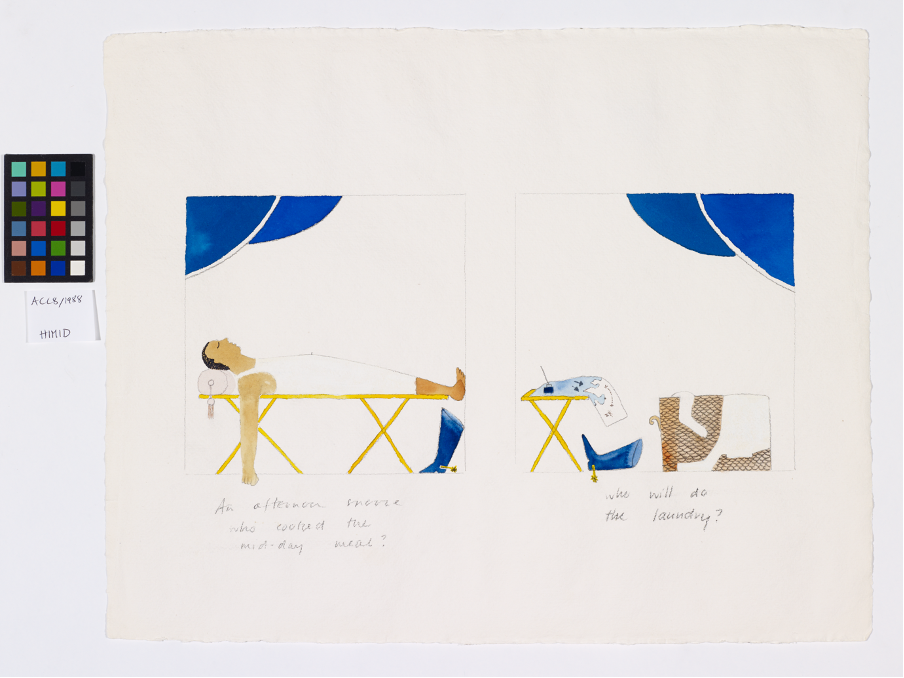
familial concerns of such lauded military heroes. In the second diptych from the series,
Toussaint Louverture is shown in repose, reclining on a cot, with his discarded clothes
and the paraphernalia of war strategy strewn about the space that he inhabits (Figure
1). The captions to the images read
“An afternoon snooze / who cooked the midday meal?” and
“who will do the laundry?” In posing such questions, Himid not only signposts the invisibilised and undocumented
female figure that grand historical narratives so often occlude, but also gestures
to the importance of domestic and emotional labour undertaken largely by women both
at home and on the battlefront. Though the visualisation of Suzanne Louverture elsewhere
in the series in part represents an active engagement with these questions, Suzanne
is a synecdochic signifier for the numerous and nameless women whose important efforts
remain
unseen. The visual representation of the material world inhabited by Louverture and
his family and the material absence of other critical interlocutors opens up the discursive
and imaginative space for the contemplation of such questions.
Even in the absence of surviving material artefacts, knowledge of their once existence
offers a point of entry for imaginative rehabilitation in the vein of Himid’s that
create new, alternative archives of understanding through expressive modalities. For
those who seek tangible answers within archives of loss, which are characterised by
the very paucity of the tangible ([
Sharpe 2020, 3]), any small fragment is often seized upon with abundant enthusiasm in the hope
that it might lead to greater truths — a larger jigsaw that the part unlocks. The
descriptive fragment of the royal dresses is all the more valuable since there is
no record of their preservation, nor any (known) extant portrait of Marie-Louise Christophe
which might serve to demonstrate how such garments were utilised symbolically in the
craft of state-making. Items of such obvious pecuniary value were likely removed along
with the
“ornaments, lighting fixtures, and even the floorboards” which
“were broken, spoiled, prised up, torn down and looted” from Henry Christophe’s Sans Souci Palace in the wake of the Kingdom’s fall [
McIntosh and Pierrot 2017, 145].
It is equally possible that they — and indeed any lost portrait — escaped the opportunistic
plunder of Sans Souci and remain nestled within one of the many proudly cultivated
vaults of Haiti’s private collectors. Those seeking to unearth hidden treasures from
this unique and important period in Haitian history — especially those attempting
to do so from outside of Haiti, whose colonial histories have shaped the dominant
epistemologies and discursive violence that has led to the endangerment and erasure
of Haitian heritage both within and beyond its sovereign borders — ought to be reminded
that, as Marlene Daut has suggested,
“we do not necessarily have a right to this knowledge” [
Daut 2019a]. For what and for whom does such knowledge serve? Is it to be used only in the service
of creating new archives which, despite claims to promote a democracy of access, unwittingly
“reproduce patterns of domination or cultural exploitation” ([
Daut 2019a])? Showing respect for these archival opacities is also important to the true work
of archival decolonisation; given the force of the types of colonial extraction that
has led to Haiti’s treasures being plundered and dispersed, it is easy to understand
why Haitians in particular may not want to “open up” collections that have been amassed
over generations and passed on through families (even, in some instances, to their
own national heritage institutions).
[3]
Venturing into such spaces demands equitable terms of engagement.
At the foundation of any effort to recover or reconstruct what has been lost, secreted,
forgotten, overlooked and effaced should be a commitment to uplifting and spotlighting
the histories that have been relegated to the margins through acts of communality,
collaboration and collective responsibility.
Fanm Rebèl endeavours to respond to this collective call to action while respecting custodianship
and modelling a decolonial praxis. In this way, it cannot be viewed as a standard
archival research project (though what exists within and beyond archives remains a
key point of articulation). Neither, however, is it ostensibly a digital humanities
or public humanities project. It is rather a constellation of resources, pathways
and synergies upheld by the principle of
rasanblaj. A Haitian Kreyòl term deployed by Gina Athena Ulysse to describe a process of (re-)assembly,
rasanblaj represents an
“explicitly decolonial project” which
“demands that we consider and confront the limited scope of segregated frameworks
to explore what remains excluded in this landscape that is scorched yet full of life,
riddled with inequities and dangerous and haunting memories” [
Ulysse 2017, 70]. In other words, those spectral fragments — which represent mere pieces and
remnants; which are signifiers of loss, of plunder and devastation — are also tethered
to the memory of the fuller, complex and kaleidoscopic stories of which they form
a part. In excavating and
“hitching together” these fragments; in reimagining the myriad lives of a dress and its wearer; in surveying
the testimonies of those at the centre of this mission of recovery; in promoting ongoing
dialogue and collaboration and in building on the important groundwork laid by others
working in this domain, we can begin to (re)assemble stories of revolutionary possibility.
This model – which draws, moreover, on explicitly Haitian epistemologies – illuminates
a pathway by which the ethical tensions of archival access and archival reproduction
articulated by Daut can be negotiated with epistemic responsibility.
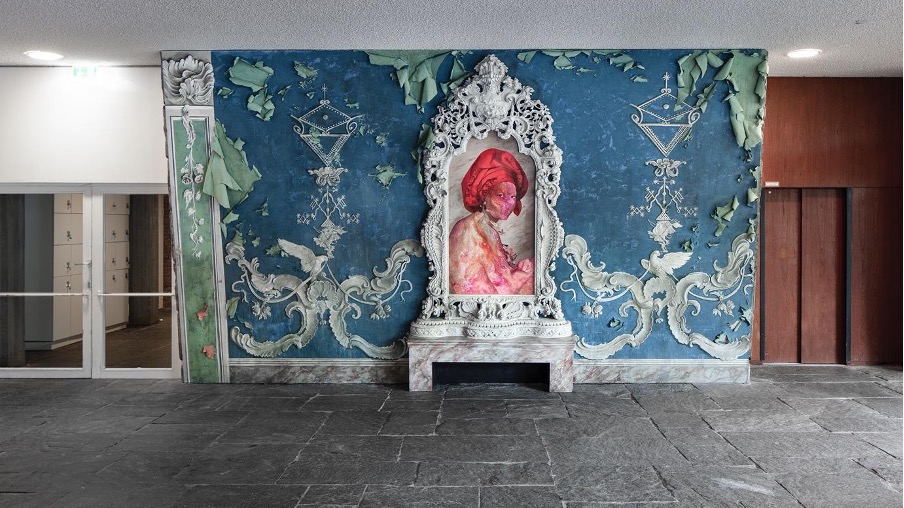
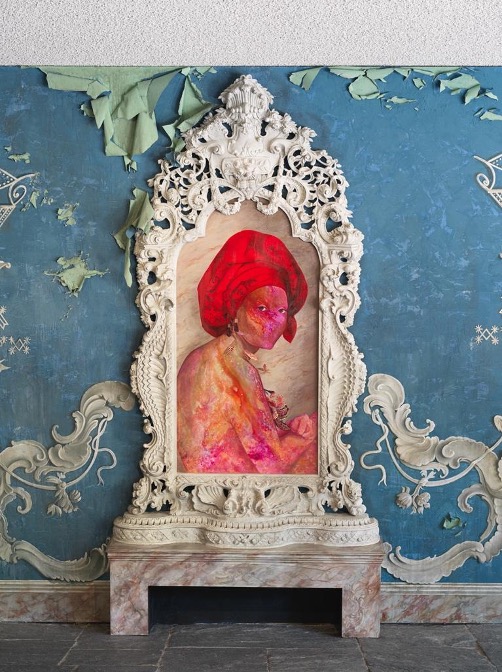
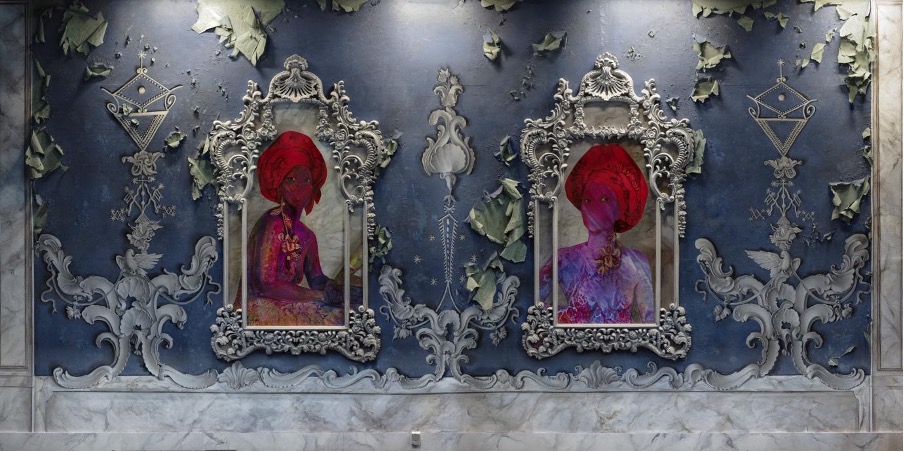
Through a succession of installations inspired by Marie-Louise Christophe, her daughters
and the worlds that they traversed, the mixed-media artist Firelei Báez deploys a
form of rasanblaj to examine the fault-lines of the colonial archive and mobilise
material histories to visualise the unseen and unknowable. In each of these installations,
which use textures of peeling paint to reference ruin and dilapidation, viewers bear
witness to the neglect and devastation of the ornate receptacles that house these
women and their stories. In so doing, they are also, however, invited to peel back
the layers and look beneath the veneer: to engage in radical acts of caretakership
and re-assembly. The mottled visages of Marie-Louise, Améthiste and Athénaïre point
to the limits of what is knowable, and reject the idea of an essentialised vision
of archival “truth” (Figures 2, 3 and 4). Their visual anonymity likewise gives them the power of transgenerational
metamorphosis. Although the women depicted might be Marie-Louise or her daughters,
they also represent the numerous and nameless Haitian women and “Anacaonas” occluded
by history. In each incarnation, the subjects’ eyes remain clearly visible, and lock
the viewer into a reciprocal gaze that holds them to account and enlists them in the
service of this collective endeavour to gather, tell and imagine.
In the same vein, the various constellations of Fanm Rebèl seek to gather, tell and imagine through a trifold mission of pedagogy, commemoration
and care. The project attempts not to complete the jigsaw, but rather to provide a
platform for its pieces — to collate stories and advance conversations via images,
objects, sounds and spaces. It unites the knowledge and expertise of scholars, digital
humanists, heritage specialists, collectors, archivists and community organisers invested
in the shared goal of gathering and re-assembling histories of Haiti’s rebel women
and re-assembling ideas of what it might mean to be a “rebel” within the genealogy of the Haitian Revolution and beyond. Above all, it aspires
to enlist others in the service of this goal in order to create a legacy that serves
the community and outlives any ephemeral work through multiple digital and public
heritage assemblages or “imprints”.
Kolektif: Collaboration and Community as Radical Caretakership
The digital output
fanmrebel.com was, first and foremost, grounded in a commitment to making material connections
— to creating a digital repository of curated fragments “hitched together,” held up
side by side to demonstrate the complex and numerous articulations of women-led resistance
before, during and in the immediate aftermath of the Haitian Revolution. It was intended
to be both a space for promoting access to historical documents and an interactive
curated gallery showcasing artefacts and artistic productions engaging imaginatively
with the untold and undocumented stories of Haiti’s rebel women
“in an effort to show the continuing force, circularity and diasporic mobility of
revolutionary stories as well as their historic roots” [
Willson2019]. However, it grew around the conversations and relationships built within and beyond
the digital terrain with scholars, artists, collectors, conservators, curators, community
organisers, advocacy organisations and others to encompass much more. These connections,
in turn, fostered a series of broader collaborations which nourished and refined its
digital and public heritage vision, and sparked efforts to create legacies that would
have material
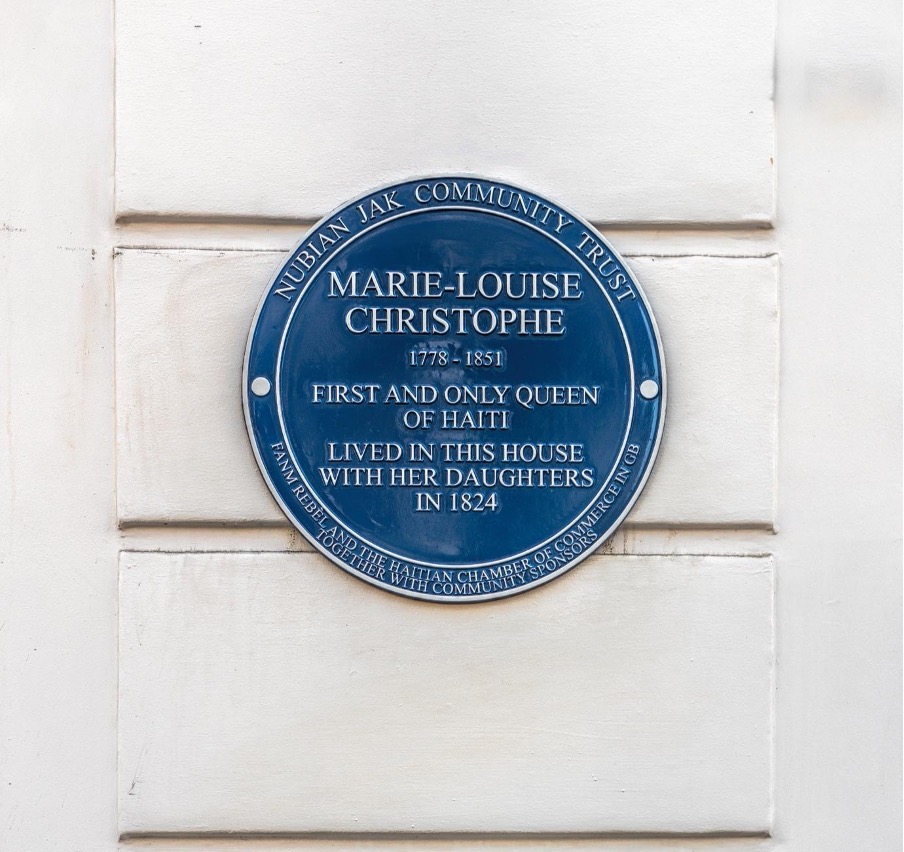
“afterlives,” manifesting in two commemorative blue heritage plaques mounted at Marie-Louise Christophe’s
former British residences in London and Hastings. Such achievements, it is fair to
say, could not have been realised without the input of active collaborators and supportive
communities.
Across the terrain of Haitian Studies, pedagogically rich and beautifully imagined
digital humanities resources abound. Though many of these projects were the genus
of an individual idea or discrete research project, and though much of the labour
associated with the preservation of such projects is often shouldered disproportionately
by individuals, their vitality is sustained by the diverse contributions of the collective:
from programmers and research assistants to transcribers and translators. Many of
these projects actively solicit a wider pool of collaborators through crowdsourced
information. Marlene Daut’s
La Gazette Royale d’Haïti, for example, which
“is designed to gather together and in one place for the first time all of the known
issues of the two newspapers published during Henry Christophe’s rule of northern
Haiti, as well as the six different versions of the Almanach Royal d’Hayti issued by the royal press” ([
Daut]) uses
hypothes.is to invite corrections or annotations to the digital transcriptions of these important
documents in order to deepen understanding about “the many people who lived in the
north of Haiti in the early nineteenth-century”. It is also a resource that self-avowedly
owes its expansion to generous contributions from scholars and archivists who have
shared digital facsimiles of the widely dispersed issues of the several periodicals
that Daut’s website aspires to collate together. By amalgamating resources and knowledge
across the collective, such projects foster a sense of community, characterised by
what Daut, referencing Jacques Roumain’s novel
Gouverneurs de la Rosée about a rural community that mobilises to irrigate the land upon which they depend,
terms the “konbit” [
Daut 2019a].
[4] In this sense, they are not purely platforms for reference, but for reciprocal exchange
that widen both access and dialogue.
These collective exchanges fuel socially just advances that enrich these evolving
platforms — such as in the case of Stephanie Curci and Chris Jones’s
Mapping the Haitian Revolution project, which began as an English-language resource but
“acknowledge[d] the problems of power in such an approach.” It has since advanced its scope to make the project available in French, Kreyòl and
Spanish with the assistance of translators at CreoleTrans (Curci and Jones, “The Project”).
These multilingual routes of access are mirrored in Stephanie Curci’s
Mapping Haitian History project, which provides an
“extensive and collaborative online visual record in English, Krèyol, and French” of Haiti’s preeminent historical sites designed for use by
“scholars and researchers, historical enthusiasts, schoolchildren, tourists and adventure
travelers” [
Curci 2008, 121]. As a digital humanities project that took its lead from these rich online
platforms celebrating Haitian cultural history,
Fanm Rebèl likewise grew thanks to valuable contributions designed to widen access and linguistic
reach to its content. However, the expansion of its access points and the growth of
its content was by no means predetermined; its conceptual evolution was driven by
interactions across an evolving network — or “kolektif” as [
Smith 2022] once described it — that came into being through digital dialogue.
Before the genesis of
fanmrebel.com, exchanges and collaborations across the digital realm helped to shape and extend
the vision for what it might become. After discovering a facsimile of a translated
copy of Marie-Louise Christophe’s last will and testament in the UK National Archives
in 2019, I began the work of transcribing this document in collaboration with Paul
Clammer and Grégory Pierrot with a view to creating an open-access platform for its
dissemination. News of the existence of this important document shedding light on
the life of a Haitian queen in exile circulated across online networked spaces such
as H-Haiti and Twitter (X), re-affirming and compounding enthusiasm within existing
digital communities and uniting new ones keen to explore ways of remembering and re-assembling
the lesser-known histories of women like Marie-Louise. This enthusiasm highlighted
the need for a space where the original facsimile could be easily signposted and the
transcription could be universally accessed. However, given the difficulty in transcribing
much of the barely legible secretarial script of the original transcriber from the
London Public Records Office, it also warranted the input of a wider pool of transcribers
with a better knowledge of the specific notarial palaeography. Our imperfect transcription
existed initially as a collaborative Google document, but considerations around its
further dissemination and collaborative input from the wider community were shaped
by issues around security, indexing and discoverability of a resource that existed
only on the Google cloud. Given that
Fanm Rebèl was in an embryonic phase of development, migrating this resource to a platform that
would allow for customisation and integration with other potential resources connected
with stories of women in the Haitian Revolution was another primary concern. Consequently,
I began to build a dedicated home for this resource within the cosmos of
fanmrebel.com that would enable collaborative interactions — especially from a wider pool of digital
transcribers. Squarespace satisfied the initial requirement for a user-friendly interface
with collaboration tools, social media integration and adaptable templates that could
be regularly and easily updated, and also facilitated design modification through
the use of custom CSS. This, in turn, gave me the ability to integrate
hypothes.is like Daut’s
Gazette Royal site, which would allow users to annotate the transcribed document.
Though in its infancy the website was only a portal for accessing the transcription
and the National Archives facsimile (and also for building collaborative exchanges
across these documents), its pedagogical and interactive scope was broader: it was
designed to simulate the multi-sensory experience of walking through an exhibition
space. This space would not be static, but would be constantly evolving to showcase
myriad imaginative interpretations of Haiti’s women revolutionaries through artworks,
artefacts, musical reconstructions and living heritage sites. Some of its earliest
content was assembled from existing online and offline collections and archives, such
as the Haiti Philatelic Society, the Musée du Panthéon National Haïtien (MUPANAH),
the Folger Special Collections Library and the British Museum’s Prints and Drawings
collection. However, the majority of its assembled “fragments” were collated through
interactions with artists such as Patricia Brintle, Richard Barbot, Lubaina Himid
and Kimathi Donkor, and Haitian private collectors such as Joseph Guerdy Lissade and
Alex Von Lignau. Spotlighting the importance of diaspora stories, memory and the transgenerational
reverberations of Haitian histories, these interactions became the foundation upon
which the website and the broader vision for the project and its numerous constellations
were built. That is to say that in curating this exhibition space, I wanted to highlight
not just the contested identities and interpretative possibilities surrounding the
histories of women protagonists such as Marie-Jeanne Lamartinière, Cécile Fatiman
and Suzanne Sanitte/Sanité Bélair, but also to demonstrate the symbolic connections
between individual artists, collectors and conservators and the material articles
that they acquired, inherited, created and cared for.
The conversations around these material things were thus in essence as central to
the rasanblaj as the things themselves. This was especially the case for the beautiful
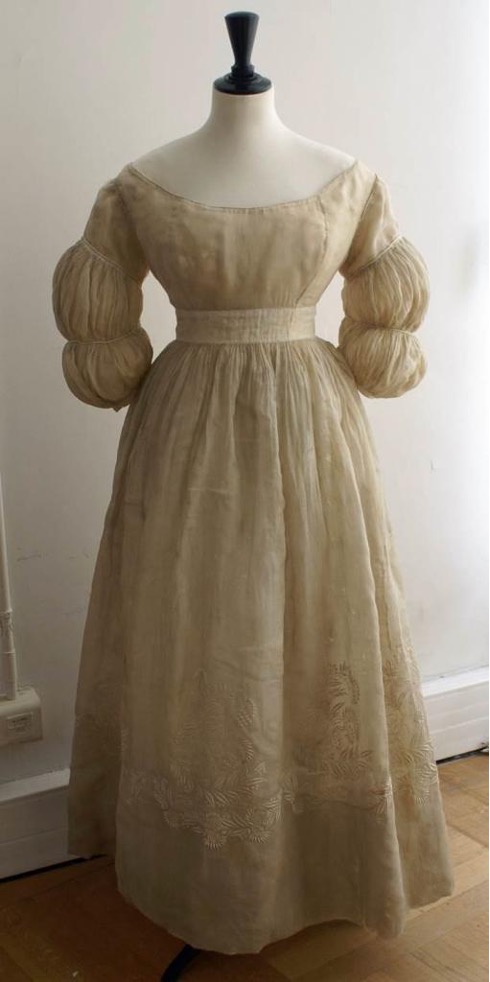
muslin gown belonging to Dame Eléonore Cheruxi (Richeux), a former
Dame d’Honneur in Marie-Louise Christophe’s court retinue, which was donated to MUPANAH in 2015
by Alex Von Lignau and is featured in
Fanm Rebèl’s gallery of “Objects/Objè” (Figure 5). Discussions with [
Bonnet 2020], the textiles restorer who worked to restore the dress, revealed interesting insights
about its periodisation, the processes and resources required for appropriate caretakership
and the surprising resilience of Haitian heritage objects. Though the dress was catalogued
by MUPANAH as a
“robe Empire” and has many of the features of cotton chemise gowns that were popular in the French
Atlantic (both in the metropole and in the colonies) from the late eighteenth century
onwards (including the gathered sleeves that were made iconic by >Marie-Antoinette),
the lower waistline is indicative of the fact that the dress is probably from a slightly
later period, according to Bonnet (around 1830, she believes). Given that Christophe’s
kingdom fell in 1820 and Marie-Louise departed Haiti for Europe in 1821, this periodisation
suggests that Eléonore Cheruxi crafted an existence
beyond Christophe’s court. In this way, the dress takes on a new signification: as a relic
not only of the plundered kingdom and its many unheralded personalities, but as an
artefact which bears witness to the creative strategies used by women to make meaning
outside of these dynastic frameworks bookmarked by the lives of Haiti’s “big men”.
Interactions with the numismatist Joseph Guerdy Lissade, vice-president of the Haitian
Society of History, Geography and Geology and founder of the collection Monnaies et
Médailles d’Haïti about women depicted in Haitian currency led to other significant
connections — not least with Alex Von Lignau, the private collector and benefactor
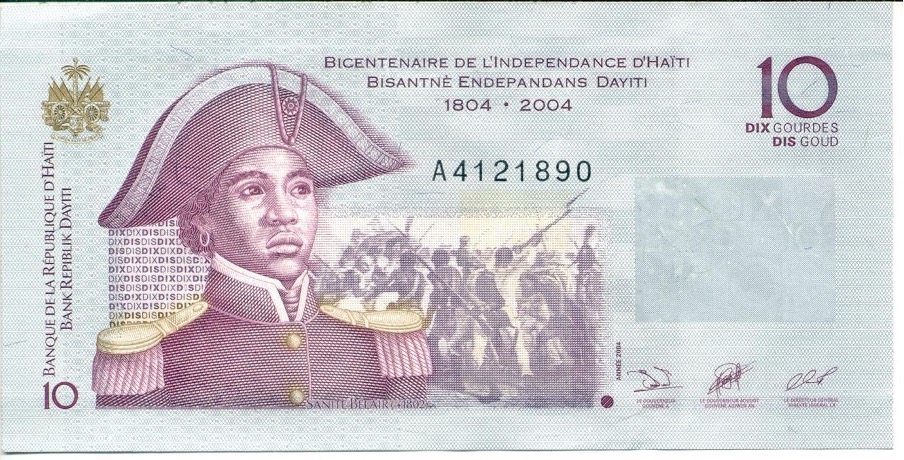
who donated the Cheruxi dress to MUPANAH, and Richard Barbot, the Haitian-Canadian
artist responsible for the vignette of Suzanne Sanitte/Sanité Bélair included on the
Haitian dix gourdes banknote printed to commemorate the bicentenary of Haitian independence
in 2004 (Figure 6). A widely circulated image (thanks, no doubt, to its association
with Haitian currency), Barbot’s iconic vignette has become a foundational template
for many subsequent reproductions and imaginative renderings of the lauded combatant
of Saint Domingue’s
Armée Indigène. This is discernibly visible in the work of other Haitian artists such as Youseline
Vital, Anne-Isabelle Bonifassi and Hertz Nazaire, whose adult colouring book interlaces
a reproduction of the commemorative banknote vignette with beautiful geometric patterns
and a silhouette of the
Nèg Mawon— the statue erected outside Haiti’s National Palace in Port-au-Prince in 1967 (2017).
However, ongoing conversations with Barbot have revealed ways in which Sanitte/Sanité
has been re-conceptualised in his own work in the two decades since the bicentenary.
In this way, the iconicity of the vignette and the banknote on which it features is
called into question by the artist himself. In juxtaposing these various representations
in the
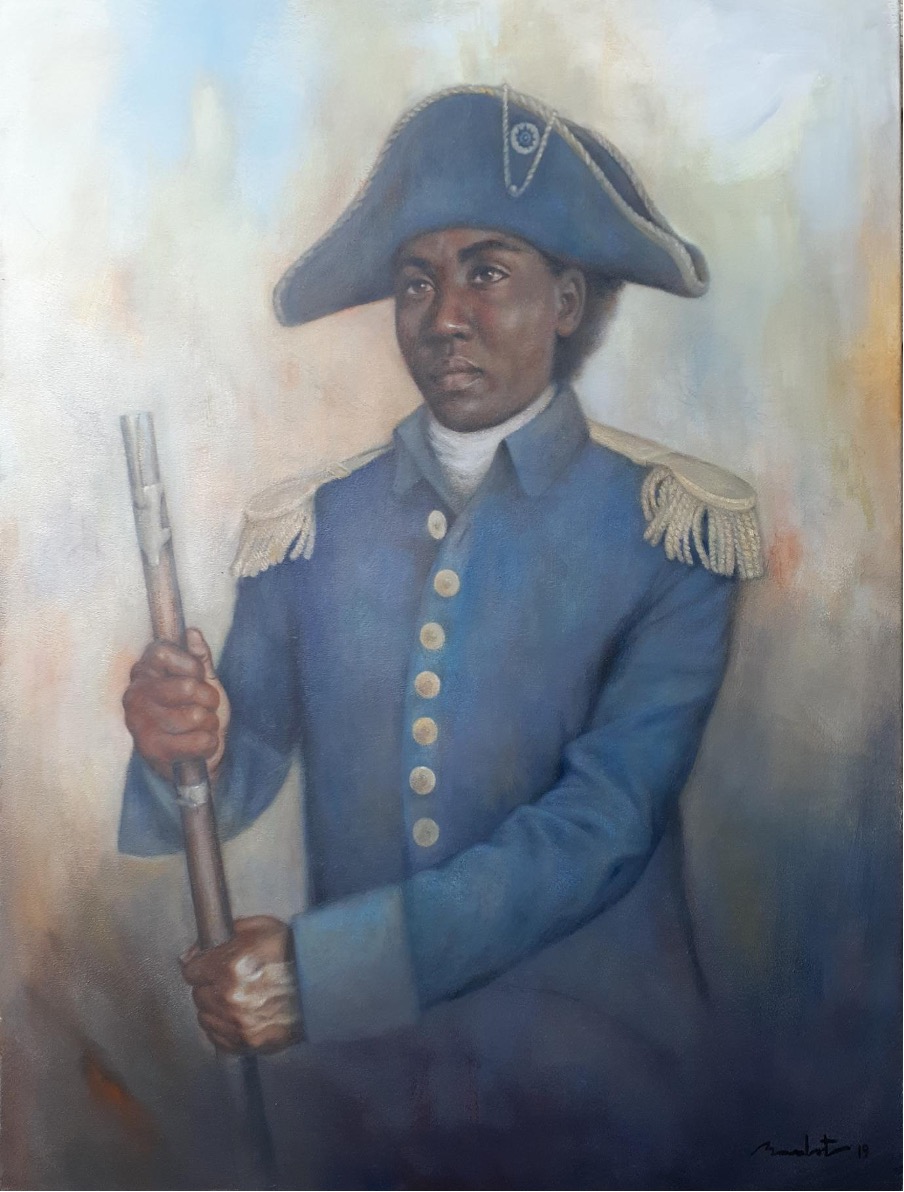
Fanm Rebèl Gallery, these tensions are brought to the foreground. In Barbot’s 2019 acrylic on
canvas portrait (Figure 7), for example, though Sanitte/Sanité is once again depicted
in full military regalia, complete with epaulettes and a bicorn hat, her furrowed
brows encode a story of strain and strife, reminding us that, like many other women
who contributed to the revolutionary saga, she made epic sacrifices. The fixed and
immutable icon is rendered unstable, complex and, above all, human. This is significant
given the unfavourable representations of Sanitte/Sanité Bélair by Haiti’s early chroniclers
of independence, such as Thomas Madiou whose
Histoire d’Haïti describes her as a “brigande” and imagines her as the protagonist of violent atrocities
avowedly committed by the renegade army with whom she was associated ([
Madiou 1989, 364]). As an image tethered to Haitian currency and thus, as a synecdochic signifier
of that object of currency, Barbot’s original vignette is likewise tethered to a narrative
of Haitian patrimony. As a constantly evolving and reimagined personality across Barbot’s
artistic oeuvre, Sanitte/Sanité escapes these constraints to create new narratives
of possibility.
An abundance of similar dialogic exchanges, across the
Fanm Rebèl kolektif (both online and offline) have expanded its possibilities as a resource
and as a site of further interaction, exchange and pedagogy. In his class on
“Repozwa and Repositories: Mourning in Haitian Literature,” for example, longstanding network collaborator Nathan Dize used the site with his
students at Oberlin College to think about how images of women could be conjured (or
assembled) from literary fragments. In turn, his students used some of the images,
especially artworks by Brintle and Barbot, to create their own imaginative responses
on this theme [
Dize 2024]. While the interactions and exchanges that have shaped
Fanm Rebèl’s growth as a multimodal project have inevitably strengthened its network, interactions
with its dialogic and pedagogic content have also thus fed into new forms of rasanblaj
and network-formation. In this sense,
Fanm Rebèl is not only a kolektif in its own right, but a point of convergence for others navigating
imaginative pathways for the reassembly of Haiti’s revolutionary histories.
Though its mission has been to create assemblages through community interaction and
provide space of imaginative and pedagogic connection, Fanm Rebèl has benefited from being connected with other established communities and kolektifs. The most celebrated achievements
of the project owe a debt to inter-community collaboration, especially with the Haitian
Chamber of Commerce in Great Britain, the Knowledge Project (formerly the Haitian
Heritage Group, a charity that aims to “build legacies for youth” from a foundation of cultural pride in the UK), Black Butterfly (a Black heritage,
wellbeing and social justice organisation based in the UK town of Hastings), the Haiti
Support Group (a UK-based advocacy organisation for Haiti) and to generous colleagues
within the international Haitian Studies, Haitian and Haitian diaspora communities.
The collective force of will and spirit of mutual support and care across these communities
has highlighted the centrality of these values at their point of intersection, which
has brought into being two blue heritage plaques (one of which was supported by a
Crowdfunder promoted across these various networks) and a YouTube documentary that
has received close to 250,000 views.
Moreover, the importance of connections and collaborations with other likeminded digital
communities that span the terrain of Haitian and Black Atlantic Studies, such as Siobhan
Meï and Jonathan Michael Square’s
Rendering Revolution: Sartorial Approaches to Haitian History project, cannot be overstated. As a project that lives almost exclusively on Instagram,
supporting Square’s belief
“in the power of social media as a platform for radical pedagogy” ([
Square(b)]),
Rendering Revolution represents
“a queer, bilingual, feminist experiment in digital interdisciplinary scholarship
that uses the lens of fashion and material culture to trace the aesthetic, social,
and political reverberations of the Haitian Revolution as a world-historical moment” [
Meï and Square]. Replicating a model of digital curatorship sophisticatedly honed in Square’s constellatory
project
Fashioning the Self in Slavery and Freedom ([
Square(a)]),
Rendering Revolution operates largely across Instagram (using the wider Meta infrastructure for dissemination).
Additionally, it harnesses a number of digital communication channels that are free
at the point of use (including Google Workspace and Whatsapp) to mobilise its network
of collaborators and translators. In this way,
Rendering Revolution has an agility and inclusivity as a truly collaborative and constantly evolving project
that centres the ethos of the lakou. It also provides a blueprint for how digital
humanities projects might elude the subscription and hosting fees and intensive and
time-consuming individual labour of purposely-curated research and pedagogical websites.
As a bilingual initiative that relies on a network of paid translators (who ensure
that its English-language content is also accessible in Haitian Kreyòl), its ability
to keep pace with its own rapid tempo is invariably contingent: curating accessible
multilingual content and upholding its ethos of
“renumerat[ing] translators whose intellectual and creative work is so often devalued
and invisibilized” ([
Meï 2020b]), for example, would not be possible without capital of any kind.
[5]
Nevertheless, its prolific early growth as a bilingual project has undoubtedly helped
to galvanise interconnected communities and ensure its visibility for those whom it
was designed to reach, especially people in Haiti and across the diaspora.
Its conception by Meï and Square as a truly collaborative and co-curated resource,
fortified by their original
“Call for Contributors and Collaborators” on
H-Haiti ([
Meï 2020a]), also raised the stakes for digital humanities offerings often established across
small communities of research collaborators and in isolation by bridging gaps
across communities. Most importantly,
Rendering Revolution, and the dynamic, agile, interactive and inclusive efforts of Meï and Square in steering
the project, expanded
Fanm Rebèl’s vision, demonstrating how it could operate with a communal, lakou ethos and exist
as a series of imprints (or as a constellated resource beyond the website as it was
initially conceived) — on YouTube, on Instagram, in various material forms and in
conversation and collaboration with other projects and communities. It also reinforced
the importance of multilingual access. Through
Rendering Revolution’s network of translators, and with the assistance of Danielle Dorvil in particular,
I was able to build localised content into the website to ensure that much of the
self-authored and curated content that I had painstakingly added to
Fanm Rebèl during the first wave of COVID-19 lockdowns was also accessible in Haitian Kreyòl.
As an eager early respondent to Meï and Square’s call on
H-Haiti (and as an ongoing though admittedly infrequent collaborator), I have endeavoured
to support the aims of our intimately enmeshed communities centring artistic imagination
and material culture. To this end, I have curated posts (and was generously solicited
to author the inaugural Instagram post featuring Patricia Brintle’s 2011 painting
of Catherine Flon), supported grant applications, and attended virtual meet-ups with
collaborators across multiple time zones and languages. Our combined vision for inclusive
and accessible spaces that de-centre colonialist texts and androcentric perspectives
and spotlight the often occluded stories of marginal figures through the creation
of alternative archives, has been mutually generative and sustaining, emboldening
and empowering our aspirations for what these assemblages might become.
Access, Ephemerality and Commemoration: Digital and Material Imprints of Fanm Rebèl
Conversations across an expanding kolektif also created opportunities for innovation
at the intersection of digital and material worlds, leading to various constellated
material and digital “imprints” of
Fanm Rebèl (or new forms of rasanblaj). Conceived with the objective of permanence (or near-permanence)
in mind, these imprints have manifested in several public heritage projects (the installation
of two blue heritage plaques commemorating Marie-Louise Christophe and her daughters’
residency in Britain and a panel documenting her connection to the “Story of Hastings”
at the Hastings Museum and Art Gallery), and a number of digitally-conceived outputs
(including reconstructions and recordings of music from the Court of Christophe and
the short documentary film
Marie-Louise Christophe: A Haitian Queen in Great Britain—all of which have been published on YouTube). In essence, these various constellations
and the circumstantially responsive and collaboratively conceived forms that they
took were exercises in what Alan Rice ([
Rice 2010, 15–16]) has described as “guerilla memorialisation,” representing an attempt to
“interven[e]” through engaged praxis, and, above all, through forms of rasanblaj, to extend the
reach of
Fanm Rebèl and to make the histories of the women at its core more visible and accessible.
In grappling with the complex
“reality of loss” in the digital humanities ([
Donaldson 2021, 20]), I recognised early that
Fanm Rebèl’s existence as a digital humanities resource might only ever be temporal. To circumvent
threats of ephemerality, I intended to create
fanmrebel.com as a hub or portal for accessing resources that were clustered across various other
platforms. I envisioned a digital ecosystem (integrating content across platforms
such as Flickr, Instagram and YouTube) that would facilitate a model of resilient
digital curation, inspired by digital archiving projects advanced by the likes of
the Smithsonian, the British Library, Royal Museums Greenwich and other heritage institutions
that made curated content and archival collections publicly accessible and used forms
of crowdsourcing to collate and expand digital exhibition spaces to create a digital
commons. Given the limits of my own digital literacy (and the integration limits of
the Squarespace platform that I had used to build fanmrebel.com), my grand ambitions
for a “constellated” and co-curated resource were stymied. In the earliest days of
the project, Squarespace did not have an aesthetically engaging integration model
that would allow me to build a compelling gallery. Moreover, such an integration would
also prohibit me from building localised content into the website framework that would
transform the curated experience for users who wished to access that content in Kreyòl.
Using Squarespace was therefore crucial to achieving a visually-engaging multilingual
platform, but came at the cost of relinquishing a constellated vision of clustered
digital resources housed within a central digital “hub”. This localised platform would
not be able to circumvent all threats of erasure, removal or disinvestment, as I had
intended. As such, I sought ways to reproduce
Fanm Rebèl in multiple digital and material spaces and in ways that promoted active, community
engagement with the imprints it produced. Embedding mechanisms of sustainable stewardship
that would allow a resource subsidised by time-limited grant funding to have various
“afterlives” thus remained a crucial objective.
Though the goal of creating sustainable and accessible legacies for
Fanm Rebèl was embedded in its original research plan, many of its imprints emerged organically
and unintentionally, in a true path-breaking and guerilla sense, in large part through
the combined energies of the kolektif and in response to shifting circumstances surrounding
the practical application of the larger research project — namely as a result of the
increasing instability that characterised the political climate in Haiti from the
point of the project’s commencement late in 2019, and the national and international
shutdowns occasioned by the COVID-19 pandemic in 2020 and 2021. These factors (among
others) hastened the partial reconceptualisation of the project and what its deployment
as a “research output” might look like without access to archives. Community, conservation
and legacy also became pressing priorities in the wake of these crises, which brought
into sharp relief issues of inequity and endangerment, especially in relation to Haitian
heritage. The devastation wrought by a fire that gutted the duomo of the Our Lady
of the Immaculate Conception church at the UNESCO World Heritage site in Milot that
is home to both the Citadelle and the ruins of the Sans Souci palace on Easter Sunday
in 2020 was a clarion call to not
“laisser périr dans l”indifférence, ses richesses patrimoniales … symboliques de son
éthos” (let perish in indifference its patrimonial riches … symbolic of its ethos: [
Saturné]), and further highlighted the importance of creating constellated “afterlives” for
the
Fanm Rebèl website.
The shift toward digital community-formation during this unprecedented moment created
space for the mobilisation of innovative public heritage initiatives that might not
have been attempted at an earlier juncture, and also promulgated necessary conversations
about the need for dynamic, evolving, sustainable and community-centred imprints of
heritage projects that often have a shallow, academic reach. Exchanges on Twitter
(X) in August 2020 with Michelet Romulus, the Vice-President of the Haitian Chamber
of Commerce in Great Britain, led to the first in a series of collaborative initiatives
that made use of accessible digital spaces and resources to execute focused public
heritage projects.
Assembling all resources at our disposal (highlighting the value of rasanblaj as methodological
praxis as well as theoretical tool), we collaborated to produce a documentary retracing
the footsteps of Marie-Louise on her diasporic journey across Britain between 1821-1824.
In so doing, we hoped to seize the bicentennial moment of the fall of Christophe’s
kingdom and give visibility to Haitian history and heritage and its global reaches
at a moment of increasing global distraction. Its reach could be magnified, moreover,
as a free and widely accessible resource on YouTube (published across multiple channels
to safeguard against threats of ephemerality and as a reflection of our jointly-realised
inter-community vision), In this way, we strove to create maximum benefit for Haitian
communities so often denied access to their cultural patrimony and for international
lay publics unfamiliar with Haiti’s rich history of post-revolutionary self-making.
The launch of the film on 1 January 2021 (Haitian Independence Day) highlighted, in
the various dialogues to which it gave rise, the cross-cultural significance of a
Black queen who had made Georgian Britain her home in an age of colonial enslavement.
This was especially germane to debates surrounding the release of Netflix’s
Bridgerton in late December 2020, which, as Marlene Daut observed, used the
“shallow representational ruse” of
“Black actors inserted into a white storyline” rather than drawing on the
“awe-inspiring world of black nobility [which] did actually exist in the nineteenth
century” [
Daut 2021]. The visibility that the documentary likewise achieved upon social media (Twitter,
Facebook and Instagram), led to it rapidly going “viral”. By its third month of release,
it had been viewed almost 110,000 times. The unprecedented and rapid distribution
of the film across digital platforms demonstrated both the compelling communicative
power of such “guerilla” intervention tactics in disseminating public history and
heritage, and the community-generating possibilities of compelling histories of unsung
Haitian women. Though the film was never intended to offer an exhaustive account of
Marie-Louise’s experience in exile, and interrogated the shortcomings of attempting
to do so in the absence of extensive testimonial sources (Willson, Marous and Romulus,
00:16:25-00:17:04), it generated large-scale digital visibility for a figure who dominant
(white, male, colonialist) written narratives have consigned to the margins. It also
demonstrated how conversations across diaspora communities in the present could offer
engaged insights into historic diasporic encounters, instigating new forms of rasanblaj
that expand the limits of the archive’s absences and erasures.
This guerilla intervention in the digital realm advanced efforts to create physical
public heritage imprints of Marie-Louise’s life in Britain via the aforementioned
blue heritage plaques mounted at residences in London and Hastings. Despite meeting
with rejection following an application submitted to the English Heritage Blue Heritage
Plaque scheme in 2019,
[6]
Fanm Rebèl’s expanding kolektif served to galvanise energies to create alternative guerilla
pathways to commemoration that transformed a project originally conceived in isolation
from the community and using the narrow, historically exclusionary selection parameters
of a heritage gatekeeping initiative into a truly inclusive and representative community
endeavour. This was achieved through partnerships in London with the Nubian Jak Community
Trust, the
“only commemorative plaque and sculpture scheme focused on memorialising the historic
contributions of Black and minority ethnic people in Britain and beyond” ([
Beula n.d.]), and in Hastings with Dawn Dublin, the founder of the Black heritage, wellbeing
and social justice organisation Black Butterfly. As an entirely crowdfunded initiative,
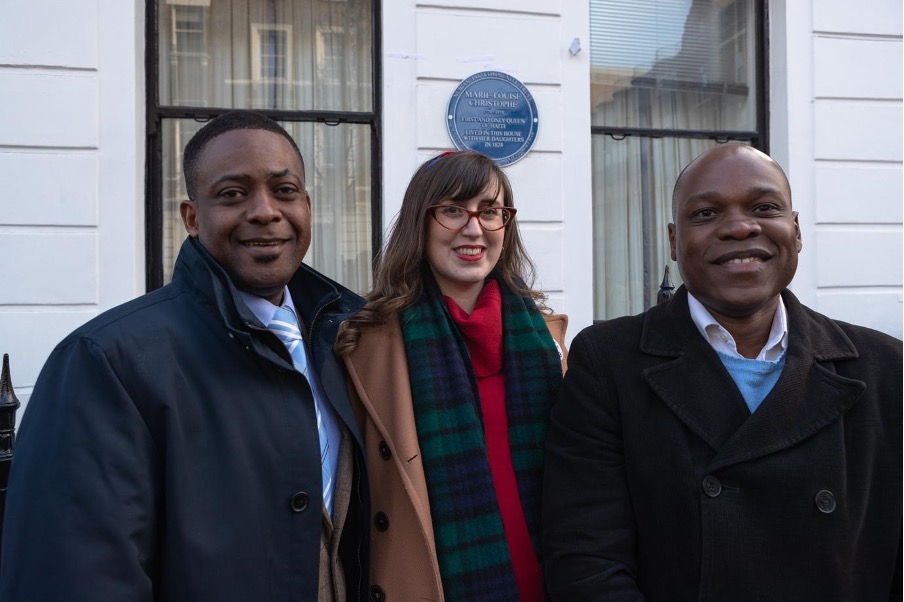
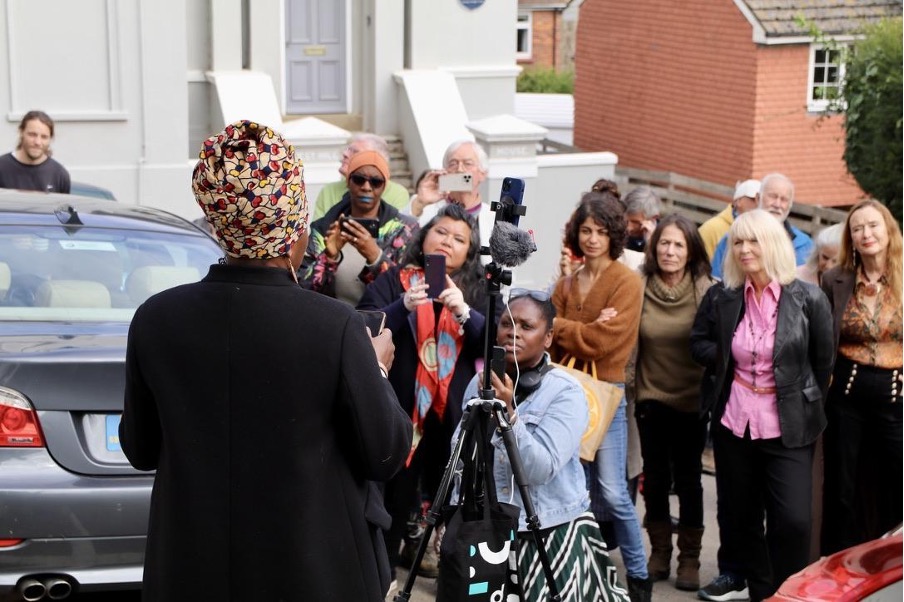
the Nubian Jak plaque mounted on Marie-Louise’s London residence on 7 February 2022
was founded on a premise of collective ownership, in which the community (and the
Haitian community in particular) had (and continues to have) a stake (Figures 8 and
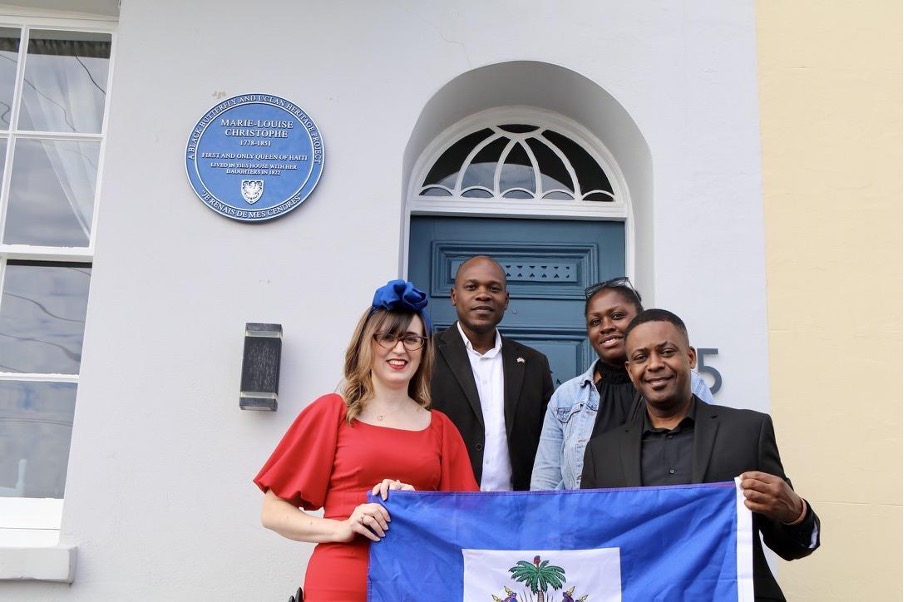
9). Similarly, the collaborative initiative in Hastings brought local and more widely
dispersed Haitian communities together in an act of commemoration (Figures 10 and
11) to centre the marginalised local
“histories and herstories” that Black Butterfly as a community organisation wished to spotlight and “unforget”
[
Dublin 2022]. As such, these initiatives not only amplified the diaspora story of Marie-Louise
Christophe and her daughters for local publics unfamiliar with her existence, but
demonstrated how that story is inextricably tethered to the diasporic histories of
other unacknowledged and minoritised figures who “official” public history and heritage
bodies have either overlooked or do not have fitting criteria to assess.
[7]
The experience of creating imprints that would live on and combat ephemerality through
their material indelibility was supplemented by the festivities marking their creation
that nurtured the ethos of Fanm Rebèl’s community vision, centring community joy.
As Knowledge Project founder Guilaine Brutus remarked in her speech at the unveiling
event ([
Brutus 2022]),
“as a Capoise, I am proud, as a Haitian, I am honoured, and as a person of African
descent, I feel lifted.” Brutus’s comments remind us that celebrating heritage in meaningful and engaged ways
has enduring and transformational resonance for communities, and especially for communities
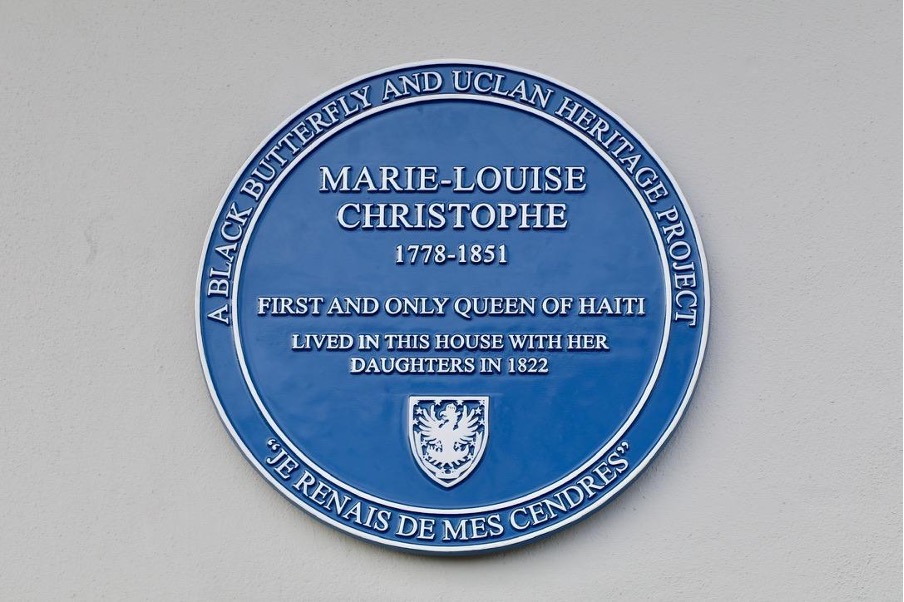
in the diaspora. That the Christophean coat of arms (with its central motif of a phoenix
rising from the ashes) and the motto
“Je renais de mes cendres” were included on this iteration of the plaque (Figure 12) was therefore significant,
championing the resilience not only of the imprint itself, but of the community that
brought it to life.
The Contingency of Resilience: Emotional Labour, Wellbeing and the Commons
The need to be resilient, to be insurgent, and to make things happen beyond the grant-funded
life-cycle of a designated research project that allows us the freedom to create with
abandon necessitates a reckoning with the fact that meaningful caretakership demands
labour. All too often, much of this labour is unpaid and uncredited, and is incredibly
extractive, especially for the untenured and precariously employed who, like me, negotiate
caregiving responsibilities and a fractional full-time equivalency. Moreover, as Kaiama
Glover has acknowledged in relation to the affordances of the digital ([
Glover and Gil 2021, 228]), our radical aspirations need
“grounding and reorient[ing]” to better understand the limits of the platforms we use and the resource that sustains
them. Whereas a resource such as the collaboratively-conceived
A Colony in Crisis: The Saint-Domingue Grain Shortage of 1789, which nevertheless owes its existence to the
“many hours” of unpaid labour contributed by its authors ([
Corlett Rivera et. al 2021]), has become self-sustaining thanks to a longstanding agreement with the institution
that has pledged to underwrite it,
[8]
many others have to draw on personal resources to keep their assemblages alive. This
was the case for Jasmine Claude Narcisse’s (now defunct)
Mémoire de Femmes, a digital reproduction of a reference work and annotated bibliography on women from
Haitian history that Narcisse was commissioned to put together by Unicef in Haiti
that was first published in 1997. Hosted on her own self-maintained website ([
Narcisse 2020]), Narcisse took down the reproduced book content pertaining to
Mémoire de Femmes in 2023, partly motivated by her own contentious feelings about a work that was completed
“over 30 years ago in Haiti, without access to all the sources available at the moment” but also in response to the fact that the book had
“been pillaged,” with people
“reproduc[ing] parts (big and small) of it with zero credit” [
Narcisse 2024]. Though a material imprint of Narcisse’s
Mémoire lives on in the original book that was published as part of the limited Unicef print-run,
the void created by its once-presence as an open-access digital resource is a further
reminder of the
“mutability of the digital” [
Donaldson 2021, 26]. Moreover, the excerpted pillaged passages that exist in various online spaces
remind us that the affordances and freedoms of the digital do not instinctively nurture
“ethical approaches … to capturing” or reproducing the work of others that shows respect
for original authorship, labour and care [
Donaldson 2021, 27].
Christina Sharpe’s directive that
“We must become undisciplined” (qtd. in [
Donaldson 2021, 19, 27]), should perhaps be foremost in our minds when we think about how our resources
can adapt to shifting pressures and outlive any limited funding stream, ephemeral
threats, pressures of time and labour, or “pillaging”. Indeed, I would venture that
we not only need to be
undisciplined, but also
antidisciplinary in our praxis. In the same sense that we need to find alternatives to
conventional archives of loss to rehabilitate the histories that have fallen within
the interstices, we need to look beyond the academy, beyond the episteme and beyond
the “traditional” frameworks of dissemination and communication characterised by
“monographs, journal articles, and book chapters” that have been heretofore privileged as most valuable [
McCarl et. al 2023]. This is not to discredit the prevailing importance of peer-reviewed scholarship
in these forms – this article, after all, operates in dialogue with standards of scholarly
rigour. It rather suggests that there are insights to be offered from co-creative,
multimodal and interdisciplinary frameworks that do not lead to exclusively “academic”
outputs.
[9]In order to create pathways toward resilience and sustainability, we need to be
“agile, mobile, insurgent” (Sample, qtd. in [
Corlett Rivera et. al 2021]): to find new (“guerilla”) interventions, strategies and frameworks that allow us
to give our resources and their beneficiaries the care that they demand without extracting
all of the time that we have to offer. This may mean that, ultimately, we relinquish
ownership, or rather that we entrust our communities with ownership — that we share
the land that we collectively till. As Daut entreats us,
“we must operate with a form of “lakou consciousness” that moves us away from a logic
of individuality (private property) and toward the feeling of togetherness (the commons)
that living collectively requires, that is, being a part of a public” [
Daut 2019a]. Of course, relinquishing ownership to a collaborative commons is not without ethical
conundrums and we must ensure that, in so doing, we do not invisibilise what is in
essence also a transference of labour and responsibility. In order to function as
a collective endeavour — for the lakou to function
as a lakou — there needs to be an equitable division of labour, which, in practice,
is almost impossible to achieve without some degree of “discipline”.
Antidisciplinary approaches are not a summons to chaos, however, but rather an insurgent
pushback against the structures that conspire to limit our endeavours. Insurgency
is, like Daut acknowledges of the principle of collaboration and rasanblaj ([
Daut 2019a]), deeply embedded in Haitian culture. Relinquishing ownership within this framework
of undisciplined and insurgent praxis is about creating heritable legacies for our
digital and public heritage assemblages, not about keeping them perpetually alive.
Indeed, it is the process of allowing it to die so that it can have a new life as
something else: a phoenix reborn from the ashes (to borrow the motif from the Christophean
coat of arms). As Donaldson reminds us,
“inhabiting the space of the undisciplined … require[s] recognizing and contending
with the temporalities of digital material.” In this way, though we may not always be able to tend to our gardens, in planting
multiple seeds — intermingled with the seeds sown by others — we might hope that some
will flower and continue to flourish even in our absence. Though Narcisse’s
Mémoire de Femmes is no longer accessible as a transcribed digital resource, it has served as a source
of inspiration for artists, scholars and others (including myself) who interrogate
the absences and erasures of “official” histories and seek to reimagine and reassemble
the lives of the brilliant Haitian women that grand narratives have overlooked. Moreover,
and most importantly, the original book remains accessible in numerous research libraries
globally. Though the impermanence of digital resources can make them difficult to
cite reliably or verify over time, creating multiple imprints of these resources (by
way of physical texts, exhibits, material objects, archiving exercises or other digital
assemblages) enables them to exist within an evolving and dynamic ecosystem that is
undergirded by the principles of rasanblaj.
Through the various constellations of Fanm Rebèl, I have endeavoured to be undisciplined and insurgent: creating multiple digital
and public heritage assemblages which have in turn been nurtured and, in many instances,
made possible by the lakou (or kolektif). My efforts to promote resilience for these
assemblages are manifested in their multiplicity and their multimodality. Each assemblage,
whether material or digital, exists as an imprint. A heritage plaque wrought in cast
aluminium and affixed to a building confers a sense of permanence and indelibility
that a website that is subject to problems of ephemerality and reliant on continued
maintenance does not. However, this presupposes the steadfastness and resilience of
the walls to which this avowedly indelible object is affixed. During the Blitz bombings
of the second World War, much of the Portman Estate development that encompassed Marie-Louise
Christophe’s Marylebone dwelling was destroyed. It is a miracle that the original
townhouse still stands. Nothing in the realm of digital or public heritage is truly permanent, however indelible it may seem. The fact remains, however, that even despite its fallibilities, imprints of its
significance as a public heritage site exist elsewhere: on social media; on recorded
livestreams; in newspaper articles (including the front page of Haiti’s premier newspaper,
Le Nouvelliste); in the radio archives of Radio France International; in the collective memory of those who attended its unveiling; in the indexed database
of “Historical Landmarks” on Google Maps; in the minds of all the passersby who have
given pause to observe it since; and in the will of the pilgrims who continue to make
special journeys to pay tribute to a site that connects them with the memory of Haiti’s
first and only queen.
There is always more work — more labour — to be given in creating heritable and resilient
pathways for our assemblages. We can always do more to push the boundaries of our
“radical collaborations” to create what Huet, Alteri and Taylor have termed
“transformational access” [
Huet et al. 2021, 104]. I, for one, hope that
Fanm Rebèl continues to expand its limits with likeminded partners, producing more curated digital
content with
Rendering Revolution and developing open-access educational resources and community outreach programmes
in association with the Haitian Chamber of Commerce, the Knowledge Project and Black
Butterfly. Whether or not each assemblage is able to endure, however, what is most
important is that the imprints of the histories at their core exist elsewhere, nurtured
by the activist aspirations and collaborative endeavours of other caring hands. In
the hands of the many, these imprints will, it is hoped, continue to multiply, converge
(and diverge) to resist colonialist violence and neglect and create possibilities
of rasanblaj for Haiti’s
fanm rebèl anew.


 https://orcid.org/0000-0001-5935-9075