Abstract
This essay introduces the MAS Muxeres Oral History Project, a digital storytelling
project that uses ArcGIS StoryMaps to share the oral histories and intimate archival
materials of the muxeres who build and sustain Mexican American Studies (MAS) programs
in Yanawana/San Antonio, Texas. The focus of this essay is twofold: 1) to introduce
the project, and 2) to explore the transformational possibilities of incorporating
critical Latinx public digital humanities (DH) approaches into MAS research. In this
current moment of anti-DEI, anti-critical race theory, and anti-LGBTQ+ legislation,
particularly within the state of Texas where this project is based, critical Latinx
public DH approaches provide the opportunity to engage in community-based and feminist
research within MAS that 1) centers women, their activism, and contributions; 2) visually
documents the larger movement for MAS and ethnic studies in Texas through the experiences
of muxeres; 3) fosters partnerships with the community to produce public research
that is accessible beyond the confines of academia; and 4) offers hands-on digital
training through the development of digital public research. In this essay, I explore
how incorporating critical Latinx public DH within MAS research helps to not only
address the intentional gaps in both U.S. and traditional Chicano history that erase
the contributions of women and queer/communities of color but also helps to address
contemporary issues in MAS and ethnic studies.
The MAS Muxeres Oral History Project as Feminist Research within Chicanx Studies
The fields of Chicanx and ethnic studies developed out of a long history of activism
by youth, their parents, and larger communities who participated in walkouts, organized
youth conferences, studied radical global movements, and protested on their campuses
to demand that universities serve the needs of the local community. The Third World
Liberation Front (TWLF), a coalition of students led by the Black Student Union at
San Francisco State University, ignited the movement in1968 with a strike lasting
five months that demanded changes to their university’s admissions policies, and later,
the hiring of faculty of color who could produce and teach radical scholarship. The
University of California at Berkeley currently houses the Third World Liberation Front
Research Initiative that compiles materials such as oral histories, books, primary
sources, audiovisual materials, and newspapers to document and preserve the history
of the movement.
Less documented is the movement for ethnic studies, and specifically MAS, in Texas.
During this same time period as, and inspired by, the TWLF’s activism, a handful of
Texas cities also organized and participated in walkouts, to include Edcouch-Elsa,
Crystal City, and San Antonio. These students shared similar demands as their California
counterparts of an equitable education which included the hiring of teachers and administrators
of color, altering schools’ punitive behavioral policies that harmed students of color,
offering college counseling and preparation, and having access to curriculum that
centers Mexican American history. This organizing ignited the larger movement for
MAS and ethnic studies in Texas which continues to this day.
In comparison to the TWLF’s growing online archive, Texas’s movement for MAS/ethnic
studies remains under-documented and as such, out of the reach of the local community.
While a few public DH projects exist on the Texas walkouts and the larger movimiento
in Yanawana/San Antonio (see the University of Texas at San Antonio Libraries’
Mapping the Movimiento), they often uphold patriarchal narratives of leadership focusing largely on Chicano
men and placing little to no emphasis on the contributions of
muxeres [
Blackwell 2011]; [
Chabram-Dernersesian 2013]; [
Delgado Bernal 1998];[
Espinoza, Cotera, and Blackwell 2018]. Cotera and Garcia Merchant’s
Chicana por mi Raza Digital Memory Project and Archive, in contrast, serves as one example of DH work that centers the activism and labor
of
muxeres within the context of the larger
movimiento. However, presently there are no existing DH projects that focus specifically on
the
movimiento for MAS as a field of study in the state of Texas. In fact, while attending a Mexican
American Studies statewide summit in the summer of 2021 organized by the Somos MAS
Colectiva comprised of MAS K-12 teachers and community college and university faculty
across the state of Texas, it became apparent that, as a whole, MAS scholars, activists,
and stakeholders were so busy building and sustaining the field that it was often
difficult for them to find the time to exchange ideas, updates, and strategies with
each other, much less document these strides visually using DH approaches.
For this reason, the
MAS Muxeres Oral History Project emerged out of a commitment to documenting and preserving the local movement through
the experiences, leadership, and expertise of the
muxeres running, sustaining, and building the field. MAS in Yanawana/San Antonio is unique
in that it boasts courses and programs at the high school, community college, and
university levels. Even more unique is the fact that the majority of these programs
at the higher education level are run by women of Mexican descent/Chicanas/x, historically
and today. While research is emerging on the development of the field, the movement
itself, and the activism and organizing of stakeholders involved ([
Saldaña 2021];[
Valenzuela and Epstein 2021];[
Valenzuela, Epstein, and Unda 2021]), more attention needs to be placed on this important movement, not just to preserve
its history, but to also to propel it into the future. Based on the oral histories
collected through the project thus far, one reason for the delayed output of research
on MAS in Texas could be because MAS
muxeres often find themselves in the role of program coordinator/director, positions that
leave less time for research and publishing.
As a Chicana starting her tenure-track faculty position within the field, I learned
immediately that to work as a faculty member in MAS or ethnic studies is different
from being in other faculty positions, particularly in Texas. Because of neoliberal
university budget models that use enrollment numbers to determine the amount of institutional
support a program or department receives, MAS, ethnic studies, and the humanities
struggle for institutional resources. These budget models leave faculty within these
areas not only having to meet their research, teaching and service requirements as
outlined by the institution, but also needing to regularly recruit students, develop
programming, fundraise, and apply for grants just to sustain and grow these programs
to in part justify their continued existence in higher education. In Yanawana/San
Antonio, muxeres primarily assume this labor in unpaid program coordinator or director positions at
the Alamo Colleges, the local community college system, as well as at public and private
universities throughout the city.
When I began my position at UTSA in MAS, I wondered how the two
muxeres credited with helping to build the MAS program – first Dr. Josie Mendez-Negrete and
soon after Dr. Marie Keta Miranda, now both retired – navigated their faculty positions
along with the never-ending labor required to grow MAS in Texas in the late 90s and
early 2000s. I imagined and desired an archive of their strategizing, their thought
processes, their private conversations and institutional
movidas ([
Espinoza, Cotera, and Blackwell 2018]), and access to any notes that helped them and their co-conspirators to build MAS,
and later the department of Race, Ethnicity, Gender and Sexuality Studies (REGSS).
As a newly hired MAS faculty member in 2020, it seemed to me that our program was
fighting the exact same battles as Dr. Mendez-Negrete and Dr. Miranda had decades
prior. And it remains that
muxeres lead the charge in growing the field still today in Yanawana/San Antonio.
Further, as a result of neoliberal universities’ publishing demands that privilege
academic research in peer-reviewed journals and books, the history of this movement
remains inaccessible and almost unknown to the local community and to succeeding generations
of MAS students. Students enrolled in MAS courses regularly express that they did
not have access to their own histories prior to enrolling in those courses, and also
that they were unaware of the history of the struggle for ethnic studies locally and
nationwide. Presently, this fight for MAS and ethnic studies looks like state legislation
removing DEI from Texas public universities; local school districts attempting to
ban books with themes related to race, ethnicity, gender and sexuality; and repeated
attacks by legislators and conservative family organizations against what they refer
to as critical race theory (CRT) – an umbrella term and a strategy used to further
whitewash curriculum in schools by eliminating any content that addresses race, racism
or gender and sexism. As such, the MAS Muxeres Oral History Project was created out of a Chicanx feminist commitment to name and document muxeres and their labor within the movement and to make this history accessible to the larger
public in this heightened moment of conservative backlash and attempts to dismantle
MAS, ethnic studies, and public education as a whole.
The incorporation of critical Latinx public DH approaches within this project allows
for the possibility of educating the larger public about the struggle for MAS in Texas
in real time through ArcGIS StoryMaps; to build community online with other MAS and
ethnic studies stakeholders; and to solicit advocacy, policy reform, and community
organizing. In other words, critical Latinx public DH approaches within feminist MAS
research help not only to preserve and document the oral histories of these muxeres, but also to engage in research in collaboration with community partners that is
accessible and is motivated and shaped by the needs of the community and larger movement.
In the next section, I outline my theoretical approach for the MAS Muxeres Oral History Project drawing from critical Latinx public DH scholars who bridge borderlands theory, Chicanx
feminisms, and DH.
“Digital Rasquachismo”: At the intersections of Chicanx Feminisms and DH
The MAS Muxeres Oral History Project uses the Chicanx feminist method of oral history, in combination with archival materials
and critical Latinx public DH approaches to document the contributions of muxeres within the MAS movement in Texas. The use of oral history is in line with the legacy
of Chicanx feminist scholars who have used the method to locate and center muxeres within the historical record. Vicki Ruiz, Yolanda Broyles-Gonzalez, Dionne Espinoza,
and Dolores Delgado Bernal are some Chicana feminist scholars who have intentionally
used oral history out of a Chicana feminist praxis to center muxeres and to document their activism within the movimiento years.
Rather than isolate these oral histories solely within traditional academic research
formats such as journal articles and books, the MAS Muxeres Oral History Project draws from critical Latinx public DH approaches to feature this history digitally.
This project relies heavily on the expertise and scholarship of critical Latinx public
DH scholars like Sylvia Fernández Quintanilla and Maira E. Álvarez, whose research
is a prototype of what it means to bridge borderlands theory, Chicanx and Latinx feminisms,
and DH to produce feminist research. For the purpose of this essay and drawing on
the work of Fernández Quintanilla and Álvarez, I define critical Latinx public DH
as research that 1) centers women, 2) visually documents social justice movements,
particularly along the border and/or in connection to borderlands spaces, 3) fosters
partnerships with the community to produce public research, and 4) encourages hands-on
digital training for researchers, community practitioners and students.
[
Álvarez and Fernández Quintanilla 2022] established their Borderlands Archives Cartography (BAC) DH project using their
expertise as
transfronterizas and scholars of border, literary and archival studies to engage in
“locating, mapping, and facilitating access to newspapers dating from 1800 to 1930
to visualize and deepen the understanding of the region, its communities, and its
shared histories” [
Álvarez and Fernández Quintanilla 2022, 520]. This DH project emerged as a result of their awareness of the impact of colonial
approaches to archiving both in the U.S. and Mexico and how these approaches have
shaped dominant narratives of the border. As such, through the digitization of newspapers
across three time periods from a feminist transborder approach, BAC functions as a
digital counter archive of the Mexico-U.S. border, highlighting the agency and resistance
of border communities. Álvarez and Fernández Quintanilla offer that their methodological
approach within BAC necessitates
“resourcefulness and adaptability, thus embodying the essence of rasquachismo” [
Álvarez and Fernández Quintanilla 2022, 150].
Rooted within Chicanx cultural studies and coined by Chicano scholar Tomas Ybarra-Frausto,
rasquachismo references the act and resulting aesthetic of working-class Chicanx communities making
do with what they have to produce something new, as evidenced by lowrider car culture.
For [
Álvarez and Fernández Quintanilla 2024] and their BAC DH project, as well as for the
MAS Muxeres Oral History Project,
rasquachismo involves dealing with
“limited funding, restricted access to archival material, and resistance from certain
institutions” which requires the development of creative
movidas in order to build a digital counter archive - what they refer to as SIGuache [
Álvarez and Fernández Quintanilla 2024, 150]. Their SIGuache methodological approach is necessary within the
MAS Muxeres Oral History Project since I am a team of one trained within women-of-color feminisms and ethnic studies
research methodologies, but not trained within DH. Learning to build a StoryMap in
which to feature the oral history interviews and other archival materials of the MAS
muxeres eliminates the long turnaround time of research publications, avoids academic journals’
paywalls, visually maps the movement, creates a space for communities to talk back
and contribute their own knowledge and information, and functions as an online counter
archive detached from an institutional host, a plus for community-engaged MAS research.
With [
Álvarez and Fernández Quintanilla 2024] SIGuache DH methodology there is grace and a leaning into a slow research process
that acknowledges the realities of engaging in digital research that makes do with
what is available in terms of time, energy, and resources. For the DH work of [
Álvarez and Fernández Quintanilla 2024] this includes recognizing the time constraints in self-learning new digital technologies,
choosing software with flexible payment plans and user-friendly functions, avoiding
institutional hosting, and utilizing open-source and minimal computing tools — all
insights and expertise that have informed the
MAS Muxeres project. Similarly, Hicks-Alcaraz refers to her counter-memorias digital testimonio
project centered on Blackness in U.S. Latinx and Latin American racial politics as
“digital rasquachismo, a socio-political praxis that retools everyday technologies
to provide creative solutions and new pathways for Black and non-Black Latinx memory
work when resources are limited” [
Hicks-Alcaraz 2022, 110].
With digital rasquachismo, SIGuache and Chicanx feminisms as a framework, I introduce the MAS Muxeres Oral History project as it slowly develops over time with the goal of creating an accessible online
counter archive that maps the movement for MAS in Texas while centering muxeres within. In the next section, I outline the project in detail as it is developing
in ArcGIS StoryMaps. I then provide a discussion of the potential of critical Latinx
public DH approaches within feminist MAS research, particularly within this sociopolitical
moment of neoliberal university budget models and conservative backlash against MAS,
ethnic studies, and the humanities.
The MAS Muxeres Oral History Project
The larger research questions that shape the project draw from Chicanx feminist oral
historians and their work in preserving women’s movement histories, as well as my
own cultural intuition as a junior MAS faculty [
Delgado Bernal 1998]. Originally and still, the project was concerned with preserving and making accessible
the origins of the MAS Movement in Texas, leadership by Chicanas/x within, and the
future of MAS in Texas. Introducing critical Latinx public DH into this project has
expanded the possibility of how to frame and visually represent the insights offered
by the MAS
muxeres, and to think of creative and collaborative ways for the community to interact with
these histories.
Since the start of the project in 2021, the MAS muxeres who have participated in oral history interviews or provided written personal narratives
for the project include two retired faculty from UTSA, one (at the time) program coordinator
at UTSA, one coordinator from Texas A&M University, San Antonio, one (at the time)
program coordinator based out of Our Lady of the Lake University, and one former coordinator
from Texas Lutheran University. All participants were offered a gift card for their
time and expertise funded by a small university faculty seed grant. Given their heavy
teaching loads, I was unable to interview the MAS muxeres from the Alamo Colleges. However, their insight is crucial to the historical narrative
of the MAS movement in Yanawana/San Antonio and Texas and their roles at the community
college are an integral pathway into MAS at the university level. I look forward to
featuring their oral histories in the future.
The MAS muxeres submitted either a written testimonio or completed a recorded oral history interview
(either in person or via Zoom), lasting at minimum 40 minutes to an hour and a half,
responding to the larger research foci (history of MAS, women’s leadership within,
and the future of the field). Archival materials are also being gathered and digitized
using materials from UTSA Special Collections, specifically Dr. Marie Keta Miranda’s
archive that she donated to the university before retiring, as well as from the personal
archives of the other MAS muxeres (such as photos, emails, flyers, posters, artwork, event programs, and other artifacts
and ephemera). The testimonios of Dr. Miranda and Dr. Mendez-Negrete were central
to this oral history project, as they worked collaboratively with each other in the
90s to strategically build MAS at UTSA.
Dr. Miranda engaged in two powerful movidas to help build MAS that were useful for
me to learn about as a junior MAS faculty, and that are also important to the history
of the development of the field in San Antonio and Texas. She, 1) created the Somos
MAS Colectiva, a collaborative of MAS faculty, teachers, students, and community members
across various institutions in the city and larger state that could organize and advocate
at the school board and at the city and state level on behalf of MAS/Ethnic studies;
and 2) developed the MAS Teacher’s Academy that could prepare future teachers to advocate
for and teach classes in MAS at the K-12 level, thus creating an institutional pipeline
for MAS K-20. This vision and strategizing is important advocacy that is key to the
MAS movimiento in San Antonio and Texas and would otherwise go unknown if not for explicitly centering
women’s labor and activism in MAS.
In embodying a SIGuache methodological approach and drawing from Chicanx feminist
oral historians, I initially envisioned and began to develop a StoryMap with the goal
of having the “data” speak for itself. Rather than people having to access and download
an academic article and read a theoretical framework and methodology section, the
public could simply go online to access the oral history interviews directly within
a GIS map that highlights the various schools where MAS is currently taught. ArcGIS
StoryMaps is an attractive choice for the project because of my limited training in
DH and specifically coding, its ability to create working teams that could allow for
future partners (graduate research assistants, community members) to log in and participate
in adding to the map, and because of its free public account with limited tool options
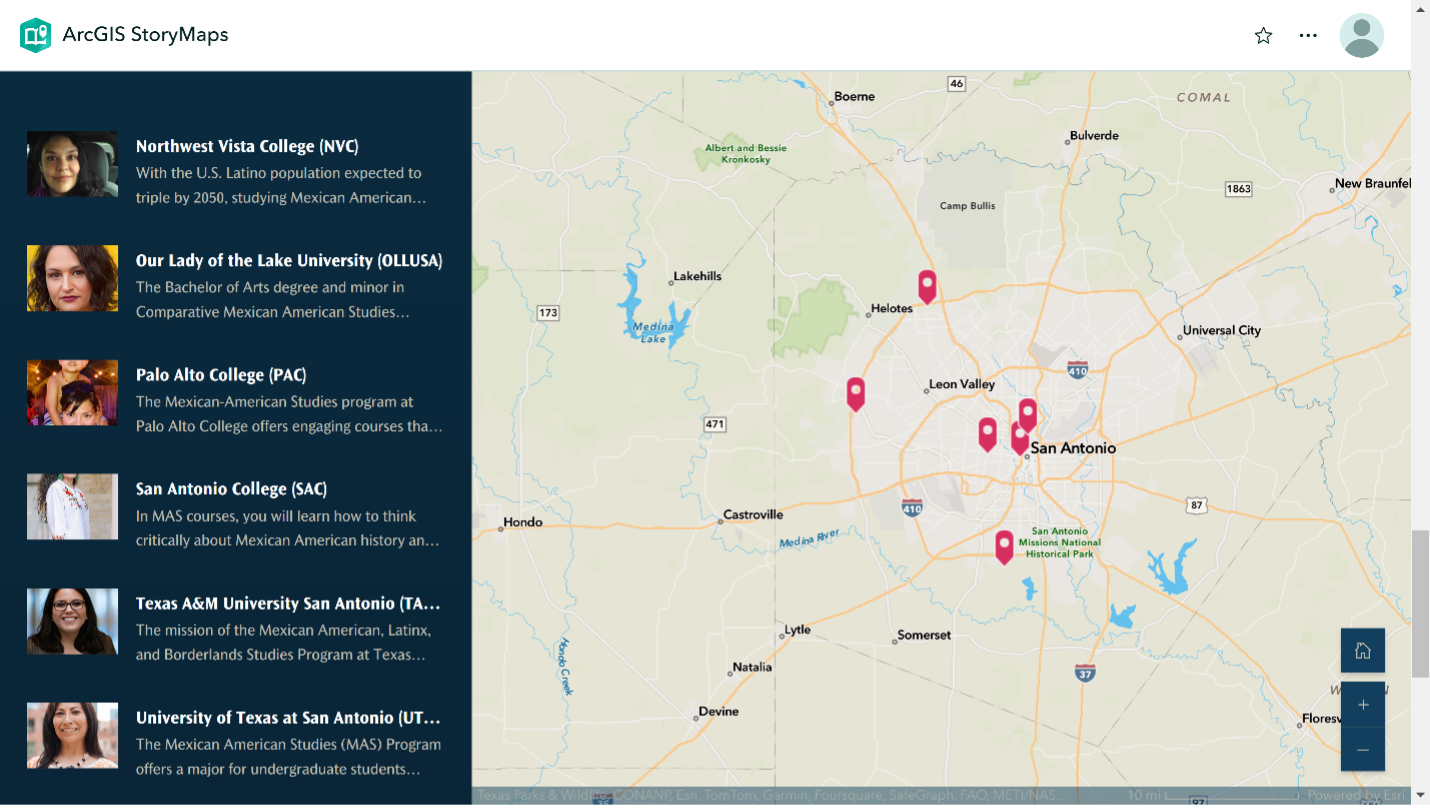
(which makes creating the StoryMap feel user-friendly). Still in process, the map
currently reflects my initial idea of using the GIS mapping system to layout the schools
with MAS programs across Yanawana/San Antonio, Texas and to have the MAS muxeres' interviews linked, respectively.
This also stems from my observations having attended the MAS statewide summit in 2021,
where MAS stakeholders shared information about their respective institutions, such
as which university boasted a MAS major and/or minor, which schools had a MAS program
or a larger department, how many students were enrolled and majoring in the field,
which institutions had an actual center for MAS, and how many faculty were hired within.
Listening to these MAS faculty from across Texas share about what their programs had
(or did not have), and their struggle to push for basic resources made me desire a
map that could provide the larger public with this information to understand the MAS
movimiento from the perspective of educational leaders within.
Further, the map could visually feature the muxeres at the helm of running and building these programs — not only their photos, but also
their CVs, publications, oral history interviews and/or written testimonios, photos,
flyers, institutional data — essentially a visual mapping and archive of women’s labor
across the city that would be useful for MAS and Ethnic studies advocates, scholars,
students, and educators. The incorporation of critical Latinx public DH approaches
and a SIGuache methodological approach have presented other opportunities and critical
questions on how to expand the StoryMap and curate this movement history.
For example, new questions around curation, audience, ethics, and community participation
emerge through critical Latinx public DH. As a novice within DH, I find myself wondering
in what ways ArcGIS StoryMaps can curate a movement history to feature “data” that
appeals to various stakeholders such as policy makers, curriculum writers, K-12 teachers
and students, community organizers, and/or higher education faculty, without losing
sight of the unique contributions, contexts, and personal archives of each of the
MAS muxeres. This question is not only a methodological one, as I learn ArcGIS StoryMaps and
DH approaches, but also a strategic one, especially post-election where educators
as a whole, and MAS/ethnic studies educators in particular, remain uncertain about
the future of the field.
Initially, I recognized that critical Latinx public DH approaches within this project
could reach a larger audience. Typically, it is MAS/ethnic studies faculty and graduate
students that are looking to access academic research about these fields. However,
a critical Latinx public DH StoryMap has the potential to reach other important communities
and stakeholders which are needed in this current sociopolitical moment to energize
the movement for MAS and to organize and advocate to keep these courses and programs
available in Texas. In what ways can the project’s StoryMap be curated to touch on
points that are needed by various stakeholders to advocate on behalf of the field?
For example, is there a way to also map the strategies of state board of education
allies or city council members who support MAS and other ethnic studies programs?
How can the StoryMap speak to ways that community members can advocate on behalf of
the programs, and include their own demands of schools and universities, as well as
their own historic contributions to the larger movement for MAS and ethnic studies
in Texas? In what ways can a StoryMap bring together various stakeholders to organize
and share information, resources, and strategies?
In considering the possibilities of a StoryMap as both online counter-archive and
potential organizing tool, how can a StoryMap be accessible to the community, while
also limiting who has access to our strategies and organizing information in order
to protect the MAS muxeres and other stakeholders involved? How do we not reveal our hand to the opponent, yet
utilize DH to still document, preserve, and organize? In what ways can the project’s
StoryMap invite connection, participation, community organizing and advocacy, beyond
its current limited use of a StoryMap as merely repository? These are questions and
practices that I am presently exploring as a MAS researcher slowly learning how to
bridge critical Latinx public DH. Critical Latinx public DH approaches are even more
urgent within MAS research today given digital public research’s immediacy compared
to traditional publication deadlines, its potential for collaboration, and its direct
training for students and community practitioners.
Given the heightened anxiety and uncertainty regarding the future of education, MAS,
and ethnic studies post-election, especially in Texas, students’ usual question around
what they can do with a MAS degree has now transformed to, “Should I even major in MAS?” Again, here is where critical Latinx public DH approaches are a salve for MAS and
MAS research, because they provide students with hands-on training and digital skills,
critical feminist research methodologies, and researcher ethics that can be applied
in any field, discipline, or industry, such as public history, communications, journalism,
museum studies, education, public administration, civic affairs, governance, etc.
Not only do critical Latinx public DH approaches help transform traditional MAS research
and make it more accessible and immediate to our communities, but it also trains students
across disciplines on how to curate histories, build StoryMaps and other online public
exhibits, ethically engage with communities, and use digital technologies to preserve,
document, community build, and solicit advocacy. The bridging of critical Latinx public
DH with MAS research provides students with both digital skills training and researcher
training that culminates in the development of a digital research project for students
to use as they prepare for the job market.
Conclusion
In this essay, I introduced the MAS Muxeres Oral History Project as an example of the transformational possibilities when critical Latinx public DH
approaches are introduced to MAS research. Through a framework of Chicanx feminisms,
digital rasquachismo and SIGuache, I outlined the slow research process of learning new technologies and
using whatever resources are available to publicly showcase feminist MAS research
that creates a counter archive, maps out the movement’s history through the contributions
and experiences of muxeres, and potentially creates a digital organizing space for stakeholders to communicate,
share resources, and build with each other into the future. Given the current sociopolitical
climate around education, I shared the ways in which critical Latinx public DH can
not only enhance MAS research but also provide training and skills that students can
take with them across disciplines and industries as they learn to curate, map, archive,
and build digital exhibits that center MAS research. The incorporation of critical
Latinx public DH approaches into MAS not only addresses students’ concerns with marketability
but also fosters the opportunity to engage in research that invites activism, thus
contributing to the larger movement for MAS in Texas.
Works Cited
Acuña 2011 Acuña, R.F. (2011) The making of Chicana/o studies: In the trenches of academe. Rutgers University Press.
Anzaldúa 1999 Anzaldúa, G. (1999) Borderlands/La frontera: The new mestiza. Aunt Lute Books.
Blackwell 2011 Blackwell, M. (2011) Chicana power! Contested histories of gender and feminism in the Chicano movement. The University of Texas Press.
Chabram-Dernersesian 2013 Chabram-Dernersesian, A., (2013) “I throw punches for my race, but I don't want to be a man: Writing us—Chica-nos (girl,
us)/Chicanas—into the movement script”, in Cultural studies, pp. 81-95. Routledge.
Cotera 2015 Cotera, M. (2015)
“Nuestra autohistoria: Toward a Chicana digital praxis”,
American Quarterly, 70(3), pp. 483-504. Available at:
https://doi.org/10.1353/aq.2018.0032. Accessed 15 November 2024.
Cotera 2018 Cotera, M., (2018) “Unpacking our mother’s libraries: Chicana memory praxis before and after the digital
turn”, in D. Espinoza, M. Cotera, and M. Blackwell (eds.) Chicana movidas: New narratives of activism and feminism in the movement era. The University of Texas Press.
Delgado Bernal 1997 Delgado Bernal, D. (1997) Chicana school resistance and grassroots leadership: Providing an alternate history
of the 1968 East Los Angeles Blowouts. Doctoral dissertation, University of California Los Angeles.
Delgado Bernal 1998 Delgado Bernal, D. (1998)
“Using a Chicana feminist epistemology in educational research”,
Harvard Educational Review, 68(4), pp. 555-583. Available at:
https://www.harvardeducationalreview.org/content/68/4/555 10.17763/haer.68.4.5wv1034973g22q48. Accessed 15 November 2024.
Delgado Bernal et al. 2012 Delgado Bernal, D., Burciaga, R., & Flores Carmona, J. (2012)
“Chicana/Latina testimonios: Mapping the methodological, pedagogical, and political”,
Equity & Excellence in Education, 45(3), pp. 363-372. Available at:
https://www.tandfonline.com/doi/abs/10.1080/10665684.2012.698149. Accessed 15 November 2024.
Espinoza, Cotera, and Blackwell 2018 Espinoza, D., Cotera, M.E., & Blackwell, M. (2018) Chicana movidas: New narratives of activism and feminism in the movement era. The University of Texas Press.
Fierros and Delgado Bernal 2016 Fierros, C. & Delgado Bernal, D. (2016) “Vamos a platicar: The contours of platicas as Chicana/Latina feminist methodology”, Chicana/Latina Studies: The Journal of Mujeres Activas en Letras y Cambio Social, 15(2), pp. 98-121.
Hicks-Alcaraz 2022 Hicks-Alcaraz, M. (2022) “Piloting the counter-memorias digital testimonio project: Blackness in U.S. Latinx
and Latin American racial politics”, The International Journal of Information, Diversity, & Inclusion, 6(4), pp. 99-119.
Montejano 1987 Montejano, D. (1987) Anglos and Mexicans in the making of Texas, 1836-1986. The University of Texas Press.
Okihiro 2016 Okihiro, G.Y. (2016) Third World Studies: Theorizing liberation. Duke University Press.
Pérez 1999 Pérez, E. (1999) The decolonial imaginary: Writing Chicanas into history. Indiana University Press.
Ruiz 2008 Ruiz, V. (2008) From out of the shadows: Mexican women in twentieth-century America. Oxford University Press.
Saldaña 2021 Saldaña, L.P., (2021)
“The struggle for Mexican American studies in Texas K-12 public schools: A movement
for epistemic justice through creation resistance”,
Association of Mexican American Educators Journal 15 (2):9-35.
https://doi.org/10.24974/amae.15.2.421.
The Latina Feminist Group 2001 The Latina Feminist Group (2001) Telling to live: Latina feminist testimonios. Duke University Press.
Valencia 2008 Valencia, R.R. (2008) Chicano students and the courts: The Mexican American legal struggle for educational
equality. New York University Press.
Valenzuela and Epstein 2021 Valenzuela, A., & Epstein, E.M.B. (2023) “Struggles for/with/through ethnic xtudies in Texas: Third spaces as anchors for collective
action”, Teachers College Record: The Voice of Scholarship in Education, 125(5), 12-24.
Valenzuela, Epstein, and Unda 2021 Valenzuela A., Epstein E., Unda M. D. C. (2021) “Mexican American studies and scholar activism in a decolonial enactment of citizenship:
From testimony to testimonio”, in Handbook of Latinos and education, pp. 219–236. Routledge.
Álvarez and Fernández Quintanilla 2022 Álvarez, M.E., and Fernández Quintanilla, S. (2022) “Borderlands archives cartography: Bridging personal, political, and geographical
borderlands”, in Paola Ricaurte, Sukanta Chaudhuri, and Domenico Fiormonte (eds.) Global Debates in the Digital Humanities. Minneapolis: University of Minnesota Press, pp. 214–24.
Álvarez and Fernández Quintanilla 2024 Álvarez, M.E., and Fernández Quintanilla, S. (2024) “Embodying SIGuache from a border(lands) lens archiving transborder newspapers through
digital cartography”, Aztlán: A Journal of Chicano Studies, 49(1), pp. 149-163.


 https://orcid.org/0000-0002-8948-3795