Abstract
This article examines how authorship is approached in story generation research publications.
Story generation research forms its own, distinctive context in which computer-generated
literary texts are being produced. Through text analysis and comparisons to other
forms of computer-generated literature, the article examines what kind of rhetoric
is used when the authorship of computer-generated texts is described in this context,
and how the roles of the programmers and the program are characterised. The findings
suggest that the approach to authorship in story generation research is mainly technical,
referring strictly to the production process of the text, and leaving out the meaning
of authorship as responsibility and accountability of the work as an aesthetic whole.
This technical view affects how human-computer relations are discussed in the research,
as “human-generated” and “computer-generated” texts are contrasted with each other. Furthermore, this dichotomy of the human and
the machine affects how the produced stories are evaluated.
Computer-generated literature has risen prominently into public discussion as large
language models (LLMs) have become available for mainstream use. These models are
only the most recent development in a long tradition of developing text-generating
programs for digital computers that dates to the 1950s and 1960s [
Ryan 2017]
[
Rettberg 2018]. Part of this tradition is story generation research,
a sub-field of computer science where programs that write creative texts are
developed. In this article, I examine how the authorship of computer-generated texts
is approached in story generation research.
Story generation research deals with core issues of literature in many ways. As
researchers Nick Montfort and Rafael Pérez y Pérez argue, the developers of story
generation programs can both discuss and operationalise key concepts of literary
theory, such as plot and character [
Montfort and Pérez y Pérez 2023, 99].
Correspondingly, text-generation programs are considered to be a part of the wide
spectrum of electronic literature: works that explore the capabilities of computers
and networks, as defined by the Electronic Literature Organization (ELO).
[1] Many story-generating algorithms from past decades have been examined in
literary research (see e.g. [
Ryan 1991]
[
Wardrip-Fruin 2009]
[
Rettberg 2018]). At its best, the intercommunication between the
disciplines of computer science and literary research can both aid the development
of story generation programs and enrich the understanding of electronic literature.
However, the potential of this dialogue has not yet been fully achieved. Commenting
on recent research, Chhun et al. point out that humanities research could have much
more to contribute to the development of story-generating algorithms and the study
of computational creativity [
Chhun et al. 2022, 5082]. I aim to
contribute to this exchange of ideas by examining newer programs in story generation
that have thus far received little attention in literary studies. I focus on the
concept of authorship, which is both thoroughly theorised in literary studies and
central to the objectives of story generation research.
Actual author and electronic literature
In literary research, a division is often made between the
“actual author,” who
is the intellectual creator of the work, and the
“implied author,” which is an
image of the author that the reader can infer from the text (see e.g. [
Booth 1961]
[
Booth 1983]
[
Chatman 1978]
[
Chatman 1994]
[
Schmidt 2010]). In this article, my focus is on the question of
how authorship is viewed in story generation research, a question that is
primarily related to the actual author.
This aspect of authorship is generally associated with the assumption of an
individual who can profit from their literary work and is responsible for and
deserving of credit for it. This perception of authorship has evolved alongside
print technology and the publishing industry [
Woodmansee 1994, 35–36]
[
Finkelstein and McCleery 2005, 69–71]
[
Febvre and Martin 1984, 165–166]. Before the invention of printing in
Europe, authorship was not defined in the same way as it is today, and the
authors of texts were not considered their owners [
Finkelstein and McCleery 2005, 69]. Writing was seen more as a form of
craftsmanship or a channelling of inspiration from a higher power [
Woodmansee 1994, 35]. The perception of authorship began to
shift as distribution of hundreds of books became possible with print
technology, and as copyright legislation began to be drafted in the 18th century
[
Woodmansee 1994, 36–37]. In addition, inspiration and
genius began to be used to characterise authors around the same time [
Jefferson 2014, 4, 61, 67–71]. These developments influenced
the formation of the current understanding of authorship, as they led to the
forming of the profession of writers who could support themselves with the
proceeds of their writings [
Woodmansee 1994, 36–37]. The
author’s role as the party that is responsible for the aesthetic whole of the
work is also often associated with the term [
Lamarque 2009, 109–111].
In many respects, electronic literature often goes against the grain of this
perception of authorship. For instance, in the 1990s, many researchers viewed
the changes brought about by computers to writing and reading as a counterforce
to the old concept of authorship that emphasised the individual author (e.g. [
Gaggi 1997, 106–107]
[
Landow 1992, 70–77]
[
Bolter 1991, 4]). Many phenomena that challenge the
established perception of authorship, such as collective writing, adaptations,
plagiarism, and crowdsourcing ideas, are also made considerably easier with
digital technologies [
Goldsmith 2011, 2–3]. With
computer-generated texts, ascribing authorship is complicated even further, as
many factors, such as the design of the program and the data that the program
has been given to work on, shape the produced text [
Henrickson 2021]. Furthermore, with computer-generated texts, the
program’s role as a co-author also comes into consideration [
Lebrun 2017], and it has been even argued that computer-generated
works can undermine the image of the author as a unique genius [
Bök 2002, 10].
These differing perspectives — the common assumption of the author as an
individual who is the owner of and responsible for their work, and the varying
approaches in electronic literature that challenge this expectation — provide a
background for analysing the research material as well. I compare how authorship
is framed in story generation research in relation to these points of view.
Story generation programs as research material
The following research material is based on a number of story generation studies
published over the last decade. In selecting the publications to analyse, I rely
on reviews that have tracked the of the state-of-the-art of story generation
programs [
van der Lee et al. 2019]
[
Herrera-González, Gelbukh, and Calvo 2020]
[
Alhussain and Azmi 2021]
[
Guan et al. 2021]
[
Chhun et al. 2022]
[
Ansag and Gonzalez 2023]. The other publications I examine [
Ammanabrolu et al. 2021]
[
Bottoni et al. 2020]
[
Cheong and Young 2015]
[
Daza, Calvo, and Figueroa-Nazuno 2016]
[
Fan, Lewis, and Dauphin 2018]
[
Guan et al. 2020]
[
Ippolito et al. 2020]
[
Jain et al. 2017]
[
Li, Ding, and Liu 2018]
[
Liu et al. 2020]
[
O'Neill and Riedl 2014]
[
Peng et al. 2018]
[
Peng et al. 2022]
[
Porteus and Lindsay 2019]
[
Tambwekar et al. 2019]
[
Xu et al. 2018]
[
Yao et al. 2019] were chosen by cross-referencing these reviews and
selecting the articles that are discussed in more than one of them. This is to
ensure that although I cannot comprehensively cover all of the recent work on
story generation in this article, my research material aligns with what multiple
other researchers have found noteworthy. The reviews themselves are also a
subject of analysis since they discuss the authorship of computer-generated
texts as well. I examine how the term
“authorship” is used across these various
publications in their entirety, including the descriptions of the programs
developed and the evaluations of the stories produced.
Story generation programs are part of a larger phenomenon of text generation.
Text generation with digital computers has been a method of producing literary
works since the mid-20th century [
Rettberg 2018, 31–33]. It
is a versatile practice where multiple sources of influence are at play. One
such influence is dadaist poetry, and methods similar to the cut-up technique
are used in computer-generated works [
Funkhouser 2007, 32–34]. Furthermore, the work of Oulipo (
Ouvroir de littérature
potentielle) has also been influential in text-generation, as they
explored the intersections of literature and mathematics from the 1960s on and
are known for experimenting with combinatory procedures and methods of
constrained writing, that is, creating rules and restrictions within which
different works could be created [
Schäfer 2007, 121]
[
Funkhouser 2007, 33–34]. Later, text generation has been
used in a similar way to produce works based on the rules created by the author
[
Funkhouser 2007, 34].
One key motivation for text-generation, especially in computer science, has been
the imitation of human creativity. Story generating programs that have been
developed in the field of computer science have been closely tied to research in
artificial intelligence [
Gervás 2012]. As Sharples & Pérez y
Pérez put it, developing programs that can perform various creative tasks is
seen as a way of modelling the human mind, and this work aims to answer
questions such as
“What is intelligence?” or
“What makes humans creative?” [
Sharples and Pérez y Pérez 2022, xii]. Here, storytelling is viewed as a task
that is particularly difficult for computers, and is thus often discussed as one
of the grand challenges of artificial intelligence [
Fan, Lewis, and Dauphin 2018, 889]
[
Xu et al. 2018, 4306]
[
Guan et al. 2020, 93]
[
Ammanabrolu et al. 2021, 5859].
The goals and practices of story generation as a field of research also affects
how the text-generation process and authorship are framed. As my analysis will
show, text generation of literary texts in the context of computer science
research is often viewed more in terms of problem solving than in terms of
creating art. This marks a difference to many computer-generated works that are
created outside of research-oriented environments. Throughout the article, I
contrast story generation with text generation outside of computer science
research, both to explore story generation as a subtype of electronic literature
and to offer an external perspective on the conceptions of authorship that might
be useful in the field.
Story generation researchers have historically utilised literary theory in the
development of the programs, and some (e.g. [
Gervás 2012]
[
Montfort and Pérez y Pérez 2023, 99]) have even suggested that story
generation could work as a means of
“testing” different concepts and theories of
literature. Story generation researchers have been especially interested in
formulations of plot in narrative theory, most notably Vladimir Propp’s famous
study
Morphology of a Folktale (1968),which has
been used either as a source of inspiration or even as a basis for story
generation programs in many instances (see e.g. [
Turner 1994]
[
Peinado and Gervás 2006]
[
Gervás 2013]
[
Veale 2014]
[
Ryan 2017]).
However, based on my review, it seems that dialogue between the fields is not
necessarily a part of all story generation research. The objective of
contributing to or utilising literary theory is not generally present in the
articles surveyed, and literary theory concerning concepts such as story and
plot is often not referenced at all or only in passing (see e.g. [
Li, Ding, and Liu 2018]
[
Xu et al. 2018]
[
Fan, Lewis, and Dauphin 2018]
[
Peng et al. 2018]
[
Tambwekar et al. 2019]
[
Ippolito et al. 2020]). Moreover, when literary theory is referenced,
it is often in the context of techniques for plot modelling (e.g. [
O'Neill and Riedl 2014]
[
Ansag and Gonzalez 2023]). I wish to suggest that engaging with other areas of
literary theory, such as stylistics and genre studies, could also be beneficial
for story generation research.
The textual analysis of the research material was conducted by first going
systematically through the articles and then identifying recurring themes
related to the research question: What or whom do the researchers view as the
stories’ author and what does that imply on how authorship is viewed in the
research? I observed that discussion related to authorship took place especially
in connection with motivating the research, evaluating the outputs, and refining
the style of the outputs. Themes that recurred throughout much of this material
were reducing the impact of the human author on the outputs, juxtaposing human
and computer-generated texts, and avoiding “machine-like” features in outputs.
In the sections that follow, I examine how these topics were addressed in the
articles and what kind of overall picture of the approach to authorship can be
drawn from them.
Authorial freedom or authorial burden – the role of the human author in story
generation
Authorship is arguably one of the most important topics in story generation
research, especially when research motivations are examined. Developing a
“computer author” that mimics human creativity is one of main objectives
expressed in these articles. This goal is expressed, for example, by linking the
research to the development of computational creativity, which is referred to
simply as an imitation of human creativity (see e.g. [
Jain et al. 2017, 2]
[
Alhussain and Azmi 2021, 1]
[
Ansag and Gonzalez 2023, 878]). Some researchers define the term
“creative” further, asserting that a program is creative if the output it
produces is different enough from the parameters and other information given to
it [
Alhussain and Azmi 2021, 25] or if the output is unpredictable to
its programmers [
Daza, Calvo, and Figueroa-Nazuno 2016, 14]. As [
Yao et al. 2019, 7381] put it, the aim is often to make a program that passes the
Turing test.
[2]
Over the time period during which the articles examined were published, the
methods of story generation have altered greatly. At the beginning of the 1960s,
in the early days of story generation research, the programmer played an
integral part in shaping the information required for storytelling into a
computer-readable form [
Ryan 2017]. Methods such as simulation,
planning, and story grammars have been and continue to be utilised in story
generation.
[3] In recent decades, however,
neural network methods, and even more recently LLMs such as generative
pretrained transformers, have surged in popularity and are regularly used
alongside other methods. With the use of neural networks, in which LLMs are also
based on, it is possible to train the program to imitate a set of training data
it has been given, for example by recognising which words typically appear
together [
Henrickson 2018a, 9–10]
[
Paaß and Giesselbach 2023, vii]. This has enabled greater levels of
automation in the story generation process.
This shift in methodology has also affected how the authorship of the produced
stories is discussed. With advances in natural language generation, such as the
increased use of neural networks, previously dominant methods such as planning
and story grammars are often criticised. [
Yao et al. 2019, 7378]
and [
Tambwekar et al. 2019, 5982] criticise older approaches for
relying heavily on extensive domain knowledge and annotation crafted by the
programmers.
“Hand-crafting” the information that is given to the program
requires a lot of effort from the developers and significantly impacts the
construction of the text, which is viewed as a shortcoming. In contrast, the use
of neural models means there is less need for
“hand-crafted” knowledge, an
outcome that is regarded as desirable [
Liu et al. 2020, 1725].
The researchers’ contributions are often contrasted with previous research by
showcasing how much they have achieved
“authorial reduction” (e.g. [
Porteus and Lindsay 2019, 1074]) or lessened the
“authorial burden” that
goes into making a story generation program [
Bottoni et al. 2020, 21]
[
Ansag and Gonzalez 2023, 878]. Correspondingly, previous work can be
praised if generating the story requires
“almost no human intervention” [
Daza, Calvo, and Figueroa-Nazuno 2016, 10]. In other words, the aim is most often to
minimise the role of the human(s) — especially the people who develop the
program — in the creation of the text.
The goal of minimising the developer’s contribution is reflected in how the
authorship of the stories is characterised. Notably, the researchers do not
generally refer to themselves as authors or writers of the produced
stories.
[4] Instead, the researchers typically name the program
they have developed and refer to that program as the writer of the stories.
Alternatively, the researchers often refer to the writer as a
“model” or
“system” and in some cases even as an
“agent,” which implies some degree of
authority over the output [
Tambwekar et al. 2019]
[
Ammanabrolu et al. 2021].
As these findings show, authorship — or more narrowly, defining the extent to
which a story is computer-generated — is closely tied to the goals of story
generation research. However, the
“authorship” term is not explicitly defined in
any of the publications, as would be the case with literary research that
focuses on authorship. Despite this, it is apparent the concept
“authorship” is
ascribed a meaning that is more specific than the everyday use of the
word. Based on the research material, the developers of story generating
algorithms seem to discuss authorship almost entirely by assessing how minimal
their own role is in the text’s construction. This approach might partly stem
from the generally desired features in software design: The less hand-crafted
material there is in a program, the more flexible it becomes [
Xu et al. 2018, 4307–4308]
[
Liu et al. 2020, 1725]. In such an approach, by focusing on the
“authorial reductions,” the concept of authorship is reduced to a technical
question: who or what has written each part in a story.
The effort to diminish the role of the human contributors as authors differs from
many other works of electronic literature that are produced using
text-generation programs. Take, for example, Philippe Bootz’s
La série des U. As Bootz who is a renowned poet in the
field of electronic literature, describes it,
“The work generates a different
text-that-is-seen [...] each time it is played through subtle variations in the
timing at which the textual elements appear and the relation between the verbal
text and the sonic component [...]” [
Bootz 2005]. Like story
generators, Bootz’s work is not a single, stable text but a text generator that
produces different iterations according to principles that he designed. The
process of creating the program that produces these texts is similar to story
generation. Yet, in contrast to the perceived computer authorship in story
generation, Bootz considers himself the (co)author of
La
série des U. This is evident from how he refers to the work as
“a
typical example of adaptive generation that illustrates my present
approach of e-poetry” [
Bootz 2005, emphasis added]. Research
on this work also refers to it as being authored by Bootz. For instance,
Alexandra Saemmer considers
La série des U as an
illustrative case of
“authors who [...] purposefully reveal details of their
program” [
Saemmer 2009, 485]. The comparison of story generation programs to
similar works outside of the field highlights how differently the roles of the
program and its developer can be viewed in terms of authorship.
Some writers who use computer-programs to generate literary texts do not view the
computer program(s) as author(s) in any sense. A computer-poet Allison Parrish,
for example, approaches making poetry with text-generation as putting together a
collage. For instance, her work
Two of Pentacles is
based on seventy-eight different snippets written by her and rearranged using
different techniques. These include assigning each snippet a vector of words and
letter sequences that represent it and a program that gives measurements on the
snippets’ similarities based on the vectors [
Parrish 2025]. She
views the different programs that she uses in the process as a medium of the
assemblage, not as authors or collaborators. As she writes,
“I never [...]
attribute authorship to a program or a model. If I publish the results of a text
generator, I am responsible for its content” [
Parrish 2021]. It is apparent that
in contrast to the way computer scientists think about authorship, Parrish views
authorship as a broader concept than merely estimating the ratio of human and
computer effort.
The authorship of story generation programs could also be approached from the
perspective of remixing and reusing material. Digital media theorist Leah
Henrickson has proposed this kind of approach for another kind of work of
algorithmic authorship: Twitter bot Pentametron made by Ranjit Bhatnagar, a bot
that gathered tweets in iambic pentameter in its feed and also arranged them
into longer poems (henrickson, 2018b, 12–13). Pentametron inspired people to use
the material in creative ways, and [
Henrickson 2018b, 13] (henrickson, 2018b, 13) argued that instead
of examining Pentametron’s retweets and poems as final literary texts, the
chains of appropriation of texts are the interesting subject of analysis. Even
though story generation programs are quite different from social media bots like
Pentametron in terms of their purpose and audience, they share a similar
function of providing material for readers that can be used in subsequent texts.
Story generation programs are mainly examined by other researchers that can
utilise them in creating their own programs. Approaching story generation
programs from this perspective could also bring a new element in discussion of
their authorship. It highlights the collaboration of not only between the
program and its developer, but between researchers.
One reason for the narrower approach to authorship in the research material is
that in story generation producing the stories is only of an instrumental value,
as the purpose of the research is technological advancement. While story
generators are developed for purposes such as storytelling [
Peng et al. 2018]
[
Porteus and Lindsay 2019]
[
Ansag and Gonzalez 2023], creating works of fiction [
Daza, Calvo, and Figueroa-Nazuno 2016], interactive entertainment [
Alhussain and Azmi 2021], and games [
Cheong and Young 2015], these aims are described as the ultimate goals of
story generation, not as direct products of the story generators in their
current state. This is perhaps the most crucial difference between story
generation and works such as
La série des U or
Two of Pentacles: The process and products of
story generation are not viewed as literary works but rather as steps towards
the goal of computational creativity. The developers seem to view their work in
reducing the
“authorial burden” as a technical task, not as an artistic
endeavour. Thus, their view of authorship is also technical, and other
dimensions of the term, such as the social role and responsibilities of the
author, are not discussed.
This technical definition of authorship that leaves out so many aspects typically
associated with literary authorship also leads one to ask whether text
generators and the texts they produce should be approached as literature. This
does not seem to be the framing in computer science, as the programs and the
texts they produce are never referred to as works of art or literature. However,
this does not necessarily mean that the programs and their outputs should not be
regarded as literature. In fact, this has been typical in older story generation
programs that are regularly mentioned as part of electronic literature as well.
Developers of older story generators such as Tale Spin or Mexica originally
framed their work primarily as research of computational creativity and
imitation of human cognition [
Meehan 1976, 212–226]
[
Sharples and Pérez y Pérez 2022, 119–120]. Yet, examining these programs as
literature has produced valuable discussion, for example on whether works of
electronic literature should strive for simulating human writing [
Aarseth 1997, 131–141]
[
Wardrip-Fruin 2009, 155].
Whether the framework of
“literature” is useful in examining story generation
programs depends also on the purpose and content of the produced texts. Older
story generation programs tended to produce outputs in an identifiable literary
genre, such as fables or fairy tales [
Meehan 1976]
[
Riedl and Young 2010], detective stories [
Klein et al. 1973], or
short stories [
Bringsjord and Ferrucci 2000]. In comparison, most stories
presented in the research material are much shorter and not easily recognisable
as belonging to a particular genre. Still, the researchers generally do have
aesthetic objectives for the produced texts. These aims include creating
suspense [
O'Neill and Riedl 2014]
[
Cheong and Young 2015], literary language [
Daza, Calvo, and Figueroa-Nazuno 2016],
deepening the characters [
Bottoni et al. 2020], following a narrative
structure [
Porteus and Lindsay 2019]
[
Liu et al. 2020], or arousing interest in the reader [
Yao et al. 2019]
[
Peng et al. 2018]
[
Jain et al. 2017]. In this sense, it is worthwhile to analyse their
outputs in literary terms.
[5]
The human-machine dichotomy
Developers of story generation programs not viewing themselves as authors or
co-authors of the stories is reflected in the juxtapositions of
“the human” and
“the machine.” This is most evident in the evaluation processes of the programs.
In studies that conduct a so-called
“human evaluation” of the texts, it is
common to include
“human-written” texts alongside computer-generated ones to be
read by the participants of the study (see e.g. [
Cheong and Young 2015]
[
Daza, Calvo, and Figueroa-Nazuno 2016]
[
Guan et al. 2020]
[
Guan et al. 2021, 6396]
[
Chhun et al. 2022, 5797]).
[6] Since the goal of story generation is to
mimic human intelligence and creativity,
“human-written” stories are used as a
yardstick against which the success of the program is measured. For example, the
evaluation scores of the stories can be used as an indicator of the program’s
effectiveness [
Liu et al. 2020, 1731],
“narrative intelligence” [
Chhun et al. 2022, 5799], or the stories’ suspensefulness [
Cheong and Young 2015]. By contrasting the
“human-generated” and
computer-generated texts in this way, the human and the machine are positioned
as separate entities.
A study conducted by [
Daza, Calvo, and Figueroa-Nazuno 2016] is an especially interesting
example of this phenomenon in terms of authorship, because it juxtaposes
experimental works by authors and texts that are generated with the program
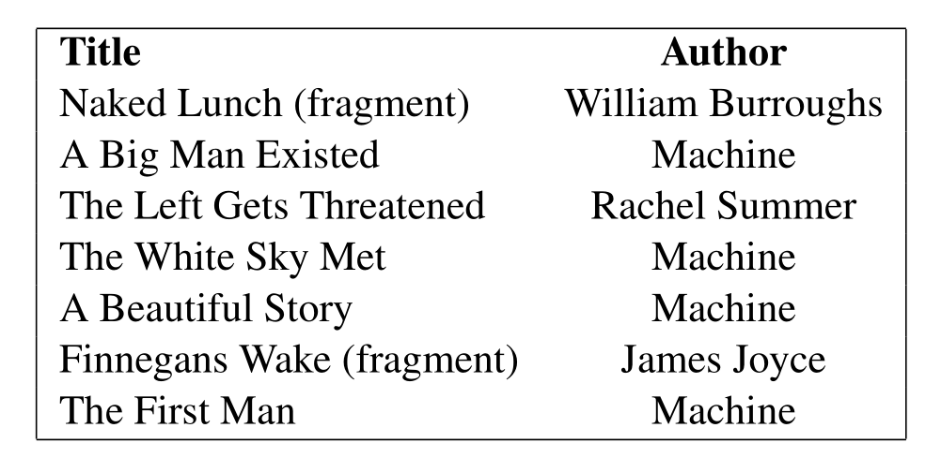
developed by the researchers. Image 1 shows a list of texts that participants
were asked to evaluate without knowledge of their authorship.
The picture depicts a dichotomy, where authors such as James Joyce are
named but the texts generated by the program are put under the generic label of
“machine.” This separation of the two is further repeated in the results, where
the performance of
“artificial texts” and
“human texts” in the evaluation is
presented. This division reflects the perception of authorship as a technical
either-or question: A text is either is or is not a result of a text-generation
process.
The picture also shows that multiple experimental works are included in the
comparison. The authors of the article state that this is because they want to
stress that the texts they produced are
“at least as experimental” as the
included human written works [
Daza, Calvo, and Figueroa-Nazuno 2016, 18]. However, the
article does not discuss in more detail how the experimental texts in question
relate to authorship. William Burroughs, for instance, famously aimed to
obfuscate authorial authority in his works: He has described writing
Naked Lunch without conscious control [
Heal 2016],
and suggested that he used the cut-up method in writing it [
Gontarski 2015, 173]. In this way,
Naked Lunch and Burrough's attempts to minimise his own conscious
role in writing it provides a kind of precursor for similar pursuits in story
generation. This nuance is lost in the human-machine dichotomy.
Furthermore, the line between
“the human” and
“the machine” is often blurrier
than the dichotomy suggests. For one, the
“computer-generated” works are often
largely shaped by the developers of the program. For example, in the case of
Suspenser, the developers have formulated a
list of fifty-seven events that the program can pick from to include in a
storyline, which has an effect on the produced stories. To evaluate the results,
Cheong & Young have also asked a
“human author” to construct stories based
on the same pool of events, and these stories are then read and evaluated by
study participants [
Cheong and Young 2015, 46]. The categories
“human-generated” and
“machine-generated” do not accurately describe the process
of creating these stories. Both types of stories are shaped by the programmers,
who have chosen what events are possible in a story, regardless of whether the
storyline itself is constructed by the human author or the
Suspenser.
Even with programs where the role of the developers is less central than with
Suspenser, they shape the produced stories
significantly. The programs need some sort of rules to function, for example
concerning the length and genre of the stories, the kinds of texts that the
program should imitate, and whether the program should focus mainly on
coherence, suspense, or literariness. These rules are designed and put in place
by the developers of the programs. As an example, [
Daza, Calvo, and Figueroa-Nazuno 2016, 19] state that their program produces output based on a single word
that the user of the program gives to it as a prompt, and that they do not have
any control over the substance of the stories produced. In a limited technical
sense — who or what has constructed the text at the sentence level — this might
be the case. However, if authorship is understood more broadly and includes
coming up with the concept of the work, the developers can be regarded as
co-authors of the texts. The researchers undeniably shape the production of the
stories by setting the program goals such as coherence and literary style, and
by choosing the training data.
Furthermore,
“purely” human-written texts are becoming an increasingly difficult
category to identify, given the recently risen popularity of LLM based programs.
As LLMs have become more widely known and available, creating partly
computer-generated literary works has been possible for a larger number of
people. This is evident, for example, on book platforms such as Amazon that have
experienced acceleration of publishing rates [
Cabezas-Clavijo et al. 2024].
[7] The fact that human and machine
writing are increasingly merging outside of the research context is making it
increasingly difficult to distinguish between
“human-written” and
“computer-generated” texts. Especially when story generation programs are
examined as a form of literature, a more accurate approach could be to
acknowledge that the outputs are not void of human influence, and that whether
they are written by a human or a machine is a sliding scale.
Writing with a machine — Approaches to “mechanical” features in texts
As demonstrated, the main goal of story generation programs is to imitate human
intelligence, and “human-written” stories are used as a measure of the success
of computer-generated stories. This aim is reflected in attempts to reduce the
“mechanical” feel of the generated texts. These attempts are most clearly seen
in evaluations of the stories, where the desirable and undesirable features of
the produced stories are defined.
Story features that are deemed
“undesirable” are discussed especially in the
evaluations of the quality of the stories. These features include, most notably,
repetition and incoherence in stories (see e.g. [
Yao et al. 2019, 7383–7384]
[
Tambwekar et al. 2019, 5986]
[
Guan et al. 2020, 93]
[
Herrera-González, Gelbukh, and Calvo 2020, 82]
[
Guan et al. 2021, 6396]). These qualities are often discussed in
contrast to the stories written by people and thus are deemed too machine-like.
Bottoni et al. describe how stylistic features such as repetition can make the
text sound
“mechanical”:
Sentences in stories are affected by the sentences around them, and most readers
can quickly notice if they don’t flow together “correctly”: e.g. “Noah went to
the store. He went to the store to buy eggs.” or “Sara saw a spaceship. She
boarded the spaceship.” There are quotation marks around “correctly” because
prescriptively these sentences have correct grammar. However, they sound robotic
and inhuman — “incorrect” in a rhetorical sense. [Bottoni et al. 2020, 24]
The style of the text — in this case, the monotone syntax of the sentences — is
deemed incorrect because of its
“mechanicalness.” Repetition in story generation
can mean repeating the same syntactic structure, as in the case of the program
by [
Bottoni et al. 2020], but also what developers characterise as
repetitiveness of plot, where the same event is depicted repeatedly.
Incoherence in stories is another feature that is often considered undesirable.
What researchers regard as incoherence can manifest in the stories in various
ways. For example, [
Xu et al. 2018, 4313] note that some of the
stories produced have a
“chaotic timeline,” meaning that the stories go
backwards in time. Conflicts of logic or impossible events can also result in
incoherence. Guan et al. give the following extract of a story with conflicting
logic:
He noticed a car in the road. He decided to stop. He got out of his car. He
drove for half an hour. [Guan et al. 2020, 103]
In this example, beginning to drive the car after exiting it is what creates
incoherence. Researchers can also define incoherence as general
“chaoticness” in
stories. For example, Liu et al. characterise one of the stories generated by
their program as
“inferior” and
“chaotic,” because it lacks a clear main
character [
Liu et al. 2020, 1731]. As in the case of repetition,
the researchers often attribute the incoherence to the computational origins of
the text. For example, when describing types of incoherence in stories, Guan et
al. point out that
“unrelated events and conflicting logic, or globally chaotic
scenes” are common in natural language generation models [
Guan et al. 2021, 6396]. Because coherence is regarded by the
researchers as an integral feature of successful stories, they try to avoid all
instances of incoherence.
This approach, which emphasises the necessity of reducing features that
supposedly give away the text’s computational origins, is different from those
of many other genres of electronic literature. Many writers specifically use
computational methods because of the features that they can bring into the text.
For example, random generation of text can be used to create surprising
associations [
Hayles 2008, 26]. In fact,
“randomness,” which
can be computationally simulated in many ways, has been an important part of the
formation of electronic literature and other forms of digital artistry [
Montfort et al. 2013]. In these cases, the
“chaoticness” is integral to
the works, which is in some ways an opposite approach to story generation.
Furthermore, in computer-generated literature outside of story generation
research, the fact that the text is a result of a joint effort of human and
computer can be embraced, as the interplay between the two is often what makes
the work interesting. The interaction between the programmer and the program can
be intentionally made visible to the reader as an integral part of the work,
either by revealing the code that produces the text [
Marino 2020, 2015–220]
[
Hongisto 2023], or by letting the reader uncover the underlying
principles of the program by observing multiple iterations of texts produced by
the same program [
Schoenbeck 2013]. The value that the
human-computer interaction brings to the text can also be partly unintentional.
Pressman et al. note that in digital culture, surprising results or glitches are
often appreciated either as an aesthetic quality of the work or as an
opportunity to catch a glimpse of the structure of the program [
Pressman, Marino, and Douglass 2015, 41]. Whereas with these kinds of works the
ambiguity of authorship is something to be examined and pondered by the reader,
the goal of story generation is to eliminate such considerations. As with the
Turing test, the aim can be that of deception [
Natale 2021, 28] — to trick the evaluators into thinking a text is written by a
human (see e.g. [
Daza, Calvo, and Figueroa-Nazuno 2016]). Contrasted with the approaches that
highlight the human-machine interaction, the aim to imitate human writing by
avoiding
“mechanicalness” in texts can be distinguished as a feature that
characterises story generation as a subtype of electronic literature, at least
in the form that the research material represents.
Considering the aim of mimicking human writing in story generation, avoiding
features that might lead the reader to believe that a text is computer-generated
is understandable. However, categorically avoiding features such as repetition
and incoherence may not always serve this goal, as it does not take into account
their value as stylistic devices. The value of the unexpectedness of
computer-generated outputs can be observed through stories that have been
labelled failures. The examples of
“unsuccessful” stories are often intriguing,
sometimes arguably more so than their
“successful” counterparts. Take for
example these two short stories generated by the model by [
Guan et al. 2020] below:
[MALE] was driving around in the snow. Suddenly his car broke down on the side
of the road. [MALE] had to call a tow truck. The tow truck came and took [MALE]
home. [MALE] was happy he was able to get home. [Guan et al. 2020, 103]
[MALE] was on thin ice with his job. He had a friend over to help him. [MALE]
was able to hold his breath the entire time. he was so cold that he froze in his
tracks. [MALE] finally felt good about himself. [Guan et al. 2020, 104]
Out of these examples, the former is the
“successful” story and the latter the
“unsuccessful” one, as Guan et al. aim to produce coherent stories and have
labelled the latter story as
“chaotic” [
Guan et al. 2020, 103–104].
However, there is something enthralling in the story’s use of metaphors that
have to do with freezing and that merge with the protagonist feeling cold, and
there is an element of surprise in the protagonist’s contentment at the end of
the story. It is not a coherent story by the standards of [
Guan et al. 2020], but it arguably generates more interest and
questions, as well as providing more room for interpretation than the
“successful” story.
Another well-known case of similar
“unsuccessful” stories turning out more
amusing than the
“successful” ones are Tale-spin’s failed stories [
Meehan 1976]. The so-called
“mis-spun” fables generated by the
program first raise genre expectations only to soon drop them, which creates a
humorous effect. These
“unsuccessful” stories have been circulated much more
widely than the successful ones, partly because of their entertainment value
[
Bolter 1991, 180]
[
Aarseth 1997, 131] [
Wardrip-Fruin 2009, 130]. The
popularity of these stories is an example that there can be value in the stories
that the programs' creators have deemed unfit.
Similarly, avoiding all instances of repetition may not effectively serve the aim
of producing texts that imitate human writing. Yao et al. give the following
example of an unsuccessful story with repetition on the level of plot:
Anna was cutting her nails. She cut her finger and cut her finger. Then she cut
her finger. It was bleeding! Anna had to bandage her finger. [Yao et al. 2019, 7380]
It is easy to understand why this story is considered a failure, since Yao et
al.) aim to describe
“a sensible sequence of events” [
Yao et al. 2019, 7378]. However, as they also want to
“mimic human practice in real
world story writing” it is worth pointing out that by forbidding repetition,
they dismiss its potential as a stylistic device [
Yao et al. 2019, 7379]. In the above story, for example, the repeated finger cutting
brings a chilling tone to the text, implying self-harm.
One could argue that pointing out the humour and tellability of these stories is
beside the point of story generation. The difficulty of producing long, coherent
texts without repetition using natural language processing models is well
established [
Fan, Lewis, and Dauphin 2018]
[
Ammanabrolu et al. 2021]
[
Peng et al. 2022]. From this perspective, it is understandable that the
researchers want to develop these capabilities in story generation models. More
generally, the critique of ignoring common literary devices in the development
of story generation programs applies best to research where the intent is to
produce a literary output. Still, avoiding incoherence and repetition entirely
and dismissing them as
“mechanical” features does not seem consistent with the
goal of mimicking human writing. Although computers are prone to producing texts
with such features, they are not inherently machine-like but common stylistic
devices in literature. Even when randomness is not used as a foregrounded
literary device, is some amount of randomness generally desirable even in
computer-generated creative texts [
Hua and Raley 2020]. If these features
are left out of writing, part of the expressive power of fiction is lost.
Conclusion
The approach to authorship remains somewhat consistent throughout the material
presented here. While the articles do not explicitly define the concept of
authorship, a closer examination suggests that the term is used in a way that
differs from its everyday use. The aim is to automatise the creation process of
texts and to minimise the role of the human authors: a challenge that seems to
be viewed as a technical one by the researchers. This view is reflected in the
technical use of the term authorship, mostly referring to who (or what) has
composed which parts of the text, while the aspect of who (or what) is
responsible for the work is not discussed.
This narrow perspective on authorship affects how the human-machine relations in
the creative process of the texts are discussed. The stories are most often
referred to as computer-generated and contrasted with texts written by humans.
This view differs from a large part of computer-generated literature, where
authorship is often regarded as a broader concept, and the role of the designer
of the program as an author is often empathised more.
This difference in approach to authorship is also reflected on the content of the
produced texts. One consequence of the dichotomy of human and machine authorship
is that the stories can often be evaluated based on the absence of features that
are regarded as “mechanical,” mainly incoherence and repetition. Developing
programs that are less prone to producing texts with such features undoubtedly
improves the understandability and fluency of texts, but without them texts
mimicking human writing would remain lacking in stylistic versatility.
Examining the approach to these
“mechanical” features in texts reveals a larger
issue within the evaluation of computer-generated texts. Many researchers stress
the difficulty of reliably evaluating the quality of the stories (e.g. [
van der Lee et al. 2019, 355]
[
Herrera-González, Gelbukh, and Calvo 2020, 86]
[
Chhun et al. 2022, 5794]). Indeed, the task of objectively and
quantifiably evaluating stories is fundamentally challenging since it enters the
territory of personal taste and aesthetic judgements — an area where absolute
claims of quality are impossible. However, incorporating more contextual
information in the process of both development and the evaluation of the program
(Whom are the stories aimed at? What types of reading situations are they meant
for?) could help in formulating the evaluation criteria. Different media, text
types, genres, and reading contexts all affect which stylistic and narrative
features are desirable, and thorough knowledge of these topics could help in
designing programs for different purposes. Developing evaluation criteria for
the stories might be an area where story generation could benefit from an
interdisciplinary approach.
The authorship of the produced texts can be discussed differently depending on
whether story generation is placed in the realm of science or art. On one hand,
in the sample of articles analysed in this article, the programs or produced
texts are regarded not as literature but as technical improvements of natural
language generation technology. This view explains the rather technical outlook
on authorship. On the other hand, story generation can be approached as a genre
of electronic literature. This approach evokes a more diverse image of
authorship than can be inferred from story generation research: It refers not
only to how the text technically came to be, but to who (or what) is accountable
for it. Outlining the extent to which story generation aims at literary
expression is an interesting question from the perspective of both computer
science and electronic literature studies. In computer science, considering the
question would mean defining the intended use of the programs more precisely,
and if the aim is literary expression, taking into account the wide range of
features of narrative and fiction. In the context of electronic literature
research, on the other hand, story generation research must be viewed as a broad
and varied field, some parts of which can be more justifiably included in the
scope of electronic literature than others. Navigating the research output of
story generation research and its relations to electronic literature — and
literature more broadly — deserve close examination also in the future.
Funding Acknowledgement
This research was funded by Emil Aaltonen Foundation (Emil Aaltosen Säätiö).
Works Cited
Aarseth 1997 Aarseth, E.J. (1997) Cybertext: Perspectives on ergodic literature.
Baltimore: Johns Hopkins University Press.
Alhussain and Azmi 2021 Alhussain, A.I. and
Azmi, A.M. (2021)
“Automatic story generation: A survey of
approaches”,
ACM Computing Surveys,
54(5), pp. 1–38. Available at:
https://doi.org/10.1145/3453156 (Accessed: April 2024).
Ammanabrolu et al. 2021 Ammanabrolu, P. et
al. (2021)
“Automated storytelling via causal, commonsense
plot ordering”, in
Proceedings of the AAAI
Conference on Artificial Intelligence, 35(7), pp. 5859–67. Available
at:
https://doi.org/10.1609/aaai.v35i7.16733 (Accessed: April
2024).
Ansag and Gonzalez 2023 Ansag, R.A. and Gonzalez,
A.J. (2023)
“State-of-the-art in automated story generation
systems research”,
Journal of Experimental &
Theoretical Artificial Intelligence, 35(6), pp. 877–931. Available
at:
https://doi.org/10.1080/0952813X.2021.1971777 (Accessed: April
2024).
Bök 2002 Bök, C. (2002)
“The piecemeal bard is deconstructed: Notes toward a potential
robopoetics”,
Object 10: Cyberpoetics,
pp. 10–18. Available at:
http://www.ubu.com/papers/object.html (Accessed: April 2024).
Bolter 1991 Bolter, J.D. (1991) Writing space: The computer, hypertext, and the history of
writing. Hillsdale: Lawrence Erlbaum Associates.
Booth 1961 Booth, W.C. (1961) PLACEHOLDER
Booth 1983 Booth, W.C. (1983) The rhetoric of fiction, 2nd edn. Chicago: University of Chicago
Press.
Bottoni et al. 2020 Bottoni, B. et al. (2020)
“Character depth and sentence diversification in
automated narrative generation”, in
Proceedings
of the 33rd Annual Florida Artificial Intelligence Research Society
Conference (FLAIRS-2020). AAAI Press, pp. 21–26. Available at:
https://cdn.aaai.org/ocs/18401/18401-79301-1-PB.pdf (Accessed: April
2024).
Bringsjord and Ferrucci 2000 Bringsjord, S.
and Ferrucci, D.A. (2000) Artificial intelligence and
literary creativity: Inside the mind of BRUTUS, a storytelling
machine. Mahwah: L. Erlbaum Associates.
Cabezas-Clavijo et al. 2024 Cabezas-Clavijo, Á. et al. (2024)
“This
book is written by ChatGPT: A quantitative analysis of ChatGPT authorships
through Amazon.com”,
Publishing Research
Quarterly, 40(2), pp. 147–63. Available at:
https://doi.org/10.1007/s12109-024-09998-w (Accessed: April
2024).
Chatman 1978 Chatman, S. (1978)
PLACEHOLDER
Chatman 1994 Chatman, S. (1994) Story and discourse: Narrative structure in fiction and
film, new edn, 6th pr. Ithaca: Cornell University Press.
Cheong and Young 2015 Cheong, Y. and Young, R.M.
(2015)
“Suspenser: A story generation system for
suspense”,
IEEE Transactions on Computational
Intelligence and AI in Games, 7(1), pp. 39–52. Available at:
https://doi.org/10.1109/TCIAIG.2014.2323894 (Accessed: April
2024).
Chhun et al. 2022 Chhun, C. et al. (2022)
“Of human criteria and automatic metrics: A benchmark of the
evaluation of story generation”, in
Proceedings
of the 29th International Conference on Computational Linguistics,
pp. 5794–836. Available at:
https://aclanthology.org/2022.coling-1.509 (Accessed: April
2024).
Daza, Calvo, and Figueroa-Nazuno 2016 Daza, A.,
Calvo, H. and Figueroa-Nazuno, J. (2016)
“Automatic text
generation by learning from literary structures”, in
Proceedings of the Fifth Workshop on Computational Linguistics
for Literature, pp. 9–19. Available at:
https://doi.org/10.18653/v1/W16-0202 (Accessed: April 2024).
Fan, Lewis, and Dauphin 2018 Fan, A., Lewis, M. and
Dauphin, Y. (2018)
“Hierarchical neural story
generation”, in
Proceedings of the 56th Annual
Meeting of the Association for Computational Linguistics (Volume 1: Long
Papers), pp. 889–98. Available at:
https://doi.org/10.18653/v1/P18-1082 (Accessed: April 2024).
Febvre and Martin 1984 Febvre, L. and Martin, H.
(1984) The coming of the book: The impact of printing
1450–1800, trans. by D. Gerard. London: Verso.
Finkelstein and McCleery 2005 Finkelstein,
D. and McCleery, A. (2005) An introduction to book
history, 2nd edn. London: Routledge.
Funkhouser 2007 Funkhouser, C. (2007) Prehistoric digital poetry: An archaeology of forms,
1959–1995. Tuscaloosa: University of Alabama Press.
Gaggi 1997 Gaggi, S. (1997) From text to hypertext: Decentering the subject in fiction, film, the
visual arts, and electronic media. Philadelphia: University of
Pennsylvania Press.
Gervás 2013 Gervás, P. (2013)
“Propp's morphology of the folk tale as a grammar for
generation”, in M.A. Finlayson et al. (eds)
2013
Workshop on Computational Models of Narrative, Vol. 32, pp. 106–22.
Available at:
https://doi.org/10.4230/OASIcs.CMN.2013.106 (Accessed: April
2024).
Goldsmith 2011 Goldsmith, K. (2011) Uncreative writing: Managing language in the digital
age. New York: Columbia University Press.
Gontarski 2015 Gontarski, S.E. (2015) Creative involution: Bergson, Beckett, Deleuze.
Edinburgh: Edinburgh University Press.
Guan et al. 2020 Guan, J. et al.
(2020)
“A knowledge-enhanced pretraining model for
commonsense story generation”,
Transactions of
the Association for Computational Linguistics, 8, pp. 93–108.
Available at:
https://doi.org/10.1162/tacl_a_00302 (Accessed: April 2024).
Guan et al. 2021 Guan, J. et al.
(2021)
“OpenMEVA: A benchmark for evaluating open-ended
story generation metrics”, in
Proceedings of the
59th Annual Meeting of the Association for Computational Linguistics and the
11th International Joint Conference on Natural Language Processing (Volume
1: Long Papers), pp. 6394–407. Available at:
https://doi.org/10.18653/v1/2021.acl-long.500 (Accessed: April
2024).
Hayles 2008 Hayles, N.K. (2008) Electronic literature: New horizons for the literary.
Notre Dame: University of Notre Dame Press.
Heal 2016 Heal, B.J. (2016)
“Authorship in Burroughs's Red Night trilogy and Bowles's translation of
Moroccan storytellers”,
CLCWeb: Comparative
Literature and Culture, 18(5), pp. 1–9. Available at:
https://doi.org/10.7771/1481-4374.2966 (Accessed: January
2026).
Henrickson 2018a Henrickson, L. (2018)
“Butterflies, busy weekends, and
chicken salad: Genetic criticism and the output of @Pentametron”,
Authorship, 7(1). Available at:
https://doi.org/10.21825/aj.v7i1.8619 (Accessed: April 2024).
Henrickson 2018b Henrickson, L. (2018)
“Tool vs. agent: Attributing agency
to natural language generation systems”,
Digital
Creativity, 29(2–3), pp. 182–90. Available at:
https://doi.org/10.1080/14626268.2018.1482924 (Accessed: April
2024).
Henrickson 2021 Henrickson, L. (2021) Reading computer-generated
texts. Cambridge: Cambridge University Press.
Herrera-González, Gelbukh, and Calvo 2020 Herrera-González, B.D., Gelbukh, A. and Calvo, H. (2020)
“Automatic story generation: State of the art and recent trends”,
Advances in Computational Intelligence, pp.
81–91. Available at:
https://doi.org/10.1007/978-3-030-60887-3_8 (Accessed: April
2024).
Hongisto 2023 Hongisto, T. (2023)
“Reading computer-generated texts: Examining code as a reading
strategy”,
Digital Creativity, 34(4),
pp. 296–310. Available at:
https://doi.org/10.1080/14626268.2023.2274451 (Accessed: April
2024).
Hua and Raley 2020 Hua, M. and Raley, R. (2020)
“Playing with unicorns: AI Dungeon and citizen
NLP”, Digital Humanities Quarterly,
14(4).
Ippolito et al. 2020 Ippolito, D. et al. (2020)
“Toward better storylines with sentence-level language
models”, in
Proceedings of the 58th Annual
Meeting of the Association for Computational Linguistics, pp.
7472–78. Available at:
https://doi.org/10.18653/v1/2020.acl-main.666 (Accessed: April
2024).
Jain et al. 2017 Jain, P. et al. (2017)
“Story generation from sequence of independent short
descriptions”, in
SIGKDD Workshop on Machine
Learning for Creativity (ML4Creativity), pp. 1–7. Available at:
https://doi.org/10.48550/arXiv.1707.05501 (Accessed: April
2024).
Jefferson 2014 Jefferson, A. (2014) Genius in France: An idea and its uses. Princeton:
Princeton University Press.
Klein et al. 1973 Klein, S. et al. (1973) Automatic novel writing: A status report. Tech. Report
186. Madison: University of Wisconsin, Computer Science Department.
Kybartas and Bidarra 2017 Kybartas, B. and
Bidarra, R. (2017)
“A survey on story generation techniques
for authoring computational narratives”,
IEEE
Transactions on Computational Intelligence and AI in Games, 9(3),
pp. 239–53. Available at:
https://doi.org/10.1109/TCIAIG.2016.2546063 (Accessed: April
2024).
Lamarque 2009 Lamarque, P. (2009) The philosophy of literature. Oxford:
Blackwell.
Landow 1992 Landow, G.P. (1992) Hypertext: The convergence of contemporary critical theory and
technology. Baltimore: The Johns Hopkins University Press.
Lebrun 2017 Lebrun, T. (2017)
“Who is the artificial author?”, in
Advances in Artificial Intelligence, Vol. 10233. Cham: Springer
International Publishing, pp. 411–15. Available at:
https://doi.org/10.1007/978-3-319-57351-9_47 (Accessed: April
2024).
Li, Ding, and Liu 2018 Li, Z., Ding, X. and Liu, T.
(2018)
“Generating reasonable and diversified story ending
using sequence to sequence model with adversarial training”, in
Proceedings of the 27th International Conference on
Computational Linguistics, pp. 1033–43. Available at:
https://aclanthology.org/C18-1088 (Accessed: April 2024).
Liu et al. 2020 Liu, D. et al. (2020)
“A character-centric neural model for automated story
generation”, in
Proceedings of the AAAI
Conference on Artificial Intelligence, 34(02), pp. 1725–32.
Available at:
https://doi.org/10.1609/aaai.v34i02.5536 (Accessed: April
2024).
Marino 2020 Marino, M. (2020) Critical code studies. Cambridge, Massachusetts: The
MIT Press.
Meehan 1976 Meehan, J. (1976) “The metanovel: Writing stories by computer”. PhD
dissertation. New Haven: Yale University, Computer Science.
Montfort et al. 2013 Montfort, N. et al. (2013) 10 PRINT CHR$(205.5+RND(1)); :
GOTO 10. Cambridge: The MIT Press.
Montfort and Pérez y Pérez 2023 Montfort, N. and Pérez y Pérez, R. (2023)
“Computational models for understanding narrative”,
Revista de Comunicação e Linguagens, 58, pp.
97–117. Available at:
https://doi.org/10.34619/gnzq-r7ri (Accessed: April 2024).
Natale 2021 Natale, S. (2021) Deceitful media: Artificial intelligence and social life after
the Turing test. Oxford: Oxford University Press.
O'Neill and Riedl 2014 O'Neill,
B. and Riedl, M. (2014)
“Dramatis: A computational model of
suspense”, in
Proceedings of the Twenty-Eighth
AAAI Conference on Artificial Intelligence, pp. 944–50. Available
at:
https://doi.org/10.1609/aaai.v28i1.8836 (Accessed: April
2024).
Paaß and Giesselbach 2023 Paaß, G.
and Giesselbach, S. (2023) Foundation models for natural
language processing: Pre-trained language models integrating media.
Cham: Springer International Publishing.
Peinado and Gervás 2006 Peinado, F. and Gervás, P. (2006)
“Evaluation of automatic
generation of basic stories”,
New Generation
Computing, 24(3), pp. 289–302. Available at:
https://doi.org/10.1007/BF03037336 (Accessed: April 2024).
Peng et al. 2022 Peng, X. et al.
(2022)
“Inferring the reader: Guiding automated story
generation with commonsense reasoning”, in
Findings of the Association for Computational Linguistics: EMNLP
2022, pp. 7008–29. Available at:
https://doi.org/10.18653/v1/2022.findings-emnlp.520 (Accessed: April
2024).
Porteous and Lindsay 2019 Porteous, J. and
Lindsay, A. (2019)
“Protagonist vs antagonist PROVANT:
Narrative generation as counter planning”, in
Proceedings of the 18th International Conference on Autonomous Agents and
MultiAgent Systems, pp. 1069–77. Available at:
https://doi.org/10.5555/3306127.3331805 (Accessed: April
2024).
Porteus and Lindsay 2019 Porteus and Lindsay
(2019) PLACEHOLDER
Pressman, Marino, and Douglass 2015 Pressman,
J., Marino, M.C. and Douglass, J. (2015) Reading project: A
collaborative analysis of William Poundstone's Project for Tachistoscope
{Bottomless Pit}. Iowa City: University of Iowa Press.
Propp 1968 Propp, V.Y. (1968) Morphology of the folktale, trans. by L. Scott. Austin: University
of Texas Press.
Rettberg 2018 Rettberg, S. (2018) Electronic literature. Cambridge: Polity.
Riedl and Young 2010 Riedl, M.O. and Young, R.M.
(2010)
“Narrative planning: Balancing plot and
character”,
Journal of Artificial Intelligence
Research, 39, pp. 217–68. Available at:
https://doi.org/10.1613/jair.2989 (Accessed: April 2024).
Ryan 2017 Ryan, J. (2017)
“Grimes' fairy tales: A 1960s story generator”, in N.
Nunes, I. Oakley, and V. Nisi (eds)
Interactive
Storytelling, Vol. 39, pp. 89–103. Available at:
http://dx.doi.org/10.1007/978-3-319-71027-3_8 (Accessed: April
2024).
Ryan 1991 Ryan, M. (1991) Possible worlds, artificial intelligence, and narrative
theory. Bloomington: Indiana University Press.
Saemmer 2009 Saemmer, A. (2009)
“Aesthetics of surface, ephemeral, re-enchantment and mimetic
approaches in digital literature”,
Neohelicon, 36(2), pp. 477–88. Available at:
https://doi.org/10.1007/s11059-009-0016-2 (Accessed: April
2024).
Schäfer 2007 Schäfer, J.
(2007) “Gutenberg galaxy revis(it)ed: Brief history of
combinatory, hypertextual and collaborative literature from the Baroque
period to the present”, in P. Gendolla and J. Schäfer (eds) Writing, reading and playing in programmable media.
Bielefeld: Transcript Verlag, pp. 121–160.
Schmidt 2010 Schmid, W. (2010) Narratology: An introduction. Berlin: de
Gruyter.
Sharples and Pérez y Pérez 2022 Sharples, M.
and Pérez y Pérez, R. (2022) Story machines: How computers
have become creative writers. London: Routledge.
Tambwekar et al. 2019 Tambwekar, P. et al.
(2019)
“Controllable neural story plot generation via reward
shaping”, in
Proceedings of the Twenty-Eighth
International Joint Conference on Artificial Intelligence
(IJCAI-19), pp. 5982–88. Available at:
https://doi.org/10.24963/ijcai.2019/829 (Accessed: April
2024).
Turner 1994 Turner, S.R. (1994) The creative process: A computer model of storytelling and
creativity. Hillsdale: Lawrence Erlbaum Associates.
Veale 2014 Veale, T. (2014)
“Coming good and breaking bad: Generating transformative character arcs for
use in compelling stories”, in
Proceedings of
the 5th International Conference on Computational Creativity, pp.
1–8. Available at:
https://computationalcreativity.net/iccc2014/proceedings/ (Accessed:
April 2024).
Wardrip-Fruin 2009 Wardrip-Fruin, N. (2009) Expressive processing: Digital
fictions, computer games, and software studies. Cambridge,
Massachusetts: MIT Press.
Woodmansee 1994 Woodmansee, M. (1994) The author, art, and the market: Rereading the history of
aesthetics. New York: Columbia University Press.
Xu et al. 2018 Xu, J. et al. (2018)
“A skeleton-based model for promoting coherence among sentences
in narrative story generation”, in
Proceedings
of the 2018 Conference on Empirical Methods in Natural Language
Processing, pp. 4306–15. Available at:
https://doi.org/10.18653/v1/D18-1462 (Accessed: April 2024).
Yao et al. 2019 Yao, L. et al. (2019)
“Plan-and-write: Towards better automatic storytelling”,
in
Proceedings of the AAAI Conference on Artificial
Intelligence, 33, pp. 7378–85. Available at:
https://doi.org/10.1609/aaai.v33i01.33017378 (Accessed: April
2024).
van der Lee et al. 2019 van der Lee, C. et
al. (2019)
“Best practices for the human evaluation of
automatically generated text”, in
Proceedings of
the 12th International Conference on Natural Language Generation,
pp. 355–68. Available at:
https://doi.org/10.18653/v1/W19-8643 (Accessed: April 2024).


 https://orcid.org/0000-0003-0228-7255