Abstract
Creating a prosopography of people who engaged with the Georgian theatre requires
interrogating mixed media sources, including archival documents; print materials including
anecdotal magazine articles, playbills, and biographies; digital authority records
like those compiled by the Virtual International Authority File (VIAF); other databases;
and traditional scholarship about theatre history. Embedded within this ecosystem
of sources is a hierarchy of information which often privileges the cultural capital
that comes with celebrity and notoriety. In this article, we use the careers of the
actor Alexander Pope and his two wives, Elizabeth Younge and Maria Ann Campion, as
case studies to investigate how these hierarchies are inscribed and reinscribed first
in historical documents and subsequently in modern scholarship. In a period with five
prominent theatrical Popes, we argue for digital prosopography as a methodology that
can counter these hierarchies. When incorporated into a project like ‘Theatronomics:
The Business of Theatre, 1732-1809’, which links people to their earnings and their
box office power, digital prosopography enables us to illuminate the labour of individuals
that might otherwise be concealed by the mythos of celebrity, and the institution
of the theatre more generally.
[1]
Introduction
Biographical data is messy. Whether found in the prose narratives of a collective
biography published in the nineteenth century or the personography of a twenty-first
century digital project, the details collected about individual lives are structured
according to the values of the collector’s cultural moment or the needs of a specific
project. As such, the terms of data collection change over time, reflecting shifting
views on matters such as gender, ethnicity, class, and geography. These challenges
are compounded the further removed we are in time from the original collation of the
biographical data; historic datasets are often incomplete due to gaps in the surviving
records. In order to develop and analyse a meaningful prosopography, scholars must
first reconcile another’s agenda for data collection with their own contemporary aims
and sensibilities. To interrogate the challenges of marshalling historic biographical
data into a relational database, this article details the difficulties of building
a digital prosopography for ‘Theatronomics: The Business of Theatre, 1732-1809’ (2025).
Our experience building a prosopography for a cultural industry fundamentally structured
by ever-present hierarchies such as celebrity status and seniority raises questions
about what is possible within digital prosopography and what best practices are, both
for individual projects and for further developing a critical, multi-disciplinary
approach to prosopographical work.
Theatronomics explores the operations of London’s two leading royal theatres in the
period between 1732, when Covent Garden first opened its doors to rival the more established
Drury Lane, and 1809, by which point both theatres had burned to the ground. The project
recovers the history of these two theatres as commercial entities, using surviving
account books and ancillary financial records to reconstruct the business of the rival
theatre companies and illuminate the careers not just of actors, singers, and dancers,
but of those who worked behind the scenes as box office keepers, tailors, carpenters,
and concessionaires. The foundational data on which the Theatronomics project draws
comes from previous attempts to wrangle disparate and mixed media sources into a cohesive
narrative. The first of these is the 8,000-page, eleven-volume work The London Stage, 1660-1800: A Calendar of Plays, Entertainments & Afterpieces, Together
with Casts, Box-Receipts and Contemporary Comment. Compiled from the Playbills, Newspapers
and Theatrical Diaries of the Period (1960-1968). This has subsequently been remediated and reencoded for the digital
age by the London Stage Information Bank (1970-78) and the London Stage Database (2019).
Theatronomics, which launched as a beta resource in fall 2025, builds upon this data
legacy to develop a new relational database oriented towards illuminating the finances
of London’s theatres through analysing the business transactions that made cultural
productions possible. To do so, developing a prosopography has been an essential first
step in contextualising a long list of transactions that otherwise dissolve into a
meaningless list of dates, names, and numbers. Yet building a digital prosopography,
as this article explores, has media specific challenges; to piece together an individual
career, the theatre historian must work across manuscript, print, digital, and visual
sources created from the eighteenth century to the present day. Taking the cluster
of individuals listed in surviving account books as ‘Pope’ as a case study, this article
seeks to explore the challenges of working with historic biographical data and illuminate
the narratives that underpin our attempts to build a fit-for-purpose prosopography.
Many of the challenges we encountered are rooted in the hierarchies of the eighteenth-century
stage, which have been reinscribed in twentieth- and twenty-first-century scholarship.
In grappling with these challenges, we explore a process of contextualisation that
makes the hierarchies embedded in data collection and analysis visible and respond
to Catherine D’Ignazio and Lauren F. Klein’s invitation to ask,
“Which power imbalances have led to silences in the dataset or data that is missing
altogether?” [
D'Ignazio and Klein 2020, 72]. Writing about the development of the London Stage Database, which provided
our project with its initial data, Mattie Burkert notes how
“the layered history” of resources like hers contain
“assumptions about the nature of humanities data that formed the invisible foundation
for humanities computing work” [
Burkert 2017, ¶26]. To draw attention to the lasting effects of this
“layered history” in twenty-first century digital scholarship, we use three interconnected and high-profile
actors as a case study: Elizabeth Younge (1740-1797), one of the highest paid performers
of the late eighteenth century; her husband, Alexander Pope (1762-1835); and Alexander’s
second wife, Maria Ann Campion (1777-1803). This article scrutinises the various resources
that have contributed to our records for the three Popes, including tertiary sources
such as encyclopaedia entries, primary sources such as manuscript account books and
published accounts of performers’ lives, and authority records, reveals how each of
these layers are inflected by the emergence of a celebrity culture, as well as the
medium of the stage itself.
Eighteenth-century theatre was a highly regulated and hierarchical affair. The theatres
in Covent Garden and Drury Lane – located just a stone’s throw apart – were, for the
majority of the eighteenth century, the only theatres in London licensed to stage
plays during the winter season, the period between September and June when the upper
classes were resident in town. During a typical evening at the theatre, patrons could
expect to see at least two productions: a conventional five-act drama, known as the
mainpiece, and a shorter two-act play, or afterpiece, which was usually a musical
or pantomime. As the century advanced, the theatrical offering expanded, and these
were increasingly supplemented with singing, dancing, interludes, or other short entertainments.
The production typically changed each night, with audiences seeing the same company
stage multiple productions over the course of a season. Actors, therefore, typically
“owned” a role and once a part was allocated it belonged to that performer until they left
the stage; those taking a career break usually fell back into their old roles upon
their return. While an individual may want to see a production of Macbeth or The Constant Couple, the real attraction was witnessing celebrity performances such as Sarah Siddons’
portrayal of Lady Macbeth or Dorothea Jordan’s Sir Harry Wildair. Prominent actors
were synonymous with their roles and specialised in either the tragic or comic line,
while more minor performers with few or no lines were considered ‘utility’ performers
– suitable for casting in choruses, slotting into crowd scenes at short notice, and
able to work across all genres. Consequently, some names loom much larger than others,
casting long shadows over other employees and making the democratising efforts of
prosopography all the more important.
As theatre is an ephemeral medium, in which the curtain rises and falls on a performance
every night, never to be created in precisely the same way ever again, analysing historical
productions relies on the anecdotal accounts printed in newspapers, recorded in manager’s
notebooks, found in personal correspondence, or absorbed into biographies of celebrity
performers – what Diana Taylor calls
“the archive of supposedly enduring materials (i.e., texts, documents, buildings,
bones)” in contrast with
“the so-called ephemeral repertoire of embodied practice/knowledge (i.e., spoken language,
dance, sports, ritual)” [
Taylor 2003, 19]. While all archival sources can be embellished by second- and third-hand information,
it is biography that is most prone to moving beyond eyewitness testimony, often relying
heavily on other sources to offer a constellation of first- and second-hand information
about the lives of others. Prior to the eighteenth century, biographical writing oriented
towards monarchs, statesmen, saints, and key historical figures; the eighteenth century
opened up the genre to include all those in the public eye. Literary biographies and
lives began to emerge, including works such as Samuel Johnson’s
Life of Mr Richard Savage (1744) and Oliver Goldsmith’s
Memoirs of M. De Voltaire (1761), as well as a wealth of biographies and autobiographies about famous actors
and actresses: Frances Abington, Kitty Clive, Mary Robinson, Mrs Sumbel, Charlotte
Charke, Colley Cibber, and David Garrick. These biographies create a central fallacy
that persists in celebrity biographical writings to this day: the subject is accessible
to all, contributing to what Tom Mole calls a
“hermeneutic of intimacy” that appears to reveal
“the celebrity’s authentic truth” ([
Mole 2007, 142]), potentially enabling celebrities to correct and reclaim narratives circulated
through gossip or printed in newspapers. Hence, as Cheryl Wanko suggests, a problem
with thespian biographies is that they
“reflect and participate in the efforts to place performers within unstable hierarchies
of cultural, literary, scientific and financial order” [
Wanko 2003, 8]. Over time, the narratives established in biographical writing, whether accurate
or embellished, become enmeshed with the historical record.
Biography, however, is a singular endeavour; it takes the life of a specific, usually
exceptional, individual and places them as the lead character around whom all other
individuals make sporadic appearances. Prosopography, by definition, is multiple;
according to Lawrence Stone, it
“is the investigation of the common background characteristics of a group of actors
in history by means of a collective study of their lives” [
Stone 1971, 46]. How a group is defined may vary, but it must consist of
“a population that shares one or more characteristic’ and its analysis should be ‘based
on the whole group considered with reference to its constituent parts” [
Keats-Rohan 2007, 143]. Likewise, in her history of the
ODNB, Alison Booth describes prosopography as,
… more than a synonym for collective biography and more than a historiographical technique
where records and auto/biographies are scarce. It is the representation of a collective
history through sets of names, images, and narratives, in forms that range from pantheons
to databases
[
Booth 2005, 273].
While K.S.B. Keats-Rohan has objected to Booth’s use of the term
“prosopography” to describe the
ODNB, drawing a sharp distinction between prosopography and collective biography, which
“can never be based on the uniform criteria characteristic of prosopography” ([
Keats-Rohan 2007, 145]), the various forms Booth cites indicate that not all prosopography relies
on the same methods or serves the same purpose. How names, images, and narratives
are presented has implications for how the group will be conceived of, represented,
and analysed.
Prosopography typically has two stages: first,
“a biographical dictionary or lexicon is compiled, providing a set of biographical
profiles of each individual in the group under investigation,” and second,
“a range of techniques is applied to the accumulated data, which are analysed according
to the questions that underlie the research” [
Keats-Rohan 2007, 146]. The compilation of biographical data is thus shaped by the research questions
underpinning the prosopography and the tools and methods used to analyse it; as Rada
Varga and Stephan Bornhofen note about network analysis, tools such as Gephi, Cytoscape,
and Palladio require
“spreadsheets to be structured and the considered data has to be limited in such a
manner as to answer certain predetermined research questions” [
Varga and Bornhofen 2024, ¶6]. The choices involved in constructing a prosopography are equally shaped by
the technologies and other resources available. Born out of nineteenth-century classical
studies, prosopography historically consisted of short narratives that provide basic
information about individuals identified within a group, which were published in codex
books; in such resources, cross-references in indices and within entries enable analysis.
In digital humanities research, prosopography has increasingly come to rely on relational
databases that structure biographical data in relation to other types of information,
allowing for more complex and less time-consuming queries. The Theatronomics database,
for instance, relates individual performers to their benefit nights – those events
on which the beneficiary took home the profits of the evening’s entertainment after
covering the theatre’s operational costs; the benefit system was highly hierarchical,
with the most successful performers having nights earlier in the season, while back
of house staff could share nights with up to twenty others.
The prosopographical form chosen has implications beyond how data has been collected
and analysed. While prose narratives can provide nuance and texture about individual
lives, they require sufficient information about their subjects, often constructing
an implicit hierarchy based on how well an individual’s life was documented and therefore
how much detail the narrative contains. By contrast, the choice to collect biographical
information on all individuals identified within a network in a relational database,
using standardised biographical data entered into set fields that often forms a digital
prosopography
“discourages and even disallows our instinctive value judgments about who counts in
a collective biography,” as Kailey Fukushima, Karen Bourrier, and Janice Parker show in relation to the TEI
prosopography embedded in the Dinah Craik project [
Fukushima, Bourrier, and Parker 2022, ¶15]. However, the democratising possibilities of digital prosopographies also have
the potential to obscure hierarchies that shape the resources used for data collection.
In the case of the eighteenth-century stage, many of these hierarchies are visible
in the roles performers were cast in and the salaries paid to performers and back
of house staff, information Theatronomics connects to individual people via its relational
database. In this article, we use the three related individuals with the surname
“Pope” as a case study to argue that historical hierarchies become encoded in the scholarly
record through the repetition of biographical narratives, and that a truly inclusive
digital prosopography must attend to those hierarchies, both within its data structure
and in the process of collecting biographical data. As John Bradley and Harold Short
assert,
“a digital prosopography must act as a kind of visible record of the analysis of the
sources produced by the scholars as they try to sort out who’s who from a close analysis
of the extant source materials” [
Bradley and Short 2005, 5]. This article acts as one such visible record, which aims to explore digital
prosopography’s relationship to nineteenth-century collective biography and how it
conditions data collection and analysis.
Received Popeish Narratives
At the time of writing, the Theatronomics database contains over 6,400 people records
which have been created through a combination of importation and manual entry. Our
initial list of people working in and around London’s theatres in the eighteenth century
was generated from the actors tagged in the London Stage Database, which we have since
supplemented with people identified in the Biographical Dictionary of Actors, Actresses, Musicians, Dancers, Managers & Other
Stage Personnel in London, 1660-1800 as being employed by either Covent Garden or Drury Lane during our period. Because
the London Stage Database does not currently have a prosopography that links a particular
individual to a given role or performance, searching for “Pope” in the “Actor” field of the advanced search will bring up every performance in which someone named
Pope appeared – be it Mr, Miss, Mrs, or Master – but not performances by either of
the Mrs Popes before their respective marriages. As a result, a vital piece of work
in the Theatronomics database has been to disambiguate people with the same name and
combine records for those individuals whose names vary over the course of a career
– either through marriage, or as a result of spelling inconsistencies in eighteenth-century
source texts and historic OCR misreadings and misidentifications. We have also modernised
names, adding first names and identifying women primarily by the first surname they
used on the stage and listing any subsequent stage or married names as variants; we
do not use honorifics such as “Miss”, “Mrs”, and “Mr” unless a person’s first name is unknown.
In addition to identifying individuals and their variant names, Theatronomics captures
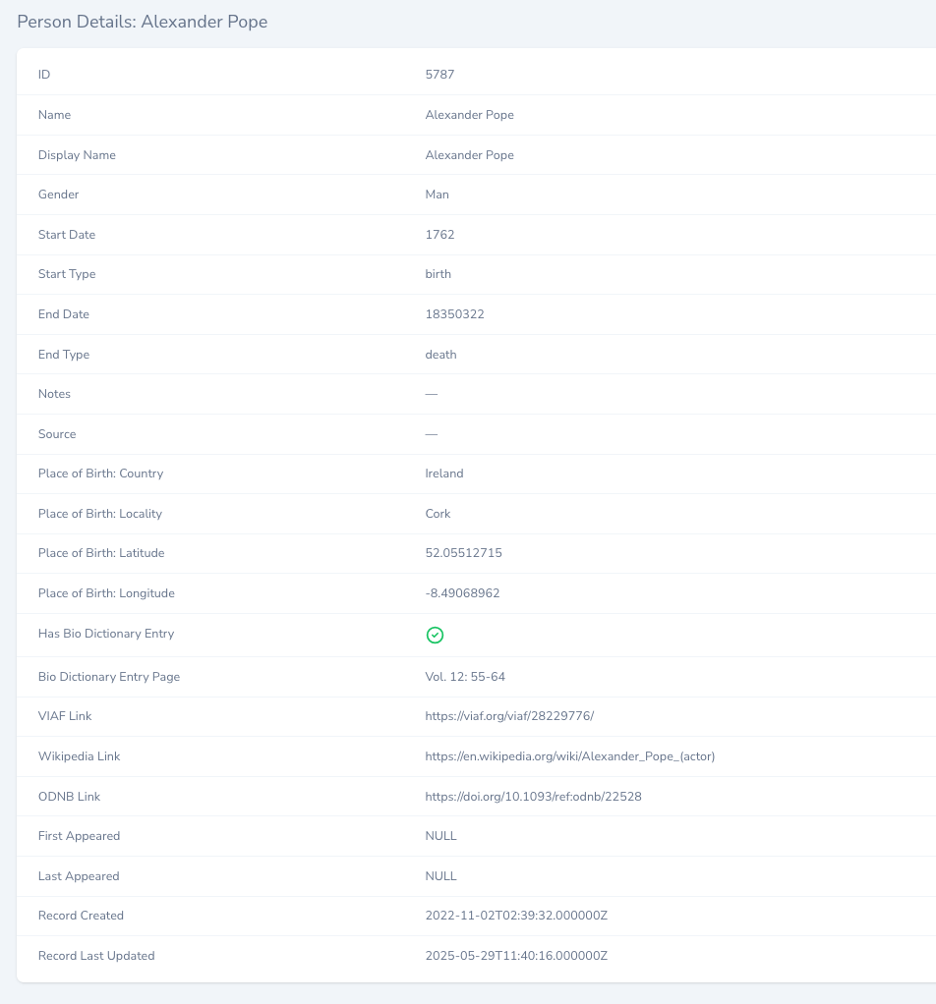
basic biographical data about them in set fields (Figure 1). These are name, gender,
start date, start type (birth, or, when unknown, baptism or flourish), end date, end
type (death, or, when unknown, flourish), and place of birth – country, place (village,
town, or city), longitude, and latitude. To collect this information, we have cross-referenced
a handful of established resources, including the
Biographical Dictionary, the
Oxford Dictionary of National Biography, and Wikipedia. We also look for Virtual International Authority Files (VIAF), records,
which offer a standardised way to bring together data about individuals that may be
dispersed across different types of resources including library catalogues, biographical
dictionaries, and museum holdings. Such centralised records are particularly vital
when it comes to feminist data as they
“do the urgent work of making the names and identities of people – especially women
– . . . discoverable” [
Leuner 2021, 17]. However, not all the subjects we have identified in Theatronomics are represented
by our sources or authority records, which are more likely to exist for well-known
figures, especially those who left behind textual or visual (and therefore catalogue-able)
traces, such as books and paintings, but far more sparser for singers, carpenters,
and constables who leave fewer traces in library and museum holdings. The fields we
collect help us identify who might be the recipient of a payment in an account book
– a Mr Smith who began to flourish in 1770 is unlikely to be the Mr Smith who received
a payment in 1743 – but also analyse careers by gender, age, and nationality.
Hence, names can only tell us so much; Theatronomics also looks at cast roles and
assigns activities, or job roles, to people in order to help us distinguish between
individuals with similar names. While about 90% of the records have been manually
assigned an activity, some 500 records currently have the activity ‘unknown’, and
many of these are likely duplicates of other records. For example, if the name ‘John
Graham’ appears in the account book for Drury Lane without any additional information
we cannot, with any certainty, determine whether this record is a new person or a
rare inclusion of a first name for one of the many Mr Grahams active around the same
time occupying roles such as actor, bricklayer, renter, and doorkeeper. Thus, John
Graham’s activity is “unknown”. Given the paucity of surviving information about eighteenth-century London bricklayers
and doorkeepers, it is unlikely that we will ever fully disambiguate the Grahams.
However, through the process of creating a digital prosopography for the eighteenth-century
theatre we have been surprised to find that even the narratives surrounding relatively
major performers with lengthy careers are often patchy and inconsistent.
The cluster of individuals with the surname ‘Pope’ offer insight into some of the
complexities involved in constructing a twenty-first-century prosopography that is
about historical subjects and relies on historical documents. The Theatronomics database
contains information about seven individuals with the surname Pope: Alexander Pope
(1688-1744), Alexander Pope (1762-1835), Master Pope (fl.1755-d.1767), Elizabeth Pope
née Younge (1740-1797), Maria Ann Pope née Campion (1777-1803), Jane Pope (1744-1818),
and William Pope (1708-1784). The first in this list was the famous poet, translator
and satirist, and the last a hairdresser and wig maker; the other five were actors
who performed at Covent Garden and Drury Lane theatres. Three of the five actors were
connected by marriage: Elizabeth and Maria Ann were both wives of the actor Alexander,
respectively from 1785-1797 and 1798-1803. While they were never referred to as ‘Mrs
Pope’ at the same time – Alexander was not a bigamist – their shared nomenclature
in playbills results in their data becoming intertwined in the London Stage Database,
creating the impression that they are a single person. Thankfully, Jane Pope never
married and was consistently billed as “Mrs Pope” throughout her career, meaning that her performances are always distinct from those
of Elizabeth and Maria Ann.
Disambiguating cast data to create unique profiles makes it possible to tease out
the individual careers of the two Mrs Popes. To do so, we first need to know enough
about the separate lives of the “Mrs Popes”. When, for example, ‘Mrs Pope’ appears as Joanna in a performance of Joanna of Montfaucon in 1800 we know this has to be Maria Ann as Elizabeth died in March 1797 and this
record can be reassigned with certainty; of the 929 cast roles initially associated
with “Mrs Pope” all those post March 1797 (some 374 records) can be assigned to Maria Ann. Such disambiguation
makes it possible to identify the shape and trajectory of an individual’s entire career,
before and after marriage(s): performance and cast data associated with Miss Younge
can be combined with the remaining 655 roles for “Mrs Pope” to illuminate Elizabeth’s career as a whole, rather than fragmenting it according
to her marital status. The received narratives that we have inherited about the Popes
from primary and tertiary sources are embedded in the process of building a digital
prosopography. Before we analyse the challenges inherent in working with the hierarchies
constructed by these sources, a brief summary of the careers of the three Popes connected
by marriage merits outlining here.
Elizabeth Younge debuted upon the London stage in 1768. Billed as
“Miss Younge,” sometimes
“Miss Young,” she was one of eight Miss Young(e)s to grace the London stage in the eighteenth century.
Elizabeth was originally employed by David Garrick at Drury Lane for the sum of £2
a week, but her talents proved to be commensurable with a higher salary and her wage
increased mid-season to £3.
[1]
Elizabeth soon established herself as one of the period’s leading tragediennes, with
her pay continuing to rise along with her fame; when Richard Brinsley Sheridan took
over Drury Lane’s management in 1776, she was earning £13 a week. Two years later,
failed salary negotiations with Sheridan saw her join the rival company at Covent
Garden – a move linked to the rise of Sarah Siddons, the period’s most famous actress,
as Elizabeth’s departure left a vacancy for the tragical at Drury Lane [
Ritchie 2023, 7]. While written articles detailing the terms of Elizabeth’s engagement at Covent
Garden do not survive, we can assume the theatre was amenable to her demands. The
account books for the 1779-80 season reveal salary payments to her of £20, a benefit
free from charges, and a clothing allowance.
[2]
Her new salary rate placed her foremost among the company’s actresses; she earned
£8 more each week than Covent Garden’s next highest-paid actress, Elizabeth Billington.
Elizabeth met Alexander in Cork in 1784 when playing in Ireland during the summer
months. Alexander was a painter by training and an amateur actor with no prior history
of playing upon big stages or within England. After Elizabeth used her influence and
recommended him to the management at Covent Garden in 1785, the year in which the
pair married, he became a regular name on the playbills. After making his debut appearance
billed simply as ‘A Young Gentleman’, Alexander went on to have a forty-two-year career.
When he was first employed at Covent Garden, he earned £8 a week – less than half
the amount paid to top earner, John Henderson, whose weekly salary stood at £17 7s,
but notably more than what Elizabeth earned when launching her career two decades
earlier. During his tenure, Alexander’s salary rose slowly and his wage held steady
at £10 a week for nine years. Allegedly, the fact that he earned £1 less than Joseph
Holman, who played similar roles, was a source of frustration and prompted his departure
from Covent Garden at the end of the 1788-89 season ([
Highfill, Burnim, and Langhans 1973-1987, 58]); Alexander stayed away for three years, returning in September 1792. He was
reengaged at the same rate, not seeing a raise until 1796 when, with a salary of £12,
Alexander finally became among the theatre’s top male earners. Alexander remained
loyal to Covent Garden until 1803, when he engaged at Drury Lane; unlike Elizabeth’s
move three decades earlier, this move was not primarily a financial decision, as he
continued at £12 until 1806. After Drury Lane burned to the ground in 1809, he played
in the provinces before returning to London in 1812 and appearing most seasons until
1827, after which he lived upon a pension from the Covent Garden Fund until his death.
Elizabeth, meanwhile, remained at Covent Garden throughout her husband’s absence and
performed consistently until January 1797 – six weeks before her death on 15 March.
Ten months later, Alexander remarried. His new wife, Maria Ann Campion, had joined
the Covent Garden company in October 1797 after a seven-year career elsewhere, initially
playing in theatres across Ireland – Dublin, Cork, Galway, Belfast – before sailing
to England and playing on the Yorkshire circuit in 1795, where she began to be billed
as Mrs Spencer. Maria Ann’s first contract in London came with remunerations of £3
a week, the same salary on which Elizabeth launched her career three decades earlier.
This saw her earn below the average salary for female actors in the 1790s, but she
soon began to ascend the ranks; her talents were commensurate with a higher wage,
and while salary increases were typically in the region of 10 shillings or £1, her
skill for performing pathetic roles secured her a substantial raise of £5 and she
earned £8 a week for the rest of her career. Yet that career was tragically short,
ending upon her death just six years later at the age of twenty-eight, causing her
comparably brief tenure to suggest a less successful career than Elizabeth or Alexander.
Tertiary Sources
The above information about the three Popes is readily available in the tertiary sources
drawn on by the Theatronomics project, and to which the project provides external
links. The Biographical Dictionary, Oxford Dictionary of National Biography (ODNB), and even Wikipedia amalgamate information from primary and secondary sources to
create prose narratives about historical figures. Tertiary sources like these represent
a wider range of individuals than secondary scholarship, which generally focuses on
celebrity performers while excluding lesser-known figures, both on- and backstage.
The summarising function of tertiary resources is particularly useful for constructing
our digital prosopography, where the primary goal is to find accurate dates, name
variants, and places of birth as efficiently as possible. However, as we shall see
with regard to the Popes, tertiary sources are nevertheless a product of their own
cultural moment and require use in conjunction with primary and secondary materials.
The limitations of using these sources for a digital prosopography are most in evidence
when dealing with the minor figures whose lives are less well-documented and well-known.
The
Biographical Dictionary focuses on the eighteenth-century stage between 1660 and 1800 and therefore is the
most consistently useful for our project, and the first one we consult. Over sixteen
volumes, it provides information about more than 8,500 individuals, many of whom had
not been identified prior to its publication in 1973. With entries varying in length
from a short paragraph to dozens of pages, it is an extensive undertaking and a testament
to the hierarchies of the stage, as well as the gendered and class-based assumptions
that pervade eighteenth-century life and twentieth-century scholarship. In particular,
star status plays an important role in determining how much attention the
Biographical Dictionary pays to an individual’s life; entries for major figures like David Garrick, Sarah
Siddons, and John Philip Kemble take up significantly more physical space than a celebrity
performer like Elizabeth Younge, who had a noteworthy and similarly long career, but
who did not have the same lasting impact on the history of performance.
[3]
These hierarchies are also evident in the representation of familial and marital relationships.
Within the
Biographical Dictionary, women’s careers tend to be subordinated to those of their husbands, in part through
patriarchal naming conventions: the heading for Elizabeth’s entry is
“Pope, Mrs. Alexander the first, Elizabeth, née Younge,” despite the fact that she had a prominent career as a tragedienne for roughly seventeen
years before her marriage. Maria Ann is similarly listed as ‘Pope, Mrs. Alexander
the second, Maria Ann née Campion, formerly Mrs. Spencer,’ a choice that privileges
her married name and not the names under which she launched her career – Campion and
Spencer. Looking for Elizabeth and Maria Ann under Younge, Campion, and Spencer will
direct the user to look under ‘Pope, Mrs Alexander’. The naming conventions, in which
women are listed under their husband’s first name as well as his surname, ensure that
Alexander is the first Pope listed, independently of other considerations, such as
whose given name comes first alphabetically or chronology. As a result, Jane Pope,
or
“Miss Pope” – the first acting Pope to be active – is listed below Maria Ann, even though her
given name is alphabetically first. These naming conventions physically situate Alexander
above his more talented wives, inflating his importance. In our project’s naming practices,
we have deliberately chosen not to replicate this hierarchy by using Elizabeth and
Maria Ann’s maiden names as their primary identifiers.
Despite its biases and limitations, the
Biographical Dictionary’s focus on the theatre does create space for more information about minor performers
and backstage employees, who would otherwise be difficult to locate. This is a welcome
addition for general collective biographies – namely those not specifically focused
on a given industry – focus on people of note. The
ODNB, for instance, describes itself as
“the national record of men and women who have shaped British history and culture,
worldwide, from the Romans to the 21st century” [
Oxford Dictionary of National Biography (ODNB)a]. To be included, one’s contribution must be exceptional. The significance of our
subjects to the eighteenth-century stage is reflected by the fact that Elizabeth,
Alexander, and Maria Ann each have their own
ODNB records, and all three also appeared in the original
Dictionary of National Biographyc(1855), although their
ODNB biographies are less detailed than those in the more specialised
Biographical Dictionary. The
ODNB also provides information about authors and composers, who do not appear in the
Biographical Dictionary unless they were also performers or musicians employed by the theatres.
Published in 2004, the
ODNB is not only more up to date than the
Biographical Dictionary, but more capacious; its present form is a series of 60 print volumes, as well as
an online database that currently contains over 60,000 narrative biographies. New
articles are routinely added and corrections made to existing records as new information
comes to light, something that is more difficult to accomplish in print. As a result,
although we use the
Biographical Dictionary first, we prioritize data found in the
ODNB if it conflicts with information found elsewhere. The
ODNB has its foundations in a late nineteenth-century printed collective biography edited
by Leslie Stephen until Sidney Lee took over in 1891, which
“was published in alphabetical sequence at quarterly intervals between 1885 and 1900”, after which point it was supplemented by additional volumes [
Oxford Dictionary of National Biography (ODNB)b]. The biographies themselves were rewritten for the current iteration of the
ODNB, but those individuals in the original
Dictionary, as well as those included in the supplements published during the twentieth century,
are still included. Consequently, foundational biases remain in terms of who is included.
The Advanced Search function for the
ODNB provides a filter by
“sex,”s which identifies that it contains 65,506 results for
“male” subjects and 9,888 results for
“female” subjects, a disparity that reflects how its nineteenth-century foundations result
in continued inequalities in the present day. At the same time, the
ODNB has made a considerable attempt to widen its focus, including through group biographies
([
Booth 2005, 999]), even if only prominent historical figures receive entries.
However, not everyone who shaped British culture through their contributions to the
eighteenth-century London theatre was British or spent enough time in Britain to be
included in the
ODNB.
[4] Theatronomics currently contains c.340 authors or composers who feature in neither
the
Biographical Dictionary nor the
ODNB, but who were, almost all born outside of Britain. As a perpetually updatable resource
not behind a paywall, Wikipedia fills this gap and enables future users of our database
to access narrative biographies easily and for free. Although Wikipedia articles do
not undergo the rigorous scholarly process of the
Biographical Dictionary or the
ODNB, they are more easily updated and information in each statement must be directly
linked to a citation. According to Wikipedia’s ‘About’ Page:
The content must conform with Wikipedia's policies, including being verifiable by
published sources. Editors’ opinions, beliefs, personal experiences, unreviewed research,
libellous material, and copyright violations will not remain. Wikipedia’s software
allows easy reversal of errors, and experienced editors watch and patrol bad edits.
The studied neutrality of Wikipedia’s policy contrasts with Booth’s description of
the ODNB as ‘a highly emotional affair’, in which the names of those included and
excluded provoke responses more akin to
“a family quarrel or a rivalry among nations or lovers” [
Booth 2005, 268]. Wikipedia is also very much a twenty-first century endeavour. Accordingly,
it is the only tertiary source consulted to list Elizabeth and Maria Ann by their
maiden, rather than their married, names, as the Theatronomics database does. In contrast
to the Biographical Dictionary and the ODNB, Alexander is decentralised; Elizabeth’s
entry only mentions him in the final paragraph, squarely putting the focus on her,
rather than her husband. In addition to Alexander’s limited importance in the Wikipedia
pages for his wives, his own Wikipedia page offers further indications that he was
the least significant of the three: two of four footnotes indicate that his article
“incorporates text from a publication now in the public domain,” in this case, both the original
Dictionary of National Biography and the 1911 edition of the
Encyclopaedia Britannica. Apparently modern Wikipedia editors do not find him sufficiently interesting to
write an entry for him from scratch.
As relatively high-profile performers, our three Popes appear in all three resources
to greater or lesser degrees and consequently have complete profiles within the Theatronomics
database. The amount of biographical detail provided in each resource offers insight
into their reputations both during their lifetimes and posthumously, but also has
the potential to inflate it. Alexander Pope’s Biographical Dictionary entry is 10 pages, the same length as Elizabeth’s, despite Elizabeth’s more illustrious
reputation, perhaps reflecting the sheer length of his career. Maria Ann’s much shorter
career is allotted five pages. In the ODNB, as in the Biographical Dictionary, Elizabeth and Alexander have biographies of similar length, while Maria Ann’s is
just over half the length; excluding the notes, Elizabeth and Alexander’s ODNB entries are both around 1,350 words, while Maria Ann’s is closer to 725 words. The
Wikipedia articles for all three are significantly shorter: Elizabeth’s is the longest,
at approximately 700 words, while Maria Ann’s is 280 words and Alexander’s only 192.
In some respects, the Popes’ presence in Wikipedia is the most representative of their
relative importance to the stage: Elizabeth’s lengthy and illustrious career nets
her a longer biography, Maria Ann’s briefer but still notable presence on the stage
is reflected in the shorter article, and Alexander’s less celebrated abilities result
in the briefest article of all, while the sheer length of his career is reflected
in the performances listed. However, our tertiary sources are only as reliable as
the sources on which they are based; their data structure hints at how eighteenth-century
theatrical hierarchies continue to shape the information available in academic sources,
such as the Biographical Dictionary and the ODNB, as well as public sources, such as Wikipedia. As we will discuss in the following
section, Maria Ann’s Wikipedia entry, for example, contains errors and elaborations
that have their roots in romanticised nineteenth-century biographies, demonstrating
how modern sources reiterate and reencode historical data, even when that data is
unreliable. By citing and linking to these records in its prosopography, Theatronomics
becomes yet another resource that gestures towards these narratives, even as it levels
the playing field by standardising the information collected.
Nineteenth-Century Biography
The entries for all three Popes in the Biographical Dictionary, the ODNB, and Wikipedia rely heavily on nineteenth-century sources. While the Popes have not
figured in twentieth- and twenty-first-century scholarship, they were prominent in
eighteenth- and early nineteenth-century writing about the stage, and continued to
be discussed throughout the nineteenth century. However, as the editors of the Biographical Dictionary emphasise, these narratives are not always reliable. Its preface acknowledges some
of the problems of establishing fact in theatrical biography, especially when relying
on a variety of sources:
Like all biographers and historians, we have placed greatest reliance on firsthand
factual evidence, particularly from any legal or quasi-legal locus . . . Nearly as credible are diaries, letters, and annotated playbills. Epitaphs
are fairly trustworthy and so is necrology published in periodicals soon after the
event (though occasionally we find actors indignantly correcting reports of their
deaths). Somewhat murkier are the memoirs. In employing these we have had to make
a careful analysis of motive and wide allowance for the vagaries of aging memory before
granting credence
(1973, 1.ix-x).
Despite this caution, the editors acknowledge that not all information needs to be
verifiable to be included:
It has sometimes been necessary to report a good but fictitious story of widespread
currency in order to impeach it. Separating an actor from his legends is, after all,
a delicate and painful operation not only because some excellent stories may be true
but because most are at least illustrative of traits of character and thus possess
some inner truthfulness (1973, 1.viii)
The contrast the editors set up between a true story and a story that
“possesses some inner truthfulness” provides grounds for retelling stories that cannot be verified. However, as Diana
Solomon points out,
“Anecdotes describing the lives of Restoration and eighteenth-century actresses are
more likely to be sexualized than those about actors; their uncritical usage accordingly
either reinscribes gendered behaviour or alludes to sexual at the expense of professional
activity” [
Solomon 2016, 22–23]. By turning to the historical sources where not only anecdotes but also
basic biographical data originated, this section analyses the circulation and replication
of nineteenth-century biography in order to draw attention to the long histories that
structure twenty-first-century data collection and preservation in digital humanities
projects and traditional scholarship alike.
Concerns about the accuracy of biographical accounts of people connected to the theatre
are not new. In an 1834 article in the New Monthly Magazine and Literary Journal, one anonymous critic proposed that thespian biographies were far from good or reliable
instances of biographical writing:
The memoranda, the diaries, and private letters of several actors and actresses of
great merit would almost contradict one part of this position; but, unhappily, where
we have been left in possession of these disjecta and disjuncta membra, they have fallen into the hands of book-makers, either of so little judgment that
they knew not how to distinguish what was keen, recherche, new and interesting, from what was common-place, trivial and vulgar; or who have
resolved to give a crude and undigested mass of the whole, in order to produce the
dual number of ponderous volumes #anon1834p. 471).
Biographical writing was designed to sell, and truth was a secondary concern. For
the most prolific theatrical biographer, James Boaden, the task of writing the lives
of performers is to show ‘gratitude to the actor’ while observing a duty to the public
to perpetuate their merits. This, he suggests,
“is not, however, a task for every hand nor for all periods’, but was one for people
such as him whose lives overlapped with their subjects” [
Boaden 1827, xii]. Boaden’s authority comes from his direct witnessing of his subject as well
as his capacity to amass secondary material in a proprietary manner. Thus, the information
in contemporary biographical works, as well as that contained within their sources,
require treating with scepticism, and with heightened critical acuity when accessed
from a distance of 200 years.
The movement between personal experience and secondary accounts sees a shift from
that which is directly witnessed, and often shared via oral transmission, into a fixed
printed medium that is primed for extended circulation. As a result, anecdotal snippets
that
“resist formal containment and display a magnetic tendency toward accretion, collection,
and performative recirculation” have permeated the factual record [
Ladd and Ritchie 2022, 2]. Such fragmented source material causes problems for documenting the lives of
women in particular, and as Hannah Hudson has shown, female biographies are often
“anecdotal, fictional, or merely so brief as to provide virtually no useful information” [
Hudson 2018, 280]. Over time, these limited narratives are encoded in the historical record through
repetition, a process that we see play out in our prosopographical research. Scrutinising
the most frequently referenced nineteenth-century sources in our core resources reveals
an ecology of contemporary accounts and later nineteenth-century collective biographies
that together structure scholarly knowledge of long eighteenth-century theatrical
persons. Our efforts to construct a digital prosopography are indebted to these efforts,
but also must engage with them sceptically.
The most frequently cited nineteenth-century source for information about the Popes
across our resources is one that the Biographical Dictionary describes in Maria Ann’s entry as ‘not always accurate in its details and with a tendency
to romanticize’: ‘The Manager’s Notebook’. Despite this assessment, the Biographical Dictionary entries for all three Popes draw extensively on this source, and it is cited in the
Wikipedia pages for both Elizabeth and Maria Ann, resulting in a total of five citations.
(None of the ODNB articles cite it, although they do draw on other nineteenth-century sources.) A column
that appeared in The New Monthly Magazine and Humourist, ‘The Manager’s Notebook’ provided short, intimate glimpses into the lives of well-known
performers. It debuted in the New Monthly Magazine in 1837, only a few years after the same magazine had questioned the reliability
of theatrical biography. Over fourteen instalments, the column profiled over thirty
actors and actresses, ranging from middle-ranking performers to the most well-known
celebrities of the eighteenth-century stage, most of whom were by then long dead.
According to the standards laid out in its preface, the authors of the Biographical Dictionary were right to treat ‘The Manager’s Notebook’ with caution. Nevertheless, even though
‘The Manager’s Notebook’ is just a single, somewhat belated article published in a
magazine, its reach is surprisingly wide. As a freely available source, digitised
on both HathiTrust and GoogleBooks, ‘The Manager’s Notebook’ is accessible to anyone
with an internet connection. As it is linked to directly from Elizabeth and Maria
Ann’s Wikipedia pages, it provides one of the most readily findable narratives about
all three Popes.
Located somewhere between a memoir and criticism, ‘The Manager’s Notebook’ was published
over thirty years after the deaths of Alexander’s first two wives but only two years
after Alexander’s own, and relies heavily on anecdotes to illustrate its articles.
For instance, it describes how Alexander and Elizabeth’s engagement was the result
of their carriage being ostensibly overtaken by highwaymen while on route to Dublin
for the summer season:
“Pope, the gallant, gay Lothario, drew his sword, which happened to be a stage one,
and made a thrust at the highwaymen through the window. The rattling of the glass,
and the other circumstances combined, caused Miss Younge to faint in Pope’s arms” [
Anon 1837, 100]. After reviving Elizabeth, Alexander reveals that
“the highwayman turned out to be the ostler, his pistol the stock-purse” [
Anon 1837, 100], and they spend the remainder of the carriage ride
“devoted to an interchange of affectionate declaration” [
Anon 1837, 100]. The humour of this anecdote positions Alexander and Elizabeth as the butt
of a joke, in which their heightened theatrical expectations of a journey by carriage
are at odds with the prosaic reality, although the result – a romantic relationship
– is the same. Here the bathos of the supposed robbery contributes to the comic element
of the union, the age gap between the two:
“on the 11th of August, 1785, they were married, the bride being forty-five, the bridegroom
twenty-three” [
Anon 1837, 100]. The conclusion to this anecdote exemplifies one of the article’s key strategies:
anecdotal detail structured around a straightforward, verifiable fact – in this case,
the date of the wedding.
This strategy of combining anecdote with fact is visible throughout the articles in
‘The Manager’s Notebook’ series. The Preface to the first instalment, which outlines
the life and career of Kitty Clive, also identifies the aim of the column and hints
at some of its sources:
We have been fortunate enough not only to receive some leaves from the manager’s book,
but the promise of many more. The devotion of the manager in question to the theatrical
profession, his acknowledged activity of research, and his unquestionable resources,
render the acquisition most valuable. We lay them before our readers as they reach
us, without regard to any historical or biographical order, certain that they will
afford our friends – at least those who have any theatrical feeling – abundance of
amusement and information [
Anon 1837, 320].
Without naming the manager, this passage assures us that his credentials are sterling:
he has both experience in theatre and access to resources that facilitate research
beyond his firsthand experience. At the very least, the column’s author seems to have
had access to theatrical documents, including letters and account books, as well as
portraits held by the Garrick Club – presumably the ‘unquestionable resources’ referred
to.
Almost all of the profiles contain some degree of financial information, although
how much and what kind varies; Nell Gwyn’s cites her will at length, while Tom King’s
provides the profit and loss totals from the 1782-3 Drury Lane Account book because
‘the theatrical reader may be amused’ to see them [
Anon 1838a, 524]. Although the article on Alexander Pope doesn’t quite reach this level of detail,
it does provide salary and benefit information for both him and Elizabeth Younge.
The numbers included in this article line up with what can be found in surviving account
books: Elizabeth was hired at £2 per week in 1768, which quickly increased to £3,
and by the end of the season had been raised to £5 per week. The article also informs
us that Alexander was hired by Covent Garden for the 1785-86 season, after a successful
debut in January 1785. Of his first performance, the article tells us:
He was very successful, but Holman was engaged for three years at £10, £11, and £12
a-week, therefore Harris told him he could not engage him for that season, but if
he wished to continue, he should have a benefit, which he would guarantee to produce
him £200, and an engagement for the next and the two following seasons at £8, £9,
and £10 a-week; this he at first refused, but, by the advice of his friends, afterwards
accepted
[
Anon 1838b, 100].
How much Pope earned for his debut performances and whether or not he did, in fact,
clear £200 on his benefit is ambiguous in the archival record; the account book for
the 1784-5 season does not survive. However, the account books for 1785-86 and 1786-87
record benefits for Alexander that brought in £255 and £207 respectively.
[5]
The only financial discrepancy in this article that we can identify arises in the
description of Holman’s contract, which, like Pope’s, was meant to increase by a pound
per week each year for three years. We do not have the financial data for the year
Holman was hired, but in the next season of his employment the account books record
his weekly salary as £11. However, in the 1786-7 season, his salary remained £11,
suggesting that either the terms of his employment were renegotiated, or that the
article’s claim that actors in general, or Holman specifically, were hired on three-year
contracts with annual pay raises is false. Despite this minor inconsistency, the inclusion
of financial data in ‘The Manager’s Notebook’ is useful for our prosopographical work:
it enables us to link people in the prosopography to lines in the account books more
easily.
While the article’s treatment of Elizabeth and Alexander uses financial facts as the
bones for an article that otherwise relies heavily on anecdote, money is barely mentioned
in connection with Maria Ann Campion. Given her shorter career, the article returns
to anecdote to make up its dearth of fact; it focuses on attributes such as her
“slender, but finely proportioned figure” and her
“retentive memory” ([
Anon 1838b, 103]), information that is less easily verifiable than her salary. Unlike the information
about Elizabeth, which takes up nearly six of the article’s twelve pages, Maria Ann’s
life and career occupies barely more than a page, some of which is inaccurate – it
notes the year of her birth as 1777 instead of 1775, an error replicated in her Wikipedia
article. Instead of rehearsing detailed anecdotes about her life, the article opts
for significant silences, such as the reasons behind her choice to adopt a stage name.
A few lines later, the article notes,
“By this marriage [to Maria Ann] Mr. Pope added to his income 200 l. a-year, which had been settled on Mrs. Spencer during her residence in Ireland’” ([
Anon 1838b, 102]), the only reference in the article to Maria Ann’s personal finances in the
article. The silence around why Maria Ann adopted a stage name and where her annuity
came from seems to hint at some kind of scandal, absent from both her contemporaries’
accounts of her life and modern-day resources like the
ODNB, suggesting that this is, perhaps, one of the exaggerations that the
Biographical Dictionary accuses the article of committing.
Although ‘The Manager’s Notebook’ provides unusually detailed information, both factual
and anecdotal, the overall structure of the narrative it offers about the Popes was
established at least thirty years previously. Contemporary accounts of performers
form a substantial number of the citations across all three of our tertiary resources,
and include newspaper advertisements and reviews, articles in periodicals such as
the
European Magazine, and early nineteenth-century dictionaries of notable performers. These dictionaries
are a precursor to the twentieth century
Biographical Dictionary, providing short biographies of performers, in which dominant narratives are established.
The first of these,
The Thespian Dictionary; or, Dramatic Biography of the Eighteenth Century was first published anonymously in 1802, with a second, corrected and updated edition,
appearing in 1805. The preface to both editions notes a curatorial strategy, stating,
“names (particularly of the inferior performers, now living) are PURPOSELY omitted, as unworthy of notice, especially
as nothing could with justice be said of them to interest the public, or to redound
their own advantage” [
Anon 1802];[
Anon 1805]. All three Popes meet the criteria for inclusion, meriting biographical sketches
that provide the familiar contours of all three lives. However, the respective length
of the biographies suggests that, in the first decade of the nineteenth century, Maria
Ann had the most substantial reputation. At about a page, her entry is about twice
the length as those for both Alexander and Elizabeth, in part because it contains
a detailed and sentimental description of the ‘violent hysterics’ she experienced
before her first appearance on stage in Dublin, a narrative replicated in the biographical
notices of her throughout the nineteenth century.
Across the editions, the entries for the Popes are essentially the same; the key difference
in the 1805 edition is the addition, ‘and died in 1803’ ([
Anon 1805]), to the final sentence of Maria Ann’s entry. Together, the two editions are cited
four times: Alexander’s
ODNB entry cites both editions, while Maria Ann’s
ODNB and Wikipedia page both cite the second edition, which was published only two years
after her death.
The narratives about the Popes in
The Thespian Dictionary act as a point of origin for biographies that circulated in subsequent years. Thomas
Gilliland’s
Dramatic Mirror (1808), is cited by four of the nine entries: the
ODNB articles on all three Popes, as well as Elizabeth’s
Biographical Dictionary entry. The first of its two volumes is a history of the British stage from Shakespeare’s
time, while the second volume consists of
“A Biographical and Critical Account of the principal Performers, at present belonging
to the London Theatres; including a Selection of those Players who distinguished themselves
in the last Century” [
Gilliland 1808, 625]. As in
The Thespian Dictionary, all three Popes are represented, and the text in their
Dramatic Mirror entries is virtually identical to the text in
The Thespian Dictionary, with some changes to punctuation, new information in Alexander’s entry about his
career up to 1808, and additional details about his skill as a portrait painter. However,
the sentimental description of Maria Ann’s first performance is replicated verbatim,
as is the remark about Elizabeth: She was, in the language of a gentleman who had
surveyed her journey through life,
“a good child, a good wife, a good friend, and a good woman” [
Anon 1802];[
Anon 1805];[
Gilliland 1808, 901]. The replication of nearly identical biographical sketches, down to the anecdotes
related, across sources like
The Thespian Dictionary and
The Dramatic Mirror is an extreme example of how anecdotes are encoded in theatrical history. As a result
of these acts of repetition, Elizabeth is encoded in theatrical history as a
“good woman”, a somewhat bland moral assessment that takes priority over her talents, while Maria
Ann, with her opening-night hysterics and sudden early death, cuts a more romantic
figure.
The romance of Maria Ann’s biography resulted in her life being further encoded in
later nineteenth-century collective biographies that did not include Elizabeth or
Alexander. Her ODNB entry cites three of them: Henry Gardiner Adams’ Cyclopedia of Female Biography (1857), E. Owens Blackburne’s Illustrious Irishwomen (1877), and Alfred Webb’s Compendium of Irish Biography (1878). Maria Ann’s Wikipedia page also cites the Compendium of Irish Biography. Her presence reflects some accidents of birth – her gender and her nationality –
but also indicates that, well after her death, Maria Ann’s life remained a compelling
story. Thus, despite her comparatively short career, she is readily findable in both
historical documents and more recent scholarly resources, but the information about
her life tends to be less reliable than that about Elizabeth or Alexander. Examining
those collective biographies in which Maria Ann appeared demonstrate both why her
life continued to fascinate the Victorians and when and how errors were introduced
into her biographical narrative.
The entries in Adams’
Cyclopedia and Webb’s
Compendium consist of a short paragraph each. The
Cyclopedia’s is the shortest at three sentences, describing her as,
“An actress, was the daughter of Mr. Campion, a respectable merchant of Waterford.
The family being left in reduced circumstances by Mr. Campion’s death, Maria went
on the stage, and soon, as a tragic actress, attained great eminence, especially by
her personation of Juliet. In 1798, she married Pope, the actor” [
Adams 1857, 628]1. Two of the three sentences relate to male relatives – her father and her
husband – and the entry does not even provide basic biographical details about her
birth and death. Although only a few lines longer, the entry in
The Compendium of Irish Biography packs in a much more detailed narrative. In a short paragraph, it provides birth
and death dates, the frequently cited anecdote about her opening-night hysterics,
and a contemporary assessment of her face and character:
Campion, Maria, (Mrs Pope) an actress, was born in Waterford in 1777. She early evinced
a partiality for the stage, and made her first appearance in Dublin, as ‘Monimia,’
in The Orphan, 17th February 1790, when it is related that she swooned both in the green room and
on the stage. She first appeared in London, in the same character, at Covent-Garden
Theatre, on 13th October 1797, and shortly afterwards (24th January 1798), married
Alexander Pope, the distinguished actor. She is stated to have been the authoress
of two novels. Charles Mathews, who saw her perform in Dublin, where she was for some
time the heroine of the stage, wrote: “There are few such actresses to be met with. She possesses a very beautiful face,
extremely elegant figure, and delightful voice, added to every advantage of nature
in mental qualifications, and every accomplishment of education.” She died of apoplexy, in London, 18th July 1803, aged 26, and was buried in Westminster
Abbey
#mathews1877.
In this case, the greater detail provided does not necessarily result in a more reliable
narrative. Maria Ann was in fact born in 1775, making her 28 at her death, an error
that also occurs in ‘The Manager’s Notebook’ and is further replicated in her Wikipedia
entry, which cites both sources. The speculation that she was ‘the authoress of two
novels’ is also repeated in her Wikipedia article, even though no evidence for this
appears in other accounts of her life. Despite these inaccuracies, it does offer insight
into those elements of her life that Victorian readers might have found compelling,
figuring her as ‘the heroine of the stage’ through references to her beauty, delicacy,
and tragic early death.
E. Owens Blackburne’s
Illustrious Irishwomen (1877), provides a much longer biography for Maria Ann; this two-volume publication
of female worthies profiles women from Saint Brigit to the Ladies of Llangollen. In
selecting his subjects, Blackburne uses a capacious definition of who counts as Irish,
giving page space to figures such as the Bristol-born actress and poet Mary Robinson
and the poet Felicia Hemans, who married an Irish army officer but spent her life
in England and Wales. At six and a half pages, Maria Ann’s biography is the shortest
of any of the modern subjects – although by far the longest narrative of her life
published in the nineteenth century. Despite the extra space, it rehearses the same
narrative found in other sources, using the additional space to flesh out the narrative
of Maria Ann’s life with novelistic detail. Readers learn that
“an odd volume of Shakespeare was her constant companion and delight” ([
Blackburne 1877, 355]), and that she entreated the stage-manager of the Dublin theatre where she
first performed to hire her with
“intense, untutored pathos” [
Blackburne 1877, 356]. As in ‘The Manager’s Notebook’, the entry in
Illustrious Irishwomen embellishes some of the scenes it describes, but it does so without the evidence
of archival research found in the former. Overall, Blackburne provides little more
than
The Compendium of Irish Biography in the way of concrete facts about Maria Ann’s life, relying instead on the anecdotes
established earlier in the century as the basis for embellished scenes.
These later nineteenth century narratives indicate that public interest in Maria Ann’s
life continued well into the Victorian period. However, they provide no reliable information
about her that is not available in earlier sources, making their presence in the bibliography
of her
ODNB entry perplexing. Indeed, they replicate the standard narratives about Maria Ann’s
life that was established in the early nineteenth century theatrical dictionaries.
While these narratives vary in length and detail, their structure and content remain
remarkably similar; this repetition of her hysterical debut, her physical and mental
virtues, her marriage to Alexander, and her early death in narratives published throughout
the nineteenth century is an extreme example of the
“magnetic tendency toward accretion, collection, and performative recirculation” that Heather Ladd and Leslie Ritchie describe [
Ladd and Ritchie 2022, 2]. In their repetition – and occasional embellishment – of the same incidents,
nineteenth-century narratives about the Popes demonstrate how anecdotes and errors
become encoded in the historical record. In building a digital prosopography for the
eighteenth-century stage, we must remain alert to how our resources reproduce and
cite the narratives contained in nineteenth-century biography, especially how verifiable
facts such as birth dates and salaries legitimize anecdotes, as well as how errors
are introduced and replicated. Likewise, analysing nineteenth century biography demonstrates
how the hierarchies that inflect our data collection were produced and reproduced
in two centuries of collective biographies. We can find basic biographical data about
Maria Ann Campion, an actor with a relatively short career, because both her performances
and her personal life were deemed notable; the same cannot always be said for other
performers with lengthy and relatively high-profile careers.
The Financial Record
In contrast to the anecdotal and romanticised narratives of nineteenth-century biographies,
the surviving eighteenth-century account books for Covent Garden and Drury Lane provide
hard evidence of an individual’s career; devoid of narrative explication and personal
reflections, the account books are a less subjective source of information though
they reflect the idiosyncrasies of each theatre’s bookkeeping practices. For the period
in which the Popes were active, all but one of the season’s account books survive,
providing a rich tranche of information about their earnings and so their literal
value to the theatre.
[6]
With no cast lists in the account books to embellish the figures and add more personal
details to the lists of performances and revenues, there are three main kinds of information
about an individual within their pages that are useful for our prosopographical work:
salary payments; records of benefit nights; and expense payments to named individuals
for items such as clothes. Together, these payments evidence the shape of a career
and enable us to reevaluate existing narratives about performers as inherited from
nineteenth-century narratives.
First, salaries. Of our nineteenth-century biographies discussed above, only ‘The
Manager’s Notebook’ makes use of this information. In the article about the Popes
and throughout the column more generally, factual information such as performers’
salaries is combined with the less easily evaluated narratives about romantic carriage
rides and audience reactions, legitimising the anecdotes through the interweaving
of cold hard financial facts. The inclusion of numbers in printed anecdotes also has
a further use. Wanko notes,
“Without citing sums, readers (especially those outside of London) may not as easily
discern the social worth of the player, but as soon as a sum is noted, readers can
place the person, comparing him or her to their own positions and inciting inquiry
into self-worth” [
Wanko 2003, 169]. The inclusion of reliable financial information seems surprising for a form
often linked to gossip and rumour. However, in an age in which only 6% of families
had an income of over £100 per annum ([
Hume 2014, 377]), it follows that the public were curious about the wages of top performers.
There was a fascination with the theatre and its mythos as a place in which one could
make it rich quick. Elizabeth would have earned £100 in just five weeks, and even
Maria Ann’s final salary of £8 per week gave her an annual income of over £400.
By linking individuals in our prosopography to the salary data from the account books,
we can begin to determine the standing of Alexander, Elizabeth, and Maria Ann within
the company. For example, working with the salary list above reveals that a female
actor at Covent Garden earned, on average, £3 18s a week in 1793-94; at £18/week Elizabeth
is not only valued much higher than her peers, but is the only woman paid on par with
top male performers. Following Elizabeth’s death in 1797, Margaret Martyr, who earned
£10 a week, became Covent Garden’s highest paid actress. This is the same level of
remuneration that Alexander was receiving, but while her salary placed Martyr foremost
among Covent Garden’s actresses Alexander tied joint fifth among the male actors,
alongside Munden and Johnstone.
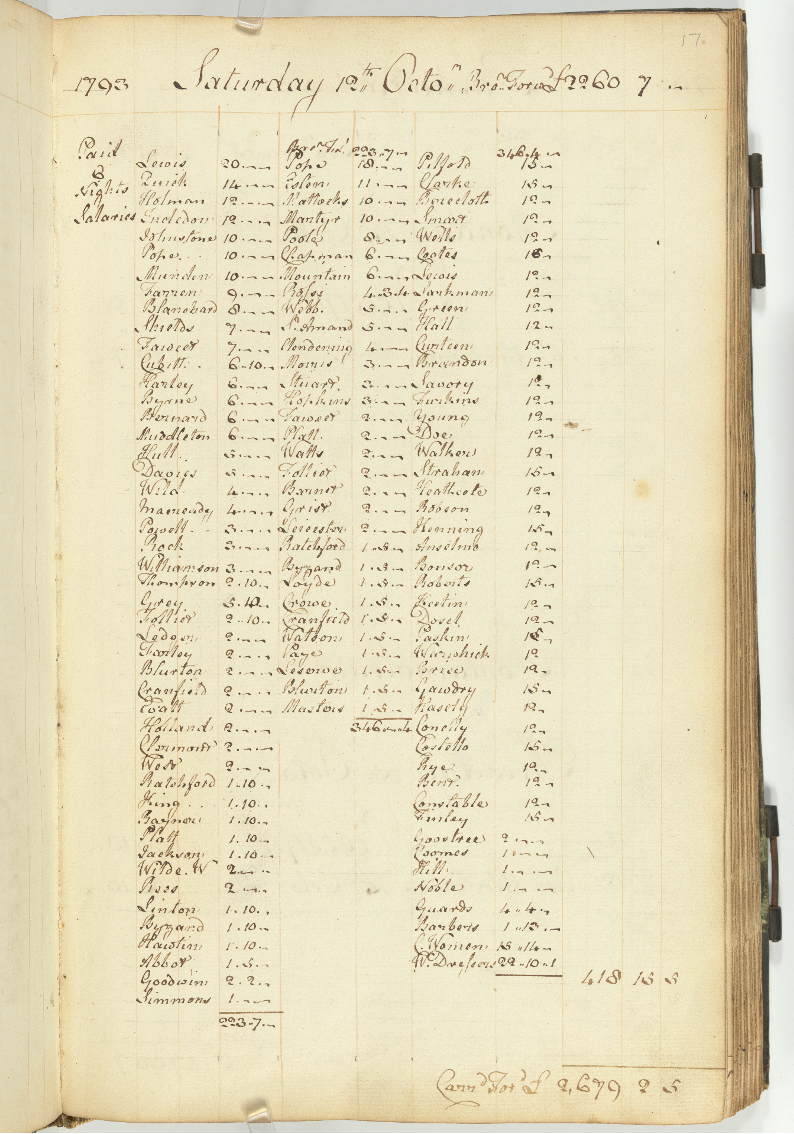
This knowledge helps us disambiguate payments made to ‘Pope’ where there is no indication
of gender in the account book (see Figure 2). By knowing the pay typically associated
with male and female performers, and with a reliable prosopography, we can disambiguate
these payments and assign records to ‘Mr Pope’, Alexander, and ‘Mrs Pope’, Elizabeth
or Maria Ann, based on dates and the size of the sum involved. The account books are
hierarchical, with male actors listed in the first column, actresses in the second,
and the third documenting a mixture of dancers and back of house staff. With payments
usually arranged highest to lowest, the pay lists entrench hierarchies that are driven
by gender and role-type. For instance, Strahan’s slightly higher wage in the right-hand
column (15s versus Walkers’ 12s in the line above) denotes a transition into a list
of doorkeepers, while Goostree, the machinist, marks a jump to £2 and a list of skilled
back of house workers; collective departmental salaries (Guards, Barbers, Dressers)
are placed at the bottom of the hierarchy. Such knowledge of the salary hierarchies
enable us to begin to unpack and allocate group payments, such as the sixty-two payments
made to ‘Mr & Mrs Pope’. Based on what we know of relative earnings, we can impute
that this was not a 50:50 split. These joint salary payments begin in 1800, and are
almost all from 1802 and 1803, indicating that Covent Garden treated the Popes as
a singular entity towards the end of Maria Ann’s life; Elizabeth and Alexander were
always kept separate in the account books, both in the salary lists and for benefit
nights.
A benefit, as noted previously, was a sign of status and the earlier it was held in
the season, and the fewer people it was shared with, the higher the status. Beneficiaries
typically chose the plays for their allocated night and were responsible for selling
advance tickets. The top performers had free benefits, others paid a charge but still
had a night to themselves; middle-ranked performers might share a night with up to
three others; utility performers and back of house staff, by contrast, could share
with up to twenty others and only received money based on their personal ticket sales
– without getting a cut sales on the door (however, they did not have to cover a charge
so the lower reward was softened by the lack of risk). Elizabeth had a benefit in
her own right every year from 1769 until her death, indicating her standing at Drury
Lane and subsequently at Covent Garden. By the 1790s, she was selling around £400
of tickets each year, selling £495 for her final benefit. Alexander’s benefits typically
saw him sell around £300 of tickets, with a notable exception for his benefit in 1797
when he sold £455.
While this event brought him £180 more than the previous year, this increase should
be contextualised with what we know about Elizabeth: was Alexander very successful
that year, or did the public want to support the man whose wife, a star actress, had
passed away two months earlier? The status associated with benefit nights raises its
head more starkly in relation to Maria Ann. While Elizabeth enjoyed a benefit night
from the outset of her career, Maria Ann’s first night was in 1799 – her second season
at the theatre, following her substantial pay rise. Earning £3 a week in 1797, she
did not have sufficient standing in the company to have her own night. Neither did
she have a strong claim to a night in her own right, with the account books logging
benefits for ‘Mr and Mrs Pope’ in 1802 and 1803 – a step up for Maria Ann, but a step
down the ranks for Alexander whose household income would diminish as a result of
having to share for the first time.
The third type of data found in the account books is the expenses. These can be more
complex but, like benefit nights, can indicate a person’s standing within the company.
As we saw earlier, a desire for a clothing allowance was one of the factors underpinning
Elizabeth’s move from Drury Lane to Covent Garden; while it was common for actresses
to supply their own costumes, only top performers were reimbursed for such expenses.
To date, the Theatronomics database has captured almost 156,000 expense items, excluding
individual salaries, for the period 1766-1809. Of these, 484 items relate, in a somewhat
obtuse fashion, to an individual called
“Pope”; with a reliable prosopography, we can begin to associate these items with a specific
individual and determine whether an expense item is associated with
“Mr”,
“Mrs”, or even
“Miss”.
[7]
Though doing so, we can also further interrogate the accuracy and reliability of the
financial information contained in our printed biographies. The account books illuminate
that Elizabeth did negotiate a new position and terms of employment in 1779-80 [
Anon 1779]; the accounts that season detail her clothing allowance of £200 – some £50 more
than she had been reimbursed for clothes at Drury Lane in 1777-78, where she had been
paid item by item as opposed to being assigned a ready budget [
Anon 1777]. Complicating the narrative, however, we see that her clothing allowance was in
flux and infer that this level of allowance was not a fixed term of her employment,
but more likely a sum designed to enable her to initially set up her wardrobe at the
new theatre and maintain it in subsequent seasons. Payments to Elizabeth for clothes
are highest in 1785-86, standing at £250, but could be as low as £100, as was the
case in 1788-89.
The account books provide bare-bones facts about the careers of our Popes, but they
are not without their challenges; accounting practices vary as managerial regimes
and bookkeepers change, reflecting personal and institutional views on how best to
record information. Despite the challenges of inconsistency and comparability this
creates, these three types of financial data from the account books serve primarily
to detail the cash flows of a business on any given day. However, these payments take
on meaning in light of the narratives circulating about the eighteenth-century stage;
they are more readily assigned to a specific person when robust accounts of their
career exist elsewhere. Yet while the account books need the biographical narratives,
the narratives only become truly reliable when the accounts enable us to interrogate
key “facts”. Account books highlight the truths and deceptions contained within anecdotes and
biographies. The money does not lie or exaggerate to win over the sympathies of a
reader; it offers a straightforwardly fact-based position from which to contextualise
a career, which through the additional information of biography and anecdote collates
and rearranges into a new hierarchy within the structures of Theatronomics’ digital
prosopography.
Recommendations
While Theatronomics’ digital prosopography is a distillation of the core facts of
an individual’s life – birth date, death date, nationality – devoid from the colour
of narrative biography, the hierarchies embedded in historic records still shape the
ways in which details of an individual's life have been recorded for posterity, if
they are recorded at all. Our exploration of the resources that contribute to our
project’s prosopography in this article has deliberately focused on performers with
easily traceable careers in order to interrogate the primary and tertiary sources
upon which the Theatronomics database is founded. The process is far more fraught,
for example, with regard to the eight performers appearing under the name “Miss Young(e)” between 1733 and 1768. With sources such as the Biographical Dictionary noting that it is impossible to differentiate between them in the playbills, a reliable
prosopography becomes the best means through which we can begin to unpick their careers,
using marriage dates, dates of first and last appearances and known activities to
disambiguate at least some of their information.
For a project such as Theatronomics, this disambiguation work has several scholarly
implications. For theatre historians, a prosopography that contains not only prominent
actors, but singers, dancers, and back of house staff creates a more holistic picture
of theatrical operations by outlining the careers of those who were integral to the
business of theatre but who were not lauded in the newspapers or promoted on playbills.
This allows us to begin to map careers more fully, building the framework from which
it could be possible to trace the lineage of a role from one actor to the next, offering
new insights into evolutions in production history while also revealing the extended
influences that feed into audience’ expectations over time. As such, a reliable prosopography
creates the foundation from which new avenues of research can be identified and enables
the single digital project to expand into new areas, with data becoming accessible
to those beyond the primary discipline(s) at which a project is targeted. For instance,
the Theatronomics data can be used by cultural economists or by economic historians
to better situate the operational practices of our two theatres within the eighteenth-century
London economy, and by scholars of music and dance to better understand performance
and reception histories. Looking further to interdisciplinarity and interoperability,
the geodata (a detailed discussion of which has lain outside the scope of this article)
highlights the international dimension of London’s theatre, opening up a continental
perspective and providing information that is likely of interest to those working
on European theatre and engaged in projects such as the Comédie-Française (2020).
Such aims, to some degree, represent the ideal for Theatronomics’ prosopographical
data. But they are not impossible or even improbable goals for digital scholarship
to work towards; from our experiences developing a prosopography for the eighteenth-century
theatre and undertaking initial disambiguation work, we have a few learnings that
might help realise these goals and enable a more joined-up, interdisciplinary approach
to prosopography going forward. As we have seen, a significant challenge is keeping
the careers of known individuals straight, especially when people change their names.
To combat this, the Theatronomics database contains several Name Variants, documenting
not just the different names a performer held during our time period, but also logging
known spelling variations in the way their name appeared on playbills and in newspaper
advertising. Thus, for example, a user can find Maria Ann within the Theatronomics
data by searching for Campion, Spencer, or Pope and be directed to a single profile
that contains all of her information, including links to the sources discussed above
as well as a link to her VIAF. This is a notable advance for, while all three iterations
of Maria Ann’s name are referenced in all of her biographical records, the VIAF only
captures one iteration: Pope. This means that if someone were to search for a VIAF
for ‘Maria Ann Campion’, no results would come up. As Leuner points out, VIAFs are
particularly important for women, whose names often change after marriage, and the
absence of Maria Ann’s maiden name and her adopted stage name in her VIAF record render
her, and her career, less findable. The creation of digital records that contain reliable
information, gathered through interrogating the printed sources on which their foundational
data is based, is essential to building a meaningful prosopography and this requires
not just consistent and reliable data capture within individual project teams but
more globally to create linked resources.
Digital prosopography, then, is an ongoing endeavour and, we suggest, an interdisciplinary
one. Developing linked open data enables projects to be put in conversation with one
another - something that Theatronomics begins to do through its use of VIAFs, The
VIAF model hints at a way to centrally deposit known information about an individual
though, as discussed, its focus on print sources and archival holdings presents media-based
challenges for working with historic data in particular. A prosopographical model
that speaks to D’Ignazio and Klein’s calls to situate data in the contexts of its
collection and make hierarchies of data visible, as this article has sought to do,
is vital to challenging the biases, conscious or otherwise, that historic practices
embed into the twenty-first century digital resource. Such an approach, however, requires
an agreed set of principles for prosopographical data collection, recognised standards
for data entry, and an agreed set of go-to sources. Our choice to work with the Oxford Dictionary of National Biography, for example, embeds the Anglocentric qualities of a project centred on London theatre
and creates less complete records for non-British nationals. To extend the reach of
our prosopography, different national equivalents, such as the Dictionary of Irish Biography (2009) or the 100 volume Dizionario Biografico degli Italiani (1960-2020), ought to be consulted; the latter, for example, would be essential
for future work on the composers in the Theatronomics dataset for whom Italian Wikipedia
sites, for the reasons outlined above, have been a key linked source.
An ongoing prosopographical endeavour across disciplines and geographic regions would
provide new avenues for research, suggesting new individuals for study either in their
own right or in conjunction with a wider network, and so, by extension, creating a
fuller picture of who prominent individuals were. The need for this is evident by
our attempts to seek out secondary sources on our Popes. Prosopographical work makes
it possible to reappraise dominant narratives about the London stage and to place
the labour of individuals – both prominent and minor performers – back into the context
in which they originally operated. Alexander Pope, for instance, is difficult to trace
in eighteenth century scholarship due to the dominance of Alexander Pope (1688-1744).
The Augustan poet, translator, and satirist looms large in all searches for
“Pope” and is also present in the Theatronomics database on account of the play
Three Hours After Marriage (1717) on which he collaborated with John Arbuthnot and John Gay. Elizabeth Younge,
meanwhile, is notable largely by her absence from secondary sources; her early career
is difficult to disentangle from the five other
“Miss Young[e]s” working on the London stage, and despite her talents as an actress, the lack of scandal
in her personal life compared to figures such as Dorothea Jordan, or even Mary Robinson,
results in her roles being swept up into larger narratives about the history of Shakespearean
production or in relation to the reception of specific plays within the repertoire,
such as with David Worrall’s exploration of
Margaret of Anjou [
Worrall 2013, 183–88].
In conclusion, then, medium matters for prosopographical research. In dealing with
historical prosopography we are, as this article has shown, largely reliant on anecdotes,
many of which, in the case of the Popes, originate not during their lifetimes in the
eighteenth century, but are fictions of the nineteenth. As we are entirely dependent
on extant archival materials to determine hard facts, the modern digital prosopography
has to contend with this subsequent rewriting and narrativizing of lives when striving
to reinscribe data that is subject to previous centuries’ prevailing biases (scholarly
or otherwise) for data collection. The ‘best fit’ approach requires a compromise between
modern priorities, such as principles for data feminism, and the information encoded
in historical documents. This is both a curse and a blessing; while it frustrates
a straightforward translation of received narratives into a digital prosopography,
it opens up opportunities to return to the archives and engage with a range of historical
data that, as yet, remains to be fully explored and inscribed in ways that are meaningful
for modern scholarship. It also encourages us as to the validity of exploiting the
project’s core financial data to refine and correct the highly subjective earlier
prose sources. For projects working on twentieth and twenty-first century materials,
it is possible to develop new methodologies from the outset and work according to
present-day priorities. Such resources offer a model for historic projects to aspire
to, but one that is not always the best fit given the condition of extant data.
As postdoctoral researchers inheriting a long line of scholarly work on eighteenth-century
London theatre – the extraordinary collective scholarship of The London Stage, 1660-1800, London Stage Information Bank, and London Stage Database – we have been forced to
grapple with the long-standing hierarchies of data that we have been describing and
their well-known shortcomings. The biases of eighteenth-century advertisements and
account books have long since moved into modern print collections and digital resources,
with each reimagining of the data containing within it the legacies of the foundational
work that came before. Digital prosopography, we hope, is the latest intervention
in this history of data production and reproduction and one that hopefully serves
to remediate archival materials to make them more readily usable for modern scholars.
The biographical data collected and presented as the prosopographical element of the
Theatronomics database is only one piece of the puzzle. Twenty-first century digital
scholarship and opportunities to link projects, particularly those relational databases
that readily facilitate interoperability through shared principles for data collection,
represent an opportunity to reinvent prosopographical work, pooling resources and
collaboratively sharing best practice to debunk received narratives and begin the
process of reinscribing data that is not easily accessible and usable, and so doing
the vital work of recovering those who have previously been confined to the margins
of scholarship and relegated to dusty corners of the archive.
Works Cited
Adams 1857 Adams, H.G. (1857) Cyclopedia of female biography. London: J. Frances.
Anon 1776-1816 Anon (1776-1816) “Journals (receipts and payments)” in Records of Drury Lane and Covent Garden Theatres. D78368. Folger Shakespeare Library.
Anon 1777 Anon (1777) Journals (receipts and payments), 1777-1778 in Records of Drury Lane
and Covent Garden Theatres. Folg. W.b. 280. Folger Shakespeare Library.
Anon 1779 Anon (1779) “July, 1779-July, 1780” English Stage after the Restoration. BL Eg. 2281. British Library.
Anon 1802 Anon (1802) The thespian dictionary; or, Dramatic biography of the eighteenth century. 2nd edn. London: James Cundee for T. Hurst.
Anon 1805 Anon (1805) The thespian dictionary; or, Dramatic biography of the eighteenth century. 2nd edn. London: James Cundee for T. Hurst.
Anon 1837 Anon (1837) “The manager’s notebook, no. I”, The New Monthly Magazine and Humourist, 51, pp. 320–333.
Anon 1838a Anon (1838) “The manager’s notebook, no. VI”, The New Monthly Magazine and Humourist, 52, pp. 523–541.
Anon 1838b Anon (1838) “The manager’s notebook, No. XI”, The New Monthly Magazine and Humourist, 54, pp. 87–107.
Avery et al. 1960–1968 E.L. Avery, C.B. Hogan, W. Van Lennep, A.H. Scouten, and G.W. Stone (eds.) (1960–1968)
The London stage, 1660-1800: A calendar of plays, entertainments and afterpieces,
together with casts, box-receipts and contemporary comment. Compiled from the playbills,
newspapers and theatrical diaries of the period. Southern Illinois University Press, Carbondale (1960-68). Available at
https://catalog.hathitrust.org/Record/000200105.
Blackburne 1877 Blackburne, E.O. (1877) Illustrious Irishwomen. London: Tinsley Bros.
Boaden 1827 Boaden, J. (1827) Memoirs of Mrs Siddons. 2 vols. London: Henry Colburn.
Booth 2005 Booth, A. (2005) “Fighting for lives in the ODNB, or taking prosopography personally”, Journal of Victorian Culture, 10.2, pp. 267-79.
Bradley and Short 2005 Bradley, J. and Short, H. (2005) “Texts into databases: The evolving field of new-style prosopography”, Literary and Linguistic Computing 20(1), pp. 3–24.
Campbell 1834 Campbell, T. (1834) “The late Mrs Siddons”, in S.C. Hall (ed.) The New Monthly Magazine and Literary Journal, 41.164. London: E.W. Allen, pp. 471-474.
D'Ignazio and Klein 2020 D’Ignazio, C. and Klein, L.F. (2020) Data feminism. Cambridge, MA: MIT Press.
Fukushima, Bourrier, and Parker 2022 Fukushima, K., Bourrier, K. and Parker, J. (2022)
“The lives of mistresses and maids: Editing victorian correspondence with genealogy,
prosopography, and the tei”,
Digital Humanities Quarterly, 16.1. Available at:
https://digitalhumanities.org/dhq/vol/16/1/000595/000595.html. Accessed 09 October 2024.
Gilliland 1808 Gilliland, T. (1808) Dramatic mirror. London: B. Macmillan for C. Chappel.
Gilliland 2004 Gilliland, J. (2004)
“Pope [née Campion, Maria Ann [performing name Mrs Spencer]”,
Oxford dictionary of national biography. Available at:
https://doi.org/10.1093/ref:odnb/22532. Accessed 09 October 2024.
Highfill, Burnim, and Langhans 1973-1987 Highfill, Jr, P.H., Burnim, K.A., and Langhans, E.A. (1973-1987) A biographical dictionary of actors, actresses, musicians, dancers, managers & other
stage personnel in London, 1660-1800. 16 vols. Carbondale, Southern Illinois University Press.
Hudson 2018 Hudson, H.D. (2018) ““This lady is descended from a good family”: Women and biography in British magazines,
1770–1798”, in Jennie Batchelor and Maushag N. Powell (ed.) Women’s periodicals and print culture in Britain, 1690-1820s: The long eighteenth
century. Edinburgh: Edinburgh University Press, pp. 278-312.
Hume 2014 Hume, R.D. (2014) “The value of money in eighteenth-century England: Incomes, prices, buying power —
and some problems in cultural economics”, Huntington Library Quarterly, 77(4), pp. 373-416.
Keats-Rohan 2007 Keats-Rohan, K.S.B. “Biography, identity, and names: Understanding the pursuit of the individual in prosopography”, in K.S.B. Keats-Rohan (ed.) Prosopography approaches and applications: A handbook. Oxford: Prosopographica et Genealogica, pp. 139–182.
Knight and Banerji 2004 Knight, Joseph and Banerji, N. (2004)
“Pope, Alexander”,
Oxford dictionary of national biography. Available at:
https://doi.org/10.1093/ref:odnb/22528. Accessed 09 October 2024.
Ladd and Ritchie 2022 Ladd, H. and Ritchie, L. (2022) “Introduction: Miniature stages of selebrity: English theatrical anecdotes, 1600–1800”, in Heather Ladd and Leslie Ritchie (ed.) English theatrical anecdotes. Newark, DE: University of Delaware Press, pp. 1-22.
Leuner 2021 Leuner, K. (2021)
“Restoring authority for women writers: Name authority records as digital recovery
scholarship”,
Huntington Library Quarterly, 84.1, pp. 13-26. Available at:
https://doi.org/10.1353/hlq.2021.0002. Accessed 09 October 2024.
Mole 2007 Mole, T. (2007) Byron’s romantic celebrity: Industrial culture and the hermeneutic of intimacy. Basingstoke, UK: Palgrave Macmillan.
Oxford Dictionary of National Biography (ODNB)a Oxford Dictionary of National Biography (ODNB)
“About”,
Oxford dictionary of national biography. Available at:
https://www.oxforddnb.com/about. Accessed 09 October 2024.
Ritchie 2023 Ritchie, F. (2023) Shakespeare in the theatre: Sarah Siddons and John Philip Kemble. London: Bloomsbury.
Solomon 2016 Solomon, D. (2016) “Anecdotes and restoration actresses: The case of Elizabeth Barry and Anne Bracegirdle”, Restoration and 18th Century Theatre Research, 31.2, pp. 19-36.
Stone 1971 Stone, L. (1971). “Prosopography”, Daedalus, 100.1, pp. 46-79.
Taylor 2003 Taylor, D. (2003) The archive and the repertoire: Performing cultural memory in the Americas. Durham: Duke University Press.
Troubridge 1967 Troubridge, St.V. (1967) The benefit system in the British theatre. London: The Society for Theatre Research.
Verboven, Carlier, and Dumolyn 2007 Verboven, K., Carlier, M., and Dumolyn, J. (2007) “A short manual to the art of prosopography”, in K.S.B. Keats-Rohan (ed.) Prosopography approaches and applications: A handbook. Oxford: Prosopographica et Genealogica, pp. 35–69.
Wanko 2003 Wanko, C. (2003) Roles of authority: Thespian biography and celebrity in eighteenth-century Britain. Lubbock: Texas Tech University Press.
Webb 1878 Webb, A. (1878) Compendium of Irish biography. Dublin: M.H. Gill and son.
Worrall 2013 Worrall, D. (2013) Celebrity, performance, reception: British georgian theatre as social assemblage. Cambridge: Cambridge University Press.