Abstract
Scaling-up, speeding-up, and powering-up of technology are all coterminous to the
hegemonic cycle of infrastructural development. These capitalist impulses shrink the
possibilities of building technology from critical perspectives. As such, this paper
explores the (im)possibility—the possibility and impossibility—of autonomous feminist
infrastructures. We focus specifically on feminist servers as a case study of these
infrastructures, critically reflecting on our experimentation to build a prototype
server. We contextualise this experiment with our work on Full Stack Feminism in Digital
Humanities (DH), drawing a line from feminist histories in computing to development
of feminist servers. Orienting our movement towards our own prototype server, we outline
our theoretical framework of queer phenomenology. We expand on queer and feminist
theorisation of infrastructure, outlining the relational role of infrastructure, in
bridging and walling out communities. From our historical context and theoretical
framing, we draw insights from experimentations. We outline the possibilities and
negotiations with existing infrastructures in building autonomous feminist servers.
Through our experimentation and reflections, we emphasise the need for a plurality
of infrastructures and an exploration of the socio-technical entanglements in which
such infrastructures exist.
The (Im)possibility of Autonomous Feminist Infrastructures
The dominant capitalist models of technology separate the labour from the product
— the frontend from the backend — in a manner that the producers of a given software
may never own the infrastructure on which they have built their application. Such
investments in infrastructure dictate the possibilities for development of technology.
In this paper, we ask what is the (im)possibility — meaning both the possibilities
and impossibilities — of feminist infrastructures that challenge hegemonic systems
of technology? What negotiations with existing infrastructures do feminist technological
autonomy require? What gains emerge in creating these autonomous infrastructures?
In responding to these questions, we draw upon intersectional feminist praxis and
queer phenomenology to conceptualise and prototype an autonomous server. As part of
our critical practice, we prioritise process over product to unpack the politics and
power of digital technologies and their underlying infrastructures.
As such, this paper draws insights from our research prototyping autonomous feminist
servers.
[1]
It builds on prior and ongoing foundational work, from projects such as TransHackFeminist,
Syster Server, Anarchaserver, and MariaLab. The work described here, therefore, represents
a single component of a larger ecosystem of activism and critical practice. With current
innovation in AI demonstrating a logic of capitalist accumulation, optimisation, and
ongoing social stratification, these counter ecosystems point to alternative possibilities
of infrastructural development. As deeper entanglements into legacy systems and accumulated
bias from historic data defines the orientation of future-facing technologies, critical
approaches to technology become invaluable. Autonomy in, and ownership of, infrastructures
become a mode to challenge current possibilities and imagine alternative futures.
As [
Posner 2016] notes, ‘when we choose not to invest in our own infrastructure, we choose not to
articulate a different possible version of the world’.
In addition to contributing to feminist infrastructure building and worldmaking, this
research contributes to digital humanities (DH) knowledge and methods. The processes
we expand on in later sections are part of a collaborative project and intervention
in DH titled ‘Full Stack Feminism in Digital Humanities’ (FSF).
[2]
FSF draws from a history of intersectional feminist theory and ongoing developments
in DH which reflect how the field is coming to terms with its histories and embracing
the need to engage with queer, feminist, and de-colonial praxis. These interventions
are threaded in the work of several DH scholars, including Tara McPherson (2017),
Elizabeth Losh and Jacqueline Wernimont (2019), Caroline Bassett, Sarah Kember, and
Kate O’Riordan (2019), Barbara Bordalejo and Roopika Risam (2019), Dorothy Kim and
Adeline Koh (2021), among others. Their publications, and the various queer, feminist
and de-colonial theories they draw from and develop, reflect a significant shift in
the socio-cultural politics of DH — that is who is doing it, for what purposes, and
who benefits. Full Stack Feminism contributes to this development within DH through
intersectional digital methods that amplify the need to critique all layers of our
social, cultural and technological infrastructures. It demands criticisms of all the
stacks of development in design and innovation. In doing so, it contributes to the
ever-expanding field of intersectional feminist, and queer digital humanities, and
provides the context for our prototype — an autonomous feminist server. The aim of
this prototype was to host FSF’s project archive on our own, purpose-built server.
In essence, we wanted to own our infrastructure, maintain our heritage, and embed
the aforementioned feminist and queer interventions in building new possibilities.
To frame our guiding concept and process, in the next sections we situate and outline
our theoretical orientations and historical context, and methods. We then move to
discuss our prototype, highlighting insights we have drawn from our experiments.
Feminist Histories to Feminist Servers
Histories which have erased women’s contributions to the development of computational
technologies were a significant motivating factor for FSF and for the development
of our prototype. The sheer abundance of literature on this subject underscores the
enormity of the issue and the daunting task required to address it. Literature on
this topic includes Judy Wajcman (2004), Cathy O’Neill (2016), Mar Hicks (2017), Taina
Bucher (2018), Safiya Umoja Noble (2018), Ruja Benjamin (2019), Jennifer L. Eberhardt
(2019), Hannah Fry (2019), Wendy Hui Kyong Chun (2021), among others. Much of this
work is influenced by, and stems from, intersectional feminist thinking and praxis,
critical race and decolonial theory, as well as social justice and equity work. It
recognises how current computational systems are entangled with our socio-cultural
and socio-political pasts.
Through forms of digitisation, whether digitisation of canonical Western texts for
machine learning, or the digitisation of our thoughts in software code and software
logics, we have transferred and embedded the ingrained biases of society into bias
in our digital spaces. These processes often replicate traditional power structures,
instead of radically overhauling them ([
O'Neil 2016];[
Chun 2021]) and result in relatively benign and unassuming software systems which discriminate
as a result of statistical anomalies and assumptions. Such anomalies, however, cause
significant harm to certain communities. Specifically, we can look to surveillance
technologies (Eberhardt, 2019), insurance and banking systems ([
O'Neil 2016]), as well as judicial decision-making algorithms ([
Benjamin 2019]) which cause significant harm to, for example, African American communities. Racist
stereotyping because of algorithmic sorting and ranking, or racist profiling because
of bias, skewed, and decontextualised data, is but one part of the technological kaleidoscope
of biased stereotyping, and profiling. As Benjamin notes, in
Race After Technology (2019), discriminatory practices precede software and hardware design and are rooted
in historical legal and social codes. Algorithms are not neutral — ‘even just deciding
what problem [an algorithm solves] requires a host of judgments; and yet we are expected
to pay no attention to the man behind the screen’[
Benjamin 2019, 6].
Feminist computer historians point a light towards the people behind the screen. Historians
such as Mar Hicks (2017) have documented, computing is a male dominated profession.
Their research, alongside that of Claire L. Evans (2018) and others, trace the historical
factors behind the ongoing gender gap in computer science and software engineering
fields [
Webb 2023b]. Amongst these factors are: the feminisation (or devaluation) and masculinisation
of certain labour because of past bureaucratic and fiscal decisions ([
Hicks 2017]); the erasure of women in computing histories ([
Evans 2018];[
Kleiman 2022]); and the marketisation of computers to boys and men during the 1970s and 80s. These,
as well as other aggravating factors, mean that as of 2023, only 19% of computing
degree applicants in UK higher education were female [
Women into Science and Engineering 2023]. This demographic unevenness (in the UK, Europe and US at least), is of course part
of a longer historical narrative which perpetuates and relies on the myth that women
are not technologists or software developers ([
Jane and Fischer 2003];[
Aspray 2016];[
Abbate 2017]), despite their significant contributions to the development of early computing
[
Edwards and Harris 2016];[
Hicks 2017];[
Kleiman 2022]. It also reflects the lack of diversity in the field of computing and who imagines,
designs, and builds technology.
While an extensive history of women’s erasure from computing is out of scope for this
paper, it is a significant motivating factor of this research. Noting this history,
both from the perspective of women’s contributions and their subsequent exclusion
from computing histories, is crucial to understanding current technological problems,
and informing their socio-technical solutions. From the above cited scholarship, it
is evident that our current digital ecosystems are a result of historic processes.
These processes not only define our present but also predict our future [
Chun and Cotte 2020]. The above histories show that technologies are not always reflective, representative
of, or work for those traditionally, or continually, marginalised in our societies.
The work of organisations such as the Algorithmic Justice League challenges the current
maelstrom. The founder, Joy Buolamwini posits in an interview ([
Tucker 2017], ‘we don’t have to bring the structural inequalities of the past into the future
we create, but that’s only going to happen if we are intentional’. Recognising that
the socio-technical stacks of bias, oppression, and discrimination are historic, allows
us reorient technology and its infrastructure with a feminist lens.
Orientations
"Technology is wedded to ideology. When people create something, they are imposing
their orientation on the world through their invention" [Alkalimat 2021, 7].
Specific world orientations are reflected in common biases in technology. User profiling
systems rely on a default user, resulting in software that works for some and often
excludes minoritised others. An example is illustrated in the design of the Strava
fitness application privacy settings. Back in 2017, its enhanced privacy setting shared
location and personal details [
Spinks 2017]. This meant that by default, users who had not turned on the
“hide from leaderboards” toggle could be tracked by strangers. Inadvertently, the default options endangered
women’s safety. The feature makes assumptions on gender and safety provisions, thereby
reflecting male, cisgender, straight, white, and ableist experiences. It begs the
question, what would a feminist orientation in software design have done for safeguarding?
These notions of defaults and universal settings are not only tied to software design
and the field of computing. The philosophical approach of phenomenology has long explored
lived experiences. Traditional phenomenology perceives lived experiences of the world
as universal, neutral, and objective. Ahmed’s (2006) conceptualisation of queer phenomenology,
however, underscores the absurdity of asserting that our individual and collective
experiences are anything but subjective, and calls for us to account for our different
orientations. Although Ahmed does not address tensions with technology, we see queer
phenomenology as key to a feminist design and technical practice.
We frame our research within a queer phenomenological approach. If traditional phenomenology
requires one universal experience, queer phenomenology ‘involves disorientation: it
makes things oblique’ [
Ahmed 2006, 178]. Queer phenomenology is a ‘disorientation device [...] open[ing]-up another
angle on the world’ ([
Ahmed 2006, 172]) — opening up alternatives that might seem impossible in the current system.
It is in this context, when we say ‘(im)possibility’ that we are referring to disorientation
and negotiation with universal systems. To queer phenomenology, then, is to ‘dwell’,
belong, inhabit worlds, however transient or impossible they may be. Employing queer
phenomenology prompts us to refocus our ‘orientation’ as a means to cultivate plural
consciousnesses, experiences, and modes of ‘dwelling’. Our orientation also includes
feminist scholars, activists, and technologists who have been alongside us or have
come before us in the context of our political positioning and ‘situated dwellings’
[
Ahmed 2006, 5]. To ‘dwell’ or inhabit, is ‘to linger, or even to delay or postpone’ [
Ahmed 2006, 20]. In imagining feminist infrastructures, we dwell in feminist worlds and their
many possibilities.
In our work, we imagine alternative “slants” — different possibilities that counter
existing socio-technical infrastructures — guided by a feminist orientation that resists
technological optimisation and reduction. This reorientation calls for openness, for
transparent boxes instead of opaque ones, for access to the codes which define operations
and functions, so that we may reveal and thereby counter what has been hidden and
normalised as default. A queer phenomenological approach does not only render visible
the invisible, it also makes technology transparent by ‘bringing what is ‘behind’
to the front’ [
Ahmed 2006, 4]. It turns us ‘toward certain objects, those that help us to find our way’ [
Ahmed 2006, 2]. In light of moving towards objects, we therefore turn towards feminist servers
as a form of autonomous feminist infrastructure. To expand on autonomous feminist
servers, we first frame our understanding of infrastructures and autonomy.
Autonomous Feminist Infrastructures
A prevalent model in the current technological environment is Infrastructure as a
Service (IaaS). IaaS is a rising model in webhosting wherein service providers use
cloud-computing to deliver hardware such as servers and software such as virtual machines
[
Bhardwaj, Jain, and Jain 2010]. Under this model, programmers do not have to buy and configure server computers
where they would store images and videos for their websites or apps. They would not
need to deal with the endless process of installing operating systems on these servers
and setting-up their virtual environment with relevant prerequisites. They would instead
pay for the services of a reliable provider who may host their content so they can
focus on design and technical functionality of their apps or websites. A capitalist
model par excellence, IaaS separates the labour from the product — the frontend from
the backend; the wait staff from the chefs and porters at the back of the restaurant;
and so on — in a manner that the producers of a given app may never own the infrastructure
on which they have built their software. In essence, under IaaS, practitioners gain
convenience, scalability, and optimisation at the cost of their autonomy alongside
any intimate knowledge of the technology.
It should come as no surprise that the same large companies that dominate the technology
sector are also the main IaaS providers [
Statista 2024]. The usual names–Amazon, Google, and Microsoft–hold the majority of the market.
In 2021, Amazon demonstrated the political power of infrastructure when it withdrew
the right-wing application Parler from Amazon Web Service (AWS) for allowing violent
content that went against Amazon’s terms of service [
Novet 2021]. This decision occurred in response to the January 6th, 2021, US Capitol attack.
Amazon stated that Parler had not controlled the posts that encouraged the violent
insurrection. Even as Amazon eventually stopped Parler from accessing its cloud servers,
it is important to note that the application had been on AWS since 2018. Essentially,
AWS infrastructure enabled the gestation of hate for three years on Parler that contributed
to the January 6th attacks. Before the patriotic disdain that led to the failure of
Parler’s/Amazon’s infrastructure was a capitalistic ambivalence. It is due to this
power, that feminist technologists emphasise a need for autonomous feminist infrastructure.
Autonomous feminist infrastructure, as with the feminist histories of computing, is
a field of inquiry with literature drawing from infrastructure studies, communication
studies, feminist science and technology studies (STS), and creative computing. ‘Infrastructure’
itself is not only a word that connects an interdisciplinary field of research, it
also has meaning in quotidian contexts that is often a subject of satire in popular
media. At the launch event of the Full Stack Feminism in Digital Humanities project,
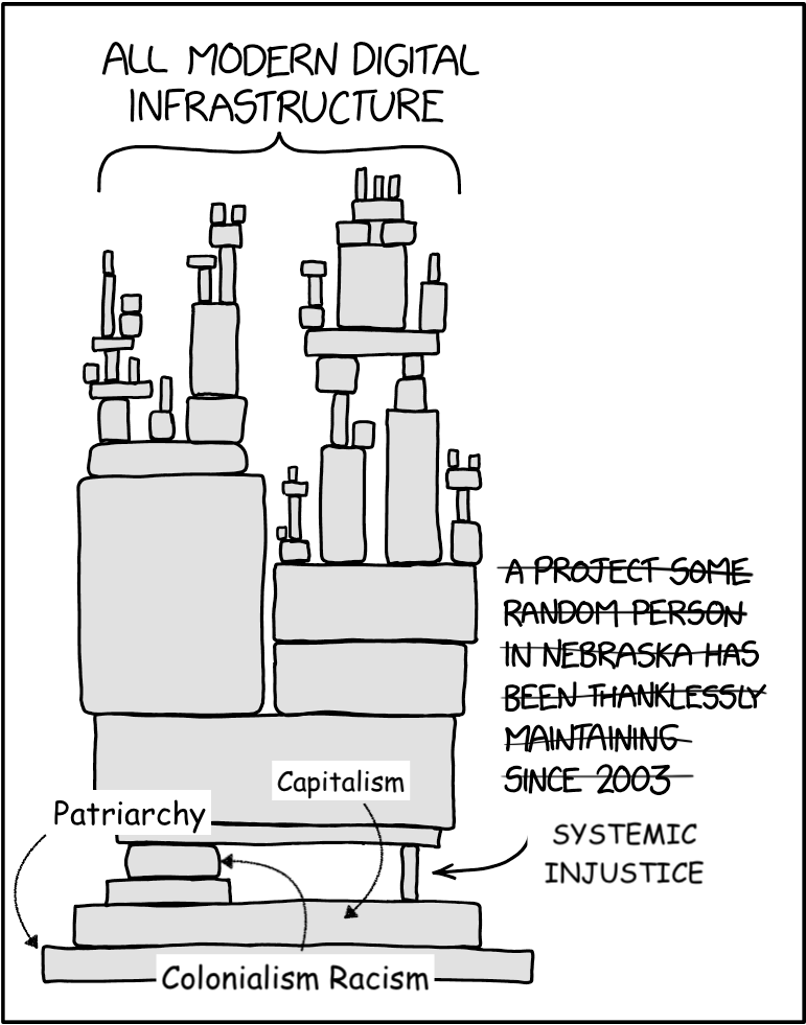
we adapted an XKCD comic frequently shared on computer programmer forums (see Figure
1). The original comic pointed to ‘A project some random person in Nebraska has been
thanklessly maintaining since 2003’ as the precariously thin block that held up the
Jenga-like stack that made up modern digital infrastructure. Our adaptation, on the
other hand, pointed to patriarchy, capitalism, colonial racism, and systemic injustice
as the foundations of this stack. This image served as an entry point and visual epistemology
of the socio-technical stack of digital infrastructure.
Within critical framing, infrastructure is not easily defined. Instead of fixing a
solid meaning to infrastructure, feminist scholar Star (1999) famously encourages
a reading of infrastructure that searches for characteristics. Such characteristics
include the embeddedness of infrastructure into other social structures and their
wide scope beyond single events or sites. In this sense, feminist framing of infrastructure
does not simply study calcified roads, pipes, and cables, but also examines their
role as part of everyday life. Researchers have explored pre-internet infrastructures
such as the Bulletin Board Systems (BBS) which supported much feminist, and queer,
community development and knowledge sharing [
McKinney 2020];[
Dame-Griff 2023]. BBS required specific knowledge to host and sustain communities. While regarded
as precarious infrastructures, bulletin board systems relied upon a network of individuals
who had an inherent, value based, interest in both upholding the network, and of being
connected to the individuals or the community it created and sustained. BBS users
and domain owners were orientated to the technology for reasons other than commercial
gain, as they sought out like-minded members/individuals with shared values and interests.
BBS, a precursor to our current social media platforms, were decentered from large
tech companies, and instead relied on individuals having the technical knowledge to
run the network. Beyond social infrastructure, researchers also interrogate code as
infrastructure. For instance, if comments are part of an infrastructure of technical
documentation, the analysis of code in Easter’s (2018) article examines how misogyny
can be embedded into a programming language and its wider community of programmers.
On the other hand, projects such as
Queering Bash ([
Soon and Karagianni 2023]) which subvert the Bourne Again Shell (Bash) language used in the highly technical
field of Systems Administration, demonstrate how communities of queer creative coders
can use command line languages to express desire through code poetry. Such analysis
and interventions of digital infrastructure illustrate that through relational readings,
infrastructure becomes uncalcified from a ‘system of substrates’ to an active ‘part
of human organisation’ [
Star 1999, 380]. An inflexible definition of infrastructure is therefore an oxymoron to its
mutable characteristics.
While infrastructure as facilities (such as roads, bridges, or broadband) might seem
universal, a queer phenomenological lens emphasises the orientations of these objects.
A queer phenomenological approach places affect as an orientation device for building
and maintaining infrastructure. As [
Wilson 2016, 262] notes infrastructures have orientations, they are ‘repurposed toward intimacies
we cherish and toward those we don’t’. Public washrooms, in Wilson’s (2016) case study,
perfectly illustrate how communities might orient infrastructures for closeness (as
in gay men’s cruising) or for division (as in racially segregated toilets in apartheid
South Africa). Indeed, these infrastructures become an ideological battleground, as
exemplified by anti-trans lobbyist obsession with gender policing in public toilets.
While both uses of public toilets could not be any further from each other, they highlight
that ‘there is power in the sewers’ [
Wilson 2016, 248]. Mundane infrastructures such as public washrooms might be taken for granted
but they express power when specific bodies are excluded or when they become zones
of radical intimacy, reclamation, and activism. Collective affect is mobilised for
the care, repair, and maintenance of some projects. It is also mobilised in ambivalence,
disdain (as with the previous Amazon/Parler example) or the failure of other infrastructures.
Failure of infrastructure is therefore a mode to understand the affective orientation
of a given facility and the intimacies they prioritise.
Feminist and queer scholars have unpacked the role of affect and failure as an essential
characteristic of infrastructure (e.g. [
Halberstam 2011])
. [
Star 1999] outlines that infrastructure is a hidden substrate that becomes visible on breakdown.
This understanding posits that infrastructures such as public trains fade into the
background of everyday transportation until there is a problem on the line. However,
recent scholarship has outlined that some broken systems have failure embedded in
their structure. The prison abolition activist Miriam Kaba (2021) emphasises this
in relation to the anti-Blackness in the US judicial infrastructure. Kaba notes that
the rhetoric of brokenness places reform as the sensible choice in place of more transformative
alternatives. In the same vein, Noble (2018) and Benjamin (2019) have expanded on
glitches that harm Black women as a feature (and not a bug) of discriminatory technology
in the larger structure of systemic racism. Berlant places their analysis of infrastructure
in ‘troubling troubled times’ ([
Berlant 2016, 395] where global social movements against racism, xenophobia, austerity, and capitalist
exploitation point to an ‘infrastructural breakdown of modernist practices of resource
distribution, social relation, and affective continuity’ (2016, p.394). Berlant theorises
that broken infrastructures reveal the opportunities for repair or abandonment for
alternate options. In this sense, infrastructure does not simply sit still. For Berlant,
infrastructure is also always moving and transforming. The process of ‘infrastructure-making’
is a social and political action of ‘assemblage and use’ that transforms and organises
the world [
Berlant 2016, 403].
Moving away from the public washroom and facilities to feminist infrastructure-making,
autonomy is a necessity in organising feminist worlds. As [
Toupin and Hache 2015, 24] note, ‘one of the main constitutive elements of feminist autonomous infrastructures
lies in the concept of self-organisation’. Examples such the aforementioned Amazon-Parler
server deplatforming, demonstrates that big tech often promises convenience and scalability.
These promises disguised as democratisation of technology and agency, take the semblance
of autonomy but are in fact a neo-liberal and individualistic Faustian bargain. Ownership
is an illusion, and access is subject to capitalist impulses. Feminist autonomy is
in opposition to these neoliberal promises of big tech. As a method or proposition
it confronts neo-liberal individualism through collective, relational understandings
that privileges embodied knowledge and intimate understandings over technological
abstraction and efficiency. As Toupin and Hache (2015) highlight, feminist autonomy
cannot be fully achieved, as feminists do not exist in silos outside of technology.
In this sense, feminist autonomy is always in negotiation with existing systems, recognising
boundaries which are negotiable and un-negotiable, possible and impossible. Within
the capitalist systems we must also negotiate the human and environmental cost.
Feminist autonomous servers are therefore a prime example of these negotiations with
current technological infrastructure. One manifesto declares a feminist server as
‘a situated technology. [… that is] run for and by a community that cares enough for
her in order to make her exist’ [
Snelting 2013]. One of the earliest documented feminist servers, Syster Server,
[3]
notes that the maintenance of a server is an act of care [
Wessalowski and Karagianni 2023]. They state that the traditional field of system administration (sysadmin) often
distinguishes the process of setting up and maintaining a server infrastructure from
care, even as the practice requires thought and consideration. As with the broader
field of computing, sysadmin is masculinised and the affective power of the servers
they maintain is devalued. Alternatively, feminist servers ‘set out to explore non-scalable
ways of forming networks of solidarity and care among themselves and beyond. [...]
They make space for ways of relating differently to each other and (with) technology’
[
Wessalowski and Karagianni 2023, 203–204]. Syster Server also describes their server as ‘an affective space for sharing
and streaming videos away from centralised platforms’ [
Karagianni 2023]. In reclaiming the affective power, servers, as a form of feminist infrastructure,
opens up opportunities of intimacy and care within a network of computers and people.
Syster Server is one of many ‘networks of solidarity and care’ that form feminist
servers and infrastructure. It is beyond the scope of this article to recount a comprehensive
history of feminist servers. In the mode of feminist citation, however, we would like
to chant out some servers as noted in earlier scholarship:
Kéfir, Vedetas, Codigo Sur, Maddix, Cl4ndestina, Systerserver, Matriar.cat, Anarchaserver,
Rhizomatica, Palabra radio, Pi-node, Tetaneutral, Framasoft, any many others... [Toupin 2020, 53].
The following section focuses on our intervention and contribution to the above ecosystem
of feminist servers and their practice of infrastructure-making.
Full Stack Feminism Server Prototype
...What would be the purposes and principles of a feminist server? Can feminist servers
support women, feminists and GLBTQI in their fight for having their rights such as
freedom of expression and opinion respected? Can we create trust among us to develop
cooperative approaches to the management of those spaces of resistance and transformation?
[Toupin and Hache 2015, 24].
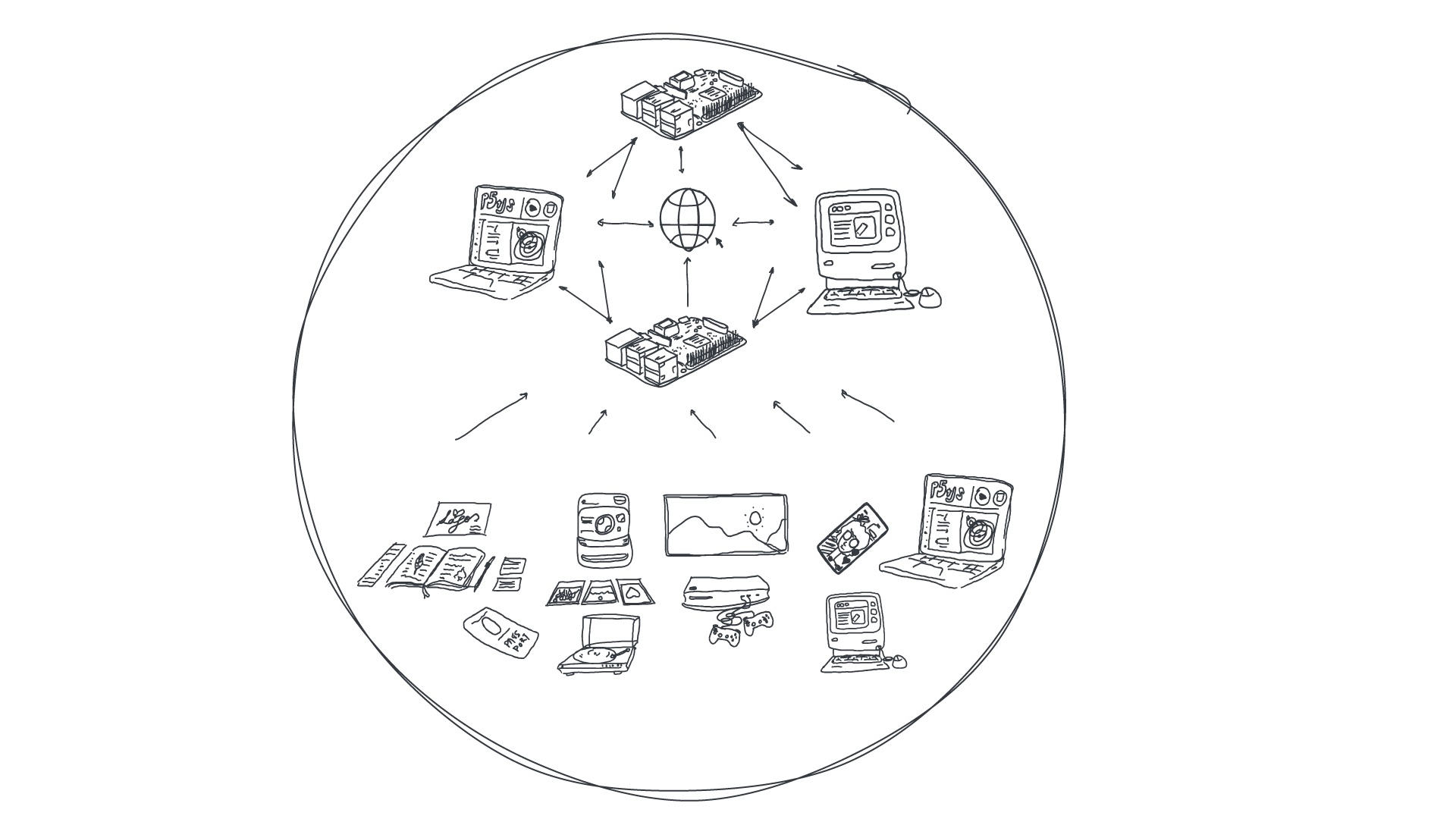
The speculative FSF server diagram (Figure 2) encapsulates our vision for our prototype.
Servers, for us, are not just software applications and hardware components, they
are material artefacts which have meaning — they are ancestral totems, and heirlooms
that connect the intimate and sacred to everyday life. In their form as software,
servers are also virtual spaces akin to traditional archival institutions that hold,
share, and recreate ideas of heritage and history. In this sense, we understand servers
as both physical and virtual holding places for collective memories, histories, and
materials. This understanding echoes with TransHackFeminist (2015) statement that
feminist servers ‘ensure that memory of feminist groups are accessible, preserved,
and managed’. Anarchaserver also reiterates that feminist servers play a role in ‘regaining
control and gaining autonomy in the access and management of our data and collective
memories’ [
spideralex 2023].
As we are concerned with both the concrete and virtual holding of archives, we aimed
to design everyday objects — such as vases, sculptures, boxes — that will house our
server. In this sense, we also draw from the understanding that ‘things,’ to paraphrase
[
Grosz 2009, 126], ‘make our world’. [
Hall 1997, 45] also notes how worldmaking emanates from our ‘fantasies, desires and imagining’
as nations, communities, and families. Subsequently, our prototyping included diagrams
(as in Figure 2) or imaginations of our autonomous feminist servers. Through our visualisation
and mapping, we engage in speculative worldbuilding. We explore how we might hold
intimate objects — passports, journals, records, video games — with care.
Given the centralisation of knowledge and power in big technology firms, our intimate
objects have been held away from us in layers of abstraction that keep us reliant
on capricious systems. Therefore, underlying our orientations towards servers was
a goal to retain autonomy and intimate knowledge of the infrastructures we so heavily
rely upon. To achieve this goal, we needed to understand the code, the machine, the
processes, the points of failure. In doing this we would also identify the possibilities
and impossibilities of autonomy. Furthermore, as feminist autonomy is ‘a desire for
freedom, self-valorisation and mutual aid’ ([
Toupin and Hache 2015, 23]), we were also concerned with accessible forms of server making that could be
shared across our communities. For this reason, we aimed to build together as a collective.
We prioritised process, understanding, and documentation over an efficient and optimised
final product. We aimed for a prototype over a marketable, universal solution with
measurable impact.
Our collective experiment took place over the course of 9-months (2022-23) with FSF
team members in Maynooth University, Ireland, and University of Sussex, UK. It included
the authors, Ranju Upadhyay (FSF Programmer at Maynooth) and Alex Peverett (FSF Technician
at Sussex). We investigated various options, including using old PCs from our universities’,
but decided to build on Raspberry Pis. The Raspberry Pi is a credit card-sized microcomputer
used in various contexts from DIY to industry, heritage exhibitions to wildlife observations.
It is relatively affordable, compared to most computer devices. It is open and encourages
tinkering, with extensive online documentation and community forums. With its size,
the Raspberry Pi is modular and portable. It has expansions such as small-screens
and microphones that can be housed in everyday objects. This means that projects built
with the Raspberry Pi are open to repair and scalable.
[4]
For our project, we aimed to explore the possibility of hosting a website with media
artefacts (text, images, sounds, or projects such as chatbots) from our coding workshops.
We wanted the server to be portable so that it could be used in exhibitions and workshops
— becoming an object that archives and connects our feminist research community. However,
a single Raspberry Pi would easily bottleneck, so we decided a Raspberry Pi cluster
would be a better option.
After researching parts we needed, we bought matching items (including a Raspberry
Pi cluster kit, ethernet splitters and cables) in Sussex and Maynooth to ensure we
had a similar hardware setup. Using online tutorials and documentations, we built
our cluster hardware together and began the software development by setting up the
operating systems and programming environments for our server. As we aimed to share
this knowledge in future workshops, we kept notes on the process. In these notes we
outlined accessible and inaccessible tutorials — those that brushed over major details,
and those that were outdated. In this sense we documented our problem-solving and
reflected on pre-existing assumptions about technical knowledge. At every step we
questioned the pursuit of autonomy given various infrastructural and technical limitations,
embracing that ‘the notion of autonomy is vital to feminist attempts to understand
oppression, subjection, and agency’ [
Mackenzie and Stoljar 2000, 3]. For example, through prototyping we were able to question whether we can be
truly autonomous when we are reliant on university access to the internet, a global
supply chain of hardware, and computers with microchips that might be made from extractive
labour. These issues are not trivial, they highlight the infrastructural entanglements
in which we exist, and which limit our options and ability to be fully autonomous.
It is on this note that we discuss negotiating with existing infrastructures and their
constraints when prototyping our autonomous feminist server. We outline our insights
from our collective experimentation and development.
Negotiations and Gains:
I’m very much interested in owning the domains, owning the understanding [of] how
to upkeep the information that we’re building and making, and how to have the community
hold those memories themselves rather than…outsource…[Brathwaite-Shirley 2023].
Breaking it Down to The Code: Accessing Technology
Our first critical infrastructural block and the resulting negotiation was related
to global supply infrastructures and the material demands of acquiring hardware for
our cluster. The compromise we made was to reconsider the scope of the project. Given
the post-2021 global supply chain shortage in computer chips — inflated by a combination
of events such as the COVID-19 disruptions, high demands for computing power for machine
learning and AI model training, and the surge in electric vehicle production amongst
others ([
Sweney 2021];[
Waferworld 2025]) — we were unable to acquire the 16 Raspberry Pi’s needed for a sizeable cluster.
To proceed with the project, and to build matching clusters during our collective
coding sessions, we had to limit our cluster to two Raspberry Pis, thus reducing both
the capacity and capability of our feminist server. Even with this change, we still
experienced disruptions in delivery which further impacted and reduced the timeframe
of our project. Academics such as Crawford (2021) write about AI and its ravenous
demand for computing power as a planetary cost. Conversely, the initial blocks we
faced highlight the opportunity cost of these ever-increasing computing demands —
that smaller scale projects lose out to capitalist technology, thereby closing off
possibilities to build alternatives.
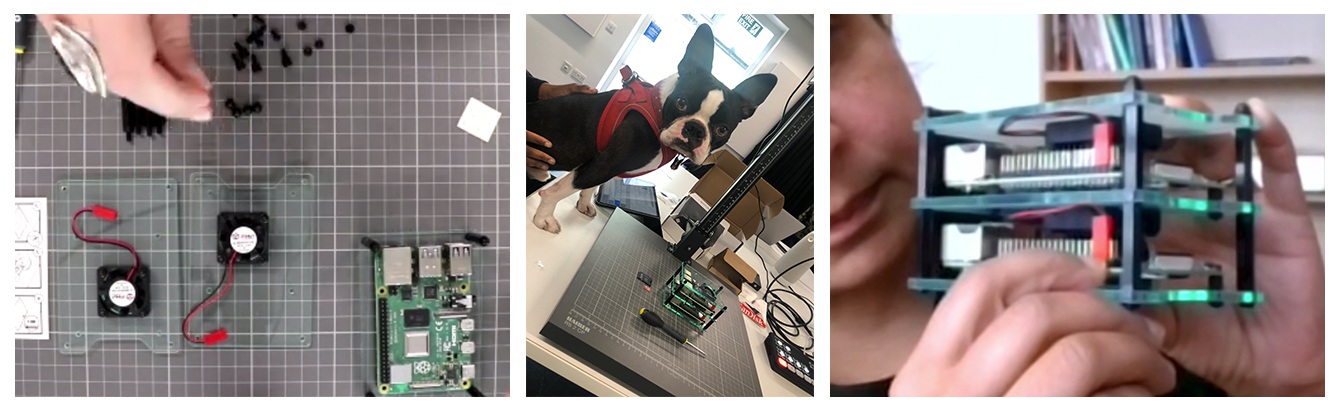
After the arrival of our components, we used a hybrid set-up to work synchronously
across geographical boundaries with team members in Maynooth and Sussex. For our real-time
collaboration, we had dual cameras for face-to-face video conferencing and a desk
view to live-share our building process (see Figure 3). Our collaborative remote workshops
highlighted different institutional infrastructural limitations and constraints. For
example, to access institutional Wi-Fi to connect our cluster, we had to develop two
different configurations. In addition, mundane situations in computing such as cross-compatibility
across different operating systems, download speed or writing operating systems onto
storage cards, take time. This meant a number of our collective workshops were dedicated
to downloading, installing, and configuring the Raspbian operating system. To reiterate,
these mundane processes are not trivial. Access to high-speed internet and uninterrupted
energy is an infrastructural privilege. They highlight the unevenness of infrastructural
capacities and the implications of broader global digital divides. In this sense,
our location within institutions with unlimited access to Wi-Fi afforded us privileges
that might not exist in other contexts.
We negotiated with another double-sided layer of access — technical knowledge. Raspbian,
the Linux-based operating system commonly used on Raspberry Pis, is a free and open-source
software. As with most open-source software, Raspbian has a community that shares
tutorials in addition to the official guidance from the Raspberry Pi Foundation. These
tutorials could be outdated or contradictory. Reading and following instructions outlined
in a given tutorial requires some technical skill. Tutorials we followed assumed prior
knowledge that frequently sent us into tangential routes in search of fixes. They
often used language charged with racial and gendered implications such as ‘master/slave’,
which is controversial even in more mainstream coding platforms [
Landau 2020]. This difficulty accessing technical knowledge via documentation is not unique.
It is actually embedded in the infrastructural culture of open-source software and
programming, characterised by the phrase “Read the F*cking Manual”. RTFM is a retort
used in open-source forums to respond to enquiries suggesting a user should consult
the manual before seeking help. This retort discourages new participants and contributes
to exclusivity and lack of access to technical knowledge. Interventions such as Read
the Feminist Manual appropriate this term, drawing attention to exclusive practices
in documentation in open-source manuals [
Karagianni 2023]. As Winnie Soon and Mara Karagianni (2022), who collectively work on feminist approaches
to sysadmin and coding, highlight, free and open-source software has a problem:
...the diversity of people contributing to free and open source…is a problem because…of
the disparity of gender imbalance and disparity in terms of ethnicity, class…we tend
to have these benevolent dictators to put it gently. They're usually the maintainers
of the software library, and they tend to dictate on decision making processes… [In
this context] how can we talk about free and open-source software as…something that's
beneficial in a society when it's monoculture based.
As a community of technologists, with prior experience in creative coding we pooled
together our knowledge and technical skills to solve problems. Our prior knowledge
meant that we had easier, albeit still challenging access to open-source software.
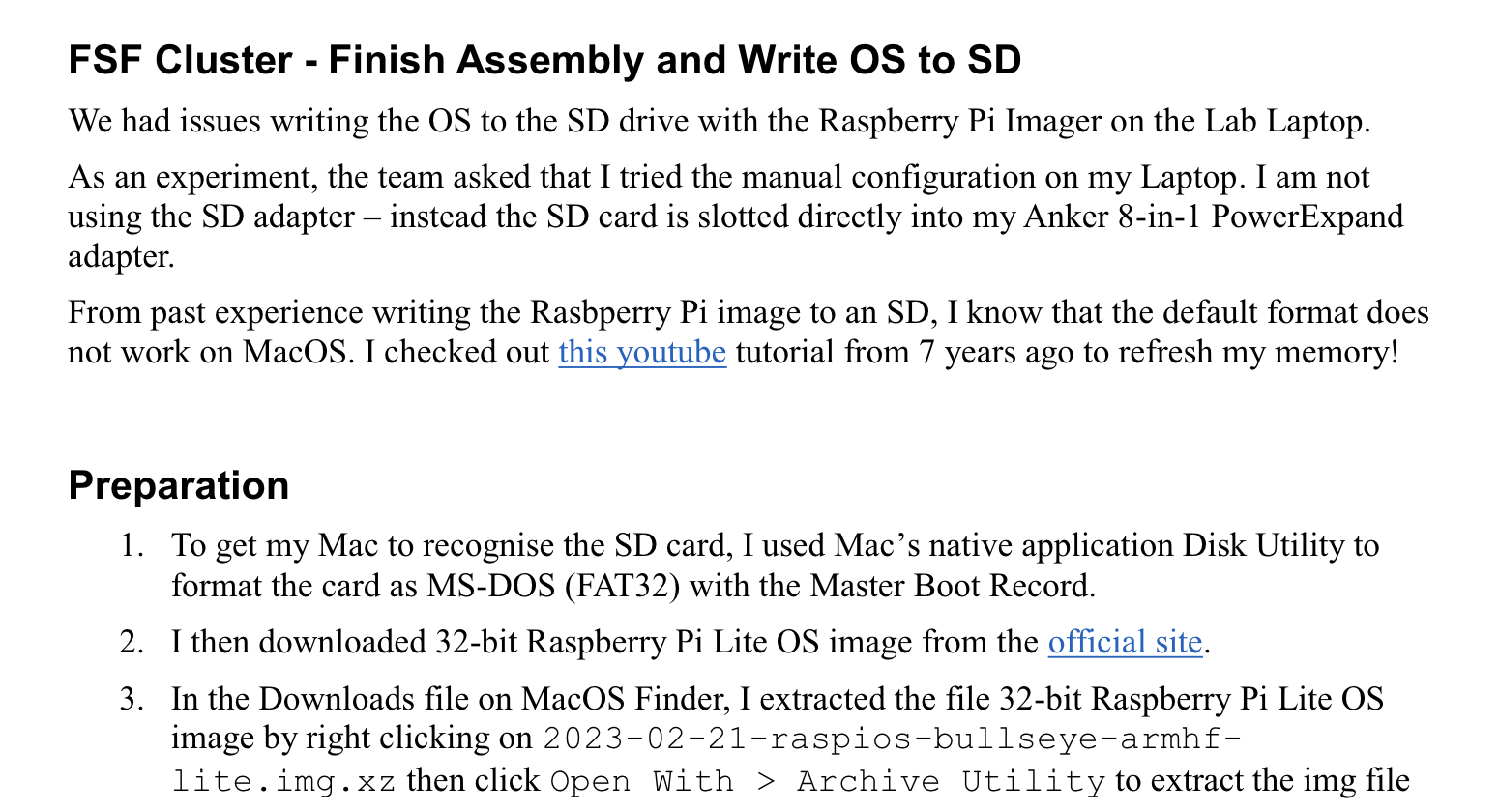
For instance, the official instructions to write the Raspbian operating system required
that we used a graphical user interface (GUI) application that failed to work. However,
with our past knowledge of command line interfaces (CLI), we were able to bypass the
abstractions of the GUI and work directly with shell code to copy the Raspbian image
to our SD card (see Figure 4). Our interventions were not limited to technical adjustments,
we critically intervened on the reproduction of racial language in configuring our
cluster by using main/clone in place of the terms “master/slave” used in tutorials.
Through our collective troubleshooting and critical interventions, we successfully
set up our software environment and connected our two-node raspberry Pi cluster to
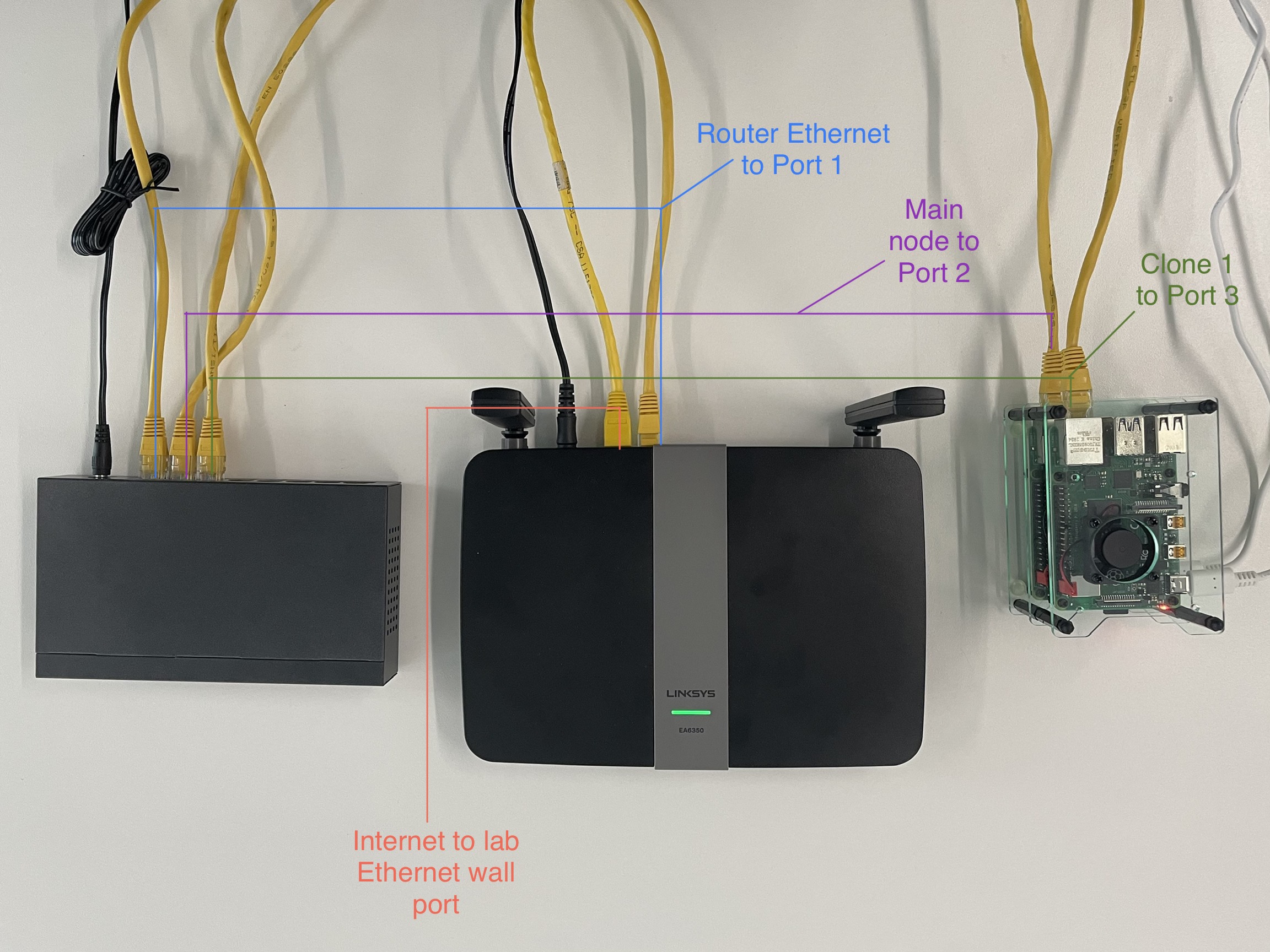
communicate with each other over the same network (see Figure 5). Following the setup,
we ran some test scripts in Python to ensure that the cluster was functional. These
test scripts served as a prototype for what would be the backend of the server that
would also be written in Python. With the test scripts running, we had successfully
configured the cluster to serve files and run code across each other, thereby preparing
it to host data (images, sounds assets, software, etc..) for the project archive.
We stopped the development at this point given time constraints and as we had achieved
a significant step of configuring the prototype server infrastructure.
Restoring intimacy and collective joy
The account of the server setup illustrates the economical, technical, and cultural
negotiations we made to build our own infrastructure. With the compromises, time,
and labour allocated to this process, it is also important that we reflect on what
we gained. As stated previously, our queer phenomenological methodological approach
emphasises the need for plurality and the role of affect in orientations towards objects
such as servers. One of our most significant gains was affective — a restored intimacy
with our technology. Developing intimate knowledge of technology means that we remained
in line with the Full Stack Feminism ethos of reclaiming technology down to the code.
More importantly, we also restored intimacy via our contribution to ‘networks of solidarity
and care’ as with other feminist servers [
Wessalowski and Karagianni 2023, pp.203–204]. The restoration of intimacy is extended not only by knowledge of technology
and contribution to feminist practice but also by our embodied experiences. Unlike
a cloud server or IaaS, we were able to tinker with our Pi Cluster. We were able to
touch and adjust all the screws on the nodes in the cluster (see Figure 3). We are
able to see which server is down by monitoring the lights on the boards. This physicality
emphasised the materiality of servers and digital infrastructures — knowledge often
lost through reliance on third party services to the detriment of the global climate.
Most importantly, we are able to build affect around the object — the thing in itself
— through the ways we as a community (including our non-human companions) interact
with the Pi Cluster.
In this respect, restoring intimacy to infrastructure through technological and embodied
knowing, is a form of reorientation. Our movement away from Infrastructure as a Service
(IaaS) orients us towards the possibilities, and impossibilities, of alternative pathways,
places and spaces from which autonomous feminist legacies can be imagined, inhabited
and maintained. As we carefully placed screws onto the plates that held each machine
on the cluster, we embodied an ethics of care that is involved both in the development
of feminist infrastructure, its maintenance, and ultimately care for the content it
will one day host. When we rethink our (re)orientations towards affective infrastructures,
they become entwined with human, digital rights, and security. As [
Foz 2022, 11] states, ‘digital care’ is intimate since ‘the online and offline are indissociable’,
meaning ‘what affects our data also impacts our bodies’
. Governance in these spaces, is therefore, governance of our bodies, thus, ‘in the
digital care perspective, taking care of our data [and of the artefacts that hold
data,] is also taking care of our body and this care should be done every day, as
a habit, a culture, politics’ [
Foz 2022, 11].
In addition to a restored intimacy with technology, we also gained insights on the
role of slowness in building autonomous feminist servers. The act of intentional slowness
is a feminist act of care. As a wider movement–slow archiving, slow scholarship, slow
computing–it counters neo-liberal approaches which foreground productivity under strict
timelines. Intentional slowness bounded the parameters of the experiment, prompting
us to stop at the configuration of our server infrastructure. As members of Syster
Server write,
[p]ractices of care and maintenance within feminist servers must be understood as
negotiations of collective responsibility. [...Sysadmins on feminist servers] participate
according to their availabilities and thereby extend the principle of care towards
themselves by taking into account the different intersectional precarities that define
their situation [Wessalowski and Karagianni 2023, 197].
This form of slow computing, as per Kitchin and Fraser (2020), is a practical and
political strategy to regain control and agency in a hyper-connected and hyper-optimised
digital world. As they note, ‘if you are a free-market capitalist, why would you care
about worker wellbeing as long as you can extract profitable value from them?’ [
Kitchin2020, 136]. Intentional slowness is therefore intentional care. Conversely, as Kitchin
and Fraser (2020) further note, by adopting and enacting a
philosophy of slow computing…We stand to experience the joys of computing, while minimizing some of the more pernicious aspects of the emerging digital society
and economy if we pursue individual and collective, practical and political, actions.
Through our experiment, we challenged the centrality of optimisation and efficiency,
foregrounding a feminist ethic of repair, maintenance, and intimacy, oriented toward
collective autonomy and care.
These acts also reorientated us towards collective joy–a return back to the energising
force within the practices of working with, making, and understanding technology essential
to capacity and solidarity building. Intentional care and slowness helped us peel
back the layers of abstraction inherent in capitalist approaches to Infrastructure
as a Service, and instead provided a space to reclaim the layers, stacks of the technologies
we rely on. If, as Langdon Winner (1980) asserts, artefacts have politics, then our
final artefact embodies our intersectional feminist politics and praxis.
Conclusions: On Possibilities and Plurality
Throughout this paper, we have examined our research questions, exploring the possibilities
and impossibilities of feminist infrastructures; negotiations we have made in maintaining
feminist technological autonomy require; and the gains we experience in creating these
autonomous infrastructures. We have also situated autonomous feminist infrastructures
within the technological terrain. From the retelling or revealing troubled histories
that have excluded women from computing, to expanding on the context of our wider
research project, to applying feminist theory to understanding infrastructures and
autonomy, to expanding on our own collective experiments, we have examined modes of
the negotiations and gains of feminist infrastructure-making within (im)possible constraints.
Our experiment demonstrates a move towards (im)possible autonomy and reflects aims
to resist the dominant socio-technical, intervening on the aforementioned historical
bias. As we have noted, our work exists within a space — a dwelling — of theorists
and practitioners that have shaped our feminist praxis.
We have demonstrated that building autonomous feminist infrastructures, such as autonomous
feminist servers, is a way to foster agency from technological gatekeepers. It is
a means to redistribute power and build shared sustainable heritage. Critically, it
is also a way to queer and reorient technology, recognising the ongoing need for more
equitable technological environments. Such equitable environments ensure that women,
including trans-women and fem-identified individuals, have agency in current and future
techno-societal contributions and possibilities. Subsequently, to maintain and care
for autonomous feminist infrastructures/servers within corporate communication technology
and academic institutions is to negotiate inhabitings and dwellings through displacements
and intimate exposures, intentional or forced. It is to accept the precarious reality
that technology is not fixed — institutions often push for a form of technological
standardisation and homogenisation and the servers that hold our collective memories
might have to inhabit the uninhabitable. That noted, the very presence of autonomous
feminist infrastructures in institutions means that we might disorient these systems.
This follows the feminist STS understanding that digital and computational technology
can both subscribe to or disrupt normative paths. Orienting our servers towards autonomy
ultimately connects back to our feminist affective practices that allows for the restoration
of intimacy and collective joy. In the two-way transformations of our infrastructures
and our socio-technical environment, care gets reoriented as an affective force and
highlights the (im)possibility of autonomy.
Feminist autonomous infrastructures — although hopeful — are never an endpoint but
an ongoing process of collective care from which recognition, shared ethos for change,
for justice are always shifting and transforming. As such, our project of building
autonomous feminist infrastructures is ongoing. For instance, our Raspberry Pi configuration
has been repurposed as a media server in exhibitions and workshops developed by our
research community — the server itself has become an artefact which prompts discussion
and dialogue about its context of development and the politics it represents. Our
feminist design is situated to our context; however, we do encourage further research
on the negotiations and gains of autonomous feminist infrastructure that contribute
to the broader ecosystem of feminist servers. As we move towards the future, these
research projects will contribute to the alternative possibilities of technological
development. They will question whose experiences and legacy becomes prioritised in
design, offering plural opportunities of restoring intimacy with technology and collective
joy.
Works Cited
Ahmed 2006 Ahmed, S. (2006) Queer phenomenology: Orientations, objects, others. Durham: Duke University Press.
Bender et al. 2021 Bender, E.M. et al. (2021)
“On the dangers of stochastic parrots: can language models be too big?”, in
Proceedings of the 2021 ACM Conference on Fairness, Accountability, and Transparency. Virtual Event, Canada: Association for Computing Machinery (FAccT ’21), pp. 610–623.
Available at:
https://doi.org/10.1145/3442188.3445922.
Benjamin 2019 Benjamin, R. (2019) Race after technology: Abolitionist tools for the new Jim code. John Wiley & Sons.
Berlant 2016 Berlant, L. (2016)
“The commons: Infrastructures for troubling times*”,
Environment and Planning D: Society and Space, 34(3), pp. 393–419. Available at:
https://doi.org/10.1177/0263775816645989.
Bhardwaj, Jain, and Jain 2010 Bhardwaj, S., Jain, L. and Jain, S. (2010) “Cloud computing: A study of infrastructure as a service (IAAS)”, International Journal of engineering and information Technology, 2(1), pp. 60–63.
Bordalejo and Risam 2019 Bordalejo, B. and Risam, R. (eds) (2019) Intersectionality in Digital Humanities. New edition. Leeds (GB): Arc Humanities Press.
Brathwaite-Shirley 2023 Brathwaite-Shirley, D. (2023) “Full Stack Feminism Interview”.
Bucher 2018 Bucher, T. (2018) If...then. Algorithmic power and politics. Oxford University Press.
Chun 2021 Chun, W.H.K. (2021) Discriminating data: correlation, neighborhoods, and the new politics of recognition. Cambridge, Massachusetts: The MIT Press.
Crawford 2021 Crawford, K. (2021)
The atlas of ai: Power, politics, and the planetary costs of artificial intelligence. Yale University Press. Available at:
https://doi.org/10.2307/j.ctv1ghv45t.
Dame-Griff 2023 Dame-Griff, A. (2023) The two revolutions: A history of the transgender internet. NYU Press.
Easter 2018 Easter, B. (2018)
““feminist_brevity_in_light_of_masculine_long-windedness:” code, space, and online
misogyny”,
Feminist Media Studies, 18(4), pp. 675–685. Available at:
https://doi.org/10.1080/14680777.2018.1447335.
Eberhardt 2019 Eberhardt, J. (2019) Biased. Uncovering the hidden prejudices that shape our lives.
Edwards and Harris 2016 Edwards, S.B. and Harris, D. (2016) Hidden human computers: The black women of NASA. Illustrated edition. Minneapolis, Minnesota: Essential Library.
Evans 2018 Evans, C.L. (2018) Broad band: The untold story of the women who made the internet. New York: Penguin Random House Press.
Fry 2019 Fry, H. (2019) Hello world: How to be human in the age of the machine. Transworld Publishers Ltd.
Halberstam 2011 Halberstam, J. (2011) The queer art of failure. Duke University Press.
Hall 1997 Hall, S. (1997)
“The work of representation”, in S. Hall (ed.)
“Representation: Cultural representations and signifying practices”. London: SAGE in association with The Open University, pp. 19–74. Available at:
https://doi.org/10.4324/9780429355363-15.
Kaba 2021 Kaba, M. (2021) We do this ’til we free us: Abolitionist organizing and transforming justice. Haymarket Books.
Karagianni 2023 Karagianni, M. et al. (2023)
“Feminist Infrastructures - Inhabiting affective infrastructures: How not to scale
a feminist video platform”,
Full Stack Feminism [Preprint]. Available at:
https://doi.org/10.21428/6094d7d2.27ff8187.
Kim and Koh 2021 Kim, D. and Koh, A. (eds) (2021)
Alternative historiographies of the digital humanities. 1st edn. punctum books. Available at:
https://doi.org/10.53288/0274.1.00.
Kitchin2020 Kitchin, R. (2020) Slow computing: Why we need balanced digital lives. Bristol: Bristol University Press.
Kleiman 2022 Kleiman, K. (2022) Proving ground: The untold story of the six women who programmed the world’s first
modern computer. London: C Hurst & Co Publishers Ltd.
Mackenzie and Stoljar 2000 Mackenzie, C. and Stoljar, N. (eds) (2000) Relational autonomy: Feminist perspectives on autonomy, agency, and the social self. New York, NY, USA: Oxford University Press.
McPherson 2017 McPherson, T. (2017) Feminist in a Software Lab. Difference + Design. Harvard: Harvard University Press.
Noble 2018 Noble, S.U. (2018) Algorithms of oppression: how search engines reinforce racism. New York: New York University Press.
O'Neil 2016 O’Neil, C. (2016) Weapons of math destruction: How big data increases inequality and threatens democracy. New York: Crown Publishing Group.
Soon and Karagianni 2022 Soon, W. and Karagianni, M. (2022)
“Interview with Winnie Soon, academic, programmer and artist, and Mara Karagianni,
artist, programmer and system administrator, as part of the Full Stack Feminism in
Digital Humanities project (2021 - 23)”. Available at:
https://doi.org/10.7486/DRI.br86r009s. Accessed: 22 August 2025.
Soon and Karagianni 2023 Soon, W. and Karagianni, M. (2023)
“Queering bash: A joint Sussex humanities lab & full stack feminism workshop”. Sussex Humanities Lab, 6 March. Available at:
https://hackmd.io/@siusoon/queeringbash#/27. Accessed: 14 June 2024.
Spinks 2017 Spinks, R. (2017) Using a fitness app taught me the scary truth about why privacy settings are a feminist
issue, Quartz. Available at: https://qz.com/1042852/using-a-fitness-app-taught-me-the-scary-truth-about-why-privacy-settings-are-a-feminist-issue
(Accessed: 12 July 2024).
Toupin 2020 Toupin, S. (2020) “Feminist hacking. Resistance through spaciality”, in The beautiful warriors. New York, NY, USA: Minor Compositions.
Wajcman 2004 Wajcman, J. (2004) Technofeminism.
Wenimont 2013 Wernimont, J. (2013) “Whence feminism? Assessing feminist interventions in digital literary archives”, Digital Humanities Quarterly [Preprint].
Wessalowski and Karagianni 2023 Wessalowski, N. and Karagianni, M. (2023)
“From Feminist Servers to Feminist Federation”,
A Peer-Reviewed Journal About, 12(1), pp. 192–208. Available at:
https://doi.org/10.7146/aprja.v12i1.140450.
Wilson 2016 Wilson, A. (2016)
“The Infrastructure of Intimacy”,
Signs: Journal of Women in Culture and Society [Preprint]. Available at:
https://doi.org/10.1086/682919.
Winner 1980 Winner, L. (1980) “Do artifacts have politics?”, , Daedalus, 109(1), pp. 121–136.


 https://orcid.org/0000-0003-4764-1078