Abstract
Work at the intersection of data visualization, literary studies and the spatial
humanities has identified the shortcomings of digital cartographic tools and
applications such as GIS in addressing the complexities and ambiguities of
literary space. In this article I present a visualization approach which takes
an alternative angle on this problem, using as an example the representation of
scalar shifts in the poems of Emily Dickinson: the plotspace, a 3D-fabricated
sculptural object which can be printed in plastic or resin or milled out of
materials such as metal or wood. A plotspace incorporates lines of text engraved
or embossed on its inner face(s), as well as a curved shape which, extending in
a three-dimensional wave-like form, plots the shifts in the size of entities
referred to in the text. Plotspaces, I argue, have the capacity to prompt and
provoke their viewers to go beyond the usual processes involved in close
reading, by considering what is illuminated by reading a text in conjunction
with a three-dimensional form which fabrication technologies make it relatively
easy for non-specialists to create for themselves. In addition to these literary
and hermeneutic affordances, plotspaces also raise questions about what it means
to model spatiality in literary texts, and what tactility, materiality and
sensory apprehension might add to the interpretive experience of reading a poem.
They also speak to prevailing concerns engaging feminist visualization scholars
about the conditions in which knowledge objects such as data visualizations are
produced, and the shaping effects of those conditions.
Introduction: The tension between digital mapping tools and non-Euclidean
literary spaces
Engaging the spatial imaginaries of literary texts through digital technologies
is an area of endeavor for the digital humanities which has proved itself
particularly conducive to provoking critical reflections on the limitations of
software. Humanities scholars who use spatial applications have found common
ground with geographers who have been engaged for some decades in problematizing
the positivistic assumptions such technologies rest on, and conceiving
alternative practices through which to deploy spatial technologies
interpretively in ways that unsettle conventional representations of lived
experience, rather than conducting spatial analyses that are anchored in
quantitative geographical information [
Kwan and Knigge 2006, p. 1999].
Aligning itself with these alternative practices from critical geography, the
project I report on in this article comes out of efforts to use digital mapping
technologies to analyze literary texts whose spatial imaginaries trouble the
boundary between the Euclidean space of the empirical world and the imaginary
spaces of fictional worlds. Scholarship in the digital humanities has long been
occupied by this problem (see for example [
Drucker 2011]), but GIS
technologies and neogeographical applications have proven themselves ill
equipped to address it. The fundamental challenge, which emerges in attempts to
construct even the simplest of point maps from literary narratives, lies in the
fact that most such texts, even ones appearing to be squarely anchored in a
realist mode, shift between the empirical world and fictional worlds, with the
division between the real and the fictional being far from easily delineated. As
the text recedes historically from the reader, the distinction becomes more
difficult to keep in view, and anchoring textual references to the spatial
co-ordinates a GIS requires becomes increasingly untenable.
The tension between the fluidity of textual meanings and the putative rigidity of
the data structures underpinning spatial software does not, however, mean that
the endeavor to bring the two together is futile. Indeed, as Susan Brown points
out, navigating this tension in ways that bring the insights of humanities
scholarship about the provisional and contingent nature of categories to bear on
the practical exigencies of working with data is one of the core tasks for the
digital humanities. Given that the classificatory actions needed to structure
data are
“not just discursively but operationally
performative,” removing information from the environments in which it
was originally produced can potentially distort, silence and obscure some
aspects of it, but at the same time enables those data to be queried, retrieved,
transformed, and exposed [
Brown 2020, p. 167]. It is a
truism that making maps and carrying out spatial analysis reduces the
complexities of the world and therefore requires inevitable compromises between
retaining those complexities and analytical utility: What emerges as valuable
from this tension are the consequences of those methodological choices.
Moreover, as technocapitalist dominance intensifies, and the algorithmic
tendrils threaded through the technologies of communication and bureaucratic
state control come to govern more of daily life, the more pressing the
imperatives are to critique and intervene into these clashing epistemologies. As
Brown observes,
“[t]he interlocking relations of
classification to scientism and informational infrastructures is precisely
why DH must not relinquish it”
[
Brown 2020, p. 167].
Spatial humanities projects which confront these epistemological questions by
interrogating GIS and other mapping technologies and the methodologies they call
forth can be seen in the light of these broader stakes. Within literary studies,
methodological innovation has tended to emerge from more historically-oriented
GIS projects, as these are more likely to have data which can be readily
georeferenced [
Black, MacDonald, and Black 1998]
[
MacDonald and Black 2000]. However, there are some projects which have
found ways to keep the narrative, stylistic, symbolic, perspectival, and other
literary qualities of their objects of study in view while using maps to
represent some aspect(s) of a literary text. As part of the
Mapping the Lakes project, Ian Gregory and David Cooper used an
“emotion mapping” approach to the travel writings
of Gray and Coleridge, coding passages according to their affective intensity
and then generating maps from these ratings in order to show the varying
affective responses of the two poets to the landscapes of the Lake District in
the British Isles [
Gregory and Cooper 2010]. The
Literary Atlas of Europe project developed an intricate data model
that distinguished between different kinds of places (settings, projected space,
zones of action, markers, and routes), the mode of projection (remembering,
dreaming, longing, or evoking), the relationship between literary space and
geospace (imported, transformed, invented, imagined, synthesized, or shifted),
and the function performed by spatial references in a text (for instance serving
as simple scenery vs. carrying symbolic connotations). Drawing on work within
the field of information visualization to represent uncertainty through elements
such as color, transparency, and animations, this project produced multiple
visualizations of place in literary texts, and layered them over conventional
cartographic base maps (see [
Reuschel and Hurni 2011]. In the
Chronotopic Cartographies project, Sally Bushell et
al. used the concept of literary topology and eschewed GIS-based tools in favor
of other forms of graphical representation such as
“topoi
maps,” which took places which were linked in narratives and
represented them as a network diagram. Generating topoi maps from the
perspective of different protagonists in
Frankenstein
and comparing them revealed the extent to which the novel’s character
and identity are spatially inflected [
Bushell et al. 2022, p. 50]. A fourth example, Alex Christie and Katie Tanigawa’s
“z-axis” approach to mapping modernist Paris, started
with a map on a flat plane and used the third dimension to distort it according
to where characters spend more time, such that a cartographic representation of,
for instance, Djuna Barnes’s
Nightwood bulges and
dips so as to defamiliarize the map of Paris in ways that resonate with the ways
Barnes’s novel subverts and destabilizes heteronormativity and social convention
[
Christie and Tanigawa 2016].
In contrast to these thoughtful and methodologically innovative projects, the
bulk of literary mapping endeavors tend to employ point maps in a more
simplistic way and rely on neogeographical tools such as Google Maps or ESRI’s
proprietary ArcGIS Story Map platform to construct them. Bushell et al. point to
a common fallacy underlying many such projects:
“the
assumption that if a fictional text uses real-world names then the fictional
representation of place corresponds directly to the real-world place and can
be mapped onto it”
[
Bushell et al. 2022, p. 43]. To collapse a literary place
into a point on the earth’s surface represented by a latitude and longitude
reference would be to fall into naïve realism, and to cross what Bakhtin
characterizes as the
“sharp and categorical boundary line
between the actual world as source of representation and the world
represented in the work”
[
Bakhtin 1981, p. 253]. It is, of course, possible to use
point maps in more nuanced ways, and one project that does so is Caitlin Burke
and Patricia Herron’s
“Frankenstein Map,” built with
Story Map, in which almost as much screen space is given to contextual
information, quotations from Mary Shelley’s novel, and images such as paintings
as to the map markers [
Burke and Herron n.d.].
But it remains the case that the most compelling discussions of how texts engage
with spatial elements and use them as specifically literary resources are
resolutely grounded in discursive rather than cartographic or visual modes. One
example is furnished by Paul Saint-Amour, building on work by Eric Bulson and
Jon Hegglund, who uses the concept of countermapping developed within sociology
to persuasively elaborate, without any actual maps of Dublin, the ways in which
James Joyce writes back to, and undermines the epistemological frameworks set up
by the Ordnance Survey maps of Ireland produced as a tool of imperial governance
by the British. Glossing a passage from
Portrait of the
Artist As a Young Man in which the protagonist, Stephen, overlays a
rich set of associations on places on his daily walk through Dublin to
university lectures — countermapping a
“reeking
slobland” as a
“silverveined cloister,”
for instance — Saint-Amour observes how Stephen’s subjective traversal of such
places
“transubstantiates them into sites of revitalizing
aesthetic experience for the colonial artist-intellectual who is able to
read widely and feel boldly”
[
Saint-Amour 2024, pp. 99–100], thereby connecting spatiality
to one of the novel’s key preoccupations. There is a clear argument and
analytical payoff here, in contrast to the many point maps of Joyce’s Dublin,
Woolf’s London, or any number of other digital literary maps that now litter the
internet, in partially or entirely deprecated form.
In this article, I seek to extend the lines of enquiry opened up by these
projects and others like them to suggest some further ways that spatially-minded
literary critics might think outside the GIS box, while leveraging the
methodological innovations that digital tools and fabrication technologies open
up for new forms of tactile and visual engagement. I do so by presenting an
approach which does not collapse the real and the imaginary in its presentation
of spatiality and avoids eliding one of the key qualities that makes literary
space worth investigating, i.e. its treatment of spatial references as something
other than positivistic, Euclidean entities. Critical attention to the
analytical value of digital mapping is an increasingly pressing concern as
generative AI has dramatically lowered the technical barriers to entry for
digital mapping, enabling users to generate geoparsing scripts and online
visualizations whose accuracy cannot be guaranteed, and which are likely to
exhibit biases reflecting the Anglocentrism and other limitations of LLM
training data. In this context, scholars in the spatial humanities need to
continue to think critically about the epistemological value of moving from a
text to a map and back again, and about the tools we are using to do so. Such an
approach is aligned with a broader project within critical geography to
repurpose digital mapping applications for critical ends and to interrogate the
assumptions underlying technologies for spatial analysis that originated in
military technologies for surveillance, espionage, and waging war. Furthermore,
as the rising prominence of genres such as speculative fiction evince a desire
to think beyond the scale of the human to the world-systems and structures of
the global and the planetary — an imperative driven by the need to meet the
challenges of the climate crisis and resist the expansion of technocapitalist
power across borders — this project seeks to rise to the challenge of finding
ways to engage with the workings of space and scale through cultural and
literary analysis.
Dickinson and the decoupling of space, scale, and size from the
geographical
One way in which the spatial, scalar or dimensional aspects of a literary text
can be decoupled from the geographical and evoked without being constrained to
an interface or a screen is to construct a three-dimensional model which can be
fabricated and handled as a tangible object. By incorporating into the design
both the words comprising a text and a rendering of a spatial quality depicted
in that text (such as size) and the way this quality changes as the text
unfolds, this object can be used to simultaneously represent and defamiliarize
the workings of spatiality. To illustrate how this works, I have used the poems
of Emily Dickinson as an exemplar. Dickinson is an apt writer for such an
endeavor, as her poems are unmappable in conventional cartographic ways: They
are almost entirely devoid of specific geographical references, but many are
preoccupied with literal and metaphorical space, and her work is steeped in a
vocabulary of scales, sizes, and spatial contrasts. As Helen Vendler observes,
there is
“an almost illimitable set of templates”
onto which Dickinson maps her poems, including
“a circular
geometry of center, circumference, and the ‘spokes’
connecting them”,
“a vertical scale extending
from ‘under the beetle’s cellar’ to the
stars” and
“a horizontal scale extending from the
East of dawn to the West of sunset”, with Dickinson disorienting the
reader by mapping these templates over the top of each other, and
“leap[ing] from plane to plane”
[
Vendler 2010, p. 10]. These leaps and shifts between
different scales form part of a poem’s metaphorical resources as they
interrogate abstractions such as existentialism, human attempts to access the
numinous, and the relationship between the human and animal worlds. It is these
shifts, and their potential intersection with more conventional ways of reading
a poem, that can be captured and visualized in a three-dimensional form that can
then be 3D-printed, which I call a
plotspace.
The plotspace
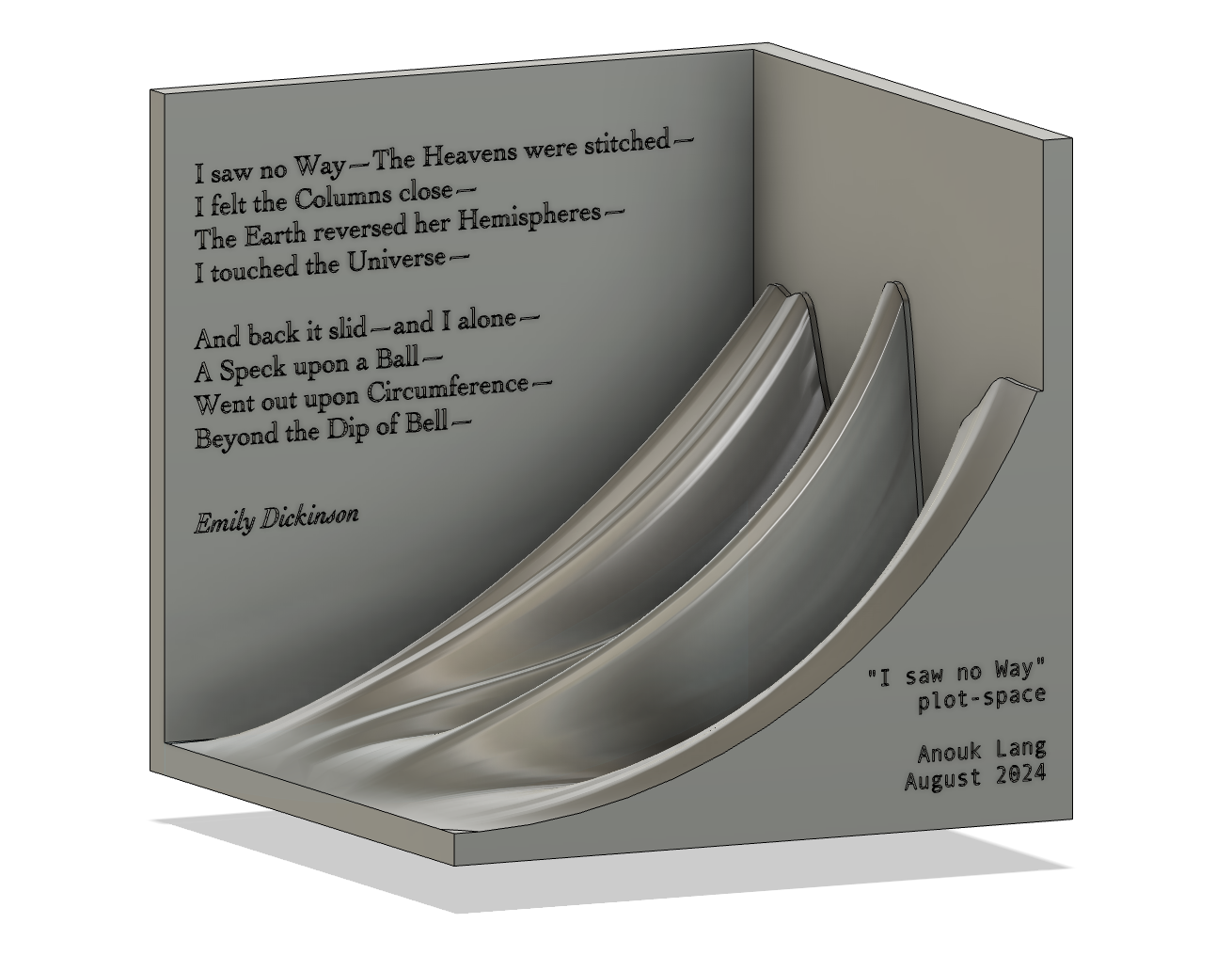
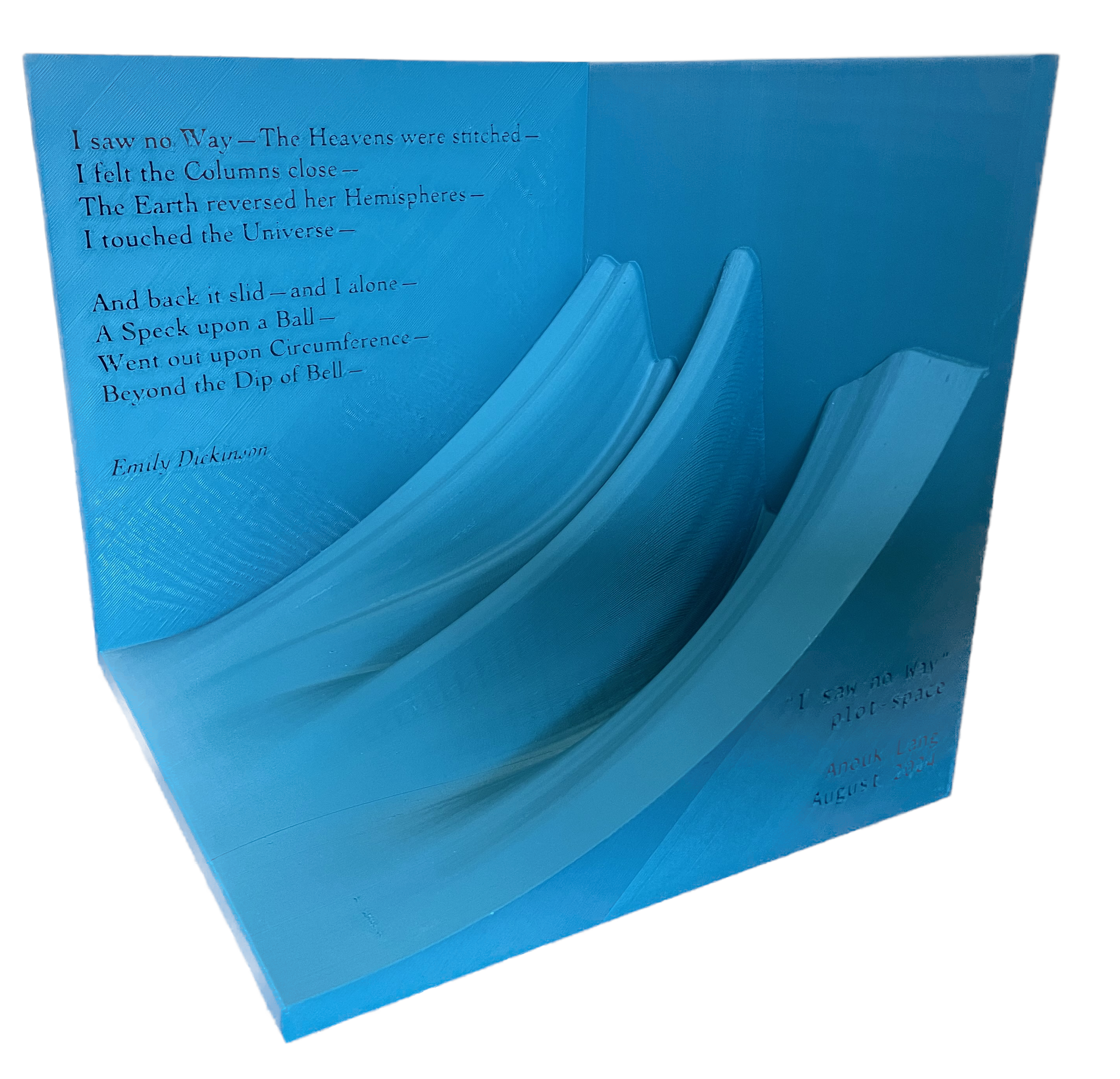
A plotspace is a three-dimensional rendering of a quality in a text
which changes as that text progresses and which can be plotted as the text
unfolds. It begins as a design in the virtual space of computer-assisted design
(CAD) software (Figure 1), and can also take physical form if 3D-fabricated
(Figure 2).
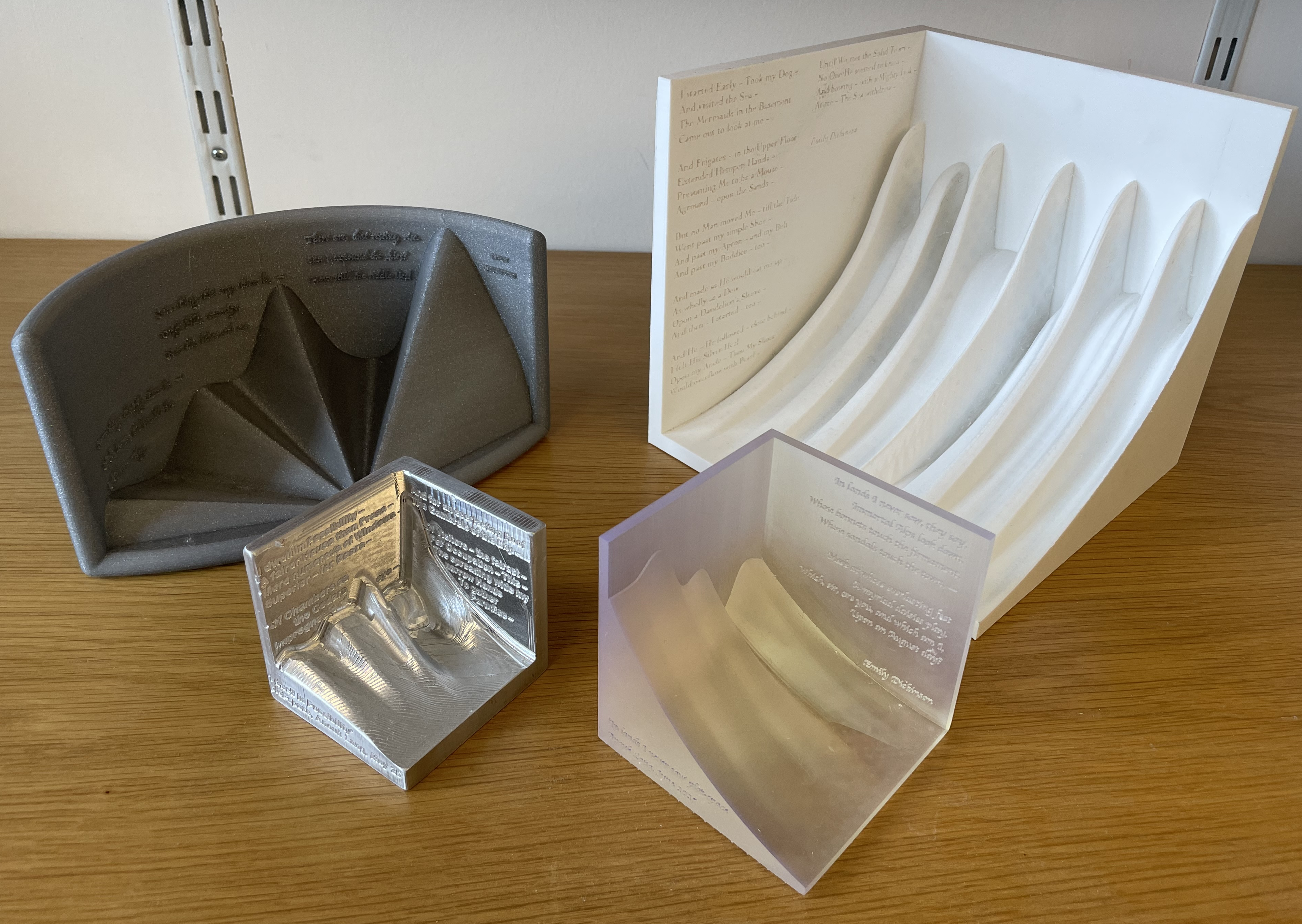
The plotspaces discussed below were printed in PLA plastic and resin, and milled
out of metal (Figure 3). Evoking the shape of a book or, in their curved
instantiations, a stage, each plotspace includes the text of a poem engraved or
embossed on its inner face(s), alongside a curve which plots the changing scales
of the entities in the poem. This curve extends out from its face in a
three-dimensional wave-like form which emphasizes the shifts in scale in the
poem, with the intention of prompting and provoking viewers to think about what
is illuminated by reading the text of the poem in conjunction with the
three-dimensional form which 3D fabrication makes possible. As I will go on to
show, encountering a poem in this unconventional way — in which the fluidity and
dynamism of circulating meanings are captured and fixed in a static form — spurs
different modes of engagement for both reader and maker, and opens up new ways
to think about how reading can be understood in terms of the relationship
between product (text and 3D-fabricated object) and process (interpretation and
fabrication). Insights have the potential to emerge from different stages in the
process, including the translation of the poem into a plot, the virtual design,
the fabrication of the material object, and the interpretation of the material
object, as well as the interactions of the various stages.
The term plotspace plays on the double meaning of plot as a noun
(i.e. what narratology designates syuzhet) and
plot as a verb (i.e. to make a graph), while space
designates both the physical space of the three-dimensional object, and the
imagined spatiality of the text being represented. This relationship between the
noun and the verb — the entity and the process by which it is constituted — is
central to the way a literary text does its work. Reading a poem, for example,
involves identifying particular “things,” for example
imagery, metrical patterning, voice, lineation, and so forth, but it is from the
interactions between these elements — a process that unfolds over time — that
meanings arise. Rather than seeking to freeze or capture a single meaning, given
that no two readers will agree on how to quantify space or scale in a poem, a
plotspace acts as a spur to interpretation: a tangible object that provokes and
defamiliarizes.
In functioning as a ground on which these two aspects — processes and entities —
can be brought together, plotspaces inhabit similar conceptual territory to
Bakhtin’s notion of the chronotope, which he describes in
The Dialogic Imagination as
“the intrinsic
connectedness of temporal and spatial relationships that are artistically
expressed in literature”
[
Bakhtin 1981, p. 84]. Bakhtin frames his explanation of the
chronotope — a theoretical construct he applies to literary genres spanning
multiple languages, and extending back to the second century C.E. — in material
and bodily terms:
In the literary artistic chronotope,
spatial and temporal indicators are fused into one carefully thought-out,
concrete whole. Time, as it were, thickens, takes on flesh, becomes
artistically visible; likewise, space becomes charged and responsive to the
movements of time, plot and history. This intersection of axes and fusion of
indicators characterizes the artistic chronotope. [Bakhtin 1981, p. 84]
For Bakhtin, it is the rich referential and
social world conjured within a novel that allows the connections between time
and space to
“thicke[n],”
“tak[e] on flesh,” and become
“fused into one … concrete whole.” If characters are an essential
part of how the connection between time and space in a novel takes on flesh,
then a plotspace enables the
“thickening” of that
connection with respect to a genre that does not rely on characters in the same
way, and by employing the kind of spatial and concrete form to which Bakhtin’s
formulation gestures. This form also resonates with the graphical dimension —
the
“intersection of axes” — of Bakhtin’s concept,
one he reports borrowing from mathematics
“for literary
criticism almost as a metaphor (almost, but not entirely).” Seen in
this light, the plotspace can be understood as taking up Bakhtin’s convictions
about the inseparability of place and time, and bringing them together in ways
that are not only entirely different to a novel, but whose fusion into a
concrete whole can, via 3D fabrication technology, be brought into the material
world for users to engage with in tactile as well as visual modes.
Plotting change over time in literary and historical texts
Before getting to the detail of how the plotting and 3D fabrication is done, it
is worth situating plotspaces in the light of other digital humanities projects
which take literary and/or historical texts, identify an aspect of interest
within them, and plot changes to that aspect over time in visually arresting
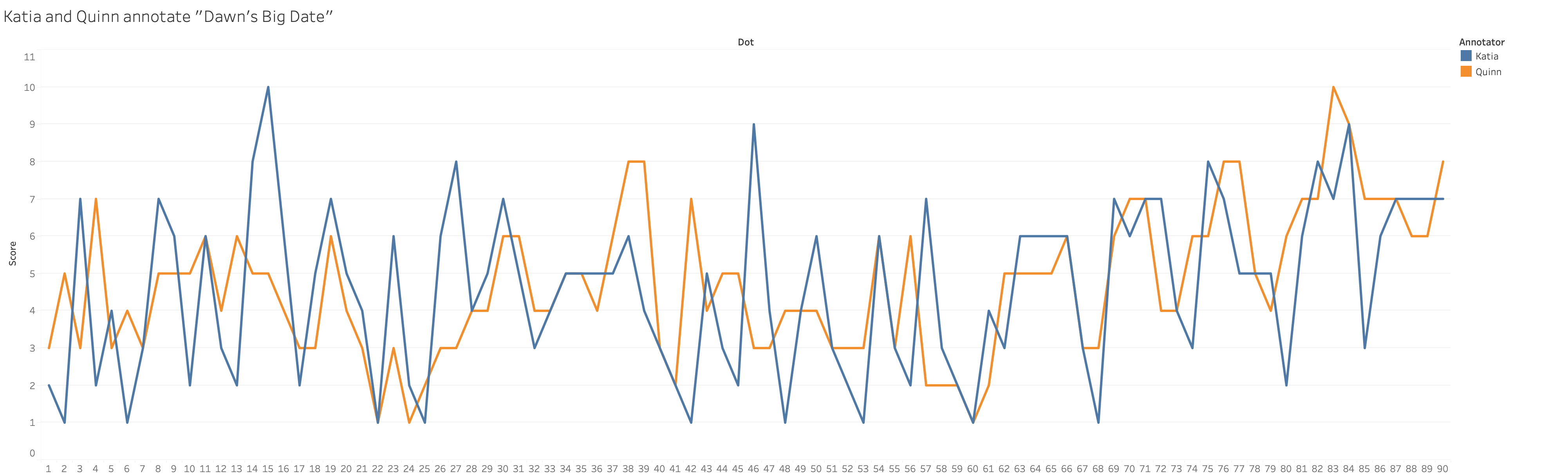
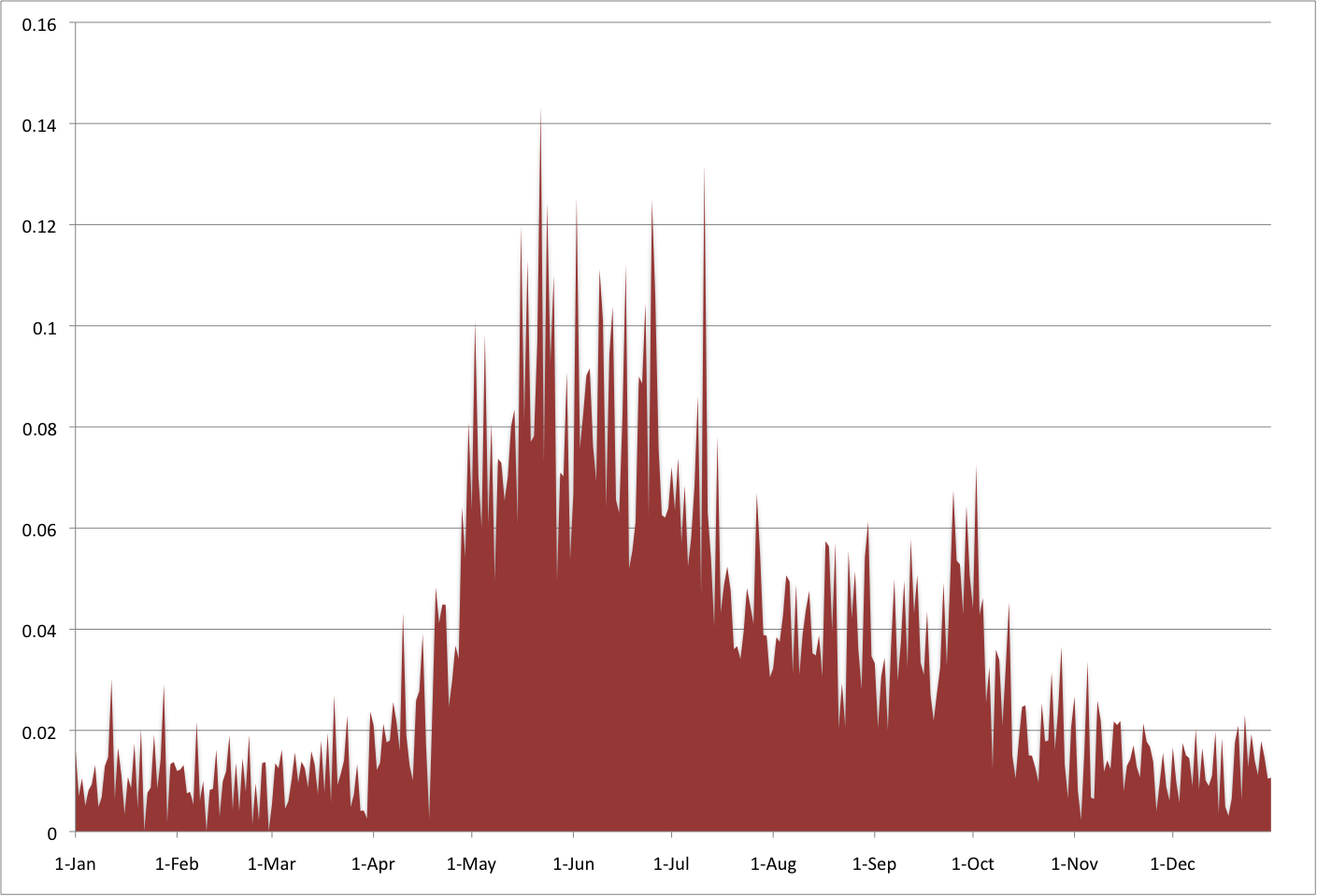
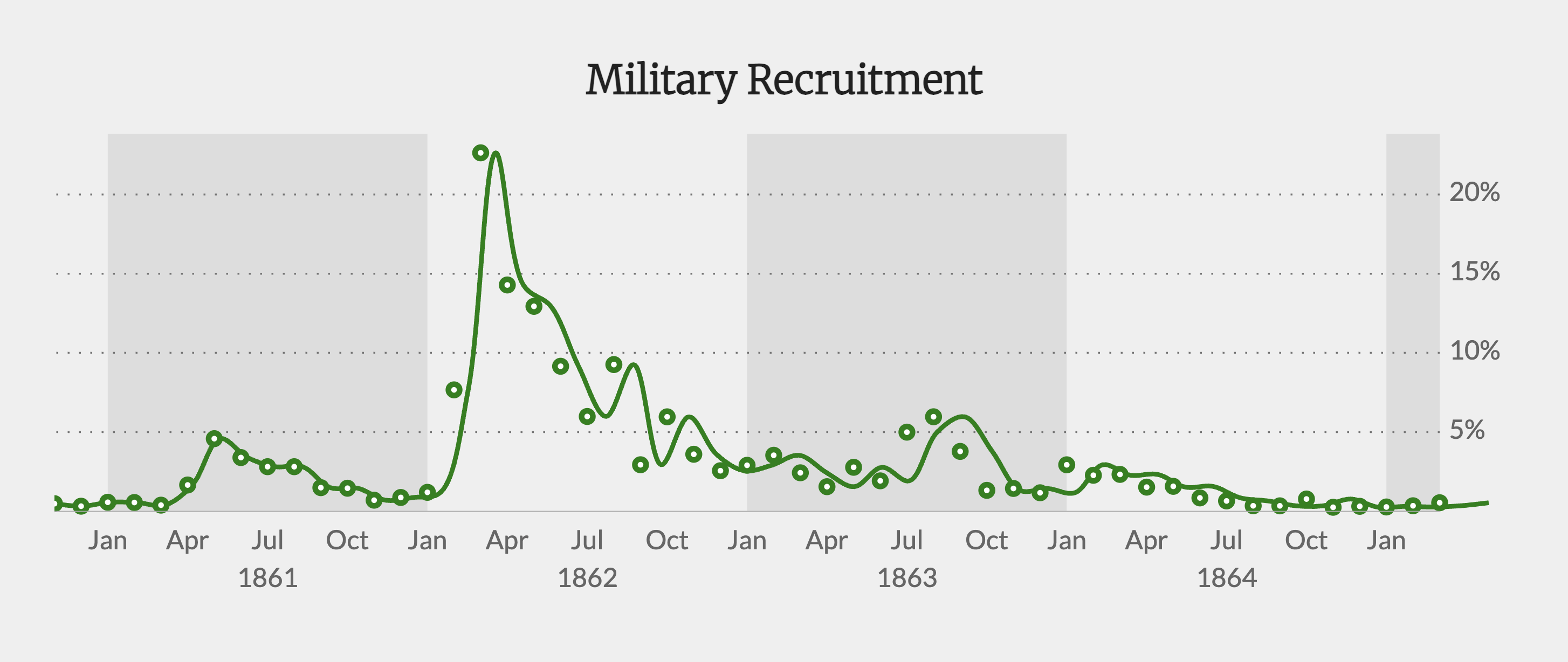
ways. These include sentiment analysis scores (Figure 4) or the changing
prominence of a topic in a topic model, something which is especially effective
in textual genres whose sections unfold over time such as diaries (Figure 5) and
periodicals (Figure 6).
Like Bakhtin’s chronotope, these visualizations are suited to narrative forms to
which chronology is important, as they make it easy to see change over time. The
utility of applying a similar visualization approach to poetic forms where
chronological progression may not be as important as, say, imagery, voice, or
metrical patterning is perhaps less clear. What is the value of
“freezing” a poem into a sculptural form when the
resulting static quiddity appears to stand so clearly in tension with the mobile
and mutable meanings that circulate within a poem? If, as Reuschel and Hurni
maintain, the drive to map individual texts is fostered by the desire
“to get a deeper, analytical insight into the spatial structure
of a story”
[
Reuschel and Hurni 2011, p. 293], then plotspaces respond to the
same desire for insights into the spatial workings of texts, but those texts
need not be oriented around stories. Rather, what they emphasize, and make
tactile, are the dramatic differences in scale that are contained in a single poem,
which in the case of Dickinson’s work can range from
“the
atom” to
“the universe.” A plotspace not
only visualizes these differences but registers the often vertiginous
shifts in a poem between these scales. As I will go on to
argue, visualizing these shifts has the capacity to contribute to a fuller
understanding of Dickinson’s poems, especially given their resistance to being
tied down to quantifiable measurements. In presenting visualizations such as
these, which give no concrete quantitative information but allow the shape of a
poem’s swoops and plunges between scales to be perceived all at once, I suggest
that such shifts provide Dickinson with the metaphorical resources to represent
and interrogate existential themes. In this way, the plotspace does not so much
shut meanings down as enable additional layers of meaning to become, literally,
visible.
More broadly, plotspaces also contribute to the project of defamiliarization that
Johanna Drucker identifies as an engine of radical critique with the power to
reveal the constructed and interpretive qualities of realist models of
knowledge, particularly those from scientific fields whose biases are
rhetorically concealed by information visualization forms that carry with them
the aura of epistemological authority. Drucker points specifically to
technologies for mapping — GIS mapping, Google maps — alongside other familiar
information visualization genres such as statistical charts and bar charts as
“a kind of intellectual Trojan horse, a vehicle through
which assumptions about what constitutes information swarm with potent
force”
[
Drucker 2011]. A provocative visualization such as a plotspace —
even one which might be felt by some to get things wrong about the poem on which
it is based — can perform this kind of perspectival and epistemological
defamiliarization that, for Drucker and other critics such as Susan Brown,
Catherine D’Ignazio and Lauren Klein, goes to the heart of humanistic critique
[
Brown 2020]
[
D'Ignazio and Klein 2020].
Methodology: How to make a plotspace
To transform Dickinson’s poems — themselves interpretable as spatial arguments —
I chose a selection in which space or scale featured consistently enough across
the whole text to be quantified and plotted. I looked not only for references to
objects with material or corporeal reality whose size could be easily specified
(human beings, insects, mountains), but also for metaphorical and metaphysical
entities whose size, large or small, might be inferred (e.g. paradise, the
heavens, “the Gambrels of the Sky”).
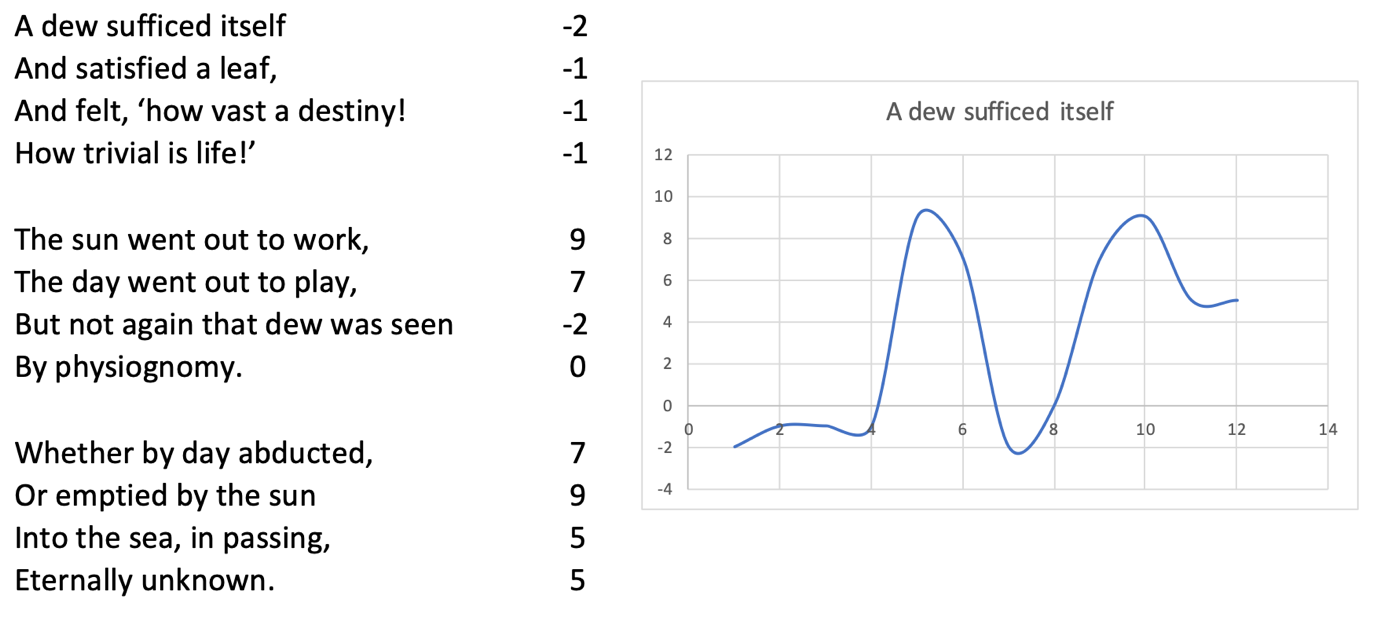
I then gave each poetic line a numerical rating and created a plot of those
ratings showing change along the horizontal axis as the text progresses. In
theory, any text and any division will work, though in practice, choosing a
short poem and dividing it into poetic lines is the most practically workable,
especially when a two-dimensional rendering on the screen is translated into a
three-dimensional material object. The numerical rating in this project
designated size, given that I was interested in poems from Dickinson’s oeuvre in
which scale and space were thematically prominent, but other aspects could also
be chosen. Generating these plots is, obviously, a highly interpretive
process, as the examples below demonstrate.
For the vertical axis, I used a log scale from 10 picometers through to 1015 m,
in the manner of the 1977 “Powers of Ten” documentary
by Charles and Ray Eames, which starts at the human level and zooms out to
progressively larger objects (a field, a city, a country, and so on), and then
zooms in to progressively smaller ones. I then rated each line of each poem with
the number corresponding to the size of what I deemed to be the line’s main entity,
designating for example 10 picometers as roughly equivalent to “an Atom” (a rating of -11), 100km as “the sea” or “the skies” as
seen from the ground (a rating of 12), and 108 m as “the
firmament” (a rating of 8). These ratings were then used to produce
plots for each poem showing how the size of what might be thought of as its
spatial imaginary varied over its lines.
To illustrate how the process works, consider “A dew sufficed
itself,” a poem of Dickinson’s which uses light and water imagery,
and the relative sizes of a drop of dew, a leaf, the sea, and the sun to explore
the relationship between significance and insignificance. The poem begins with a
personified dewdrop musing on its sense of its own inconsequentiality in
relation to a leaf, an object only one step above it in the scalar order. The
drop then disappears as the viewfinder pulls back to take in much larger
phenomena: the sun moving across the sky, and water evaporating to be condensed
back into rain and returned to the sea. Although the individual drop of dew
recedes from view as the scale shifts, the water cycle described in the latter
half of the poem makes clear its significance in the wider scheme of things, but
the poem tempers any facile or bathetic resolution with the uneasy tension
between the drop of dew’s capacity for existential reflection and its “eternally unknown” destiny. Not only, then, are the
relative sizes of entities in the poem — at least in this reading — crucial to
understanding its overall meaning, but the contrast between sizes, and the
sharpness of that contrast, are also key to the way the poem conveys its
meanings.
This process of translating the poem into a plot illustrates one of the
analytical uses of the plotspace, i.e. reading a text with this spatial coding
schema in mind. Rather than deterministically limiting a line to a single
reference, however, I suggest that the ratings can be understood as the outcome
of a process in which multiple options are weighed and related to the perceived
message of the poem as a whole. Reading for size and scale in this way acts as a
discipline of sorts, akin to how a particular theoretical frame will serve to
foreground some elements in a text that a reader might not otherwise have
noticed, while necessarily relegating other elements to the background. One
difference between a theoretical framing and a spatial rendering of scalar
shifts is that the latter can be transmuted into a form that can be apprehended
in both visual and tactile ways, and it is to the ramifications of this
transmutation, and the move from two to three dimensions, that I now turn.
Moving from two dimensions to three dimensions
Work at the intersection of literary studies and information visualization
demonstrates that spatial metaphors can furnish a resonant repertoire with which
to represent developments in literary and cultural history (see for example [
Goldstone and Underwood 2013]
[
Goldstone and Underwood 2014]
[
Gavin et al. 2019]
[
Underwood and So 2021].) It has, however, proved more difficult for
literary visualizations to cross from two dimensions into three, and some of the
most experimental and deformative scholarly projects which engage
three-dimensional forms such as the Z-axis modernism project mentioned earlier
have remained constrained to the screen. As Bethany Nowviskie suggests, moving
content from the screen
“into our embodied, place-based,
mobile lives”
[
Nowviskie 2016] via technologies for locative and augmented
reality, and bringing it into material and permanent existence through
consumer-accessible 3D fabrication technologies has the capacity to open up
generative possibilities for literary studies, something already well in
evidence in fields such as archaeology and public history. While scholars and
practitioners in the fields of editing, paleography, archives, and book history
are used to confronting the material forms of the media through which texts
travel, this does not hold consistently across the range of subfields that make
up literary studies, and it is to literary studies that Nowviskie directs her
challenge:
“What new, interpretive research avenues will
open up for you, in places of interesting friction and resistance, when you
gain access to the fresh, full circuit of humanities computing — that is,
the loop from the physical to the digital to the material text and artifact
again?”
[
Nowviskie 2016, pp. 179–180]. In their 3D-fabricated form,
then, plotspaces represent an attempt to respond to Nowviskie’s call, some dozen
years after she initially issued it in a paper given at the 2013 MLA Convention,
as they bring into view new interpretive avenues for the possibilities critical
making might hold for literary studies.
At the same time as affirming these possibilities, I want to hold at a distance
the techno-solutionist rhetoric that is sometimes attendant on 3D printing,
along with the fabricated artefacts — the smoothness and shininess of which
belie the multiple failed and glitchy progenitors on whose development their own
apparent flawlessness depends — which serve as apt metaphorical distillations of
this kind of utopian thinking. As anyone who has spent time doing 3D fabrication
in a makerspace will know, resistance in the materials is ubiquitous. But, as
Nowviskie points out, when William Morris’s celebrated phrase is invoked it is
accompanied only rarely by the line that follows it:
“And it
seems to me, too, that with a machine, one’s mind would be apt to be taken
off the work at whiles by the machine sticking or what not” (qtd. in
[
Nowviskie 2016, p. 177]). Whereas for Morris, the
“sticking or what not” stops the flow of artistic
creation, I suggest that what this
getting stuck-ness enables is
the potential for new insights, ideas, and critiques to emerge. In moving from
two dimensions to three, then, I seek to get beyond the representational and the
figurative to explore how the glitchy and subversive possibilities of 3D
fabrication might lend themselves to renderings of literary texts that
illuminate more than just those texts. First, however, I set out the processes
involved in moving from the poetic plots described above to 3D-printed physical
objects.
Making a poetic plot into a physical object, and what it can reveal
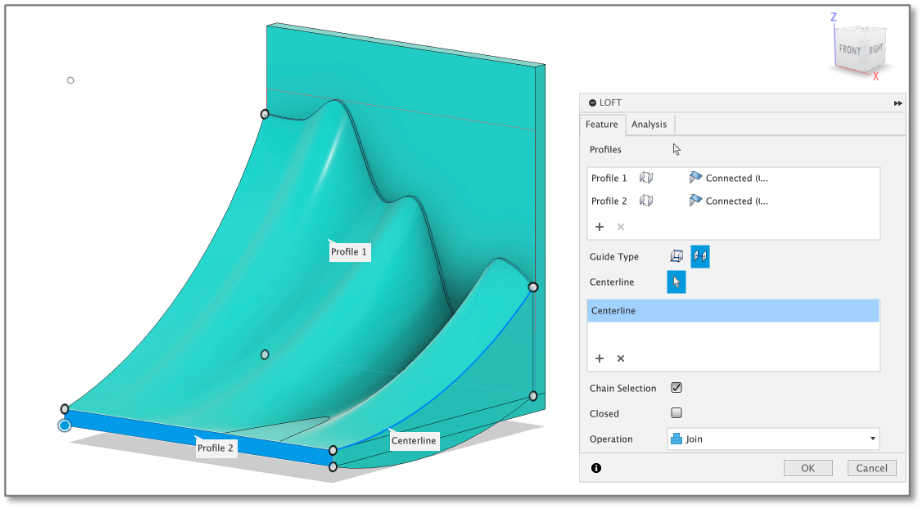
To move from the two-dimensional plot to a three-dimensional object, I used the
CAD software package Autodesk Fusion 360 to construct three flat planes joined
at a single vertex to make the three faces of a cube.
[1] I traced
the line of the plot created in an earlier step onto the inner face of one of
the vertical walls, and — depending on the material chosen for fabrication —
either engraved text into, or extruded text out of, one or both of the vertical
faces. To give three-dimensional volume to the plot, i.e. to bring the curved
line of the plot out from the vertical face and create three-dimensional
“waves” falling down from it to meet the horizontal
face, I used Fusion’s loft function, which allows for different shapes (or
“profiles”) to be seamlessly blended together.
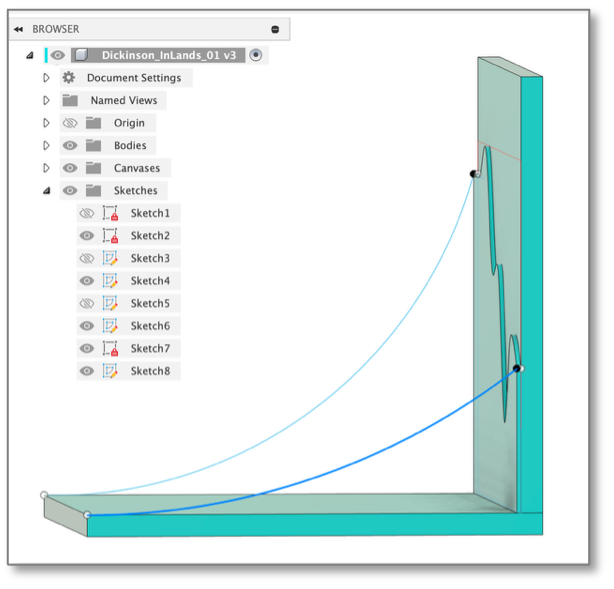
This involved creating rails: guide lines to indicate how the waves will be
shaped, from a gentle curve that is close to a diagonal line, to a more
pronounced concave curve (Figure 8), with convex curves and straight lines also
possible. The decision about the shape of the rails is an interpretive one, and,
as discussed below in relation to the
“I started Early —
Took my Dog” and
“It sifts from Leaden
Sieves” plotspaces, can be chosen to resonate with aspects of poetic
meaning. Figure 9 shows the different parameters the user can choose during the
process of lofting, including whether to treat a rail as a guide or as a
centerline.
[2]
As Figure 1 shows, the resulting shape resembles an open book which enables a
user to see the text of the poem at the same time as the visual rendering of the
shifts in space and scale, while also allowing them to apprehend these shifts by
holding the object and running one’s fingers over it. I made many design
decisions — for instance about whether the lofted curve would be shaped in a
concave or convex way — based on my own reading of the poem, and I discuss some
of these below. The most important decision, however, was the initial choice of
the poem, given that it needed to be able to fit onto the walls in its entirety.
I was therefore constrained not only to relatively short poems, but ones whose
scalar shifts, once plotted, were sufficiently dramatic to make for interesting
shapes, and which left sufficient room for the poem to be printed. In the era of
endless digital scroll, encountering space as a constraint is relatively
unusual, and in this context served as a reminder of Dickinson’s extraordinary
skill in packing a great deal of meaning into poems that are often very short.
As I designed more plotspaces, I continued to notice things in the poems that I
might not otherwise have paid attention to had I not been building 3D models of
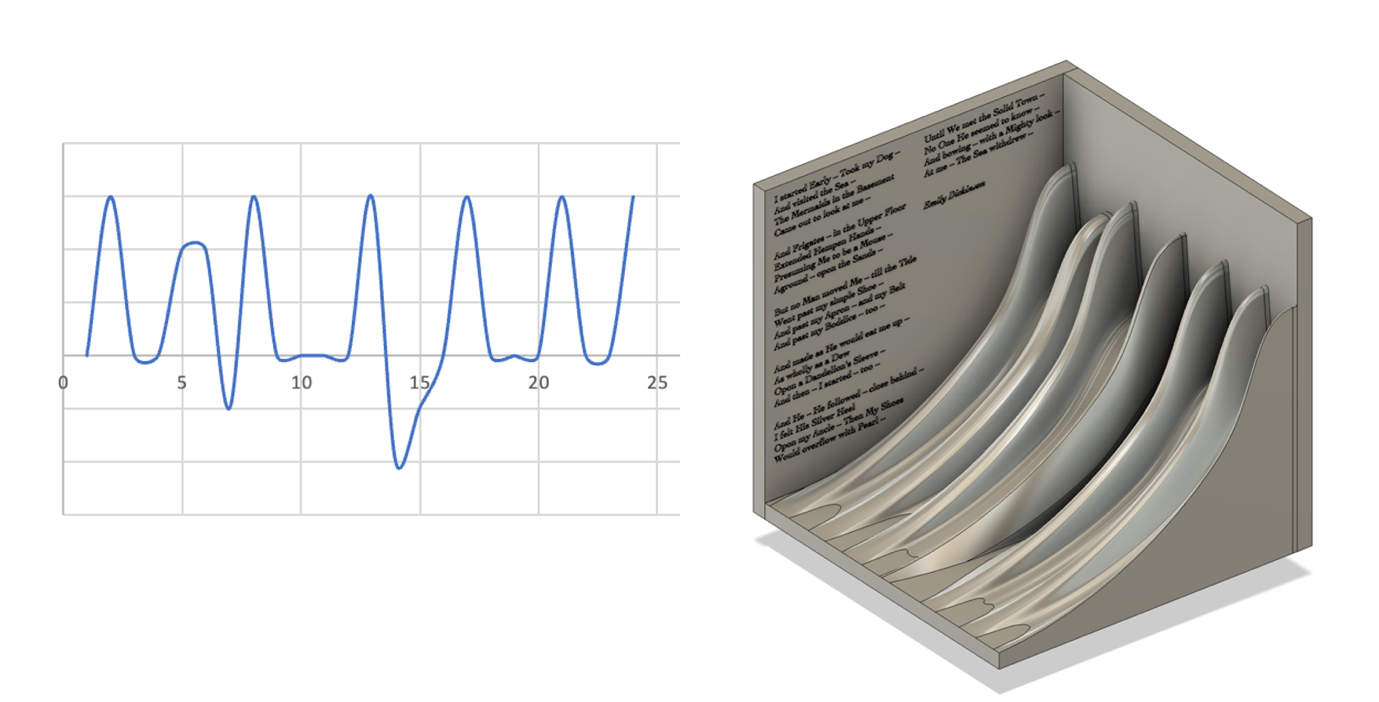
their shifts in size and scale. One example is the poem
“I
started Early — Took my Dog,” which begins at the human scale, zooms
out to
“the Sea,” then back to the human scale of
“Mermaids,” then out to
“Frigates,” and so on, creating a recurrent series of regular shifts.
The resulting wave shapes evoke the waves chasing the narrator, and they can be
easily seen in the plotspace (Figure 10).
There are, however, other ways to interpret the insistent back-and-forth motion
that are more menacing. The speaker’s unsettling encounter at the shore is
gendered: The sea, presented as a masculine persona, threatens to “eat [her] up” and pursues her as she retreats. The
overtones of sexual threat are evident from conventional close reading: images
such the tide that goes “past my Apron – and my Belt / And
past my Boddice – too” and the way the speaker’s shoe “overflows with Pearl” are startlingly visceral. But
what I did not notice until I undertook the coding and plotting was the
regularity of the shifts: The zooming in and out which the wave shapes of the
plotspace make so clearly visible. It is not just the shifts but their
regularity which emphasizes the overtones of latent sexual violence, and this
patterning of the poem’s perspectival shifts, and what their rapid back and
forth might evoke, is brought out by the visual rendering.
When I lofted these curves in CAD software, I made a decision to keep them quite
bony and austere to convey the sense of menace that I took from my reading of
the poem. When 3D printed in PLA plastic the curves were, indeed, pleasingly
severe. But if this severity could be readily perceived with the eyes, its
material reality required more effort to contend with, given the amount of
additional filament that was needed as support for each of the waves. After the
model had finished printing, I spent a lot of time wedging needlenose pliers
into the tiny crevices between waves in the attempt to pull out as many of these
scraps of filament as I could, something a temporary hand injury made even more
difficult as I could not grasp the pliers as tightly as I ordinarily would.
Trying to get sandpaper into the gaps to smooth away the remnants of filament
support was no easier. While the design decisions made on the screen had been
hermeneutically satisfying and achieved with no more effort than changing
parameters, entering numbers and redrawing some curves several times, then,
encountering the material instantiation of these design decisions led me to
notice in a bodily way the implications of the difference between these curves
and the gentler ones of a poem such as “A dew sufficed
itself.”
The ratings that give rise to the shape of the plot in Figure 10 are, evidently,
highly subjective. Readers might, for instance, disagree on the size of entities
such as “Frigates” (which I deemed bigger than humans
or a house, but not as big as “the Sea”), the key
entity in a line of poetry to which a scale rating should be applied, or the
meaning of an allusive term like “the Basement.”
Beyond the specifics of any individual reading, however, is the methodological
widening that is prompted by the shift to working in non-textual modes: the way
that the processes of rating, plotting, and visual designing drew out this
patterning which I was then able to adduce as additional evidence in service of
a reading which brought to light multiple dimensions of the gendered violence at
which the poem hints. Constructing a plotspace and giving it material form is
not about determining the single way a poem should be read. Rather, it takes one
interpretation, gives it physical form, and stands back to ask what is
illuminated by the act of making.
There were other ways in which bringing a plotspace off the screen and into the
physical world were generative, as decisions about how to shape its form
interacted with other choices such as the material with which to print it, and
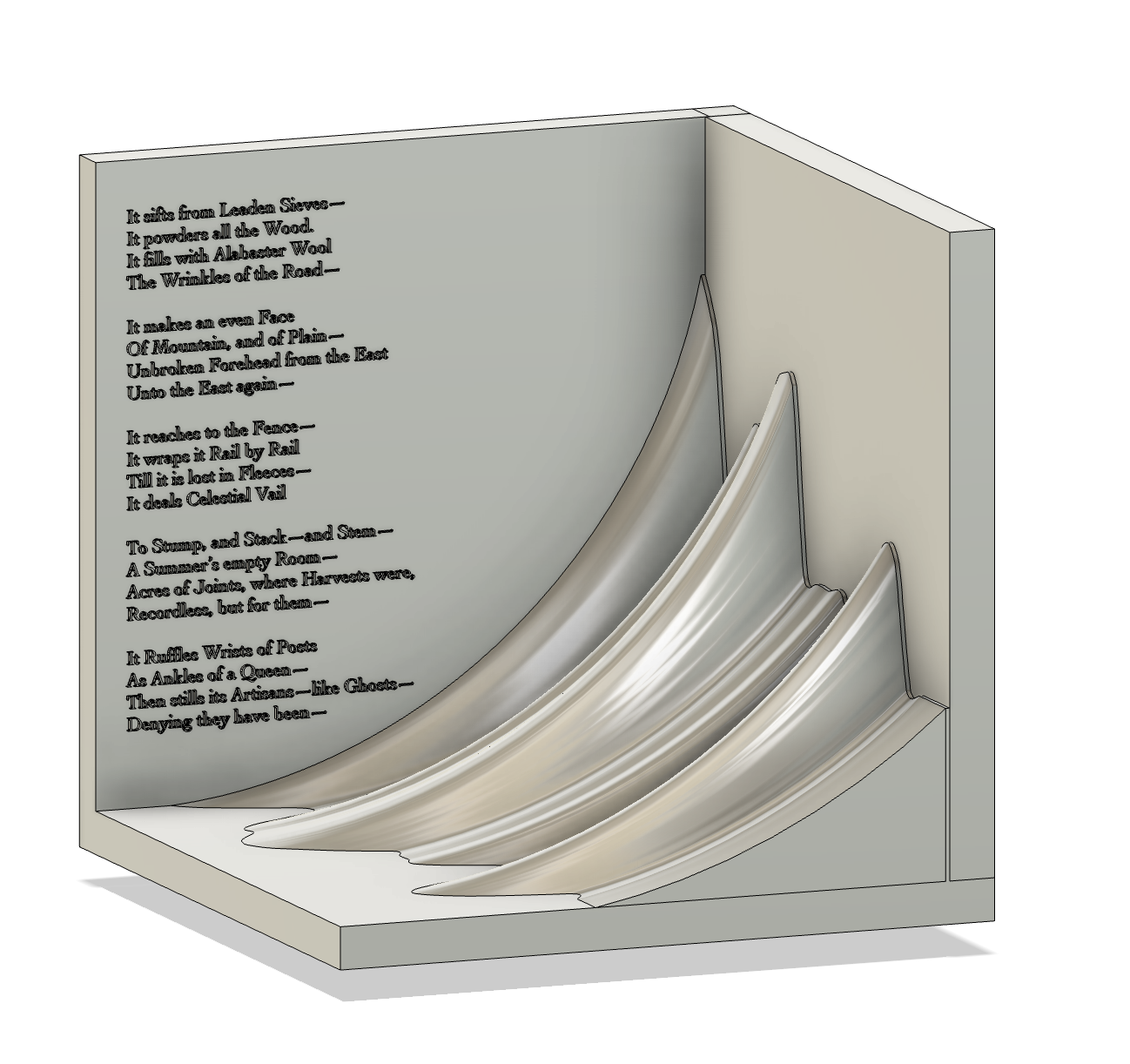
with my interpretation of a poem’s circulating textual meanings. In “It sifts from Leaden Sieves” (Figure 11), I elected to
make the curves concave because, printed in white PLA, they evoked the shapes of
snowy slopes and snowdrifts. Once printed, the plotspace gave tactile expression
to the striking contrast between the fluffy, natural qualities associated with
snow and the way the poem imagines it falling out of industrial metal sieves:
The curves of the model printed in white PLA (polylactic acid) do somewhat
resemble snow-covered slopes until, in a further act of defamiliarization, touch
reveals their smooth artificiality.
Plotspaces as hermeneutical instruments and theory frameworks
One of the affordances of a 3D-printed plotspace is that it is simultaneously
small enough to be carried around, turned over in one’s hands and passed to
others, while being large enough for a poem to be inscribed on its surfaces
alongside a spatialized rendering of its shifts. Occupying this middle ground
allows it to provoke interpretation in particular ways. While poems also provoke
interpretation, the visual and tactile dimensions of the plotspace bring other
elements into the hermeneutic mix, complicating the reading of the poem by
setting up a dialectical relationship between its potential meanings and those
of the material object in one’s hands.
In this way, plotspaces can be understood as what Stephen Ramsay and Geoffrey
Rockwell term
“hermeneutical instruments” and
“telescopes for the mind”: digital artifacts capable of
casting new light on the objects of humanistic enquiry. Beyond their potential
for illumination, such digital artifacts enable the production of theories
through which other phenomena can be better understood.
“We
might,” they suggest,
“consider digital artifacts
as ‘theory frameworks’ for interpreting, in the
same way that Jonathan Culler views Foucault’s theoretical
interventions”
[
Ramsay and Rockwell 2012, p. 79]. Indeed,
“digital artifacts like text analysis and visualization tools are theories
in the very highest tradition of what it is to theorize in the humanities,
because they show us the world differently”
[
Ramsay and Rockwell 2012, p. 79]. If Dickinson’s poems, first
encountered by many readers at school, have become sclerified into firmly
canonical texts, plotspaces offer a way to temporarily disrupt the familiar
contours of their meaning, and to see them differently: to foreground spatial
elements over other aspects; to call attention to rapid shifts in size; and to
think about the structure of a poem not in terms of familiar elements such as
metrical regularity, lineation or the number of lines in a stanza, but in terms
of how references to space and scale may differ considerably from the start of a
poem to the end, or what an oscillation between two different scales might
reveal about the other meanings circulating in a text.
Plotspaces as models
Within digital humanities, computation has been extensively theorized as a
modelling activity, with Willard McCarty noting
“the
fundamental dependence of any computing system on an explicit, delimited
conception of the world or ‘model’ of it”
[
McCarty 2005, p. 21]. As Ramsay and Rockwell observe,
thinking about digital humanities scholarly work as modelling has been a
productive idea, helping as it has to establish a critical discourse within
the field by connecting humanities-oriented research questions to the
literature and philosophy of science in which modelling is an established
practice [
Ramsay and Rockwell 2012, p. 81]. Moreover, the
description of a model put forward by the computer scientist Charles L.
Isbell and co-authors — as
“a representation of some
information, physical reality, or a virtual entity in a manner that can
then be interpreted, manipulated, and transformed”
[
Isbell et al. 2010, p. 198] — is a characterization that
not only fits a computer model but also a poem, while the view of
computation as modelling is redolent of the processes that a plotspace spurs
in its users. For Isbell et al., the modelling activity at the heart of
computing is centred on establishing how one domain, usually a phenomenon in
the world or in the imagination, corresponds to another in computational or
algorithmic form. A computing machine or artifact might be
“typically manipulated through some language that provides
a combination of symbolic representation of the features, objects, and
states of interest as well as a visualization of transformations and
interactions that can be directly compared and aligned with those in the
world,” with the computationalist, or indeed the digital
humanist,
“acting as an intermediary between models,
machines, and languages and prescrib[ing] objects, states, and
processes” [
Isbell et al. 2010, p. 198]. This definition of
modelling speaks to the symbolic representation of the different spatial and
scalar levels by the curve of the plot, and the lofted shapes that emerge
into three-dimensional space from it. The transformation of textual meaning
into physical shapes can be compared and aligned with the material world,
and the mediating role of the plotspace modeller, as with the
computationalist, is evident.
It is, however, useful to retain some distance from understanding a plotspace
purely or primarily as a model, because although it is possible to read a
plotspace as a model of a text’s spatiality — or, as discussed earlier,
other aspects such as sentiment or topic prominence — it has a wider and
richer set of functions. In overtly signalling the subjective nature of the
information they model, plotspaces serve as a reminder that, as Joris van
Zundert observes, data models are anything but neutral, as they present
“a purposefully specific selection of semantic
categories and properties”
[
van Zundert 2016, p. 343]. Beyond simply the selection
of data and the choice of categorization method, they are aligned with the
tradition of digital humanities artefacts that demonstrate the centrality of
interpretation, and the way that
choices made in the
analytical conception of any given digital humanities project affect its
hermeneutic makeup. The choices of what properties to quantify, what
probability distribution functions are chosen, which statistical tests
are used, are in essence hermeneutically informed. [van Zundert 2016, pp. 343–344]
Beyond simply pointing to the subjective nature of the selection of
particular data, specific analytic methods and visualization choices, then,
plotspaces foreground
“the reciprocal shaping of the
hermeneutics of digital humanities by the methods of computer
science”
[
van Zundert 2016, p. 343]. If such reciprocal shaping
is a well-established notion within digital humanities, it is perhaps less
commonly encountered within literary studies, where the media through which
texts reach their readers — usually pages and screens, and less commonly
print forms like manuscripts or archival ephemera — has a tendency to recede
into the background, as the form and content of the text assumes analytical
center stage. Placing a plotspace into an individual’s hands and watching
what they do with it, however, brings not only the medium but also the human
interpreter back into view. When handing a plotspace to someone, I have
found that a common reaction is that they first read the poem on its inner
surface and then begin surmising how the curves might relate to the textual
elements, wondering for instance whether they represent metrical patterning.
Size or scale are usually not identified as the features being visualized,
but, at least from what is articulated out loud, the interaction between the
textual and the sculptural elements lead to people approaching the poem in
ways that differ from established modes of interpretation. Once informed
what the curves represent, they continue assessing the physical form against
their reading of the poem, passing their fingers over its curves and turning
it over in their hands: The materiality of the plotspace evidently does not
close off interpretation but continues to stimulate it. This includes people
questioning or resisting what they understand the curves to be expressing
about the poem’s meanings and sometimes taking issue with the very idea of
freezing the spatial referents in a poem into a single static
representation. This is, of course, part of the point: Plotspaces are
designed to be provocative. If all models have interpretive frameworks
embedded within them, a plotspace performs an additional function. Its
tactility and handheld qualities — the way it prompts users to hold it and
stroke its curves — set up a relation of three-way interpretive reciprocity
between the user, the poem, and the object, bringing the processes of
visualization and interpretation to the fore, where they can be examined and
contested.
Plotspaces as instances of feminist data materialization
One of feminist theory’s core preoccupations is attentiveness to the
conditions in which knowledge is produced, and to the shaping effects of
those conditions. Seen in this light, the issue is not that data
visualization may be biased in a particular way, but rather that all
visualizations necessarily represent particular perspectives, and their
meanings reach users through framing devices. As Catherine D’Ignazio and
Lauren Klein observe in
Data Feminism,
“[w]hen visualizing data, the only certifiable fact is that
it’s impossible to avoid interpretation”
[
D'Ignazio and Klein 2020, p. 80]. A plotspace, emerging as it
does from a set of conditions that it has been possible to only briefly
sketch here, can thus be thought of not so much as a factual representation
of some quality in a poem, but rather as an artefact that opens up a space
for thinking about additional meanings of a poem, along with meditations on
materiality, the framing devices it brings with it, and the perspectival
partiality which results.
The fact that plotspaces — like Dickinson’s poems themselves — are not
transparently interpretable, coupled with their ability to open up questions
about the power relations governing the conditions in which they are
produced, make them amenable to being situated in the tradition of feminist
visualization. Lauren Klein, discussing historical visualizations made by
the nineteenth century designer Elizabeth Palmer Peabody in the form of
floor rugs, elaborates on some of feminist visualization’s anchoring
principles: acknowledging that visualizations give rise to
“a multiplicity of meanings,”
“locat[ing] knowledge in the interplay between viewer,
image, and text,” and seeing visualizations
“not as evidence or proof of results, but as a tool in the process of
knowledge production”
[
Klein 2017]. Within a plotspace, knowledge emerges from the
interplay between viewer, image, and text, and to those things three further
epistemic entities can be added: bodies, ability, and labor. Another
affordance of a plotspace is that it prompts its user to hold multiple modes
of interpretation against another: textual interpretation vs. visual
perception vs. tactile apprehension. Klein observes that the creation of
knowledge can occur not only through perceiving visualizations but also
through the act of creating them, something which was the case for Peabody,
and which I found was also the case for me during the processes of design,
fabrication, and post-processing.
[3]
Conclusion: Resistance in the materials and in the makerspace
In Klein’s reading, Peabody’s floor rug visualizations provoke a different mode
of sensory engagement, asking
“viewers to reconsider the
actual position of their bodies in relation to their objects of
knowledge” and thereby inviting physical engagement with what one is
seeing and what it might mean [
Klein 2017]. A plotspace also
invites bodily involvement: picking it up and turning it over in one’s hands to
see it from multiple angles recalls the process of interpreting a poem, which is
similarly iterative and unfolds over time as aspects of the meaning which emerge
from one poetic feature are then brought to bear on other potential meanings
arising out of other features. If, to adapt I.A. Richards’s phrase, a text is a
machine to think with, then
“the machine sticking and what
not” — a line on an otherwise smooth plastic face indicating where
the amount of filament was underestimated and more has had to be loaded into the
printer, strands of plastic support that stubbornly resist the ability of human
hands to remove them, or the legibility of words easily perceived on a screen
which is confounded by the limitations of layer heights and nozzle size on a 3D
printer — opens up opportunities for insight which the familiarity born of
habituation might otherwise close off. As the design researcher Sara Hendren
observes, you
“build something so that you can
think with that thing”
[
Hendren 2025].
This project began as an attempt to use visualization methods to understand the
workings of space and scale in poems in ways not tied to Euclidean geometry and
positivistic cartography. As it proceeded, its broader implications emerged in
ways that swiftly outpaced its disciplinary beginnings: the ways that our
increasing reliance on and immersion in digital technologies makes it too easy
to ignore the material implications of their use. A plotspace, in its
translation from poem to screen to material object, speaks to Alan Liu’s call
for those in DH to continue asking
“[h]ow the digital
humanities advances, channels, or resists today’s great postindustrial,
neoliberal, corporate, and global flows of information-cum-capital”
[
Liu 2012, p. 491]. As literary studies pursues theoretical
vocabularies and frameworks appropriate to grappling with materiality at a
moment when we are confronted with hyperobjects like climate catastrophe,
accelerating extinction rates, and planetary forces that not only challenge
conceptualization but push forms like narrative and poetry to their limits, we
will need ways to think outside the disciplinary box as a way of approaching
scale, as well as keeping in view the increasing amounts of energy, water, and
resources that digital technologies require. Poems, that most ephemeral of
literary forms — often so short that they can be memorized and the need for
mediating interfaces can be avoided completely — might seem an unintuitive way
to approach these questions. But, transmuted into plotspaces, they can become a
vehicle for reconsidering the position of one’s body to cultural artefacts and
to see with fresh eyes the material, and the technologies, with which those
artefacts are made.
Acknowledgements
I am very grateful to Peter Bentley, who runs the Edinburgh Futures Institute
Makerspace at the University of Edinburgh, for his expertise and patience in
teaching me to use the machines for milling, resin printing, and 3D printing
which were essential to this project. I also want to acknowledge Ruth Buckley
and the staff of uCreate, the makerspace at the University of Edinburgh library,
for their help and guidance.
Works Cited
Bakhtin 1981 Bakhtin, M.M. (1981) The Dialogic Imagination: Four Essays. Translated by
Emerson, C. and Holquist, M. Austin: University of Texas Press.
Black, MacDonald, and Black 1998 Black, F.A.,
MacDonald, B.H. and Black, J.M.W. (1998)
“Geographic
information systems: A new research method for book history”,
Book History, 1(1), pp. 11–31. Available at:
https://www.jstor.org/stable/30227281.
Bushell et al. 2022 Bushell, S. et al.
(2022)
“Digital literary mapping: II. Towards an integrated
visual–verbal method for the humanities”,
Cartographica: The International Journal for Geographic Information and
Geovisualization, 57(1), pp. 37–64. Available at:
https://doi.org/10.3138/cart-2021-0007.
Christie and Tanigawa 2016 Christie, A. and
Tanigawa, K. (2016) “Mapping modernism's z-axis: A model for
spatial analysis in modernist studies”, in Ross, S. and O'Sullivan,
J. (eds.) Reading Modernism with Machines: Digital
Humanities and Modernist Literature. London: Palgrave, pp.
79–107.
D'Ignazio and Klein 2020 D'Ignazio, C. and Klein, L.F. (2020) Data
Feminism. Cambridge, MA: MIT Press.
Gavin et al. 2019 Gavin, M. Jennings, C.,
Kersey, L, and Pasanek, B. (2019)
“Spaces of meaning:
Conceptual history, vector semantics, and close reading”, in Gold,
M.K. and Klein, L.F. (eds.)
Debates in the Digital
Humanities 2019. Minneapolis: University of Minnesota Press, pp.
243–267. Available at:
https://www.jstor.org/stable/10.5749/j.ctvg251hk.24 (Accessed: 10
April 2025).
Goldstone and Underwood 2014 Goldstone, A.
and Underwood, T. (2014) “The quiet transformations of
literary studies: What thirteen thousand scholars could tell us”,
New Literary History, 45(3), pp.
359–384.
Gregory and Cooper 2010 Gregory, I. and
Cooper, D. (2010) “GIS, texts, and images: New
approaches”, Poetess Archive Journal,
2(1), pp. 1–22.
Isbell et al. 2010 Isbell, C.L. et al. (2010)
“(Re)defining computing curricula by (re)defining
computing”,
SIGCSE Bulletin, 41(4), pp.
195–207. Available at:
https://doi.org/10.1145/1709424.1709462.
Klein et al. 2024 Klein, L. et al. (2024)
“The work of knowledge: Elizabeth Palmer Peabody's
chronological grids”,
Data by Design.
2024 public beta. Available at:
https://dev.dataxdesign.io/chapters/peabody (Accessed: 26 October
2025).
Kwan and Knigge 2006 Kwan, M.-P. and Knigge, L.
(2006)
“Doing qualitative research using GIS: An oxymoronic
endeavor?”,
Environment and Planning A,
38(11), pp. 1999–2002. Available at:
https://doi.org/10.1068/a3846.
Liu 2012 Liu, A. (2012)
“Where is
cultural criticism in the digital humanities?”, in Gold, M.K. (ed.)
Debates in the Digital Humanities. Minneapolis:
University of Minnesota Press, pp. 490–510. Available at:
https://www.jstor.org/stable/10.5749/j.ctttv8hq.32 (Accessed: 7 April
2025).
MacDonald and Black 2000 MacDonald, B.H.
and Black, F. (2000)
“Using GIS for spatial and temporal
analyses in print culture studies: Some opportunities and
challenges”,
Social Science History, 24(3),
pp. 505–536. Available at:
https://www.jstor.org/stable/1171610.
McCarty 2005 McCarty, W. (2005) Humanities Computing. Basingstoke: Palgrave
Macmillan.
Nowviskie 2016 Nowviskie, B. (2016)
“Resistance in the materials”, in Gold, M.K. and Klein,
L.F. (eds.)
Debates in the Digital Humanities 2016.
Minneapolis: University of Minnesota Press, pp. 176–183. Available at:
https://www.jstor.org/stable/10.5749/j.ctt1cn6thb.18 (Accessed: 7
June 2025).
Ramsay and Rockwell 2012 Ramsay, S. and
Rockwell, G. (2012)
“Developing things: Notes toward an
epistemology of building in the digital humanities”, in Gold, M.K.
(ed.)
Debates in the Digital Humanities.
Minneapolis: University of Minnesota Press, pp. 75–84. Available at:
https://www.jstor.org/stable/10.5749/j.ctttv8hq.8 (Accessed: 8 May
2025).
Reuschel and Hurni 2011 Reuschel, A.-K. and
Hurni, L. (2011)
“Mapping literature: Visualisation of
spatial uncertainty in fiction”,
The
Cartographic Journal, 48(4), pp. 293–308. Available at:
https://doi.org/10.1179/1743277411Y.0000000023.
Saint-Amour 2024 Saint-Amour, P.K. (2024)
“Countermapping Ulysses”,
Affirmations: Of the Modern, 9(1), pp. 90–110. Available at:
https://doi.org/10.31646/am.144.
Vendler 2010 Vendler, H. (2010) Dickinson: Selected Poems and Commentaries. Cambridge,
MA: The Belknap Press of Harvard University Press.
van Zundert 2016 van
Zundert, J.J. (2016) “Screwmeneutics and hermenumericals:
The computationality of hermeneutics”, in Schriebman, S., Siemens, R.
and Unsworth, J. (eds.) A New Companion to Digital
Humanities. Malden, MA: Wiley, pp. 331–347.


 https://orcid.org/0000-0001-9597-1026