Abstract
This case study presents challenges and solutions for building calibrated
syntactically annotated diachronic corpora of French. Through a series of integrated
projects that developed methods for syntactic annotation of medium and large
collections of non-literary texts over a long period of time (13th – 19th centuries),
we consider how the availability of tools and the emergence of research questions
shape and direct corpus-building activity. Supported by the experience of an earlier
project, a semi-automated workflow for syntactic annotation was developed to allow
processing of two corpora calibrated by provenance and genre, with a focus on
parts-of-speech tagging in three annotation frameworks. The workflow combines the
use
of a neural dependency parser, a lexicon of lemmata and forms and a Python library.
This experience, in turn, gave rise to a new initiative that aimed at formulating
and
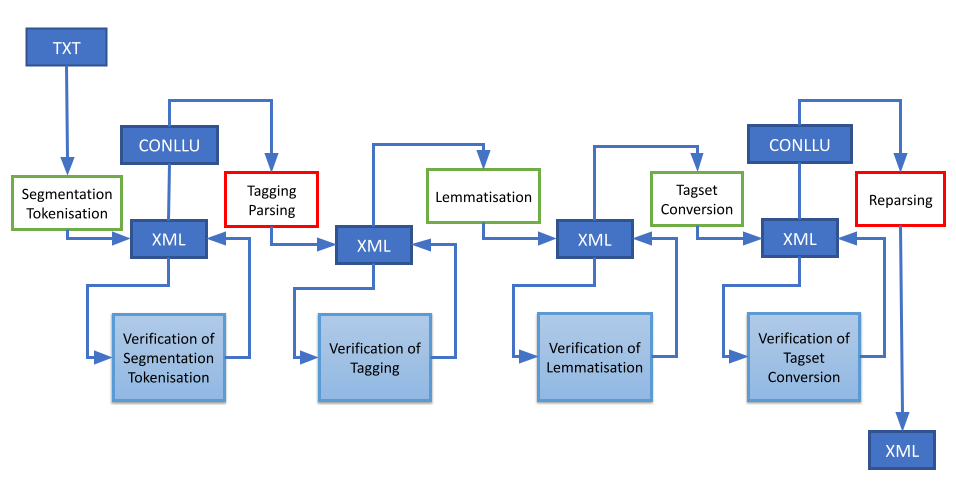
testing best practices for creating syntactically annotated treebanks
for different periods of the history of the language.
Introduction[1]
The study of the evolution of language over several centuries is facilitated by
access to digital collections of syntactically annotated texts. Such
corpora allow searching for syntactic structures automatically in
order to identify particular configurations. Annotation of lemmata, parts of speech
(PoS) and syntactic functions make it possible for researchers to compare and
contrast the shape of language through time, explain the observable patterns and test
general hypotheses. Such enrichment by lexical and grammatical metadata can be
achieved by modern computer-assisted methods, including, most recently, deep-learning
tools such as neural network parsers. For the history of French language, a number
of
annotated resources exist. However, they:
- are usually limited to a particular period, which impedes comparative work
across the history of the language; [2]
- consist predominantly of literary material which exhibits conservative traits
and is believed to be removed from the everyday language [Balon and Larrivée 2016]
[Pinzin and Goux forthcoming];
- lack accurate annotation of syntactic functions, which means that even after
the extraction of desired configurations of parts of speech considerable
investment is often needed to review the data manually.[3]
In the present contribution, we discuss how a series of integrated projects conducted
in 2018-2024 at the CRISCO Laboratory at the University of Caen (France) set out to
address these challenges making use of language processing technologies available
to
researchers at each stage.
[4]
Corpora
Supporting research into the history of French syntax, the three projects
presented here sought to integrate existing tools and develop methodologies for
successful management and syntactic annotation of medium to large diachronic
corpora. To limit potential documentation biases, all three share
a common approach to the selection of data, opting for texts of a given
non-literary genre and produced in the same geographical area (Normandy), to
control for extraneous variation (
Table 1). The ConDÉ
project (2018-2021)
[5] produced a large
digitized corpus of Norman customal law texts (
coutumiers normands)
from the 13th to the 18th century, based on a method trialed on a set of
historical letters (EPELE).
[6] Building on the experience of ConDÉ, High-Tech project
(2021-2023) gave rise to a collection of chronicles and historical treatises from
the 12th to the 19th centuries, with one text per century.
[7] In addition, as part of the Franco-German MICLE project
(2021-2024), a further medium-sized corpus of legal texts was elaborated which
includes trial accounts and
styles de procéder from the 12th to the
17th centuries, with one text per half-century.
[8] Below, we refer to the corpus of customal
law as
ConDÉ, to the corpus of chronicles produced as part of the
High-Tech project as
Chroniques and to the corpus of trial accounts
and
styles de procéder, created by the French team of the MICLE
project, as
MICLE-Fr. The semi-automated workflow for lemmatization
and annotation developed by the High-Tech project and tested during the annotation
of
Chroniques and
MICLE-Fr corpora is referred to as the
HT-CRISCO workflow. The annotated collections can be consulted via the CRISCO
Laboratory’s TXM server and two dedicated websites.
[9] Most
texts are out of copyright and can be consulted either in full or via a
concordance, whereas for a small minority of sources only concordance view is
available.
| Project/Funding Period/Funder |
Corpus |
Text Types |
Period |
Number of Tokens |
Annotation |
|
ConDÉ
2018-2021
(Réseau d’Intérêts Normands)
|
ConDÉ
|
Norman customals |
13th-19th cent. |
4,452,540 tokens |
*lemmata
*PoS (Presto)
|
|
MICLE
2021-2024
(ANR/DFG Franco-German grant)
|
MICLE-Fr
|
Legal texts (trials)
Legal treatises (styles de procéder)
|
13th-17th cent. |
422,117 tokens |
*lemmata
*PoS (UD, UPenn, Presto)
*syntactic functions UD (automatic)
|
|
High-Tech
2021-2023
(Réseau d’Intérêts Normands)
|
Chroniques
|
Chronicles
|
12th-19th cent. |
313,518 tokens |
*lemmata
*PoS (UD, UPenn, Presto)
*syntactic functions UD (automatic)
|
Table 1.
Diachronic corpora of Medieval French projects at the CRISCO Lab
2018-2024
Methodology
The different stages of processing of the data, from image to annotated text, are
described below. The major methodological and practical challenges include
transcription and digitization of large amounts of textual data from heterogeneous
original sources, lemmatization and syntactic annotation. Appropriate tools need to
be selected to process the data at each stage. Different types of software use
different data formats; therefore, conversion scripts need to be provided to ensure
interoperability. In addition, choices need to be made about when linguists intervene
to correct outputs of automatic processing.
Transcription
All corpora were digitized from reproductions of manuscripts or scans of printed
editions using OCR and HTR technologies made available via the Transkribus portal.
[10] Transkribus allows the use
of pre-trained transcription models and training of new models adapted to
particular sources. Creating custom-made models was especially necessary in the
case of the ConDÉ project, which processed a mass of material: the two volumes by
Basnage (1678), for example, run up to a million characters. As part of
MICLE-Fr, one particular challenge was the complete and fully
verified transcription of a 16th-century manuscript of witness statements from the
island of Guernsey Greffe Crime 1 (more than 41,000 tokens).
[11]
The diversity of sources from across several centuries, ranging from medieval
manuscripts to modern critical editions, not to mention early printed books, meant
that the texts of the corpora presented considerable variation where
spelling of individual words were concerned. The decision to remain as close to
the original as possible and not to normalize the spelling was taken for all
projects as the tools available permitted to accommodate variation. Lemmatization
allowed grouping all grammatical forms and all spelling variants of the same word
under the same headword. For example, in the Chroniques corpus, the
French word king can be encountered under the forms rei,
reis, rey, reys, roi,
rois, all lemmatized under the headword roi.
File formats
Once digitized, the texts of
ConDÉ,
Chroniques and
MICLE-Fr corpora were converted into the XML-TEI format [
DeRose 1999]. This format permits encoding editorial interventions
such as corrections of the original (e.g., in case of repetition of words). The
use of this format facilitated manual correction of the data throughout the
annotation pipeline described below and allowed integration of the final versions
of the annotated files into the TXM-portal and websites to enable consultation and
interrogation of the
corpora. Texts were processed and corrected
individually, with a different file corresponding to each.
The chosen format allowed reflecting the structure of the original (i.e., the
manuscript or printed version that had been digitized) in the structure of the XML
document. According to the XML-TEI hierarchy, a text can be divided into books, a
book can be divided into sections, a section into chapters, and a chapter into
paragraphs; the corresponding tags made it possible to indicate where paragraphs
and larger sections of the text begin and end.
[12]
For ConDÉ, only XML-TEI format was used throughout all stages of
processing. For Chroniques and MICLE-Fr, files needed to
be converted into the CONLL-U tabular format that is used by the syntactic parsers
twice during the execution of the workflow (see 3d-2 below). To reintegrate the
parsed data into the XML-TEI corpus, CONLL-U files were converted back into the
XML-TEI format. The synchronization between the XML-TEI version and CONLL-U
version of the files was done via the assignment of a unique ID to each sentence
of the text. Thus, sentence 1 in paragraph 3 of chapter 34 in section 1 of book 2
would be given sentence ID “2_1_34_3_1”. This number
would, in turn, allow finding the place of the sentence in the XML-TEI structure
after parsing is completed.
Segmentation
Prior to any further treatment, the texts were tokenized and, in the case of
Chroniques and MICLE-Fr, segmented into sentences
(using strong punctuation as a prompt for automatic segmentation, followed by
manual revision). For the ConDÉ project, annotation was done exclusively on the
token level, whereas for High-Tech and MICLE-French sentence segmentation was an
essential step towards preparing the data for syntactic parsing using an automatic
tool.
Annotation
Considering the nature of the data and of the research needs as well as the
availability of annotation tools, the sequence of projects followed two different
yet complementary axes:
1) increased accuracy of the annotation and formalization of the correction
process;
2) introduction of more layers of annotation.
Where ConDÉ is lemmatized and annotated in PoS using one set of tags,
Chroniques and MICLE-Fr are lemmatized, PoS-annotated
in three different systems, adding a layer of morphological annotation, and
(automatically) annotated in syntactic functions. At every stage of this process,
new tools, resources and methodological approaches were integrated as they became
available to the linguistic community.
Lemmatization and PoS tagging (ConDÉ)
Following an extensive campaign of digitization, conversion to XML-TEI and
tokenization, the texts of the
ConDÉ corpus were lemmatized and
PoS-annotated. These two operations were accomplished using the Presto lexicon.
This lexicon takes the form of a list of possible (attested and
computer-generated) word forms of modern and historical French
lemmata, with an indication of the grammatical category (using
the Presto
tagset, a set of labels particularly adapted to French)
of each word [
Blumenthal et al 2017]
[
Lay and Pincemin 2010].
[13] The information contained in the lexicon was compared
to the data in the XML-TEI file using a dedicated Python script.
While the use of the Presto lexicon and the script allowed matching the form of
the word with a possible lemma and PoS, it did not make use of contextual
information. It neither disambiguated when there was more than one lemma or PoS
speech possible, nor offer a solution when the form was not listed. In order to
address such cases, a programme of semi-manual correction was put in place to
reduce manual intervention.
[14] For example, the French word form
en can have the role of a preposition (usually when followed by
a common or proper noun or by a determiner) or that of a pronoun (usually
preceding a verb), and disambiguating the two is important for identifying
specific kinds of constructions (e.g., prepositional noun phrases or verbs
preceded by a pronoun, see
Figure 1). Similarly,
the word
fait may be a noun (
fact) to be classified
under the lemma
fait or a form of the verb (
to do,
to make) to be lemmatized under
faire.
Even though, given the size of the corpus (just under four and a half million
tokens), a comprehensive manual correction was never conducted, it proved to be
a reliable resource for tracing grammatical change [
Goux 2022].
3d-2. Neural dependency parsing for annotation in PoS, lemmata, syntactic
functions (Chroniques and MICLE-Fr)
The challenges identified during work on
ConDÉ were addressed as
part of the elaboration of the annotation pipeline for
Chroniques
and
MICLE-Fr corpora, that resulted from two projects that run in
parallel from 2021. Whereas the former focused on methodological issues
(creation of an annotation workflow and a user-friendly consultation site), the
latter was constituted around the research question that aimed at clarifying
the evolution of the Verb Second (V2) word order in a diachronic perspective.
The availability of tools and resources, on the one hand, and the research need
for simplified access to annotated verb forms and subject and object nominal
phrases, on the other, determined the choice of the annotation to be added and
the accuracy level of correction. Where in
ConDÉ annotation
centered on linear succession of the tokens and on a set of rules and
light-touch manual interventions to disambiguate ambivalent forms, the
HT-CRISCO workflow, also used to annotate
MICLE-Fr, put at its core a syntactic parser that operates both at
the level of the word and sentence. Graph-based dependency parsers inspired by
Dozat and Manning’s architecture [
Dozat and Manning 2017] are computer
programmes that can use models trained on pre-annotated
corpora to
automatically annotate other texts in PoS (
tagging) and syntactic
functions (
parsing) in the Universal Dependencies (UD) framework
[
de Marneffe et al 2021]. The accuracy of annotation depends on
the proximity of the language on which the model was trained (
training
corpus) to the
target corpus (corpus to be
annotated).
The workflow developed and tested by the two project teams relied on a
succession of automatic stages followed by manual checks (
Figure 2).
[15] The use of an
automatic parser allowed to conduct PoS tagging using UD parts of speech to
provide a basis and necessary contextual disambiguation for lemmatization and
refinement of PoS and morphological information (using UPenn [
Santorini 2007] and Presto [
Blumenthal et al 2017]
tagsets) at later stages of the processing. Manual revision of the
data occasionally led to corrections (e.g., of OCR or HTR errors) or changes in
sentences segmentation and tokenization, which meant that the automatic parsing
(identification of the syntactic head and function of each token) needed to be
performed again to take these changes into account (manually verified PoS tags
and lemmata were preserved).
Among existing dependency parsers, HoPS parser was selected because in 2021 the
developers of this tool had made available a model trained on a corpus of Old
and Middle French literary texts, and a large proportion of the data to be
annotated dated from the medieval period. Contextual analysis provided by HoPS
allowed successfully distinguishing between forms that otherwise would have
remained ambiguous. To take examples cited before, HoPS was very successful in
distinguishing
en prepositions (for example
en
Normandie
“in Normandy”) and pronouns (
et
en receipt le roy l’hommaige
“and of-it received the king hommage”, an example
from a 1373 text from
Chroniques). Similarly, in
Je dy qu’il a bien prouvé tel fait “I say that he proved this fact well” it was possible
to correctly tag
fait as a noun and lemmatize under
fait whereas in
L’adjournement en cas de
dolléance est fait en ceste manière “in case of
grievance the adjournment is done in this manner” the same word was
tagged as a past participle of the verb
faire (both examples from
the 1425 text,
MICLE-Fr). The overall performance of automatic
parsing on the prediction of parts of speech (
tagging) across a
very diverse corpus has been very satisfactory.
[16]
Results
The absence of annotation of syntactic functions in
ConDÉ limited
research potential of the corpus to an extent (in part compensated by the corpus
size). Thus, the corpus was highly relevant for the search of particular items, such
as relatively infrequent postverbal clitic pronouns [
Olivier and Folli 2023]. Syntactic queries called for more elaborate strategies. An example is the
analysis of the so-called
bare nouns in the corpus [
Larrivée and Goux 2024]. Whereas French nouns could be used without an
article (also known as
determiner) in its early history, as is the case
in other Romance languages and in Latin, that possibility was severely reduced over
time. Because the search could not refer to functions that would have allowed us to
pick up the boundaries of the noun phrase, finding nouns without a determiner had
to
be realized using approximate heuristics. The strategy was to look for nouns that
were not immediately preceded by a determiner. Nouns preceded by an adjective before
the article were therefore counted as
bare (i.e., nouns used without an
article). We had to be content with the fact that the same search was applied equally
to all texts, meaning that the same systematic errors would creep in, allowing
meaningful comparison. The alternative would have been a manual examination of data,
and, while this was impractical given the thousands of occurrences concerned, that
could not ensure that the occurrences not returned did not contain some relevant
examples.
Modern neural network parsers that provide statistics-based predictions not only for
annotation in PoS (
tagging) but also for syntactic functions
(
parsing). In the UD approach, parsing consists in the identification
of a series of asymmetric syntactic relations between two tokens with one being the
head and the other the
dependent; and in the nature of
the relation, defined by labels such as
nsubj (subject),
obj (direct object) or
advcl (adverbial clause). Such
annotation is most susceptible to error, especially when the distance between the
training corpus used to create the annotation model and the annotated
corpus is important (e.g., when the
corpora belong to different
dialects, chronological periods and/or textual genres; for example, models for Modern
French would be less successful on Medieval French material). One text-internal
factor that we have observed to multiply mistaken syntactic annotation is sentence
length [
Ziane and Romanova 2024]
[
Daoudi et al 2026]. Despite its considerable value for linguistic
research, syntactic annotation would thus require most resources, time and expertise
to be corrected. The creation of manually checked
treebanks being
outside the scope of
ConDÉ,
Chroniques and
MICLE-Fr projects, we nevertheless empirically observed that
automatic annotation in key functions such as subjects and objects was quite reliable
and, combined with PoS annotation and lemmatization, allows structures such as
postverbal subjects [
Larrivée et al 2024] and preposed objects [
Larrivée 2024] to be identified and to understand and explain their
patterns of evolution.
[17]
At the center of our preoccupations when setting up and implementing the diachronic
corpora projects at the CRISCO lab has been the promotion of
accessibility of processes and alignment to international practice. An example was
the development as part of the High-TECH project of a visualization and search portal
to make resources readable and searchable in an ergonomic format.
[18] We adopted UD format and tools to contribute to the
development of both the historical French corpus field, and the international
treebank movement, while providing tags in other annotation systems.
Finally, the annotation process and the scripts developed as part of
HT-CRISCO workflow can be used for lemmatization and PoS-tagging of
new diachronic corpora in French to achieve annotation that can be used
for exploring texts of any period of the history of the language.
Research perspectives
Broader implications of the projects discussed here are found in highlighting
shortcomings in the current approaches to corpora building. The combined
Chroniques and MICLE-Fr corpora result in a collection
of just under a million tokens across eight centuries, reflecting diachronic
variation in the calibrated conditions of controlled provenance and text type,
lemmatized and annotated in PoS. The next stage is achieving reliable annotation of
syntactic functions to enable cross-textual analysis that can be done in one
click without a need for approximation or manual post-processing. In
addition to the costly demands in human effort to correct large corpora,
we are faced with two main interconnected challenges:
- Lack of training corpora for creating models for all periods of
the history of the French language.
The texts of
Chroniques and
MICLE-Fr present considerable diachronic variation, ranging as
they are from the 12th to the 19th century. As far as the choice of annotation
model is concerned, in the UD collection, only the medieval and the
contemporary period have reference
corpora for French
language.
[19]
- Lack of consistency in the annotation principles for Medieval and Modern French
which impedes training of models and analysis. In the UD collection, Old/Middle
French and Modern French are treated as different languages with slightly
divergent annotation guidelines, e.g., where the annotation of modal verbs is
concerned. For example, for Old/Middle French, modal verbs (devoir,
pouvoir, souloir) [20] are treated as auxiliaries of the main lexical verb in
the infinitive (e.g., Il peut travailler “He can work”). For modern French, on the other hand, the
modal verb is the head of the clause, and the infinitive of the lexical verb is
the head of an open clausal complement (xcomp). For reasons of
consistency of annotation and given that the majority of our texts dates from before
the
17th century, we used the pre-trained model for Old French supplied by the
creators of the HoPS parser [Grobol et al 2022] and we have thus
annotated modal verbs as auxiliaries across the corpus but more discussion about
homogenizing guidelines for different periods of French (and other Romance
languages) is needed.[21]
In addition to HoPS, several graph-based syntactic parsers are currently available
to
researchers, including UDify [
Straka et al 2016]
[
Guiller 2020]. UDify can be used via a user-friendly portal UDPipe and
BertForDeprel is integrated into an annotation and graph rewriting tools ArboratorGrew
[22]. The latter also allows retraining models and adapting them to the
text or corpus being annotated, by progressively adding annotated material to improve
the quality of the annotation at each iteration, using a
bootstrapping
approach [
Peng et al 2022]
[
Romanova et al 2025(a)].
[23]
Funding
Projects presented in this paper have received funding from Normandy Region (RIN:
Réseau d’Intérêts Normands): ConDÉ, High-Tech, and from the ANR: Agence Nationale
de
Recherche (MICLE-Fr as part of the ANR-DFG-funded Franco-German scheme).
Support was also brought by the Institut universitaire de France.
Works Cited
Balon and Larrivée 2016 Balon, L. and Larrivée, P.
(2016) “L’ancien français n’est déjà plus une langue à sujet nul
– nouveau témoignage des textes légaux”. Journal of
French Language Studies 26(2): 221-237.
Blumenthal et al 2017 Blumenthal, P.,
Diwersy, S., Falaise, A., Lay, H., Souvay, G. and Vigier, D. (2017)
“Presto, un corpus diachronique pour le français des XVIe-XXe
siècle.”
Traitement Automatique des Langues Naturelles (TALN).
June 2017, Orléans, France. 18-26. URL:
https://taln2017.cnrs.fr/wp-content/uploads/2017/06/actes_ACor4French_2017.pdf
(accessed 8 June 2026).
Daoudi et al 2026 Daoudi, K., Dehouck M., Ziane
R. and Romanova N. (2025)
“Explicit Edge Length Coding to Improve
Long Sentence Parsing Performance.”
Proceedings of the First Workshop on Advancing NLP for
Low-Resource Languages Varna, Bulgaria, 102-110. URL:
https://aclanthology.org/2025.lowresnlp-1.11 (accessed 8 June 2026).
de Marneffe et al 2021 de Marneffe, M.-C.,
Manning, C. D., Nivre, J. and Zeman, D. (2021)
“Universal
Dependencies,”
Computational Linguistics, 47(2): 255–308. URL:
https://doi.org/10.1162/coli_a_00402 (accessed 8 June 2026).
Denoyelle et al 2024 Denoyelle, C., Kraif, O.,
Mounier, P., Renwick, A., Sorba, J. and Souvay, G. (2024)
“Le
corpus PhraséoRoChe: les défis de l’établissement des textes et de l’hétérogénéité
des états de la langue.”
Corpus, 25. 18 pp. URL:
https://journals.openedition.org/corpus/8501
https://journals.openedition.org/corpus/8501 (accessed 8 June 2026).
Dozat and Manning 2017 Dozat T.C. and Manning, C.
D. (2017)
“Deep Biaffine Attention for Neural Dependency
Parsing.” International Conference on Learning Representations (ICLR) 8 pp.
URL:
https://arxiv.org/abs/1611.01734 (accessed 8 June 2026).
Goux 2024(a) Goux, M. (2024)
“De
très grands corpus pour l’étude diachronique du français : annotations,
informations métalinguistiques et paratextes.”
Humanités numériques, 9.
https://journals.openedition.org/revuehn/3930 (accessed 8 June
2026).
Goux and Pinzin 2024 Goux, M. and Pinzin, F. (2024)
“Challenges of a Multilingual Corpus (Old French/Old
Venetian): The Example of the MICLE project.” Fontana A. and Pezzini E.
Franco Cesati (eds.) Venezia e la Francia tra Medioevo ed età
Moderna. Similitudini, specificità, interrelazioni. Florence : Cesati
Editore, pp. 153-175.
Grobol et al 2022 Grobol, L., Regnault, M., Ortiz
Suarez, P., Sagot, B., Romary, L., and Crabbé, B. (2022).
“BERTrade: Using Contextual Embeddings to Parse Old French.” IN Calzolari,
N., Béchet, F., Blache, P., Choukri, K., Cieri, C., Declerck, C., Goggi, S., Isahara,
H., Maegaard, B., Mariani, J., Mazo, H., Odijk, J., and Piperidis, S.
Proceedings of the Thirteenth Language Resources and Evaluation
Conference European Language Resources Association, pp. 1104–1113. URL:
https://aclanthology.org/2022.lrec-1.119 (accessed 8 June 2026).
Guiller 2020 Guiller, K. (2020). Analyse syntaxique automatique du pidgin-créole du Nigeria à l’aide d’un
transformer (BERT): Méthodes et Résultats. MA Dissertation, Sorbonne
Nouvelle.
Guillot-Barbance et al 2017 Guillot-Barbance, C., Heiden, S. and Lavrentiev, A. (2017)
“Base
de français médiéval : une base de référence de sources médiévales ouverte et
libre au service de la communauté scientifique.” Diachroniques, 7:168-184.
URL:
https://shs.hal.science/halshs-01809581 (accessed 8 June 2026).
Larrivée 2024 Larrivée, P. (2024)
“Deux déterminismes du déclin des objets antéposés dans
l'histoire du français.” Congrès Mondial de Linguistique Française, 2024,
Université de Lausanne.
Larrivée et al 2024 Larrivée, P., Poletto, C., Pinzin, F., and Goux, M. (2024)
“Asymmetry as a general cue for V2 (loss).” Isogloss: Open Journal of
Romance Linguistics, 10(7). 22 p. URL:
https://hal.science/hal-04839429 (accessed 8 June 2026).
Lay and Pincemin 2010 Lay, M.-H. and Pincemin, B.
(2010) “Pour une exploration humaniste des textes:
AnaLog.”. Proceedings of 10th International Conference Journée d’Analyse
statistique des Données Textuelles 9-11 Juin 2010 – Sapienza University of Rome.
Bolasco, S., Chiari I. and Giuliano L. (eds.) V.2, 1045-1056.
Le Squer 2024 Le Squer M. (2024) “Le registre « Crime » 1563-1569 au Greffe de Guernesey.”.
Master’s dissertation. University of Caen.
Nockels et al 2022 Nockels J., Gooding P., Ames,
S. and Terras M. (2022) “Understanding the application of
handwritten text recognition technology in heritage contexts: A systematic review
of Transkribus in published research.” Archival Science, 22(3):
267-392.
Olivier and Folli 2023 Olivier, M., Sevdali, C.
and Raffaella, F. (2023) “Clitic climbing and restructuring in
the history of French.”
Glossa: a journal of general linguistics, 8(1):
1–45.
Peng et al 2022 Peng, Z., Gerdes, K., and Guiller,
K. (2022).
“Pull your treebank up by its own bootstraps” in
Becerra L., Favre B., Gardent C., and Parmentier Y. (eds.)
Journées Jointes des Groupements de Recherche Linguistique
Informatique, Formelle et de Terrain (LIFT) et Traitement Automatique des Langues
(TAL). Pp. 139–153. URL:
https://hal.science/hal-03846834 (accessed 8 June 2026).
Pica in preparation Pica, M. (in preparation)
L'intertextualité dans les commentaires sur la coutume de
Normandie, miroir de l'univers intellectuel des praticiens du droit à l'époque
moderne. Apprentissage automatique et triplets RDF au service de la recherche en
Histoire. (Thesis in preparation at the Université Paris Sciences et
Lettres under the supervision of Arabeyre P. and Hodel T.) URL:
https://theses.fr/s378092 (accessed 8
June 2026).
Pinzin and Goux forthcoming Pinzin, F. and Goux, M.
“How genre affects word order: a diachronic analysis of
French”, in P. Larrivée and F. Pinzin (eds.) Syntactic
change through text-types. Berlin: de Gruyter.
Prévost and Stein 2013 Prévost, S. and Stein, A. (2013) “Syntactic annotation of
medieval texts: the Syntactic Reference Corpus of Medieval French (SRCMF)”,
in Bennett, P., Durrell, M., Scheible, S. and Whitt, R. (eds.) New Methods in Historical Corpus Linguistics. Narr Verlag.
Pp.275-282.
Prévost et al 2024 Prévost
Prévost, S., Grobol, L., Dehouck, M., Lavrentiev, A. and Heiden. S. (2024)
“Profiterole: un corpus morpho-syntaxique et syntaxique de français
médiéval.” Corpus 25. 25 pp. URL:
https://journals.openedition.org/corpus/8538 (accessed 8 June 2026)
Romanova et al 2025(a) Romanova, N., Larrivée,
P. and Ziane, R. (2025)
Procedure for semi-automatic parsing of
Romance corpora (Version 1). Zenodo. URL:
https://doi.org/10.5281/zenodo.17737727 (accessed 8 June 2026).
Romanova et al 2025(b) Romanova, N., Ziane, R.
and Francioni, B. (2025)
“Adaptation of models for parsing of Old
Gascon.” Lift2-2025: Journées scientifiques du réseau
thématique LIFT2 – linguistique informatique, formelle et de terrain, GDR
LIFT. URL:
https://hal.science/hal-05338944 (accessed 8 June 2026).
Straka et al 2016 Straka, M., Hajič, J. and
Straková, J. (2016) “UDPipe: Trainable Pipeline for Processing
CoNLL-U Files Performing Tokenization, Morphological Analysis, POS Tagging and
Parsing.” Proceedings of the Tenth International
Conference on Language Resources and Evaluation (LREC'16), European
Language Resources Association (ELRA), Portorož, Slovenia. pp. 4290–4297.
Ziane and Romanova 2023 Ziane, R. and Romanova,
N. (2023)
“Vers l’intégration des outils d’annotation syntaxique:
proposition d’une chaîne de traitement itérative pour faciliter l’adoption et
l’accès aux technologies d’apprentissage automatique.”
Actes des 11èmes Journées Internationales de Linguistique de
Corpus, 3-7 juillet 2023, pp. 278-383. URL:
https://jlc2023.sciencesconf.org/data/pages/abstracts_JLC_2024.pdf
(accessed 8 June 2026).
Ziane and Romanova 2024 Ziane, R. and Romanova, N.
(2024)
“Pistes pour l'optimisation de modèles de parsing
syntaxique.” LIFT 2 - 2024: Journées de
lancement, Nov 2024, Orléans, France. URL:
https://hal.science/hal-04800011v1 (accessed 8 June 2026).


 https://orcid.org/0000-0001-8447-7102