Abstract
Named Entity Recognition in historical texts faces unique challenges, including non-standardized
language, transcription noise, and limited annotated material. We evaluate two approaches
on two tasks on the Historical Land Records of Basel, a dataset of 829 German-language
documents from the 14th to 18th century. Task 1 involves classic NER, identifying
persons, locations, and organizations, while Task 2 addresses nested entity annotations,
additionally requiring the identification of grammatical structures such as heads,
appositions, and attributes. We compare generative LLM-based tagging (GPT-4o) with
domain-specific fine-tuned sequence taggers using Flair contextual character embeddings,
examining the impact of variable training data. GPT outperforms Flair in few-shot
scenarios, particularly for low-frequency tags, while Flair achieves superior performance
with larger training sets and longer spans. We find that, no matter which system,
a substantial increase in accuracy can be gained by increasing the amount of training
data. We also analyze annotation cost and speed, showing that manually curated datasets
can be generated efficiently and support well-performing models. Our findings demonstrate
that LLMs provide strong initial results, but lighter traditional systems remain competitive
with sufficient training data.
TEST
Introduction
Named Entity Recognition (NER) is a field of Natural Language Processing concerned
with extracting references to entities - typically persons, places, and organizations,
but sometimes extended to include works of art, brands, and other categories - from
text. In historical editions, the annotation and linking of these entities was commonplace
long before the advent of the internet. When entities are properly annotated and identified
in a database, the resulting information can be used to build large-scale registries
through which historians, sociologists, and other researchers, as well as the interested
public can quickly find materials of interest. Understandably, an increasing number
of historical projects are seeking to enrich their digitized datasets through automated
methods.
Historical texts, however, present a number of challenges for building well-performing
NER models. In addition to the difficulties posed by high spelling variation and noisy
transcriptions, the persistent lack of available training data has long hindered research
in historical NLP [
Ehrmann 2023]. The extent of this data scarcity is evident in the survey on premodern NER by [
Ehrmann 2023]: among the datasets listed, only one German-language resource refers to documents
produced before the 18th century. Even within that dataset,
Deutsches ROman Corpus, only two out of ninety novel fragments date from before 1700, and nine from before
1800 [
Krug et al. 2017]. Overall, just one dataset in the survey includes documents from medieval and early
modern periods: a multilingual collection of annotated medieval charters [
Aguilar 2022].
Unsurprisingly, researchers have sought solutions that require little or no training
data. One such method was to rely on rule-based systems in combination with gazetteers
- for example, lists of common person names [
Grover et al. 2008]. For historical texts that are linguistically close to their modern counterparts,
a valid strategy is to apply a model trained on modern language and fine-tune it using
a small amount of historical data [
Blouin et al. 2021].
More recently, with the rise of generative large language models (LLMs) such as GPT,
zero- and few-shot approaches have become increasingly prevalent [
González-Gallardo et al. 2023]; [
Hiltmann et al. 2025].
[1]
Although most studies indicate that traditional methods, such as recurrent neural
networks and BERT architectures, continue to outperform generative LLMs on the majority
of information extraction tasks ([
González-Gallardo et al. 2023]; [
Wang et al. 2015]; [
Keraghel et al. 2024]), the ease of use and minimal preparation required to obtain acceptable results
can tempt scholars in the (digital) humanities to rely exclusively on generative LLMs.
Consequently, results produced by these models are often accepted as sufficiently
accurate, and in some cases, no systematic evaluation of the automated output is conducted.
This paper examines what we risk losing when depending solely on zero- and few-shot
systems. We do so by presenting a case study that explores performance differences depending
on the amount of available training material. Specifically, we evaluate two Named
Entity Recognition strategies, one based on GPT-4o ([
OpenAI 2023]) and the other on the Flair framework ([
Akbik et al. 2019]), using a historical dataset of German-language administrative documents. We then
reflect on these methods with respect to both accuracy and financial cost.
We evaluate the accuracy of the models in two distinct settings: First, we consider
a standard NER task in which only proper names must be identified. Second, we address
a nested entity recognition task employing an expanded tagset designed for more complex
historical inquiries. Because GPT-4o possesses pre-trained knowledge about named entity
recognition, our goal here is to assess how effectively the model can follow specific
annotation guidelines in such complex contexts. The case study further illustrates how the amount of available training data influences
the performance of both approaches.
Dataset
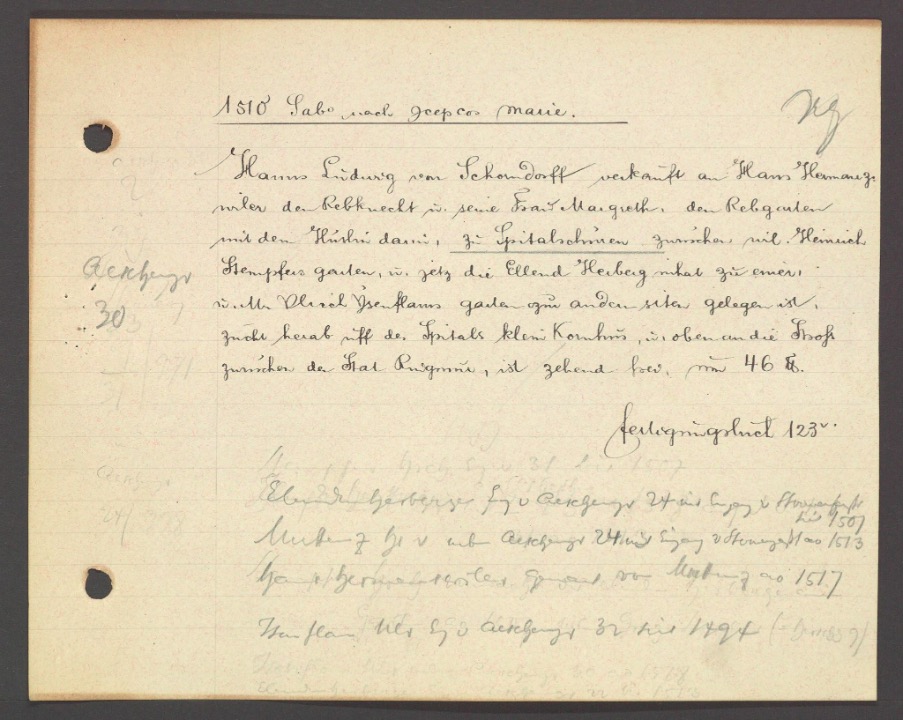
The foundational dataset for this case study is the
Historical Land Records of Basel Ground Truth corpus (HLR-GT) [
Prada Ziegler, Hitz, and Fuchs 2025]. The corpus comprises 829 digitized and annotated archival index cards containing
excerpts from administrative documents dating from the fourteenth to the eighteenth
century. It provides an ideal scenario for Natural Language Processing on historical
material, as it features all the characteristic challenges: noise introduced by handwritten
text recognition (HTR), non-standardized language, scarcity of annotated material,
and the absence of a suitable baseline model.
From a scholarly perspective, the corpus offers a rich foundation of information well-suited
for quantitative analysis. Each index card contains an excerpt or copy of an original
document written in Early New High German. Most entries record a single transaction,
trade, or list of dues payments, though less frequent document types, such as court
cases or testaments, are also represented. While capitalization and punctuation are
generally present, both are inconsistent; although this information can assist the
models in learning and predicting annotations, it may also occasionally introduce
noise. Documents from the same source (e.g., court books) often exhibit strong structural
similarity. For instance, a property purchase frequently follows the formula:
“<Actor A> sells <Actor B> <Property> for <Money>.” Systems that learn to recognize such formulaic structures tend to perform better.
However, they are also at risk of overfitting and may fail to generalize to documents
that deviate from these patterns. These observations were previously noted in [
Prada Ziegler 2024].
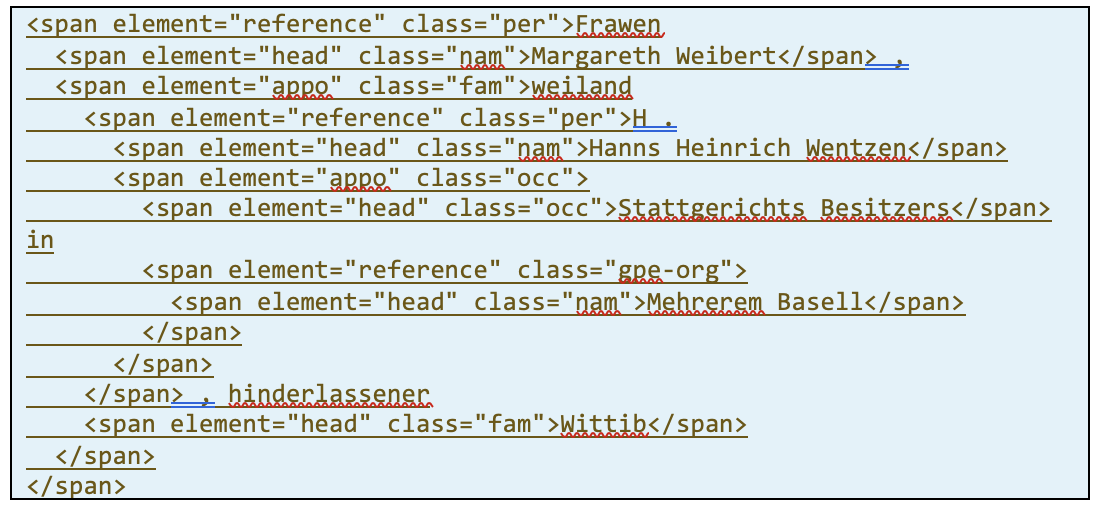
The HLR is annotated according to a variant of the BeNASch standard,
[2]
which employs a deeply nested entity annotation scheme. An example of this structure
is shown in figure 2. In the excerpt, three separate entities are mentioned (
reference):
Margareth Weibert,
Hanns Heinrich Wentzen, and
Greater Basel (the part of the city west of the Rhine). Through nesting, additional layers of information
are encoded. Heads, appositions, and attributes (the latter not present in this example)
provide further details about each entity, including names (
nam), occupations (
occ), and family relationships (
fam). In subsequent processing, this nested information can be leveraged to extract relationships.
For instance,
Margareth is related to
Hanns as
Wittib (widow), and
Hanns is employed by
Greater Basel as
Stattgerichts Besitzer (member of the court).
For Task 1, representing a conventional named entity recognition setup, all annotations
were removed except head elements with the nam class. For Task 2, the full tagset was retained. The dataset comprises a total of
54,925 tokens across 829 documents. Document length varies considerably, with an average
of 66.26 tokens and a standard deviation of 34.33 tokens. The shortest document contains
7 tokens, while the longest extends to 237 tokens.
Approaches
In this study, we compare two approaches to named entity recognition on historical
texts: LLM-based tagging and specifically trained supervised taggers. For the latter,
we developed and applied Flair models in three distinct configurations. In parallel,
we implemented a commercially available LLM using a strategy that has proven successful
in prior work.
Flair leverages contextual character embeddings [
Akbik, Blythe, and Vollgraf 2018]. Unlike most other embedding strategies that rely on subword-based tokenization
such as WordPiece that split words into common subword tokens (e.g.
“pretrained” becomes
“pre,” “train,” “ed”) and encode those, this strategy bases the encoding of tokens on their individual
characters, as well as the context that comes before and after the token. This results
in a smaller drop in performance when confronted with noise and variable spelling
and, has demonstrated robust performance for premodern German [
Schweter and Baiter 2019]; [
Hodel et al. 2023]. In addition, because these embeddings, as well as the task-specific models, are
trained using recurrent neural network architectures (Bi-LSTM), they require less
training material than would be required to train or finetune a LLM like BERT [
Schweter and März 2020].
Flair: Base
This approach employs the pre-trained Flair model
ner-german
[3] [
Akbik, Blythe, and Vollgraf 2018]. This model was trained on the CoNLL-03 revised dataset ([
Tjong Kim Sang and De Meulder 2003]), consisting primarily of modern, annotated newspaper articles. Using this model
out of the box is the quickest approach, but its lack of knowledge about the target
domain is expected to limit performance. It is important to note that the annotation
guidelines for CoNLL-03 and the reduced HLR-GT dataset are not fully aligned. Hence
some annotations that would be considered correct under CoNLL-03 standards may not
be recognized as correct in our evaluation.
Flair: Fine-tuned
In this approach, the pre-trained ner-german model is fine-tuned on the HLR-GT dataset. Fine-tuning is a suitable strategy when
only limited raw data is available and training a language model from scratch is impractical.
The objective is to enrich the base model with domain-specific knowledge as well as
familiarity with the desired annotation guidelines. Fine-tuning was performed using
the available training data for each scenario, with a learning rate of 0.00005 over
50 epochs. The number of epochs was determined through evaluation on the validation
set during initial testing.
Flair: Customized
In this approach, we fine-tuned contextual character embeddings, the
de-forward and
de-backward models provided by Flair, using all available text from the historical land records
[4] (including documents which are not part of the annotated dataset, totaling approximately
9 million tokens). Using these fine-tuned embeddings, we then trained custom SequenceTagger
models in Flair with default parameters.
[5]
Other “Traditional” Embeddings
In preliminary experiments, we investigated the performance of BERT ([
Devlin et al. 2019]), fastText ([
Bojanowski et al. 2017]), and word2vec embeddings ([
Mikolov et al. 2013]) in combination with the Flair sequence tagger, both with and without stacking alongside
contextual character embeddings. When used without stacking, performance was significantly
worse, while stacking did not yield any significant improvement. Therefore, these
embeddings were not included in the experiments reported in this case study.
Generative AI (GPT-4o)
Several strategies have been proposed for prompting generative LLMs to perform entity
extraction. In this study, we follow the recent approach by [
Hiltmann et al. 2025] and conduct our experiments with the framework NER4all.
[6]
All experiments were executed using
gpt-4o-2024-08-06. In the following sections, we detail the changes we made to the default NER4all configuration.
Detailed Context Prompt
Following the recommendations of [
Hiltmann et al. 2025], we augmented the prompt with detailed contextual information. We selected a German
full prompt, which demonstrated slightly better performance on the validation set.
Further task-specific fine-tuning and adaptation of the prompt are described in the
relevant sections. All prompt fine-tuning was conducted using a validation set comprising
83 documents. Complete prompts are provided in the appendix.
Similarity-based Examples
As part of the prompt, the system is provided with a set of examples, which is particularly
important for learning non-standard annotation guidelines. In [
Hiltmann et al. 2025], examples were manually selected to ensure coverage of all tags in the tagset.
When we simulate scenarios with limited training data in the following experiments,
if the available training data is smaller than the number of shots, the examples are
chosen randomly. Curated examples can perform better in such cases, as random selection
may omit some entity classes or include only generic examples.
Given that the number of available examples often exceeds the prompt’s context length,
we implemented a strategy proposed by [
Wang et al. 2015], who found that selecting contextually appropriate examples rather than random ones
can substantially improve model output. The strategy aims to find examples that are
similar to the given input. We use the
DocumentPoolEmbeddings provided by the Flair framework to combine the language models trained for the
flair-custom model to generate embeddings for all samples in our training data. During prompt
construction, the input sample is embedded using the same method, and cosine distances
to all training samples are calculated. The examples with the smallest distances,
i.e., the most similar samples, are then selected to be presented to the model.
| Input |
seinem Haus zur Büttenen genannt bey sant Urbans Brung nen gelegen |
| 1 |
seinem Eckhaus hinder sant Elsbethen ob des Spittal Kornhaus zum Widerlin genannt
gelegen |
| 2 |
seinem hauss zum Fürst genant an der Gerbergassen , gelegen |
| 3 |
seinem Haus gegen sant Elsbethen überhin gelegen |
Table 1.
An example of how the similarity-based retrieval works to get annotation examples
of different house references. Tags are omitted in favor of readability; the prompt
will include each example with and without tags.
Increased Shots
[
Hiltmann et al. 2025] report that a maximum of 32 examples (
“shots”) is typically optimal due to the context window limitations of the models. In our
experiments, we evaluated different shot counts on the validation set and selected
the configuration that yielded the best performance: 128 shots for Task 1 and 64 shots
for Task 2. Although the performance differences between 32, 64, and 128 shots were
generally small, they were statistically significant. In Task 2, for instance, reducing
the number of shots from 64 to 32 resulted in an approximate 2 percentage point decrease
in performance.
Accuracy
Task 1: Named Entity Extraction
Task Description
In this task, the models are required to identify conventional named entity spans,
typically corresponding to proper nouns. The target categories are persons (PER),
organizations (ORG), and locations (LOC). Geopolitical entities, which are tagged
separately in the HLR-GT dataset, were mapped to these categories depending on context
(e.g., “I live in Basel” ⇒ LOC, “I am a citizen of Basel” ⇒ ORG).
The HLR-GT contains 2,583 PER tags, 2,079 LOC tags, and 518 ORG tags.
To assess the effect of available training data, models were trained or prompted using
subsets of 4, 8, 16, 32, 64, 128, 256, 512, and 662/745 samples.
[7]
Thresholds of 4 and 8 were omitted for Flair models, as performance at these levels
was entirely unusable. Each experimental configuration was executed three times to
improve reliability of the results.
Generative AI Setup
Validation set experiments indicated that a 128-shot configuration was optimal for
this task. Based on a review of NER4all’s performance on the validation set, we introduced
additional instructions to address recurring errors in the model output. Specifically,
the guidelines were extended as follows: 1) Annotate only proper names. 2) Assign
geopolitical entities to the appropriate category based on context. 3) For organizations
and locations, annotate the grammatical head. 4) Do not annotate names of saints when
they occur as part of other entity names.
Results
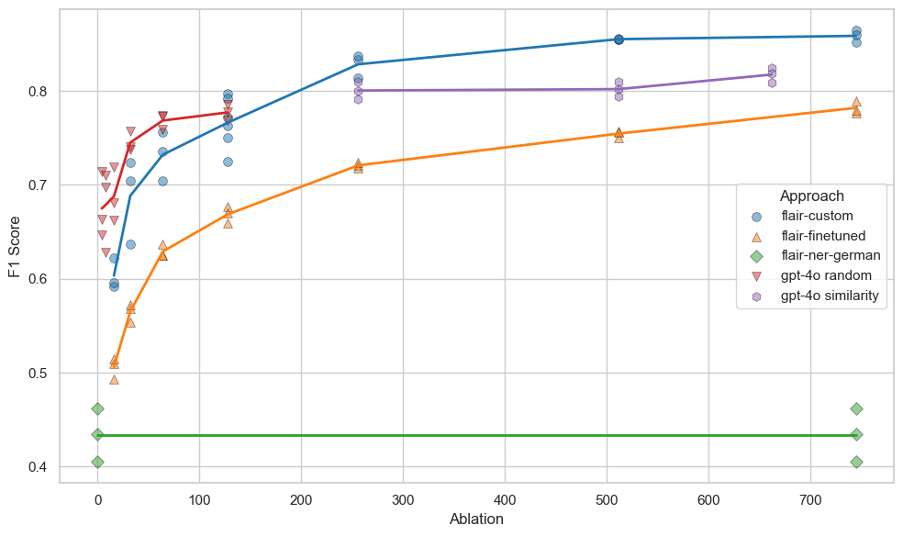
The results are plotted in figure 3 and listed as a table in appendix D. As expected,
GPT-4o dominates the few-shot scenarios, outperforming the best-performing Flair models
by 5-10 percentage points. Consistent with prior findings ([
Hiltmann et al. 2025]), the non-fine-tuned Flair model performs substantially worse than all other approaches,
likely due to its inability to handle the historical language and lack of knowledge
regarding the annotation guidelines. Among the Flair models, the custom model trained
from scratch achieved the highest performance, surpassing even the fine-tuned Flair
model. The fine-tuned model’s relatively lower performance appears to result from
the absence of a corpus-specific language model. Regarding GPT-4o, there appears to
be a critical threshold in the number of examples provided: performance increases
sharply from 16 samples (68.76% F1) to 32 samples (74.51% F1), with further significant
gains observed as the number of samples doubles up to 256. Beyond this point, performance
begins to plateau, with a slight upward trend observed at 662 samples. For Flair-Custom,
results are highly variable when training data is limited. This may be attributable
to the relatively small validation set, comprising approximately 10% of the total
documents (e.g., only 3 documents in the validation set for the 32-sample scenario).
A small validation set may cause training to terminate before an optimal model state
is reached; however, initial testing indicated that increasing the validation set
proportion generally worsened average performance. At around 128 samples, Flair-Custom
matches GPT-4o performance, while at 256 samples, it outperforms all other models.
Performance appears to plateau after 512 samples.
Error Analysis
To investigate the observed performance plateaus, we analyzed predictions classified
as incorrect during automated evaluation. We found that 66% of Flair’s errors and
54% of GPT-4o’s errors could be attributed to one of the following categories:
- HTR-induced noise: Errors stemming from heavy transcription errors, where even human annotators could
only roughly infer the correct annotation (Flair: 13%, GPT-4o: 8%).
- Ground truth inaccuracies: Cases in which the model’s prediction was correct, but the ground truth was erroneous
(Flair: 19%, GPT-4o: 13%).
- Reasonable deviations: Predictions that differed from the ground truth but were reasonable enough that
they would likely not significantly affect downstream tasks, such as entity linking
(Flair: 34%, GPT-4o: 33%). For example, the ground truth might mark “frowen zu Clingental”
as the entity mention while the model only annotated “Clingental”, with both phrases
referring to the same concept of the monastery of Klingental. These errors often mirror
inconsistencies in the training data.
In addition, approximately 10% of errors in both models were simple ORG-–LOC confusions.
While potentially more impactful for downstream tasks such as event recognition, these
errors are of limited relevance for tasks like creating a corpus index. Additionally,
GPT-4o occasionally annotated non-named entity references (e.g., “Brugg” as a bridge), which accounted for 10% of its errors. Again, for most downstream tasks,
this would not be particularly problematic behaviour. Overall, only 28% of GPT-4o’s
errors and 24% of Flair’s errors could not be explained by one of the categories above.
Given the already strong performance of both models, this analysis suggests that further
improvements would require substantially larger amounts of training data.
Task 2: Nested Extraction
Task Description
The HLR-GT dataset features a complex nested annotation scheme, in which entity references
are further annotated to capture additional information about the entities they contain.
Task 2 evaluates model performance on the full annotation set. Each tag consists of
an element tag (e.g., reference) and, in most cases, an associated class tag (e.g., person). An overview of element tags is provided in table 2.
| Tag |
Description |
Example |
| REF |
Entity reference |
Johann the tailor |
| HEAD |
Head element in reference |
Johann the tailor |
| APPO |
Apposition in reference |
Johann the tailor |
| ATTR |
Attribute in reference |
the house in Basel |
| DATE |
Reference to a date |
1573 / sunday after martini |
| CURR |
Monetary value or similar |
5 lb / 2 satchels of corn |
| EV |
Event Trigger |
Johann sells a house |
Table 2.
Overview of the element tags the systems must detect in task 2.
For references, event triggers, and descriptive elements (HEAD, APPO, ATTR), a class
tag must also be identified. The full combined element+class tagset comprises 80 tags
and is provided in Appendix E, including tag frequencies. Further details on the tagset
are available in the HLR-GT annotation documentation.
[8]
As in task 1, we examine the impact of available training data by training or prompting
models with varying numbers of examples. Each experimental configuration was executed
three times to improve reliability. For this task, we restrict Flair experiments to
the flair-custom model.
Flair Setup
The Flair SequenceTagger architecture can be adapted to handle nested annotations
using a bottom-up recursive approach [
Prada Ziegler 2024b]. In the first step, the entire text is used as input. If entity references are detected,
the text inside the entity reference is re-annotated by the model. For elements that
allow nested content, namely, entity references, appositions, and attributes, additional
annotation passes are performed recursively until no further nested elements remain.
The final output consists of all predicted tags collected throughout this process.
Each input span is pre- and suffixed with a tag indicating its type, for example:
[B-REFERENCE-PER] Johann Müller, the tailor [E-REFERENCE-PER].
For model training, the dataset is prepared so that every element potentially containing
nested annotations (documents, references, appositions, and attributes) is represented
as a separate training sample. Only immediately nested tags are included as targets:
[B-REFERENCE-PER] <HEAD>Johann Müller</HEAD> , <APPO-OCC>the tayilor</APPO-OCC> [E-REFERENCE-PER].
In this example, the head inside “the tailor” is not annotated because it is not directly connected to the reference; a separate
sample handles this annotation.
Generative AI Setup
NER4all does not natively support nested annotations. To address this, we evaluated
two methods of our own design: the single prompt method and the recursive prompting
method. In both approaches, we found that 64 shots provided optimal performance.
Single Prompt Method
Generative AI models are capable of producing strings with nested annotations, for
example: “<<PER <<HEAD Johann /HEAD>> <<APPO the tailor /APPO>> /PER>>.” We adapted the prompts and examples accordingly and modified NER4all to decode nested
annotations while retaining its ability to correct the output if it deviates from
the input. The full prompt is provided in appendix C.
Recursive Prompting Method
This method mirrors the bottom-up recursive approach used in the Flair pipeline. At
each annotation layer, a suitable prompt is selected, and examples are generated according
to the layer. A major drawback of this approach is an increase in API calls by approximately
a factor of 15 compared to the single prompt method. This estimate includes a safeguard
that first checks whether the input is already present in the training data, reducing
required calls by about 20%.
Results
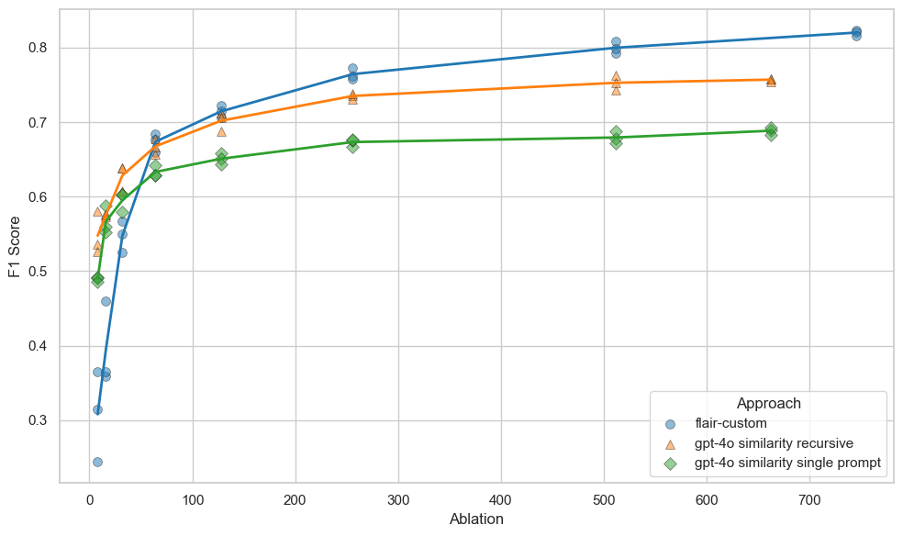
The results for task 2 are presented in figure 4. Consistent with task 1, both GPT-based
systems outperform Flair in few-shot scenarios. The recursive GPT-4o system significantly
outperforms the single prompt approach. At 64 documents, Flair performs on par with
the recursive GPT system (67.36% vs. 66.75% F1). With 128 documents, Flair marginally
outperforms the recursive GPT system (71.45% vs. 70.20% F1). At 256 documents Flair
achieves a clear advantage (76.45% vs. 73.52% F1), and this performance margin continues
to grow with additional training data. GPT performances appear to plateau between
512 and 662 training samples, while flair-custom continues to improve.
Closer examination reveals that recursive GPT occasionally generates its own tag categories.
Depending on the amount of training data, hallucinated tags accounted for 2–5% of
total incorrect predictions, particularly introducing new event trigger classes. While
advanced post-processing could potentially map these tags to existing categories and
improve accuracy, we did not further explore this.
Tag Frequency Analysis
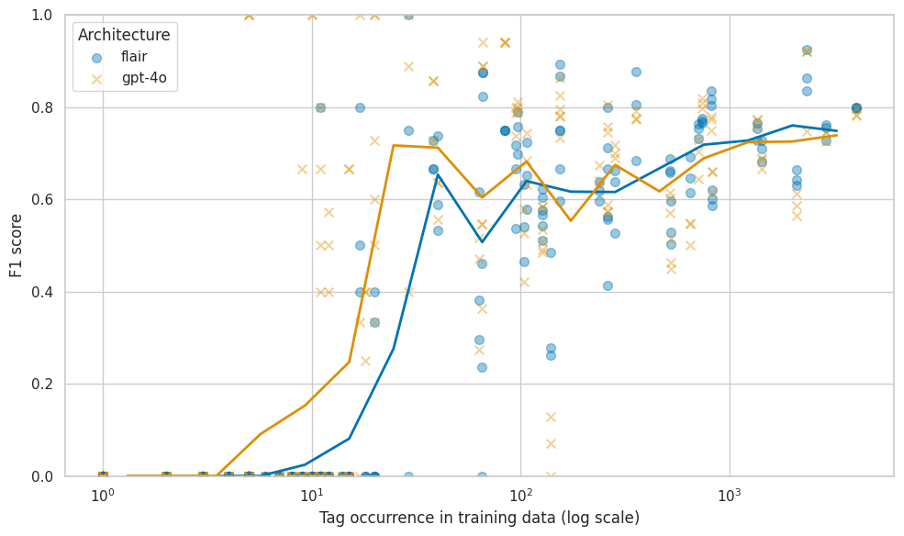
We investigated how tag frequency impacts model performance, which is particularly
relevant given the highly unbalanced tagset of HLR-GT. Some tags, such as a role apposition
(e.g., “Johann, the seller”), appear only 12 times in the training corpus, whereas the most common tag - the
proper name head - appears 4,027 times.
Figure 5 compares the flair-custom model with the recursive GPT system using 128 training samples. We find that the
models are affected to different degrees by an unbalanced tagset. Recursive GPT generally
outperforms Flair on low-frequency tags. For high-frequency tags, GPT also surpasses
Flair in some cases: out of 25 tags with frequency greater than 100, GPT performs
better on 9. Notable large margins are observed for appositions of class family (e.g., “Anna, Johann’s wife”) and event triggers of the sale class.
For most high-frequency annotations, Flair slightly outperforms recursive GPT; however,
there are some tags that see an even larger advantage for Flair: facility references (marking houses), as well as references to organizations. The stronger performance on facility tags can be explained by the following tag
length evaluation. We suspect that in the case of the organization tag that GPT suffers due to a lack of background knowledge. For instance, the phrase
“die Frauen an den Steinen” (the women at the Stones) refers to a particular monastery and was thus annotated
as an organization in the HLR-GT. If GPT does not encounter this phrase among the
selected examples, it cannot know about this and may misclassify the phrase as a reference
to a person (group). Flair is less affected because, in the case of the 128-sample
scenario, it has seen all samples (minus 12 for validation), whereas GPT only receives
the most similar examples, which might not contain the necessary entity.
Tag Length Analysis
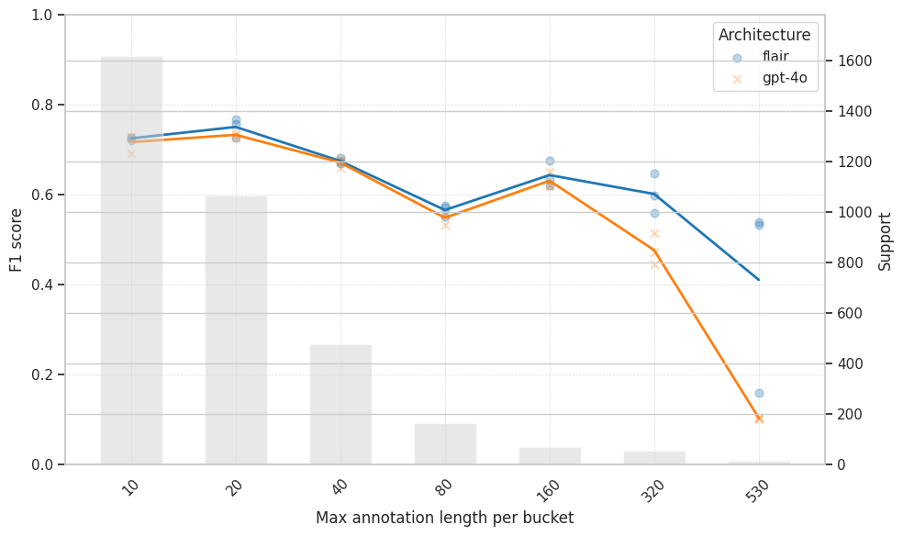
We observed that the recursive GPT system struggles more with annotating very long
spans compared to Flair. Figure 6 visualizes these differences. For annotations up
to approximately 160 characters, the performance gap is minimal, with Flair slightly
outperforming GPT. However, for spans exceeding 160 characters, Flair clearly demonstrates
superior performance. Long spans typically correspond to house descriptions, such
as the following example:
jrem Hus & Hofstatt genant Nüwenstein , an der gerwergassen zwüschen dem Hus Helfenstein
ze einer , u . Hanns ful des scherers hus zer andern siten , zinset vormals voneig
1sh . zu s . Lienh . sodan 1 fl den frauen an den steinen , widerk . mit 20fl .
English Translation: their house & homestead called Nüwenstein, at the Gerwergassen between the house Helfenstein
on one, and Hanns Ful the barbers' house on the other side, pays dues already for
hereditary reasons 1 sh. to St. Lienh. also 1 pound to the women at the Stones, redeemable
with 20 pounds.
Incomplete annotation of such spans can result in the loss of critical information,
for example, the dues obligations associated with the property. This may also cause
follow-up errors, like a dues or location attribute cut short.
Inspecting the Model Performance Qualitatively
To illustrate how increased training data improves model performance, we present an
example document from HLR-GT. The German text reads:
Es verkauft Herr Hanns Ulrich Falckhner und gibt zu Kaufen Frawen Margareth Weibert
, weiland H . Hanns Heinrich Wentzen Stattgerichts Besitzers in Mehrerem Basell ,
hinderlassener Wittib eine Behausung bey dem schwartzen Pfol , einseits neben Herrn
Bonaventura von Braun , Pfarhl bey St . Peter , andseits neben H . Johann Curtzen
dem Jüngern gelegen .
An approximate English translation is:
It is sold by Mr. Hanns Ulrich Falckhner, and he gives to purchase to Lady Margareth
Weibert, the late Mr. Hanns Heinrich Wentzen, a member of the city court in Greater
Basel, widow, a house, at the Schwartzen Pfol, on one side next to Mr. Bonaventura
von Braun, pastor at St. Peter, on the other side next to Mr. Johann Curtzen the Younger,
located.
We intentionally chose a document that is rather simple compared to others and where
we observed better predictions with increased training data. This is, of course, not
true for most documents, as the inherent randomness of machine learning algorithms
may, in specific cases, cause worse models to result in better performance.
Beyond entity identification, models must correctly connect entities and classify
information about them. Relevant facts include: Wentzen’s role as a city court member,
Weibert as his widow, the house location, and the occupation of the pastor von Braun.
Additionally, the sale event must be annotated. In the HLR scheme, repeated triggers
are annotated only on the first occurrence, so either “verkauft” (sold) or “Kaufen” (purchase) would be acceptable in a wider sense, but only one is tagged.
We compare annotations across five scenarios with increasing training data: recursive
GPT-4o with 32 and 64 samples, Flair with 128, 256, and 512 samples. For clarity,
each model is referred to by its number of training samples, and differences in annotation
are highlighted for each part of the document.
- “verkauft” (sold)
- All models correctly identified the span “verkauft” as a trigger for the sale event.
- The seller
- The full span “Herr Hanns Ulrich Falckhner” was correctly identified by all models
as a person reference, with the proper name annotated as a head element of class nam.
- “gibt zu kaufen” (gives to purchase)
- The double expression of the event posed challenges for most models. Models with 32
and 64 training examples tagged “gibt zu kaufen” as an additional sales trigger, while the 128-example model incorrectly tagged “gibt” as a dues trigger and “Kaufen” as a sales trigger. The 256-example model annotated both spans incorrectly as sales triggers, and only the 512-example model correctly avoided any unnecessary annotations.
Notably, the GPT models outperform most Flair models in this scenario, even when trained
on fewer examples. This observation aligns with findings from previous sections, highlighting
the influence of tag frequency on accurate prediction. Event triggers are among the
least frequently occurring annotations in the dataset, which can lead to inconsistent
predictions in models trained on limited data.
- The buyer
- This span represents the most complex annotation challenge. It consists of the long,
heavily nested reference:
Frawen Margareth Weibert, weiland H . Hanns Heinrich Wentzen Stattgerichts Besitzers
in Mehrerem Basell , hinderlassener Wittib
All models correctly identified the head “Margareth Weibert”. However, the nested
structure caused errors for all models except the 512-sample model.
Model 256 was mostly correct, but annotated the widow apposition “Weiland H . Hanns
[…] hinderlassener Wittib” as a separate person reference.
Model 128 made the same mistake, additionally splitting “Mehrerem Basell” into two
references and incorrectly tagging “Frawen” as a name head in addition to the correct head, likely misled by capitalization. Model 32 failed
to identify the widow apposition, resulting in a missing relationship between Weibert
and Wentzen. It also incorrectly attached “in Mehrerem Basell” directly as an attribute
to Wentzen instead of the occupation apposition “Stattgerichts Besitzers in Mehrerem
Basell”.
Model 64 recognized that the widow phrase belongs to Margareth Weibert, but misassigned
“hinderlassener Wittib” as a head, and nested “weiland H . Hanns Heinrich Wentzen”
into an attribute of class dead (which doesn’t make any sense). Finally it incorrectly added the occupation apposition
“Stattgerichts Besitzers in Mehrerem Basell” to Margareth Weibert.
In summary, the 64-sample model produced highly misleading annotations, while the
32-, 128-, and 256-sample models were incorrect but less misleading. Only the 512-sample
model predicted this span correctly without errors.
- The house
- This span presented fewer difficulties than anticipated. All models except the 32-example
model correctly predicted the full reference:
“eine Behausung bey dem schwartzen Pfol , einseits neben Herrn Bonaventura von Braun
, Pfarhl bey St . Peter , andseits neben H . Johann Curtzen dem Jüngern gelegen”
and correctly identified the head “Behausung”. Model 32 only included “bey dem schwartzen
Pfol” as an attribute describing the house's location and annotated the remaining
entity references separately. Both models 32 and 64 struggled with the occupation
apposition of Bonaventura von Braun. Model 32 annotated “Pfarhl bey St . Peter” as
a separate location reference, likely thrown off by the HTR error (“Pfarrhr” is likely
the correct phrase). Model 64 correctly annotates the apposition but fails to predict
“St . Peter” as an organization reference, instead adding it as part of the head.
The models 128, 256, and 512 all correctly predict this part.
- Summary
- This example demonstrates that increasing the amount of training data results in more
consistent and contextually accurate annotations, even for relatively straightforward
documents. While all models correctly identified core elements, such as the sales
event and principal actors, the precision and correctness of nested structures improved
substantially with larger training sets. The model trained on 512 samples produced
the only fully correct annotation, accurately handling the complex buyer reference
with multiple nested attributes and relationships.
The Cost of Automated Entity Extraction
Using GPT-4o for annotation, we observed an average cost of $0.03 per document for
task 1, and $0.12 per document for task 2 when employing the recursive prompting method.
For large-scale collections, total costs may reach several thousand or even tens of
thousands of dollars. OpenAI provides a batch API option, which reduces costs by approximately
50%, though this has not yet been implemented in NER4all, and it would be very difficult
to combine with any recursive approaches. Reducing the number of examples in the prompt
is another way to lower expenses, however this compromises performance. Open-weight
models offer a cost-free alternative if suitable infrastructure is available to a
research team; however, our experiments with GPT-OSS ([
OpenAI 2023]) showed significantly worse performance than GPT-4o. The commercial model outperformed
the locally hosted model by more than 15 percentage points in F1-Score in all scenarios.
Further experiments with Deepseek-r1-70b ([
DeepSeek-AI 2025]) did not produce viable outputs, as the model struggled with the encoding of the
tags in the output.
[9]
To give a pointer on how much creation of training data costs, we timed the annotation
progress of a PhD student, who worked with and annotated the dataset previously. The
PhD student was able to annotate on average 94 documents (7854 tokens, 636 annotations)
per hour when utilizing the simple tagset from task 1. Annotation speed for the complex
tagset in task 2 was considerably lower with appr. 16 documents (1212 tokens, 526
annotations) per hour.
[10]
For the simple tagset, a single experienced scholar could feasibly annotate sufficient
data within less than one workday to train a Flair model that outperforms GPT-4o (on
this dataset). For the complex tagset, generating enough high-quality training data
requires multiple days of work. Additionally, best practices involve multiple annotators
for the same documents and a curation process to resolve conflicts, further increasing
time and personnel costs. Regardless of the system used, the creation and publication
of annotated datasets constitute a valuable contribution to the digital humanities,
particularly when adhering to FAIR principles, especially reusability. As demonstrated,
even if insufficient data exists to train a fully competitive Flair model, GPT-4o
benefits substantially from a larger pool of annotated examples.
Another key factor to consider is the speed of the annotation systems. Flair trains
very quickly, requiring approximately 10 minutes for task 1 and 60–90 minutes for
task 2, and deploys even faster: the recursive annotation of the 84-document test
set was completed in under one minute on an RTX 3090.
[11]
In contrast, GPT-4o predicted the same test set in approximately 80 minutes, with
similarity-based example selection having negligible impact on processing time when
run on an RTX 4070 SUPER. Depending on the size of the document collection, this difference
may be a relevant criterion when selecting a system. This limitation is also why we
did not conduct this study with GPT-5; a single pass over the test set in the recursive
scenario could exceed 10 hours, making it impractical for use in our project despite
its potential performance advantages over GPT-4o.
Limitations and Future Work
While this research allows for some more general conclusions, it is ultimately a single
case study based on premodern German administrative records with a very specific language
and structure. The specific performance thresholds and optimal data sizes observed
here will naturally vary across different projects. A multitude of factors dictate
the baseline difficulty of any extraction task, including the general complexity of
the language, the specific phrasing used in the documents, the depth of the chosen
annotation scheme, and the severity of the noise introduced by HTR errors and inherent
spelling variation. We want to underline the importance of further similar case studies
and evaluations of historical NER to help future researchers find their optimal strategies
for automated information retrieval.
Our investigation into the effects of tag frequency and annotation length revealed
distinct, complementary strengths and weaknesses for both approaches. Future research
should focus on combining these methodologies to create synergies and ultimately build
better-performing systems. For example, considering the observed weakness of GPT-4o
in correctly classifying entities it has not explicitly seen in its prompt examples,
future work could explore entity-embedding-based example selection following [
Wang et al. 2015] to improve the coverage of unseen entities.
Finally, our generative AI experiments focused on a commercial, closed-weight model.
Although our preliminary tests with smaller open-weight models did not yield competitive
results, the rapidly evolving landscape of open-weight LLMs warrants a much deeper
investigation. Especially considering our experiments with Deepseek failed due to
the encoding strategy employed by NER4all, evaluating stronger local models with different
strategies remains a priority for further research.
Conclusion
This study addresses a practical dilemma for projects in history (and the humanities
more generally): should researchers rely on modern generative AI, which provides immediate
results, or invest time in manually curating data to train specialized, traditional,
controllable systems? Our findings demonstrate a trade-off. Generative AI acts as
a capable assistant out-of-the-box, providing a strong starting point when historical
training data is virtually nonexistent. However, it may struggle to adapt to complex,
project-specific rules, and the noise and language inherent to historical documents.
Both, traditional models, represented in these experiments by Flair, as well as generative
AI in the form of GPT-4o, showed a significant increase in performance when supplied
with additional training data to learn from. Even when model training from scratch
might be out of scope for a project, our experiments demonstrated that increasing
the training samples for either model to 32, 64 or 128 would yield significant improvements
over the previous step. In the long run, building a dedicated dataset and training
a lighter, specialized model may not only yield superior accuracy and offer more transparency,
but also prove to be significantly faster, more cost-effective and less ecologically
harmful to run at scale.
Importantly, researchers do not need to commit to a specific system before they begin
annotating data. The creation of ground truth is a dynamic process. As we have demonstrated,
evaluating multiple models can be beneficial even when only a small amount of training
data is available. Comparing outputs across different training set sizes on multiple
systems helps determine the utility of further manual annotation and may ultimately
guide the final choice of system. Finally, we want to remind that the creation of
data is a dynamic process. As we have shown and as should be considered by other approaches,
the evaluation of multiple approaches is necessary, even if only a little training
data is available. Comparing outputs with different amounts of training data can help
to determine how useful the creation of more manually annotated data will be, and
if resources should rather be put into the generation of annotated data, with the
additional upside of creating something reusable.
Acknowledgments
This research was undertaken as part of the project
Economies of Space, which was funded by the Swiss National Science Foundation (Grant Nr. 208093). Calculations
were performed on UBELIX (
https://www.id.unibe.ch/hpc), the HPC cluster at the University of Bern.
Appendix
Appendix A: Task 1 Prompt
### SETTING ###
Als erfahrener Sprachwissenschaftler mit Spezialisierung auf Named Entity Recognition
(NER) für historische Texte und Experte insbesondere für frühneuzeitliches Deutsch
besteht deine Aufgabe darin, einen gegebenen Text für die maschinelle Weiterverwertung
zu annotieren. Es handelt sich hierbei um einzelne Sätze, die zusammenhangslos transkribiert
wurden. Dir wird in jeder Zeile ein Satz vorgegeben.
Beachte, dass auch einzelne Abschnitte des Textes in Latein stehen können. Führe die
NER dort dann auf Latein aus.
Achte wirklich darauf, dass Du jeden Satz einzeln bearbeitest und zeichengenau wiedergibst.
Nimm Dir Zeit und arbeite so genau wie möglich. Ich möchte die Ergebnisse später computationell
weiterverarbeiten.
Bei dem Text handelt es sich um einen Ausschnitt aus dem Historischen Grundbuch der
Stadt Basel. Die Originaldokumente sind zwischen dem 14. und 18. Jahrhundert entstanden.
Sie beschreiben Kaufverträge, Zinsverzeichnisse, Frönungen und weitere Ereignisse,
die sich um Liegenschaften in der Stadt Basel drehen.
### INSTRUCTION ###
Folge diesen Schritten:
- Wiederhole den gegebenen Text exakt. Achte dabei sehr genau darauf, dass abgesehen
von den Annotationen nichts hinzugefügt
oder entfernt wird.
- Die Aufgabe ist es BEREICHE bestimmten Kategorien zuzuordnen. Benutze hierfür Tags
mit den entsprechenden Regeln:
- - Wenn ein Bereich beginnt, markiere dies durch einen Kategorie-Tag. Zur verfügung
stehen hier unter anderem die Kategorien '<<PER ' für Personen, '<<LOC ' für Orte
und '<<ORG ' für Organisationen.
- - Wenn ein Bereich endet, markiere das Ende durch den entsprechenden Tag, also ' /PER>>',
' /LOC>>' oder ' /ORG>>'.
- - Achte darauf, dass jeder geöffnete Tag auch geschlossen werden muss.
- - Tags dürfen sich überlappen oder geschachtelt sein - allerdings ist es unwahrscheinlich,
dass dieses zu häufig passiert.
- - BEACHTE: Die Texte sind in sehr alter Schrift gehalten und durch technische Verfahren
fehlerbehaftet.
- - BEACHTE: Früher hat man "nach Gehör" geschrieben. Dies bedeutet, dass für eine Erkennung
ausreicht, wenn der Bereich sich *phonetisch* anhört wie eine Person, Ortschaft oder
Organisation.
- - BEACHTE: Teils handelt es sich um Reiseberichte mit altertümlichen Einheiten wie
Meilen, alten Bezeichnungen für Orte, Gewässer und ähnliches.
- - BEACHTE: Wir sind wirklich nur an Nennungen mit Eigennamen interessiert!
- - BEACHTE: Bei geopolitischen Entitäten hängt die Kategorisierung vom Kontext ab.
Wohnt jemand "zu Basel" ist es LOC, ist jemand ein "Bürger zu Basel" eine ORG.
- - BEACHTE: Bei ORG und LOC Entitäten sind auch grammatikalische Kerne mitzuannotieren,
sofern sie mit einem Eigennamen zusammenstehen. Es ist also z.B. "Kloster Klingental",
nicht nur "Klingental".
- - BEACHTE: Heiligennamen sind generell nicht als PER zu annotieren (sie kommen z.B.
in Datumsangaben oder ORG-Namen vor).
### EXAMPLE ###
### HINTS ###
Beachte, wie in jedem Beispiel alle Schritte eingehalten wurden:
- Wiederholung des exakten Textes.
- Jeder Bereich hat einen Tag, der
- - markiert ist
- - Beginn und Ende hat
Der Text muss ANSONSTEN unverändert reproduziert werden.
Meine Karriere hängt davon ab, dass du keine Fehler machst. Daher bekommen sowohl
du, als auch deine Oma jeweils $100k für jede erfolgreiche Annotation, die im weiteren
Verlauf maschinenlesbar ist.
### TASK ###
Nun atme tief durch und gehe Schritt für Schritt vor. Hier der zu annotierende Text:
- Role: user
- ```
- INPUT_TEXT
- ```
Appendix B: Task 2 Prompt (recursive)
For Task 2 the prompt was modified depending on the annotation layer. This example
shows the prompt for the document layer. First, an explainer added to the instructions
which explained what type of textual element was to be annotated (reference, attribute,
etc.). Second, the tagset was modified accordingly. For example, if the input was
an entity reference, the instructions would be prefaced with “Bei diesem Auszug spezifisch handelt es sich um eine Entitätenerwähnung. Dein Ziel
ist es, die Elemente innerhalb dieser Erwähnung auszuzeichnen.”
### SETTING ###
Als erfahrener Sprachwissenschaftler mit Spezialisierung auf Named Entity Recognition
(NER) für historische Texte und Experte insbesondere für frühneuzeitliches Deutsch
besteht deine Aufgabe darin, einen gegebenen Text für die maschinelle Weiterverwertung
zu annotieren. Es handelt sich hierbei um einzelne Sätze, die zusammenhangslos transkribiert
wurden. Dir wird in jeder Zeile ein Satz vorgegeben.
Beachte, dass auch einzelne Abschnitte des Textes in Latein stehen können. Führe die
NER dort dann auf Latein aus.
Achte wirklich darauf, dass Du jeden Satz einzeln bearbeitest und zeichengenau wiedergibst.
Nimm Dir Zeit und arbeite so genau wie möglich. Ich möchte die Ergebnisse später computationell
weiterverarbeiten.
Bei dem Text handelt es sich um einen Ausschnitt aus dem Historischen Grundbuch der
Stadt Basel. Die Originaldokumente sind zwischen dem 14. und 18. Jahrhundert entstanden.
Sie beschreiben Kaufverträge, Zinsverzeichnisse, Frönungen und weitere Ereignisse,
die sich um Liegenschaften in der Stadt Basel drehen.
### INSTRUCTION ###
Folge diesen Schritten:
- Wiederhole den gegebenen Text exakt. Achte dabei sehr genau darauf, dass abgesehen
von den Annotationen nichts
hinzugefügt oder entfernt wird.
- Die Aufgabe ist es, BEREICHE bestimmten Kategorien zuzuordnen. Benutze hierfür Tags
mit den entsprechenden Regeln:
- - Wenn ein Bereich beginnt, markiere ihn nur einen Tag. Verwende dafür das Format
TAG. Welche Tags zur Auswahl stehen, siehst du im nächsten Punkt.
- - Wenn ein Bereich endet, markiere das Ende durch den entsprechenden Tag, also /TAG>>.
- - Achte darauf, dass jeder geöffnete Tag auch geschlossen werden muss.
- - Falls sich Bereiche überlappen, markiere nur den äusseren Bereich.
- Die zur Verfügung stehenden Tags sind:
- Referenzen auf Entitäten:
- - PER für Personen
- - LOC für Orte
- - ORG für Organisationen
- - GPE für Geopolitische Entitäten mit einer Unterklasse:
- - GPE-GPE ohne oder in unklarem Kontext
- - GPE-ORG im Kontext einer Organisation
- - GPE-LOC im Kontext eines Ortes
- Werte:
- - DATE für Datumsangaben
- - TIME für Zeitangaben
- - CURR für Geldwerte oder andere Zahlungsmittel
- Ereignisse:
- - EV für Triggerwörter für Ereignisse mit einer Unterklasse, welche das Ereignis
- bestimmt:
- EV-ACQUISITION
- EV-CONSENT
- EV-CONSTRUCTION
- EV-DEBT
- EV-DECLARATION
- EV-DUE
- EV-ENDOWMENT
- EV-EXCHANGE
- EV-GIFT
- EV-HEREDITARY
- EV-INHERITANCE
- EV-LITIGATION
- EV-OTHER
- EV-OWNERSHIP
- EV-PAYMENT
- EV-REDEMPTION
- EV-RENT
- EV-REPOSSESSION
- EV-SALE
- EV-SANCTION
- EV-SEIZURE
- EV-TESTAMENT
- EV-TRANSFER
- EV-TYPE
- Diese Annotation ist recht komplex, orientiere dich daher an den gegebenen Beispielen.
- - BEACHTE: Die Texte sind in sehr alter Schrift gehalten und durch technische
Verfahren fehlerbehaftet.
- - BEACHTE: Früher hat man "nach Gehör" geschrieben. Dies bedeutet, dass für eine
Erkennung ausreicht, wenn der Bereich sich *phonetisch* anhört wie eine Person, Ortschaft
oder Organisation.
- - BEACHTE: Teils handelt es sich um Reiseberichte mit altertümlichen Einheiten wie
Meilen,
alten Bezeichnungen für Orte, Gewässer und ähnliches.
### EXAMPLE ###
### HINTS ###
Beachte, wie in jedem Beispiel alle Schritte eingehalten wurden:
- 1. Wiederholung des exakten Textes.
- 2. Jeder Bereich hat einen Tag, der
- - markiert ist
- - Beginn und Ende hat
- Der Text muss ANSONSTEN unverändert reproduziert werden.
- Meine Karriere hängt davon ab, dass du keine Fehler machst. Daher bekommen sowohl
du, als auch
deine Oma jeweils $100k für jede erfolgreiche Annotation, die im weiteren Verlauf
maschinenlesbar ist.
### TASK ###
- Nun atme tief durch und gehe Schritt für Schritt vor. Hier der zu annotierende Text:
INPUT_TEXT
- ```
Appendix C: Task 2 Prompt (single)
### SETTING ###
Als erfahrener Sprachwissenschaftler mit Spezialisierung auf Named Entity Recognition
(NER) für historische Texte und Experte insbesondere für frühneuzeitliches Deutsch
besteht deine Aufgabe darin, einen gegebenen Text für die maschinelle Weiterverwertung
zu annotieren.
Es handelt sich hierbei um einzelne Sätze, die zusammenhangslos transkribiert wurden.
Dir wird in jeder Zeile ein Satz vorgegeben.
Beachte, dass auch einzelne Abschnitte des Textes in Latein stehen können. Führe die
NER dort dann auf Latein aus.
Achte wirklich darauf, dass Du jeden Satz einzeln bearbeitest und zeichengenau wiedergibst.
Nimm Dir Zeit und arbeite so genau wie möglich. Ich möchte die Ergebnisse später computationell
weiterverarbeiten.
Bei dem Text handelt es sich um einen Ausschnitt aus dem Historischen Grundbuch der
Stadt Basel. Die Originaldokumente sind zwischen dem 14. und 18. Jahrhundert entstanden.
Sie beschreiben Kaufverträge, Zinsverzeichnisse, Frönungen und weitere Ereignisse,
die sich um Liegenschaften in der Stadt Basel drehen.
### INSTRUCTION ###
Folge diesen Schritten:
- 1. Wiederhole den gegebenen Text exakt. Achte dabei sehr genau darauf, dass abgesehen
von den
Annotationen nichts hinzugefügt oder entfernt wird.
- 2. Die Aufgabe ist es BEREICHE bestimmten Kategorien zuzuordnen. Benutze hierfür Tags
mit den entsprechenden Regeln:
- - Wenn ein Bereich beginnt, markiere ihn nur einen Tag. Verwende dafür das Format
<<TAG. Welche Tags zur Auswahl stehen siehst du im nächsten Puntk.
- - Wenn ein Bereich endet, markiere das Ende durch den entsprechenden Tag, also /TAG>>.
- - Achte darauf, dass jeder geöffnete Tag auch geschlossen werden muss.
- - Tags dürfen verschachtelt sein, und sind es auch häufig.
- 3. Die zur Verfügung stehenden Tags sind:
- Referenzen auf Entitäten:
- - PER für Personen
- - LOC für Orte
- - ORG für Organisationen
- Beschreibende Elemente:
- - HEAD für den grammatikalischen Kern
- - APPO für Appositionen
- - ATTR für Attribute
- Werte:
- - DATE für Datumsangaben
- - CURR für Geldwerte oder andere Zahlungsmittel
- Diese Annotation ist recht komplex, orientiere dich daher an den gegebenen Beispielen.
- - BEACHTE: Die Texte sind in sehr alter Schrift gehalten und durch technische Verfahren
fehlerbehaftet.
- - BEACHTE: Früher hat man "nach Gehör" geschrieben. Dies bedeutet, dass für eine Erkennung
ausreicht, wenn der Bereich sich *phonetisch* anhört wie eine Person, Ortschaft oder
Organisation.
- - BEACHTE: Teils handelt es sich um Reiseberichte mit altertümlichen Einheiten wie
Meilen, alten Bezeichnungen für Orte, Gewässer und ähnliches.
- - BEACHTE: Referenzen auf Entitäten können sehr lange Spannen umfassen, da auch Artikel
und Attribute mit annotiert werden sollen.
- - BEACHTE: Eigennamen sind keine Voraussetzung für eine Annotation. Sämtliche Bezeichnungen,
die eindeutig auf eine Person, einen Ort oder eine Organisation verweisen, sind zu
markieren.
- - BEACHTE: Beschreibende Elemente (HEAD, APPO, ATTR) können nie ausserhalb von Referenzen
auf Entitäten (PER, LOC, ORG) oder Appositionen (APPO) auftreten.
- - BEACHTE: Bei geopolitischen Entitäten hängt die Kategorisierung vom Kontext ab.
Wohnt jemand "zu Basel" ist es LOC, ist jemand ein "Bürger zu Basel" eine ORG.
- - BEACHTE: Heiligennamen sind generell nicht als PER zu annotieren (sie kommen z.B.
in Datumsangaben oder ORG-Namen vor).
- - BEACHTE: Die Grenzen der Bereiche folgen meist den Regeln der Konstituenzgrammatik
(Referenzen => Nominalphrase, HEAD => Kern). Es kann aber auch vorkommen, dass diese
davon abweichen.
### EXAMPLE ###
### HINTS ###
Beachte, wie in jedem Beispiel alle Schritte einghalten wurden:
- 1. Wiederholung des exakten Textes.
- 2. Jeder Bereich hat einen Tag, der
- - markiert ist
- - Beginn und Ende hat
Der Text muss ANSONSTEN unverändert reproduziert werden.
Meine Karriere hängt davon ab, dass du keine Fehler machst.
Daher bekommmen sowohl du, als auch deine Oma jeweils $100k für jede erfolgreiche
annotation, die im weiteren Verlauf maschienenlesbar ist.
### TASK ###
Nun atme tief durch und gehe Schritt für Schritt vor. Hier der zu annotierende Text:
- Role: user
- ```
- INPUT_TEXT
- ```
Appendix D: Task 1 Results
Note that we performed two more runs for flair-custom-128-samples because the variance
between the initial three runs was extraordinarily high.
| approach |
ablation |
run |
f1 score |
| flair-custom |
16 |
0 |
59.23% |
| flair-custom |
16 |
1 |
62.19% |
| flair-custom |
16 |
2 |
59.61% |
| flair-custom |
32 |
0 |
72.34% |
| flair-custom |
32 |
1 |
63.69% |
| flair-custom |
32 |
2 |
70.46% |
| flair-custom |
64 |
0 |
70.48% |
| flair-custom |
64 |
1 |
73.55% |
| flair-custom |
64 |
2 |
75.62% |
| flair-custom |
128 |
0 |
72.49% |
| flair-custom |
128 |
1 |
79.70% |
| flair-custom |
128 |
2 |
79.20% |
| flair-custom |
128 |
3 |
77.14% |
| flair-custom |
128 |
4 |
74.98% |
| flair-custom |
128 |
5 |
76.32% |
| flair-custom |
256 |
0 |
83.37% |
| flair-custom |
256 |
1 |
83.74% |
| flair-custom |
256 |
2 |
81.43% |
| flair-custom |
512 |
0 |
85.46% |
| flair-custom |
512 |
1 |
85.48% |
| flair-custom |
512 |
2 |
85.63% |
| flair-custom |
745 |
0 |
86.42% |
| flair-custom |
745 |
1 |
85.99% |
| flair-custom |
745 |
2 |
85.20% |
| gpt-4o random |
4 |
0 |
64.68% |
| gpt-4o random |
4 |
1 |
71.41% |
| gpt-4o random |
4 |
2 |
66.37% |
| gpt-4o random |
8 |
0 |
69.77% |
| gpt-4o random |
8 |
1 |
62.85% |
| gpt-4o random |
8 |
2 |
71.03% |
| gpt-4o random |
16 |
0 |
71.95% |
| gpt-4o random |
16 |
1 |
68.13% |
| gpt-4o random |
16 |
2 |
66.27% |
| gpt-4o random |
32 |
0 |
74.09% |
| gpt-4o random |
32 |
1 |
75.73% |
| gpt-4o random |
32 |
2 |
73.72% |
| gpt-4o random |
64 |
0 |
75.93% |
| gpt-4o random |
64 |
1 |
77.36% |
| gpt-4o random |
64 |
2 |
77.28% |
| gpt-4o random |
128 |
0 |
78.53% |
| gpt-4o random |
128 |
1 |
76.84% |
| gpt-4o random |
128 |
2 |
77.78% |
| gpt-4o similarity |
256 |
0 |
79.14% |
| gpt-4o similarity |
256 |
1 |
80.95% |
| gpt-4o similarity |
256 |
2 |
80.06% |
| gpt-4o similarity |
512 |
0 |
80.18% |
| gpt-4o similarity |
512 |
1 |
79.47% |
| gpt-4o similarity |
512 |
2 |
80.95% |
| gpt-4o similarity |
662 |
0 |
80.89% |
| gpt-4o similarity |
662 |
1 |
82.42% |
| gpt-4o similarity |
662 |
2 |
81.92% |
| flair-finetuned |
16 |
0 |
50.97% |
| flair-finetuned |
16 |
1 |
49.36% |
| flair-finetuned |
16 |
2 |
51.50% |
| flair-finetuned |
32 |
0 |
55.39% |
| flair-finetuned |
32 |
1 |
56.88% |
| flair-finetuned |
32 |
2 |
57.26% |
| flair-finetuned |
64 |
0 |
62.54% |
| flair-finetuned |
64 |
1 |
62.50% |
| flair-finetuned |
64 |
2 |
63.67% |
| flair-finetuned |
128 |
0 |
67.72% |
| flair-finetuned |
128 |
1 |
65.93% |
| flair-finetuned |
128 |
2 |
66.98% |
| flair-finetuned |
256 |
0 |
72.12% |
| flair-finetuned |
256 |
1 |
72.34% |
| flair-finetuned |
256 |
2 |
71.77% |
| flair-finetuned |
512 |
0 |
75.02% |
| flair-finetuned |
512 |
1 |
75.76% |
| flair-finetuned |
512 |
2 |
75.61% |
| flair-finetuned |
745 |
0 |
78.97% |
| flair-finetuned |
745 |
1 |
77.64% |
| flair-finetuned |
745 |
2 |
78.00% |
| flair-ner-german |
0 |
0 |
40.54% |
| flair-ner-german |
0 |
1 |
46.18% |
| flair-ner-german |
0 |
2 |
43.42% |
| flair-ner-german |
745 |
0 |
40.54% |
| flair-ner-german |
745 |
1 |
46.18% |
| flair-ner-german |
745 |
2 |
43.42% |
Appendix E: Element + Class Tagset for Task 2
| tag |
frequency in training set |
| head-nam |
4027 |
| per |
2874 |
| date |
2335 |
| fac |
2086 |
| head-type |
1425 |
| curr |
1353 |
| attr-loc |
821 |
| head-occ |
813 |
| appo-occ |
736 |
| head-pro |
705 |
| ev-due |
645 |
| org |
520 |
| attr-owner |
518 |
| head-fam |
357 |
| appo-fam |
282 |
| loc |
261 |
| appo-nam |
261 |
| gpe-loc |
238 |
| ev-sale |
154 |
| attr-dead |
153 |
| attr-dues |
139 |
| appo-title |
127 |
| head-title |
127 |
| gpe-org |
107 |
| attr-includes |
104 |
| ev-type |
103 |
| head-org-aff |
97 |
| appo-org-aff |
95 |
| ev-seizure |
84 |
| head-heir |
66 |
| ev-rent |
65 |
| head-role |
63 |
| attr-org-aff |
40 |
| ev-litigation |
38 |
| head-owner |
29 |
| head-gen |
20 |
| appo-gen |
20 |
| ev-redemption |
18 |
| appo-owner |
17 |
| ev-testament |
15 |
| unk |
15 |
| ev-hereditary |
14 |
| appo-role |
12 |
| gpe-gpe |
12 |
| ev-payment |
11 |
| head-repr |
11 |
| ev-consent |
11 |
| attr-part-of |
11 |
| ev-declaration |
10 |
| ev-transfer |
10 |
| head-self |
10 |
| ev-bequest |
9 |
| head-unk |
9 |
| ev-inheritance |
8 |
| head-rel |
8 |
| ev-construction |
7 |
| ev-pledge |
6 |
| ev-offer |
5 |
| head-creditor |
5 |
| appo-rel |
5 |
| appo-unk |
5 |
| appo-type |
5 |
| attr-unk |
5 |
| attr-type |
5 |
| ev-sanction |
5 |
| head-quant |
5 |
| attr-sale |
4 |
| attr-other |
4 |
| head-loc |
4 |
| attr-has-member |
3 |
| ev-endowment |
3 |
| ev-outbid |
3 |
| unclear-unclear |
3 |
| appo-repr |
2 |
| ev-debt |
2 |
| ev-other |
2 |
| appo-loc |
1 |
| appo-creditor |
1 |
| attr-creditor |
1 |
| ev-receipt |
1 |
Appendix F: Task 2 Results
| approach |
ablation |
run |
f1 score |
| flair-custom |
8 |
0 |
24.44% |
| flair-custom |
8 |
1 |
31.40% |
| flair-custom |
8 |
2 |
36.48% |
| flair-custom |
16 |
0 |
35.92% |
| flair-custom |
16 |
1 |
36.52% |
| flair-custom |
16 |
2 |
45.98% |
| flair-custom |
32 |
0 |
55.03% |
| flair-custom |
32 |
1 |
52.53% |
| flair-custom |
32 |
2 |
56.67% |
| flair-custom |
64 |
0 |
67.64% |
| flair-custom |
64 |
1 |
68.47% |
| flair-custom |
64 |
2 |
65.98% |
| flair-custom |
128 |
0 |
71.51% |
| flair-custom |
128 |
1 |
72.21% |
| flair-custom |
128 |
2 |
70.64% |
| flair-custom |
256 |
0 |
77.28% |
| flair-custom |
256 |
1 |
76.21% |
| flair-custom |
256 |
2 |
75.86% |
| flair-custom |
512 |
0 |
79.22% |
| flair-custom |
512 |
1 |
80.86% |
| flair-custom |
512 |
2 |
79.89% |
| flair-custom |
745 |
0 |
82.28% |
| flair-custom |
745 |
1 |
82.15% |
| flair-custom |
745 |
2 |
81.65% |
| gpt-4o similarity recursive |
8 |
0 |
53.61% |
| gpt-4o similarity recursive |
8 |
1 |
58.06% |
| gpt-4o similarity recursive |
8 |
2 |
52.58% |
| gpt-4o similarity recursive |
16 |
0 |
57.53% |
| gpt-4o similarity recursive |
16 |
1 |
57.72% |
| gpt-4o similarity recursive |
16 |
2 |
57.36% |
| gpt-4o similarity recursive |
32 |
0 |
63.87% |
| gpt-4o similarity recursive |
32 |
1 |
63.84% |
| gpt-4o similarity recursive |
32 |
2 |
60.79% |
| gpt-4o similarity recursive |
64 |
0 |
67.80% |
| gpt-4o similarity recursive |
64 |
1 |
65.71% |
| gpt-4o similarity recursive |
64 |
2 |
66.73% |
| gpt-4o similarity recursive |
128 |
0 |
68.76% |
| gpt-4o similarity recursive |
128 |
1 |
71.23% |
| gpt-4o similarity recursive |
128 |
2 |
70.60% |
| gpt-4o similarity recursive |
256 |
0 |
73.58% |
| gpt-4o similarity recursive |
256 |
1 |
73.10% |
| gpt-4o similarity recursive |
256 |
2 |
73.87% |
| gpt-4o similarity recursive |
512 |
0 |
76.26% |
| gpt-4o similarity recursive |
512 |
1 |
74.30% |
| gpt-4o similarity recursive |
512 |
2 |
75.30% |
| gpt-4o similarity recursive |
662 |
0 |
75.86% |
| gpt-4o similarity recursive |
662 |
1 |
75.82% |
| gpt-4o similarity recursive |
662 |
2 |
75.45% |
| gpt-4o similarity single prompt |
8 |
0 |
49.22% |
| gpt-4o similarity single prompt |
8 |
1 |
49.10% |
| gpt-4o similarity single prompt |
8 |
2 |
48.53% |
| gpt-4o similarity single prompt |
16 |
0 |
55.95% |
| gpt-4o similarity single prompt |
16 |
1 |
55.27% |
| gpt-4o similarity single prompt |
16 |
2 |
58.77% |
| gpt-4o similarity single prompt |
32 |
0 |
57.99% |
| gpt-4o similarity single prompt |
32 |
1 |
60.29% |
| gpt-4o similarity single prompt |
32 |
2 |
60.22% |
| gpt-4o similarity single prompt |
64 |
0 |
62.82% |
| gpt-4o similarity single prompt |
64 |
1 |
64.24% |
| gpt-4o similarity single prompt |
64 |
2 |
62.88% |
| gpt-4o similarity single prompt |
128 |
0 |
65.81% |
| gpt-4o similarity single prompt |
128 |
1 |
65.12% |
| gpt-4o similarity single prompt |
128 |
2 |
64.34% |
| gpt-4o similarity single prompt |
256 |
0 |
66.73% |
| gpt-4o similarity single prompt |
256 |
1 |
67.54% |
| gpt-4o similarity single prompt |
256 |
2 |
67.71% |
| gpt-4o similarity single prompt |
512 |
0 |
67.85% |
| gpt-4o similarity single prompt |
512 |
1 |
67.14% |
| gpt-4o similarity single prompt |
512 |
2 |
68.82% |
| gpt-4o similarity single prompt |
662 |
0 |
68.91% |
| gpt-4o similarity single prompt |
662 |
1 |
68.30% |
| gpt-4o similarity single prompt |
662 |
2 |
69.33% |
Works Cited
Aguilar 2022 Aguilar, S. T. (2022) “Multilingual named entity recognition for medieval charters using stacked embeddings
and bert-based models”, in Proceedings of the Second Workshop on Language Technologies for Historical and Ancient
Languages, pp. 119–128.
Akbik et al. 2019 Akbik, A. et al. (2019) “FLAIR: An easy-to-use framework for state-of-the-art NLP”, in Proceedings of the 2019 Conference of the North American Chapter of the Association
for Computational Linguistics (Demonstrations), pp. 54–59.
Akbik, Blythe, and Vollgraf 2018 Akbik, A., Blythe, D., and Vollgraf, R. (August 2018) “Contextual string embeddings for sequence labeling”, in Proceedings of the 27th International Conference on Computational Linguistics, pp. 1638–1649.
Blouin et al. 2021 Blouin et al. (2021) “Transferring modern named entity recognition to the historical domain: How to take
the step”?, in Workshop on Natural Language Processing for Digital Humanities (NLP4DH).
Bojanowski et al. 2017 Bojanowski, P. et al. (2017) “Enriching word vectors with subword information”, Transactions of the Association for Computational Linguistics, 5, pp. 135–146.
De Toni et al. 2022 De Toni, F. et al. (2022) “Entities, dates, and languages: Zero-shot on historical texts with t0”, arXiv preprint arXiv:2204.05211.
DeepSeek-AI 2025 DeepSeek-AI (2025) “Deepseek-r1: Incentivizing reasoning capability in LLMs via reinforcement learning”, arXiv preprint arXiv:2501.12948.
Devlin et al. 2019 Devlin, J. et al. (2019) “Bert: Pre-training of deep bidirectional transformers for language understanding”, in Proceedings of the 2019 Conference of the North American Chapter of the Association
for Computational Linguistics: Human Language Technologies, Volume 1 (Long and Short Papers), pp. 4171–4186.
Ehrmann 2023 Ehrmann, M. et al. (2023) “Named entity recognition and classification in historical documents: A survey”, ACM Computing Surveys, 56(2), pp. 1–47.
González-Gallardo et al. 2023 González-Gallardo, C.E. et al. (2023) “Yes but.. can chatgpt identify entities in historical documents?”, in 2023 ACM/IEEE Joint Conference on Digital Libraries (JCDL), pp. 184–189.
Grover et al. 2008 Grover, C. et al. (2008) “Named entity recognition for digitised historical texts”, in Proceedings of the International Conference on Language Resources and Evaluation,
LREC 2008, pp. 1343–1346.
Hiltmann et al. 2025 Hiltmann, T. et al. (2025) “NER4all or context is all you need: Using LLMs for low-effort, high-performance NER
on historical texts. A humanities informed approach”, arXiv preprint arXiv:2502.04351.
Hodel et al. 2023 Hodel, T., Prada Ziegler, I., and Schneider, C. (2023)
“Pre-modern data: Applying language modeling and named entity recognition on criminal
records in the city of Bern”. Presented at the Digital Humanities 2023. Collaboration as Opportunity (DH2023),
Graz, Austria. Available at:
https://doi.org/10.5281/zenodo.8107616. Accessed: 4 September 2026.
Keraghel et al. 2024 Keraghel, I., Morbieu, S., and Nadif, M. (2024) “A survey on recent advances in named entity recognition: a comprehensive survey and
comparative study”. arXiv preprint arXiv:2401.10825.
Klie et al. 2018 Klie, J. C. et al. (2018) “The INCEpTION platform: Machine-assisted and knowledge-oriented interactive annotation”, in Proceedings of the 27th International Conference on Computational Linguistics: System
Demonstrations, pp. 5–9.
Mikolov et al. 2013 Mikolov, T. et al. (2013) “Efficient estimation of word representations in vector space”, arXiv preprint arXiv:1301.3781.
OpenAI 2023 OpenAI (2023) “GPT-4 technical report”, arXiv preprint arXiv:2303.08774.
Prada Ziegler 2024 Prada Ziegler, I. (2024) “Exploration of event extraction techniques in late medieval and early modern administrative
records”, in Proceedings of the Computational Humanities Research Conference 2024, pp. 761–771.
Prada Ziegler 2024b Prada Ziegler, I. (2024b)
“What's in an entity? Exploring nested named entity recognition in the historical
land register of Basel (1400-1700)”. Presented at DH Benelux 2024, Leuven, Belgium. Available at:
https://doi.org/10.5281/zenodo.11500543. Accessed: 4 September 2026.
Prada Ziegler, Hitz, and Fuchs 2025 Prada Ziegler, I., Hitz, B. and Fuchs, K. (2025)
“The Basel Land Records Ground Truth: An annotated dataset for information extraction
on German-language administrative records”,
Journal of Open Humanities Data, 11(1), 82. Available at:
https://doi.org/10.5334/johd.387. Accessed: 4 September 2026.
Schweter and Baiter 2019 Schweter, S. and Baiter, J. (2019) “Towards robust named entity recognition for historic German”, in Proceedings of the 4th Workshop on Representation Learning for NLP (RepL4NLP-2019), pp. 96–103.
Schweter and März 2020 Schweter, S. and März, L. (2020) “Triple E - Effective ensembling of embeddings and language models for NER of historical
German”, in CLEF (Working Notes).
Tjong Kim Sang and De Meulder 2003 Tjong Kim Sang, E. F. and De Meulder, F. (2003) “Introduction to the CoNLL-2003 shared task: Language-independent named entity recognition”, in Proceedings of the Seventh Conference on Natural Language Learning at HLT-NAACL 2003, pp. 142–147.
Wang et al. 2015 Wang, S. et al. (2025) “GPT-NER: Named entity recognition via large language models”, in Findings of the Association for Computational Linguistics: NAACL 2025, pp. 4257–4275.


 https://orcid.org/0000-0003-4229-8688