Abstract
Archivists, designers, and scholars speak a hybrid language when they negotiate how
collections should appear on screen. Words like ‘generous’ or ‘unfolding’ do work
that neither computer science nor cultural theory does on their own, and usually vanish
once the project ends. I call this a pidgin philosophy for data visualization and
examine its methodological value for research and design. Drawing on cross-cultural
aesthetics and critical interface studies, three such terms are documented in this
paper: wanderer, fold, and shimmer. Each is traced to its sources and checked against
interfaces built for cultural collections. Together they form a grammar comprising
basic principles, a phrase book, and a research framework. Treated as research and
design instruments, these words can help mixed teams collaborate without dissolving
epistemic differences.
Introduction
28 August 2013. Ten people are cutting up photographs into collages at a table in
the Architecture Building of Newcastle University in the UK. These images come from
the Amber Film & Photography Collective’s archive of working-class life in North East
England. Those taking part in the workshop titled ‘Finding new Pathways in Rich Archives’
include members of the collective, artists, and researchers [
Chen et al. 2014]. They barely share a vocabulary for what an archive interface should look like.
During the discussion, one participant warns that if everybody can contribute, the
story they are trying to open up may be lost. However, opening the archive is the
point of the exercise, but opening it too far also poses a danger to this mission.
The notion of ‘opening’ carries multiple meanings. For the curator the word signals
access, for the designer an interface gesture, and for the researcher a claim about
interpretation. Nobody stops to fix the ambiguity of the term, and the conversation
proceeds. That is what this paper is about: words that coordinate work precisely because
they have not been pinned down. ‘Opening’ holds the group’s competing commitments
together long enough for the more difficult negotiations to take place over what to
show and on whose terms.
The workshop in Newcastle held several incompatible answers to the question of how
to open an archive, let alone what an archive actually is. Archives have never been
neutral repositories of evidence. From their inception, they have been tangled in
competing projects of power and preservation. Born alongside the modern nation-state,
historical archives enshrined both official memory and governmental authority [
Featherstone 2006]. Even in their earliest photographic manifestations, archives had a dual purpose:
honorific when celebrating respected citizens, repressive when sorting bodies into
criminological types [
Sekula 1986]. They can be viewed as both sites of authority and sets of archiving processes that
actively shape what will count as memory [
Derrida 1996]. Likewise, the humanities tend to theorize the archive as a place of power and memory
work, whereas archival studies aim to advance more practical frameworks for creating
and maintaining archives [
Caswell 2024]. A central concern of archival work is provenance, which is not merely the point
of origin of archival objects, but
“the network of relationships between objects, agents and functions” [
Michetti 2017]. Archives are approached by many with a mix of positivist promise and voyeuristic
desire, drawn by the allure of recovering a lost past while attempting the
“reanimation of ghostly traces” on today’s terms [
Freshwater 2003].
Recent practices further expand the promise of the archive, from activist collections
mobilizing documents as tools of empowerment [
Pell 2015] to digital editors seeking sensory pleasure in the flexible remediation of manuscript
ecologies [
Kim 2018]. Critical archivists call for a shift from rights-based neutrality toward radical
empathy and liberatory memory work [
Caswell and Cifor 2016]; [
Caswell 2021]. Digitizing cultural heritage now places archives at a flashpoint: big-data surveillance
and platform capitalism demand exposure and extraction at scale, while communities
and scholars call for provenance and epistemic justice [
Thylstrup et al. 2021]. Nowhere is this tension sharper than for materials of Indigenous origin. Many cultural
collections were gathered through dispossession or coercion. Now, communities are
demanding the return of these collections and for community-led governance that allows
for culturally appropriate access [
Russo Carroll et al. 2020]. These contradictory custodial imperatives set the stage for difficult deliberations
about the design of archive interfaces.
Under pressure to widen access and empower communities while protecting sensitive
materials and resisting extraction and surveillance, mixed teams consisting of digital
archivists, interface designers, and humanities scholars communicate about prototypes
and platforms that attempt to reconcile these conflicting demands. During such exchanges,
the conversation slips into a hybrid language. Database ‘records’ mingle with discussions
of ‘provenance’; ‘users’ become ‘visitors’; and the viability of a prototype is judged
by the likelihood of ‘serendipity’. This improvised idiom is neither the technical
jargon of computer science nor the theoretical argot of cultural studies; it is a
vocabulary in-between, assembled on the fly so that disparate expertise can hold a
collaborative project together and pursue ambitions at the crossroads. This language
gives teams a way to deliberate how and when cultural materials should be displayed
or withheld, rather than assuming access as a given. Following the idea of disciplinary
trading zones [
Galison 1997], this paper recognizes this hybrid language as an emergent pidgin philosophy for
the visualization of cultural collections.
Visualization’s own long history foreshadows this linguistic bricolage. Long before
screens or algorithms, people marked walls and knotted cords to translate experience
into a compressed form, from the Altamira bison drawings to the Andean quipus [
Drucker 2014]; [
Urton 2017]. Modernity overlaid statistical reasoning on that heritage: from William Playfair’s
charts of international trade to Florence Nightingale’s diagrams of preventable death
in army hospitals [
Friendly and Wainer 2021]. W.E.B. Du Bois created information graphics representing African Americans’ social
conditions at the turn of the 20th century [
Battle-Baptiste and Rusert 2018], and a few years later Otto and Marie Neurath, along with Gerd Arntz, developed
a visualization system to convey the complexity of social change in Austria [
Vossoughian 2006]. John Tukey’s exploratory data analysis showed that algorithms could accelerate
what pencils once attempted, inviting ever-larger datasets onto the screen [
Tukey 1962]. Over the last two decades, digital humanities projects have re-appropriated these
methods, for example, to map colonial slave trade [
Eltis and Richardson 2008], reveal literary correspondence networks [
Edelstein et al. 2017], represent the sonic patterns of poetry [
McCurdy et al. 2016], or, more generally, open up exploratory access to cultural collections [
Windhager et al. 2019]. The growing use of visualization in the humanities has already prompted a reconsideration
of the vocabulary for interpretative practices [
Drucker 2011].
What is missing is neither theory nor technique, both of which are plentiful, but
a working vocabulary that survives the time frame of a particular project. This paper
therefore shifts from devising new visualization techniques to doing vocabulary work:
reclaiming words that could keep collection interfaces open to surprise, friction,
and care. It gathers three terms—wanderer, fold, and shimmer—that are starting to
circulate in interdisciplinary conversations. Unpacking each term through feminist
[
D’Ignazio and Klein 2020] and pluriversal [
Escobar 2018] lenses makes visible the commitments already implicit in contemporary data work
and design practice. Naming those commitments as a pidgin philosophy is meant to embed
them in the active vocabulary of interdisciplinary research and design. The terms
can be understood as ‘strong concepts’ [
Höök and Löwgren 2012], intermediate-level knowledge that travels between specific designs. Crucially,
noticing a pidgin should not fossilize it: by definition it remains open-ended, patched
together from languages at hand, and remade with every new encounter [
Thomason and Kaufman 1988]. The lexicon presented here is offered in the spirit of a conceptual commons open
to revision, not a fixed inventory.
“It matters what stories make worlds, what worlds make stories” [
Haraway 2016], and vocabulary work is one way of remaining open for more stories than one.
In this paper, I attempt three things: 1) trace the pidgin philosophy’s emergence
and justify vocabulary work as a methodological stance, 2) describe three terms through
their lineages, theoretical commitments, and practical examples, and 3) synthesize
them into a cross-cutting grammar for the design and study of collection visualizations.
But before proceeding, a word on where this comes from. This is an interpretive account
rather than an ethnography: in addition to readings of scholarly publications, the
observations about how mixed teams talk come from co-design projects since 2013, beginning
with the Newcastle workshop [
Chen et al. 2014] and continuing in numerous projects in Potsdam (e.g., [
Dörk et al. 2020]). For this article, I coded no transcripts and counted no term frequencies. The
interfaces discussed below I consider as texts to be interpreted. However, I was involved
in the creation of several of them. The paper is addressed to the people who make
such interfaces and to those who study them.
Following Caswell’s distinction between ‘the archive’ of humanities theory and ‘an
archives’ with provenance and a custodian [
Caswell 2024], I write ‘collection’ for any body of digitized cultural material and reserve ‘archive’
for cases where provenance, custodianship, or terms of access are critical. Most of
the interfaces discussed in this paper are in fact museum and library projects rather
than archival ones.
Pidgin Philosophy as a Living Lexicon
In historical linguistics a pidgin is a pragmatic contact language that emerges when
communities without a shared language need to trade, build, or govern together [
Thomason and Kaufman 1988]. Its vocabulary is blended and its grammar is minimal—just enough words and phrases
to load the ships and sign the treaty. Pidgins also arise in situ between domains,
exemplifying what science studies scholars may call a trading zone idiom [
Galison 1997]: a stripped down but creative language that lets specialists cooperate without fully
understanding one another’s disciplinary terms. Visualization projects that straddle
archival studies, interface design, and digital humanities show similar dynamics,
when an archivist explains a finding aid convention to a visualization researcher
or when a literary scholar sketches an interface idea for a designer. Fragments of
archive theory, cultural studies, visual analytics, and other disciplines fuse into
sentences that belong fully to none of the contributing fields. During co-creation
workshops and feedback sessions, phrases like ‘serendipitous encounters’ [
Foster and Ford 2003], ‘generous interfaces’ [
Whitelaw 2015], ‘unfolding details’ [
Bludau et al. 2020], or ‘critical cognition’ [
Windhager et al. 2025] seem to appear out of nowhere.
They prove useful, but then often vanish once the prototypes are launched and the
papers are published. The notion of ‘sandcastling’ names the ephemeral visualizations
that mediate between disciplines, giving a team a word for the design process itself
[
Hinrichs et al. 2018]. Recognizing such fleeting speech as a pidgin helps us appreciate its performative
power despite its ephemeral nature. ‘Performative’ here refers to how language can
actively shape social connections and make commitments, which aligns with speech act
theory and a more general performative turn in cultural studies [
Bachmann-Medick 2016]. It is also evident in many Indigenous knowledge practices, where speaking is a
means of establishing relations and responsibilities [
Robinson 2019]. Considering this hybrid speech a pidgin philosophy foregrounds its pragmatic character
and shared ethos that lets collaborative work proceed before perfect translations
are found.
A related concept to this pidgin philosophy is that of boundary objects, initially
developed by Susan Leigh Star and James R. Griesemer in their seminal study of a natural
history museum [
Star and Griesemer 1989]. They found that cooperation among amateur collectors, academic biologists, and
museum administrators was made possible through objects such as specimens and maps.
These items carried different meanings for each group yet provided enough common structure
for coordinated work, bridging social worlds while accommodating divergent interests.
Boundary objects have since been used to understand collaboration across institutions
and worldviews, including classification systems in queer archives [
Junginger and Dörk 2021] and interdisciplinary knowledge integration [
Caccamo et al. 2023]. In a similar vein, visualization artifacts produced during design study processes
can themselves function as boundary objects that support sense-making and decision-making
across stakeholder groups in heterogeneous organizational contexts [
Otto and Davidoff 2024]. In contrast to boundary objects that center artifacts, I want to foreground language
itself as the medium of negotiation, focusing on terms that carry just enough resonance
across disciplines to support mutual orientation. For example, ‘generosity’ and ‘serendipity’
do not function as shared artifacts, but rather as discursive bridges. While boundary
objects enable work despite divergent views, a pidgin philosophy can synthesize diverse
perspectives into a shared vocabulary with which to develop a collective vision.
Pidgin words can be powerful during the time frame of a project, but they can evaporate
once the team disbands, forcing the next collaboration to reinvent its vocabulary
from scratch. Amber is my exemplar here [
Chen et al. 2014]. By the end of that afternoon a group of artists, archive members, and researchers
had arrived at a shared way of describing the collection as
“a living archive that grows and changes over time” and its exploration akin to
“walking as an open-ended mode of engagement.” None of us could have done that in the morning.
However, that shared idiom did not outlive the day. Fragments of it may have travelled
on in individual speakers, but as a common language it dissolved when the group did.
Rather than standardizing and preserving the language (which would diminish its agility),
I propose a limited lexicon as a small starting point, or rather waypoint, for terminological
reflection at the intersection of archives, design, and humanities.
Debates inside humanist visualization have already revolved around naming. When Johanna
Drucker argues that scholars should treat data as ‘capta’—that is, taken, not given—she
is not suggesting a new chart type but a new word to reorient research and design
values [
Drucker 2011]. Mitchell Whitelaw’s call for ‘generous interfaces’ likewise substitutes a normative
adjective for the default of efficient search in cultural collections [
Whitelaw 2015]. Feminist data visualization asks designers to consider categories to be contingent,
to embrace affective and embodied experiences, and to examine power relations within
project teams [
D’Ignazio and Klein 2016]. Across these interventions, terminology operates as a catalyst for design and critique
in heterogeneous groups. The pidgin philosophy is intended to equip interdisciplinary
teams with a living lexicon to articulate what ‘good’ visualization practices might
look like when aesthetics and ethics meet.
The sections that follow discuss three terms—wanderer, fold, and shimmer—that encapsulate
ideas already being exchanged in the trading zone of archive studies, interface design,
and digital humanities. Clearly, three terms do not make a lexicon, but they serve
as seeds for a grammar of design principles and research methods. I selected these
terms because they respond to critical commitments in cultural heritage: relations
over objects, duration over speed, and gaps over totality. However, someone else at
this interdisciplinary crossroads would probably have picked others.
Wanderer
The figure of the wanderer offers a counterimage to the rational and rushed ‘user’
at the center of most information-seeking models. Whereas a conventional searcher
quickly scans a result list for relevant sources, the wanderer enters an information
landscape willing to pause and ready to be surprised. This disposition fosters a kind
of care for overlooked materials, for the invisible labor of collection-making, and
for the stories that connect different archival worlds.
Origins
The notion of a calm and curious wanderer originates in the nineteenth-century flâneur
strolling the streets of Paris [
Baudelaire 1965]; [
Benjamin 1973], but should be broadened here to include wayfarers [
Ingold 2007] and the flaneuse [
Elkin 2017]. Prior work draws from the historical figure of the flâneur to formulate design
cues for digital interfaces: just as the urban stroller drifts between arcades and
alleyways, an information flaneur moves from item to item, noticing beauty and contradiction
along the way [
Dörk et al. 2011]. Echoing the qualities of exploratory search [
Marchionini 2006] and leisurely browsing [
Morse et al. 2021], the information flaneur engages in open-ended and casual information seeking. This
poetic persona is a deliberate rejection of deficiency-based conceptions of information
seekers, replacing the anxious searcher with an attentive wanderer [
Dörk et al. 2011].
While the digital environments may appear disembodied, the politics of movement still
shape who feels safe and welcome to explore at leisure. The flâneur’s freedom to look
and linger depended on a range of social and economic privileges. Susan Buck-Morss
complicates idealized notions of the flâneur and places him on a continuum with the
street’s less celebrated, more marginalized figures [
Buck-Morss 1986]. In her reading, flânerie is possible only within a political economy that turns
idleness into both commodity and threat. The gaze that lingers in front of shop windows
is never far from the policing of loitering. Elizabeth Wilson presses the question
further, arguing that the flâneur is less a figure of mastery than of unease, and
that the city has been for women both a site of danger and one of unexpected freedom
[
Wilson 1992]. Even so, the freedom to linger has never been evenly distributed. Simone Browne
shows how racialized surveillance renders unhurried movement suspect, while the same
slowness is read as leisure when practiced by white pedestrians [
Browne 2015]. These dynamics carry over to digital space, where freedom to wander is constrained
by bandwidth, language, censorship, and tracking systems. Wandering in an archive
unfolds both within and in tension with its rules of gathering and organizing contents
and the terms of entry [
Derrida 1996]. Rather than claiming frictionless access, wanderer-aware interfaces could make
thresholds legible: who is hosted, under what authority, and which traces are retained.
To challenge the androcentric and Eurocentric pedigree of the flaneur, two complementary
threads can be woven into the wanderer. First, feminist flânerie foregrounds safety,
self-definition, and resistance against surveillance [
Elkin 2017]. Collection interfaces should expose positionality cues and allow annotation layers
where marginalized wanderers can leave counternarratives. Second, Indigenous wayfaring
reframes movement as relation-making [
Ingold 2007]. Inuit conceptions of travel characterize wayfaring as a way of being, in which
the traveler quite literally becomes the line of travel, sustaining identity through
an unfolding mesh of paths that link people, animals, and land as co-participants
rather than as origins and destinations. A wanderer-aware interface can echo this
by making relations visible: how a photograph is tied to land, kin, or species, and
where those threads lead if followed laterally rather than down a hierarchy. Together
these perspectives shift wandering from idle luxury to an ethic of attentive movement:
traversing digital environments slowly enough to perceive what is usually overlooked.
Meanings
To embrace the ethos of the wanderer during design, navigating the collection as a
kind of wandering can be translated into three commitments for digital interfaces.
Mindful meandering. Interfaces that serve wanderers should let curiosity, not efficiency, dictate movement.
Instead of channeling visitors through a search box toward a ranked list, a wander-aware
design offers multiple thresholds and represents progress as a branching constellation.
Visual cues can hint at untaken side streets, encouraging the wanderer to drift laterally
and discover the collection’s breadth before diving into depth. This resembles the
common experience in a physical reading room, where the careful handling of boxes
and files often leads to slow discovery. Yet in digital settings, slow looking often
registers as inactivity in analytics dashboards, even though it is central to the
ethos of wandering. The importance of slowness is also echoed in Indigenous pedagogies,
where slow reflection is essential to learning and being in the world [
Leddy and Miller 2020]. Designers can affirm the value of slow perusal by disabling aggressive session
time-outs, preserving navigation histories, and displaying subtle hints affirming
that browsing without hurry is welcome.
Relational revelation. A wanderer’s detours are most rewarding when they expose hidden ties. Whenever an
item comes into view, the interface should foreground its web of relationships among
linked people, places, events, and subjects. By letting wanderers move across relational
views, the interface honors the collection’s layered structure and helps visitors
sense how any single record participates in larger, intertwined stories. This vision
aligns with long-standing efforts in the heritage community to model complex connections
among records, actors, and contexts. Notably, Records in Contexts by the International
Council on Archives provides a framework of entities and relations for archival description
[
ICA 2023]. Similarly, CIDOC-CRM provides a general ontology for expressing event- and object-based
connections across archives, libraries, and museums [
ICOM 2024]. When a visualization exposes these links, metadata ceases to be back-room matter
and becomes part of exploratory travel.
Reflexive gaze. Looking is never neutral. Who we are shapes what we see, and archives are thick
with symbols of power. Interfaces could surface this situatedness through lightweight
changes to wording, letting wanderers reflect on their own position in relation to
the archive. Role badges such as ‘public passerby,’ ‘contributing member,’ or ‘registered
researcher’ could appear in the header, reminding every wanderer that the view is
partial and shaped by standpoint. Such framing would ideally be developed with the
communities whose materials are held, so that the roles reflect lived relationships
to the archive. Infrastructural aspects such as scanner settings, digitization credits,
and redaction notices might hover at the margins, pointing to the labor, privilege,
or censorship beneath each record. Furthermore, a clickstream layer could let visitors
inspect their own paths, asking whether they have drifted into confirmation loops
or entered unfamiliar ground. Such devices could turn wandering from pleasant drift
into a reflexive practice: an oscillation between recognizing the archive’s street
signs of authority and acknowledging one’s own position therein.
These commitments shift the design question from “How do we guide users to items quickly?” to “How do we host wanderers so they can linger, wonder, and connect within and across
archival worlds?”
Because wandering privileges open-ended movement, it can clash with institutional
requirements for preservation, copyright, or cultural protocol. Designers must therefore
negotiate between openness and sovereignty. For Indigenous archives, wanderer-centered
interfaces should default to invitation-based rather than unrestricted download. In
addition, for sensitive community collections, wandering could be staged through curated
pathways coauthored with stakeholders. Accessibility is another stake: exploratory
navigation must be viable via screen reader and on low-bandwidth connections. Providing
alternative text for visual material and offering lightweight webpages can help make
sure that wandering is not reserved for the fully sighted or broadband-privileged.
Usage
The ethos of the wanderer is already partially realized in interaction techniques
of experimental collection interfaces. In the following, three examples demonstrate
the practical viability of wandering as an alternative mode of access and appreciation.
Collections Dive was created for Tyne & Wear Archives & Museums as a probe into tempo-based browsing
[
Coburn 2016]. Visitors enter a generous grid of thumbnail tiles that stretches far beyond the
viewport and is replenished continuously when scrolling down. The engine samples the
aggregated corpus according to scroll speed: slow scrolling returns similar objects,
fast scrolling retrieves artifacts from distant domains. Every click shows more detail
on a given item, and the items a visitor selects generate a retrospective network
map that weaves them into a web of shared keywords. Coupling tempo-sensitive drift
with a reflective navigation network, this playful interaction demonstrates how a
collection interface could cultivate attentiveness, surface latent relationships without
hierarchy, and invite reflection on the path that led there.
Dive into Color [
Vane 2019] takes a different route, using perceptual hue as the organizing logic for artifacts
drawn from Cooper Hewitt’s design holdings. After selecting a segment in a color wheel,
matching catalog records are rendered as tiles placed along a temporal layout. Because
hue rarely maps neatly onto curatorial taxonomies, browsing becomes an act of lateral
association: a vase with blue décor may nudge up against a blue soup spoon. Curators
testing the interface report that the layout can trigger questions about gaps in metadata,
as when a hue selection generates an oddly sparse timeline. A side drawer tracks every
tile the viewer hovers over, allowing chromatic detours to be retraced. The color
field promotes open-ended drift, while the chromatic adjacency of items foregrounds
material and historical links that standard searches tend to miss.
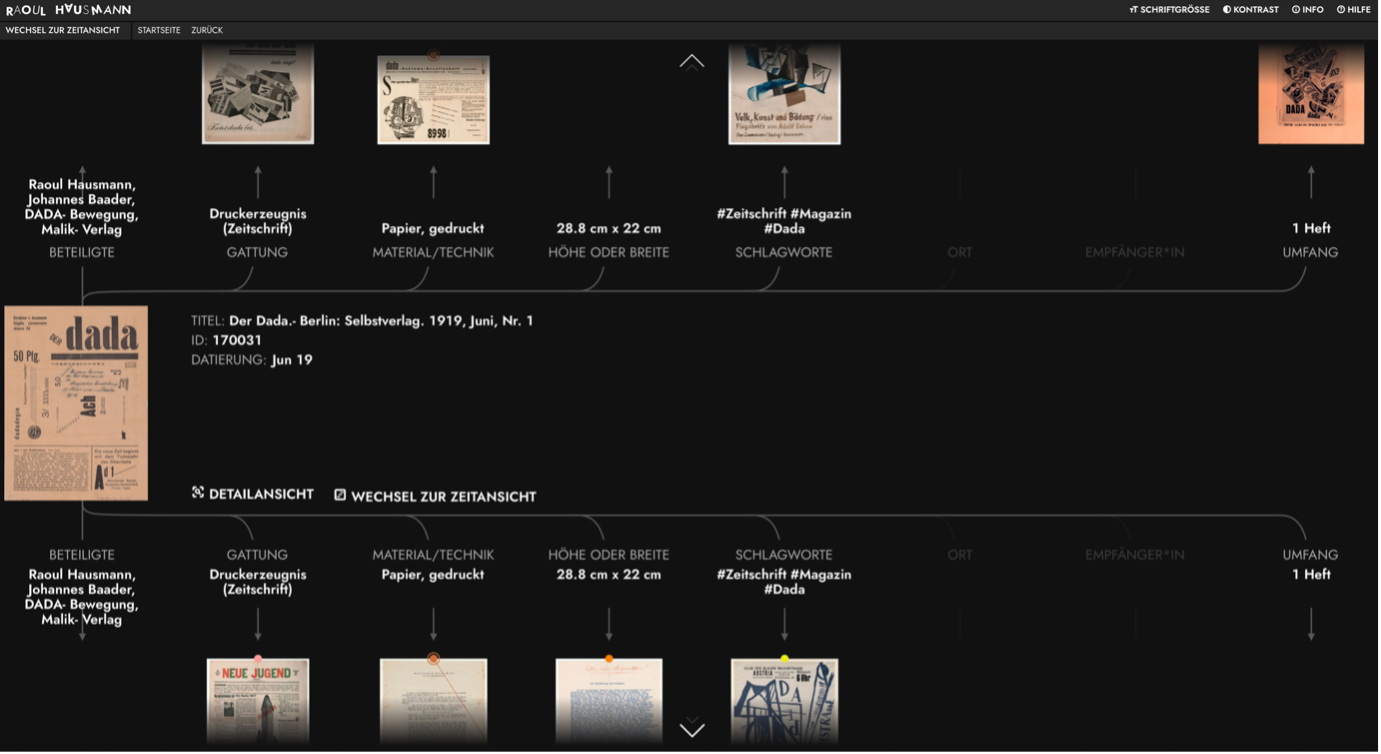
Where the previous two projects privilege an open drift, the
Relational Perspectives interface for the
Raoul Hausmann collection invites visitors to pivot the corpus from successive item-based vantage points [
Bludau et al. 2021]. The entry mosaic presents a faceted overview, but once an artifact is chosen, it
is placed in the middle of the interface in the context of related items (see Figure
1). Each click on another artifact re-centers the display on the new focal item, enabling
lateral hops among photographs, collages, and letters, producing an almost kaleidoscopic
form of navigation. The temporal view makes indeterminacies more explicit, with gradient
bands stretching across spans where dates are ambiguous, surfacing the gaps in collection
knowledge.
Against the three commitments these examples are uneven. All three interfaces support
mindful meandering, and two support relational revelation (Collections Dive and Relational
Perspectives). Reflexive gaze is absent from all three, since none tells a visitor
who they are taken to be or what is being logged about them. Wandering as movement
is well developed. However, wandering as a situated and observed act is not (yet)
well supported.
Fold
Having followed the wanderer along the archive’s shelves and boxes, we now consider
the fabric of those structures themselves. If the wanderer foregrounds attentive movement,
the fold orients us to the form of the interface: the mutable contours that appear
and contract as we drag, scroll, and click. Just as a traveler rolls and unrolls a
map to reveal new routes without tearing the paper, a folding interface must expand
detail while preserving the context of the whole.
Origins
The fold enters contemporary theory through Gilles Deleuze’s reading of Leibniz, where
every phenomenon is figured as a pleated surface whose successive explications, implications,
and complications knit thought to matter [
Deleuze 1993]. In visualization research the metaphor has been adopted to describe zooms, semantic
lenses, and other interactions that reveal fine detail without disrupting the larger
context [
Brüggemann et al. 2020]. Deleuze’s baroque lineage, however, is only one thread.
Many Indigenous knowledge systems understand folding and weaving not as metaphors
but as ontological practices that make the world. In Mesoamerica, the topology of
the cosmos is conceived as a fabric whose solar obverse and intensive reverse are
separated, and so brought into being, by an incessant operation of folding, the movement
by which fragments of the other side fold themselves into the solar world and solar
beings unfold back into the virtual domain [
Pitarch 2021]. Textile arts supply the conceptual template for this cosmology: ritual bundles
and body wrappings are understood as folds that momentarily stabilize a heterogeneous
multiplicity before it slips away again. Here, to fold is already to relate, and every
crease is an event of passage and transformation. A comparable logic is articulated
in Warlpiri and Yolŋu thought.
In dialogue with Samuel Curkpatrick, the senior Warlpiri elder and scholar Wanta Jampijinpa
Pawu describes
ngurra-kurlu (home-having) as a pattern for living handed down from the ancestors, one that shows
how everything is related. It has many names, one of them sacred and spoken only by
men in initiation ceremony. That name has to do with weaving and is also a name for
the Southern Cross, whose stars weave together into the diamond shape representing
the whole of ngurra-kurlu. As Pawu puts it, it is not you who does the weaving: country
weaves you, so that you become your
ngurra (home) [
Curkpatrick et al. 2023]. Among Yolŋu,
raki’ (string), twined from the bark fiber of the kurrajong tree in Wägilak ceremonial
song from northeast Arnhem Land, stands for the connection between a present generation
and its ancestors, and for the obligations and attachments that hold kin to one another
[
Curkpatrick et al. 2023].
A further dimension of the fold emerges in Indigenous critiques of colonial archives,
where it can also mark sites of erasure, concealment, and woundedness. As Dana Claxton
articulated at the Crossing Fonds symposium [
Claxton 2024], Indigenous knowledge often enters the archive not by invitation but appropriation,
and the fold becomes a space where such knowledge is withheld in shadow. In her view,
the fold carries the wounds of the archive, holding the dual potential for harm as
well as for healing. Claxton’s vision complicates the aesthetics of inclusion by asking
whether the archive’s folds can ever be complete without Indigenous presence, or whether
they must remain in tension, stitched but never sealed.
Recognizing these genealogies reframes the fold from an elegant philosophical trope
into a situated, relational ethic. Data never arrive as neutral sheets waiting to
be pleated. Instead, power, custodianship, and vulnerability are already woven through
them. A folding interface that expands an archive record while keeping provenance
visible, or that leaves restricted materials enveloped unless proper ceremony is observed,
honors this ethic.
Meanings
When weaving aspects of the fold into visual interfaces, four intertwined qualities
can guide the design process: coherence, elasticity, infinity [
Brüggemann et al. 2020], and depth.
Coherence requires that every partial view remains visibly tethered to the broader weave. Collapsing
a family branch, filtering by period, or zooming out must leave the overall framework
intact so that relations stay legible even when compressed. A collection interface
should let readers open a facet without severing it from the fabric it rests on. A
fold that erases its hidden layers breaks trust with both data and viewer.
Elasticity values supple transformation over brittle jumps. Interactive sliders, drag-to-weight
controls, or touch-based stretch gestures should let the visual fabric give and rebound
as interests evolve. Micro-animations that show nodes elongating before they settle
or timelines bending under pressure make a change of view legible. Elasticity is a
claim about interfaces, not on knowledge. Collections are full of discontinuities,
in the form of destroyed, stolen, or withheld records. Applied indiscriminately, elasticity
can smooth those gaps into a gradient. While a break that is an artifact of the current
view can be animated, a break that belongs to the collection should stand out.
Infinity acknowledges that every unfolding is provisional. The word needs qualifying, since
collections are indeed finite. What is open is the set of relations, not the holdings.
Gradient fades at the canvas edge, or the refusal to display a triumphant ‘all items
loaded’ badge, remind visitors that deeper pleats remain out of sight, sometimes because
of cultural protocol, sometimes because the collection is simply unfinished. Better
than a soft edge is a named one: this holding ends in this year because the donor’s
papers do, or two hundred items are restricted and appear in no view. Stated that
way, the exposed finitude is provenance information rather than a defect to be visually
softened, while infinity conveys an ethic of humility.
Depth frames the fold as a layered space of memory. Every fold introduces a surface but
also a recess, something set aside or held in reserve. This is not simply a matter
of scale, but of responsibility: what lies beneath may be sacred or wounded. Designing
with depth means acknowledging that not everything in a collection should be immediately
seen, allowing space for latency and partiality. Visually, this can be signaled by
shadow, blur, or layering. Depth unfolds in time, through gestures that require pause
or reciprocal engagement before proceeding.
The fold offers a counterproposal to flattened dashboards and rigid result lists.
Rather than pretending that data display is friction-free, it treats interaction as
the skilled handling of cloth: stretching to reveal, relaxing to protect. Does a faceted
filter sever a record from its custodial kin, or does it leave a visible selvedge
of context? Akin to the idea of seamful visualizations exposing the stitches of their
own making and the contingencies of the underlying data [
Hengesbach 2022], a folding interface earns trust not by hiding imperfections but by letting viewers
sense where the weave is patched or worn thin.
Usage
The practical reach of folding has already been mapped in visualization research.
A recent survey on un/foldable data visualizations [
Bludau et al. 2025] catalogs more than a hundred techniques that rely on progressive revealing and compressing
rather than window-switching or pop-up layering. Across widely different data domains
the survey demonstrates the same guiding logic: new detail is woven into the graphic
surface while contextual cues remain present as scale shifts. Folds are not rare novelties
but an emerging design pattern for visualizations of complex, stratified information.
In the following, three collection interfaces illustrate the idea in distinct ways.
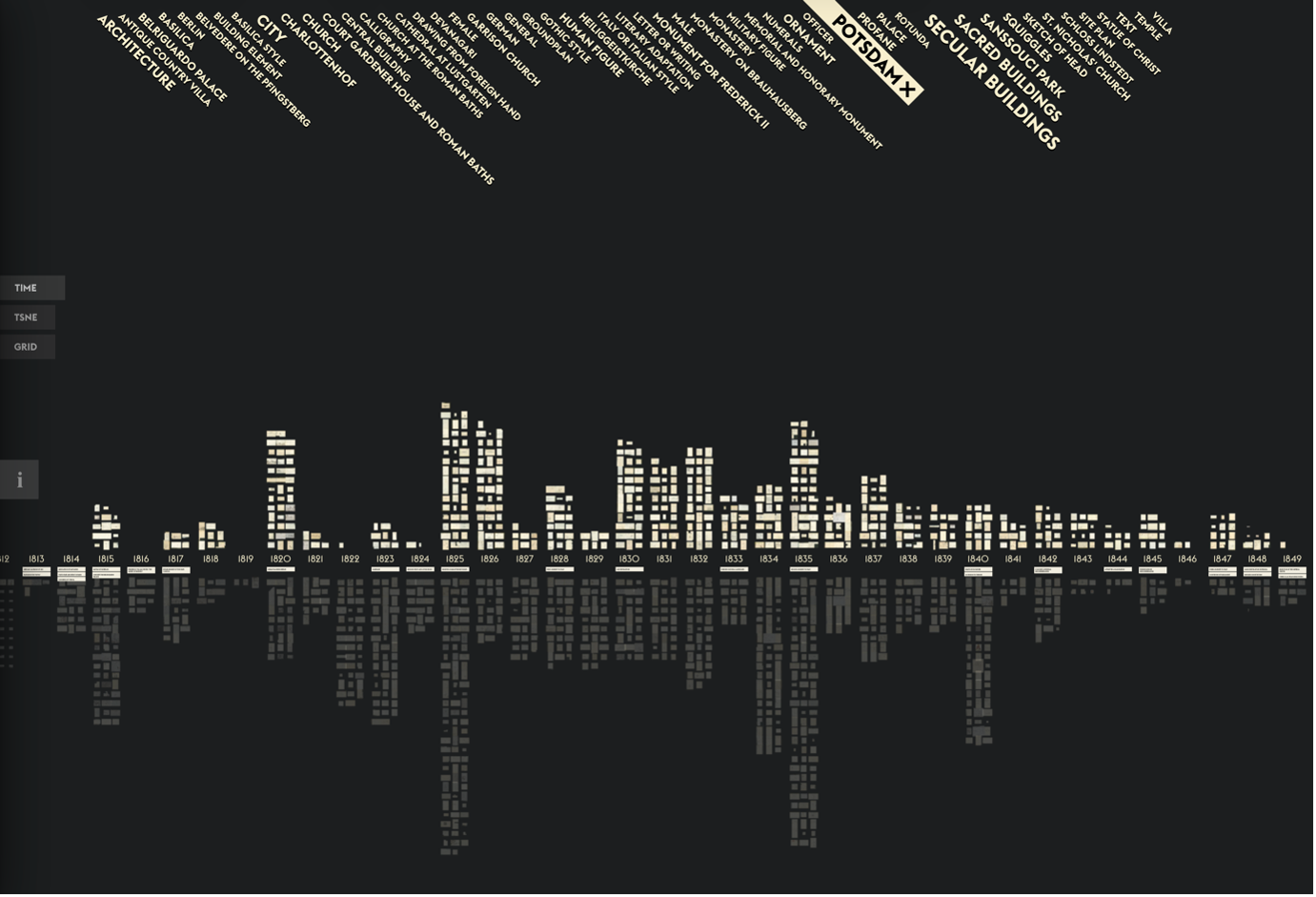
Past Visions is a dynamic visualization environment accommodating 1,492 nineteenth-century drawings
by Frederick William IV of Prussia (1795-1861) on a zoomable and filterable canvas
[
Glinka et al. 2017]. The landing view positions every sheet—pertaining to a broad range of topics from
urban planning to poetry—as a tiny thumbnail along a timeline whose granularity grows
or shrinks as the viewer zooms into or out of the arrangement. The timeline features
historical and biographical information contextualizing this collection. At the top
of the interface is a linearized word cloud featuring subjects and themes characterizing
the drawings. Filtering by theme gradually reshapes the arrangement of tags and images.
The thumbnails not matching any selection criteria become translucent and gently move
below the timeline (see Figure 2). Every state change is animated in place. In contrast
to conventional interfaces, nothing jumps to a new window. At the maximum magnification
the resolution is so high that it is possible to see the texture of pencil strokes
and paper grain. Anonymous usage logs suggest that the gradually zoomable environment
invites a rhythm of approach and retreat rather than a one-way drill-down.
From zooming to scrolling,
Reading Traces visualizes Theodor Fontane’s (1819-1898) hand-library in a flexible form that can
be gradually expanded and compressed via continuous scroll movements [
Bludau et al. 2020]. The interface opens on a shelf-like band of 155 vertical bars, each bar a book;
the varying widths of the bars encode how densely Fontane annotated that volume. Scrolling
downward echoes running a finger along the spines: bars lengthen into page strips,
and, with a further scroll, individual marginalia come out as colored squares that
give access to facsimile scans. Scrolling in the opposite direction, the individual
bars eventually merge into an overview summarizing the traces for each author. When
the viewer shifts between different granularities, the bars and curves gradually stretch
and compress without ever disappearing, allowing the eye to track continuity across
scales. Resembling a complication in Deleuze’s terms, a toggle in the sidebar pivots
the display into a similarity arrangement based on the character and frequency of
marginalia left by Fontane for each author or book.
A different folding tactic guides
Close-up Cloud, a visualization prototype built around the glass negatives by the photographer Wilhelm
Weimar (1857-1917) at Hamburg’s Museum for Art and Design [
Junginger et al. 2020]. Instead of presenting a synoptic overview first, as in the other cases, the interface
begins as a graphical tag cloud featuring cropped details whose tile size reflects
how often that motif occurs in the corpus. The tiles transition with a gentle cross-fading
animation between different instances of the tag across the collection. Hovering over
any tile reveals the tag’s name and frequency. Clicking on a tile centers the view
and unfolds all the close-ups sharing this tag grouped by the respective glass negatives
on which this tag has been placed. A second click on an item’s tile gently moves all
the close-ups belonging to this negative to their exact coordinates on the original
image, after which the full plate fades in, only then completing a full image of a
glass negative.
Visitors can flip the entire display from negative to positive, converting the abstract
originals into their more intuitive counterparts that better convey depth of the depicted
artworks and design objects. The smooth transitions from fragmented detail views to
cohesive object views illustrate how folding can invert the usual hierarchy of overview
and detail: viewers begin immersed in minute fragments and only later assemble a coherent
artifact, seeing the collection gradually unfold around the paths they take in the
interface.
Coherence and elasticity are where these three are relatively strong, and depth is
partly there: each stages the collection in layers and requires a descent to reach
any single item. Its other half, the refusal to show, is untested since none of these
collections holds restricted material. Infinity fares worst: a bounded, fully digitized
corpus in each case, with no signal of what is missing.
Shimmer
Collection interfaces are more than scaffolds and surfaces. They can hold moments
that feel alive, beckoning the visitor to pause and look closer. Such radiant moments
are what can be called shimmer: a pulse of relational brilliance that discloses a
hidden connection and suggests that a collection is a living ecology rather than a
static repository. Shimmer is playful and unpredictable, and of the three terms discussed
in this paper, it is the most speculative when it comes to the design of collection
visualizations.
Origins
The English word ‘shimmer’ refers to a wavering gleam, yet the concept is given far
greater depth in the Yolŋu languages of northern Australia. There, bir’yun names the
brilliance a surface acquires once it has been worked from dull to bright, a shimmer
in which ancestral power is felt to be present [
Morphy 1989]. Just as a sudden break in a cloud can cause a river to flash, the finely cross-hatched
lines of a painting can emit a similar radiance.
Deborah Bird Rose extends this concept to include multispecies lures: the blossom
that attracts flying-fox pollinators, the patterns of song and dance that light up
a ceremony, or the gleam of sunlight on wet leaves [
Rose 2022]. Shimmer is therefore not a property held by any one thing but a capture running
in several directions at once: water reflecting the sun, the sun glinting on the water,
the eyes of the beholders caught and held. However, that vitality is precarious. Rose
writes that
“extinction cascades drag shimmer from the world” as relationships falter and species disappear [
Rose 2017]. To notice shimmer is to sense both beauty and peril. When the term migrates into
digital interfaces, the baggage comes with it. While the effect itself travels across
cultures, its interpretation does not. A graphic that sparkles for mere effect resembles
the stimulus, but drops everything that made it mean anything.
Meanings
Shimmer belongs to the family of what anthropologist Anna Tsing calls ‘arts of noticing’:
practices that train perception to catch short-lived signals of entanglement before
they slip away [
Tsing 2015]. In Yolŋu thought, bir’yun is a quality of the worked surface, and a painting need
not even be seen for that quality to do its work: most ritual paintings are covered
or rubbed out within hours, and much of the experience of them is a glimpse from the
corner of the eye. The brilliance is relational in its meaning, which is culture-specific,
while the experience of being captured by it reaches across cultures.
Ephemeral encounter. Translating shimmer to collection visualization demands that we reconceive graphical
accent not as ornament but as a momentary co-presence between the aggregated collection
and the wandering visitor. Because shimmer is inherently fleeting, it gestures toward
a temporal ethics. It does not promise continuous access; instead, it models a shift
in its appearance that respects ceremonial timing, ecological cycles, or community
protocols. In design terms, this may mean valuing latency over permanence, making
room for absence as an integral part of presence.
Precarious allure. Shimmer also carries the experience of fascination towards an entity that is at
risk of destruction. The flash of vitality can slide into voyeuristic spectacle if
severed from context, yet declining to lure at all risks rendering fragile ties invisible.
The conceptual challenge is to hold allure in tension with responsibility: illumination
must come twinned with an offer to reciprocate, through credit or stewardship.
Partial survival. The warning that extinction pulls shimmer from the world suggests that visualization
should not cling to wholeness but acknowledge incompleteness. Brilliance indicates
vitality, while its withdrawal registers loss. Rose distinguishes between dullness
as a phase in a pulse, a resting state that can brighten again, and dullness as a
flat absence. An interface that dims can mean either, and telling the two apart is
the design problem: a collection between states looks much like one that is disappearing.
A greyed-out facet may indicate a record under embargo, a digitization backlog, or
a holding that no longer exists, and only the first of these will return. Shimmer
therefore works as an invitation, calling attention to relations that need care if
they are to persist.
Shimmer in a collection interface should therefore not be decorative sparkle but a
carefully staged moment of lively, risky presence: it appears only long enough to
allow a charge of curiosity and accountability, then dims so that other relations
can come forward. Whether shimmer can be designed at all is doubtful. The effect is
the tractable part, since brilliance is produced by technique and the light in a cross-hatched
painting is real. What cannot be arranged is what a viewer brings to it, and it is
there that the meaning of bir’yun stays with the source communities. A designer can
only prepare conditions. This makes shimmer a term of reflection and interpretation
more than of implementation or evaluation.
Usage
Although shimmer remains the most tentative of the three terms, some existing interfaces
arrange conditions under which it might occur. None of the projects below was designed
along the lines of shimmer, and none is offered here as proof that it was achieved.
They can be read instead for possible rather than actual shimmers.
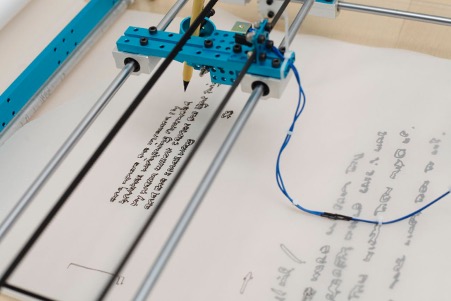
As part of the Poetics of the Archive project, the concept of archival liveness reimagines
the digitization of the still-uncatalogued
Bloodaxe Archive as a live event [
Schofield et al. 2015]. A mechanical plotter slowly redraws handwritten notes from freshly scanned manuscripts
on an endless paper scroll (see Figure 3), while a companion social media bot posts
each fragment as it is being recognized. Because both systems operate only when new
pages are being processed, the intermittent activity flares and subsides with the
rhythms of the repository. Before the feed falls silent again, viewers may catch a
glimpse of a poem title or a scrawled correction, reminding them that the collection
is still becoming. Exposing the incompleteness of the catalog and the labor behind
it also signals how easily this liveliness could be lost if the underlying work stalls.
The
Speculative W@nderverse is not built for a canonical library, but for a private science fiction collection:
72 handmade anthologies compiled by Canadian superfan Bob Gibson. His cut-and-paste
volumes mix forgotten pulp stories, comic panels, and marginalia [
Hinrichs et al. 2016]. The interface treats this material as a living, unlikely cosmos. It features a
keyword cloud and a hierarchy that form a hybrid taxonomy negotiating between fan
keywords and scholarly terms. The covers of the anthologies are partially visible
based on the current filters, and a timeline provides the temporal context of when
the volumes were published. At the center of the hierarchy is a cluster of unfamiliar
symbols that refer to themes, genres, and ratings, though a key for these symbols
has not yet been found.
When the cursor hovers over a symbol, the story’s cover art comes into focus, offering
some clues as to what they might mean. These flashes of clarity are where I would
locate shimmer’s precarious allure, provisionally, since the effect rests on a symbol
key that has never been found. They reveal women authors absent from standard bibliographies
and undated snippets of avant-la-lettre science fiction. By coupling fascination with
the disclosure of absence, the interface transforms an idiosyncratic collection into
a speculative laboratory where readers can glimpse the richness of science fiction’s
“great unread” [
Forlini et al. 2016].
Lastly, the generative works
Succession and
Drifter remix large heritage datasets into endlessly recomposed visual ‘fossils’ [
Whitelaw 2018]. In
Succession, five archival images linked to industrial Newcastle are superimposed in the browser,
then slowly dissolve, making room for the next composite. Drifter harvests river-catchment
maps, frog calls, and fragments from historic newspapers. Each refresh stitches a
new alignment that lingers for only a minute before washing away. Viewers can save
a fleeting arrangement, but the system returns immediately to its generative drift,
underscoring that any captured frame is provisional. These projects stage conditions
for shimmer as relational moments that may disclose entangled ‘matters of concern’
while refusing definitive closure. The brilliance here is produced by recombination,
which yields it rarely.
What these three interfaces share is an openness to something that cannot be ensured.
Any brilliance in them arrives, if it arrives at all, from a particular viewer meeting
a unique arrangement in a specific situation. This makes shimmer the weakest of the
three terms as a specification for design, yet a clear illustration of what vocabulary
work can do. A concept that can neither be implemented nor measured still has the
capacity to change what a diverse team may decide to leave room for.
A Grammar for Visual Collection Interfaces
At this point, the three terms are discrete entries in a small dictionary. A pidgin
becomes useful only when words form phrases in acts of speech. The terms gain force
when they are spoken in the situations where interfaces are imagined and interpreted:
co-design workshops, community reviews, field deployments, and studio pedagogy. What
follows outlines a grammar for visual collection interfaces. The principles formulate
overarching commitments, a phrase book suggests how the terms can be combined, and
a research framework proposes a methodology.
Principles
Wanderer, fold, and shimmer share more than a rhetorical affinity. Together they suggest
a coherent way of thinking about interface design for collection visualizations.
Relationality. Conventional information systems treat data as self-contained objects waiting to
be retrieved. The pidgin philosophy redirects attention to the ties that bind entities
together and to the actors who forge and traverse those ties. The wanderer is defined
not by arrival at a target but by a continuously renegotiated distance between self,
record, and contexts. A collection is not a closed trove but a space for responsive
accumulation: wanderers may annotate, trace paths, or offer commentary as participants
in an expanding web of relations rather than as external observers. A fold does not
add more content, but reorganizes adjacency and bends layers to center peripheral
items. Shimmer puts the relational focus most sharply. The brilliance is produced
by the surface, but what it comes to mean depends on what the viewer brings to the
encounter. While it may seem romantic, shimmer points to a moment of affective tension
in a situated encounter. In a collection interface built on the principle of relationality,
the default unit of design is a connection: a co-citation, a shared provenance tag,
or a kinship line.
Temporality. Standard usability doctrine values immediacy: pages that load in under two hundred
milliseconds, search results that stream as you type. The pidgin philosophy argues
instead for transitions that give temporal texture to the collection interface. The
wanderer’s slow drift encourages hesitation and side-tracking, while the folds stretch
or compress the movement between overview and detail, letting the eye acclimate. Shimmer
offers an evanescent pulse that may or may not recur, reminding viewers that collections,
like ecosystems, breathe. Designing with multiple tempos entails choreographing moments
of stillness, such as a lingering hover before metadata blooms, alongside bursts of
intensity. Attention to tempo counters the flattening effect of real-time dashboards,
returning duration and rhythm to inquiry.
Partiality. The three terms also converge on an ethics of necessary incompleteness. Wandering
accepts that some corridors remain closed; folds keep certain pleats latent to honor
custodianship or cognitive load; shimmer appears only when conditions are right. Friction
and refusal, often treated as obstacles to be engineered away, could become design
affordances in their own right. This stance resonates with feminist critiques of full
disclosure as a colonial gesture, Indigenous data-sovereignty protocols [
Russo Carroll et al. 2020], and growing privacy concerns [
Windon and Youngblood 2024]. While archival policies increasingly accommodate such ethics, interface design
has yet to catch up: few systems make partiality perceptible as part of the visitor
experience. Interfaces that embrace partiality should therefore build in graceful
dead-ends, consent-to-unfold gates, and quiet indicators that something is withheld.
Relationality, temporality, and partiality offer a compact set of principles for collection
visualizations that foreground ties over nodes, rhythm over speed, and care over completeness.
Phrase book
The potential of this pidgin philosophy shows when people speak it at different stages
along the life cycles of collection interfaces. Those situations include co-design
workshops where sketches and collages prompt the generation and discussion of ideas,
community reviews where ethical and technical tradeoffs are deliberated, field deployment
when server logs and visitor feedback inform iterative refinement, and studio pedagogy
where students test new terms against canonical vocabulary.
For these conversations, the three terms can assume complementary grammatical roles.
The wanderer is the subject moving through digital information spaces. The fold provides
the predicate embodying transformations of the visualizations during interaction.
Finally, shimmer acts as an object that signals vitality and vulnerability. Constructions
built from this trio serve as phrases that transdisciplinary groups can invoke while
brainstorming, sketching, prototyping, testing, or teaching.
Wanderer → Fold. When an exploratory view brings a visitor to an unfamiliar node, whether a cloud
of terms or a map of oral-history locations, the interface may allow the wanderer
to fold the surrounding scene rather than open a modal window or redirect. The cloud
contracts and the map reconfigures its layers, keeping peripheral traces visible while
presenting focused detail. This construction can remedy dead-end navigation by offering
a continuous transition that preserves orientation and respects the partiality of
the larger context.
Fold + Shimmer. Here structural compression is punctuated by a transient element that signals depth.
After a branch in a hierarchy or an interval in a timeline is folded, the newly condensed
element can carry a brief emphasis, such as a visual pulse of light, scaled to the
density or sensitivity of the material now tucked away. Whether that emphasis registers
as shimmer is not up to the designer, but if it does, it marks that the relations
are still there and tells the visitor where to look for them.
Wanderer ↔ Shimmer. In this phrase, the agency of the terms may alternate as the shimmer invites the
wanderer’s attention, who in turn might seek to find shimmer. During periods of tentative
hovering, common in image, sound, or mixed-media collections, a restrained emphasis
may appear on an adjacent yet unexplored record. If the visitor accepts the invitation,
the path branches sideways, and control then returns to the visitor. The interplay
balances guided discovery with exploratory autonomy, which distinguishes it from a
conventional recommendation cue.
Wanderer → Fold → Shimmer. Lastly, the tripartite phrase articulates complex information experiences. Lateral
wandering establishes the scope of what is there, folding reveals how it is layered,
and a brief emphasis on a single element can open up the experience of shimmer. The
pattern could be applied across a range of domains, from literary corpora to biodiversity
databases, giving each collection a sequence for working out what relationality, temporality,
and partiality mean in its own case. What counts as a lateral move differs between
a set of letters and a set of species records, as does what should be foldable and
what deserves a moment of emphasis.
These phrases are not tried and tested templates to be copied wholesale. Like clauses
in any living language, they invite elaboration, inversion, or abandonment as local
constraints and ambitions dictate.
Research framework
Because the grammar of the pidgin philosophy claims fidelity to design practice as
much as to interpretive scholarship, its research program should combine methods drawn
from those traditions. I organize them into three overlapping passes that can repeat
and inform each other in any order: designerly probing, humanistic reading, and situated
evaluation.
Designerly probing treats visualization creation as a research process in its own right. Here the team
works through iterative sandcastles [
Hinrichs et al. 2018] that follow one emerging question at a time: a constellation view that foregrounds
wandering, or an elastic stack that resembles folding. Situated cultural-probe exercises,
such as sketchbooks or speculative postcards, can prompt participants to voice sensory
memories and contested readings of a place, demonstrating how in-situ design probes
stimulate plural, critical perspectives on cultural heritage [
Schofield et al. 2019]. Collaborative critique sessions borrow from reflective practice: collages are pinned
up and openly discussed in the group to inform the next iteration [
Dörk et al. 2020]. The outcome is not a finished product but a clarified design question.
Humanistic reading replays prototype sessions as if they were texts: screen recordings and transcriptions
of think-aloud expressions become trace documents for close reading and thick description.
Rather than asking whether a visitor completed a task, the reading asks what a pause
was doing, where an expectation was disappointed, and which vocabulary a participant
reached for when the interface offered none. Collaborators should pursue their own
readings of prototypes to formulate ‘friendly critique’ and give suggestions for iterations.
Indigenous elders may refuse a fold that exposes restricted knowledge, while poets
may celebrate a wandering path that produces serendipitous juxtapositions. These hermeneutic
moves return ethical and cultural nuance to what could otherwise remain purely interactional
data.
Situated evaluation investigates how the pidgin philosophy holds up in real encounters with an interface.
However, the canonical metrics tend to capture the wrong thing. Dwell time, click
depth, and task completion may measure efficiency, but a wanderer who lingers is indistinguishable
from a visitor who has left the room. Logs can be useful, but as traces to be read
rather than aggregated. A single session replayed as a path shows where a visitor
doubled back, which unfolding was abandoned midway, and when a threshold was never
crossed. In addition to these, observations and interviews with visitors, curators,
archivists, and community members can determine if the terms represent anything meaningful
in their encounters with the collection.
The three passes circulate in a spiral. A puzzling pattern in the traces may send
designers back to build another prototype, while a close reading of a fold that participants
consistently misread suggests a different kind of vocabulary. Design iterations produce
new material for interpretation. Throughout, the open glossary serves as a kind of
knowledge base: heuristics are tagged with observations, terms fork into stricter
or looser dialects, and new words enter when existing ones no longer speak to an emerging
practice. Each strand honors relationality through collaboration across expertise,
temporality through an iterative rhythm rather than a waterfall, and partiality through
the admission that no single method can claim total truth.
Discussion
This pidgin philosophy sets out a vocabulary and grammar for the design and study
of data visualizations of archival fonds and cultural collections, yet several important
aspects fall outside the scope of this paper. Below I briefly acknowledge key concerns
that are readable as shortcomings of the framework or as directions for future work.
Infrastructural debt. Behind every elegant interface lies a hidden accrual of technical and organizational
liabilities. Digitization backlogs often delay whole swaths of a collection, while
grant cycles dictate which servers are maintained and which silently age. Cold-storage
cloud tiers can make a master file effectively unreachable just when a community demands
higher-resolution evidence. As the
Endings Project has shown, most cultural-heritage sites are launched with short-term funds but without
a plan to migrate code, refresh formats, or document bespoke stacks once the grant
ends. The result is a maintenance burden that outstrips staff capacity and makes even
the most ethically charged shimmer meaningless the moment the underlying asset decays
or the framework breaks after a security update [
Holmes et al. 2023]. To keep the pidgin realistic, any grammar of interfaces needs an underlying lexicon
that names the conditions for preservation. Making the terms of maintenance explicit
in early scoping meetings would let collaborators weigh visual ambition against long-term
resilience.
Data-capture politics. In this paper, I consider collections as given, yet many digital archives originate
in contexts of injustice ranging from colonial extraction to surveillance regimes
[
Thylstrup 2019]. The principle of partiality, with its license to blur, hide, or withhold, mitigates
some downstream harm, but it cannot undo the coercive conditions under which some
of these records were first ‘captured.’ To confront that history the lexicon itself
needs new terms. A consent ledger could travel with a record, logging who authorized
what use and when that consent expires. A refusal register would document requests
by source communities to suppress, restrict, or repatriate items; a sovereignty tag
might mark materials governed by Indigenous data protocols such as CARE [
Russo Carroll et al. 2020]. Embedding such terms, along with the accompanying technical specifications, would
extend the pidgin from design for encounter to the conditions of capture, and open
a path to restitution or deletion where justice demands it. However, what constitutes
justice or violence depends on the specific situation. The same act may be perceived
as preservation in one community and as a violation in another. Navigating these tensions
requires a language that enables dialogue across value systems shaped by time and
place.
Risk of oversimplification. Any pidgin gains its usefulness by limiting language to negotiable chunks. Rendering
wanderer, fold, and shimmer as design heuristics inevitably compresses the dense strata
of philosophies from which they spring. What begins as a mobile metaphor can become
a decorative trope, an instruction to add a shimmer effect here and insert a fold
there, detached from the histories the terms were meant to foreground.
The pidgin’s brevity is a provisional bridge, not a destination. Each term should
act as a prompt to return to its source traditions, to cite them, and to involve their
living communities where possible. The pidgin itself must remain seamful [
Hengesbach 2022]: its visible stitches should remind designers that behind every concise phrase lies
a thicker fabric of theory and practice that must be revisited if the critical force
of the concepts is not to fray.
Ocular-centrism. This project assumes that knowledge is encountered first and foremost through the
eye: a wanderer glances across a visual field, folds reshape a graphic surface, and
shimmer flashes as transient light. Such emphasis risks marginalizing collections
whose primary materials are sonic or haptic, and it under-serves communities that
approach collections through touch, voice, or vibration. Extending the pidgin therefore
means recruiting new parts of speech.
A term like ‘echo’ might designate a reverberant relation that emerges only when sounds
overlap in time. Similarly, ‘grain’ could name the tactile residue that lingers after
a page is handled. Developing such multisensory terms, and pairing them with interface
techniques that privilege hearing or touch, would counter the bias toward sight and
offer more inclusive grammars for collections whose stories should resonate beyond
the visual.
Distance from archival practice. Admittedly, the conversation described here barely touches the daily work of description,
delivery, and discovery. The people who write finding aids and answer reference queries
are rarely involved when a collection interface is designed, and their perspectives
may differ from the ones assumed above. Slowness, there, is not an ethic but a service
failure. A term is only useful for a practitioner if it links to something already
in their frame of reference. Fold fits in readily, since a finding aid is itself a folded structure, and most discovery
interfaces render it badly. Wanderer fits since it suggests a kind of browsing that reference statistics have never recorded
and failed to support.
Shimmer attaches to nothing I can identify at this point. If this pidgin philosophy is to
travel, the intention is not to simply propagate three words but to learn how they
resonate with, and rub against, archival practices.
Asymmetry in the metaphor. A pidgin is not a meeting of equals. Its lexicon comes primarily from one of the
languages in contact, while its grammar comes primarily from none of them [
Thomason and Kaufman 1988]. Something is always supplying the words, and it is rarely the party with the least
power, even if the direction of dominance is not uniform. Likewise, the settings described
in this paper are not level either. Design and software vocabulary tends to set the
terms, since it is attached to what will actually get built, while archivists and
humanities scholars more often do the translating. This paper is not exempt, since
some of the terms are in part borrowed from Indigenous thought, from communities who
were not included when the borrowing happened. Naming a lexicon is itself an act of
authority, and a pidgin philosophy that only celebrates hybridity would miss this.
The more demanding question is not what the words mean but who gets to coin them,
and whether the people who hold the material can shape a prototype as forcefully as
the people who build it.
Conclusion
This paper set out to do three things. The first was to trace the emergence of a pidgin
philosophy in the trading zone of archival studies, interface design, and the digital
humanities, and to argue for vocabulary work as a methodological stance. The second
was to describe three terms, wanderer, fold, and shimmer, through their lineages,
theoretical commitments, and practical uses. The third was to synthesize them into
a grammar: the principles of relationality, temporality, and partiality, a phrase
book for combining the terms, and a tripartite research framework.
I opened with a workshop that was never meant to produce an interface. The aim was
to stimulate a mixed group’s imagination about what a photo archive might become on
screen, and to test a format for prompting that kind of conversation [
Chen et al. 2014]. What the afternoon produced was a group who could, for a few hours, discuss the
same collection in the same words.
That idiom did not outlive the day, and no single interface can be traced to it. What
travelled was the format: collaging proved a durable way of bringing people with different
expertise into a common language, and it carried into more than a decade of visualization
projects in Potsdam [
Dörk et al. 2020]. The conversation itself likely informed Amber’s later redevelopment of its own
website, and echoes of it persist in the terms gathered here. The afterlife was largely
methodological. That is what this paper has been trying to name.
The lexicon and its grammar suggest how vocabulary work might function as a methodological
resource for design and research. Considering visitors as wanderers foregrounds surprise
and slowness and makes room for lingering. Modeling interaction as folding keeps continuity
and tension as qualities worth designing for. Letting shimmer appear and recede directs
attention to the vitality and vulnerability of cultural collections and to the care
they require. Whether these terms do such work beyond the settings in which I have
used them remains an open question, and the research framework sketches one way of
finding out.
Any pidgin remains provisional. A contact language stays alive by being spoken, revised,
and contested. The lexicon presented here is therefore an opening rather than a closure.
Future collaborations will need new terms that speak, for example, to sound archives
or haptic collections and will uncover contexts in which these three fail to evoke
interest or imagination. Fresh words can be coined, old ones retired, and familiar
phrases adjusted to fit local ethics and aesthetics. Which words those turn out to
be, and who gets to propose them, will be settled in the collaborations themselves
rather than in a paper.
Acknowledgments
I thank the organizers of the Crossing Fonds symposium 2024, the editors of this special
issue, and the DHQ reviewers for their thoughtful feedback and suggestions. Much of
the thinking here is based on the collaborations with colleagues on the projects and
publications cited throughout. Thanks also to the Amber collective and to the participants
and co-organizers of the 2013 workshop in Newcastle.
Works Cited
Bachmann-Medick 2016 Bachmann-Medick, D. (2016)
“The performative turn”, in
Cultural turns: New orientations in the study of culture, pp. 73–102. Berlin/Boston: de Gruyter. Available at:
https://doi.org/10.1515/9783110402988-004.
Battle-Baptiste and Rusert 2018 Battle-Baptiste, W. and Rusert, B. (eds) (2018) W.E.B. Du Bois’s data portraits: Visualizing Black America. New York: Princeton Architectural Press.
Baudelaire 1965 Baudelaire, C. (1965) The painter of modern life and other essays. London: Phaidon Press.
Benjamin 1973 Benjamin, W. (1973) “The Paris of the second empire in Baudelaire: II the Flâneur”, in Charles Baudelaire: A lyric poet in the era of high capitalism. London: NLB, pp. 35–66.
Bludau et al. 2020 Bludau, M.J., Brüggemann, V., Busch, A., and Dörk, M. (2020)
“Reading traces: scalable exploration in elastic visualizations of cultural heritage
data”,
Computer Graphics Forum, 39(3), pp. 77–87. Available at:
https://doi.org/10.1111/cgf.13964.
Bludau et al. 2021 Bludau, M.J., Dörk, M., and Heidmann, F. (2021)
“Relational perspectives as situated visualizations of art collections”,
Digital Scholarship in the Humanities, 36, pp. ii17–ii29. Available at:
https://doi.org/10.1093/llc/fqab003.
Bludau et al. 2025 Bludau, M.J., Dörk, M., Bruckner, S., and Tominski, C. (2025)
“Fluidly revealing information: A survey of un/foldable data visualizations”,
Computer Graphics Forum, 44, e70152. Available at:
https://doi.org/10.1111/cgf.70152.
Browne 2015 Browne, S. (2015) Dark matters: On the surveillance of blackness. Durham, NC: Duke University Press.
Brüggemann et al. 2020 Brüggemann, V., Bludau, M.J., and Dörk, M. (2020)
“The fold: Rethinking interactivity in data visualization”,
Digital Humanities Quarterly, 14 (3). Available at:
https://doi.org/10.63744/5aycaj9wtv7j.
Buck-Morss 1986 Buck-Morss, S. (1986) “The flâneur, the sandwichman and the whore: The politics of loitering”, New German Critique, 39, pp. 99–140.
Caccamo et al. 2023 Caccamo, M., Pittino, D., and Tell, F. (2023)
“Boundary objects, knowledge integration, and innovation management: A systematic
review of the literature”,
Technovation, 122, 102645. Available at:
https://doi.org/10.1016/j.technovation.2022.102645.
Caswell 2021 Caswell, M. (2021) Urgent archives: Enacting liberatory memory work. New York: Routledge.
Caswell 2024 Caswell, M.L. (2024)
““The archive” is not an archives: On acknowledging the intellectual contributions
of archival studies”, in
Archives: Power, truth, and fiction, pp. 21–36. Oxford: Oxford University Press. Available at:
https://doi.org/10.1093/oxfordhb/9780198829324.013.0002.
Chen et al. 2014 Chen, Ko-Le, Dörk, Marian, and Dade-Robertson, Martyn (2014)
“Exploring the promises and potentials of visual archive interfaces”, in
Proceedings of the 2014 iConference, pp. 735–741. Available at:
https://doi.org/10.9776/14348.
Claxton 2024 Claxton, D. (2024) “Interpreting Indigenous histories through digital artworks”, in Crossing Fonds Symposium. Vancouver.
Curkpatrick et al. 2023 Curkpatrick, S., Bacaller, S., Pawu, W.J., and Wilfred, D. (2023)
“Interweaving fibres: Relational dynamics in Indigenous australian thought and performance”,
Journal of Intercultural Studies, 44(5), pp. 649–657. Available at:
https://doi.org/10.1080/07256868.2023.2239561.
Deleuze 1993 Deleuze, G. (1993) The fold: Leibniz and the baroque. London: Athlone Press.
Derrida 1996 Derrida, J. (1996) Archive fever: A Freudian impression. Chicago: University of Chicago Press.
Drucker 2014 Drucker, J. (2014) Graphesis: Visual forms of knowledge production. Cambridge, MA: Harvard University Press.
Dörk et al. 2011 Dörk, M., Carpendale, S., and Williamson, C. (2011)
“The information flaneur: A fresh look at information seeking”, in
CHI ’11: Proceedings of the SIGCHI Conference on Human Factors in Computing Systems, pp. 1215–1224. Available at:
https://doi.org/10.1145/1978942.1979124.
Dörk et al. 2020 Dörk, M., Müller, B., Stange, J.E., Herseni, J., and Dittrich, K. (2020)
“Co-designing visualizations for information seeking and knowledge management”,
Open Information Science, 4, pp. 217–235. Available at:
https://doi.org/10.1515/opis-2020-0102.
D’Ignazio and Klein 2016 D’Ignazio, C. and Klein, L.F. (2016) “Feminist data visualization”, in VIS4DH: 2016 Workshop on Visualization for the Digital Humanities.
Edelstein et al. 2017 Edelstein, D., Findlen, P., Ceserani, G., Winterer, C., and Coleman, N. (2017)
“Historical research in a digital age: Reflections from the mapping the republic of
letters project”,
The American Historical Review, 122(2), pp. 400–424. Available at:
https://doi.org/10.1093/ahr/122.2.400.
Elkin 2017 Elkin, L. (2017) Flâneuse: Women walk the city in Paris, New York, Tokyo, Venice and London. New York: Farrar, Straus & Giroux.
Eltis and Richardson 2008 Eltis, D. and Richardson, D. (2008) Extending the frontiers: Essays on the new transatlantic slave trade database. New Haven: Yale University Press.
Escobar 2018 Escobar, A. (2018) Designs for the pluriverse: Radical interdependence, autonomy, and the making of worlds. Durham, NC: Duke University Press.
Forlini et al. 2016 Forlini, S., Hinrichs, U., and Moynihan, B. (2016)
“The stuff of science fiction: An experiment in literary history”,
Digital Humanities Quarterly, 10(1). Available at:
https://doi.org/10.63744/tdb62g22n8ub.
Foster and Ford 2003 Foster, A. and Ford, N. (2003)
“Serendipity and information seeking: An empirical study”,
Journal of Documentation, 59(3), pp. 321–340. Available at:
https://doi.org/10.1108/00220410310472518.
Freshwater 2003 Freshwater, H. (2003) “The allure of the archive”, Poetics Today, 24(4), pp. 729–758.
Friendly and Wainer 2021 Friendly, M. and Wainer, H. (2021) A history of data visualization and graphic communication. Cambridge, MA: Harvard University Press.
Galison 1997 Galison, P. (1997) Image and logic: A material culture of microphysics. Chicago: University of Chicago Press.
Glinka et al. 2017 Glinka, K., Pietsch, C., and Dörk, M. (2017)
“Past visions and reconciling views: Visualizing time, texture and themes in cultural
collections”,
Digital Humanities Quarterly, 11(2). Available at:
https://doi.org/10.63744/ghpg9yjddxwt.
Haraway 2016 Haraway, D.J. (2016) Staying with the trouble: Making kin in the Chthulucene. Durham, NC: Duke University Press.
Hengesbach 2022 Hengesbach, N. (2022)
“Undoing seamlessness: Exploring seams for critical visualization”, in
CHI Conference on Human Factors in Computing Systems Extended Abstracts (CHI ’22), pp. 1–7. Available at:
https://doi.org/10.1145/3491101.3519703.
Hinrichs et al. 2016 Hinrichs, U., Forlini, S., and Moynihan, B. (2016)
“Speculative practices: Utilizing infoVis to explore untapped literary collections”,
IEEE Transactions on Visualization and Computer Graphics, 22(1), pp. 429–438. Available at:
https://doi.org/10.1109/TVCG.2015.2467452.
Hinrichs et al. 2018 Hinrichs, U., Forlini, S., and Moynihan, B. (2018)
“In defense of sandcastles: Research thinking through visualization in digital humanities”,
Digital Scholarship in the Humanities, 34, pp. i80–i99. Available at:
https://doi.org/10.1093/llc/fqy051.
Holmes et al. 2023 Holmes, M., Jenstad, J., and Huculak, J.M. (2023)
“Introduction to special issue: Project resiliency in the digital humanities”,
Digital Humanities Quarterly, 17(1). Available at:
https://doi.org/10.63744/g7c3rkvm5bzr.
Höök and Löwgren 2012 Höök, K. and Löwgren, J. (2012)
“Strong concepts: Intermediate-level knowledge in interaction design research”,
ACM Transactions on Computer-Human Interaction, 19(3), p. 23. Available at:
https://doi.org/10.1145/2362364.2362371.
ICA 2023 International Council on Archives (2023)
Records in contexts: A conceptual model for archival description (RiC-CM), version
1.0. Paris: International Council on Archives. Available at:
https://www.ica.org/app/uploads/2023/12/RiC-CM-1.0.pdf. Accessed: 1 September 2026.
ICOM 2024 International Council of Museums, CIDOC CRM Special Interest Group (2024)
Definition of the CIDOC conceptual reference model, version 7.1.3. Paris: International Council of Museums. Available at:
https://cidoc-crm.org/Version/version-7.1.3. Accessed: 1 September 2026.
Ingold 2007 Ingold, T. (2007) Lines: A brief history. London: Routledge.
Junginger and Dörk 2021 Junginger, P. and Dörk, M. (2021)
“Categorizing queer identities: An analysis of archival practices using the concept
of boundary objects”,
The Journal of Feminist Scholarship, 19 (Fall), pp. 66–79. Available at:
https://doi.org/10.23860/jfs.2021.19.05.
Junginger et al. 2020 Junginger, P., Ostendorf, D., Avila Vissirini, B., Voloshina, A., Hausmann, T., Kreiseler,
S., and Dörk, M. (2020)
“The close-up cloud: Visualizing details of image collections in dynamic overviews”,
International Journal for Digital Art History, 5, pp. 6.2-6.13. Available at:
https://doi.org/10.11588/dah.2020.5.72039.
Kim 2018 Kim, D. (2018)
“Building pleasure and the digital archive”, in Losh, Elizabeth and Wernimont, Jacqueline (eds)
Bodies of information: Intersectional feminism and digital humanities. Minneapolis: University of Minnesota Press, pp. 230–260. Available at:
https://doi.org/10.5749/j.ctv9hj9r9.17.
Leddy and Miller 2020 Leddy, S. and Miller, L. (2020)
“Weaving slow and Indigenous pedagogies: Considering the axiology of place and identity”, in Lyle, E. (ed)
Identity landscapes, pp. 268–280. Leiden: Brill. Available at:
https://doi.org/10.1163/9789004425194_024.
McCurdy et al. 2016 McCurdy, N., Lein, J., Coles, K., and Meyer, M. (2016)
“Poemage: Visualizing the sonic topology of a poem”,
IEEE Transactions on Visualization and Computer Graphics, 22(1), pp. 439–448. Available at:
https://doi.org/10.1109/tvcg.2015.2467811.
Michetti 2017 Michetti, G. (2017) “Provenance in the archives. The challenge of the digital environment”, in Archives in liquid times, pp. 229–246. ’s-Hertogenbosch: Stichting Archiefpublicaties.
Morphy 1989 Morphy, H. (1989)
“From dull to brilliant: The aesthetics of spiritual power among the Yolngu”,
Man, 24(1), pp. 21–40. Available at:
https://doi.org/10.2307/2802545.
Morse et al. 2021 Morse, C., Niess, J., Lallemand, C., Wieneke, L., and Koenig, V. (2021)
“Casual leisure in rich-prospect”,
Journal on Computing and Cultural Heritage, 14(3), pp. 1–23. Available at:
https://doi.org/10.1145/3437257.
Otto and Davidoff 2024 Otto, J.T. and Davidoff, S. (2024)
“Visualization artifacts are boundary objects”, in
2024 IEEE Evaluation and Beyond-Methodological Approaches for Visualization (BELIV), pp. 81–88. Available at:
https://doi.org/10.1109/beliv64461.2024.00014.
Pitarch 2021 Pitarch, P. (2021)
“The folds of the world: An essay on Mesoamerican textile topology”,
HAU: Journal of Ethnographic Theory, 11(3), pp. 1191–1205. Available at:
https://doi.org/10.1086/717128.
Robinson 2019 Robinson, D. (2019) “Speaking to water, singing to stone: Peter Morin, Rebecca Belmore, and the ontologies
of Indigenous modernity”, in Levine, V. L. and Robinson, D. (eds) Music and modernity among first peoples of North America, pp. 220–239. Middletown: Wesleyan University Press.
Rose 2017 Rose, D.B. (2017)
“Shimmer: When all you love is being trashed”, in Tsing, Anna, Swanson, Heather, Gan, Elaine, and Bubandt, Nils (eds)
Arts of living on a damaged planet, pp. 51–63. Minneapolis: University of Minnesota Press. Available at:
https://doi.org/10.5749/9781452954486-005.
Rose 2022 Rose, D.B. (2022) Shimmer: Flying fox exuberance in worlds of peril. Edinburgh: Edinburgh University Press.
Russo Carroll et al. 2020 Russo Carroll, S., Garba, I., Figueroa-Rodríguez, O.L., Holbrook, J., Lovett, R.,
Materechera, S., Parsons, M., Raseroka, K., Rodriguez-Lonebear, D., Rowe, Robyn, S.,
Rodrigo, Walker, J.D., Anderson, J., and Hudson, M. (2020) ‘The CARE Principles for
Indigenous Data Governance’, Data Science Journal, 19, p. 43. Available at: https://doi.org/10.5334/dsj-2020-043
Schofield et al. 2015 Schofield, T., Kirk, D., Amaral, T., Dörk, M., Whitelaw, M., Schofield, G., and Ploetz,
T. (2015)
“Archival liveness: Designing with collections before and during cataloguing and digitization”,
Digital Humanities Quarterly, 9(3). Available at:
https://doi.org/10.63744/69xs2ywktkzp.
Schofield et al. 2019 Schofield, T., Foster Smith, D., Bozoglu, G., and Whitehead, C. (2019)
“Design and plural heritages: Composing critical futures”, in
Proceedings of the 2019 CHI Conference on Human Factors in Computing Systems (CHI
’19), pp. 6:1–6:15. Available at:
https://doi.org/10.1145/3290605.3300236.
Sekula 1986 Sekula, A. (1986) “The body and the archive”, October, 39, pp. 3–64.
Star and Griesemer 1989 Star, S.L. and Griesemer, J.R. (1989) “Institutional ecology, “Translations” and boundary objects: Amateurs and professionals
in Berkeley’s Museum of Vertebrate Zoology, 1907-39”, Social studies of science, 19(3), pp. 387–420.
Thomason and Kaufman 1988 Thomason, S.G. and Kaufman, T. (1988) Language contact, Creolization, and genetic linguistics. Berkeley: University of California Press.
Thylstrup 2019 Thylstrup, N.B. (2019) The politics of mass digitization. Cambridge, MA: MIT Press.
Thylstrup et al. 2021 Thylstrup, N.B., Agostinho, D., Ring, A., D’Ignazio, C., and Veel, K. (eds) (2021)
Uncertain archives: Critical keywords for big data. Cambridge, MA: MIT Press. Available at:
https://doi.org/10.7551/mitpress/12236.001.0001.
Tsing 2015 Tsing, A.L. (2015) The mushroom at the end of the world on the possibility of life in capitalist ruins. Princeton: Princeton University Press.
Tukey 1962 Tukey, J.W. (1962) “The future of data analysis”, The Annals of Mathematical Statistics, 33(1), pp. 1–67.
Urton 2017 Urton, G. (2017) Inka history in knots: Reading Khipus as primary sources. Austin: University of Texas Press.
Vossoughian 2006 Vossoughian, N. (2006)
“Mapping the modern city: Otto Neurath, the International Congress of Modern Architecture
(CIAM), and the politics of information design”,
Design Issues, 22(3), pp. 48–65. Available at:
https://doi.org/10.1162/desi.2006.22.3.48.
Whitelaw 2018 Whitelaw, M. (2018)
“Mashups and matters of concern: Generative approaches to digital collections”,
Open Library of Humanities, 4(1). Available at:
https://doi.org/10.16995/olh.291.
Wilson 1992 Wilson, E. (1992) “The invisible flâneur”, New Left Review, 191, pp. 90–110.
Windhager et al. 2019 Windhager, F., Federico, P., Schreder, G., Glinka, K., Dörk, M., Miksch, S., and
Mayr, E. (2019)
“Visualization of cultural heritage collection data: State of the art and future challenges”,
IEEE Transactions on Visualization and Computer Graphics, 25 (6), pp. 2311–2330. Available at:
https://doi.org/10.1109/tvcg.2018.2830759.
Windhager et al. 2025 Windhager, F., Mayr, E., and Glinka, K. (2025)
“From exploration to critique: Catalyzing critical inquiry with cultural collection
visualizations”,
IEEE Computer Graphics and Applications, 45 (2), pp. 1–15. Available at:
https://doi.org/10.1109/mcg.2025.3559769.
Windon and Youngblood 2024 Windon, K. and Youngblood, J. (2024)
“Privacy considerations in archival practice and research”, in
Human privacy in virtual and physical worlds: Multidisciplinary perspectives, pp. 205–234. Cham: Springer. Available at:
https://doi.org/10.1007/978-3-031-51063-2_11.


 https://orcid.org/0000-0002-3469-7841