Abstract
This paper considers the three phases and five decades of the Women’s Labour History
Project (WLHP) archive. It documents a transmediated feminist archival process, which
has its origins in the pre-digital world and makes use of various technologies, and
arrives at Crossing Fonds, a digital humanities initiative. Transmediation represents the process of moving
records from one medium to another in ways that conserve but also offer new opportunities.
The WLHP engaged in critical archival studies from the 1970s to the 1990s, exploring
human and archival memory, undertaking a forensic search for relevant bibliographic
and archival records regarding women, work, and labour organization, and then growing
into a multi-decade reuse of archival footage to reinterpret diverse histories. Decades
later, the first phase led to Phase Two, the activation of Women’s Labour History
Project series as a component of the larger Sara Diamond fonds—a collection within
the Crista Dahl Media Library & Archive (CDMLA) at VIVO Media Arts through digitization
and generous interfaces built to encourage access. Phase Three is Case Study 1 within
the larger Crossing Fonds Omeka S archival collaboration platform. Digital archives provide the opportunity
to develop new analyses prompted by access to documents from institutional and community
archives. Researchers can redescribe, contextualize, and apply critical archival practices
to consider new relationships, including between items and fonds.
Introduction
This article considers the three phases and five decades of the Women’s Labour History
Project (WLHP) archive. It documents a transmediated feminist archival process, which
has its origins in the pre-digital world and makes use of various technologies, and
arrives at
Crossing Fonds, a digital humanities initiative.
“Transmediation” draws from Peña and Kedrick’s (2023) broad definition,
“Whatever the nature of media, transmediation intends to account for the transference
of content between different forms of it” [
Peña and James 2023]. Transmediation can include
“ideas, works, media itself, semiotic systems”, sensory, signal and raw data. This article considers continuities and new opportunities
informed by capabilities in the online archive field, maturation of critical archival
studies, and changing user needs. It begins with a brief overview of the
Crossing Fonds Omeka S archival collaboration platform. It then discusses the three phases of the
WLHP.
Phase One (1970s–1990s) – WLHP and Feminist Archival Activism engaged human and archival memory, undertaking a forensic search for relevant bibliographic
and archival records regarding women, work, and labour organization and then a multi-decade
reuse of archival footage to reinterpret diverse histories. Decades later, the first
phase led to
Phase Two – Bringing the WLHP/Diamond fonds to VIVO Media Arts, the creation of the Women’s Labour History Project fonds in 2018 as a component
of the larger Sara Diamond fonds — a collection within the Crista Dahl Media Library
& Archive (CDMLA) at VIVO Media Arts.
[1]
CDMLA undertook extensive digitization and created a transmediated series of public
facing WLHP web experiences.
Phase Three – Crossing Fonds Case Study – Women’s Labour History: Restaurant Work in the Vancouver
Area uses the Omeka S platform to investigate women’s labour and labour organization in
British Columbia, Canada’s restaurant and hotel sectors in the 1930s, 1940s, and 1970s.
Researchers sought to inform the platform’s ability to provide new pathways and relationships
that are metadata-driven and that traverse diverse sources, supporting new realizations
and welcoming community engagement and reinterpretation. The platform itself acts
as a transmediated space beyond its singular items. This essay discusses the tools
and analysis enabled by the platform and the contribution to feminist labour history
and digital archival research.
Crossing Fonds
Crossing Fonds is an Omeka S digital humanities platform that supports collaborative access across
institutional, community, and counter archives. It was created by Simon Fraser Archives,
SFU Library and Special Collections, City of Vancouver Archives, VIVO Media Arts Centre
(Crista Dahl Media Library & Archive), BC Labour Heritage Centre, OCAD University
Visual Analytics Lab, The Centre for the Black Canadian Diaspora, and the Black Arts
Centre (BLAC), Surrey. This coalition produced
Crossing Fonds to encourage collaboration between researchers, archivists, community members, artists,
and other participants. Bringing together these distinct types of archives opens the
range of digital materials relevant to diverse participants and does so in a spirit
of collaboration, reciprocity, co-design, and co-learning. Community and counter archives
provide records that inspire alternative interpretations of histories, including those
of marginalized groups, artists, and activists [
Chew, Lord, and ].
The goal is to enable scholarship, community-driven projects, and reinterpretation
of collections through inclusive filters. When connected to institutional holdings,
a rich discursive space is enabled that can challenge hegemonic understandings of
the past. Users can collaboratively create new interpretations of historical records
and illustrate connections between official documents and personal items within a
shared space. Collections related to one organization or person already cross archives
for pragmatic or institutional reasons (changes in status of an organization for example,
or the wishes of different donors who create the records of a singular entity or even
funder requirements). Linking archives and collections databases, and allowing searches
across institutions, is not new.
[2]
However, designs that deploy linked data strategies across archives are rare.
The
Crossing Fonds platform is an open-source digital ecosystem/platform.
[3]
The platform is hosted on the Digital Research Alliance of Canada with a WordPress
interface that provides access to the Omeka S site, information about the project,
and documentation of its 2024 symposium. The
Crossing Fonds Omeka S site supports multiple media formats, allowing users to display relationships
between related items (individual digital objects with metadata) of different media.
Crossing Fonds can manage items and metadata description from Collective Access, AtoM, and DublinCore
(metadata standards). There are examples of effective Omeka S applications such as
the Union of BC Indian Chiefs archive (
https://www.ubcic.bc.ca/library) that served as inspiration.
Crossing Fonds designers (Kahani Ploessl, OCAD U; Syr Reifsteck, VIVO) and creating resource templates
based upon the Resource Data Framework (RDF) model.
The Omeka S platform of
Crossing Fonds supports the creation of case study modules that permit further connections between
collections through item-level, item-set (collections of digital objects), and module
access (affordances that support interaction). Items can also be connected across
case studies. The designers established a set of roles that emerged through co-design
workshops and persona user journeys to support a variety of users and user groups.
These draw from and are limited by role capabilities of the Omeka S software.
[4]
Ploessl, as Global Administrator, oversaw installation and site administration and
acted as Site Administrator. She was joined by several other managers who could approve
content and grant user permissions. Editors/Creators are content experts able to edit
the site and add or verify content. These were researchers, archivists, and participating
artists. A site-specific Guest category could browse items, curate their own personal
collection of items, and explore and compare item sets made by other users.
Digital humanities research brings critical data studies
[5]
into play with digital archival research [
Allison-Cassin 2020]; [
Anderson and Christen 2019]; [
Luker 2017]; [
Doyle and Lawson 2015]; [
Farnel et al. 2017].
[6]
Enhanced metadata description tools support understanding and reinterpretation of
records and their provenance. The Omeka S design included
Crossing Fonds-customized resource templates, vocabularies, and ontologies that allow users to navigate
to the item (object) within
Crossing Fonds and to the originating digital archive. The moderated
“Commenting” feature (renamed to
“Interpretive Analysis”) assigns message boards to individual item pages, allowing guests to add context
via comments, with administrators able to retain or remove comments before publication.
The
“Contributions” feature supports guest users in proposing metadata suggestions which can be included
or deleted by administrators and adopted by contributing archives.
The
“Add Item” feature allows guests to submit a new item using an online form that accompanies
an item; they are then required to provide and authenticate rights and permissions.
Participating archives may choose to acquire the item. The
“Collecting” feature allows guests to make their own selection of available items which can be
made public and added to item sets by administrators. Researchers tested these four
features in participatory design workshops that provided access to Case Study 1 to
a diverse community and at a
Crossing Fonds symposium and received new items from participants collections, tags, and suggestions
for new data on personal lives. Participants created new item sets that combine Case
Study 1 items with items in Case Study 3 (Black Cultural History in the Lower Mainland.
The prototype required administrative permissions to use these features and even in
a final version suggested changes to metadata that would need approval by the originating
archive. In future designs, interpretive analysis would require moderation and factchecking.
The current interface clearly separates commentary from metadata.
A module or item set can act as an exhibition space where smaller related item sets
can be shown relationally and where Editors/Creators can invite other users to interact
and comment. All categories of users can tag items with descriptive terms to support
navigation by others to the items and visualization. Simple visualization can occur
for example by exploring connections between items and their provenance through timelines
of events and related diverse documents (newspaper clippings, minutes, testimonies).
[
Lemieux 2015] and [
Harris and Harris 2019] emphasize the value of visualizing archival data to relate items and all manner
of metadata associated with the item, enhance cross-referencing, and lessen cognitive
load in support of analysis. Editors/Creators can develop navigable, customized Excel
databases that connect items and act as filters and can be made accessible to other
users. For this reason,
Crossing Fonds Case Study 1 offers interactive navigation tools, a Thematic Research Guide, and
an Oral History Research document that support deep dives into relationships between
items and item sets from five archives, digital genealogical datasets, and newspaper
collections — hence
“crossing fonds”.
Crossing Fonds offers the possibilities of associative digital memory as
#ernst2019 proposes, which is unique and distinct from physical engagement with single or even
multiple objects.
Phase One – WLHP and Feminist Archival Activism
Critique, activism, and restructuring of archives bears a strong lineage in feminist
historiography. The critical assessment of archives began well before the twenty-first
century and formed a baseline for the Women’s Labour History Project’s engagement
with collecting institutions through the 1970s to the 1990s. Absences in official
archives coupled with biases inherent in their mandates, content, finding aids, and
metadata descriptions led to the eventual creation of the Sara Diamond fonds as a
supplemental resource, which includes the Women’s Labour History Project archives.
Feminist and feminist labour historians of the 1970s and early 1980s reflected on
what was collected and excluded, including the structure of ontologies, which indicate
hierarchies of description. Sheila Rowbotham contributed a cogent critique of biases
and exclusions in archives. In
Hidden from History: 300 Years of Women's Oppression and the Fight Against It (1973), Rowbotham argues that institutional archives working within the traditional
archival framework and the resulting historical narratives have systematically excluded
women’s life experience, especially those of working-class women, by focusing on public
and political spheres dominated by men. She proposes that these exclusions are born
of material inequities reflecting patriarchal and class-based structures that shape
what is considered historically significant. Rowbotham emphasized that women's lives
are underrepresented in official records and institutional archives because they are
centered around domestic labour and caregiving, with resistance often expressed outside
formal organizations. These concerns about exclusion find reflection decades later
in the thinking of Michele Caswell in her treatise
“The Archive is not an Archive” (2016) and in the feminist taxonomies of [
Van Haitsma and Book 2019].
Alice Kessler-Harris, a leading twentieth-century feminist labour historian, was equally
influential with the insistent 1981 monograph
Women Have Always Worked: A Historical Overview. Kessler-Harris not only recovered the voices of working women but also challenged
the structures and assumptions of archival and historical practice, recognizing that
institutional archives excluded records representing the experiences of working, immigrant,
and racialized women
#kessler2008,
#kessler2019. Kessler-Harris argued (
#kessler1981; [
Vapnek 2019]) to broaden the types of archival sources that historians used, including oral histories,
union newsletters, personal correspondence, fiction and autobiographies, and government
policy documents. [
Caswell 2016], [
Rowbotham 1999], and
#kessler1981 all argue that historians must look beyond institutional archives to uncover women's
histories, using sources such as personal letters, oral histories, pamphlets, and
grassroot publications, which are conventionally ranked as less authoritative. [
McKinney 2020] in her study of records held in lesbian counter-archives, not in institutional or
personal archives, documents a dilemma for women’s histories. She invokes the intensive
(largely volunteer) labour required to preserve and ethically represent such records
and how transmediation raises serious issues around confidentiality and women’s safety.
Reflecting the turn to positionality in social sciences and humanities — where researchers
locate and disclose their social status and identities — these historians of different
generations propose that there is no objective position for the researcher undertaking
archival explorations [
Bourdieu and Wacquant 1992]. Their experience and memory will mediate responses to documents and objects. These
views influence the ways that the WLHP produced
“revisionist” histories that reconsidered both the history of women and labour and the ways their
lives were represented in the records of their time.
[7]
These methodologies are reflected in the structure of
Crossing Fonds, which enables community users to comment on metadata and items and to curate their
own interpretive item sets.
WLHP strategies relied on oral histories, and then video histories a decade later,
to address the lack of women’s underrepresentation in archives and library collections.
Rowbotham and Kessler-Harris underscored the imperative of women’s oral histories,
at best in concert with other records, but at times as the only source of history,
to provide testimony, lived experience, life, and life cycle reflections.
[8]
[
Gluck and Patai] retheorize oral histories as a negotiation between the interviewer and the subject
and as an exchange of power. Attention to questions and care for the subject were
critical to the practice; in contemporary terms, this is an ethics of care [
Caswell and Cifor 2019]. Diamond and the WLHP collected life histories from the women they interviewed,
with a focus on understanding what motivated women’s activism and their context, as
much as the methods of organization [
O'Neill, Roberts, and Sparkes 2015].
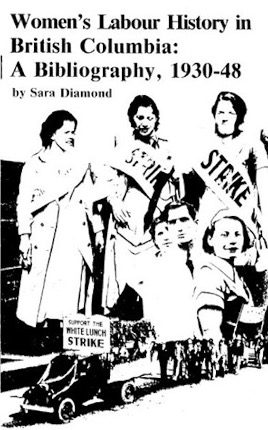
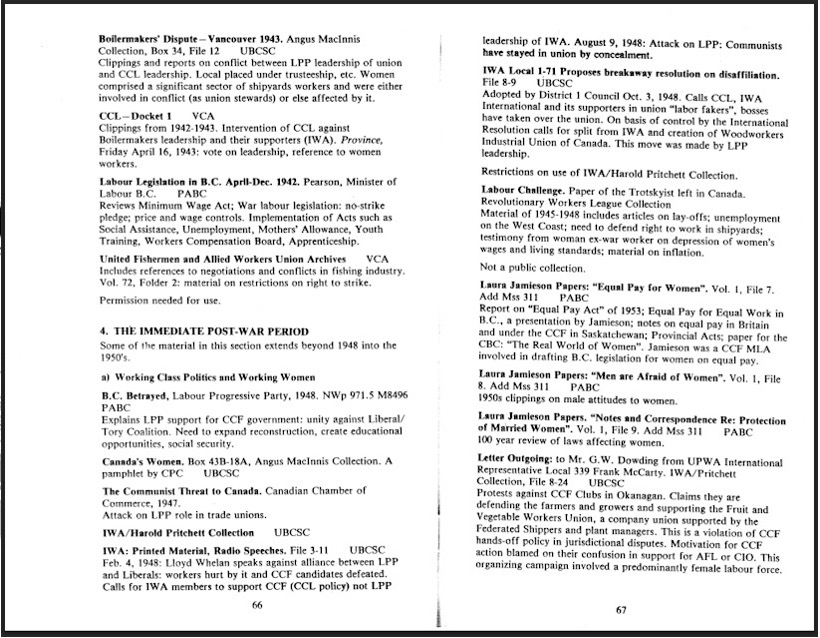
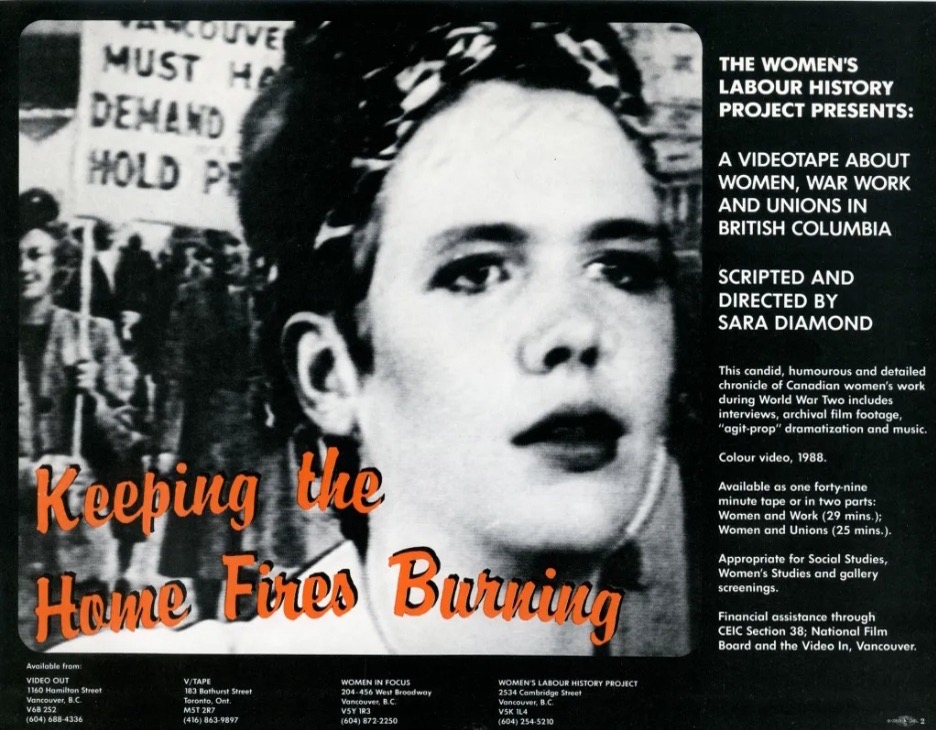
Early on in its work, the WLHP created and published the annotated Women’s Labour History in British Columbia: A Bibliography, 1930-1948 (1980) and an Aural (oral) history guide, Chambermaids and Whistle Punks: An Aural History of Women in B.C. Labour, 1930-55 (1982). The bibliography includes a wide range of sources, from fonds within institutional
archives and libraries to feminist alternative publications, archives held by trade
unions, press, journal, conference articles, book chapters, and books. These early
guides are updated and provided for Crossing Fonds Case Study 1. Further, in a strategy reiterated in Case Study 1, the WLHP refused
to create a hierarchy of records by recognizing oral histories, labour press, and
employer archives as each playing a role within a network of positioned resources.
Union records are rich sources to catalogue women’s presence, issues, and debates,
but very rarely created from the perspective of women workers or organizers.
Caswell and Cifor’s (2019) theorization of ethics of care serves as both motivation
and methodology for engagement with marginalized communities in the construction and
interpretation of archives. What further differentiated the Women’s Labour History
Project in Phase One was positioning it not only as an academic or artistic project
but equally its role in creating versions of histories that could be used by community
activists. The WLHP was committed to creating counter narratives. and its tactics
included interpretive practices such as experimental documentaries, fictionalizations,
television broadcasts, photographic exhibitions, publications, and curriculum. The
WLHP’s work required forensic quests for archival footage and photographic images
from the historical eras that it represented, literally dumpster diving to retrieve
footage that media organizations were discarding.
The WLHP was able to build a new visual and oral archive of women’s labour by reassembling
and remediating records from these archives. The WLHP then wrote original scripts
inspired by historical research and sources, such as advertising and documentary scripts,
and montaged photographic images and footage. [
Russell 2018] proposes that these practices constitute
“archiveology” — the reuse, recycling, appropriation, and borrowing of archival sounds and images
by filmmakers provide ways to imagine the past and the future. The archive moves from
a site of preservation to one of critical investigation. The WLHP’s artistic methods
provided complex rereading of oral history transcripts and biographies, as [
O'Neill, Roberts, and Sparkes 2015], linking reinterpreted stories to historical events and shared culture. The WLHP
shared its creations, exhibitions, and public readings from oral histories through
union education and outreach.
[9]
Samples of these works are included in the Case Study 1 item sets.
Three feminist digital archive projects are rooted in the need to surface absent activist
histories and offer complementary transmediation approaches to the WLHP’s efforts.
Fuerza Feminista, Chicana por mi Raza, and the Domestic Workers Timeline embody cultures of care, respectful data collection and organization, and effective
site navigation strategies. All projects have links to relevant organizations, as
did the WLHP in its ties to feminist unionism, and more recently Crossing Fonds and the CDMLA in their collaboration with the BC Labour Heritage Centre.
Sylvia Fernández and Cynthia Bejarano began
Fuerza Feminista: Intimate Recovery of Memory Archive (
FFIRMA) in 2019. FFIRMA provides documentation of thirty years of gender-based violence
in the Mexican state of Chihuahua, bordering Texas and New Mexico, and resistance
to it by local communities. Fernández and Cynthia Bejarano develop
“tools and methodologies for feminist data and digital humanities scholars, activist-scholars,
and others to utilize when documenting and analyzing crimes against humanity” #fernandez2025. As was true of the WLHP in its original phase, their research challenges “intersectional
data violence” to address data inaccuracies and absences which appear in official
records, combining personal records with public accounts to identify and defend victims
of femicide.
Fernández and Bejarano
“argue that to confront IDV, it is important to collect data and metadata that center
intimate archives with care and responsibility and to also create archives in a slow
manner through a long-term commitment and with an ethics of mutuality” #fernandez2025. This ethical process of data gathering,
“intimate archiving,” fits the WLHP longitudinal history, including their return to interview subjects
over several decades (1970s through the 1990s) in the comfort of their homes, sharing
recordings with participants, care taken in the disclosure of personal information,
and
Crossing Fonds' efforts at redescription of inaccurate metadata.
María Eugenia Cotera and Linda Garcia Merchant’s
Chicana por mi Raza project documents the labor, activism, and social justice work of Chicana women during
the Chicano rights movement, through personal and collective archives, creating a
community-based feminist archive. It was created in collaboration with
The Institute for Computing in Humanities Arts and Sciences at the
University of Illinois Urbana-Champaign. The archive includes over 80 oral histories and thousands of personal documents.
Like Diamond’s stated positionality within the WLHP as a labour organizer, and her
efforts to situate women unionists within a broader male-dominated labour movement,
Cotera and Garcia Merchant’s initiative is motivated by their personal histories of
activism and familial relationship to the Chicano rights movement. They frame this
work as
“centering collaboration, reciprocity, relatedness, and a shared obligation to the
past, present, and future,” which creates space
“to write with the past rather than about it” [
Cotera 2026, 1]. Archival interface design is comprised of subsites that delve deeply into incidents
and movements. This strategy echoes the CDMLA’s effective narrative sub-curation of
collections, such as the
Women & West Coast Labour, in which subsites serve as both organizational tools and gateways. It relies on navigable
digital tools and includes timelines and story map visualizations of Chicana activism
(women engaged with the Chicano movement). Like the WLHP’s narrative video works,
the resulting
“recovered historias [stories]” act as transmediations of archival artifacts and oral histories so that
“we can reconstruct rich retellings of important actions and moments in Chicana activist
history that have been otherwise omitted from the record” [
Cotera 2026, 1]. A goal of this work is to achieve a better understanding of the present and
look forward to
“embracing a relation of knowledge production in which the present and the past are
in active dialogue” [
Cotera 2026, 207].
Smith College’s Guglielmo and Joffroy
#guglielmo2018, [
Guglielmo and Joffroy 2021] developed
The Domestic Workers Timeline with the
National Domestic Workers Alliance. It presents a timeline visualization to navigate the complex history of domestic
service and resistance from pre-Conquest times to the present, with a first version
completed in 2018 and an updated version in 2021 (
https://dwherstories.com/). They note,
“This timeline documents the history of domestic work and organizing in the United
States. It demonstrates how control over domestic workers has been key to the rise
and consolidation of oppressive systems. It also captures how domestic workers personally
and collectively experienced exploitation and oppression” [
Giglielmo and Joffroy 2020a, 1]. Rather than an archive, it draws from secondary sources listed in its bibliography,
which are summarized with text and audio clips that are linked to the timeline. A
film version of these histories was added in 2021. Given the close relationship of
domestic labour to restaurant and hotel labour, this resource further situates the
archival materials and histories presented in
Crossing Fonds and discussed in this article. The fine-tuned timeline navigation strategy provides
a model for future development of the
Crossing Fonds OMEKA S site.
Case Study 1 offered several opportunites: return to source archival documents from
the early work of the WLHP; transmediate these into digital forms; include early analytic
texts by Diamond, other team members, and historians from the period; search for new
relationships and interpretations or reinforcements of previous analysis; and create
new tools.
[10]
It can be situated as a contribution to contemporary feminist archival practices.
Phase Two – Bringing the WLHP/Diamond fonds to VIVO Media Arts
Diamond donated her fonds to the CDMLA in 2018, situating the materials that were
created while Diamond lived in Vancouver within the context of, and in dialogue with,
mixed media collections of other Vancouver feminist artists, collectives, and movements,
many of which had collegial and overlapping histories. For VIVO, the acquisition was
significant for its recognition of Diamond
“as an innovator and influencer in Vancouver’s cultural and academic communities,” and as an educator and curator at Video Inn (now VIVO) in the 1980s. As importantly,
Diamond is a critical figure in the history of feminist early adopters of portable
audio and video recording technologies that would become ubiquitous tools for the
documentation and reframing of experience and ideas through a feminist lens.
[11]
Since the early 1970s, Canadian media-focused artist-run centres (ARCs), like VIVO,
took the initiative to collect analog and, later, born-digital media representing
the cultural and political activities of marginalized communities. From the 1980s,
in a collective act of transmediation, ARCs developed sophisticated and “good-enough”
media migration and preservation protocols for video. These digital collections fill
a vital gap in the historical record left by institutional archives that were late
to collecting the histories of and by marginalized communities, especially those who
were working in analog video.
Creating rich (generous) interfaces: philosophy and examples
The CDMLA began experimenting with putting their archival videos online in 2015. In
2018, as part of the CDMLA’s push to make the Sara Diamond fonds publicly accessible,
Knights initiated a project using digital access, navigation, and
“generous interfaces” [
Whitelaw 2012],
#whitelaw2015. Mitchell Whitelaw [
Whitelaw 2012],
#whitelaw2015 called for
“generous archives,” a radical resetting of archival finding aides and interfaces that breaks with the
reading room metaphor of collections hidden behind a search box and that instead encourages
liberal sharing of archival holdings [
Whitelaw 2012], including cultural collections
#whitelaw2015 that display rich visual content with deep browsable views while providing contextual
awareness and relationships.
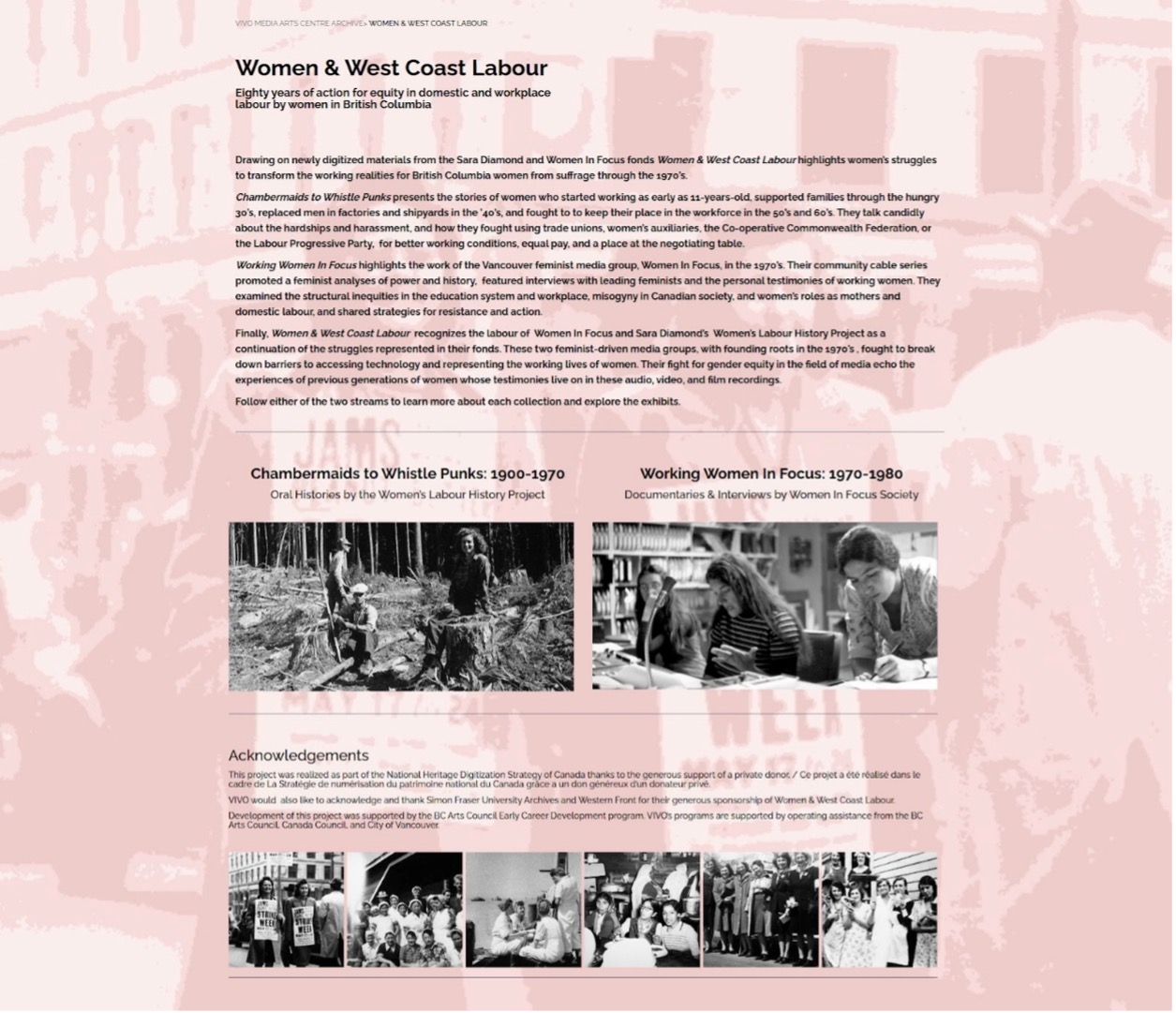
The curated online exhibition
“Women & West Coast Labour: Eighty years of action for equity in domestic and workplace
labour by Women in British Columbia” launched on the VIVO archive site in 2019.
[12]
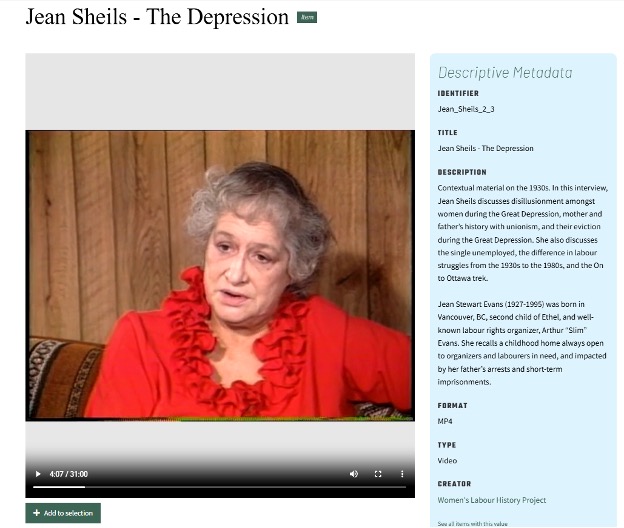
Digitization of Diamond’s fonds contributed: video and audio oral histories; production
photographs and photographs donated from interviewees’ personal collections; educational
resources developed through Diamond’s research; and relevant interviews with Diamond.
The fonds also contributed work by Amelia Productions, a feminist documentary video
and fiction film collective, and interviews with labour activists by Jean Sheils,
a long-term political activist. These were linked through a visually rich
“generous interface.” This is equally a form of transmediation, in which modes of perception are reconfigured,
rather than preserved [
Salmose 2020, 5].
The WLHP collection is complimented in the online exhibition by the collection of
Vancouver’s first feminist media centre, Women in Focus (WIF). The WIF fonds contributed
episodes of their community cable television show, film and video documentaries and
narrative works (1974-1980), media catalogues, political leaflets on workplace harassment,
and photographs documenting the labour of the WIF collective. In their examination
of women’s working lives in the 1970s, the WIF materials reiterated the historical
conditions and struggles of women workers that can be traced back through Diamond’s
interviews.
Audiences browsing the online exhibition could imagine the relationships between the
two collections and their objects. However, unlike Crossing Fonds, participants could not move or regroup objects across these distinct but thematically
related fonds. The online exhibition benefitted from a significant digital file exchange
between Simon Fraser University Archives and the CDMLA and the enriched metadata that
were connected through one site; this exchange hinted at the archival aggregation
strategy and generous interface design that would be represented fully in the Crossing Fonds platform. Through the course of the project, online access to the Sara Diamond fonds
inspired new partnerships, including several substantive and ongoing digital exhibition
collaborations with The British Columbia Labour Heritage Centre (BCLHC), a community
based historical society and partner on the Crossing Fonds project.
Phase Three – Crossing Fonds Case Study 1
Knights and Diamond worked on Case Study 1 as Editors/Creator of the emerging platform,
the former as a community archivist and the other as an historian, as well as a donor
of one of the source fonds and Principal Investigator of
Crossing Fonds. Building on the previous phases of the WLHP, their overall goal was to create a
collaborative workspace for researchers, artists, and non-academic community members.
Salmose & Elleström propose that transmediation is about
“‘picking out’ elements from a medium and using them in a new way in another medium” [
Salmose 2020, 5]. The platform itself was a transmediation of previous ways of presenting these
archives, preserving original content while transferring medium, shifting semiotics,
and engaging with raw and mediated data in a respectful feminist context.
[13]
Diamond and Knights hoped 1) to experiment with the Omeka S interface and its modules,
craft the process of collecting archival items into a unified digital space, find
ways to interact with materials from multiple sources and of multiple media types,
and create new relationships; 2) to cultivate new interpretations of the histories
represented through the records uploaded and organized on the platform; 3) to build
a set of interactive tools that both supported the research and that other users of
the collaborative space would find of value; 4) to create coherence within the case
study item sets to provide a meaningful, if not fully interactive experience, for
public users, including public presentations; and 5) to provide opportunities for
other users to comment on, enhance, and correct the records in the fonds as a further
step of transmediation.
Building Case Study 1
Case Study 1 considered the broader context of work, society, and labour organization
in the 1930s, 1940s, and 1970s. These decades were chosen by the researchers because
of their significant differences in service sector demographics, working conditions,
political formations, and forms of labour organization, such as craft, industrial,
and independent feminist and Indigenous unionism. These periods were also chosen in
part because of the range of relevant archived diverse media in collections and that
the WLHP fonds and the HREU fonds were distributed across multiple archives.
The above considerations informed the Creator/Editor research team Diamond and Knights’
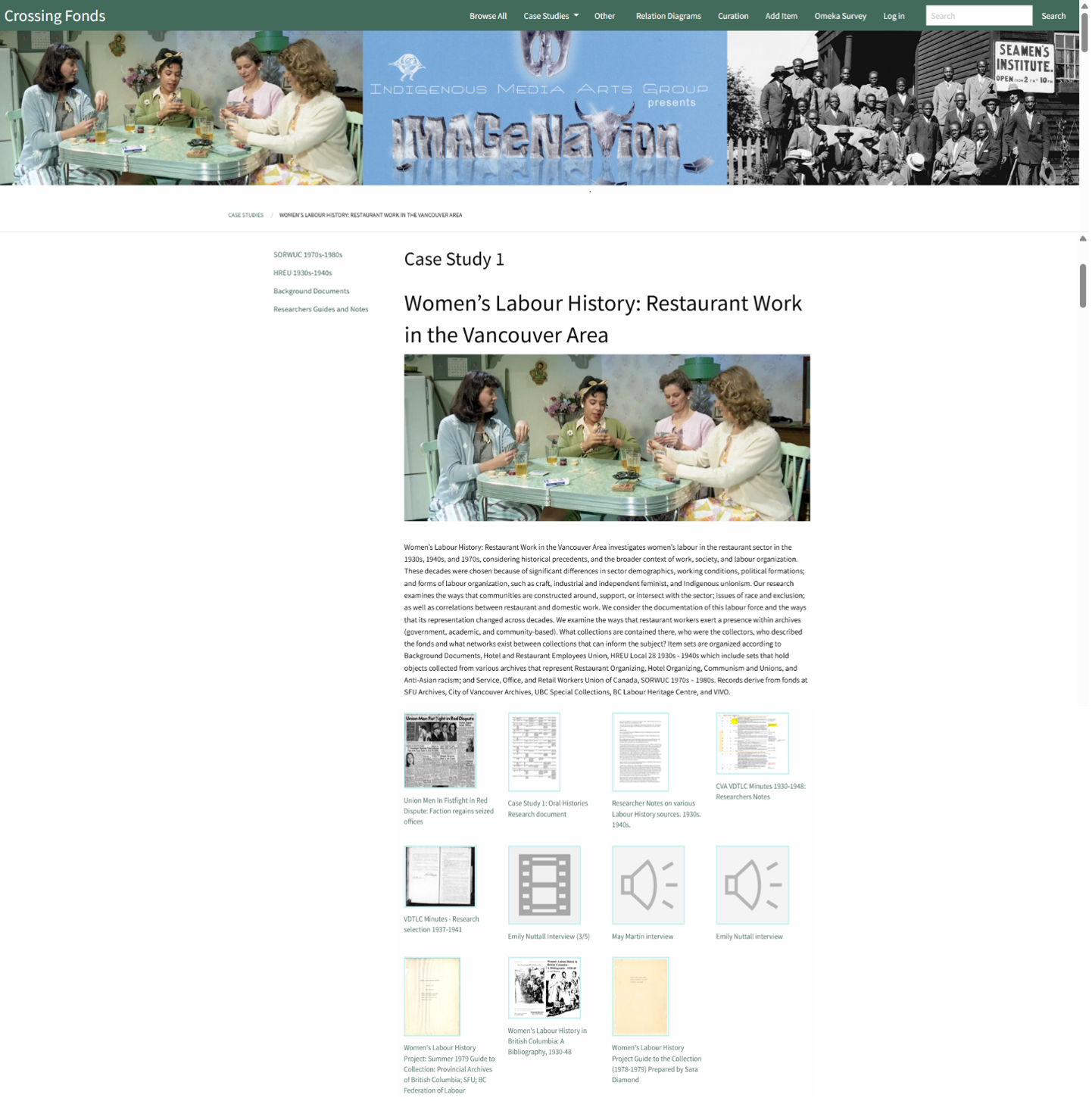
decisions around structuring the research for Crossing fonds. Case Study 1 is divided into four primary item sets, one with four sub-sets within
it.
Case Study 1 primary item sets
SORWUC 1970s-1980s: An item set regarding the Service Office and Retail Workers Union of Canada, a feminist
union representing service and finance sector workers, and Indigenous workers.
[14]
Records originate from Diamond’s fonds at the CDMLA, SFU Archives, and UBC Special
Collections.
[15]
SORWUC led a significant and highly publicized strike at the Muckamuck, a restaurant
featuring Indigenous food and an all-Indigenous staff but owned by wealthy international
art dealers Jane Erikson and Doug Christmas.
[16]
HREU 1930s-1940s: Includes items from the HREU Local 28 fonds from multiple archives (City of Vancouver
Archives, UBC Special Collections, the CDMLA); researchers notes from the HREU minutes;
Vancouver District Trade and Labour Council (VDTLC) minutes which contextualize the
larger labour movement; HREU International minutes items regarding British Columbia
and international locals.
[17]
There are personal testimonies (oral and video recordings), press clippings of strikes
and political conflicts, and documentation of the role of the HREU in labour policy.
[18]
There are digitized ephemera such as union cards and buttons.
Background Documents: This item set constitutes a selection of information on the case study topic, including
archival materials and academic historical publications.
Researchers Guides and Notes: This item set includes the Thematic Guide for Case Study 1 records core data on
the research resources and as a guide for other researchers
[19] and the extensive Oral History Research documents.
HREU 1930s-1940s were organized further with subsets:
Restaurant Organizing: Items pertaining to restaurant organizing from the 1930s to
the 1940s.
Hotel Organizing: Items pertaining to hotel organizing from the 1930s to the 1940s.Communism
and Unions: Items pertaining to HREU Local 28’s rocky affiliation with the Vancouver
Trades and Labour Council and its international union, and the intense internecine
struggle between political factions.
Anti-Asian Racism: Items pertaining to campaigns against white women working in “Chinatown
cafes,” resistance by waitresses, the history of anti-Asian legislation and campaigns,
including within the labour movement.
Rather than create a unified item set of all hotel and restaurant organizing, SORWUC
and HREU records were separated to invite comparison between organizing in the 1970s
and the 1930s-1940s. SORWUC’s history is also distinct because of its focus on feminist
unionism as detailed by Smith (2015) and its engagement with Indigenous workers and
communities and their rights not only as workers but as Indigenous culture bearers
(Nicol, 1997).
The Site Administrator Ploessl provided the Case Study 1 team with access to the back
end of the Omeka S platform to add and manage items. Omeka S provides Creator/Editors
with the choice to bulk upload (via CSV) or to create stand-alone items. Manual item
addition is often employed if the collection is small, or, in the case of the Sara
Diamond fonds, does not have existing item-level descriptions. The manual feature
also allowed the Creator/Editors to add items on an ad hoc basis. All items were included
in the Case Study 1 Parent Set (a container for all items uploaded for that case study).
Resource Templates (preset combinations of metadata fields) determine the basic structure
of the item record. A Creator/Editor can choose a preset best suited to their collection
or object. The Case Study 1 researchers chose media-specific resource templates (i.e.
Moving Image, Document, Sound). AV records (video and audio files), while unique resource
templates, integrate into an item set. Ease of uploading and integrating media was
a critical requirement in the design of the platform. The Creator/Editor can also
add specialized vocabularies, ontologies, and more, hence a relevant feature for Case
Study 1, was that descriptive metadata can easily be revised by the team, which became
a critical feature for the reinterpretation, correction, or enhancement of metadata
for any item. The WLHP was attentive to issues of racism and Indigenous representation
in their work decades earlier, and documents considering racism and Indigenous contributions
to labour are included in the item sets. The platform offered the opportunity to reframe
Diamond and her WLHP colleagues’ decades-old description of Indigenous and other materials
in revised metadata notes.
[20]
For example, Diamond clarified that she collected Indigenous oral histories and documents
in the 1970s as a labour activist, in collaboration with Indigenous family members.
Oral histories were again returned to the families.
An integrated media importer allows multiple discrete media items (across types) to
be linked to each item. These items can be components of a larger item, for instance,
the aggregation of twenty discrete spreadsheets that make up the Oral History Research
document or a variety of media related to the core item. Each item is associated with
an Item Set(s) (a collection of items) for organizational or display purposes. The
researchers defined item sets by subject, theme, date, or creator.
The team created primary item records (detailed later in this essay) which included
rich metadata descriptions as well as discussions of relationships with other items
and their context. While item records are common in digital archives, Crossing Fonds supported a generous archives strategy where notes were displayed alongside item
and item sets. These formed the basis for Comments and Contributions for metadata
corrections and enhancements.
Metadata Description and Explanatory Notes
OMEKA S provides a beneficial range of metadata values, including text entries and
bi-directional links, provenance, media description, customized tags, and categories.
[
Waugh 2020] emphasizes the opportunity that digital archives offer for rich metadata description
for discoverability and context provision. The research team provided enhanced or
corrected (Frederick, S. 2019) metadata description on an item-by-item basis.
The researchers also utilized the facility to create custom Research Collection sub-sets
to represent a theme, for example, an individual or trade union action. An overarching
Research Collection record is created under which sub-set the unique items are organized.
Like all items and item sets, it allows custom descriptive metadata. The flexibility
of the descriptive fields encourages researchers to use them for whatever purpose
they feel serves the set. In addition to descriptive metadata, a Creator/Editor can
add notes about the metadata, contextual information, or, in the case of guides, instructions
on how to use and navigate them. Research Collections can be used to organize records
(i.e., a chronological mapping of correspondence)
[21]
or to recontextualize disparate items. The latter can illuminate how the actions of
government, unions, employers impact women’s personal and professional lives; or surface
new information about union organizing.
[22]
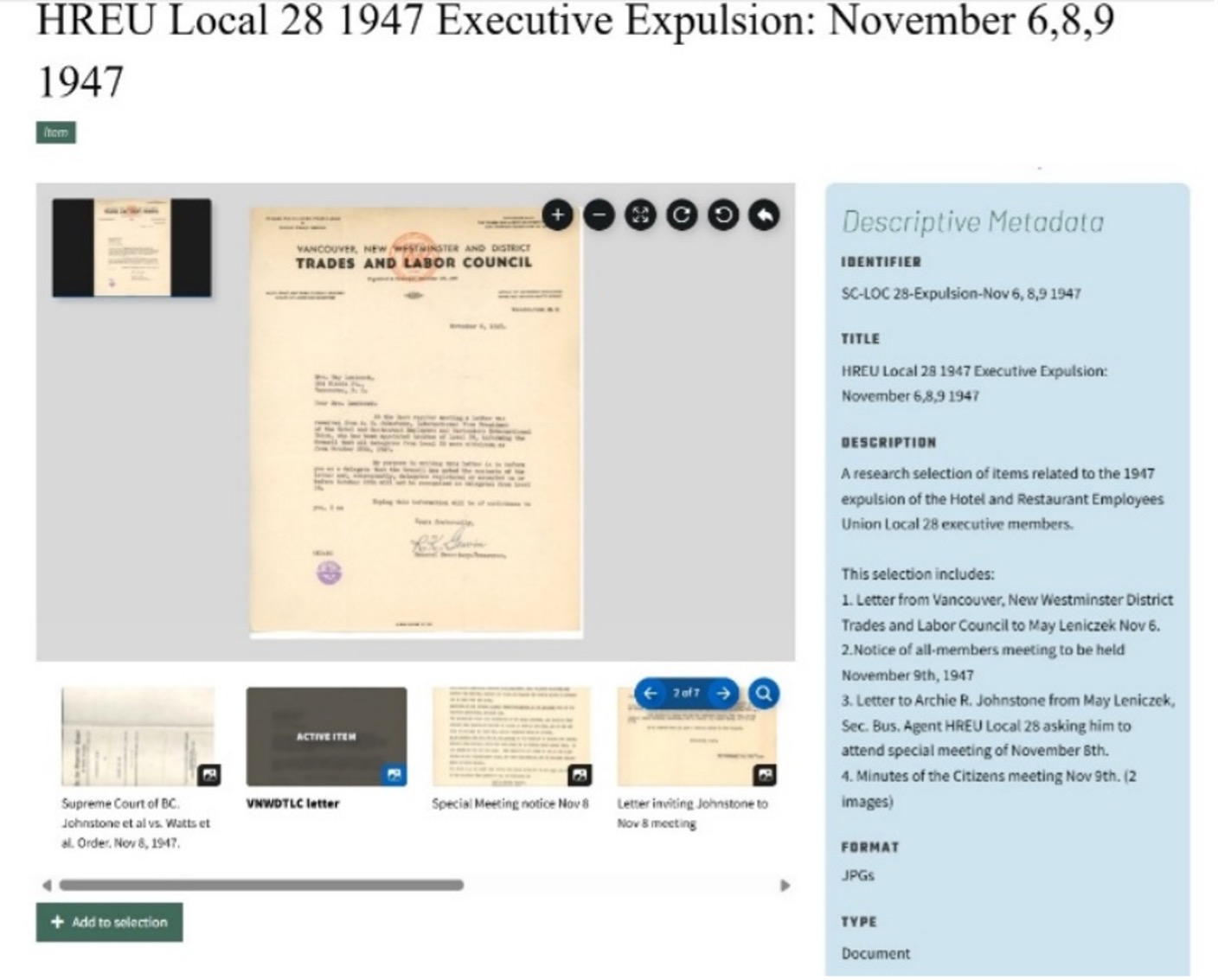
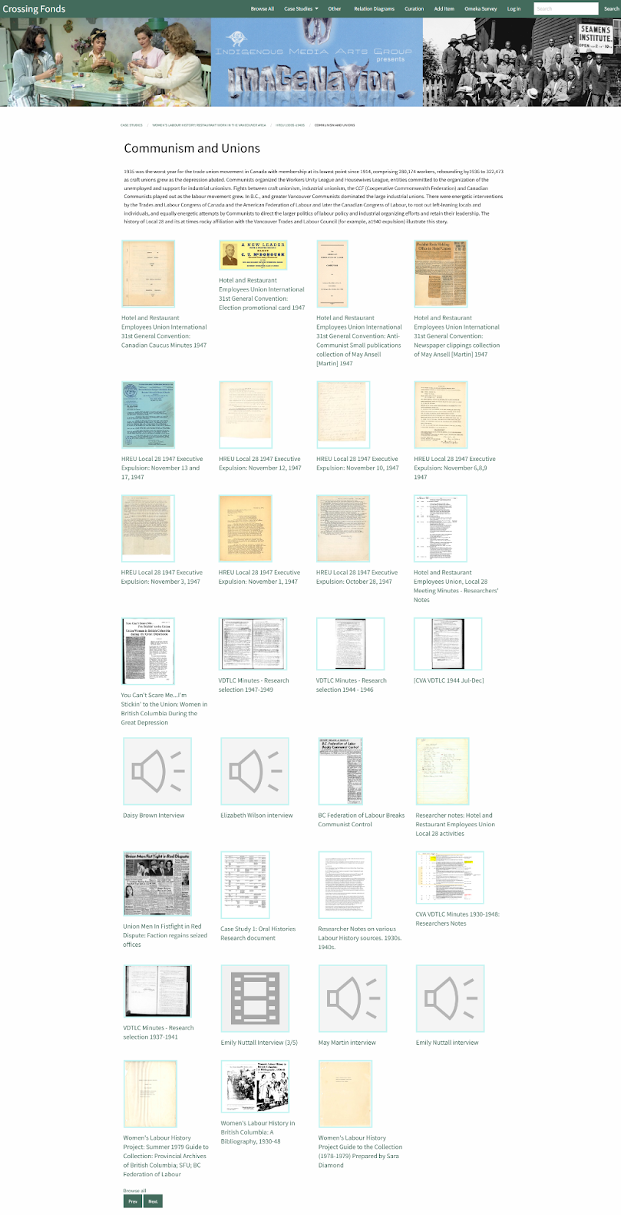
One example is the “HREU Local 28 1947 Executive Expulsion: November 6, 8, 9 1947”
item set that assembles union correspondence, meeting minutes, and legal documents
related to a critical confrontation between HREU International and Officers of Local
28. It includes handwritten minutes of a “Citizen’s Meeting” following the cancellation
of a Local 28 meeting that same day by the HREU International. The minutes document
a motion carried by the attendees to resign from Local 28 and form an independent
union.
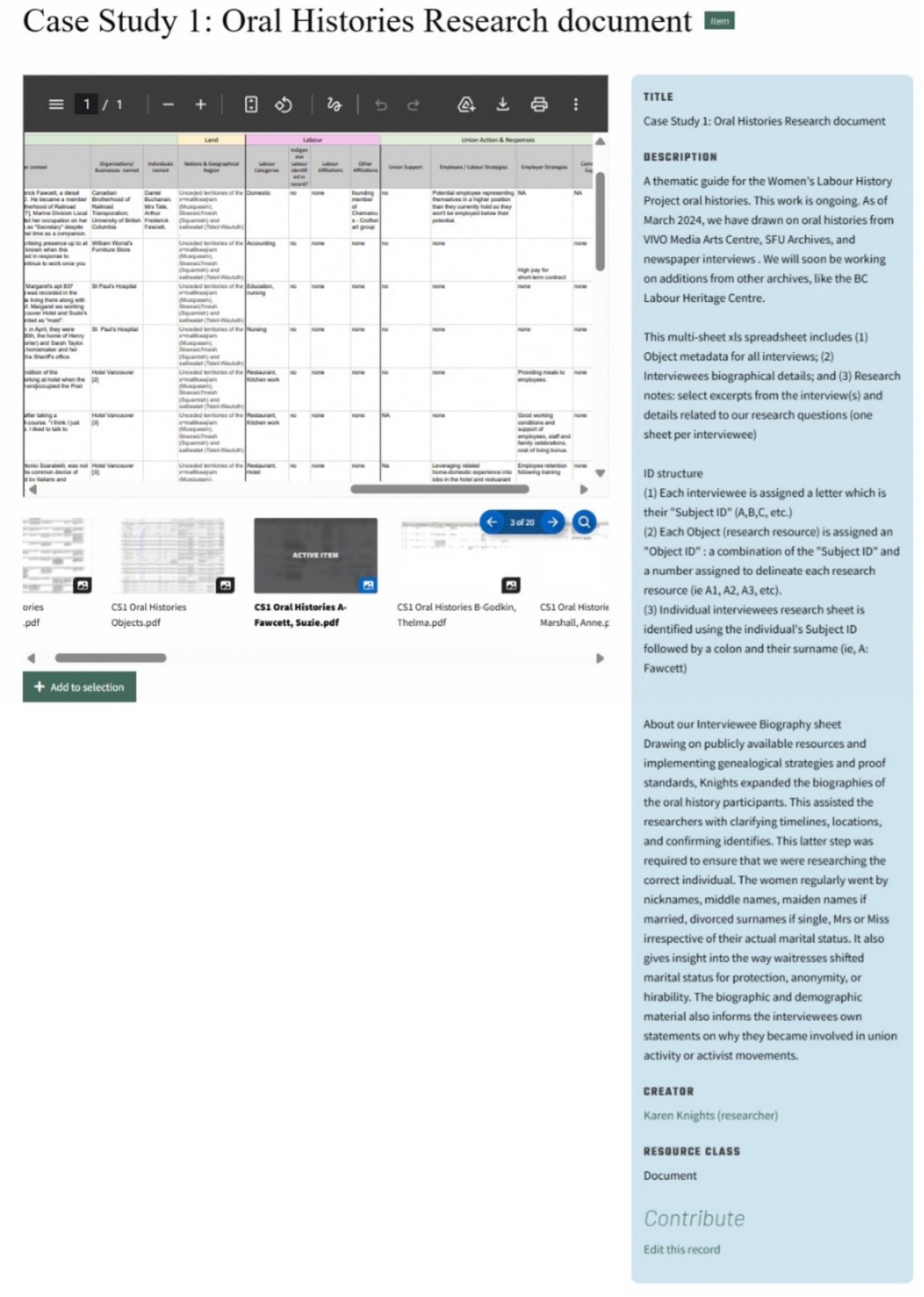
Researchers created an Oral Histories Research document. The multi-sheet XLS workbook
consists of three types of data sheets. These are Object (listing each archival item
related to the biographical subject), Subject (the interviewee’s biographical data
including birthdates, immigration status, gender expectations, etc.), and Research
Notes (one sheet per interviewee with select excerpts from the interview(s) that record
“relevant occurrences” which are core observations or experiences of the interviewee
directly related to research questions such as: strategies for organizing women workers
in British Columbia, domestic life, supportive and related social and political movements.
The metadata describes the guide and how to use it. Additional notes deploy genealogical
research to inform the biographies.
Supporting Commentary and Metadata Revision
Critical archival practices include reinterpreting content through the correction
and annotation of original metadata and descriptions of archival holdings to better
represent equity-seeking groups whose records exist in archives. This practice is
at times described as decolonizing description and attribution and can accompany the
return of archives to originating communities (Allison-Cassin, 2020; Anderson & Christen,
2019; Luker, 2017; Doyle et al., 2015; Farnel et al., 2015). Crossing Fonds held a series of description workshops led by Dr. Andrea Fatona (OCAD U) and participatory
design workshops led by Dr. Sheelagh Carpendale (SFU), Melanie Hardbattle (SFU Archives)
and Andrea Tarnawsky (SFU Library) which supported participants — historians, archivists,
librarians, artists, members of the Indigenous community — in using the Comments (retitled
to “Interpretive Analysis”) and Contribution features to describe and rewrite metadata
descriptions, comment on items within an item set, and upload relevant items to item
sets. We plan to expand opportunities to share these histories and gather commentary
and metadata interpretation suggestions with contemporary organized hotel and restaurant
workers in collaboration with BCLHC.
Thematic Guide
The Thematic Guide for Case Study 1 was inspired by the Women’s Labour History in
British Columbia: A Bibliography, 1930-1948 (1980). It records core data on the research
resources for analysis and serves as a guide for other researchers.
[23]
It is currently in prototype form. Archival arrangement has traditionally been organized
by provenance (the creator of the fonds, usually an individual, organization, company,
or family). Fonds may comprise materials on one subject or many. In the post-digital
era, some archives have supplemented traditional finding aids (often a hierarchical
inventory of the collection with series descriptions and file lists) with curated
finding aids or research guides that provide a scan of materials across fonds on a
particular subject or theme. These are increasingly web-based and searchable and link
to items at online digital repositories. They are tailored to research trends and
public interests and are editable.
VIVO’s archivists developed two curated, searchable, online thematic guides for CDMLA
prior to Crossing Fonds: “Every Queer Thing: A Subject Guide to Archival Materials
on Queer Identity and Experience” (2020)
[24]
and “Presence – A Research Guide to Indigenous Materials at the CDMLA” (2021).
[25]
The first guide expanded production metadata to acknowledge worker and community contributions.
The second expanded fields to surface Indigenous content, language, place, and creators
not included in the original descriptive metadata. Users were able to select their
fields of interest, search for keywords, and download the data in multiple formats.
Weideman (2019) argues that Thematic Guides can be counterproductive, directive, and
at times substituted for rigorous cataloguing, which inhibits standardization and
rich metadata. Addressing these concerns, Case Study 1’s Thematic Guide facilitates
individual and collaborative study through a centralized, sharable interface. It comprises
metadata (original and/or generated by the research team) and enhanced context for
digital objects sourced from academic, governmental, and community archives. It provides
fields intended to surface new contexts that are relevant to transmediation, for example,
how technologies may inform a reading of the object. The categories listed below manage
source and location data for the object and provide linked access to institutions,
collections, creator, and the digital object. Additional fields describe the object’s
unique traits and context relevant to the theme. In total, the guide allows for comparative
analysis across multiple sources and illustrates pathways to further analysis.
| Theme |
Primary theme(s) |
| Subjects |
All relevant subject categories and/or keywords |
| Repository |
Institution where object is held |
| Fonds |
Fonds or collection |
| Series |
A group of similar records |
| Subseries |
Subdivision of the series |
| Item ID |
Unique identifier assigned to the object |
| Crossing Fonds link |
Link to object on Omeka site |
| Repository link |
Link to object on repository site (if available) |
| Title |
Object title |
| Object type |
Video recording, photograph, notebook, etc. |
| Digital object |
Mp3, pdf, etc. |
| Original object |
If derived from another source, i.e., transcript of a recording |
| Creator |
Individual, business, organization, government |
| Type of creator |
Description encapsulating relevant characteristics |
| Year |
Year created |
| Decade |
Decade created |
| Description |
Description of object |
| Demographics |
Of individuals or groups related to the object |
| Provenance |
Collection origin and choice of repository |
| Relevance to creator of fonds or research collection |
Reason for inclusion |
| Copyright holder(s) |
Copyright and permission details |
| Nations and geographic regions |
First Nations territories, geographic and urban locations relevant to the object |
| Labour Categories |
Represented in the record |
| Indigenous labour |
If evident in the record |
| Technology: Type |
Type of object, technology related to its creation |
| Technology: Context |
Technical, cultural, historical |
| Technology: Relevance to creator |
Why the creator chose that specific technology |
| Technology: Impact on content |
Impacts on content structure, interpretation, creator’s intention |
Guided by the Guides: Learnings Enabled by Crossing Fonds
Crossing Fonds allowed Diamond and Knights to gain a deeper understanding of the extreme working
conditions of restaurant workers. By seeking entries in the Thematic Guide and Oral
History Research document, searching and comparing records from the HREU and the Vancouver
and District Labour Trades and Council (VDTLC), reviewing digitized artifacts, including
oral and video histories and press coverage, Diamond and Knights learned of workers’
tactics towards establishing and sustaining a union house (restaurant) in the face
of harassment and low pay, sometimes seven days a week for as long as ten hours per
day and split shifts. Union cards and labels designated union houses. Workers were
expected to carry union cards to prove they were paying dues and were checked and
fined if they did not comply; in turn, the local placed women into restaurants, giving
members priority. HREU consistently appealed to the VDTLC for unionists to frequent
unionized restaurants and boycott anti-union employers. Minutes record arguments over
non-compliance. Union activity was characterized by spontaneous strikes and work-to-rule
actions because of the use of non-union labour and poor conditions.
[26]
Yet the efforts of HREU organizers and activists, connected through these records,
saw the local grow from thirty-five card-carrying members in 1935 to the third largest
member of the VDTLC by 1938, made up of eighty percent women.
[27]
Women increasingly took up the torch as organizers for HREU with campaigns and strikes
throughout the decade of the 1940s as women returned to service jobs after the war.
Hotel organizing campaigns were orchestrated and achieved by Emily Nutall and May
Martin (Leniczek; Ansell)
[28] and escalated in the immediate post-war period resulting in a national agreement.
[29]
The Hotel Organizing sub-item set allows researchers to examine the list of organized
hotels and the full agreement, read engaging and passionate testimonies from organizers
and press coverage, and find evidence of the contradictory ways that these successes
were reported and received by the labour movement.
[30]
Analysis across these documents allows a timeline to emerge, pinpointing individual
organizers, key actions, and shifting attitudes. On the one hand, women faced paternalism,
expressed in minutes of the VDTLC; on the other, they built a powerful union, under
almost impossible conditions, all of which are expressed in minutes of the HREU.
Violence against women was an issue for women working in the restaurant sector and
foregrounded by the HREU in the 1930s and 1940s. Case Study 1 linked government policy
documents, union minutes, testimonials, and press clippings to show the arc of proposed
remedies. Reformers, including women’s rights advocates, debated whether to restrict
women to day work to protect them against violence when leaving late shifts, while
union women fought for better transportation and late-night policing as they had no
choice but to work and to walk home. After the murder of waitress Olga Hawryluk on
May 2, 1945, the labour movement supported legislation to require employers to provide
safe transport for night shift workers. These views contradicted earlier labour movement
policies to restrict shift work for women.
[31]
The linked documents connected minutes of the HREU, press clippings and WLHP oral
histories. These starkly illuminated the direct connections between media representation
of the tragedies, the resulting public outcry, and the union’s ability to leverage
these concerns to force employers’ action to improve women’s safety.
Researchers used both guides and a wide array of items to grasp the profound internecine
warfare between HREU Local 28’s Communist and progressive Vancouver leadership and
the conservative American HREU international and its representatives in the Vancouver
and District Labour Council.
Crossing Fonds for the first time brings together competing sets of HREU records. This previously
untold story is richly illuminated by a trove of digitized original documents given
to Diamond by Martin
[32]
from her personal archives.
[33]
Records relate to the Vancouver HREU business office takeover by leaders Emily Nuttall
and May Martin in 1947 after they were removed from union leadership. Examples include
a variety of escalating letters between the HREU 28 leaders and the HREU International
(who described the women as insurrectionists), annotated minutes from competing union
sources, court documents, financial records and convention documents (expulsion was
in part predicated by the Canadian caucus’s support of an alternative leader for the
International at the Milwaukee Convention).
[34]
These items allow researchers to decipher the history of the union local within the
larger contemporaneous labour context. These item sets enable a day-by-day account
of the crisis. The evidence was so compelling that it inspired a physical exhibition
of digital and scanned artifacts as part of the
Crossing Fonds Symposium exhibitions at VIVO.
Racism was a virulent force in British Columbia and in Greater Vancouver during the
decades of this case study, fueled by fears of competition for jobs, jealousy regarding
economic gains by Chinese and Japanese communities, and xenophobic beliefs in white
supremacy. Case Study 1 follows the efforts on the part of city officials to ban white
women working in Chinese owned restaurants in Vancouver’s Chinatown, ostensibly over
concerns for their moral purity. Advocates for restrictions succeeded despite resistance
by the waitresses who launched a public campaign and the HREU who supported the right
to work
[35] for these non-unionized women waitresses.
[36]
Theme sets in Case Study 1 provide a wide range of documents, including census records,
government policy (such as “An Act for the Protection of Girls and Women in Certain
Cases”),
[37]
café licenses, minutes, press clippings, theses, and oral histories. It included supplementary
scholarship regarding Chinese women and their labour with links to oral history interviews.
Canadian labour historians Star Rosenthal (1979) and Gillean Creese (1989) documented
the anti-Orientalism that divided the labour movement and excluded Chinese workers
who, like women, wanted to join unions but were excluded. Relevant academic analyses
of women’s labour histories are provided and linked as references to original documents.
[38]
The range of documents prove that anti-Asian sentiment was a plank of organized labour
throughout the 19th and early 20th centuries, although records show that by the 1930s
and 1940s there were individuals and organizations in stark contrast, such as the
Communist Party and Canadian Commonwealth Federation (CCF) who spoke out against racism
and attempted to organize Chinese workers (Creese, 1989). Researchers built a timeline
that is integrated into the sub-item set and indicates the dynamics of this campaign.
[39]
In the broader context of North American labour history, this item set echoes Rowbotham
and Kessler-Harris’ documentation of labour dynamics and race in twentieth century
USA.
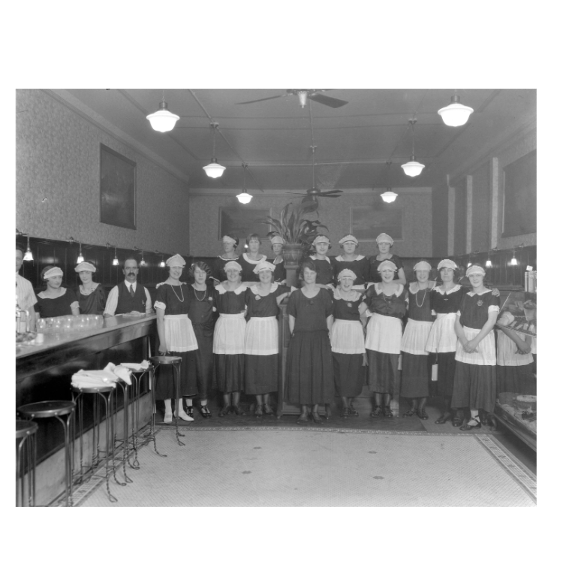
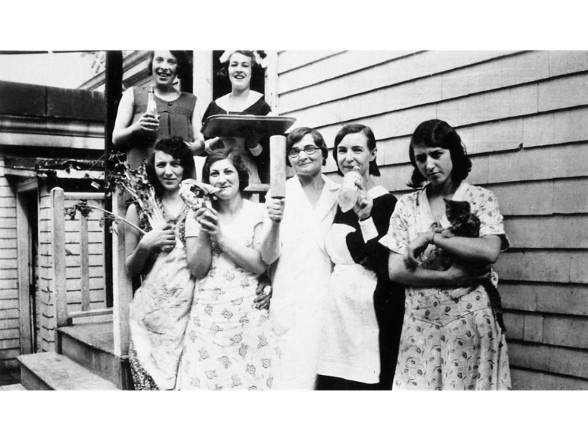
Linked rich metadata description supports analysis of photographic collections of
working women held by various archives. Over the decades (1930s–1970s) union workers
began to photograph themselves in social, work, and family contexts and share these
images. These photographs that were contributed to the WLHP fonds from personal archives
contrast with those created by industrial and labour photographers. Metadata description
notes photographic technology of these varied image sources, helping to explain this
shift in authorship.
[40]
Crossing Fonds Case Study 1: Expanded Feminist Biographical Research
The Omeka S platform supports expanded biographical research (O’Neill et al., 2015),
that is, the exploration of the history of the women who were featured in the audio
and video recordings as union activists and in the larger framework of their work
and social context. Feminist biography in context has been a consistent thread of
all three phases of the Women’s Labour History Project. From its outset, WLHP researchers
hoped to examine the ways that a critical consciousness developed in individuals and
social groupings to trace the interaction of material and ideational structures which
underpin personal identity and activities. This corresponds to a view of history as
a dynamic process, where conflict produces constant change.
The Oral History Research document, described previously, is composed of information
extracted from Case Study 1’s primary source, the WLHP’s oral histories. Biographical
details and interviewee quotes were transferred to each interviewee’s data sheet and
sorted chronologically under categories representing research questions. It surfaced
pivotal employment and union affiliations, chronicled strategies used by employers
and trade unions to control conditions within the workplace, and provided details
related to research questions that were asked in the 1980s and ones relevant to feminist
historiography today. lxxxi The document also surfaced data gaps, including changing
domestic status and identity, long-term employment patterns, race, and lives, and,
for some, details of domestic life, sexuality, and their economic and social context
relative to their demographic. Recent feminist historiography of women and work emphasizes
the role of women in paid and unpaid domestic labour and socialization, reinforcing
earlier analyses but adding heightened awareness of intersectionality (Ferguson, 2019).
Applying Genealogical Methodology to Case Study 1
As with any qualitative source, the oral histories have nuance and context. It was
important to understand actual incidents the interviews were referring to when memory
was not specific or contradicted other sources. The researchers undertook extensive
cross-referencing with union minutes, including placing Vancouver District Labour
Council (VDLC) minutes against Hotel and Restaurant Employees Unions Local 28 (HREU)
minutes and examining press and relevant fonds. The oral histories in turn enhanced
the minimal information about women trade unionists found in union records and revealed
key incidents unrecorded in these. The researchers' intention was to surface information
that existed in tension and find new sources that further examination pointed to.
This prompted the inclusion of digital genealogical and demographic research that
Knights added to the Oral History sheets and provided as separate items for individual
biographies. Knights used professional genealogical methods (Smith, 2018; Shown Mills,
2018) to verify and supplement oral history demographic, employment, and biographical
metadata, using publicly available online digital databases.
[41] These included
[42]
the largest genealogical platforms holding indexed digital records of socio-economic,
migration, and demographic data across centuries. This work was attentive to concerns
about the ways that genealogical narratives are constructed using assumptions about
gender and gender expectations (Smith, 2018). The WLHP records and deeper research
into union movements at times acted as a counter narrative to genealogical records.
Obituaries and vital records (death and marriage) de-emphasized or erased women’s
work and activist history and emphasized women’s ongoing role as homemakers, while
oral histories and union records shone the light on a period of activism in their
lives. Employing genealogical databases raises McKinney’s concerns regarding privacy
and safety. Crossing Fonds is both a public-facing display platform and a private
research space. Sandboxes can be used to keep sensitive research materials private.
Building a basic family tree
[43] for each interviewee provided linked access to data sets and document images, including
source citations.
[44] This data resolved many of the gaps and inaccuracies in demographic data and enhanced
context, and it matched accurate timelines to biographical recounting in the oral
histories. When available, data regarding wages and other employment conditions expanded
or corrected data relevant to the case study for all WLHP oral histories. Research
supplemented individual women’s narrations and historical records and permitted the
identification of women unionists who were not part of the original network of interviewees.
Diamond and Knights applied these techniques to understand a group of twenty-four
HREU members, not included in the original interviews, who had worked in advocacy
or administrative roles by serving on committees, as delegates, or on the Executive
during the same period as those interviewed. Only their names and periods of involvement
as recorded in the HREU minutes were available. Digital genealogical tools surfaced
sufficient data for 71% of this group, and demographic data was consistent with those
interviewed. The
Crossing Fonds item set “Researchers Guides and Notes” includes an example of a biographical chart
created for one of these individuals: “HREU Women Leaders - Florence Lucy nee Allen
(1898-1960).”
[45]
Allen was a waitress, HREU member (1919-1955), Local Joint Executive Board Executive,
and the first Lifetime Member of the Hotel and Restaurant Employees Union Local 28.
She was also on the Executive during both purges of communists from HREU Local 28.
The research chart is informed by a Death Notice providing new information on her
HREU career; the Omeka S platform supports the combination of these discrete items.
[46]
Research on marital status clarified the ways that women navigated their workspaces.
Waitresses, chambermaids and union organizers used variations of their legal names,
mixing middle names, nicknames, maiden names, divorced or common-law partner surnames,
and even aliases. Honorifics, too, were often revised as a form of economic or even
physical protection;
[47]
for example, “Mrs.” was used when single or living common-law to secure employment,
housing, or simply for reasons of propriety, or “Miss” when in fact married, in order
to secure employment. In choosing how they represented marital status when working
in exploitative and sometimes sexualized workplaces and professions, women gained
some power over their privacy and their choice of workplace and enhanced their physical
security. Researchers found that the HREU included couples who shared leadership,
as well as couples who were active within different unions. Item sets such as union
minutes and personal photographs suggest that unionism provided culture, friendship,
and social and political identity, crossing over into personal life. The research
team confirmed previous findings of Kaminski and Pauly (2013) and Kaminski and Yakura
(2008) that indicate that women who ascended to union leadership were more likely
to remain unmarried or experience marital disruption, compared to male counterparts.
Those who were married faced burdens as caregivers and their potential careers as
leaders were impacted by these responsibilities. Hinshaw (2014) argued that women
union leaders were significantly less likely to have children and were more often
divorced or never married than male leaders.
Researchers applied genealogical research that challenged the limited narrative visible
in the archival record. Looking into the spare archival traces of the campaign against
non-unionized white waitresses working in Chinatown, Diamond and Knights located a
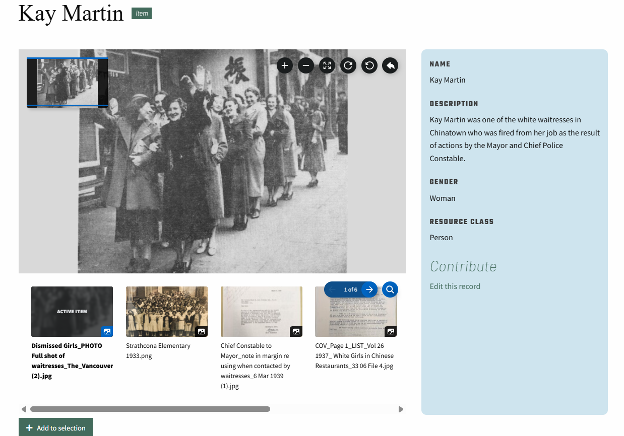
single document related to the waitresses’ public spokesperson, Kay Martin. The Mayor
and Chief Police Commissioner were using a police report to slander Martin and other
protesters. Building a full biographical profile of Martin using common genealogical
datasets, the research revealed a strongly supported counternarrative exposing municipal
and policing biases against the poorer and racialized population, and working women,
on Vancouver’s Eastside.
In an effort to represent the experience of racialized waitresses in Vancouver of
the period, researchers applied the same genealogy research techniques as they had
to the core group of interviewees. Researchers found that this methodology did not
yield sufficient data to contribute to findings, despite new digital tools.
[48]
This result reflects, in part, the racist and classist structures of early 20th-century
demographic procedures. Local histories, community memory, newspaper accounts, and
vital records were also included in the research; however, most references to racialized
women working in the restaurant industry either criminalized or degraded them. The
research team included anonymized 1931 census data to the Researchers Guides and Notes
item set to illustrate how Indigenous, Black, and women of colour are excluded from
common research sources. To avoid reproducing racist biases, the descriptive metadata
note explains the challenges with the census process of that time and the inbuilt
biases. The
Crossing Fonds platform supports participants from marginalized groups to upload their own data
and records. Case Study 1 and Case Study 3 (Black Labour and Cultural History in the
Greater Vancouver Area) addressed these gaps by collecting and adding personal family
histories.
This assemblage of biographical and professional data helps stitch together a stronger
and more layered understanding of the individual women. Researchers hoped to cultivate
new interpretations of the histories represented through the records uploaded and
organized on the platform and to build a set of interactive tools that both supported
the research and that other users of the collaborative space would find of value.
Humanities researchers may find value through access to genealogical and demographic
data on the site.
Conclusion
This essay draws on over four decades of transmediated feminist archival studies,
predicated in the early work of the Women’s Labour History Project. Over the years,
WLHP research has enacted “transmediation” through iterated approaches to archival
items, data, and interfaces. Phase One sought to identify and describe, in part through
bibliographic annotation, the presence of working women in the archival collections
of its time. It supplemented official records with oral and video histories and community-created
materials. It reused archival materials to produce experimental video interpretation
of the past. These included experimental documentaries, fictionalizations, and exhibitions
that remediated and transmediated archival content, like thematic web sites. Phase
Two continued with “generous interfaces” of navigable digital documents that were
created by CDMLA at VIVO to explore the WLHP within the Diamond collection and its
sister collection, Women in Focus. Phase Three saw the creation of a collaborative
Omeka S case study that provided digital versions of items and new pathways between
these, with the goals of supporting reflection on the structure of items, the relationships
between archives and their item sets. Researchers sought to foster engaged reinterpretation
of the records of hotel and restaurant workers across multiple archives in British
Columbia.
Crossing Fonds created an expanded environment where collections held by counter-archives can, through
linked data, occupy a shared archival space, challenge dominant narratives, unite
collections shared across multiple archival institutions, or inform contemporary collections
seeking to redress inequities in past archival collecting practices. This methodology
echoes the still relevant concerns and strategies provided by Kessler-Harris and Rowbotham
over four decades ago. The Case Study 1 item sets supported by the Thematic Guide
and the Oral History Research support researchers to navigate newly-related documents
and provide a coherent aggregation of case study items to allow public engagement
with historical documents. Case Study 1 supports an ongoing reappraisal of the history
of women workers and unionists, one that builds on research from earlier decades that
relied on dispersed physical records, many of which are now digitized and uploaded
and aggregated on the platform and are significantly augmented by records from personal
archives, a far broader span of union minutes, and genealogical and demographic data.
It provided continuity with WLHP transmediated feminist approaches to emerge women’s
agency from the historical record.
As much as Case Study 1 is a history of labour union activity, issues, strategies,
and actors within these unions, it can equally be used for contemporary archival digital
humanities research. Critical archival studies foreground the importance of provenance,
collection description, and redescription, creating continuity with second wave feminist
critiques of archives and strengthened awareness of marginalized communities, representation,
and self-representation, as well as Indigenous data sovereignty. The case study supports
an examination of the ways that restaurant workers exert a presence within archives
(government, academic, personal, and community-based). What collections are contained
there, who were the collectors, who described the fonds, and what networks exist between
collections that can inform the subject? The
Crossing Fonds platform suggests the value of a curated research space, capable of supporting depth
and breadth of analysis.
[49]
Notes
[1] VIVO Media Arts Centre (est. 1973) located in Vancouver, Canada, is a non-profit,
artist-run centre originally founded as a free public library of international “alternative video” [Abbott 2000]. It supports experimental media practice through low-barrier access to education,
exhibition, production, and distribution. Its Crista Dahl Media Library & Archive
(CDMLA) is a counter-archive holding the complex histories of video and media art
and the communities who created them.
[2] See https://www.memorybc.ca/. In Canada, several provincial archive associations maintain pan-provincial archive
databases such as MemoryBC
[6] Citations include authors who propose critical engagement with data (need to
know how produced, by whom, for which purposes, and access) and archival remediation
through collections management, description and metadata changes or additions.
[7] While feminist historiography held an important influence on the research of
the Women’s Labour History Project, so did British Columbian explorations of Indigenous
labour as well as Canadian and regional labour history. Notable is Rolf Knight’s Indians at Work: An Informal History of Native Labour in British Columbia 1858-1930, an extensively researched analysis of the critical role of Indigenous labour in
the creation of the capitalist economy of British Columbia, as well as the interventions
by government and industry to decrease the power and effect of Indigenous labour.
The attention to Indigenous labour is reflected across the WLHP collection and projects,
and in priorities of Crossing Fonds.
[8] Democratic oral history practices emerged in the UK, and Paul Thompson’s book
The Voice of the Past (1978) argued that oral histories could include working class, women’s and other
excluded voices.
[9] WLHP researchers scoured archives for photographs, magazine illustrations, audio
records, and moving images. Canada’s Library and Archives Canada film collection,
National Film Board, Canadian Broadcasting Corporation (where we were literally dumpster
diving when alerted to tapes from the 1940s and 1950s being thrown out), Royal BC
Museum and Archives, Vancouver City Archives, BC Federation of Labour, International
Woodworkers of America, and regional and personal archives provided sources that included
early photographs and film footage shot by nurses, travelers, hobbyists, industry
representatives, government, labour and labour activists to media institutions. These
were transferred to video and then digital formats.
[11] Recordings were shared through women’s groups, community centres, artist-run
centres, LGBTQ organizations, alternative media distributors, community television
and radio, media festivals venues that in the 1970s through the 1990s were building
rich, counter-archives for the feminist and marginalized voices that Caswell, Kessler-Harris,
and others, found absent from institutional archives.
[12] Accessible at: https://archive.vivomediaarts.com/women-and-west-coast-labour/
[13] Peña and Kedrick helpfully describe the fungibility of the concept of transmediation,
and its ability to include sensory, semiotic, signal, raw data and medium transformation.
[20] The Crossing Fonds project included Indigenous and racialized community membership within the research
and archival staff teams, and description was shared widely.
[21] The “HREU Local 28 1947 Executive Expulsion: November 6,8,9 1947” item set
is derived from the collection of Local 28 Secretary Business Agent, May (Leniczek)
Martin which was donated to Sara Diamond. This collection that documents the communist
purge undertaken by the International fills the gap in the Local 28 records available
at the City of Vancouver and UBC Archives. It illustrates the value of the Crossing
Fonds platform that brings together institutional, community, and personal archives.
See https://omeka.crossingfonds.com/s/crossing-fonds/item/1345
[22] https://omeka.crossingfonds.com/s/crossing-fonds/item/1265 details the strike at the Crescent restaurant. Women won better wages. This may also
have been the first Chinese owned restaurant that the HREU organized. Coverage by
The Lumber Worker provides the tactics of the striking waitresses and how the HREU negotiated with
a reluctant employer and can be contrasted with the Province coverage. Item description provides details on the history and comparative documentation
[26] Vancouver District Trades and Labour Council Minutes, 1938
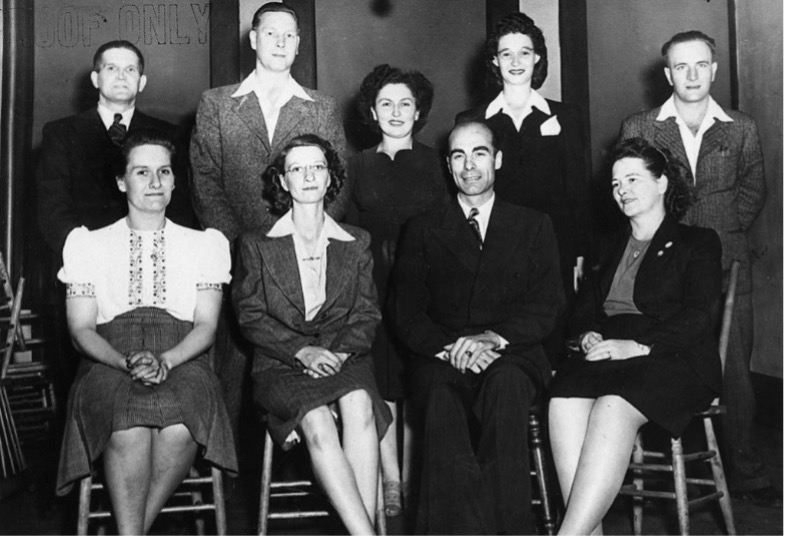
[28] (Back row L-R) Margaret Shelton, Chairman [sic] of Education and Publicity and
Gertrude Philip, Chairman of the Social Committee. (Front row L-R) Arabella Beck,
Recording Secretary; Emily Watts, President; May Ansell, Secretary Treasurer and Business
Agent.
[32] Diamond had ensured redundancy of the oral histories through deposits at the
BC Archive, Simon Fraser Archives, and VIVO Media Arts Centre. The original documents
reside at VIVO’s archive. In “Exclusion or Solidarity: Vancouver Workers Confront
the Oriental Problem” Gillean Creese writes about these contradictory approaches:
https://omeka.crossingfonds.com/s/crossing-fonds/item/934
[35] Dismissed Girls Parade To City Hall (Sep 25, 1937)
[38] Sheila Lewenhak who wrote Women and the Trade Unions (1977) considered Britain’s
definitive history of feminist labour activism, consulted archival resources while
again noting absences of valuable records.
[39] See the timeline at: https://omeka.crossingfonds.com/s/crossing-fonds/item/959
[41] In the past twenty years, there has been a dramatic increase in the breadth
and quantity of records digitized and aimed at the amateur genealogy market. Professional
genealogical research strategies and proof standards were applied to family history
research. Methods used in this research derived from Professional Genealogy: Preparation, Practice & Standards (edited by Elizabeth Shown Mills, Genealogy Publishing Company. Baltimore, Maryland.
2018).
[43] Interviewee, parents, grandparents (and further back if necessary to establish
ethnic origin), domestic partners, children (relevant years).
[44] Trees were created to surface documents that contributed to meeting genealogical
proof standards. Where information was found that informed the oral histories, it
was included in the Subject Guide. Secondary information like names and identifying
vital statistics related to ancestors were not.
[45] https://omeka.crossingfonds.com/s/crossing-fonds/item/1512: Researchers Guides and Notes: HREU Women Leaders Florence Lucy nee Allen - Biographical
Data. Using city directories supplemented with scattered mentions in union records
it was possible to identify her employment history between 1918 and 1960.
[47] Several high-profile cases of waitresses being murdered by people they had met
in their workplace occurred during the case study’s years of enquiry.
[48] https://omeka.crossingfonds.com/s/crossing-fonds/item/1426: This item includes searches of the 1931 census using new Ancestry handwriting recognition
tools show anonymized results for Vancouver and New Westminster districts for women
in the restaurant sector by occupation, work categories, and were identified as Black,
Japanese, or Chinese under the "racial origin" category. See the attached "Bulletin
No XXII, Population of Canada, 1931, By Racial Origins" for more details on how the
1931 Census represented these.
[49] “An intentionally assembled collection of archival resources with varying provenances.”
“Glossary of Archival Terms”, Cameron Hart (ed.), Archives Advisor of the Saskatchewan
Council for Archives and Archivists (SCAA).
Works Cited
Abbott 2000 Abbott, J. (2000) “Contested relations: playing back video”, in Making video “in”: The contested ground of alternative videos on the west coast. Satellite Video Exchange Society.
Battaglia, Clarke, and Siegenthaler 2020 Battaglia, G., Clarke, J., and Siegenthaler, F. (2020)
“Bodies of archives / Archival bodies, an introduction”,
Visual Anthropology Review 36(1), pp. 8-16. Available at:
https://dx.doi.org/10.1111/var.12203.
Bourdieu and Wacquant 1992 Bourdieu, P., and Wacquant, L. J. D. (1992) An invitation to reflexive sociology. Chicago: University of Chicago Press.
Breakell 2015 Breakell, S. (2015)
“Archival practices and the practice of archives in the visual arts. Archives and
records”,
The Journal of the Archives and Records Association, 36, pp. 1-5. Available at:
https://doi.org/10.1080/23257962.2015.1018151.
Brilmyer et al. 2019 Brilymer, G., Gabiola, J., Zavala, J., and Caswell, M. (2019)
“Reciprocal archival imaginaries: The shifting boundaries of ‘community’ in community
archives”,
Archivaria, 88, pp. 6-48. Available at:
https://archivaria.ca/index.php/archivaria/article/view/13695.
Caswell 2016 Caswell, M.L. (2016)
“‘The archive’ is not an archives: On acknowledging the intellectual contributions
of archival studies”,
Reconstruction: Studies in Contemporary Culture, 16(1). Available at:
https://escholarship.org/uc/item/7bn4v1fk. Accessed: 3 August 2026.
Caswell and Cifor 2019 Caswell, M. and Cifor, M. (2019) “Neither a beginning nor an end: Applying an ethics of care to digital archival collections”, in Lewi, H., Smith, W., Lehn, D., Cooke, S. (eds.) The Routledge international handbook of new digital practices in galleries, libraries,
archives, museums, and heritage sites. London: Routledge, pp. 159–168.
Cotera 2026 Cotera, M.E. (2026) Fleshing the archive: An intimate genealogy of Chicana knowledge praxis. Austin: University of Texas Press.
Diamond et al. 2025 Diamond, S., Knights, K., Claxton, D., Fatona, A., and Hardbattle, M. (2025)
“Crossing fonds – Pollinating access and interpretation – Building a space for online
collaboration”,
Public: Art, Culture, Ideas, 36(71), pp. 35-45. Available at:
https://doi.org/10.1386/public_00236_1.
Doyle and Lawson 2015 Doyle, A. M., Lawson, K., and Dupont, S. (2015)
“Indigenization of knowledge organization at the Xwi7xwa Library”,
International Journal of Library and Information Studies. Available at:
http://dx.doi.org/10.14288/1.0103204.
Farnel et al. 2017 Farnel, S., et. al. (2017) “Decolonizing description: Changing metadata in response to the truth and reconciliation
commission”. University of Alberta. Available at: https://toolshed-data-prod.s3.ca-central- 1.amazonaws.com/Presentations/Decolonizing_Description_Netspeed_2017.pdf.
Ferguson 2019 Ferguson, S. (2019) Women and work: Feminism, labour and social reproduction. Toronto: Between the Lines Press.
Frederick 2019 Frederick, S. (2019) “Decolonization in the archives: at the item level”, The iJournal: Graduate Student Journal of the Faculty of Information, 4(2), pp. 14-22.
Giglielmo and Joffroy 2020a Guglielmo, J. and Joffroy, M. (2020a) History of domestic work and worker organizing, History: Faculty Publications, Smith College, Northampton, MA. Available at: https://scholarworks.smith.edu/hst_facpubs/11.
Guerrero 2019 Guerrero, E. (2019) “Indigenous records, art, and traces in the CDMLA: Reflections and recommendations”, VIVO Internal document.
Guglielmo and Joffroy 2021 Guglielmo, J. and Joffroy, M. (2021)
The domestic workers timeline. Available at:
https://dwherstories.com/.
Harris and Harris 2019 Harris K. and Harris A. (2019) “Data visualization tools for archives and special collections”, MAC Newsletter, pp. 26-29. Available at: https://ecommons.udayton.edu/imri_faculty _publications/39.
Kessler-Harris 2007 Kessler-Harris, A. (2007) Gendering labor history. Urbana: University of Illinois Press.
Kessler-Harris 2018 Kessler-Harris, A. (2018)
Women have always worked. A concise history. Second Edition. The Working Class in America Series. Urbana: University of Illinois
Press. Available at
https://www.press.uillinois.edu/books/?id=p083587.
Knight 1878 Knight, R. (1978) Indians at work: An informal history of Native Indian labour in British Columbia,
1858-1930. Vancouver: New Star Books.
Lemieux 2015 Lemieux V. L. (2015)
“Visual analytics, cognition and archival arrangement and description: studying archivists’
cognitive tasks to leverage visual thinking for a sustainable archival future”,
Arch Sci, 15, pp. 25–49. Available at:
https://link.springer.com/article/10.1007/s10502-013-9212-y.
Lewenhak 1977 Lewenhak, S. (1977) Women and trade unions: An outline history of women in the British trade union movement. London: Benn.
McKinney 2020 McKinney, C. (2020) Information activism: A queer history of lesbian media technologies. Durham and London: Duke University Press.
Norwood 2009 Norwood, S. H. (2009)
“Organizing the neglected worker: the Women’s Trade Union League in New York and Boston,
1930–1950”,
Labor History, 50(2), pp.163–185. Available at:
https://doi.org/10.1080/00236560902826071.
O'Neill, Roberts, and Sparkes 2015 O'Neill, M., Roberts, B., and Sparkes, A.C. (eds.) (2015) Advances in biographical methods: creative applications. New York: Routledge.
Phillips 1967 Phillips, P. (1967) No power greater: A century of labour in British Columbia. Vancouver: B.C. Federation of Labour and Boag Foundation.
Quintanilla and Bejarano 2025a Quintanilla, S. and Bejarano, C. (2025a)
“Fuerza feminista: Confronting intersectional data violence by archiving the movement
against antifeminicides in the Paso del Norte Region”,
Sexuality, Gender & Policy, 8(4), e70022. Available at:
https://doi.org/10.1002/sgp2.70022.
Quintanilla and Bejarano 2025b Quintanilla, S. and Bejarano, C. (2025b) Fuerza Feminista. Available at: https://fuerza-feminista.org/fuerza-feministaorg/index
Rowbotham 1973 Rowbotham, S. (1973) Hidden from history: 300 years of women's oppression and the fight against it. London: Pluto Press.
Rowbotham 1999 Rowbotham, S. (1999) Threads through time, writings on history and autobiography. London: Penguin Books.
Russell 2018 Russell, C. (2018) Archiveology: Walter Benjamin and archival film practices. Durham, NC: Duke University Press.
Salmose 2020 Salmose, N. and Elleström L. (2020) Transmediations communication across media borders. London: Routledge.
Shown Mills 2018 Shown Mills, E. (2018) Professional genealogy: Preparation, practice & standards. Baltimore, Maryland: Genealogy Publishing Company.
Smith 2018 Smith, A.M. (2018) Introduction: Gender’s influence on genealogy narratives, Genealogy 2018, 2(3), p. 30; Available at: https://doi.org/10.3390/genealogy203003
Vapnek 2019 Vapnek, L. (2019) “Becoming a feminist, becoming a labor historian, an interview with Alice Kessler-Harris,
we’re all in this together”, Labor and Working Class History Association. Available at: https://lawcha.org/2019/03/20/becoming-a-feminist-becoming-a-labor-historian-an-interview-with-alice-kessler-harris/
Waugh 2020 Waugh, D. (2020) “Description and delivery”, in Purcell, A.D. (ed.) The digital archives handbook. New York: Roman & Littlefield.